
Add a note on surfaces structure of enamel for 2 marks Give answer according to the exam point of view, important point from the book, okay?
Surface Structure of Enamel
Key exam points: Prismless layer + perikymata + Nasmyth's membrane (primary enamel cuticle) = the three classic surface features tested in histology. For 2 marks, define prismless layer and Nasmyth's membrane with a line on perikymata.
I think this is a very long answer. Give answer point wise and make a little bit good structure like proper appropriate answer for two marks.
Surface Structure of Enamel
- Outermost 20–30 μm of enamel lacks rod/prism structure
- Crystals are tightly packed and parallel → harder and more mineralized
- Most prominent on cuspal surfaces
- Transverse, wave-like surface ridges
- External manifestations of the lines of Retzius
- Represent incremental growth; gradually worn away after eruption
- Thin, non-mineralized organic membrane covering enamel at eruption
- Last secretion of ameloblasts (reduced enamel epithelium)
- Soon lost after eruption due to mastication
- Thin salivary protein film deposited after eruption
- Acts as a base for dental plaque formation
Note: The prismless layer and Nasmyth's membrane are the most commonly asked surface features in exams.
Can you give me a bit more short answer and important point mention only?
Surface Structure of Enamel
- Outermost 20–30 μm, lacks prism structure
- Crystals tightly packed → more resistant to acid
- Transverse ridges on enamel surface
- External representation of lines of Retzius
- Worn away after eruption
- Thin organic membrane covering enamel at eruption
- Last product of ameloblasts; lost soon after eruption
- Salivary protein film; forms base for dental plaque

Give answer of 5 number With appropriate pointwise and answer exam point of view, answer everything, give in a nice pattern, important point, and give answer in such a way that I get 3 upon 3 marks, and please prefer book, don't give AI type of answer.
Q.5 Enumerate the Various Histological Structures of Enamel [4+2=6]
Definition
Histological Structures of Enamel
A. ENAMEL RODS (Prisms) (Most important)
- Basic structural unit of enamel
- Each rod runs from dentinoenamel junction (DEJ) to the outer enamel surface
- Dimensions: 4 μm wide, 8 μm high
- Cross-section shape: keyhole (or paddle) shaped - with a head (oriented superiorly) and a tail (directed inferiorly)
- Crystals in head: parallel to long axis; in tail: more oblique
- Each rod is the product of one ameloblast
B. CROSS STRIATIONS
- Transverse markings seen on each enamel rod at regular intervals (~4 μm apart)
- Represent daily increments of enamel matrix formation
- Appear as light and dark bands along the length of the rod
C. LINES OF RETZIUS (Striae of Retzius / Contour Lines)
- Brown incremental growth lines seen in longitudinal ground section
- Represent periodic/rhythmic enamel deposition (weekly rhythm)
- Appear as concentric rings (like growth rings of a tree)
- In deciduous teeth, a prominent line called the neonatal line marks the transition from prenatal to postnatal life
- Externally seen as perikymata on the tooth surface
D. HUNTER-SCHREGER BANDS
- Alternating light (parazone) and dark (diazone) bands seen in longitudinal ground section under reflected light
- Result from the alternating direction of groups of enamel rods
- Seen in the inner 2/3rd of enamel
- Functional significance: Resist splitting or fracture of enamel during mastication
E. ENAMEL TUFTS
- Short, grass tuft-like hypomineralized structures arising from the DEJ
- Extend only 1/5th into the enamel thickness
- Contain organic material rich in tuftelins (acidic proteins)
- Represent groups of poorly mineralized enamel rods
F. ENAMEL LAMELLAE
- Thin, leaf-like vertical cracks extending from the enamel surface toward (or reaching) the DEJ
- Filled with organic material
- Three types: Type I (incomplete mineralization), Type II (degenerated cells), Type III (organic material from oral fluids post-eruption)
- Act as potential pathway for bacterial invasion (caries susceptibility)
G. ENAMEL SPINDLES
- Short, spindle-shaped structures at the DEJ
- Are the trapped ends of odontoblast processes that crossed the DEJ during enamel formation
- More common under cusps
H. DENTINOENAMEL JUNCTION (DEJ)
- Scalloped/wavy junction between enamel and dentin
- Scalloping increases surface area → mechanical interlocking for better adhesion
- Site of origin of enamel tufts and spindles
I. SURFACE STRUCTURES
- Prismless (Aprismatic) layer: Outermost 20-30 μm; no rod structure; more mineralized
- Nasmyth's membrane (Primary enamel cuticle): Thin organic membrane covering enamel at eruption; soon lost
Diagram
ENAMEL SURFACE
________________________
| Prismless layer |
| ~~~ Perikymata ~~~ |
| |
| Enamel Lamellae (↕) |
| |
| Hunter-Schreger Bands|
| (alternating light |
| and dark bands) |
| |
| Lines of Retzius |
| (curved brown lines) |
| |
| Enamel Tufts (↑ DEJ) |
| Enamel Spindles (DEJ)|
|_______________________|
DEJ (scalloped wavy line)
| Dentin |
Label in diagram: Enamel rods, Cross striations, Lines of Retzius, Hunter-Schreger bands, Enamel tufts, Enamel lamellae, Enamel spindles, DEJ, Prismless layer
Colors diagram give
A detailed, colorful histology diagram of enamel ground section for dental students, showing all histological structures of enamel clearly labeled with arrows. Include: - Enamel rods (prisms) running from DEJ to surface, shown as parallel rod-like structures in light blue - Cross striations on enamel rods shown as dark transverse lines - Lines of Retzius (Striae of Retzius) shown as curved brown incremental lines crossing the enamel - Hunter-Schreger bands shown as alternating light yellow (parazone) and dark orange (diazone) bands in inner 2/3rd of enamel - Enamel tufts shown as dark green short tuft-like projections at DEJ extending 1/5th into enamel - Enamel lamellae shown as thin red vertical cracks from surface toward DEJ - Enamel spindles shown as small purple spindle shapes at DEJ - Prismless (aprismatic) layer at the outermost enamel surface in light pink - DEJ (dentinoenamel junction) as a wavy scalloped line at bottom in dark brown - Dentin below the DEJ in yellow - All structures clearly labeled with neat leader lines and bold text - Title at top: "Histological Structures of Enamel (Ground Section)" - Clean white background, educational medical illustration style
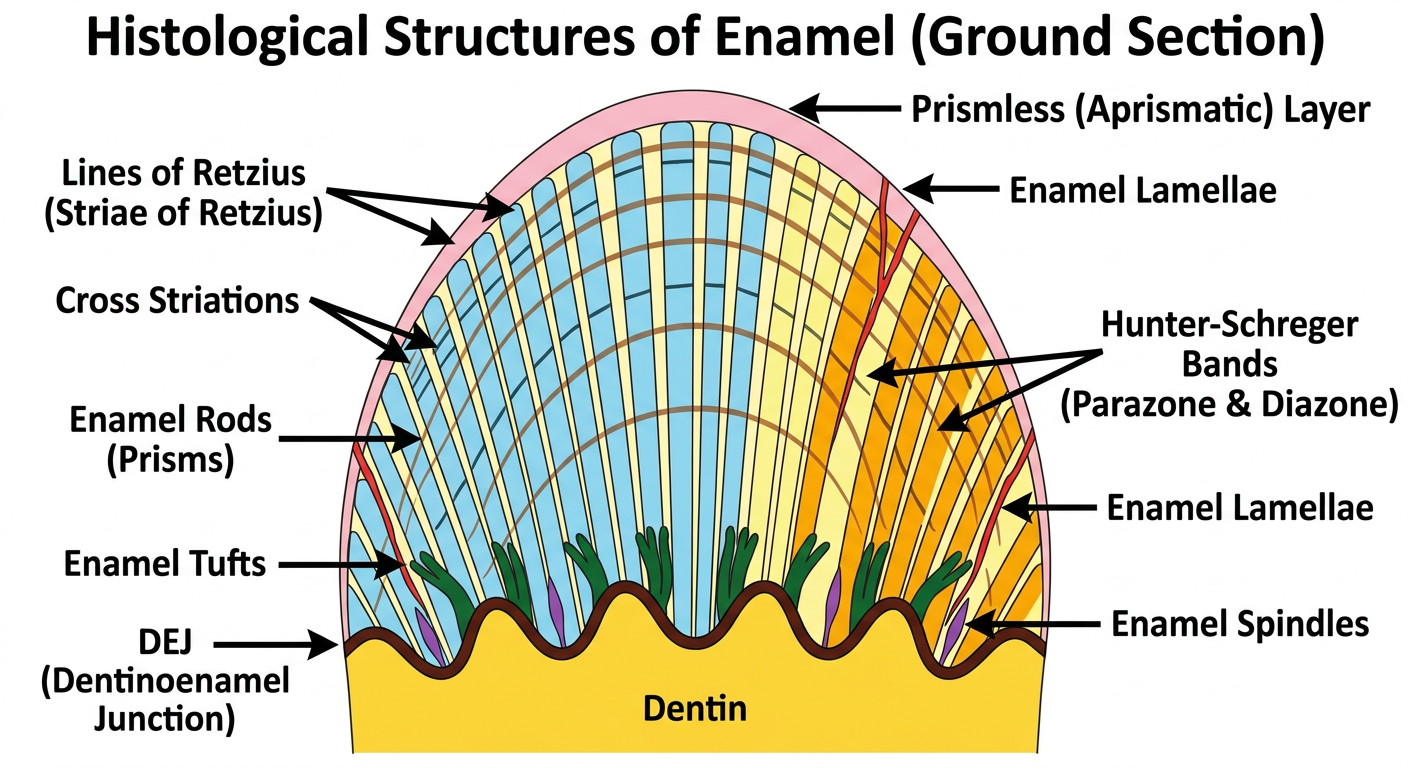
| Color | Structure |
|---|---|
| 🔵 Light Blue | Enamel Rods (Prisms) |
| 🟤 Brown curved lines | Lines of Retzius |
| 🟡 Yellow / 🟠 Orange bands | Hunter-Schreger Bands (Parazone / Diazone) |
| 🟢 Dark Green tufts | Enamel Tufts (at DEJ) |
| 🔴 Red vertical lines | Enamel Lamellae |
| 🟣 Purple | Enamel Spindles (at DEJ) |
| 🩷 Pink top layer | Prismless (Aprismatic) Layer |
| 🟤 Wavy brown line | DEJ (Dentinoenamel Junction) |
| 🟡 Yellow below | Dentin |
Give more perfect clear and color diagram
A highly detailed, clear, professional medical histology diagram titled "Histological Structures of Enamel (Ground Section)" for dental anatomy textbook. Layout: Vertical rectangular diagram showing a cross-section of tooth enamel layer from surface (top) to dentin (bottom). Structures to show clearly with distinct colors and bold black label arrows: 1. TOP - "Prismless (Aprismatic) Layer" - thin smooth pale pink band at very top of enamel surface with label 2. "Enamel Lamellae" - 2 thin bright red vertical crack lines running from surface downward through entire enamel thickness, with label 3. "Enamel Rods (Prisms)" - the main body of enamel filled with densely packed parallel wavy columns in sky blue color running from DEJ to surface, each rod clearly visible as a separate unit 4. "Cross Striations" - dark navy blue fine horizontal lines crossing the enamel rods at regular intervals, showing daily growth increments, with label 5. "Lines of Retzius" - bold curved brown arc lines running diagonally across enamel from surface to DEJ representing incremental growth, with label on side 6. "Hunter-Schreger Bands" - in the inner 2/3 of enamel, alternating light yellow bands (labeled Parazone) and dark orange bands (labeled Diazone) showing alternating rod directions, with label 7. "Enamel Tufts" - dark green short bushy tuft-like projections arising from DEJ, extending only 1/5th into enamel, with label 8. "Enamel Spindles" - small purple elongated spindle shapes projecting just above DEJ into enamel, with label 9. BOTTOM - "DEJ (Dentinoenamel Junction)" - a clearly visible undulating/scalloped wavy dark brown border line separating enamel from dentin, with label 10. VERY BOTTOM - "Dentin" - pale yellow area below DEJ showing dentinal tubules as fine parallel lines All labels in bold black text on white background with clear pointer arrows. Clean white background. Title in large bold text at top. Legend box in corner showing color key. High resolution, sharp, educational illustration style like a professional dental anatomy atlas.
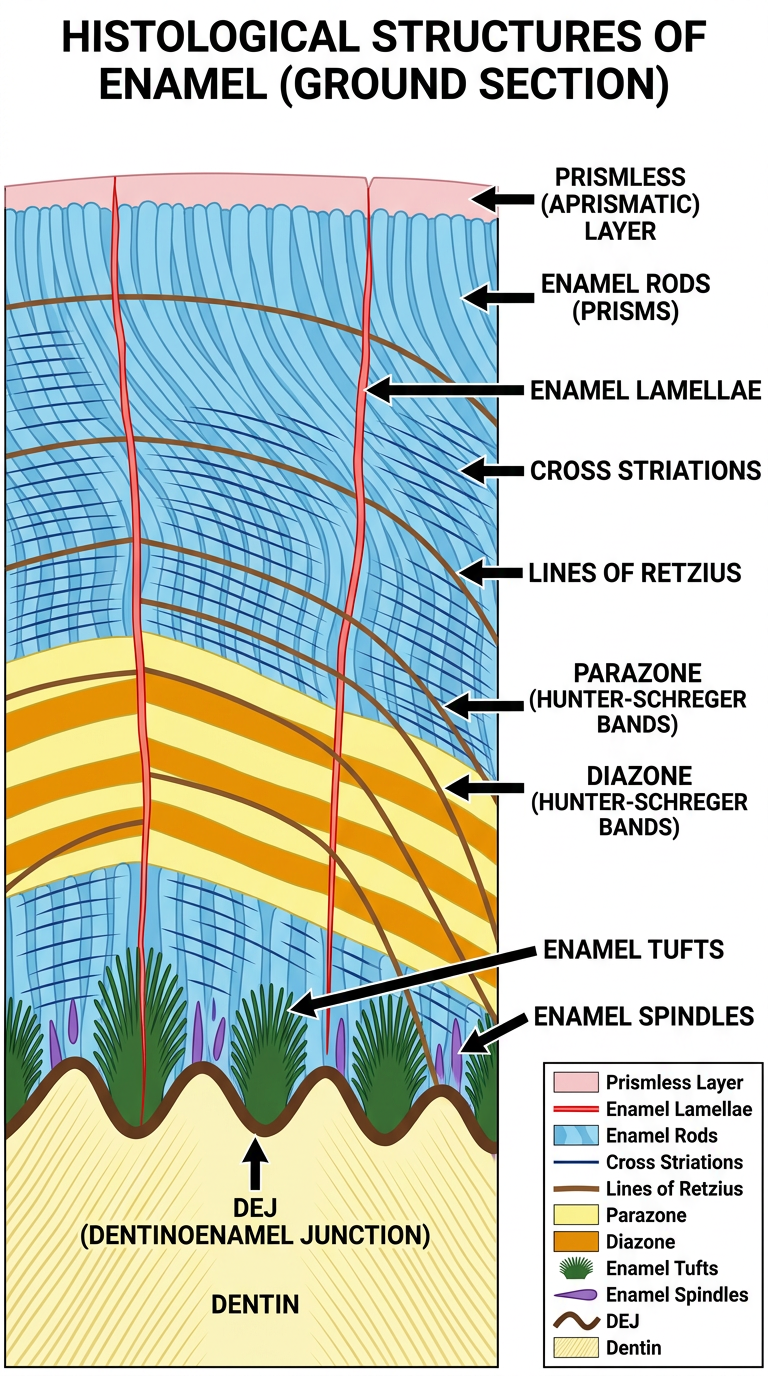
| Structure | Color | Key Point |
|---|---|---|
| Prismless Layer | 🩷 Pink | Top surface of enamel |
| Enamel Rods | 🔵 Sky Blue | Run full thickness DEJ → surface |
| Cross Striations | 🔷 Dark Blue lines | Daily growth increments |
| Lines of Retzius | 🟤 Brown arcs | Weekly incremental lines |
| Hunter-Schreger Bands | 🟡/🟠 Yellow-Orange | Parazone & Diazone alternating |
| Enamel Tufts | 🟢 Dark Green | Short, arise from DEJ |
| Enamel Lamellae | 🔴 Red vertical | Full thickness cracks |
| Enamel Spindles | 🟣 Purple | Odontoblast processes at DEJ |
| DEJ | 🟤 Wavy brown line | Scalloped junction |
| Dentin | 🟡 Yellow | Below DEJ |
Stetch human diagram
What type of human diagram do you want?
A hand-drawn pencil sketch style diagram of histological structures of enamel, as a student would draw in a dental anatomy exam. Clean black ink on white paper look. The diagram shows a rectangular block representing enamel ground section: TOP EDGE labeled "Enamel Surface" with a thin band labeled "Prismless Layer" MAIN BODY of enamel: - Densely packed wavy vertical lines representing enamel rods/prisms running from bottom to top, each rod with small cross marks showing cross striations - 2-3 diagonal curved lines sweeping across labeled "Lines of Retzius" with arrow - In the middle zone, alternating darker and lighter vertical band groups labeled "Hunter-Schreger Bands" with "Parazone" and "Diazone" labeled - 2 thin straight vertical lines from top to bottom labeled "Enamel Lamellae" with arrow NEAR BOTTOM (at DEJ): - Small bushy tuft shapes labeled "Enamel Tufts" - Small oval spindle shapes labeled "Enamel Spindles" BOTTOM EDGE: a wavy undulating line labeled "DEJ (Dentinoenamel Junction)" BELOW DEJ: hatched area labeled "Dentin" with fine parallel lines (dentinal tubules) All labels written in neat handwriting style with leader lines pointing to each structure. Title at top: "Histological Structures of Enamel" in neat block letters. Simple, clean, educational exam-style sketch with light shading. Black and white with minimal color highlights in blue for rods, brown for Lines of Retzius, green for tufts, red for lamellae.
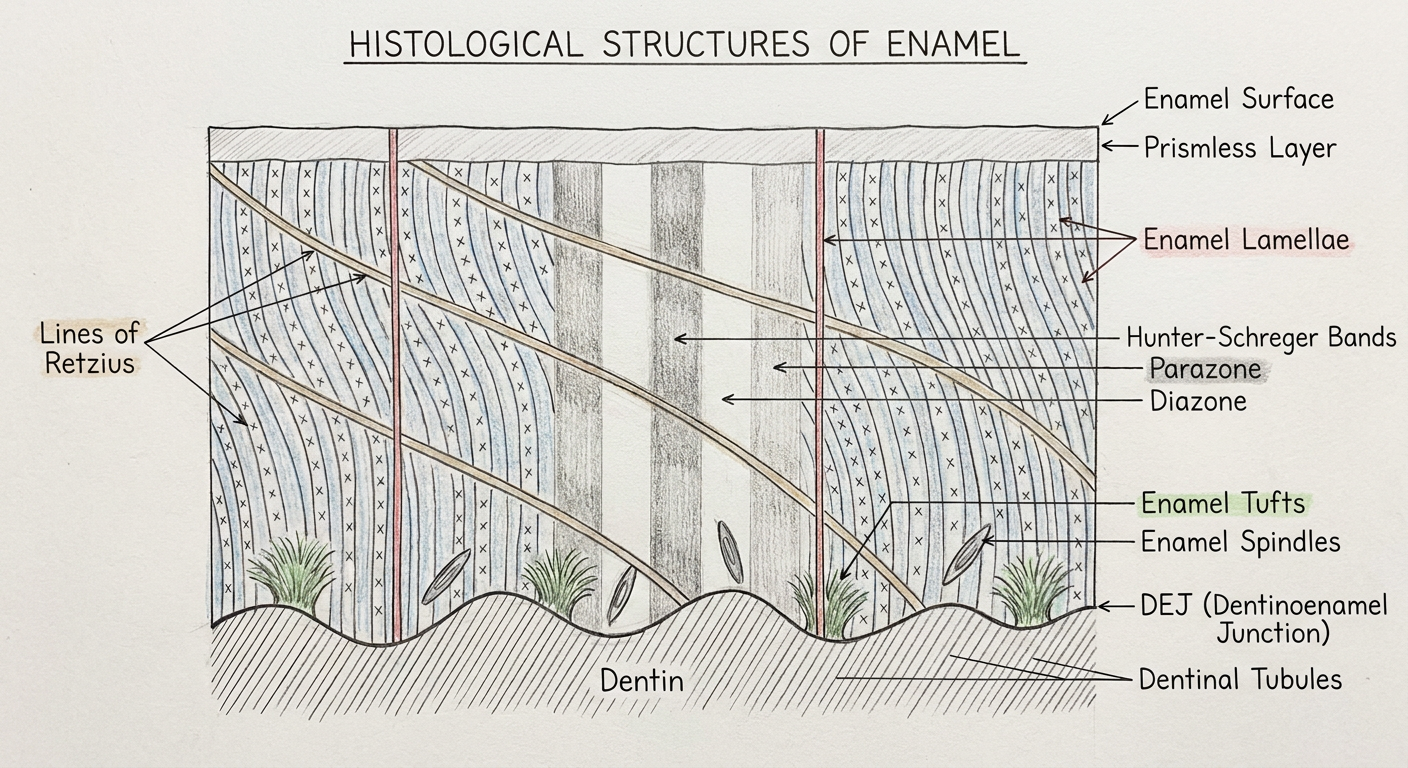
- Draw a simple rectangle for the enamel block
- Draw wavy vertical lines (rods) filling the block
- Add 2-3 curved diagonal lines for Lines of Retzius
- Draw small tufts and spindles at the bottom (DEJ)
- Draw a wavy line at the bottom for DEJ
- Add label arrows neatly on both sides
- Takes only 3-4 minutes and gives you full 2 marks
Where is neonatal line?
Neonatal Line - Location & Significance
What is it?
Where is it located?
ENAMEL SURFACE
________________________
| |
| Postnatal enamel | ← Formed AFTER birth
| (lighter zone) |
= = = = = = = = = = = = = ← NEONATAL LINE (thick brown line)
| Prenatal enamel | ← Formed BEFORE birth
| (darker zone) |
|_______________________|
DEJ
- It sits between prenatal enamel (below) and postnatal enamel (above)
- Appears as a thick, dark, hypomineralized band in ground section
- Located closer to the DEJ side in deciduous teeth (since most enamel forms before birth)
Key Points for Exam:
| Feature | Detail |
|---|---|
| Nature | Accentuated/prominent Line of Retzius |
| Cause | Abrupt change in environment at birth (metabolic disturbance - trauma of birth, change from placental to oral nutrition) |
| Found in | All deciduous teeth + first permanent molar (only teeth forming at time of birth) |
| NOT found in | Other permanent teeth (form entirely after birth) |
| Significance | Proves live birth in forensic cases; used for age estimation |
| Appearance | Wider, darker band compared to regular Lines of Retzius |
Exam tip: The neonatal line divides enamel into two zones - prenatal enamel (smoother, better mineralized, formed in stable intrauterine environment) and postnatal enamel (slightly less mineralized due to birth stress).
No, the diagram you have sent me, human skein diagram of a structure of enamel, please locate their neonatal line.
A hand-drawn pencil sketch style diagram of histological structures of enamel, as a student would draw in a dental anatomy exam. Clean black ink on white paper look. The diagram shows a tall rectangular block representing enamel ground section: TOP EDGE labeled "Enamel Surface" with a thin band labeled "Prismless Layer" MAIN BODY of enamel filled with densely packed wavy vertical lines (enamel rods/prisms) with small cross marks (cross striations): UPPER ZONE (above neonatal line) - labeled "Postnatal Enamel" on the side - lighter shading A THICK DARK PROMINENT HORIZONTAL LINE running across the full width roughly 1/3 from the bottom, clearly colored DARK RED/MAROON, bolder and thicker than the Lines of Retzius, labeled with a bold arrow: "NEONATAL LINE (Accentuated Line of Retzius)" - this is the most prominent feature in the diagram LOWER ZONE (below neonatal line, above DEJ) - labeled "Prenatal Enamel" on the side - slightly darker shading OTHER STRUCTURES clearly labeled with arrows: - 3-4 thin curved diagonal brown lines labeled "Lines of Retzius" (thinner than neonatal line) - Alternating light and dark vertical band groups in middle labeled "Hunter-Schreger Bands (Parazone / Diazone)" - 2 thin red vertical lines from surface to DEJ labeled "Enamel Lamellae" - Small bushy green tufts at DEJ labeled "Enamel Tufts" - Small purple ovals at DEJ labeled "Enamel Spindles" BOTTOM EDGE: wavy undulating dark brown line labeled "DEJ (Dentinoenamel Junction)" BELOW DEJ: hatched yellow area labeled "Dentin" with fine parallel lines Title at top in bold: "Histological Structures of Enamel (Ground Section)" All labels in neat handwriting with clear leader lines on both sides. Educational exam sketch style.
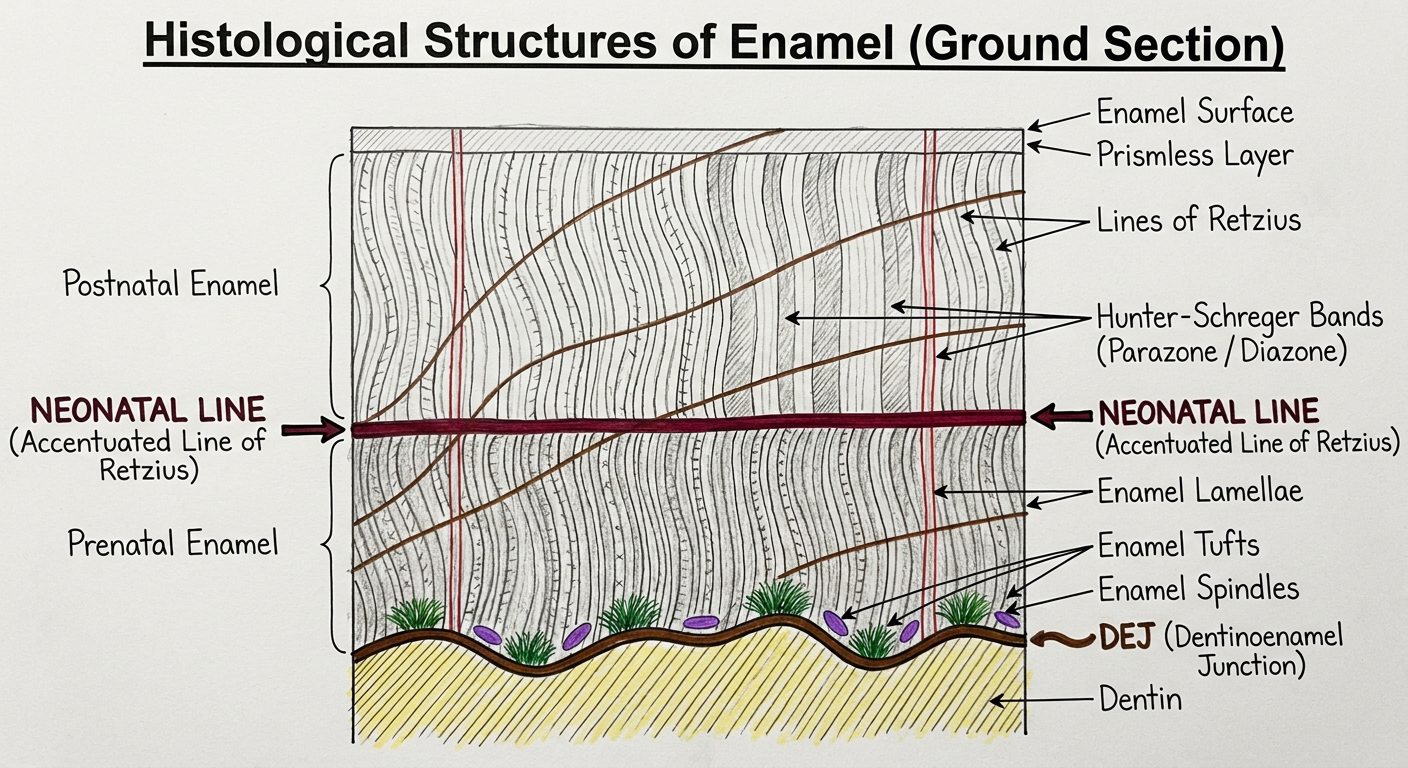
- Above the neonatal line → Postnatal Enamel (formed after birth)
- Below the neonatal line → Prenatal Enamel (formed before birth)
Key point to remember:
O describe hypomineralized structure of enamel.
Hypomineralized Structures of Enamel
1. Enamel Tufts
- Location: Arise from the DEJ, extend only 1/5th into enamel thickness
- Appearance: Short, dark, bush/grass-like projections in ground section
- Composition: Rich in tuftelins (acidic, insoluble proteins) - these proteins cause hypomineralization
- Why hypomineralized? Tuftelins have high organic content → enamel tufts have more organic material than surrounding enamel
- Significance: Weak points in enamel; possible pathway for caries
2. Enamel Lamellae
- Location: Thin vertical sheet-like defects running from enamel surface toward (or reaching) the DEJ
- Appearance: Thin, leaf-like cracks in ground section
- Composition: Filled with organic material (degenerated cells or salivary proteins)
- Types:
- Type I - Incomplete calcification of enamel rods (formed before eruption)
- Type II - Degenerated cells filling the crack (formed before eruption)
- Type III - Organic material from oral fluids (formed after eruption)
- Significance: Act as pathways for bacterial invasion → major caries risk site
3. Neonatal Line
- Location: A wide, prominent Line of Retzius running horizontally across enamel
- Composition: A wider band of hypomineralization in deciduous teeth and first permanent molar
- Cause: Abrupt nutritional/metabolic change at birth disturbs normal mineralization temporarily
- Significance: Divides enamel into prenatal (below) and postnatal (above) zones
4. Enamel Spindles
- Location: Short spindle-shaped structures at the DEJ
- Composition: Trapped odontoblast processes (organic in nature) that crossed the DEJ before enamel mineralization
- Why hypomineralized? They are organic extensions within a mineralized matrix
Quick Comparison Table
| Structure | Location | Contents | Significance |
|---|---|---|---|
| Enamel Tufts | DEJ → 1/5th enamel | Tuftelins (organic) | Weak areas |
| Enamel Lamellae | Surface → DEJ (vertical) | Organic/cells | Caries pathway |
| Neonatal Line | Horizontal band | Hypomineralized zone | Marks birth |
| Enamel Spindles | At DEJ | Odontoblast processes | Least significant |
Exam tip: The three classic hypomineralized structures are Tufts, Lamellae, and Spindles - all contain more organic material than the surrounding enamel. Of these, lamellae are most clinically significant as they predispose to dental caries.
What is hyper and hypocalcified of enamel?
Hypercalcified and Hypocalcified Structures of Enamel
A. HYPERCALCIFIED (Over-mineralized) Structures
1. Interglobular Dentin zones (in enamel context - Sclerotic zones)
In enamel proper, hypercalcification is mainly seen as a clinical/pathological condition rather than a normal histological structure.
2. Dental Fluorosis (Mottled Enamel) - Hypercalcified Zones
- Cause: Excessive fluoride ingestion during tooth development (before age 8)
- Effect: Fluoride disrupts ameloblast function → partial hypercalcification in patches
- Appearance:
- Mild: small white opaque spots (paper-white areas)
- Moderate: yellow-brown pitting
- Severe: deep brown-black pits with corroded appearance
- Mechanism: Fluoride replaces hydroxyl group in hydroxyapatite → forms fluorapatite (harder, more resistant to acid)
- Key point: Superficially the enamel appears hypermineralized but structurally it is defective
B. HYPOCALCIFIED (Under-mineralized) Structures
1. Normal Histological Hypocalcified Structures
| Structure | Location | Reason for hypocalcification |
|---|---|---|
| Enamel Tufts | DEJ → 1/5th enamel | Rich in tuftelins (organic proteins) |
| Enamel Lamellae | Surface → DEJ (vertical) | Filled with organic material/cells |
| Enamel Spindles | At DEJ | Trapped odontoblast processes (organic) |
| Neonatal Line | Horizontal band in enamel | Metabolic disturbance at birth → incomplete mineralization |
2. Pathological Hypocalcification
- Genetic defect in enamel matrix proteins (amelogenin, enamelin)
- Enamel forms in normal thickness but is soft, chalky, and poorly mineralized
- Easily chips off, yellow-brown color
- Types: Hypoplastic / Hypocalcified / Hypomaturation
- Causes: Vitamin A, C, D deficiency; high fever; prematurity; intrauterine infection (syphilis, rubella); tetracycline use; hypoparathyroidism
- Results in pits, grooves or bands on enamel surface
- Enamel that forms is poorly mineralized
Quick Summary Table
| Hypercalcified | Hypocalcified | |
|---|---|---|
| Mineral content | Increased | Decreased |
| Organic content | Decreased | Increased |
| Hardness | More hard | Soft, chalky |
| Normal example | Outer enamel surface | Tufts, Lamellae, Spindles |
| Pathological example | Dental Fluorosis | Amelogenesis imperfecta, Enamel hypoplasia |
| Caries susceptibility | Less | More |
Exam tip: The three normal hypocalcified structures - Tufts, Lamellae, Spindles - are always asked together. For pathological, Amelogenesis imperfecta (hypocalcification type) and Fluorosis are the most important.
Transient structure involved in the structure of enamel.
Transient Structures of Enamel
1. Tomes' Process (Most Important)
- What: Apical cytoplasmic extension of each secretory-stage ameloblast
- Location: Projects from the apical end of the ameloblast, surrounded by developing enamel
- Function: Contains numerous secretory granules → secretes enamel matrix proteins (amelogenin, enamelin)
- Why transient? Once enamel matrix is fully secreted and maturation begins, ameloblasts lose their Tomes' process and transform into maturation-stage ameloblasts
- Significance: The shape and direction of Tomes' process determines the keyhole shape of each enamel rod
- Key point: Each Tomes' process produces one enamel rod - the rod forms in the wake of the moving ameloblast
2. Primary Enamel Cuticle (Nasmyth's Membrane)
- What: Thin, non-mineralized organic membrane covering entire enamel surface at eruption
- Formed by: The last secretion of maturation-stage ameloblasts just before they degenerate + remnants of reduced enamel epithelium
- Why transient? Lost soon after eruption due to mastication and toothbrushing
- Composition: Non-mineralized organic glycoprotein layer
- Significance: Provides initial protection to newly erupted enamel
3. Reduced Enamel Epithelium (REE)
- What: Fused layer of inner and outer enamel epithelium after enamel formation is complete
- Formation: Inner enamel epithelium (ameloblasts) + stratum intermedium + stellate reticulum + outer enamel epithelium → all collapse together → form reduced enamel epithelium
- Function: Covers the crown of unerupted tooth; fuses with oral epithelium just before eruption to guide the tooth through gum
- Why transient? Degenerates completely at time of tooth eruption
- Clinical significance: Remnants can give rise to dentigerous cysts
4. Stellate Reticulum
- What: Star-shaped (stellate) cells within the enamel organ, separated by large intercellular spaces filled with fluid
- Function: Acts as a cushion/shock absorber, protecting developing enamel from mechanical injury; also plays a nutritive role
- Why transient? Collapses during maturation stage of amelogenesis - cells flatten and become part of the papillary layer
- Disappears: Before enamel maturation is complete
5. Enamel Matrix (Transient Organic Matrix)
- What: Organic proteinaceous matrix (rich in amelogenin, enamelin, ameloblastin) secreted first before mineralization
- Why transient? As enamel matures, amelogenins and ameloblastins are degraded and removed by proteases; only enamelins and tuftelins remain in mature enamel
- Significance: Guides hydroxyapatite crystal growth during enamel rod formation
Quick Summary Table
| Transient Structure | Formed by | Disappears when | Significance |
|---|---|---|---|
| Tomes' Process | Secretory ameloblast | Maturation stage begins | Forms one enamel rod |
| Nasmyth's Membrane | Maturation ameloblasts/REE | Soon after eruption | Protects new enamel |
| Reduced Enamel Epithelium | All layers of enamel organ | At eruption | Can form dentigerous cyst |
| Stellate Reticulum | Enamel organ | During maturation | Cushions developing enamel |
| Enamel Matrix proteins | Secretory ameloblasts | During maturation | Guides crystal growth |
Exam tip: The most commonly asked transient structure is Tomes' Process (forms enamel rod) and Nasmyth's Membrane (primary enamel cuticle). Remember - "transient = present during development/eruption, absent in mature enamel."