
Advances in design of modern ultrasound transducers in detail
ultrasound transducer design advances
modern ultrasound transducer technology advances 2024 2025 CMUT PMUT matrix array
PMID: 36671890
PMID: 37316428
PMID: 37792426
PMID: 34069613
PMID: 37217752
https://www.mdpi.com/2079-6374/13/1/55
matrix array transducer 3D ultrasound beamforming
Advances in the Design of Modern Ultrasound Transducers
1. Fundamental Architecture (Classical Baseline)
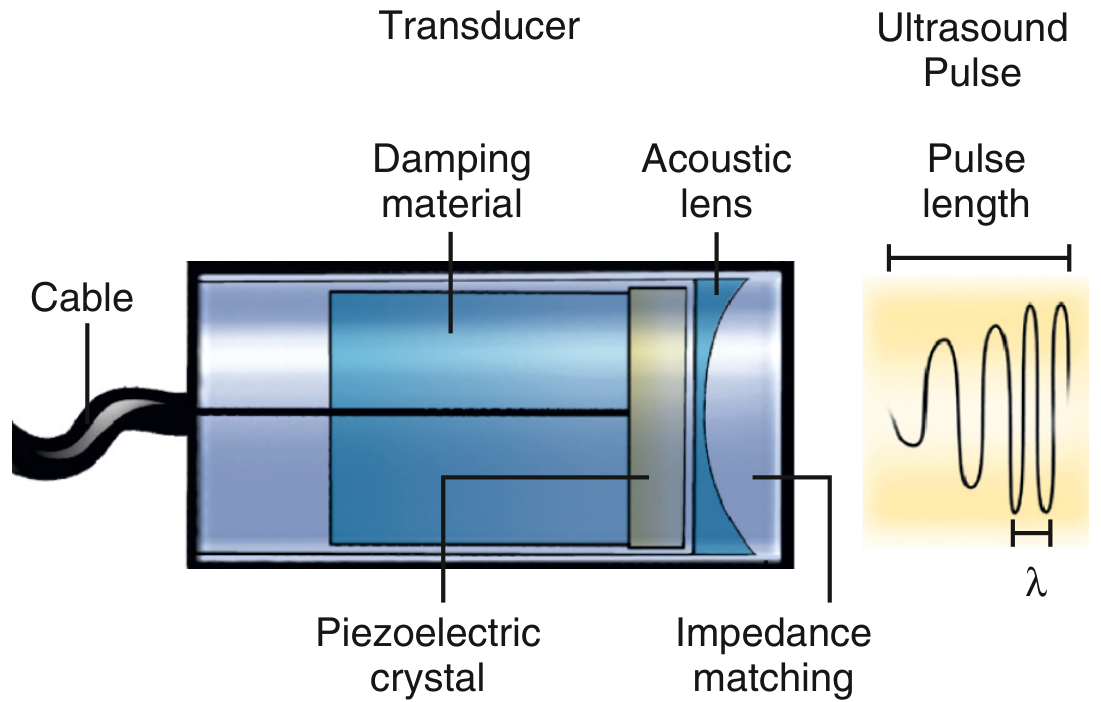
- Piezoelectric crystal: converts electrical current → mechanical compression (transmit) and pressure wave → electrical signal (receive). Common materials: lead zirconate titanate (PZT), barium titanate, quartz.
- Damping (backing) material: absorbs rearward energy; shortens pulse length → improves axial resolution.
- Acoustic lens: converges the beam to a focal zone.
- Impedance matching layer: λ/4-thick layer that reduces acoustic mismatch between the crystal (~30 MRayl) and soft tissue (~1.5 MRayl), maximizing energy transfer.
- Frequency: determined by crystal thickness — thinner crystal = higher frequency. Higher frequency = better resolution, less penetration. Clinical range: 2.5 MHz (cardiac TTE) to ≥20 MHz (intravascular).
- Bandwidth: range of frequencies in the pulse; wider bandwidth = better axial resolution and better reception of harmonic frequencies. — Textbook of Clinical Echocardiography
2. Array Architectures
Linear & Phased Arrays
1.5D Arrays
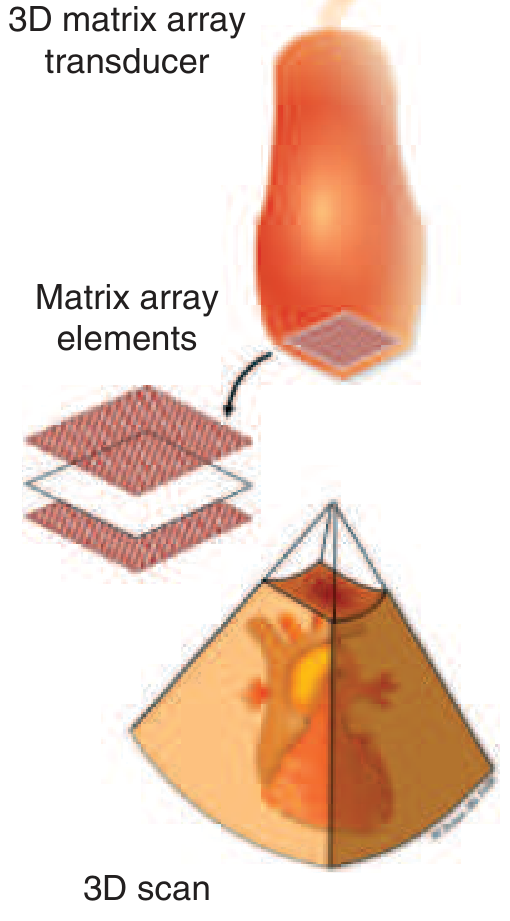
Full 2D Matrix Arrays (for 3D imaging)
3. Micromachined Ultrasound Transducers (MUTs)
- Batch (wafer-scale) fabrication → dramatically lower cost
- Integration with CMOS electronics on the same chip
- High element density — 2D arrays with pitches as small as 20 µm
- Miniaturization for catheter-based and wearable applications
- High-frequency operation (tens of MHz for IVUS)
a. Capacitive Micromachined Ultrasound Transducers (CMUTs)
- Exceptional bandwidth (up to 175%), enabling broadband imaging and multi-frequency operation
- High electromechanical coupling (kT² ~0.85 at optimal bias)
- Wide dynamic range
- CMOS-compatible → on-chip signal processing and beamforming
- Require large DC bias near "collapse voltage" (risk of membrane failure)
- Separate cavity heights may be needed for transmit vs. receive
- CMUT fabrication uses either sacrificial layer release (etch away a sacrificial material to form the air gap) or wafer bonding (bond a pre-thinned silicon wafer over a patterned cavity)
b. Piezoelectric Micromachined Ultrasound Transducers (PMUTs)
- No DC bias required (simpler drive electronics, safer)
- Operate on standard CMOS-compatible low voltages
- Flexible substrate compatibility for wearable/conformable devices
- Mass-producible via standard photolithography
- PZT (Lead zirconate titanate): highest coupling coefficients, but lead-based (environmental concern)
- AlN (Aluminum nitride): CMOS-compatible, lead-free, moderate coupling
- ScAlN (Scandium-doped AlN): significantly higher piezoelectric response than AlN, emerging standard
- ZnO: biocompatible, used in flexible devices
4. Bandwidth and Broadband Design
- Matching layer optimization: multiple λ/4 matching layers between crystal and tissue, reducing acoustic impedance mismatch
- Composite piezoelectrics (1-3 composites): PZT pillars embedded in polymer matrices — reduces lateral coupling, lowers acoustic impedance, broadens bandwidth
- Heavy damping backing: sacrifices sensitivity but greatly shortens pulse and broadens bandwidth
- Apodization: applying non-uniform voltage weighting across array elements to reduce side-lobe artifacts
5. High-Frequency and Intravascular Transducers (IVUS)
- Transducer diameter: ≤1 mm (to fit within 3–3.5 Fr catheters)
- Very high frequency: 40–60 MHz for atherosclerotic plaque characterization
- Single-element rotating design (mechanical) or solid-state phased array
- PVDF (polyvinylidene fluoride) and P(VDF-TrFE) polymer transducers — better acoustic impedance match to tissue, high-frequency response, flexible
- PMN-PT and PIN-PMN-PT single crystal piezoelectrics — higher coupling coefficients than PZT for superior sensitivity at small apertures
- CMUT-IVUS catheters — forward-looking (not just side-viewing) imaging of vessel bifurcations; improved bandwidth for multimodality integration
- IVUS + OCT hybrid catheters — co-registered optical coherence tomography and ultrasound on the same catheter — Peng et al., Sensors 2021 [PMID: 34069613]
6. Conformable and Wearable Transducers
- Substrate: polyimide, PDMS, or other polymer films replace rigid PCBs
- Active layer: PZT thin films, PVDF, or flexible PMUT membranes on polymer substrates
- Interconnects: serpentine copper traces allow stretching without fracture
- Fabrication: spin-coating piezoelectric films on flexible substrates; laser lift-off for substrate release; ICP-CVD silicon nitride structural layers
7. ASIC Integration and On-Chip Beamforming
- Micro-beamforming ASICs: custom integrated circuits placed immediately behind the transducer array (in the probe head) perform partial beamforming on subgroups of elements, reducing the cable count from thousands to tens
- CMUT/PMUT + CMOS monolithic integration: transducer fabricated directly on top of CMOS read-out circuitry, minimizing parasitic capacitance and maximizing sensitivity
- Deep learning beamforming: neural networks replace delay-and-sum algorithms to reconstruct images from sparse receive data, enabling high-frame-rate 3D imaging at reduced channel count (PMID: 36253231)
- Row-column addressed (RCA) arrays: instead of N×N individual element addressing, only N+N connections needed — drastically simplifying wiring while retaining volumetric imaging capability
8. Advanced Acoustic Design Features
| Feature | Mechanism | Clinical Benefit |
|---|---|---|
| Acoustic lens | Converges near-field beam | Fixed focal zone |
| Electronic multi-focus | Sequential transmissions at different focal depths | Improved lateral resolution across depth |
| Dynamic receive focusing | Continuously adjusts receive focus as echoes return | Near-optimal lateral resolution at all depths |
| Apodization | Tapered element weighting | Reduced side lobes, fewer artifacts |
| Coded excitation | Chirp/Golay sequences instead of single pulses | Higher SNR, deeper penetration, or lower output power |
| Diverging wave / plane wave transmit | Full aperture unfocused transmission | Ultrafast imaging (>10,000 frames/sec) enabling shear wave elastography and ultrasound localization microscopy |
9. Specialized Transducer Types
| Transducer | Frequency Range | Design Specifics |
|---|---|---|
| Adult TTE (transthoracic echo) | 2–5 MHz | Phased array, small footprint for intercostal access |
| TEE (transesophageal echo) | 5–7 MHz | Miniaturized array on flexible endoscope tip |
| Intracardiac echo (ICE) | 5–10 MHz | Array on 8–10 Fr catheter; rotational or phased array |
| IVUS | 20–60 MHz | Single element rotational or solid-state array on coronary catheter |
| Vascular / linear array | 5–15 MHz | Flat array for near-surface structures |
| Endocavitary (transvaginal, transrectal) | 5–10 MHz | Curved array, small probe diameter |
| High-frequency small-parts | 12–20 MHz | Linear array, thyroid, skin, superficial masses |
| Intraoperative 3D TEE | 5–7 MHz | Full matrix array in miniaturized TEE scope |
10. Emerging and Future Directions
- Single-crystal piezoelectrics (PMN-PT, PIN-PMN-PT): electromechanical coupling kT ≥ 0.9, enabling high-sensitivity transducers with bandwidth exceeding 100%
- Lead-free piezoelectrics: KNN (potassium sodium niobate), BaTiO₃-based — driven by RoHS environmental regulations
- Large-area PMUT arrays on display-compatible processes: imec's 4×4 cm² arrays point toward ultrasound imaging patches worn like a band-aid
- Volumetric ultrasound localization microscopy (vULM): matrix array transducers performing super-resolution vascular imaging by tracking individual microbubbles in 3D — resolution below the diffraction limit (PMID: 39453807)
- Internet-of-Medical-Things (IoMT) integration: wearable USoP patches transmitting continuous hemodynamic data wirelessly
- Photoacoustic ultrasound hybrids: same transducer receives both ultrasound echoes and laser-excited photoacoustic signals for simultaneous anatomical + molecular imaging
- AI-assisted adaptive beamforming: neural networks optimizing transmit sequences in real time based on tissue characteristics
Key References
- Textbook of Clinical Echocardiography — Piezoelectric Crystal, Types of Transducers, Beam Shape and Focusing
- Harrison's Principles of Internal Medicine 22E — Echocardiography, 3D matrix array transducer
- Miller's Anesthesia 10e — Harmonic Imaging, 3D Image Acquisition, Matrix Array
- Fuster & Hurst's The Heart 15e — Three-Dimensional Echocardiography
- He Y et al. Piezoelectric Micromachined Ultrasound Transducer Technology. Biosensors 2022 [PMID: 36671890]
- Herickhoff CD & van Schaijk R. cMUT technology developments. Z Med Phys 2023 [PMID: 37316428]
- Zhang L et al. Conformable Ultrasound Electronics. Adv Mater 2024 [PMID: 37792426]
- Lin M et al. Wearable ultrasound system-on-patch. Nat Biotechnol 2024 [PMID: 37217752]
- Peng C et al. Advances in IVUS Transducers. Sensors 2021 [PMID: 34069613]
- Denis L et al. Volumetric Ultrasound Localization Microscopy. IEEE TUFFC 2024 [PMID: 39453807]
Doppler spectral analysis and display in detail , give me in such a way in gain full marks in exam as msc student
Doppler spectral analysis ultrasound FFT spectral broadening aliasing MSc medical physics
https://pmc.ncbi.nlm.nih.gov/articles/PMC12645071/
Doppler spectral waveform display aliasing pulsed wave continuous wave
Doppler Spectral Analysis and Display — Complete MSc Exam Guide
SECTION 1: THE DOPPLER EFFECT — Fundamental Physics
1.1 The Doppler Principle
1.2 The Doppler Equation
| Symbol | Meaning |
|---|---|
| $f_d$ | Doppler frequency shift (Hz) |
| $f_0$ | Transmitted ultrasound frequency (Hz) |
| $v$ | Velocity of the moving target (blood) (m/s) |
| $\theta$ | Angle between ultrasound beam and direction of flow |
| $c$ | Speed of sound in tissue ≈ 1540 m/s |
| Factor of 2 | Because the beam travels to and from the moving target |
1.3 Angle Dependence — Critical Exam Point
| Angle θ | cos θ | Effect |
|---|---|---|
| 0° (parallel) | 1.0 | Maximum Doppler shift; ideal |
| 20° | 0.94 | 6% underestimation — clinically acceptable |
| 45° | 0.71 | 29% underestimation |
| 60° | 0.50 | 50% underestimation — maximum acceptable clinical angle |
| 90° (perpendicular) | 0 | Zero Doppler shift — no velocity can be measured |
Exam rule: Always use θ ≤ 60°. The empirical method to ensure near-parallel alignment is to examine from multiple acoustic windows and use the highest measured velocity as the closest to true (i.e., most parallel alignment). — Textbook of Clinical Echocardiography
SECTION 2: GENERATING THE SPECTRAL DISPLAY
2.1 The Fast Fourier Transform (FFT)
- Input: A short time window of the received Doppler signal (typically 5–10 ms)
- Output: The amplitude (power) at each frequency within that window
- Display: A single vertical column of the spectrogram at that time point
2.2 The Spectral Display — Axes and Conventions
VELOCITY
(m/s or cm/s)
↑
| ████ ████ ← Flow TOWARD transducer (positive)
| ████ ████
|────────────────────────────────── BASELINE (zero velocity)
|
| ▓▓▓▓ ▓▓▓▓ ← Flow AWAY from transducer (negative)
|
└────────────────────────────────── TIME (seconds)
| Display Element | Meaning |
|---|---|
| Y-axis | Velocity (m/s or cm/s) — proportional to frequency shift after angle correction |
| X-axis | Time, scrolling left to right; ECG trace usually displayed simultaneously |
| Above baseline | Flow toward transducer (positive Doppler shift) |
| Below baseline | Flow away from transducer (negative Doppler shift) |
| Brightness (grayscale) | Amplitude (power/intensity) of the Doppler signal — proportional to the number of RBCs moving at that velocity at that instant |
| Spectral envelope | Outer edge of the brightest signals = peak (maximum) velocity |
| Spectral window | Clear area beneath the peak velocity envelope in laminar flow |
SECTION 3: TYPES OF SPECTRAL DOPPLER
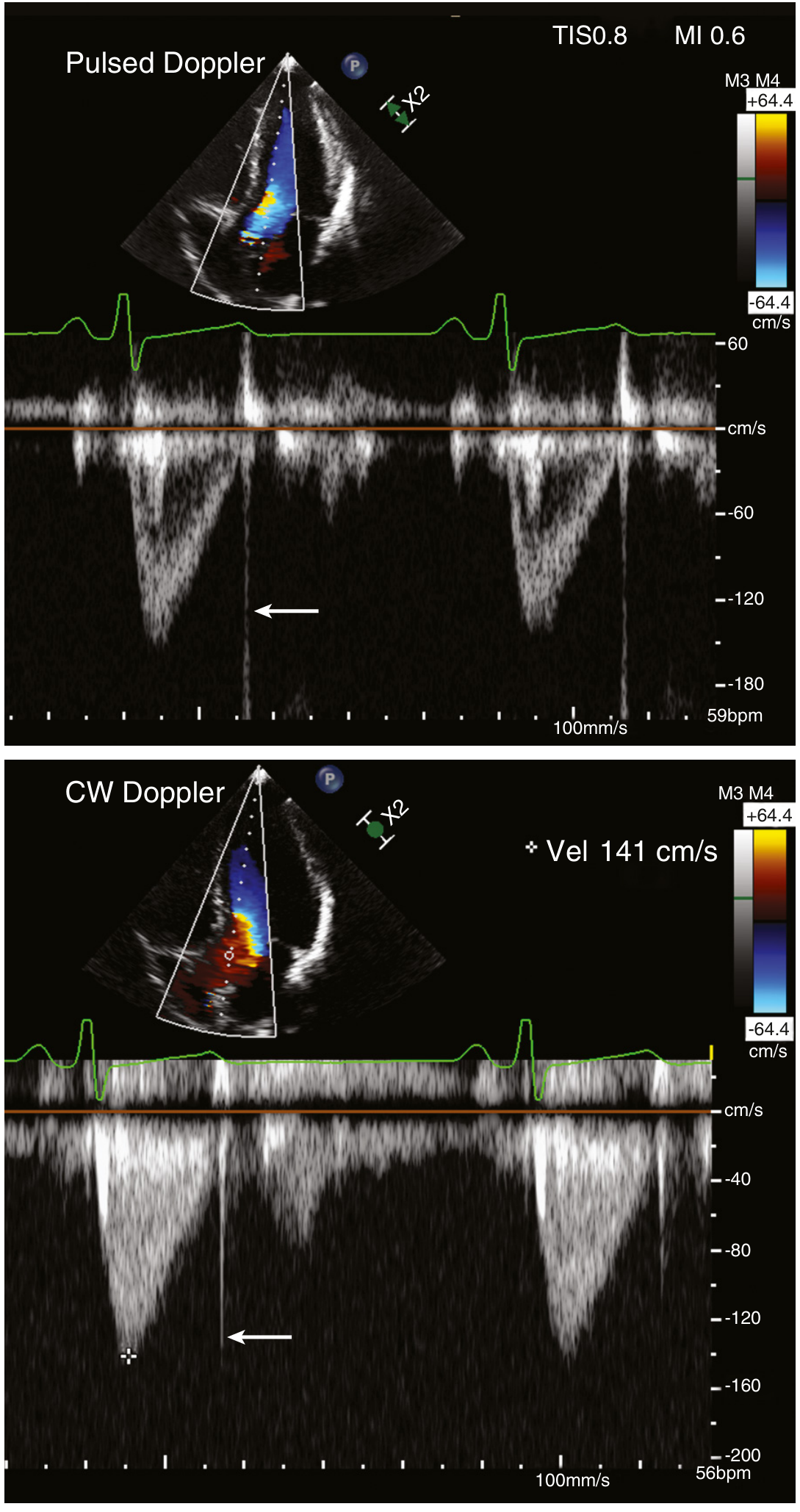
3.1 Pulsed Wave (PW) Doppler
- Depth = set by the operator (position of gate on B-mode image)
- Length = determined by the duration of the receive window (typically 3 mm; adjustable 1–10 mm)
- Width = determined by beam geometry
3.2 Continuous Wave (CW) Doppler
3.3 PW vs. CW — Head-to-Head Comparison Table
| Feature | Pulsed Wave (PW) | Continuous Wave (CW) |
|---|---|---|
| Depth selectivity | ✅ Yes — range-gated | ❌ No — entire beam |
| Maximum velocity | Limited by Nyquist | Unlimited |
| Aliasing | Yes | No |
| Spectral appearance | Hollow envelope (window) | Filled-in waveform |
| Mechanism | Pulsed transmit/receive | Continuous separate Tx/Rx crystals |
| Best use | Low-to-moderate velocities, site-specific | High-velocity jets (stenosis, regurgitation) |
| Display | Velocity at sample volume | All velocities along beam |
SECTION 4: THE NYQUIST LIMIT AND ALIASING
4.1 Nyquist Theorem Applied to PW Doppler
4.2 What Aliasing Looks Like
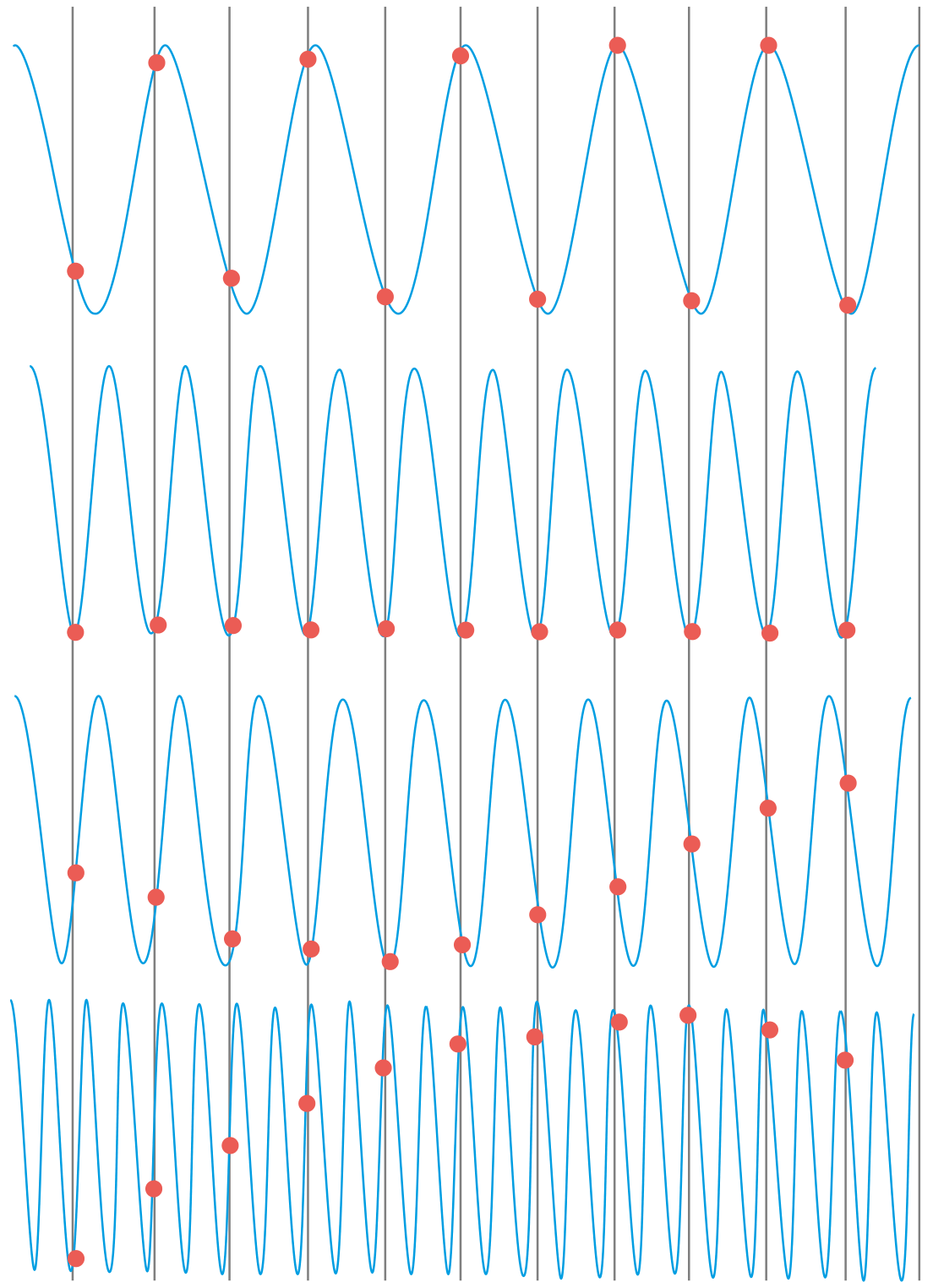
- Mild aliasing: Waveform appears "cut off" at the top, with the peak appearing in the reverse channel
- Severe aliasing: Repeated wrap-around; undifferentiated band of velocities — appears visually and aurally similar to turbulent flow
4.3 Methods to Resolve Aliasing
| Method | Mechanism | Limitation |
|---|---|---|
| Use CW Doppler | No sampling → no Nyquist limit | Loses depth information |
| Baseline shift | Electronic "cut and paste" — moves baseline to edge, extends velocity range in one direction | Only doubles usable range |
| Increase PRF (to maximum for that depth) | Higher PRF → higher Nyquist | PRF limited by depth (c/2d) |
| High-PRF mode | Multiple gates along beam at multiples of PRF | Range ambiguity (multiple sample volumes) |
| Lower transducer frequency | Lower f₀ → larger velocity for same frequency shift | Reduced image resolution |
| Reduce depth | Greater PRF allowed | May not always be possible |
| Reduce Doppler angle | Lower cos θ at 0° → signals closer to Nyquist for same true velocity | Geometry dependent |
Exam tip: CW Doppler is always the most reliable solution for aliasing when high-velocity jets must be quantified accurately.
SECTION 5: SPECTRAL BROADENING
5.1 Definition
5.2 Causes
- Turbulent flow: In turbulent flow (e.g., downstream of a stenosis), RBCs travel with chaotic, multi-directional velocities — producing a wide range of Doppler shifts simultaneously. Spectral window is filled or obliterated.
- Flow separation/recirculation: At stenotic segments, post-stenotic recirculation adds reverse-velocity components to the display.
- Beam geometry: Linear and phased array transducers use multiple elements, producing a range of insonation angles across the beam width. Different path angles → different cos θ values → range of Doppler shifts even from cells moving at the same true velocity.
- Large sample volume: A large sample gate captures RBCs with different velocities (velocity profile effect — slower near walls, faster at center in laminar flow).
- Excessive gain: Electronic noise broadens the spectrum toward the baseline.
- High transducer frequency: Larger aperture angle subtended → more angular spread → more intrinsic broadening.
- Near-field sampling: Superficial vessels experience greater intrinsic broadening due to wider angular spread of the beam.
5.3 Clinical Significance
| Spectral Feature | Interpretation |
|---|---|
| Clear spectral window | Laminar flow, normal |
| Mild broadening (near baseline) | Normal parabolic velocity profile (slower RBCs near wall) |
| Filled-in window with high velocities | Turbulent flow — stenosis, regurgitation, AVM |
| Broadening at low velocities only | Large sample volume artifact, not pathological |
SECTION 6: SPECTRAL DISPLAY SETTINGS — OPERATOR CONTROLS
6.1 Gain
- Controls amplification of the received Doppler signal
- Too high: noise fills the display, mimics spectral broadening or high velocities
- Too low: weak signal, poor waveform definition
- Optimal: Maximum signal without background noise at the margins
6.2 Scale (Velocity Range / PRF)
- Sets the Y-axis maximum velocity displayed
- Equivalent to selecting the PRF
- Too low: aliasing of normal velocities
- Too high: waveform compressed; low-velocity components not visible
- Optimal: Waveform fills ~75% of scale
6.3 Baseline Position
- Moves the zero-velocity line up or down
- Allows the operator to shift more of the display to one direction
- Used to: (1) prevent aliasing by giving the main waveform more room, (2) display forward and reverse flows asymmetrically
- Effective electronic equivalent of extending the Nyquist limit in one direction
6.4 Wall Filter (High-Pass Filter)
- Removes low-frequency, high-amplitude signals from slow-moving structures (vessel walls, valve leaflets, myocardium)
- Set too high: eliminates low-velocity diastolic flow or venous flow
- Set too low: wall-motion "thump" artifact masks near-baseline velocities
- Typical setting: 100–200 Hz for cardiac; 50–100 Hz for low-flow venous studies
6.5 Sweep Speed
- Sets the X-axis time scale (mm/s)
- Slow sweep: more cardiac cycles visible, good for rhythm
- Fast sweep: individual waveform morphology better resolved, good for measurement
6.6 Sample Volume Size (PW Only)
- Longer gate: more signal, broader spectral broadening artifact
- Shorter gate: better range resolution, less ISB, but weaker signal
- Standard: 3 mm; can reduce to 1–2 mm for precise interrogation
6.7 Insonation Angle Correction (Angle θ)
- Available on duplex vascular scanners
- Operator manually aligns cursor with vessel axis on B-mode image
- System applies cos θ correction to convert frequency shift → velocity
- Not used in cardiac Doppler (assumes beam aligned with flow)
SECTION 7: DOPPLER WAVEFORM ANALYSIS — QUALITATIVE
7.1 Normal Arterial Waveform
- Systolic peak — rapid forward flow during cardiac systole
- Early diastolic reversal — brief reverse flow as elastic recoil closes peripheral arterioles (increased peripheral resistance)
- Late diastolic forward flow — small forward component from aortic valve recoil
7.2 Abnormal Waveforms — Disease Patterns
| Finding | Pattern | Cause |
|---|---|---|
| Monophasic waveform | Single forward peak, no reversal | Proximal stenosis or occlusion reducing pulsatility; or intrinsically low-resistance bed |
| Tardus–parvus | Low-amplitude, delayed peak, rounded upstroke | Upstream high-grade stenosis — damped waveform |
| Increased diastolic flow | High diastolic-to-systolic ratio | Low-resistance distal bed (e.g., organ hyperemia, AVM) |
| Absent diastolic flow | Flow returns to baseline before systole | High peripheral resistance, critical ischemia |
| Reversed diastolic flow | Diastolic component below baseline | Severe aortic regurgitation (diastolic reversal in aorta), high peripheral resistance |
| High-velocity jet + spectral broadening | Aliased peak with filled-in window | Stenosis |
7.3 Venous Doppler
- Normal veins: phasic with respiration (flow varies with respiratory cycle)
- Loss of phasicity: suggests proximal obstruction (DVT upstream)
- Augmentation: compression of distal limb → increase in venous Doppler signal; absent augmentation = DVT between probe and compression site
SECTION 8: QUANTITATIVE SPECTRAL ANALYSIS — WAVEFORM INDICES
8.1 Peak Systolic Velocity (PSV)
8.2 End-Diastolic Velocity (EDV)
8.3 Resistive Index (RI) — Pourcelot Index
- Normal: 0.5–0.7 (organ-dependent)
- RI → 1.0: high resistance (absent or reversed diastolic flow)
- RI → 0: low resistance (very high diastolic flow)
- Angle-independent (numerator and denominator both scaled by cos θ, which cancels)
8.4 Pulsatility Index (PI) — Gosling Index
- Wider range than RI; more sensitive to upstream flow resistance changes
- Higher PI → higher pulsatility → higher resistance
- Normal carotid: PI ~1.5–1.8; Umbilical artery: PI used in obstetric assessment
8.5 Systolic/Diastolic (S/D) Ratio
8.6 Velocity-Time Integral (VTI)
8.7 Acceleration Time (AT) and Deceleration Time (DT)
- AT: Time from onset of flow to peak velocity
- DT: Time from peak velocity to return to baseline
- Shortened AT: Seen in pulmonary hypertension (RVOT AT < 100 ms)
- Prolonged DT: Seen in mitral stenosis pressure half-time (PHT) analysis
8.8 Pressure Half-Time (PHT) — Mitral Valve Area
SECTION 9: SPECTRAL DOPPLER ARTIFACTS — SYSTEMATIC CLASSIFICATION
| Artifact | Appearance | Mechanism | Clinical Implication |
|---|---|---|---|
| Aliasing | Waveform "wraps" to opposite side of baseline | Nyquist limit exceeded | Cannot measure true peak velocity — switch to CW |
| Spectral mirror image | Identical waveform above and below baseline simultaneously | Gain too high or Doppler angle ≈ 90° causing ISB to produce signals in both channels | Reduce gain; adjust angle |
| Range ambiguity | Signals from more than one depth recorded simultaneously | High-PRF mode or very high PRF — pulse repeats before previous echo returns | Occurs with high-PRF; know which sample volume is active |
| Beam width artifact | Superimposed signals from different flows | Beam wide enough to encompass adjacent vessels or valves | CW especially prone; use PW to isolate depth |
| Electronic interference | Horizontal bands or noise across display | Electrical interference from adjacent equipment | Shielding; common in ICU/OR |
| Transit-time effect | Slight velocity overestimation | Change in ultrasound propagation speed through moving medium | Minor effect; "blurring" on velocity axis |
| Wall thump | Low-frequency, high-amplitude artifact near baseline | Valve/wall motion detected | Increase wall filter |
| Intrinsic spectral broadening (ISB) | Artificially widened spectrum | Multiple beam angles across aperture produce range of cos θ | Reduces spectral window; can mimic turbulence |
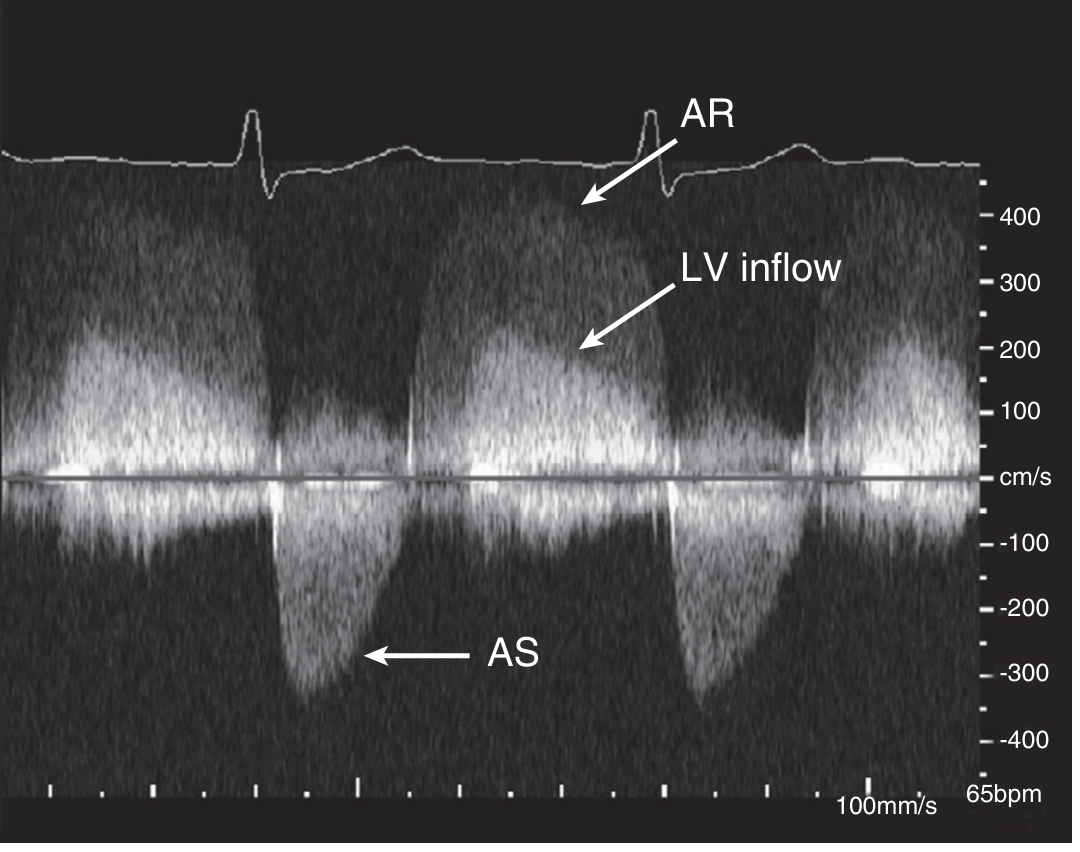
SECTION 10: COLOR FLOW DOPPLER — RELATIONSHIP TO SPECTRAL DOPPLER
- For each scan line: 8 pulses (burst length) are transmitted and the received signals autocorrelated
- Autocorrelation (not FFT): calculates mean velocity at each depth along each scan line — much faster than FFT, enabling real-time 2D display
- Trade-off: Color Doppler measures mean velocity only, not the full spectral distribution — this is why spectral (PW/CW) Doppler is needed for quantitative velocity measurements
- Color encoding: Flow toward transducer = red; away = blue; turbulence/aliasing = mosaic of green/yellow
| Mode | Analysis Method | Output | Velocity info |
|---|---|---|---|
| Spectral PW/CW | FFT | Spectrogram (velocity vs. time) | Full velocity spectrum |
| Color Doppler | Autocorrelation | 2D color map | Mean velocity only |
| Power Doppler | Amplitude-based | 2D map of signal strength | Direction only; no velocity |
SECTION 11: CLINICAL APPLICATIONS BY SYSTEM
Cardiac (Echocardiography)
- Aortic stenosis: CW Doppler across valve → peak velocity → modified Bernoulli: ΔP = 4v²
- Mitral inflow: PW at mitral leaflet tips → E wave (early filling), A wave (atrial contraction), E/A ratio for diastolic function
- LVOT VTI: PW in LVOT → VTI × CSA = stroke volume; track changes in cardiac output
- Pulmonary hypertension: TR jet velocity by CW → RVSP = 4v² + RAP; RVOT AT by PW
Vascular (Peripheral)
- Carotid stenosis: PSV >125 cm/s = ≥50% stenosis; PSV >230 cm/s + ICA/CCA ratio >4 = ≥70% stenosis
- Renal artery stenosis: PSV >180–200 cm/s; RI >0.70 in intrarenal arteries suggests distal disease
- Ankle-Brachial Index (ABI): CW hand-held Doppler + sphygmomanometer; normal 0.9–1.4; <0.9 = significant arterial disease; <0.4 = critical limb-threatening ischemia — Bailey & Love's Surgery 28e
Obstetric
- Umbilical artery: S/D ratio; absent or reversed end-diastolic flow = severe fetal compromise
- Middle cerebral artery (MCA): Peak PSV > 1.5 MoM for gestational age indicates fetal anemia (brain-sparing)
- Uterine artery: RI, PI; early diastolic notch = abnormal placentation
SECTION 12: HIGH-YIELD EXAM SUMMARY TABLE
| Topic | Key Fact |
|---|---|
| Doppler equation | $f_d = 2f_0 v \cos\theta / c$ |
| Maximum angle | 60° (cos 60° = 0.5; 50% underestimation) |
| At 90° | cos 90° = 0; no Doppler shift measured |
| Nyquist limit | PRF/2 |
| Aliasing appearance | Waveform wraps to opposite side of baseline |
| CW advantage | No aliasing; unlimited velocity range |
| CW disadvantage | No depth selectivity (entire beam recorded) |
| PW advantage | Depth-selective (range-gated) |
| PW disadvantage | Aliasing at high velocities |
| Spectral window | Clear area under peak = laminar flow |
| Spectral broadening causes | Turbulence, large sample volume, ISB, gain artifact |
| FFT role | Decomposes received signal into component frequencies for each time window |
| Color Doppler analysis | Autocorrelation (not FFT); gives mean velocity only |
| RI formula | (PSV − EDV) / PSV |
| PI formula | (PSV − EDV) / TAMV |
| VTI clinical use | × CSA = stroke volume |
| Bernoulli equation | ΔP = 4v² (simplified; v in m/s, ΔP in mmHg) |
| PHT formula for MVA | MVA = 220 / PHT |
| ABI normal range | 0.9–1.4 |
| ISB — what is it | Artificial spectral broadening from beam geometry (range of angles) |
| Wall filter purpose | Remove low-frequency wall-motion signals |
SECTION 13: WORKED EXAMPLE — COMPLETE DOPPLER CALCULATION
References
- Textbook of Clinical Echocardiography — CW Doppler, PW Doppler, Aliasing, Spectral Analysis, Color Flow, Artifacts
- Miller's Anesthesia 10e — Harmonic Imaging, 3D Imaging, Perioperative Echo
- Fuster & Hurst's The Heart 15e — Doppler Ultrasound, Carotid DUS
- Bailey & Love's Short Practice of Surgery 28e — Doppler Blood Flow Detection, ABI
- Principles of Doppler ultrasound and emerging blood flow imaging — PMC 2025 Review
- Brett Gerrard — Doppler Ultrasound Physics (spectral broadening, ISB)
3d ultrasound imaging , acquisition, visualisation, display methods in detail and instrumentation
3D ultrasound imaging acquisition methods visualization display voxel volume rendering instrumentation
https://pressbooks.palni.org/ultrasoundphysicsanditsapplicat…
3D ultrasound volume rendering surface rendering multiplanar reconstruction
3D Ultrasound Imaging: Acquisition, Reconstruction, Visualisation, Display Methods, and Instrumentation
SECTION 1: CONCEPTUAL OVERVIEW — FROM 2D TO 3D
1. ACQUISITION → 2. RECONSTRUCTION → 3. VISUALISATION/DISPLAY
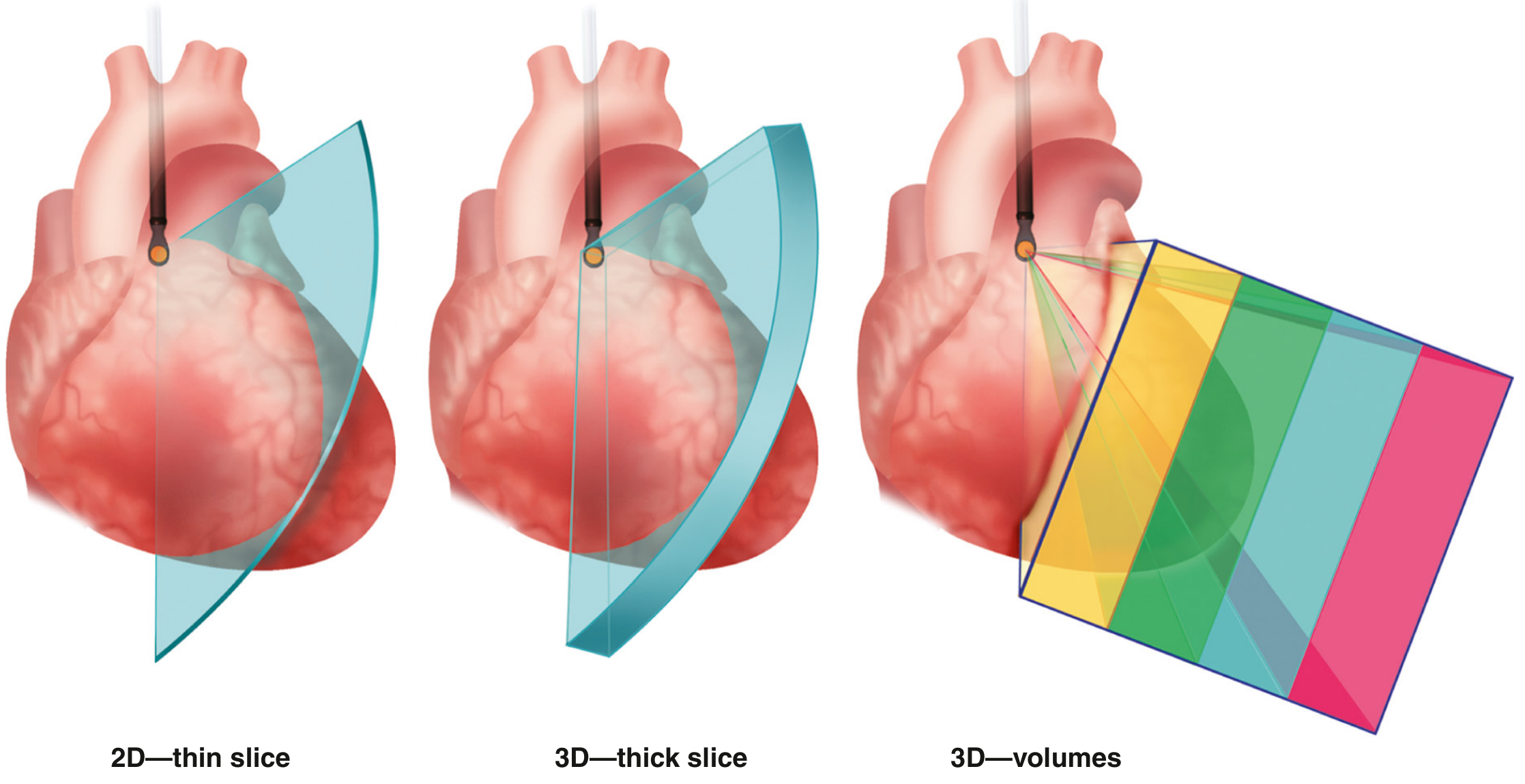
SECTION 2: INSTRUMENTATION — THE 3D TRANSDUCER
2.1 Matrix Array Transducer — The Key Hardware
- Element count: 2,500–9,000+ elements (e.g., 50×50, 60×60, or 72×72 grids)
- Transmit elements: may be a subset; receive elements: fully sampled
- Aperture: typically 25–30 mm × 25–30 mm
- Frequency: 2–7 MHz (cardiac TTE/TEE)
- Element pitch: ~0.2–0.3 mm (approximately λ/2 at operating frequency)
2.2 ASIC Integration in 3D Probes
- Micro-beamforming: The ASIC groups elements into sub-apertures (patches of ~16 elements) and performs partial beamforming within each patch, reducing the cable count from thousands to ~128–256 signal channels transmitted to the system
- Time-delay control: Precise sub-nanosecond delay chips in the ASIC for each element
- Transmit/receive switching: High-voltage transmit multiplexers and low-noise receive amplifiers on chip
- Power management: On-chip bias and power-supply regulation within the probe handle
2.3 Probe Variants
| Probe Type | Design | Application |
|---|---|---|
| Transthoracic 3D (xMATRIX) | Large matrix array, handheld | Cardiac TTE, 3D echo |
| 3D TEE (miniaturized matrix) | Miniaturized matrix in TEE endoscope tip | Intraoperative, valve assessment |
| 3D Intracardiac Echo (ICE) | Matrix array on catheter | Structural heart interventions |
| 3D Abdominal/OB probe | Mechanical or electronic matrix | Fetal, gynecology, abdominal |
| Mechanical 3D probe | Motor-driven 1D array | Abdominal, musculoskeletal |
| Freehand 3D system | Conventional 2D probe + position sensor | Research, vascular |
SECTION 3: DATA ACQUISITION METHODS
3.1 Method 1: Real-Time Matrix Array (Electronic Steering) — Gold Standard
- The matrix array transmits a diverging wavefront (or series of focused beams) covering the full pyramidal sector in both lateral dimensions
- Line-by-line (or plane-by-plane) data is collected by sequential beam-steering
- A complete volumetric dataset is assembled within a single or few cardiac cycles
- Volume rate (temporal resolution)
- Pyramid size (field of view)
- Spatial resolution (number of scan lines per volume)
3.2 Method 2: Mechanical 3D Scanning
- Linear sweep: Array translates along the elevation axis in fixed step increments → parallel 2D slices stacked to form a rectangular volume (used in fetal/abdominal 3D)
- Tilt/fan sweep: Array pivots about a central axis → radially arranged 2D slices forming a fan-shaped volume (used in transvaginal 3D, small-parts)
- Rotational sweep: Array rotates about the beam axis → cone-shaped volume (used in transvaginal 3D; basis of STIC acquisition)
3.3 Method 3: Freehand 3D Scanning
- Electromagnetic tracking (most common): small coils on the probe measure position and orientation within an external magnetic field (6 degrees of freedom — 3 translational + 3 rotational)
- Optical (infrared) tracking: retroreflective markers on probe tracked by overhead camera
- Acoustic arm: rigid mechanical arm with joint encoders (3 DOF) — accurate but restricts probe movement
- Sensorless (speckle tracking): decorrelation of RF speckle patterns between frames used to estimate relative probe displacement — no external hardware needed but less accurate
3.4 Method 4: ECG-Gated Multi-Beat Acquisition (Cardiac — Most Important Clinically)
Beat 1: Subvolume 1 (left wedge of pyramid)
Beat 2: Subvolume 2 (adjacent wedge)
Beat 3: Subvolume 3
Beat 4: Subvolume 4
↓
Offline stitching → Full pyramidal volume
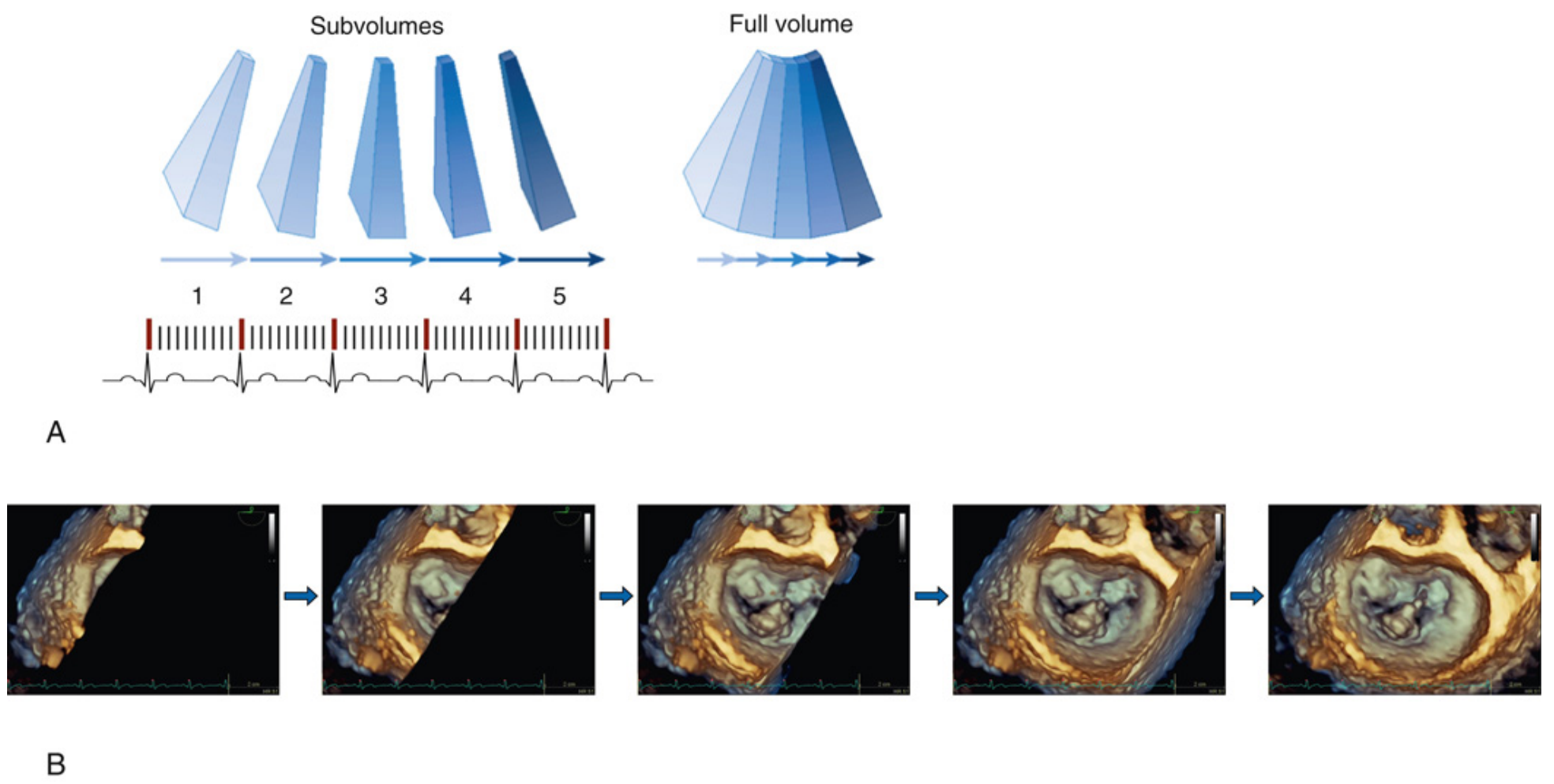
- Irregular heart rhythm (atrial fibrillation)
- Respiratory motion
- Patient body movement
- Significant beat-to-beat variation in stroke volume
3.5 Spatiotemporal Image Correlation (STIC) — Fetal Cardiac Imaging
- A slow linear or rotational sweep acquires ~150–400 2D frames over ~7.5–15 seconds
- The system automatically detects the fetal heart rate from the temporal periodicity in the acquired frames (by detecting pulsations) — no ECG leads required
- Frames are retrospectively sorted by their phase within the cardiac cycle
- Results in a 4D cine loop of the fetal heart — a complete volumetric cardiac dataset cycling through systole and diastole
- Can be combined with B-mode, colour Doppler, power Doppler, or HD-Flow for vascular mapping
SECTION 4: VOLUME RECONSTRUCTION (2D → 3D Dataset)
4.1 Voxel-Based Methods (VBMs) — Most Common
4.2 Pixel-Based Methods (PBMs) — Forward Projection
4.3 Function-Based Methods (FBMs) — Interpolating Functions
SECTION 5: COORDINATE SYSTEMS AND IMAGE PLANES
↑ AXIAL (depth axis, A-plane)
|
|
+———→ LATERAL (azimuthal, left-right)
/
/
ELEVATIONAL (sagittal-equivalent, front-back = C-plane)
| Plane | Definition | Equivalent |
|---|---|---|
| A-plane | Standard 2D B-mode sweep plane | Long-axis equivalent |
| B-plane | Elevation cross-sections perpendicular to A-plane | Short-axis equivalent |
| C-plane (en face) | Parallel to probe face at a given depth | "Bull's eye" or en-face view |
SECTION 6: VISUALISATION MODES — DISPLAY METHODS
6.1 Multiplanar Reconstruction / Reformatting (MPR)
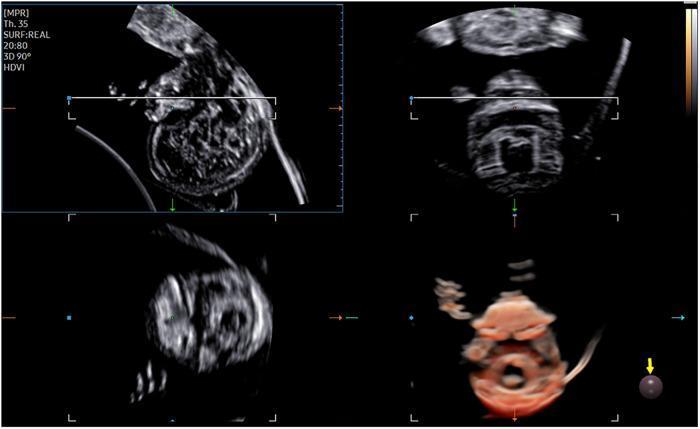
- Top-left: Primary reference plane (e.g., sagittal / long-axis)
- Top-right: Second orthogonal plane (e.g., transverse / short-axis)
- Bottom-left: Third orthogonal plane (e.g., coronal / elevation)
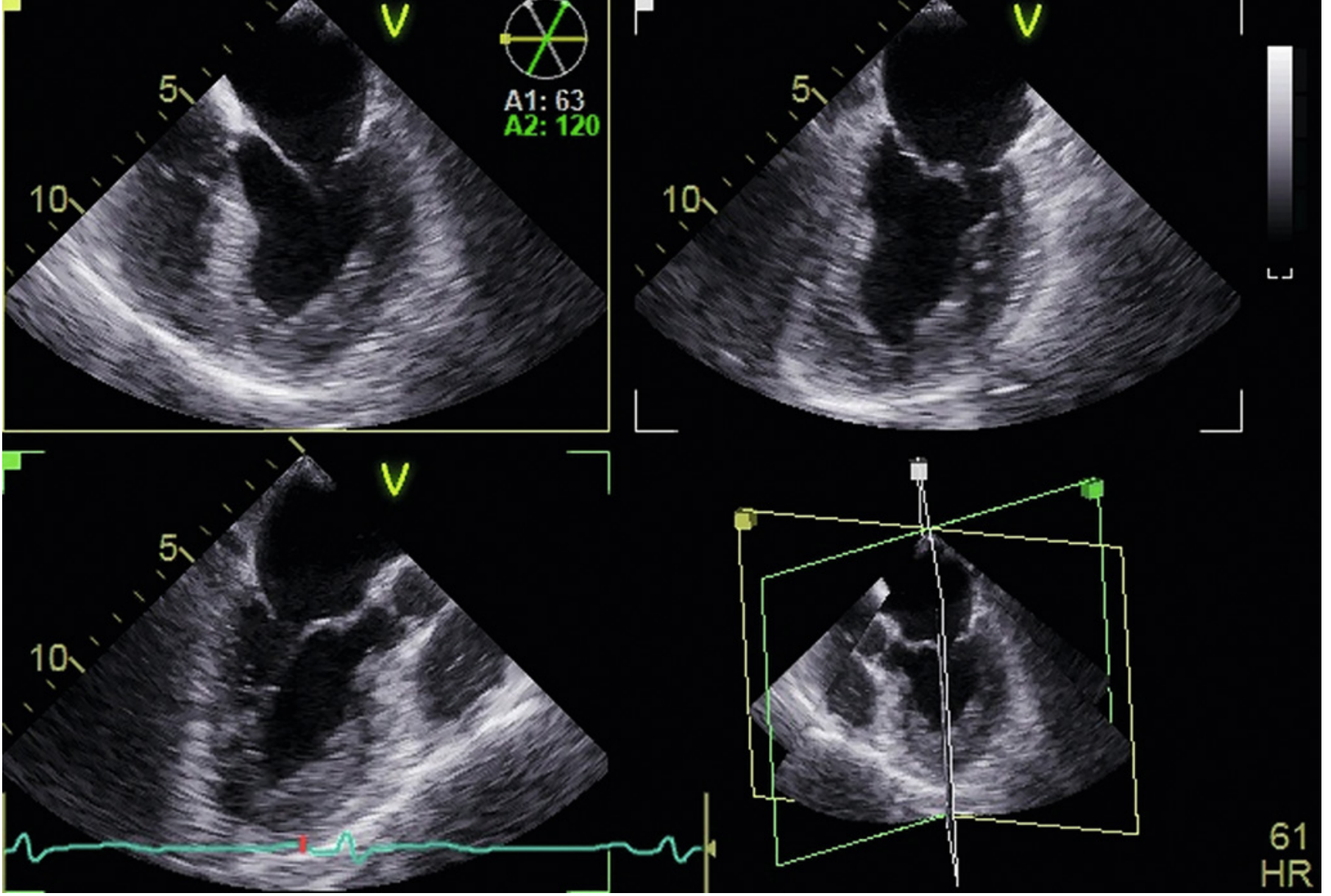
- Bottom-right: 3D rendered or reference volume with colour-coded intersection lines
- Acquire the volumetric dataset
- Select the desired anatomical reference point — the system displays all three orthogonal planes through that point simultaneously
- Rotate or tilt any plane independently — the others update in real time
- Use for planimetry (area measurement), annulus sizing, lesion localization
6.2 Slice Projection (Thick-Slab MIP/MinIP)
- Maximum Intensity Projection (MIP): Each projected pixel = maximum brightness voxel along the ray through the slab. Best for hyperechoic structures (calcified valves, calculi, bony landmarks)
- Minimum Intensity Projection (MinIP): Each pixel = minimum voxel. Best for anechoic fluid-filled structures (cysts, cardiac chambers, vessels)
- Average Projection: Blends all voxels — improves SNR but reduces contrast
6.3 Surface Rendering
- Segmentation: Define the interface between two tissue types (e.g., blood–endocardium, fluid–fetal skin). May be manual (operator traces boundary on multiple 2D planes), semi-automated (active contour/snakes algorithm), or automated (tissue-type classification)
- Mesh generation: The boundary points are connected into a polygonal mesh (triangles), forming a 3D surface
- Shading and rendering: A virtual light source illuminates the surface — near structures appear bright, far structures shadowed — creating depth perception
- Display: The rendered surface is projected onto the 2D monitor as a photorealistic-looking structure
- Fetal face: Photorealistic surface of fetal skin — used in obstetric 3D ultrasound
- LV endocardial surface: The LV inner wall traced over the cardiac cycle → beating 3D model for volume quantification (LV EF without geometric assumptions)
- Mitral valve: 3D leaflet surface shows prolapse segments, flail, restricted motion from LA or LV perspective
- Aortic valve: En-face view from aorta shows cusp number, calcification, orifice area
6.4 Volume Rendering — The Most Clinically Used Method
Voxel Data
↓
Transfer Function (maps grey-value → colour + opacity)
↓
Compositing (integrate along each ray through volume)
↓
Projected 2D Image on Screen
- Low grey values (anechoic blood/fluid) → fully transparent (rendered invisible)
- Mid grey values (myocardium, soft tissue) → semi-transparent, coloured orange/gold
- High grey values (calcium, valve leaflets) → opaque, bright white/yellow
6.5 Wireframe Display
- 3D LV models showing endocardial wireframe contracting over time
- Mitral valve annulus: 3D saddle-shaped annulus outline
- Research quantification where the boundary coordinates are extracted for numerical analysis
6.6 Parametric Colour Maps (Bull's-Eye Plots)
- Displayed on a flat "bull's-eye" map (apical view looking from apex)
- Provides a comprehensive at-a-glance overview of regional LV function
- Ischaemic territories show synchrony defects as colour differences
- Used for dyssynchrony assessment and regional wall-motion analysis
6.7 Simultaneous Multiplane (Biplane / Triplane) Display
- Primary reference plane + one or two secondary planes at adjustable angles
- Each plane is independently rotatable in real time
- The 3D orientation of all planes shown in a fourth "locator" panel
- Advantage: Highest temporal and spatial resolution of all 3D modes (because each plane still uses full array aperture) — Miller's Anesthesia 10e
6.8 4D Ultrasound (Real-Time 3D Cine)
- Single-beat 4D: volume rate ~5–15 volumes/second (limited by pyramid size and depth)
- Multi-beat 4D (gated): retrospective reconstruction → higher effective temporal resolution but requires stable rhythm
SECTION 7: ACQUISITION MODES — CLINICAL 3D IMAGING MODES IN DETAIL
7.1 Real-Time Narrow Sector (3D Live / Narrow Volume)
| Feature | Value |
|---|---|
| Pyramid size | ~30° × 60° |
| Volume rate | ~20–30 Hz |
| Spatial resolution | Highest of live modes |
| Data source | Single beat, real-time |
| Best for | Quick orientation, guiding catheter/needle, complex anatomy assessment |
| Limitation | Narrow FOV — entire structure often excluded |
7.2 Real-Time Zoom / Wide Sector Mode
| Feature | Value |
|---|---|
| Pyramid size | User-selected enlarged ROI |
| Volume rate | ~10–20 Hz |
| Spatial resolution | Reduced (wider pyramid = fewer scan lines per area) |
| Data source | Single beat |
| Best for | Real-time manipulation, valve visualization, procedure guidance |
| Limitation | Lower spatial and temporal resolution; cannot save/reanalyse post-hoc |
7.3 Full-Volume Gated (Multi-Beat) Mode — Highest Quality
| Feature | Value |
|---|---|
| Pyramid size | Full cardiac pyramid (~90° × 90°) |
| Number of subvolumes | Typically 4–6 heartbeats |
| Volume rate | High (4-beat = ~4× improvement over single-beat) |
| Data source | Multi-beat ECG-gated stitching |
| Best for | LV volume/EF quantification; post-hoc analysis; valve assessment |
| Limitation | Requires regular rhythm; stitch artifact with arrhythmia/movement |
| Post-processing | Full data set saved → can re-crop, re-render, quantify offline |
7.4 Single-Beat Full Volume (Live Full-Volume)
- Same pyramidal coverage as multi-beat but acquired from a single heartbeat
- Eliminates stitch artifact (suitable for AF, arrythmia, non-compliant patients)
- Lower spatial and temporal resolution than gated acquisition
- Frame rate: ~3–8 Hz — adequate for general assessment but not precise quantification
7.5 3D Colour Flow Doppler
- Volume-rendered pyramidal dataset with colour Doppler overlaid on grey-scale
- Acquired in real-time (single beat) or multi-beat gated mode
- Very low volume rate (colour acquisition requires multiple pulses per line → fewer volumes/second)
- Optimised using R-wave gated multi-beat acquisition
- Clinically used to visualize 3D distribution of paravalvular leaks, intracardiac shunts, mitral regurgitation jets — Textbook of Clinical Echocardiography; Miller's Anesthesia 10e
SECTION 8: THE FUNDAMENTAL TRIAD TRADEOFF
TEMPORAL RESOLUTION
(Volume rate, Hz)
/\
/ \
/ \
/______\
SPATIAL FIELD OF VIEW
RESOLUTION (Pyramid size)
- Smaller pyramid → higher volume rate (better temporal resolution) OR more scan lines (better spatial resolution)
- Greater depth → lower PRF per line → lower volume rate
- More scan lines → better lateral resolution → lower volume rate
- Multi-beat gating → overcomes the tradeoff by spreading the scan line load across multiple beats
- Narrow sector: best temporal + spatial resolution, small FOV
- Zoom: larger FOV, worse both
- Full-volume single beat: largest FOV, worst both
- Full-volume multi-beat gated: largest FOV, best of all — at the cost of stitching requirements
SECTION 9: IMAGE OPTIMISATION FOR 3D ACQUISITION
Gain and Compression
- Start with slight over-gain (~50 units) to avoid echo dropout appearing as holes in structures
- Excess gain → obscures fine detail (e.g., aortic valve cusp edges appear fused)
- 3D images are more sensitive to gain than 2D because dropout is amplified in volume rendering
- Effect: Low gain → dropout (holes); optimal → clean anatomy; high gain → obscured detail — Textbook of Clinical Echocardiography, Fig. 4.4
Time-Gain Compensation (TGC)
- Adjust so that the near field and far field are equally bright before acquiring 3D
- Uneven TGC is magnified in volume-rendered images
Focus Depth
- Set the focal zone at the centre of the structure of interest
- Single focal zone recommended to maximise frame rate
Sector Size and Depth
- Reduce depth to minimum that still includes the entire structure → increases PRF → increases volume rate
- Reduce pyramid width to minimum necessary → same effect
Post-Processing
- Threshold: Adjusts opacity mapping — varies which grey values become transparent. Critical for separating blood pool from myocardium
- Depth: Adjusts virtual illumination angle
- Rotation/Cropping: After full-volume acquisition, crop interactively to reveal internal anatomy from any perspective
SECTION 10: ARTEFACTS SPECIFIC TO 3D ULTRASOUND
| Artifact | Appearance | Mechanism | Solution |
|---|---|---|---|
| Stitch artifact | Vertical bright/dark line across volume | Misregistration of subvolumes due to irregular rhythm/motion | Ensure regular rhythm + breath-hold; use single-beat mode |
| Echo dropout | Holes in solid-appearing structures | Insufficient gain; structure parallel to beam | Increase gain; optimise transducer angle |
| Stitching ghosting | Double or ghost image of moving structures | Beat-to-beat variation in cardiac position | Use single-beat acquisition in arrhythmia |
| Foreshortening | Underestimation of LV length | Beam not parallel to LV long axis | Optimise transducer position |
| Resolution anisotropy | Axial resolution >> lateral resolution in elevation | Beam wider in elevation than lateral | Accept as inherent limitation; optimise focus |
| Reduced frame rate | Blurry or jerky 3D motion | Pyramid too large / excessive depth | Reduce depth, reduce sector angle, use multi-beat |
| Range ambiguity | Signal from outside stated pyramid | High-PRF equivalent in 3D mode | Limit pyramid depth |
SECTION 11: QUANTITATIVE ANALYSIS FROM 3D DATA
11.1 LV Volume and Ejection Fraction
- 3D LV EF is the most accurate non-invasive method — no geometric assumptions (unlike Simpson's biplane which assumes an ellipsoid)
- Method: Semi-automated endocardial border tracing in MPR, then software calculates enclosed volume at each time point
- LV EF = (EDV − ESV) / EDV × 100%
- Reference standard comparison: excellent correlation with cardiac MRI — Fuster & Hurst's The Heart 15e
11.2 Mitral Valve Analysis
- 3D TEE allows en-face "surgeon's view" of the mitral valve from LA perspective
- MPR determines precise annulus dimensions: major/minor axis, 3D annular area, annular perimeter — used for MitraClip sizing, surgical ring sizing
- Dynamic annular tracking over cardiac cycle reveals saddle-shape deformation
11.3 Multiplanar Reformatting (MPR) for Measurements
- Linear dimensions and areas (e.g., aortic annulus for TAVI)
- Planimetry of stenotic orifices (precise short-axis cross-section through stenotic jet)
- Left atrial appendage dimensions for occlusion device sizing
- The simultaneous multi-axis visualization guides transcatheter procedures — Miller's Anesthesia 10e
SECTION 12: CLINICAL APPLICATIONS BY SPECIALTY
| Specialty | Application |
|---|---|
| Cardiac — Structural | LV EF; RV volume; CHD anatomy; TAVI planning; mitral valve prolapse mapping; aortic valve en-face |
| Cardiac — Interventional | Real-time 3D TEE guidance of TAVI, MitraClip, WATCHMAN LAA closure, ASD/VSD closure, transseptal puncture |
| Cardiac — Electrophysiology | Pulmonary vein 3D anatomy; LAA morphology assessment |
| Obstetrics | Fetal face (cleft lip/palate); fetal cardiac STIC; placenta volume; fetal biometry |
| Gynecology | Uterine anomalies (arcuate, bicornuate, septate); IUD position; ovarian follicle counting |
| Vascular | 3D CEUS endoleak detection; carotid plaque volume; 3D vascular mapping |
| Urology | Prostate volume; renal mass characterization |
| Musculoskeletal | Volumetric joint imaging; neonatal hip dysplasia |
SECTION 13: SUMMARY COMPARISON TABLE
| Feature | 2D Ultrasound | 3D Single-Beat | 3D Multi-Beat Gated | 4D / RT-3D |
|---|---|---|---|---|
| Frame rate | 50–100 Hz | 3–15 Hz | High (beat number dependent) | 5–20 Hz |
| FOV | One plane | Narrow pyramid | Full pyramid | Adjustable pyramid |
| Spatial resolution | High (one plane) | Reduced | Highest | Variable |
| Requires ECG gating | No | No | Yes | No |
| Affected by arrhythmia | No | No | Yes (stitch artifact) | No |
| Post-hoc rotation | No | Limited | Full | Limited |
| Quantification (LV EF) | Geometric assumptions | Moderate | Best (no geometric assumptions) | Moderate |
| Real-time procedural guidance | Yes | Yes | No (offline stitching) | Yes |
SECTION 14: HIGH-YIELD EXAM SUMMARY POINTS
- 3D ultrasound stages: Acquisition → Reconstruction → Visualisation
- Matrix array key feature: Thousands of elements in 2D rectangular grid; electronic steering in both lateral and elevation planes; ASIC micro-beamforming reduces cable count
- Pyramidal output: All 3D cardiac datasets are pyramid-shaped with apex at transducer face
- Tradeoff triad: Volume rate ↔ Spatial resolution ↔ Field of view — cannot optimise all three simultaneously
- Multi-beat gating: Overcomes the tradeoff by spreading scan lines over N beats; requires regular rhythm + breath-hold; produces stitch artifact if either fails
- Volume reconstruction algorithms: VBM (nearest-neighbour, distance-weighted), PBM (forward projection), FBM (function-based/spline) — VBM NN is fastest; FBM most accurate
- Three visualisation planes: A-plane (standard B-mode), B-plane (elevation cross-section), C-plane (en-face/depth)
- MPR: Any arbitrary 2D plane extracted from 3D dataset; 4-quadrant display; angle-independent measurement
- Volume rendering: Opacity + colour transfer function applied to raw voxel data; no segmentation required; most clinically used 3D display
- Surface rendering: Requires boundary segmentation first; photorealistic; used for fetal face, LV EF model
- Gain critical: Over-gain → obscures detail; under-gain → dropout holes in solid structures
- 3D EF: Most accurate; no geometric assumption; correlates with MRI; method of choice for LV volume quantification
- STIC: Fetal cardiac 4D — retrospective gating using intrinsic cardiac pulsation; no ECG needed
- Stitch artifact: Vertical line; cause = irregular rhythm/movement during multi-beat acquisition; solution = single-beat mode or ensure regular rhythm
References
- Textbook of Clinical Echocardiography — Three-Dimensional Echocardiography (Ch. 4): acquisition modes, image display, gain optimisation, stitch artifact
- Miller's Anesthesia 10e — 3D Image Acquisition, Multiplane Imaging, Gated Acquisition, MPR, Quantitative Analysis
- Fuster & Hurst's The Heart 15e — 3D Echocardiography: matrix array, surface rendering, LV/RV volumes, MRI correlation
- Barash's Clinical Anesthesia 9e — 3D TEE: pyramidal dataset, volume rendering, procedural guidance
- PALNI Ultrasound Physics — Equipment design, STIC, 4D display, rendering methods
- Steen E, Olstad B. Volume rendering of 3D medical ultrasound data using direct feature mapping. IEEE Trans Med Imaging 1994 [PMID: 18218527]
3d ultrasound imaging , acquisition, visualisation, display methods in detail and instrumentation
- Conceptual overview (2D → 3D transition)
- Instrumentation — Matrix array transducer design, element count, ASIC micro-beamforming, probe variants
- Acquisition methods — Electronic matrix steering, mechanical scanning (linear/tilt/rotational), freehand with position tracking (EM/optical/acoustic arm/sensorless), ECG-gated multi-beat stitching, STIC (fetal)
- Volume reconstruction — VBM (nearest-neighbour, distance-weighted, Gaussian), PBM (pixel-based), FBM (function-based/spline)
- Visualisation & Display methods — MPR/multiplanar reformatting, slice projection (MIP/MinIP), surface rendering, volume rendering (with transfer function pipeline), wireframe, parametric bull's-eye maps, simultaneous multiplane, 4D real-time
- Acquisition modes — Narrow sector, zoom/wide sector, full-volume single-beat, full-volume multi-beat gated, 3D colour Doppler
- The fundamental triad tradeoff — Volume rate ↔ Spatial resolution ↔ Field of view (with equation)
- Image optimisation — Gain, TGC, focus, sector size
- 3D-specific artifacts — Stitch, dropout, ghosting, resolution anisotropy
- Quantitative analysis — LV EF, MVA, MPR-guided measurements
- Clinical applications by specialty
- High-yield exam summary (14 key points)
4D ultrasound imaging , acquisition, visualisation, display methods in detail and instrumentation
4D ultrasound imaging acquisition visualization display instrumentation real-time volume rate
https://obgynkey.com/volume-sonography-core-concepts-for-cli…
4D ultrasound cardiac STIC fetal acquisition volume rate GPU rendering instrumentation 2024
https://developer.nvidia.com/gpugems/gpugems/part-vi-beyond-…
4D ultrasound real-time fetal cardiac STIC volume rendering display
4D Ultrasound Imaging — Acquisition, Visualisation, Display Methods, and Instrumentation
SECTION 1: DEFINITION AND CONCEPTUAL BASIS
1.1 What is 4D Ultrasound?
- 3D ultrasound: Acquires a single static volumetric dataset (x, y, z spatial dimensions)
- 4D ultrasound: Acquires a continuous, rapidly updating sequence of 3D volumes displayed in real time, so the anatomy is seen moving within the 3D volume
"Four-dimensional ultrasonography: an imaging method that adds the dimension of time via the fast and continuous acquisition and display of 3D volumes, especially useful for imaging moving targets (fetal heart, moving limbs)." — Volume Sonography Core Concepts
1.2 Terminology Clarification
| Term | Meaning | Context |
|---|---|---|
| RT-3D (Real-Time 3D) | Live 3D volumes displayed continuously | Cardiac echo (some authors call this 4D) |
| 4D ultrasound | Live 3D cine loop, typically at lower volume rates | Obstetric (fetal face, body movements) |
| 4D-STIC | Retrospectively gated 4D cine of fetal heart | Fetal echocardiography |
| Live 3D | Single-beat real-time 3D | Cardiac (e.g., Philips, GE nomenclature) |
| 4D echo | Real-time 3D cardiac with colour Doppler | Cardiology |
"RT-3D imaging acquires data over a single heartbeat; some authors and vendors refer to this as 4D imaging." — Miller's Anesthesia 10e
SECTION 2: INSTRUMENTATION FOR 4D IMAGING
2.1 The Matrix Array Transducer — Core Instrument
| Parameter | Value |
|---|---|
| Element count | 2,500–9,000+ elements |
| Grid configuration | Square: e.g., 50×50, 60×60, 72×72 |
| Frequency range | 1–8 MHz (cardiac 2–7 MHz; obstetric 3–7 MHz) |
| Volume rate (real-time) | 5–30 volumes/second |
| Volume rate (zoom, reduced aperture) | Up to 24–60 volumes/second |
| Pyramid angle | 30°×60° (narrow) to 90°×90° (full volume) |
- A 1D phased array steers in the azimuthal plane only → 2D fan image
- To get the elevation plane, the array would need to be mechanically tilted → too slow for real-time 3D
- The 2D matrix array steers electronically in BOTH planes → can sweep through the full pyramid within milliseconds → true real-time volume acquisition
2.2 ASIC Technology in 4D Probes
- Transmit beamforming: Time-delay chips apply precise sub-nanosecond delays to each element for focused transmit beam steering in both x and y directions
- Micro-receive beamforming: Elements are grouped into patches (~4×4 = 16 elements); partial beamforming summed within each patch → reduces cable count from ~3,000 to ~128 channels
- Low-noise amplification: Each element's receive signal amplified before digitisation, minimising noise
- High-voltage multiplexing: Transmit/receive (T/R) switches protect the sensitive receive electronics from high transmit voltages
- Power supply management: On-chip voltage regulation, thermal management
2.3 Mechanical 4D Probes
- A conventional 1D phased or curved array is mounted on a motor-driven pivot within the probe housing
- The motor continuously rocks (tilts) the array back and forth through the elevation plane
- Each complete sweep (one direction + return) generates one 3D volume
- The sweep repeats continuously → produces a 4D cine loop
- Sweep angle: 40°–85° elevation range
- Volume rate: 1–24 volumes/second (depends on sweep angle and depth)
- Frequency: 3–9 MHz (transvaginal), 2–8 MHz (transabdominal)
- Frame count per volume: 100–400 2D slices per sweep
2.4 GPU-Based Real-Time Rendering Engines
- Scan conversion: Transform pyramidal coordinates → Cartesian voxel grid
- Volume rendering: Ray-casting or texture-based projection with opacity mapping
- Real-time display: Repeat at 10–30 volumes/second
- Store the pyramidal volume directly as a 3D projective texture in GPU memory (no explicit Cartesian conversion needed)
- Use 3D projective texture mapping to perform ray-casting directly in pyramidal coordinates
- GPU fragment and vertex processors execute the opacity transfer function and compositing in parallel for every screen pixel simultaneously
- Result: Volume rendering at the rates required for cardiac 4D imaging — NVIDIA GPU Gems Ch. 40
2.5 4D Transducer Variants
| Probe Type | Technology | Application | Volume Rate |
|---|---|---|---|
| xMATRIX (Philips) | Full 2D matrix, 3000 elements | Cardiac TTE | 5–30 Hz |
| 4D TEE (miniaturised matrix) | Matrix in endoscope tip | Intraoperative cardiac | 5–20 Hz |
| Voluson E10 probe (GE) | Mechanical motor + curved array | OB/GYN 4D | 1–24 Hz |
| RM7C (mechanical) | Tilting curved array | Fetal 4D face/body | Up to 35 Hz |
| V6C (electronic matrix) | Reduced aperture matrix | Fast fetal 4D | Up to 60 Hz |
| High-density matrix (research) | 9000+ element full matrix | All applications | Variable |
SECTION 3: THE 4D ACQUISITION PIPELINE
START IN 2D B-MODE
↓
Select region of interest (ROI) and optimise 2D image
↓
Choose 4D acquisition mode (sector size, volume rate)
↓
ACQUIRE VOLUMETRIC DATA
├─ Single-beat real-time (cardiac)
├─ Multi-beat ECG-gated (cardiac)
├─ Mechanical sweep (OB/GYN)
└─ STIC (fetal cardiac)
↓
SCAN CONVERSION (pyramidal → Cartesian voxels)
↓
VOLUME RENDERING (GPU)
↓
DISPLAY (scrolling 4D cine loop)
↓
POST-PROCESSING + QUANTITATIVE ANALYSIS
SECTION 4: ACQUISITION METHODS IN DETAIL
4.1 Single-Beat Real-Time 4D (Cardiac)
- $c$ = speed of sound ≈ 1540 m/s
- $d$ = imaging depth (m)
- $N_{lines/volume}$ = number of scan lines per volume (proportional to pyramid width × line density)
| Mode | Pyramid Size | Volume Rate | Spatial Resolution | Best Use |
|---|---|---|---|---|
| Narrow sector | 30°×60° | Highest (~20–30 Hz) | Highest | Procedure guidance, real-time manipulation |
| Wide sector (Zoom) | User-defined ROI | Medium (~10–20 Hz) | Reduced | Valve visualisation, entire valve in one volume |
| Live Full-Volume | 90°×90° | Lowest (~3–8 Hz) | Reduced | Gross anatomy, arrhythmia patients |
4.2 Multi-Beat ECG-Gated 4D (Cardiac — Highest Quality)
- Regular sinus rhythm (RR interval variability <10 ms ideally)
- Breath-hold during acquisition
- No patient movement between beats
4.3 Mechanical Sweep 4D (Obstetric/Abdominal)
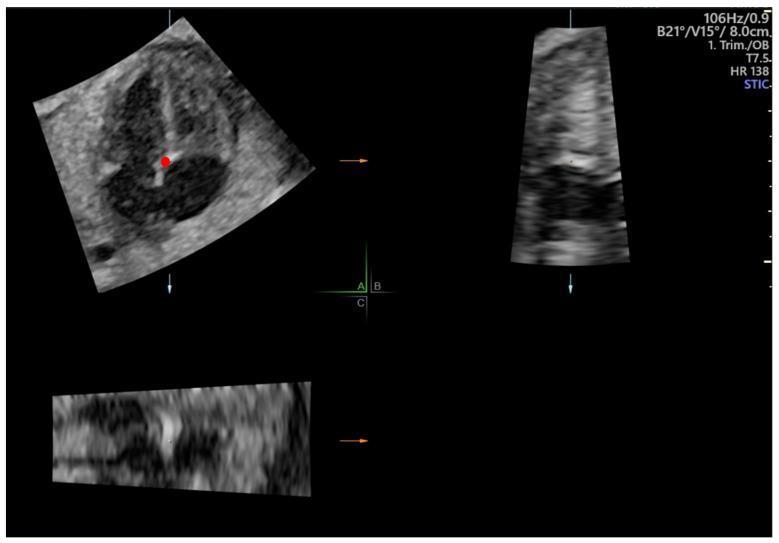
4.4 STIC (Spatiotemporal Image Correlation) — 4D Fetal Cardiac Imaging
4.4.1 STIC Acquisition Protocol
- The mechanical probe performs a slow, steady sweep through the fetal chest in the elevation direction over 7.5–15 seconds (user-selectable)
- During this sweep, ~200–400 2D B-mode frames are acquired with timestamps but no spatial position tracking
- Auto-detection of cardiac rate: The software analyses the periodic motion patterns (wall/valve motion) in the acquired frames to automatically detect the fetal heart rate — no ECG needed
- Retrospective temporal sorting: All frames are sorted according to their estimated phase within the cardiac cycle (systole or diastole) based on the detected rate
- Volume construction: Frames belonging to the same cardiac phase are assembled into a 3D volume; frames at the next phase into another volume; and so on until a full cardiac cycle is reconstructed
- Result: A 4D cine loop of 10–40 volumetric frames spanning one complete fetal cardiac cycle — can be played back repeatedly as a loop
4.4.2 STIC Technical Parameters
| Parameter | Value | Effect |
|---|---|---|
| Sweep time | 7.5–15 seconds | Longer → more frames, better temporal resolution |
| Sweep angle | 15°–40° elevation | Wider → larger chest volume covered |
| Frame rate during sweep | 50–120 Hz | Higher → more frames, better temporal resolution |
| Resulting 4D frames | 10–40 volumes/cardiac cycle | More = smoother motion playback |
| Fetal HR detection method | Autocorrelation of motion signal | Automatic, no ECG |
4.4.3 STIC Limitations and Failure Modes
- Fetal movement during sweep: Causes blurring and misregistration of cardiac phases
- High/irregular fetal HR: Difficult auto-detection of rate; unreliable sorting
- Poor acoustic window: Insufficient signal for cardiac motion detection
- Operator sweep speed: Must be slow, uniform, and straight in one direction
- Artefact: If HR is incorrectly estimated, cardiac structures appear at wrong phase → misdiagnosis risk
4.4.4 STIC Combined Modalities
| STIC Combination | What it shows |
|---|---|
| STIC + B-mode | Standard grey-scale 4D cardiac anatomy |
| STIC + Colour Doppler | 4D colour flow through cardiac structures |
| STIC + Power Doppler | 4D mapping of vascular flow, placental vascularity |
| STIC + VOCAL | Automated fetal cardiac chamber volume calculation |
| STIC + M-mode | Virtual M-mode through any plane in stored volume |
| STIC + Glass-body | Angiographic-style 4D rendering of cardiac vessels |
SECTION 5: SCAN CONVERSION (DATA TRANSFORMATION)
5.1 Coordinate Transformation
5.2 Interpolation Methods
| Method | Algorithm | Speed | Quality |
|---|---|---|---|
| Nearest-Neighbour | Assign each voxel the value of its closest acquired sample | Fastest | Blocky; adequate for real-time |
| Trilinear | Weighted average of 8 surrounding samples | Fast | Smooth; standard for clinical 4D |
| Gaussian kernel | Weighted sum using Gaussian function of distance | Moderate | Better SNR; smooth |
| Spline / RBF | Fitted smooth function | Slow | Best quality; offline only |
5.3 Direct Pyramidal Rendering (No Explicit Scan Conversion)
- The pyramidal volume is stored directly in GPU memory as a 3D projective texture
- Ray-casting is performed in the original pyramidal coordinate system
- The GPU's projective texture sampling hardware handles the geometric transformation implicitly
- Advantage: eliminates the scan conversion step, saving time and memory — NVIDIA GPU Gems Ch. 40
SECTION 6: VISUALISATION AND DISPLAY MODES
6.1 Real-Time 4D Cine Loop Display
- Volume rate (Hz): Adjusted by sector size and depth
- Playback speed: Can replay stored 4D loops at slower speed for detailed review
- Rotation: Volume can be rotated in any direction during real-time display
- Cropping: A virtual cut-plane reveals internal anatomy (e.g., remove anterior wall → view mitral valve)
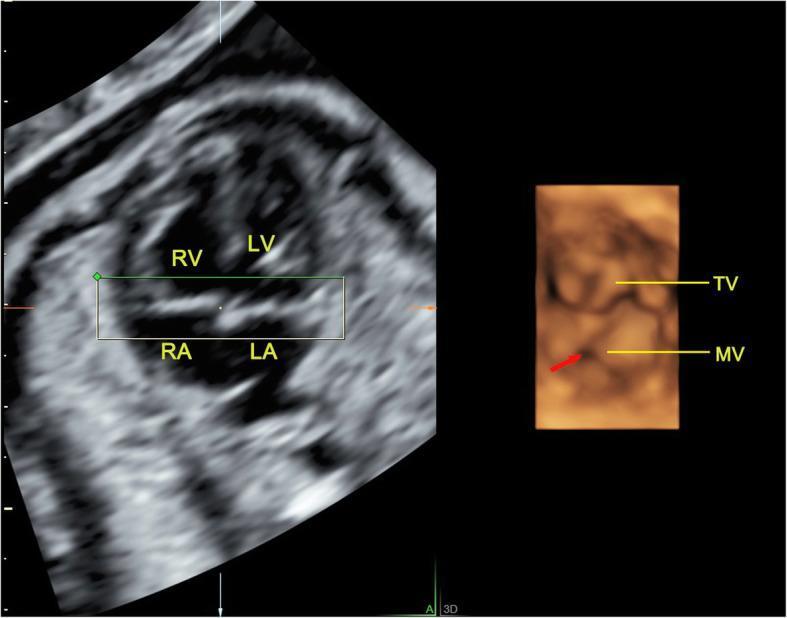
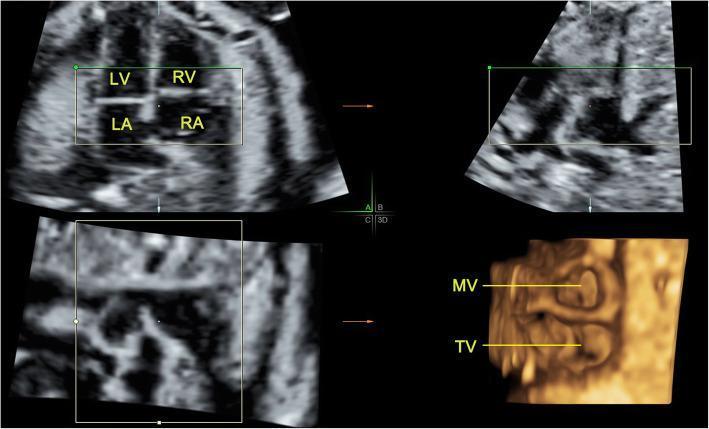
6.2 Volume Rendering (The Primary 4D Rendering Method)
- Anechoic blood → transparent (rendered invisible) → cavity appears empty (black)
- Myocardium/tissue → semi-transparent, orange/amber → structures appear solid
- Highly echogenic structures (calcium, valve leaflets, sutures) → opaque, bright → rendered prominently
- Perspective projection: Structures closer to the virtual camera appear larger
- Phong shading: A virtual light source illuminates the scene — near surfaces are bright, shadowed areas create depth
- Transparency compositing: Semi-transparent tissues show underlying anatomy
6.3 Surface Rendering in 4D
- At each time frame, the endocardial (or epicardial) border is detected (semi-automatically or automated)
- The surface is rendered as a solid, lit mesh
- As the 4D loop plays, the surface appears to contract and expand — showing myocardial motion
- Used for: LV endocardial motion, fetal face movement, fetal limb motion, valve leaflet morphology
6.4 Multiplanar Reconstruction (MPR) in 4D
- Navigate to end-diastole or end-systole and measure dimensions at precisely those phases
- Extract virtual planes that were never available physically (e.g., true coronal plane of fetal chest)
- Play the MPR cine to watch one plane's anatomy changing through the cardiac cycle
- Simultaneous triplane MPR: Three orthogonal planes shown simultaneously, all animating through the cardiac cycle
6.5 Volume Contrast Imaging (VCI)
- Rather than projecting through the entire volume, a thin slab of voxels (typically 3–8 mm thick) is projected
- The maximum, minimum, or average of the slab is displayed as a 2D image
- VCI-A (coronal plane): Renders a thick coronal slice, equivalent to viewing a "slice" of the volume from above — produces images with dramatically improved contrast resolution vs. standard 2D
- VCI-A in real time: The ultra-fast volume rate of modern probes (e.g., Voluson E10) allows VCI-A to be used live as a standard real-time mode, improving imaging of fetal brain, extremities, or heart in difficult patients
6.6 Glass Body / Inversion Mode
- Colour/power Doppler is acquired within the 4D volume
- The grey-scale anatomy is made transparent; only the Doppler signal is displayed
- Result: an "angiographic" 4D rendering showing only moving blood — a pulsating vascular tree
- Clinical uses: Placental vascularity mapping, intrahepatic flow, tumour vascularity, fetal cardiac outflows
- Inverts the signal intensity: anechoic (fluid) becomes bright; echogenic tissue becomes dark
- Fluid-filled structures (cysts, cardiac chambers, bladder, renal pelvis) appear as bright solid masses
- Allows volume calculation of fluid-filled organs without manual tracing
- Clinical: fetal stomach volume, amniotic fluid pockets, LV volume, renal pelvis volume
6.7 4D LV Quantification Display (Cardiac)
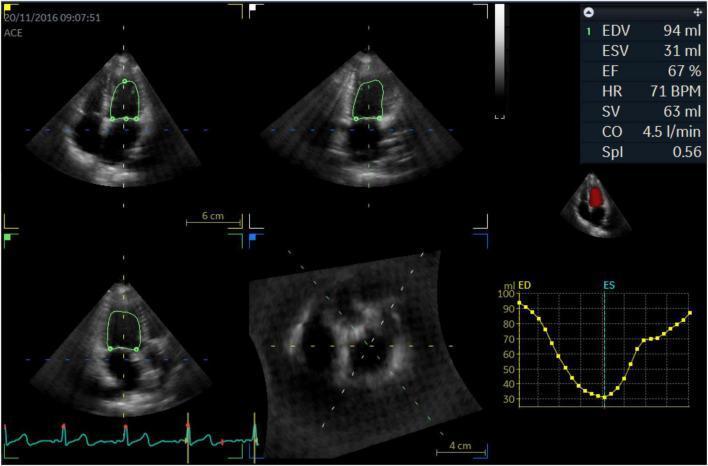
- Acquire full-volume gated 4D dataset (4–6 beats)
- Place landmark points (apex, mitral annulus) in one or two frames
- Software propagates endocardial surface detection across all time frames using active appearance models or deformable mesh tracking
- LV volume is calculated at each time point without geometric assumptions
- Volume-time curve displayed: LV volume (y-axis) vs. cardiac cycle phase (x-axis) — shows full volume excursion
- Output: EDV, ESV, EF, SV, CO, dV/dt (rate of volume change)
6.8 Parametric 4D Display — Regional Function Maps
- LV divided into 17-segment AHA model
- Each segment's parameter colour-coded on a flat disc (apex at centre, base at periphery)
- Parameters: time-to-minimum volume, regional EF, wall thickening, radial displacement
- Synchrony map: Colour shows timing of peak contraction per segment — used to identify dyssynchrony for CRT (cardiac resynchronization therapy) selection
- Software tracks speckle patterns frame-to-frame through the 4D dataset
- Derives regional myocardial deformation: longitudinal strain, circumferential strain, radial strain, area strain
- Displayed as colour-coded maps on the 3D LV surface, animating through the cardiac cycle
- More comprehensive than 2D strain (covers all segments without foreshortening)
SECTION 7: THE FUNDAMENTAL 4D TRADEOFF — TEMPORAL vs. SPATIAL vs. VOLUME
| To improve volume rate | Consequence |
|---|---|
| Reduce depth | May lose far-field anatomy |
| Reduce pyramid angle | Narrower FOV |
| Reduce line density | Worse lateral resolution |
| Use multi-beat gating | Requires regular rhythm; stitch artifacts |
| Use reduced aperture | Worse spatial resolution |
| Use parallel receive beamforming | Increased hardware complexity |
| Application | Minimum Volume Rate Needed | Reason |
|---|---|---|
| Fetal face 4D | 5–10 Hz | Slow facial movements |
| Fetal limb 4D | 10–15 Hz | Moderate speed movement |
| Fetal cardiac 4D (STIC) | N/A (retrospective gating) | Inherently high HR (~150 bpm) |
| Adult cardiac 4D | 15–25 Hz | HR ~70 bpm; need ≥5 frames/cycle |
| LV EF quantification | 25–30 Hz minimum | Need to capture end-systole accurately |
| Valve dynamics (transcatheter guidance) | ≥20 Hz | Rapid leaflet motion |
| 3D Colour Doppler | 5–10 Hz | Reduced PRF for colour acquisition |
"The number of volumes per second required for imaging a fetal face is far less than the number required for imaging the human heart — the heart moves rapidly and we need several 3D volumes per cardiac cycle to adequately visualise heart motion." — NVIDIA GPU Gems, Sumanaweera
SECTION 8: ARTIFACTS SPECIFIC TO 4D IMAGING
| Artifact | Appearance in 4D | Mechanism | Solution |
|---|---|---|---|
| Stitch artifact | Vertical discontinuity across cine loop | Sub-volume misregistration from arrhythmia/movement | Regular rhythm, breath-hold; use single-beat mode |
| Temporal smearing | Blurred valve or wall at fast events | Volume rate too low to capture rapid motion | Reduce sector size, increase volume rate |
| STIC misregistration | Structural phantom/ghost in wrong phase | Incorrect fetal HR detection during STIC | Repeat acquisition; avoid fetal movement |
| Dropout | Holes in solid surfaces (valve, myocardium) | Beam parallel to structure; insufficient gain | Optimise gain; different acquisition angle |
| Side-lobe clutter | False structures adjacent to bright reflectors | Grating lobes from large element spacing | Intrinsic to array design; reduce gain |
| Ghost volumes | Duplicated moving structures | Beat-to-beat cardiac position variation during gating | Ensure stable transducer position |
| Temporal aliasing | Jerky, discontinuous motion in cine loop | Too few volumes per cardiac cycle | Increase volume rate, reduce sector size |
| Reduced frame rate with colour | Slow, jerky 4D colour flow loop | Colour acquisition requires multiple pulses per line | Use gated acquisition for colour 4D |
SECTION 9: POST-PROCESSING AND OFFLINE ANALYSIS
9.1 Virtual Planes Navigation
- Scroll through any 2D plane (A/B/C) at any cardiac phase
- Equivalent to having acquired any 2D scan plane during the examination — "virtual rescan"
- Critical for: fetal anomaly re-review, missed views, operator re-learning
9.2 VOCAL (Virtual Organ Computer-aided AnaLysis)
- Operator places a reference point within the fetal heart at a defined phase
- Software automatically segments the cardiac chamber at multiple rotational planes
- Calculates chamber volume, myocardial volume, cardiac output
- Used for: Fetal cardiac function assessment, hydrops evaluation
9.3 4D Auto LVQ / HeartModel (Cardiac)
- Automated software (Philips HeartModel, GE 4D AutoLVQ) fully automated endocardial detection across all 4D frames without manual interaction
- Produces: EDV, ESV, EF, wall motion score, synchrony analysis
- Research-grade accuracy correlating with MRI
9.4 M-Mode from 4D Dataset
- A virtual M-mode can be reconstructed from any stored 4D dataset by extracting a single scan-line's time-amplitude trace across the cardiac cycle
- Provides temporal resolution equivalent to real M-mode from planes never physically acquired
SECTION 10: 4D DOPPLER IMAGING
10.1 4D Colour Flow Doppler
- The matrix array acquires colour Doppler data simultaneously across the full pyramidal volume
- Each scan line requires 8–16 transmit pulses (burst length) for autocorrelation → volume rate drops significantly (typically 2–8 Hz for 4D colour)
- Best acquired with multi-beat ECG gating to overcome low volume rate
- Display: Colour-coded flow animated within the 3D volume
- Clinical: Paravalvular leak localisation (360° spatial view), ASD/VSD shunt direction, intracardiac catheter guidance
10.2 4D Power Doppler (Glass-Body Mode)
- Power Doppler (amplitude-only, no velocity direction) is acquired within the volume
- All grey-scale rendered transparent → only flow signal shown as coloured vascular tree
- No aliasing (power Doppler is angle-independent and has no Nyquist limit for display)
- Applications: Placental blood flow assessment, hepatic vasculature, tumour angiogenesis mapping
SECTION 11: CLINICAL APPLICATIONS OF 4D ULTRASOUND
11.1 Obstetrics and Fetal Medicine
| Application | Method | Clinical Value |
|---|---|---|
| Fetal face | RT-4D mechanical sweep | Cleft lip/palate, parent bonding |
| Fetal body movements | RT-4D | Biophysical profile scoring |
| Fetal cardiac anatomy | STIC 4D | CHD screening, surgical planning |
| Fetal cardiac function | STIC + VOCAL | Cardiomyopathy, hydrops, arrhythmia |
| Fetal limbs and spine | RT-4D | Skeletal dysplasia, neural tube defects |
| Placental vascularity | 4D Power Doppler (glass-body) | Placenta accreta spectrum, molar pregnancy |
| Fetal CNS | STIC-derived neurosonogram | Corpus callosum, cerebellar vermis |
11.2 Cardiac (Adult Echocardiography)
| Application | Method | Clinical Value |
|---|---|---|
| LV EF + volumes | Full-volume gated 4D | Most accurate; MRI-equivalent |
| RV volume/function | Full-volume 4D | RV is non-geometric; 4D is only accurate method |
| Mitral valve prolapse | RT-4D zoom; surface rendering | Map exact prolapsing scallop |
| Mitral valve TAVI planning | Full-volume + MPR | Annulus area, perimeter, commissure anatomy |
| Paravalvular leak | 4D colour Doppler | 3D localisation for transcatheter closure |
| ASD/VSD guidance | RT-4D TEE | Real-time device positioning |
| Dyssynchrony | 4D LV parametric maps | CRT patient selection |
| Cardiac thrombus | RT-4D | 3D confirmation, extent mapping |
11.3 Other Applications
| Specialty | Application |
|---|---|
| Gynaecology | Uterine anomalies; IUD position; endometrium |
| Vascular | 4D CEUS of endoleak; 4D carotid imaging |
| Breast | Lesion vascularity; biopsy guidance |
| Musculoskeletal | Dynamic joint assessment; neonatal hip 4D |
| Interventional | Real-time 4D TEE guidance of structural heart procedures |
SECTION 12: COMPARISON — 2D vs 3D vs 4D
| Feature | 2D | 3D (Static) | 4D (RT-3D) |
|---|---|---|---|
| Spatial dimensions | x, y | x, y, z | x, y, z |
| Temporal dimension | Yes (video) | No (single frame) | Yes (cine loop of volumes) |
| Frame rate | 50–100 Hz | — | 5–30 Hz (volume rate) |
| Anatomy captured | One plane at a time | Full volume (one instant) | Full volume through time |
| LV EF accuracy | Moderate (geometric assumption) | Good | Best (no assumptions) |
| Procedural guidance | Yes | Limited | Yes (RT-4D TEE) |
| Requires gating | No | Only for high-res | For high-res (or single-beat) |
| Operator skill needed | Standard | High | High |
| Acoustic window req. | Standard | Stricter | Stricter |
| Post-acquisition re-analysis | No (re-scan needed) | Yes (any plane) | Yes (any plane + any time point) |
SECTION 13: HIGH-YIELD EXAM SUMMARY
- 4D = 3D + time: A continuously updated sequence of 3D volumes; each voxel has position (x,y,z) + time
- Instrumentation: Matrix array (2D grid of elements); ASIC micro-beamforming (reduces 3000 cables → 128 channels); dedicated GPU for real-time volume rendering
- Mechanical 4D probes (OB/GYN): Motor-driven tilt of 1D array; 1–35 Hz; not fast enough for adult cardiac
- Electronic matrix 4D (cardiac): Full electronic beam-steering; 5–30 Hz; can reduce aperture for 60 Hz
- Three single-beat RT-4D modes: Narrow (best temporal/spatial; small FOV) → Zoom (larger FOV; reduced) → Full-volume (largest FOV; worst temporal/spatial)
- Multi-beat gated 4D: Overcomes the tradeoff; N beats = N× better volume rate; requires regular rhythm; vulnerable to stitch artifact
- STIC: Slow mechanical sweep (7.5–15 s); retrospective cardiac phase sorting from motion detection (no ECG); produces 4D cardiac cine loop; can combine with colour/power Doppler/VOCAL
- GPU rendering: 3D projective texture mapping for real-time volume rendering of pyramidal data — avoids explicit scan conversion
- Volume rendering transfer function: Maps grey-value → opacity + colour; anechoic = transparent; tissue = semi-opaque amber; calcified = opaque white
- 4D LV EF: Automated endocardial detection through all cardiac phases; EDV, ESV, EF without geometric assumptions; volume-time curve; correlates with MRI
- 4D colour Doppler (Glass Body): Power Doppler rendered in 3D; all grey-scale transparent; angiographic vascular tree display; used for placenta, cardiac shunts
- Inversion mode: Anechoic fluid made bright; used for volume calculation of fluid-containing organs
- STIC failure causes: Fetal movement, irregular fetal HR, poor acoustic window, non-uniform sweep
- Volume rate minimum: Fetal face 5 Hz; fetal cardiac via STIC (retrospective); adult cardiac 15–25 Hz minimum for diagnostic quality
- VCI-A: Thick-slab coronal projection from 4D volume; improved contrast resolution; used in real-time mode on modern machines
References
- Miller's Anesthesia 10e — Real-Time Three-Dimensional Imaging, Gated Acquisition, 3D Colour Flow
- Textbook of Clinical Echocardiography — THREE-DIMENSIONAL ECHOCARDIOGRAPHY (acquisition modes, display types, stitch artifact)
- Barash's Clinical Anesthesia 9e — 3D TEE volume rendering, procedural guidance
- Fuster & Hurst's The Heart 15e — 3D/4D echocardiography, LV volume/EF, MRI correlation
- Creasy & Resnik's Maternal-Fetal Medicine — STIC fetal echocardiography for CHD
- Sumanaweera T. Chapter 40: Applying Real-Time Shading to 3D Ultrasound Visualization. NVIDIA GPU Gems — pyramidal grid volume rendering, GPU projective texture mapping
- Volume Sonography Core Concepts for Clinical Practice — 4D definitions, mechanical probe types, VCI, glass-body mode, VOCAL (ObgynKey)
- MIT CSAIL Real-Time 4D Ultrasound Reconstruction Thesis — prospective/retrospective gating, RT3D systems