
11 year old suffering from alopecia areata
Reading File
Now I'll search the medical library and PubMed in parallel for alopecia areata in a pediatric patient.
Finding Sources
Searching PubMed
"alopecia areata"[MeSH Terms] AND child[MeSH Terms]
Good. Now I'll read the two most comprehensive textbook sections in parallel - Andrews' (10 paragraphs) and Fitzpatrick's main block.
Reading File
Reading File
Now let me get the treatment section from Andrews' and the pediatric-specific content:
Reading File
Finding Sources
Now let me read the pediatric-specific content from Fitzpatrick's and the rest of the treatment section:
Reading File
Reading File
I now have comprehensive information to provide a detailed answer. Let me also fetch the mechanism diagram image from Fitzpatrick's:
Loading Image
I now have all the information needed for a comprehensive answer. Here is a full clinical overview of alopecia areata in an 11-year-old:
Alopecia Areata in an 11-Year-Old Child
Overview
Alopecia areata (AA) is the most common form of alopecia seen in children. It is a nonscarring, immune-mediated hair loss disorder affecting all ages, including infants. In the pediatric age group, all clinical variants can occur. Childhood onset is considered a poor prognostic marker - a key point for managing expectations in this 11-year-old.
- Fitzpatrick's Dermatology, Vol. 1-2
- Andrews' Diseases of the Skin, 13e
Pathophysiology
The central mechanism is a collapse of the normal "immune privilege" of the hair follicle. During anagen, the hair bulb is normally shielded from immune surveillance by low MHC class I/II expression and local immunosuppressive cytokines. In AA, this privilege breaks down, and autoreactive CD8+ T cells (supported by IL-15 and IFN-γ) attack follicular melanocytes and the hair matrix, driving the follicle into premature catagen.
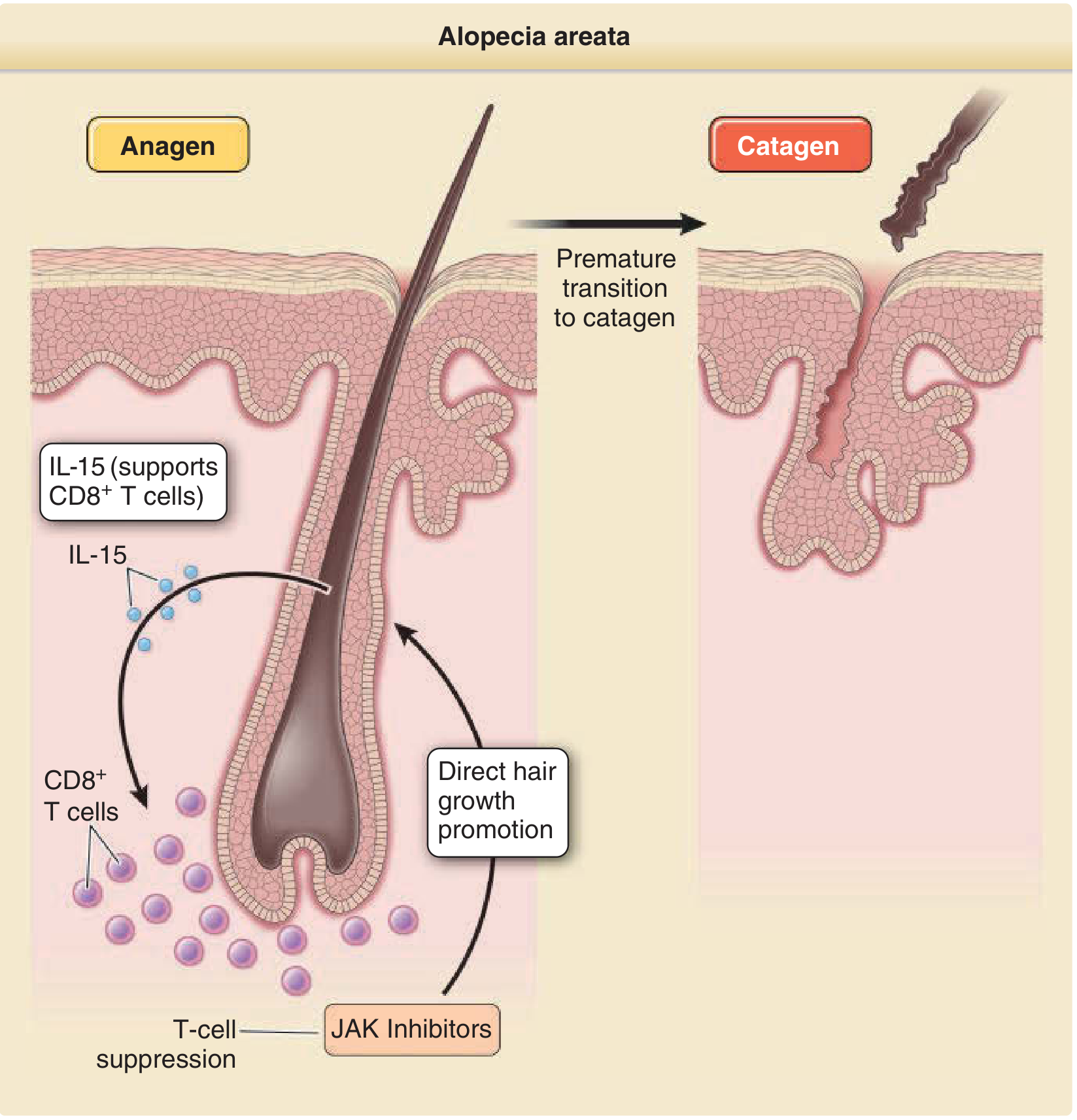
Key cytokines: IL-2, IFN-γ, TNF-α (type 1 cytokines drive early hair loss). CD4+CD25+ regulatory T cells normally prevent disease; their deficiency promotes it.
Clinical Features
| Feature | Details |
|---|---|
| Pattern | Round/oval patches of complete hair loss, typically 1-5 cm, on scalp, eyebrows, eyelashes, beard |
| Exclamation point hairs | Tapered, fractured anagen hairs at patch periphery - pathognomonic |
| Gray/white hair sparing | Early stages - grey hairs often spared (melanocytes are targets) |
| Nail involvement | ~50% of children (vs. 20% of adults) show nail changes: geometric pitting, trachyonychia, onychomadesis, red lunulae |
| Dermoscopy | Perifollicular yellow dots (diffuse, round, or polycyclic) |
Variants:
- Alopecia totalis - complete scalp hair loss
- Alopecia universalis - complete body hair loss
- Ophiasis - band-like loss along temporal/occipital scalp (poor prognosis, treatment-resistant)
- Sisaipho - entire scalp sparing only the ophiasis band
Associated Conditions
AA in children is associated with higher-than-usual rates of:
- Atopic dermatitis (strongest association in pediatric AA)
- Down syndrome
- Autoimmune diseases: thyroiditis, SLE, vitiligo, diabetes mellitus, myasthenia gravis
- Lichen planus
However, most cases occur without associated disease, and routine screening is not recommended unless symptoms are present. About 25% of patients have a positive family history.
Differential Diagnosis
| Condition | Distinguishing Feature |
|---|---|
| Tinea capitis | Scaling, broken hairs, black dots - KOH/fungal culture positive |
| Trichotillomania | Irregular patches, broken hairs of varying lengths, behavioral history |
| Androgenetic alopecia | Diffuse, patterned; no exclamation point hairs |
| Traction alopecia | Distribution follows hair styling |
| Congenital triangular alopecia | Stable, temporal location, no regrowth |
| Lupus (early) | Scarring features, systemic signs |
| Secondary syphilis | Plasma cells on histology, serology |
Prognosis in Children
- Spontaneous recovery is common in mild, patchy disease - in one series, all but 4 of 63 patients regrew hair within 1 year
- Poor prognostic indicators:
- Childhood onset (this patient's case)
- Atopic dermatitis
- Ophiasis pattern
- Extensive/widespread involvement
- Disease duration > 5 years
- Onychodystrophy
- Acute diffuse and total alopecia in young adults has a relatively good prognosis
Treatment (Pediatric Approach)
1. Watchful Waiting
For limited, patchy disease - a reasonable first approach given high spontaneous remission rates.
2. Topical Corticosteroids
High-potency topical steroids (e.g., clobetasol) are the safer first-line option, especially in children who cannot tolerate injections. Less reliable than intralesional injections.
3. Intralesional Corticosteroids
- Triamcinolone 2-10 mg/mL - treatment of choice for localized, cosmetically conspicuous patches (frontal hairline, eyebrows)
- Injected intradermally or in superficial subcutis
- Risk of atrophy with high concentrations or large volumes
- Caution: retinal artery embolization risk with high-pressure injection
4. Pulse Oral Corticosteroids (for extensive/rapidly progressing disease)
- Methylprednisolone: In children, 5 mg/kg/day twice daily for 3 days monthly
-
60% response in widespread patchy AA; 50% in alopecia totalis
- Predictors of response: disease duration ≤6 months, onset before age 10, multifocal disease
- Ophiasis pattern: does NOT respond
5. JAK Inhibitors (emerging/refractory)
- Tofacitinib and ruxolitinib have shown excellent responses
- Tofacitinib specifically studied in adolescents with AA and variants
- Topical JAK inhibitors studied in pediatric AA (JAAD 2017)
- Baricitinib - FDA-approved for adults; use in children evolving
6. Contact Sensitizers (refractory cases)
- Diphencyprone (DPCP), squaric acid dibutyl ester, DNCB
- Useful for extensive, refractory disease
7. Other Options
- Topical minoxidil - adjunct or monotherapy
- Short-contact anthralin 1% - applied 15-20 min, then washed off
- Topical PUVA / 308-nm excimer laser - for refractory or widespread disease
- Methotrexate - specifically studied in pediatric AA
- Cyclosporine - alone or combined with PUVA
Psychological Impact
AA can cause significant psychological stress in children and adolescents. Recent systematic reviews (PMID 39376033) confirm that pediatric AA is associated with high rates of anxiety, depression, and reduced quality of life. Counseling, peer support, and information about wigs/cosmetic alternatives should be offered. The National Alopecia Areata Foundation (naaf.org) is an excellent resource for patients and families.
Recent Evidence (2023-2026)
A Cochrane network meta-analysis (2023) reviewed treatments for AA, supporting JAK inhibitors as highly effective. A 2026 S3 guideline (PMID 41855094) provides updated diagnostic and epidemiological standards. Psychosocial comorbidities in pediatric AA are well-documented in Sejdiu et al. 2024 (PMID 38739703).
Sources: Andrews' Diseases of the Skin, 13e | Fitzpatrick's Dermatology, 9e (Vol. 1-2) | Dermatology 2-Volume Set, 5e
This is a shared conversation. Sign in to Orris to start your own chat.