
Air Pollution? Source of air pollution, strategies regarding the preventive measures of air pollution in our country (Aug 2008, Feb 2020) ★★
write a essay from park text book
AIR POLLUTION
Essay - Park's Textbook of Preventive and Social Medicine
DEFINITION
BASIC DEFINITIONS
Primary Air Pollutants
Secondary Air Pollutants
Gaseous Air Pollutants
Particulate Air Pollutants
- Suspended particulate matter (SPM): particles remaining in suspension in the atmosphere for varying periods
- Settleable dust: larger particles that settle rapidly under gravity
- Aerosols: fine particles (solid or liquid) in a gaseous medium
SOURCES OF AIR POLLUTION
A. Natural Sources
- Volcanic activity - releases sulfur dioxide, carbon dioxide, and particulate matter
- Forest fires - produce smoke, carbon monoxide, and hydrocarbons
- Dust storms - suspend large amounts of particulate matter
- Pollen and spores - biological allergens released into the air
- Sea spray - introduces salt particles into the atmosphere
- Decomposition of organic matter - releases methane, hydrogen sulfide, and ammonia
B. Man-Made (Anthropogenic) Sources
1. Stationary Combustion Sources
- Power plants (coal/oil burning) - major sources of sulfur dioxide (SO₂), nitrogen oxides (NOₓ), and particulate matter
- Industrial boilers and furnaces - emit fly ash, carbon monoxide (CO), and heavy metal particles
- Domestic coal and wood burning - significant source in developing countries, producing CO, SO₂, and soot
2. Mobile Sources (Transportation)
- Motor vehicles are the single most important source of air pollution in urban areas, releasing:
- Carbon monoxide (CO) - from incomplete combustion
- Hydrocarbons (HC) - from petrol vapors and exhaust
- Nitrogen oxides (NOₓ)
- Lead (from leaded petrol)
- Particulate matter
- Diesel engines release high amounts of particulate matter and polycyclic aromatic hydrocarbons (PAH)
- Aircraft and railways also contribute, though to a lesser extent
3. Industrial Sources
- Chemical and petrochemical industries release volatile organic compounds (VOC), benzene, toluene
- Cement and construction produce dust and particulate matter
- Steel plants, smelters release iron oxides, manganese, and heavy metals
- Paper and pulp industries release hydrogen sulfide, mercaptans
- Mining and quarrying produce silica and mineral dust
4. Agricultural Sources
- Burning of crop residue (stubble burning) - a major seasonal problem in India
- Use of pesticides and fertilizers - releases ammonia (NH₃) and nitrous oxide
- Livestock rearing - produces methane and ammonia
5. Indoor Air Pollution (a major concern in India)
- Biomass burning (wood, cow dung, agricultural waste) in rural households - produces CO, particulates, and PAH
- Kerosene stoves - CO and hydrocarbons
- Tobacco smoke - particulates, CO, formaldehyde, carcinogens
- Building materials - radon, asbestos fibers
- Solvents and paints - VOCs
MAJOR AIR POLLUTANTS AND THEIR EFFECTS
1. Sulfur Dioxide (SO₂)
- Source: burning of coal and oil
- Effects: irritates the respiratory tract, aggravates asthma and bronchitis, causes acid rain
2. Carbon Monoxide (CO)
- Source: incomplete combustion (vehicles, stoves)
- Effects: forms carboxyhemoglobin (COHb), reduces oxygen-carrying capacity of blood; at high concentrations causes unconsciousness and death
3. Nitrogen Oxides (NOₓ)
- Source: motor vehicles, power plants
- Effects: lung irritation; combine with hydrocarbons to form photochemical smog; NO₂ causes pulmonary edema
4. Particulate Matter (PM₁₀ and PM₂.₅)
- Source: industries, vehicles, biomass burning
- Effects: the smaller the particle, the deeper it penetrates the lung; PM₂.₅ (fine particles <2.5 µm) reach alveoli and cause the most damage; associated with respiratory and cardiovascular morbidity and mortality
5. Lead (Pb)
- Source: leaded petrol (now largely banned), paint, smelters
- Effects: neurotoxic especially in children; causes anemia, renal damage; impairs cognitive development
6. Ozone (O₃) - Photochemical Pollutant
- Source: secondary pollutant - formed by UV radiation acting on NOₓ and hydrocarbons
- Effects: causes photochemical smog; irritates eyes and lungs; damages vegetation; at ground level is a health hazard (not to be confused with the protective stratospheric ozone layer)
7. Hydrocarbons
- Source: petrol engines, industrial solvents
- Effects: some are carcinogenic (e.g., benzo[a]pyrene, a PAH); react with NOₓ to form ozone
8. Formaldehyde
- Source: tobacco smoke, building materials, fabrics
- Effects: eye and respiratory irritant; classified as a human carcinogen
9. Radon
- Source: naturally occurring radioactive gas from soil and building materials
- Effects: second leading cause of lung cancer after tobacco
HEALTH EFFECTS OF AIR POLLUTION
Respiratory Effects
- Acute: irritation of nose, throat, bronchi; exacerbation of asthma
- Chronic: chronic obstructive pulmonary disease (COPD), chronic bronchitis, reduced lung function, lung cancer
Cardiovascular Effects
- Air pollution, especially fine particles (PM₂.₅) and CO, is associated with increased risk of myocardial infarction, stroke, arrhythmias, and cardiac death
Effects on Children
- Impaired lung development, increased susceptibility to respiratory infections, reduced cognitive development (lead)
Carcinogenic Effects
- Lung cancer is associated with exposure to PAH, asbestos, arsenic, radon, and tobacco smoke
Other Effects
- Eye irritation (photochemical smog)
- Impairment of visibility (haze/smog)
- Effects on vegetation: acid rain destroys forests, damages crops
- Damage to buildings and monuments (e.g., the Taj Mahal is affected by the Mathura refinery pollution)
AIR POLLUTION EPISODES (HISTORICAL)
- Meuse Valley, Belgium (1930): Industrial smog from a narrow valley; 60 deaths
- Donora, Pennsylvania, USA (1948): Smog from zinc smelter; 20 deaths, thousands ill
- London Smog (1952): The "Great Smog" - coal smoke + fog; approximately 4,000 acute deaths (later estimates suggest up to 12,000); led to the UK Clean Air Act 1956
- Bhopal Gas Tragedy, India (1984): Methyl isocyanate (MIC) leak from Union Carbide pesticide plant; over 2,500 immediate deaths, thousands disabled - the worst industrial disaster in history
CONTROL AND PREVENTIVE MEASURES
WHO Air Quality Guidelines
| Substance | Guideline Value | Averaging Time |
|---|---|---|
| Carbon monoxide | 10 mg/m³ | 8 hours |
| Carbon monoxide | 100 mg/m³ | 15 minutes |
| Nitrogen dioxide | 400 µg/m³ | 1 hour |
| Sulfur dioxide | 500 µg/m³ | 10 minutes |
| Lead | 0.5-1.0 µg/m³ | 1 year |
| Ozone | 100-120 µg/m³ | 8 hours |
| Formaldehyde | 100 µg/m³ | 30 minutes |
Preventive Strategies
A. Legislative and Policy Measures (India)
- Air (Prevention and Control of Pollution) Act, 1981 - the primary legislation in India mandating standards for air quality and penalties for violations; amended in 1987
- Environment (Protection) Act, 1986 - comprehensive legislation enacted after the Bhopal disaster; empowers the central government to set environmental standards
- Motor Vehicle Act - provisions for emission standards
- National Ambient Air Quality Standards (NAAQS) - set by the Central Pollution Control Board (CPCB)
- Central Pollution Control Board (CPCB) and State Pollution Control Boards (SPCBs) - monitor and enforce pollution control
- National Air Quality Monitoring Programme (NAMP) - CPCB monitors air quality across the country
B. Technical and Engineering Measures
-
Control at Source:
- Use of cleaner fuels (natural gas, LPG replacing coal)
- Catalytic converters in motor vehicles to reduce CO, HC, NOₓ
- Phasing out of leaded petrol (India phased it out in 2000)
- Euro/Bharat emission norms for vehicles (India adopted Bharat Stage VI norms in April 2020 - a major step)
- Use of electrostatic precipitators, bag filters, and scrubbers in industries to remove particulates
- Stack height regulations to improve dispersal of pollutants
-
Fuel Standards:
- Low-sulfur diesel and petrol
- CNG (Compressed Natural Gas) for public transport - successfully implemented in Delhi from 2001 onward
- Promotion of electric vehicles (EVs)
-
Industrial Controls:
- Mandatory Environmental Impact Assessments (EIA) before setting up industries
- Industrial zoning - industries sited away from residential areas
- Effluent Treatment Plants (ETPs) and pollution abatement equipment
C. Reduction of Vehicle Emissions
- Odd-even scheme (e.g., Delhi) - restricts traffic on alternate days
- Promotion of public transport (Metro rail, buses)
- Inspection and Maintenance (I&M) programs for vehicles
- Fuel efficiency standards
D. Agricultural Measures
- Ban on stubble burning - enforcement of Supreme Court orders against crop residue burning in Punjab, Haryana
- Subsidies for machinery (happy seeders, straw choppers) that eliminate the need to burn crop residue
- Promotion of organic farming reducing chemical inputs
E. Indoor Air Pollution Control
- Transition from biomass to clean fuels: The Pradhan Mantri Ujjwala Yojana (PMUY) provides free LPG connections to below-poverty-line households - a landmark scheme directly targeting indoor air pollution
- Improved cook stoves (chulhas) with chimneys
- Better ventilation in homes
- Ban on smoking in public places under The Cigarettes and Other Tobacco Products Act (COTPA), 2003
- Use of low-VOC paints and materials
F. Green Measures
- Afforestation and Urban Green Cover: trees absorb CO₂, particulates, and SO₂; act as natural air purifiers
- Green belts around industries and highways
- Rooftop gardens and urban forestry
G. International Cooperation
- Kyoto Protocol - commitments to reduce greenhouse gas emissions
- Paris Agreement, 2015 - India committed to reduce emission intensity of GDP by 45% by 2030 and achieve 50% electricity from non-fossil fuel sources
- Stockholm Convention - control of persistent organic pollutants
H. Public Health and Educational Measures
- Public awareness campaigns (e.g., Swachh Vayu Sarvekshan - National Clean Air Ranking of Cities)
- National Clean Air Programme (NCAP), 2019 - India's first comprehensive national level strategy to tackle air pollution; target: 20-30% reduction in PM₁₀ and PM₂.₅ concentrations by 2024 (base year 2017) in 122 non-attainment cities
- School and community education on reducing pollution
- Health surveillance and early warning systems for pollution episodes
ROLE OF THE COMMUNITY AND INDIVIDUAL
- Avoid burning waste in the open
- Use public transport or cycling instead of private vehicles
- Reduce, reuse, recycle to minimize waste burning
- Plant trees
- Avoid using fireworks during festivals (Diwali)
- Report polluting industries to authorities
CONCLUSION
/visualizelearning
What would you like to visualize from the Air Pollution topic?
A detailed medical mind map concept diagram on "AIR POLLUTION" for a preventive medicine textbook (Park's). The central node reads "AIR POLLUTION" in bold. Six major branches radiate outward: 1. DEFINITION - "Presence of harmful substances in atmosphere generated by human activities affecting health, safety, environment" 2. TYPES OF POLLUTANTS - sub-branches: Primary (emitted directly: SO₂, CO, NOₓ, Pb, Particulates) | Secondary (formed in atmosphere: Ozone, Photochemical smog) | Gaseous vs Particulate (SPM, PM2.5, PM10) 3. SOURCES - sub-branches: Natural (Volcanic, Forest fires, Pollen, Dust storms) | Man-made: Transport (CO, HC, NOₓ, Lead), Industry (SO₂, Heavy metals, PAH), Domestic/Indoor (Biomass burning, Tobacco, Kerosene), Agriculture (Stubble burning, Ammonia) 4. HEALTH EFFECTS - sub-branches: Respiratory (Asthma, COPD, Lung cancer) | Cardiovascular (MI, Stroke) | Neurological/Lead (Children: impaired IQ) | Carcinogenesis (PAH, Radon) | Episodes: London Smog 1952, Bhopal 1984 5. CONTROL MEASURES - sub-branches: Legislative (Air Act 1981, EPA 1986, NCAP 2019, CPCB) | Technical (Catalytic converters, Scrubbers, CNG, BS-VI norms) | Agricultural (No stubble burning, PMUY-LPG) | Green measures (Afforestation, Green belts) | International (Paris Agreement, Kyoto Protocol) 6. WHO GUIDELINES - key values: CO 10mg/m³ (8h), SO₂ 500µg/m³ (10min), NO₂ 400µg/m³ (1h), Pb 0.5-1.0µg/m³ (1yr), Ozone 100-120µg/m³ (8h) Use a clean white background, color-coded branches (each branch a different color: blue, green, red, orange, purple, teal), clear readable fonts, arrows connecting sub-branches, small icons for each category. Style: professional medical education diagram.
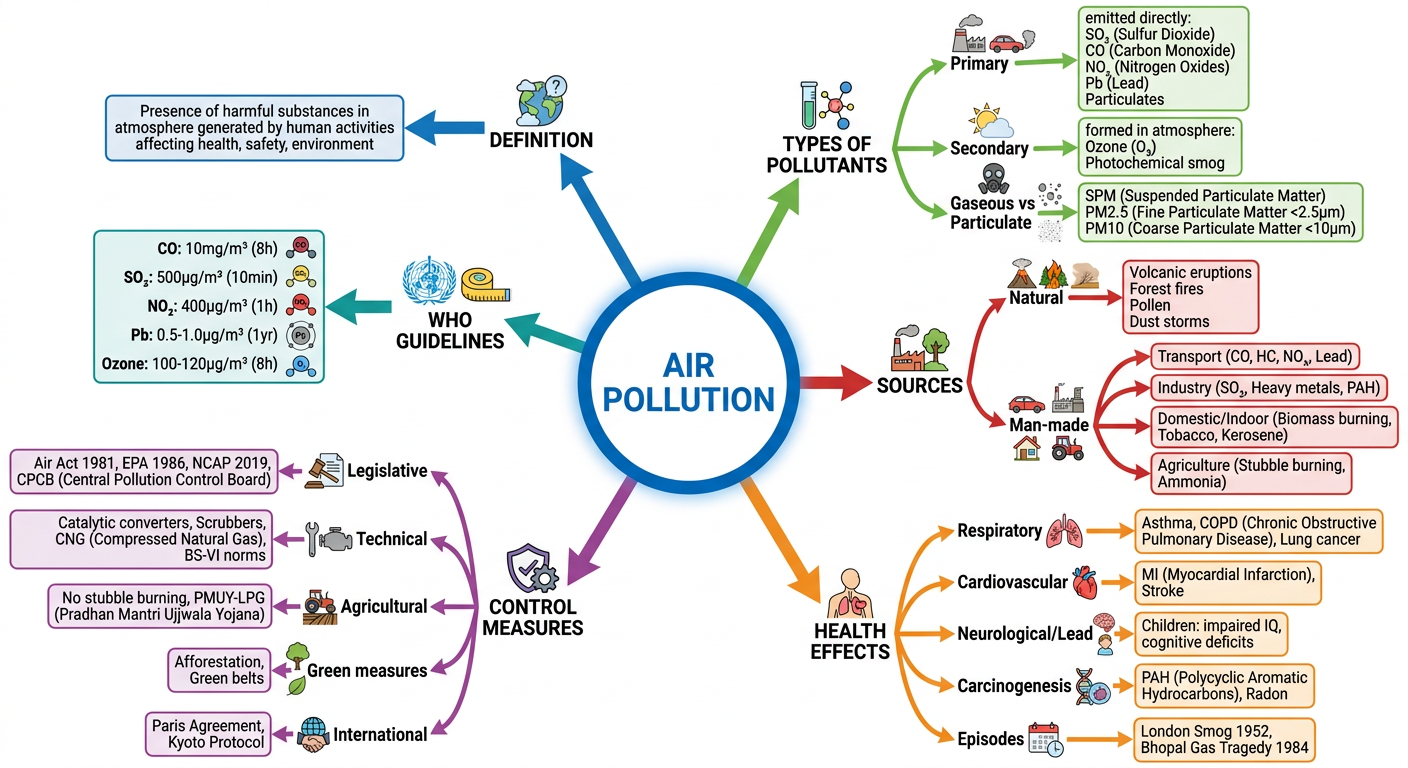
How to use this for exam revision:
| Branch | Key Exam Points |
|---|---|
| Definition | "Ambient atmosphere + human activities + health/safety/environment" |
| Types | Primary vs Secondary; Gaseous vs Particulate (PM2.5 most important) |
| Sources | Transport = #1 urban source; Biomass = #1 rural/indoor source |
| Health Effects | Respiratory > Cardiovascular > Neurological; Episodes (London 1952, Bhopal 1984) |
| Control | Air Act 1981, EPA 1986, BS-VI norms, NCAP 2019, PMUY scheme |
| WHO Standards | CO, SO₂, NO₂, Pb, Ozone - memorize values + averaging times |