
I am a mbbs student currently doning my stager ship in dermatology teach me scabies and head lice
Reading File
Now let me search the medical library for both topics in parallel.
Finding Sources
Finding Sources
Excellent - found great sources. Let me now read the key dermatology textbook sections in parallel.
Reading File
Reading File
Reading File
Now let me read the detailed dermatology 5e sections plus head lice content in parallel.
Reading File
Reading File
Reading File
Now let me get more detailed content from Dermatology 5e on scabies treatment + the Red Book on head lice, and fetch some images in parallel.
Reading File
Reading File
Loading Image
Loading Image
I now have comprehensive information from multiple authoritative textbooks. Let me compile the full teaching session.
🪲 Scabies & Head Lice - A Complete Dermatology Primer for MBBS Students
PART 1 — SCABIES
The Organism
Scabies is caused by Sarcoptes scabiei var. hominis, a host-specific, eight-legged mite measuring 0.35 x 0.3 mm — too small to see with the naked eye. Animal scabies mites (e.g., S. scabiei var. canis from dogs) do not cause human scabies but can cause transient bite reactions.
Life cycle (30 days, entirely within the epidermis):
- Female mite burrows into the stratum corneum
- Lays 2-3 eggs/day; eggs take ~10 days to hatch
- Larvae mature to adults and repeat the cycle
- Typical infestation = 10-15 mites (up to 100 in classic scabies)
- Mites survive off a human host for only 3 days (up to 7 days from crusted scabies patients)
Epidemiology
- ~150-200 million people affected globally; ~2.5% worldwide prevalence
- Affects all ages, races, and socioeconomic groups
- WHO designated it a neglected tropical disease in 2017
- Higher rates in tropical regions, overcrowded settings, institutions, prisons, nursing homes
- Transmission: direct close personal contact (skin-to-skin) > fomites (bedding, clothing)
- Spread among family members is the rule, not the exception
Pathogenesis (Why Does It Itch?)
In a first-time infestation:
- Incubation = 2-6 weeks before symptoms appear (sensitization period)
- Pruritus is a delayed hypersensitivity reaction to mite proteins, eggs, and feces (scybala)
- Pruritus is mediated by nonhistaminergic mechanisms (explains partial response to antihistamines)
In a re-infestation:
- Symptoms develop within 24-48 hours due to prior sensitization
Clinical Features
Classic Scabies
The Cardinal Symptom: Intense pruritus, classically worse at night and after a hot bath/shower.
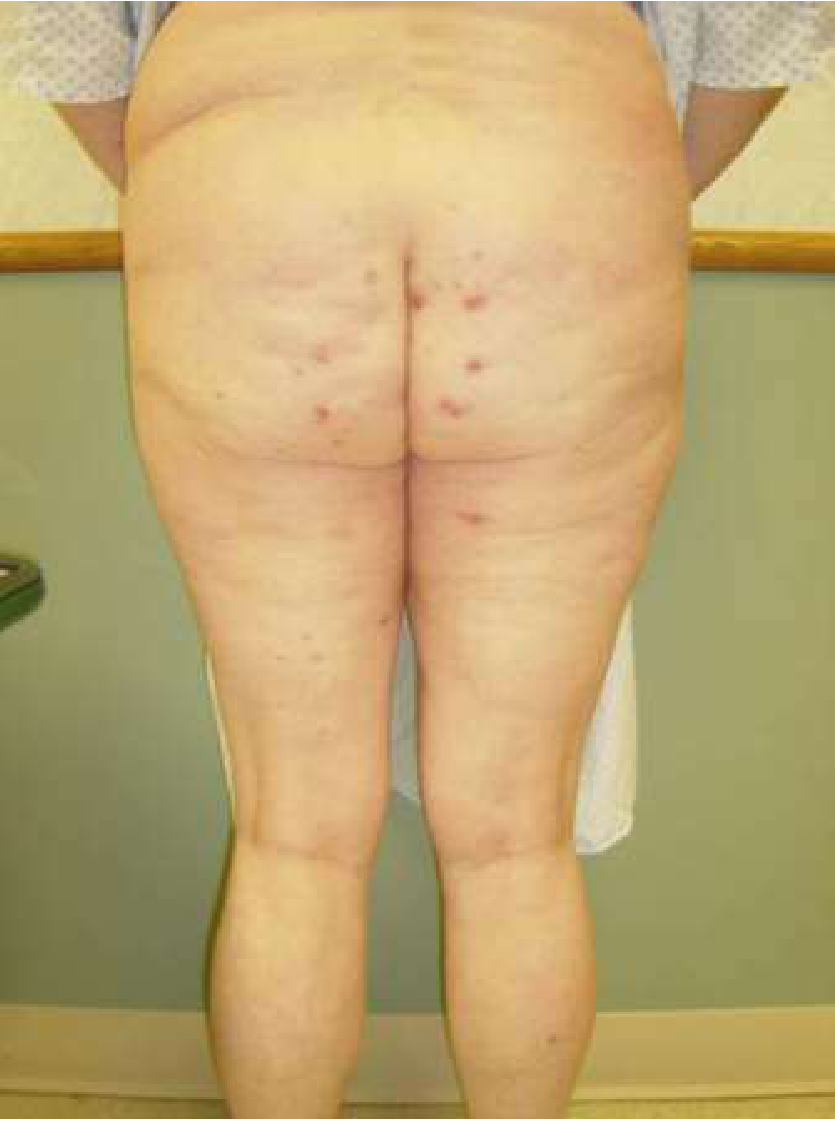
Lesions: Symmetrical erythematous papules, vesicles, nodules, eczematous patches, and excoriations.
The Pathognomonic Sign - The Burrow:
- Wavy, thread-like, grayish-white line, 1-10 mm in length
- Represents the tunnel the female mite excavates while laying eggs
- Best sites to look: interdigital web spaces, wrists, ankles
- A dermoscope shows the "jet with a contrail" sign - the dark mite (jet) at the end of the burrow (contrail)
Distribution - The Classic Sites:
| Site | Notes |
|---|---|
| Interdigital web spaces (hands) | Most common, best for scraping |
| Flexural wrists | Look for burrows here |
| Axillae | Nodular lesions common |
| Periumbilical area | |
| Buttocks & waist | |
| Genitalia (men) | Penile/scrotal nodules = highly suggestive |
| Areolae/nipples/vulva (women) | |
| Posterior auricular area |
In infants: Face, scalp, palms, and soles are also involved (unlike adults). Acral vesiculopustules are a clue.
In elderly/immunocompromised: All skin surfaces susceptible, including face and scalp.
Here is scabies presenting with erythematous papules and excoriations over the buttocks and thighs:
Crusted (Norwegian) Scabies
A severe variant - not a separate disease, but a failure of normal host immune control.
Who gets it?
- Elderly, HIV-positive, HTLV-1, organ transplant recipients
- Patients with decreased sensation or inability to scratch (leprosy, paraplegia)
- Dementia patients
Key features:
- Minimal or no pruritus despite massive infestation
- Thick, hyperkeratotic, crusted plaques - favor acral sites (palms, soles, subungual areas), elbows, knees
- Nail dystrophy (thickened, dystrophic nails)
- Host may harbor thousands to millions of mites
- Extremely contagious - mites can survive in shed skin debris on sheets, floors, curtains for up to 7 days
- Can cause institutional outbreaks in nursing homes
Diagnosis
Primarily clinical - based on:
- History of nocturnal pruritus
- Characteristic distribution of lesions
- Similar symptoms in household contacts or sexual partners ← very helpful clue
Confirmatory tests (when in doubt):
- Skin scraping (mineral oil preparation): Scrape a burrow or papule with a No. 15 blade, place on glass slide with mineral oil or KOH, examine under light microscopy → look for mites, eggs, or feces (scybala = dark, oval fecal pellets). Mites have 4 pairs of legs; eggs are oval.
- Dermoscopy: Look for the "delta-wing jet" or "triangle sign" - the dark triangular head of the mite at the end of a burrow
- Wood's lamp: Not primarily used for scabies (more useful for tinea, vitiligo)
Histopathology (rarely needed): Eosinophil-rich infiltrate in dermis; may see transected mite in epidermis; "pink pigtail" structures = mite exoskeleton fragments.
Differential Diagnosis
| Condition | Distinguishing Features |
|---|---|
| Atopic dermatitis | Chronic, personal/family atopy history, flexural distribution |
| Papular urticaria | Insect bite history, no burrows |
| Contact dermatitis | Exposure history, patch test positive |
| Dermatitis herpetiformis | Blistering, associated with celiac disease, IgA deposits on biopsy |
| Lichen planus | Violaceous polygonal papules, Wickham's striae |
| Pityriasis rosea | Herald patch, Christmas tree distribution |
| Secondary syphilis | Involve palms/soles, serology positive |
| Psoriasis | Silvery scale, Auspitz sign |
| Bullous pemphigoid | Elderly, tense blisters, IgG at DEJ |
Treatment
First-Line
Permethrin 5% cream
- Apply from the neck down (entire body surface) - including under nails, umbilicus, nipples, genitals
- In infants and young children: also include face and scalp
- Leave on overnight (8-14 hours), then wash off
- Repeat in 1-2 weeks (to kill newly hatched mites)
- FDA approved for infants ≥2 months
- Considered safe in pregnancy
Second-Line / Special Situations
| Drug | Dose | Indications | Notes |
|---|---|---|---|
| Ivermectin (oral) | 200 mcg/kg on day 1 and day 8 | Resistant/crusted scabies; immunocompromised; large outbreaks | Not approved <15 kg; use with caution in pregnancy |
| Benzyl benzoate 10-25% | Apply overnight day 1 and 8 | Alternative in developing countries | Irritant contact dermatitis possible |
| Sulfur ointment 5-10% | Overnight x 3 consecutive nights | Safe in infants, pregnancy | Malodorous; messy |
| Lindane 1% | Overnight days 1 and 8 | Largely abandoned | CNS toxicity, high resistance |
For crusted scabies: Combine oral ivermectin + topical permethrin (multiple doses of each); consult dermatology for protocol.
Symptomatic Relief
- Antihistamines (cetirizine, hydroxyzine) for pruritus
- Mid-potency topical corticosteroids for post-scabetic itch
- Warn patients: Pruritus can persist for weeks to months after successful treatment because dead mites and their antigens remain in the skin. This does not mean treatment has failed!
Environmental Decontamination (Mandatory)
- Machine-wash all clothing, bedding, towels in hot water (>60°C)
- Dry clean or hot-dryer items that can't be washed
- Items that can't be cleaned → seal in plastic bags for 1 month (or 1-2 weeks for most items)
- Treat all household members and close contacts simultaneously - failure to do this is the most common reason for recurrence
Summary Table - Dermatology 5e Treatment Reference
| Therapy | Administration | Efficacy | Key Concerns |
|---|---|---|---|
| Permethrin 5% cream | Topically overnight, days 1 & 8 | Excellent | Rare allergic contact dermatitis |
| Spinosad 0.9% suspension | ≥6 hours, day 1 | Good | FDA approved ≥4 yrs |
| Sulfur ointment 5-10% | Overnight x3 days | Good | Safe in pregnancy/infants |
| Benzyl benzoate 10-25% | 24 hours, days 1 & 8 | Good | Irritant dermatitis |
| Ivermectin oral | 200 mcg/kg days 1 & 8 | Excellent for crusted | CNS risk in infants/young children |
| Lindane 1% | Not recommended | Poor - high resistance | CNS toxicity |
Sources: Dermatology 2-Volume Set 5e, Rosen's Emergency Medicine, Textbook of Family Medicine 9e
PART 2 — HEAD LICE (Pediculosis Capitis)
The Organism
Pediculus humanus capitis - the head louse. An obligate human ectoparasite.
Biology:
- Size: 2-3 mm, tan to grayish-white, with claws on all 6 legs (used to grip hair shafts)
- Needs a blood meal every 4-6 hours - survives only <24 hours away from the scalp
- Life span of adult female: ~30 days
- Egg laying: up to 10 eggs/day, each cemented firmly to the hair shaft 1-2 mm from the scalp
- Egg-to-nymph incubation: ~1 week (6-9 days)
- Nymph to adult: ~7 days
Nits vs. Lice:
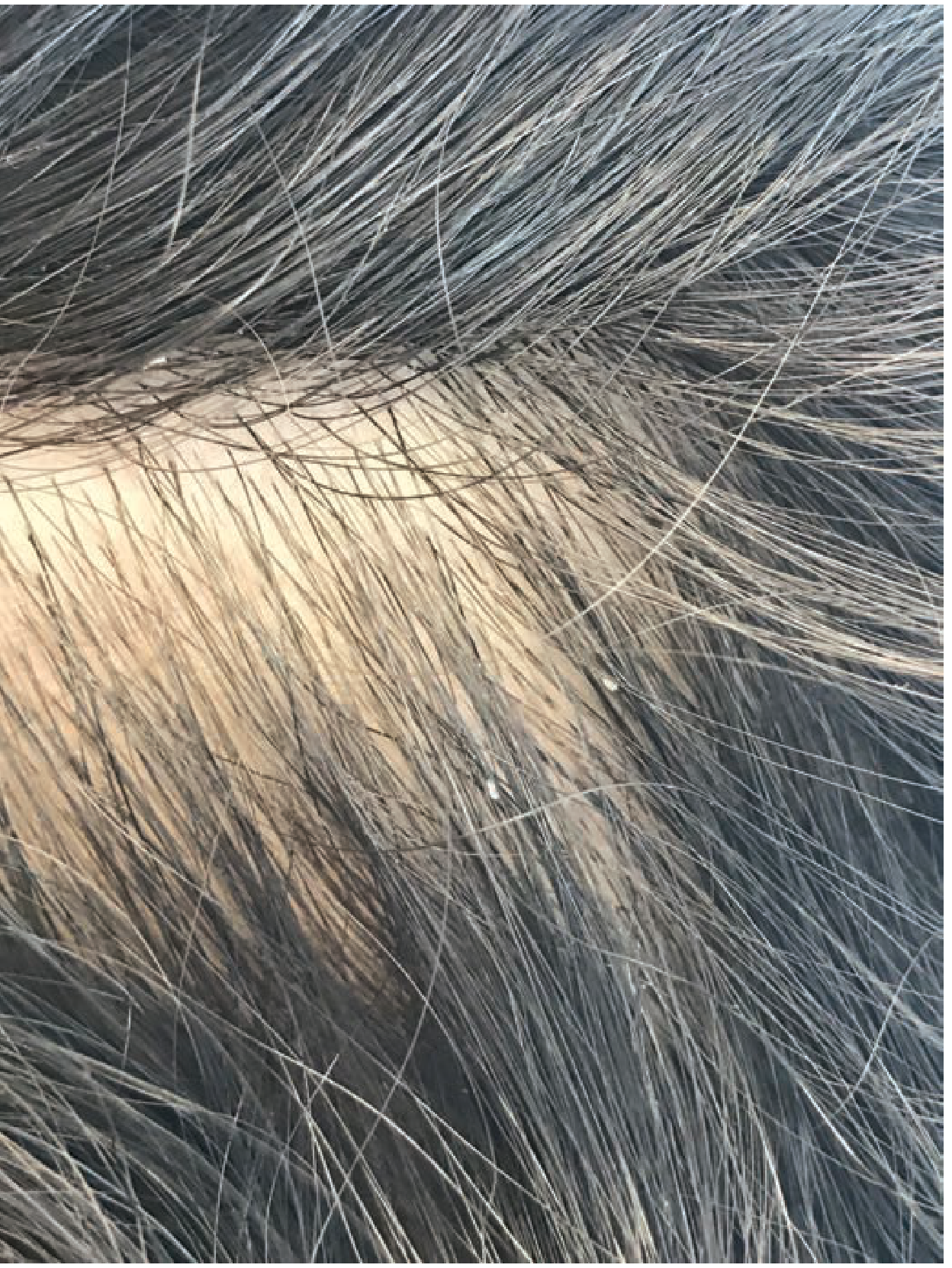
- Nit = egg attached to hair shaft (oval, gray-white; or empty white casing after hatching)
- Louse = live insect (egg → nymph → adult)
- Nits are cemented with a proteinous matrix and cannot be easily pulled off (unlike dandruff)
Here are nits (egg casings) visible on hair shafts close to the scalp:
Epidemiology
- Most common in children aged 3-11 years (school-age), but any age can be affected
- NOT a sign of poor hygiene - all socioeconomic groups affected
- NOT influenced by hair length, texture, or frequency of shampooing
- Does not transmit any systemic disease
- Transmission: direct head-to-head contact (main route); fomites (combs, brushes, hats) are uncommon
- Outbreaks in daycare centers, classrooms, camps, homeless shelters
Clinical Features
Symptoms:
- Intense pruritus of the scalp (from allergic reaction to louse saliva) - many children are asymptomatic initially
- Pruritus develops ~2 weeks after initial infestation
Signs:
- Nits on hair shafts, most visible behind the ears and nape of neck
- Adult lice (shy light, move rapidly - use a fine-tooth comb to catch them)
- Excoriations, crusting
- Secondary bacterial infection → cervical/occipital lymphadenopathy
Useful clinical trick: Hair grows ~1 cm/month, so the distance of a nit from the scalp estimates the duration of infestation. Nits >7 mm from scalp = likely old, non-viable infestation.
Diagnosis
- Clinical diagnosis by identification of live lice or viable nits with the naked eye or a hand lens
- Wet combing with a fine-tooth comb on wet hair (conditioner slows lice) improves detection
- Dermoscopy can confirm live lice and nits
- Wood's lamp: nits and lice fluoresce
- Differentiate from: dandruff (easily brushed off), hair casts (slide off the shaft easily), fungal infections
Active infestation = finding a live louse or viable nit within 6-7 mm of the scalp
Nits only (no live lice found), especially if >1 cm from the scalp → likely old, inactive infestation; may not require retreatment.
Treatment
Two treatments 7-10 days apart are required to kill lice hatching from eggs that survived the first treatment.
First-Line (OTC Available)
| Agent | Application | Notes |
|---|---|---|
| Permethrin 1% cream rinse | Apply to towel-dried hair, leave 10 min, rinse; repeat in 7-10 days | Most widely used; some resistance emerging |
| Pyrethrins + piperonyl butoxide (RID, Pronto) | Apply to dry hair, 10 min, rinse; repeat in 7-10 days | Do not use with ragweed allergy |
Prescription Options
| Agent | Application | Notes |
|---|---|---|
| Malathion 0.5% | Apply to dry hair overnight, rinse; repeat in 7-10 days | Effective for resistant cases; flammable - avoid heat sources; not for children <6 years |
| Ivermectin lotion 0.5% | Apply to dry hair, leave 10 min, rinse | Single application often sufficient |
| Spinosad 0.9% suspension | Apply to dry hair 10 min, rinse | FDA approved ≥6 months |
| Benzyl alcohol 5% lotion | Apply to dry hair, 10 min, rinse | Suffocates lice, not ovicidal - repeat in 7 days |
| Oral ivermectin | 200-400 mcg/kg on days 1 and 8 | For resistant cases |
Physical/Mechanical Treatment
- Wet combing with fine-tooth comb - labor intensive but safe alternative, especially in pregnancy
- Application of thick occlusive agents (petrolatum, thick moisturizers) + blow drying - used for resistant cases
Nit Removal
- Not strictly necessary after successful treatment
- Can be done with a fine-tooth comb
- A 50% vinegar-and-water rinse may reduce adherence of nits to the hair shaft
- Many schools have "no-nit" policies but evidence shows these are excessive and children need not be excluded
Environmental Decontamination
- Wash bedding, clothing in hot water; dry on high heat
- Soak combs, brushes, barrettes in hot water (≥60°C) for 10 minutes
- Items that can't be washed → seal in plastic bags for 2 weeks
- Adult lice survive <1 day away from the scalp and eggs become non-viable within 1 week - so environmental decontamination is less critical than in scabies
- Treat all household contacts simultaneously; examine sexual contacts
Types of Lice - Quick Summary for Completeness
| Type | Organism | Location | Special Notes |
|---|---|---|---|
| Head lice | P. humanus capitis | Scalp hair | Most common in children |
| Body lice | P. humanus corporis | Clothing seams (not body) | Transmits typhus, trench fever, relapsing fever |
| Pubic lice ("crabs") | Pthirus pubis | Pubic hair, axillae, eyebrows, eyelashes | STI; screen for other STIs |
KEY COMPARISON TABLE: Scabies vs. Head Lice
| Feature | Scabies | Head Lice |
|---|---|---|
| Organism | Sarcoptes scabiei var. hominis (mite, 8 legs) | Pediculus humanus capitis (insect, 6 legs) |
| Size | 0.35 mm, invisible to naked eye | 2-3 mm, visible |
| Location | Entire body (especially folds, genitals) | Scalp only |
| Pathognomonic sign | Burrow | Nit firmly attached to hair |
| Pruritus timing | Worst at night | Constant, especially at scalp |
| Incubation (1st infestation) | 2-6 weeks | ~2 weeks |
| Contagiousness | Very high (skin-to-skin) | High (head-to-head) |
| Severe form | Crusted (Norwegian) scabies | - |
| First-line treatment | Permethrin 5% cream | Permethrin 1% cream rinse |
| Oral option | Ivermectin 200 mcg/kg | Ivermectin 200 mcg/kg |
| Post-treatment itch | Can persist weeks-months (dead mites) | Resolves with successful treatment |
| Disease transmission | None (but secondary bacterial infection) | None |
Clinical Pearls for Your Dermatology Rotation
- "Whole family itches at night" = scabies until proven otherwise. Treat all contacts on the same day.
- Burrow = pathognomonic; if you can't find one, look harder at interdigital spaces with a dermatoscope.
- Post-scabetic pruritus lasting weeks is common - do not re-treat unnecessarily. Manage with mid-potency steroids.
- Crusted scabies can look like psoriasis or eczema. Think of it in any immunocompromised patient with a "psoriasiform" rash that isn't responding - they can cause ward-level outbreaks.
- Head lice don't spread disease and are not a hygiene problem - reassure parents. "No-nit" school policies are not evidence-based.
- Nit distance from scalp dates the infestation: >1 cm from scalp often means old, inactive infestation - look for live lice before retreating.
- In an infant with palm/sole vesiculopustules, think scabies (classic distribution extends to face/scalp/acral sites in infants).
- Genital nodules in an adult male + nocturnal pruritus = scabies until proven otherwise.
Sources: Dermatology 2-Volume Set 5e, Rosen's Emergency Medicine, Textbook of Family Medicine 9e, Red Book 2021 (Committee on Infectious Diseases), Tintinalli's Emergency Medicine
This is a shared conversation. Sign in to Orris to start your own chat.