
Fever differential diagnosis approach flowchart
Fever: Differential Diagnosis Approach
Definition
Step 1 - Initial Triage: Stable vs. Unstable
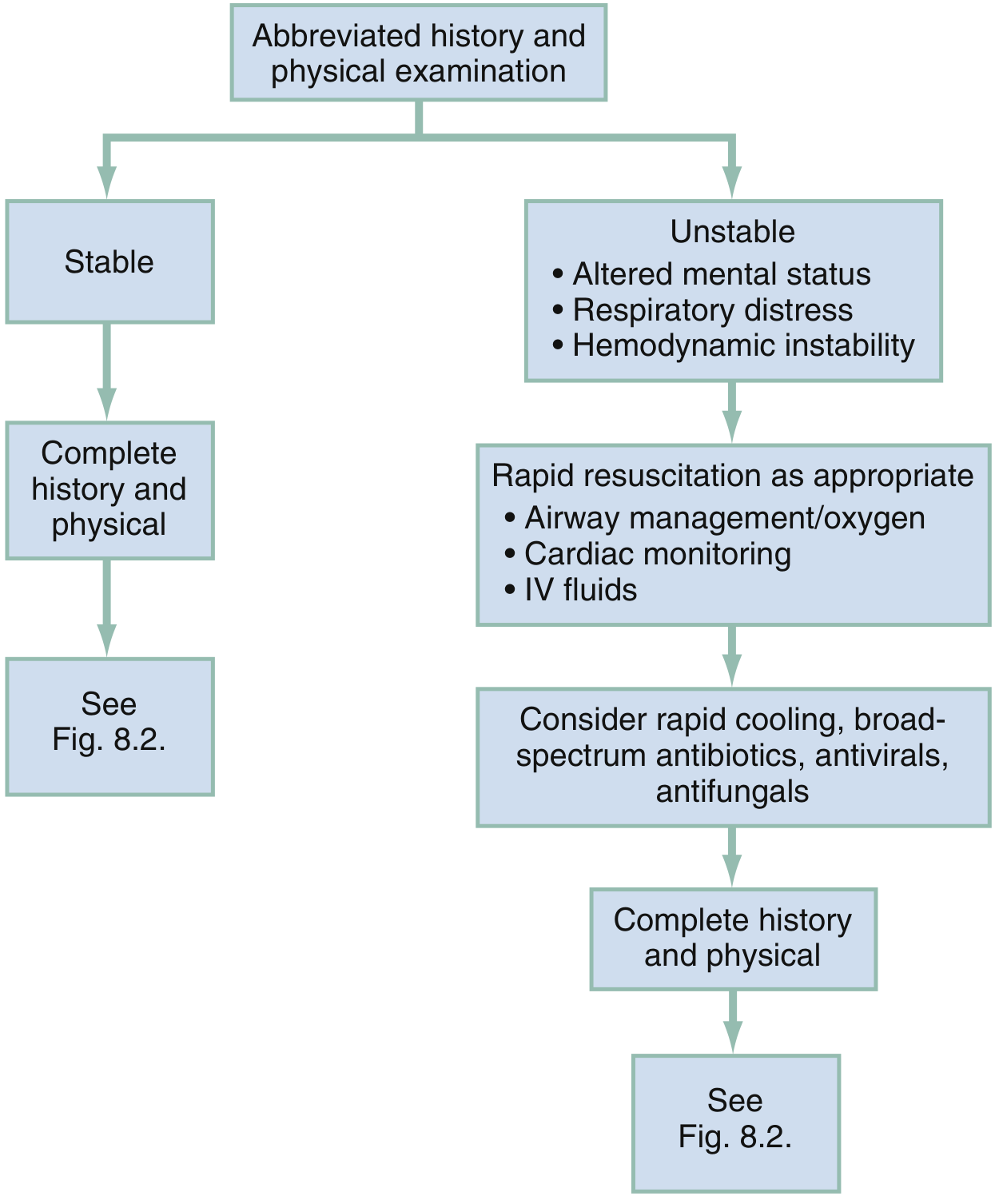
- Altered mental status
- Respiratory distress
- Hemodynamic instability (tachycardia, hypotension)
Step 2 - Approach to the Stable Febrile Patient
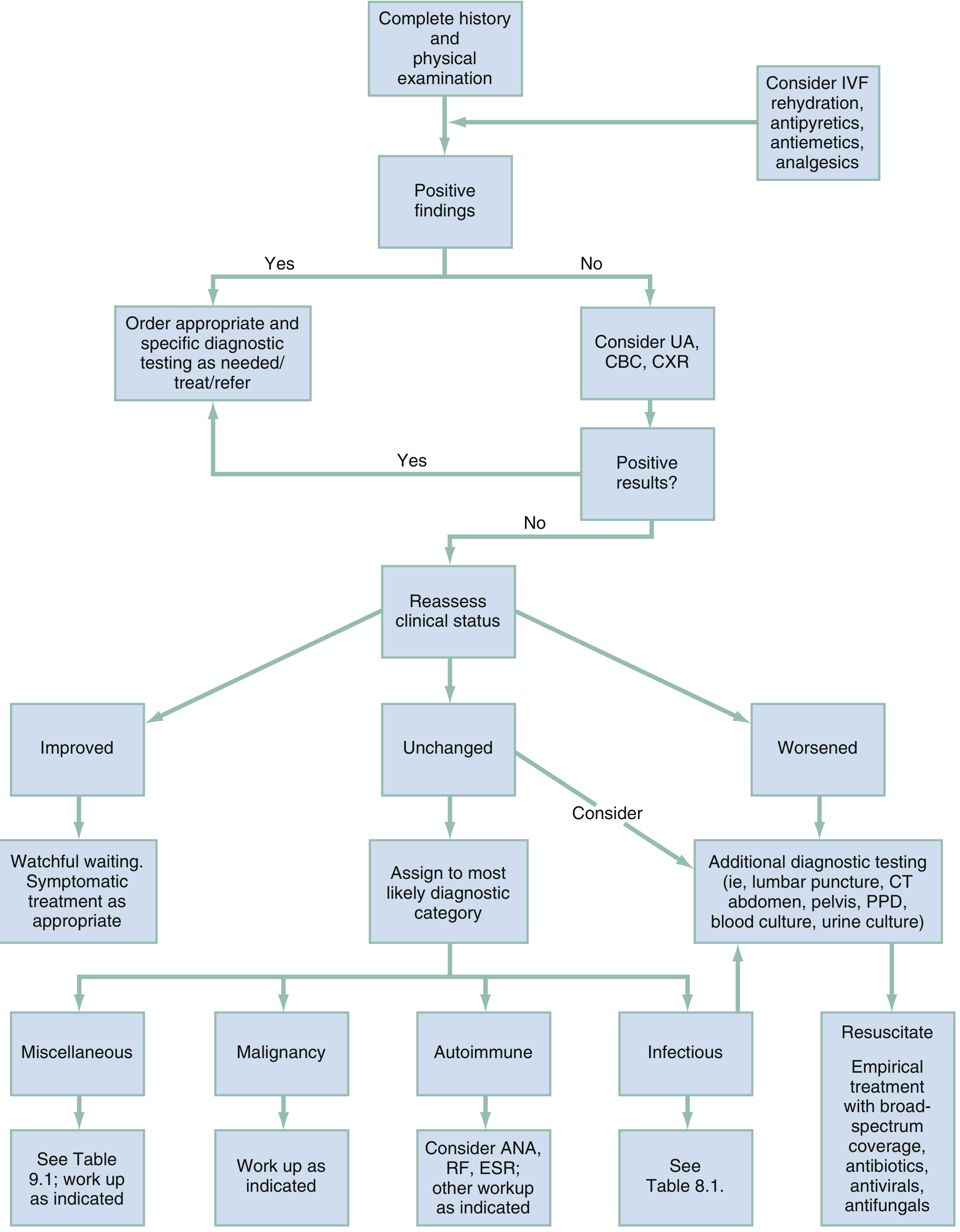
- Positive localizing findings on H&P - Order targeted diagnostic tests; treat/refer accordingly.
- No localizing findings - Screen with UA, CBC, CXR.
- Positive results - targeted workup/treatment.
- Negative results - reassess clinical status:
- Improved - Watchful waiting, symptomatic care.
- Unchanged - Assign to most likely diagnostic category (Infectious / Autoimmune / Malignancy / Miscellaneous). Consider ANA, RF, ESR for autoimmune; blood/urine cultures; CT for occult infection.
- Worsened - Additional diagnostics (LP, CT abdomen/pelvis, blood cultures) + empirical broad-spectrum coverage.
Step 3 - Differential Diagnosis Categories
A. Infectious Causes (most common treatable causes)
| Organ System | Critical | Emergent | Nonemergent |
|---|---|---|---|
| Respiratory | Bacterial pneumonia with respiratory failure | Pneumonia, peritonsillar abscess, epiglottitis | Otitis media, sinusitis, pharyngitis, bronchitis, influenza, TB, COVID-19 |
| Cardiovascular | - | Endocarditis, pericarditis | - |
| GI | Peritonitis | Appendicitis, cholecystitis, diverticulitis, intra-abdominal abscess | Colitis, enteritis |
| GU | - | Pyelonephritis, tubo-ovarian abscess, PID | Cystitis, epididymitis, prostatitis |
| Neurologic | Meningitis, cavernous sinus thrombosis | Encephalitis, brain abscess | - |
| Skin/Soft tissue | - | Cellulitis, infected decubitus ulcer, soft tissue abscess | - |
| Systemic | Sepsis/septic shock, meningococcemia | Influenza, COVID-19 | - |
B. Noninfectious Causes (Box 8.1 - Rosen's EM)
- Acute MI, pulmonary embolism/infarction
- Intracranial hemorrhage, CVA
- Neuroleptic malignant syndrome
- Thyroid storm, acute adrenal insufficiency
- Transfusion reaction, pulmonary edema
- CHF, dehydration, recent seizure
- Sickle cell disease, transplant rejection, pancreatitis, DVT
- Drug fever, malignancy, gout, sarcoidosis, Crohn disease
Step 4 - Fever of Unknown Origin (FUO)
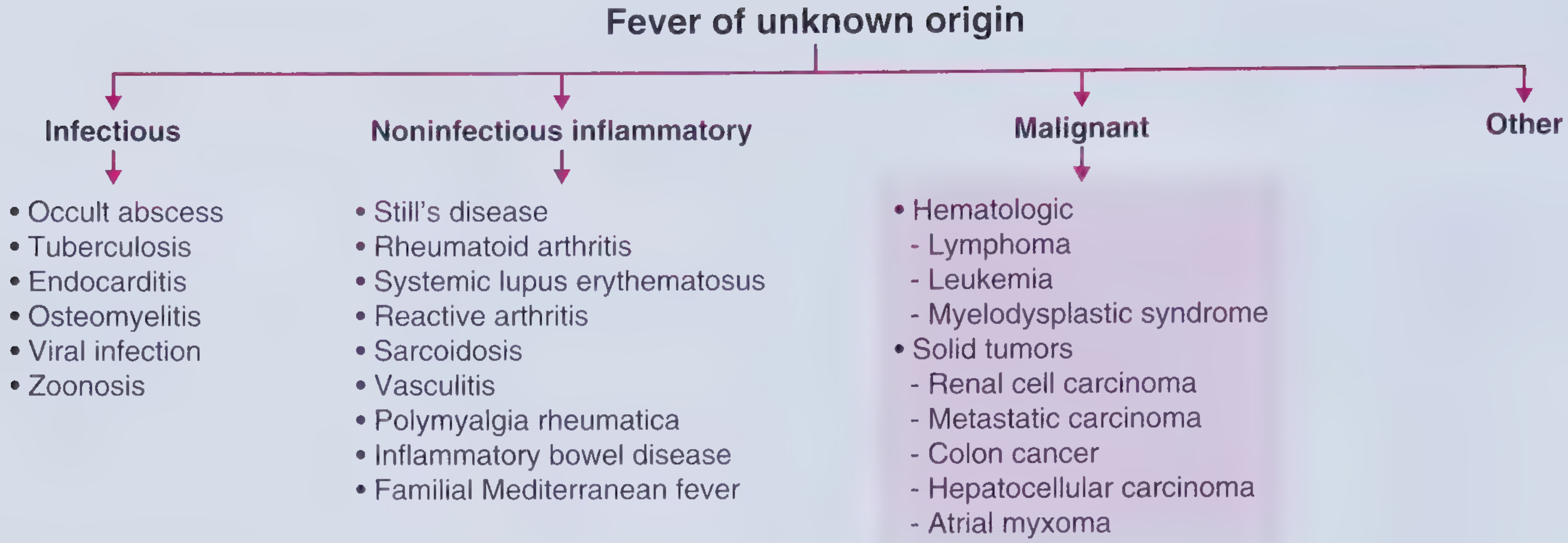
| Category | Examples |
|---|---|
| Infectious | Occult abscess, TB (especially miliary), endocarditis (culture-negative), osteomyelitis, viral infections, zoonoses |
| Noninfectious inflammatory | Still's disease, RA, SLE, reactive arthritis, sarcoidosis, vasculitis, polymyalgia rheumatica, IBD, Familial Mediterranean Fever |
| Malignant | Lymphoma, leukemia, myelodysplastic syndrome; renal cell carcinoma, metastatic carcinoma, colon cancer, HCC, atrial myxoma |
| Other | Drug fever, factitious fever, undiagnosed in ~20% of cases |
Key History Clues
| Feature | Consider |
|---|---|
| Travel history | Malaria, typhoid, viral hemorrhagic fevers, leishmaniasis |
| Zoonotic exposure | Brucellosis, Q fever, tularemia, bartonellosis (cat scratch) |
| Medications | Drug fever (often with eosinophilia, rash, ALP elevation) |
| IV drug use / prosthetic valve | Endocarditis |
| Indwelling catheter / surgery | Hospital-acquired: C. diff, wound infection, vascular catheter infection |
| Morning stiffness >1 hour | Rheumatoid arthritis, Still's disease |
| B symptoms (night sweats, weight loss) | Lymphoma, TB, endocarditis |
| Periodic/recyclical pattern | Malaria, Familial Mediterranean Fever, lymphoma (Pel-Ebstein) |
| Immunocompromised (HIV, chemo) | Opportunistic infections, broader organism coverage |
Lab & Imaging Approach
- Respiratory: sputum culture, PCR panel, procalcitonin
- Meningeal signs: LP (cell count, glucose, protein, culture, PCR)
- GI/abdominal: CT abdomen/pelvis
- Cardiac murmur: Echocardiogram, serial blood cultures
- Prolonged FUO: ANA, RF, ESR, CRP, ferritin (markedly elevated in Still's), SPEP, LDH, HIV, hepatitis serologies, PPD/IGRA, CT chest/abdomen/pelvis, PET scan if malignancy suspected
- Rosen's Emergency Medicine: Concepts and Clinical Practice (Table 8.1, Box 8.1, Figs. 8.1-8.2)
- Goldman-Cecil Medicine, Ch. 259 (Diagnosis of fever, inpatient vs. outpatient approach)
- Frameworks for Internal Medicine (FUO categories and clinical reasoning framework)
seizure management with proper pathway with doctors order case sheet
Seizure Management - Complete Clinical Pathway & Doctor's Order Sheet
PART 1 - MANAGEMENT ALGORITHM (Tintinalli's Emergency Medicine, Fig. 171-1)
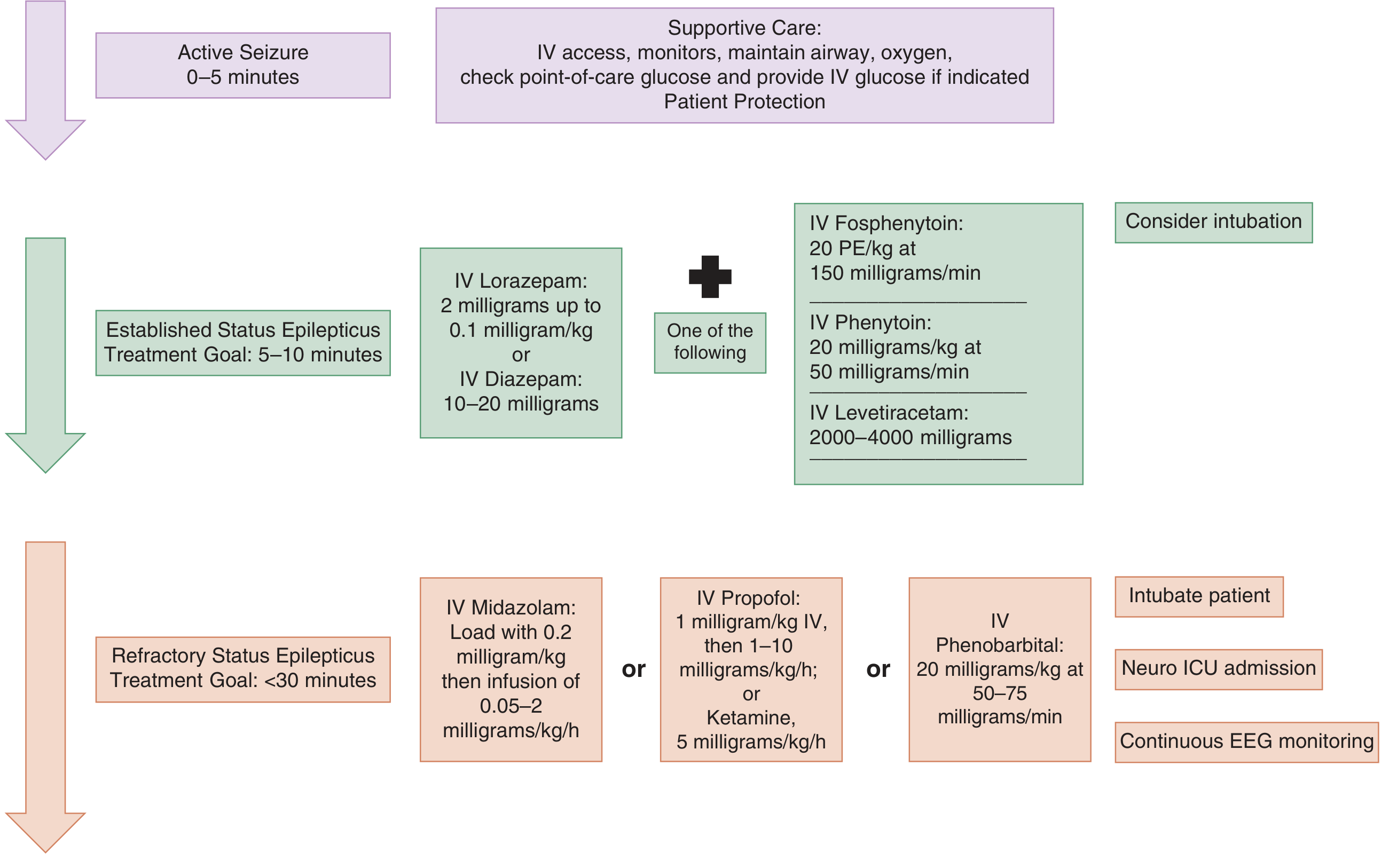
PART 2 - TIME-BASED CLINICAL PATHWAY
Phase 0 (0-2 min) - Immediate Recognition & Safety
- Seizure: Abnormal, excessive, synchronous neuronal discharge
- Status Epilepticus (SE): Single seizure ≥5 minutes OR 2+ seizures without return to baseline consciousness
- Seizures lasting >5 min are unlikely to terminate spontaneously and begin causing neuronal damage; SE is a neurologic emergency
- Protect the patient - lateral (recovery) position, pad surroundings
- Do NOT restrain limbs or insert anything in mouth
- Call for help / activate emergency response
- Note time of seizure onset
- Suction if secretions are pooling
Phase 1 (0-5 min) - Active Seizure / Supportive Care
| Action | Details |
|---|---|
| Airway | Position head, jaw thrust if needed; suction; O2 by facemask (10 L/min) |
| Breathing | Continuous pulse oximetry; target SpO2 >94% |
| Circulation | Cardiac monitor, BP q5 min; large-bore IV x2 |
| Blood glucose | Point-of-care glucose immediately |
| Glucose | Give D50W 25 g IV (50 mL) if hypoglycemic or unknown; give thiamine 100 mg IV first if alcoholic/malnourished |
| Temperature | Monitor; treat hyperthermia with passive cooling |
| Labs | Bedside glucose, CBC, CMP (Na, Ca, Mg, glucose), lactate, toxicology screen, anticonvulsant levels if on AED, pregnancy test if applicable, LFTs |
| Imaging | CT brain - defer until seizures controlled (unless trauma, first unprovoked seizure, focal deficit) |
| Position | Lateral decubitus to prevent aspiration; insert NG tube and urinary catheter once stable |
Phase 2 (5-20 min) - Established Status Epilepticus | 1st-Line: Benzodiazepines
| Drug | Route | Dose | Onset | Notes |
|---|---|---|---|---|
| Lorazepam (preferred if IV access) | IV | 0.1 mg/kg IV (usual 2-4 mg); max 4 mg/dose; may repeat x1 in 5 min | 3 min | Duration 12-24 h; drug of choice |
| Midazolam (if no IV) | IM | 0.2 mg/kg IM (max 10 mg); or 0.2 mg/kg IN | 5 min | Preferred prehospital/IM route; equally effective |
| Diazepam (if no IV) | IV/PR | IV: 5-10 mg; PR: 0.2 mg/kg | 2 min | Duration only 15-60 min - must follow with 2nd-line AED |
Phase 3 (10-20 min) - 2nd-Line Antiepileptic Drugs (AEDs)
Current guidelines do not recommend one 2nd-line agent over another - choose based on availability, contraindications, and patient factors.
| Drug | Dose | Infusion Rate | Key Considerations |
|---|---|---|---|
| Fosphenytoin (preferred over phenytoin) | 20 PE/kg IV (max 1500 mg PE) | 150 PE/min | Fewer infusion reactions; can give IM; monitor ECG and BP |
| Phenytoin | 20 mg/kg IV (max 1000-1500 mg) | ≤50 mg/min (25 mg/min if elderly/cardiac disease) | Cardiac monitor required; do NOT mix in glucose; avoid in 2nd/3rd degree AV block |
| Levetiracetam | 60 mg/kg IV (usual 2000-4500 mg) | Over 15 min | Excellent safety profile; no cardiac monitoring needed; renally dosed |
| Valproic acid | 40 mg/kg IV (max 3000 mg) | Over 10 min | Avoid in pregnancy, liver disease, mitochondrial disorders; black box for hepatic failure |
| Lacosamide | 200-400 mg IV | Over 15 min | Alternative with limited data; blocks sodium channels |
Phase 4 (20-60 min) - Refractory Status Epilepticus
- Intubate (RSI with short-acting paralytic - do NOT use long-acting paralytic as it masks ongoing seizure)
- Continuous EEG monitoring (seizures may continue without motor activity)
- Neuro ICU admission
- Neurology consultation
| Drug | Loading Dose | Infusion | Notes |
|---|---|---|---|
| Midazolam | 0.2 mg/kg IV | 0.05-2 mg/kg/h; titrate to effect | Easily titrated; may accumulate in renal failure |
| Propofol | 1 mg/kg IV | 1-10 mg/kg/h | Short half-life; monitor for propofol infusion syndrome (>40 mg/kg/h or >48 h) |
| Ketamine | 1.5-2 mg/kg IV | 5 mg/kg/h | NMDA antagonist; emerging evidence; may be neuroprotective |
| Phenobarbital | 20 mg/kg IV | 50-75 mg/min | High risk of respiratory depression + hypotension; 3rd line |
| Pentobarbital (super-refractory) | 5-15 mg/kg IV | 0.5-3 mg/kg/h | "Burst suppression" on EEG goal; vasopressors often needed |
PART 3 - DOCTOR'S ORDER SHEET
╔══════════════════════════════════════════════════════════════════════════╗
║              PHYSICIAN ORDERS - SEIZURE / STATUS EPILEPTICUS            ║
║  Patient: _________________  MRN: __________  Date/Time: ______________  ║
║  Allergies: ____________________________  Weight: _______ kg            ║
╚══════════════════════════════════════════════════════════════════════════╝

MONITORING & ACCESS
□ Continuous cardiac monitoring
□ Continuous pulse oximetry
□ BP q5 min (q15 min after seizure cessation)
□ Temperature monitoring q1h
□ Large-bore IV access x2 (or IO if no IV access)
□ Urinary catheter - strict I&O

AIRWAY / OXYGENATION
□ O2 via facemask at 10 L/min; titrate to SpO2 > 94%
□ Suction at bedside; lateral decubitus positioning
□ Prepare for intubation (RSI if refractory - see below)

STAT LABS
□ POC glucose (bedside)
□ CBC with differential
□ Comprehensive metabolic panel (Na, K, Ca, Mg, Cl, CO2, BUN, Cr)
□ Serum lactate
□ Serum anticonvulsant levels (if patient on AEDs)
□ Urine/serum toxicology screen
□ Pregnancy test (females of reproductive age)
□ LFTs, ammonia level
□ ABG (if intubated or SpO2 < 94%)
□ Blood cultures x2 (if fever/suspected infection)

GLUCOSE CORRECTION (if glucose < 60 mg/dL or unknown)
□ Thiamine 100 mg IV over 5 min (GIVE BEFORE GLUCOSE if alcoholism/malnutrition)
□ D50W 50 mL (25 g) IV push

IV FLUIDS
□ Normal saline (0.9% NaCl) at _____ mL/h
  *** DO NOT use glucose-containing fluids if phenytoin anticipated ***

─────────────────── PHASE 1 (0–5 min): ACTIVE SEIZURE ───────────────────

1st-LINE BENZODIAZEPINE (choose ONE based on access):

IF IV ACCESS:
□ Lorazepam (Ativan) 0.1 mg/kg IV slow push (max 4 mg/dose)
  - May REPEAT x1 in 5 min if seizure continues
  - Usual adult dose: 2-4 mg IV

IF NO IV ACCESS:
□ Midazolam (Versed) 0.2 mg/kg IM (max 10 mg)    OR
□ Midazolam 0.2 mg/kg intranasal via MAD device   OR
□ Diazepam (Valium) 0.2 mg/kg rectal gel (max 20 mg)

────────────── PHASE 2 (10–20 min): 2nd-LINE AED (choose ONE) ─────────────

□ Fosphenytoin (Cerebyx) 20 PE/kg IV at 150 PE/min
  - Adult usual: 1500 mg PE IV
  - Monitor ECG + BP during infusion

□ Levetiracetam (Keppra) 60 mg/kg IV over 15 min
  - Adult usual: 2000-4500 mg IV
  - Reduce dose if CrCl < 50 mL/min

□ Phenytoin (Dilantin) 20 mg/kg IV at ≤50 mg/min
  - Adult usual: 1000-1500 mg IV
  - Mix in NS ONLY; cardiac monitor required
  - Contraindicated: 2nd/3rd degree AV block

□ Valproic acid (Depacon) 40 mg/kg IV over 10 min
  - Adult usual: 2000-3000 mg IV
  - Contraindicated: pregnancy, hepatic failure, suspected mitochondrial disease

─────── PHASE 3 (>20-30 min): REFRACTORY STATUS EPILEPTICUS ───────────────

RSI & INTUBATION (if not already done)
□ Succinylcholine 1.5 mg/kg IV (or Rocuronium 1.2 mg/kg IV)
  *** Use SHORT-ACTING paralytic only; arrange continuous EEG ASAP ***
□ Etomidate 0.3 mg/kg IV (induction - hemodynamically unstable)
   OR Ketamine 1-2 mg/kg IV (induction - preferred if bronchospasm/hypotension)

CONTINUOUS INFUSION (choose ONE; titrate to seizure cessation on EEG):
□ Midazolam (Versed) - Load 0.2 mg/kg IV, then 0.05-2 mg/kg/h infusion
□ Propofol (Diprivan) - Load 1 mg/kg IV, then 1-10 mg/kg/h infusion
    *** Monitor for propofol infusion syndrome if >48h or >40 mg/kg/h ***
□ Ketamine - 5 mg/kg/h IV infusion (emerging; NMDA antagonist)
□ Phenobarbital - 20 mg/kg IV at 50-75 mg/min

SUPER-REFRACTORY (>24 h):
□ Pentobarbital - Load 5-15 mg/kg IV, then 0.5-3 mg/kg/h (target burst suppression on EEG)
    *** Vasopressors likely required; Neurology + Neuro-ICU required ***

CONSULTATIONS
□ Neurology - STAT
□ Neurocritical Care / Neuro-ICU admission if refractory SE
□ Anesthesia (if intubation planned)
□ Pharmacy for drug preparation and dosing verification

IMAGING
□ CT brain non-contrast STAT (after seizures controlled, or if:
    - First unprovoked seizure
    - Focal deficit / altered consciousness
    - Head trauma
    - Fever + meningeal signs)
□ MRI brain with/without contrast (after stabilization)
□ EEG - Continuous monitoring (mandatory if intubated/paralyzed or NCSE suspected)
□ Lumbar puncture (only AFTER imaging, only AFTER seizures controlled, if CNS infection suspected)

TREAT UNDERLYING CAUSE
□ Suspected bacterial meningitis: Ceftriaxone 2 g IV q12h + Vancomycin 25-30 mg/kg IV + Dexamethasone 0.15 mg/kg IV q6h (before or with 1st antibiotic dose)
□ Suspected herpes encephalitis: Acyclovir 10 mg/kg IV q8h
□ Eclampsia: Magnesium sulfate 4-6 g IV load then 1-2 g/h infusion
□ Alcohol withdrawal: Lorazepam (per CIWA protocol) + Thiamine
□ Isoniazid toxicity: Pyridoxine (B6) gram-for-gram with INH dose IV

PHYSICIAN SIGNATURE: _______________________ DATE/TIME: __________________
PHARMACIST VERIFICATION: __________________ DATE/TIME: __________________
PART 4 - DIFFERENTIAL DIAGNOSIS OF NEW-ONSET SEIZURE
| Category | Examples |
|---|---|
| Metabolic | Hypoglycemia, hypo/hypernatremia, hypocalcemia, hypomagnesemia, uremia, hepatic encephalopathy |
| Infectious | Bacterial meningitis, viral encephalitis (HSV), brain abscess, neurocysticercosis, cerebral malaria |
| Structural | Stroke (ischemic/hemorrhagic), brain tumor, cortical dysplasia, AVM |
| Toxic | Cocaine, amphetamines, isoniazid, TCAs, tramadol, bupropion, fluoroquinolones, organophosphates; drug withdrawal (alcohol, benzodiazepines, barbiturates) |
| Traumatic | Acute TBI, subdural/epidural hematoma, diffuse axonal injury |
| Vascular | PRES (posterior reversible encephalopathy), CVST (cerebral venous thrombosis), hypertensive emergency |
| Autoimmune | Anti-NMDA receptor encephalitis, LGI1 antibody, Rasmussen encephalitis |
| Eclampsia | Seizure after 20 weeks gestation + hypertension |
| Febrile | Simple febrile seizures in children 6 months - 5 years |
| Epilepsy | Known epilepsy + breakthrough (missed AEDs, sleep deprivation, fever, new drug interaction) |
PART 5 - SEIZURE TYPE CLASSIFICATION (to guide AED choice)
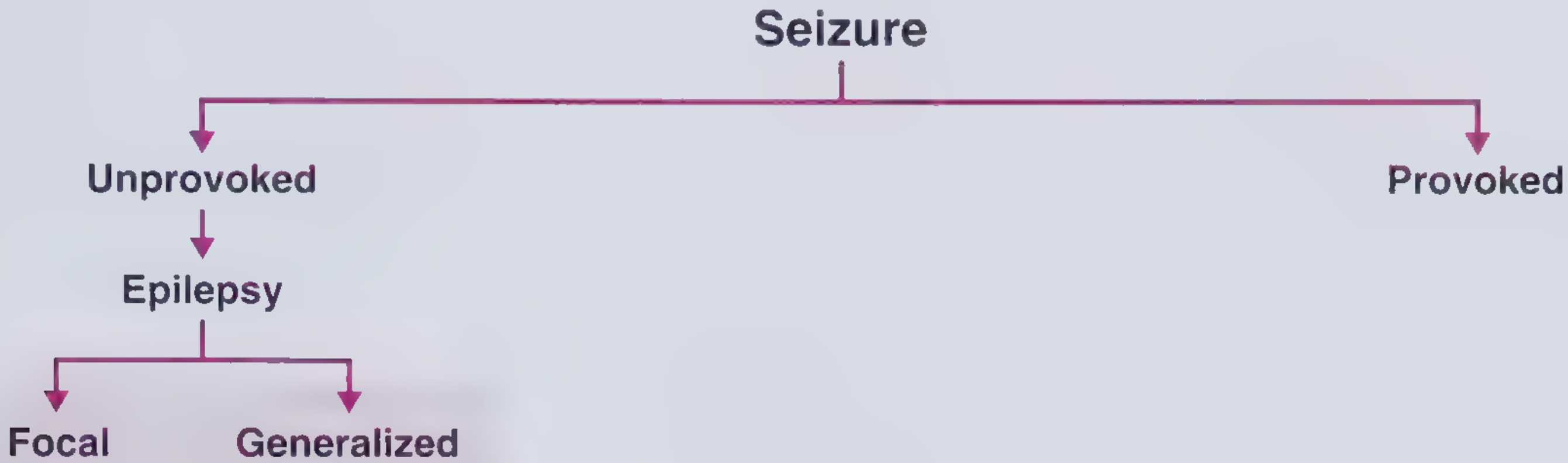
| Type | Features | Preferred AEDs |
|---|---|---|
| Focal (partial), no LOC | Jacksonian march, aura, automatisms, preserved awareness | Carbamazepine, oxcarbazepine, lamotrigine, lacosamide |
| Focal with LOC (complex partial) | Staring, automatisms, postictal confusion | Carbamazepine, lamotrigine, levetiracetam |
| Focal - secondary generalized | Starts focal, spreads to bilateral tonic-clonic | Valproate, lamotrigine, levetiracetam |
| Generalized tonic-clonic (GTC) | LOC, tonic + clonic phase, postictal phase | Valproate, levetiracetam, lamotrigine |
| Absence | Brief staring, no postictal phase, 3 Hz spike-wave on EEG | Ethosuximide, valproate, lamotrigine |
| Myoclonic | Brief muscle jerks, often morning | Valproate, levetiracetam, clonazepam |
| Atonic ("drop attacks") | Sudden loss of muscle tone | Valproate, lamotrigine, clonazepam |
Critical note: Carbamazepine, oxcarbazepine, and phenytoin may worsen generalized epilepsy syndromes (e.g., juvenile myoclonic epilepsy) by blocking sodium channels in a way that exacerbates absence and myoclonic seizures.
PART 6 - POST-SEIZURE / DISCHARGE CHECKLIST
| Item | Action |
|---|---|
| Post-ictal monitoring | Neurologic checks q15-30 min until fully returned to baseline |
| AED initiation | Start maintenance AED after second unprovoked seizure or if structural cause found |
| Driving restrictions | Patient must be counseled - most states require 3-12 months seizure-free before driving |
| Outpatient EEG | Arrange if first unprovoked seizure (helps classify syndrome, guides AED choice) |
| Neurology follow-up | Within 1-2 weeks |
| Patient education | Triggers (sleep deprivation, alcohol, missing doses, fever), safety precautions, rescue benzodiazepine at home if recurrent |
| Rescue medication at home | Diazepam rectal gel or midazolam nasal spray for patients with known recurrent SE |
- Tintinalli's Emergency Medicine (Ch. 171 - Status Epilepticus, Fig. 171-1, drug dosing tables)
- Rosen's Emergency Medicine (Ch. 14 - Seizure, first-line agent recommendations)
- Frameworks for Internal Medicine (Ch. 42 - Seizure classification and epilepsy framework)
- Miller's Anesthesia 10e (Status Epilepticus - RSI and anesthetic management)
- Katzung's Basic and Clinical Pharmacology 16e (Benzodiazepine mechanisms and indications)Here's a summary of what's covered in the complete reference above:
- Phase 0 (0-2 min): Safety, positioning, call for help
- Phase 1 (0-5 min): ABCs, O2, IV access, glucose, labs
- Phase 2 (5-20 min): 1st-line benzodiazepines with doses and route selection
- Phase 3/4 (20-60 min): 2nd-line AEDs (fosphenytoin, levetiracetam, valproate, lacosamide) then refractory SE agents (midazolam infusion, propofol, ketamine, phenobarbital, pentobarbital)
explain with a seizure case
Case-Based Seizure Management Walkthrough
THE CASE
Mr. Arjun R., 34-year-old male Brought to the Emergency Department by his wife at 10:05 AM Chief complaint (per wife): "He collapsed and started shaking while having breakfast. He hasn't woken up properly."
SCENE: ARRIVAL - T = 0 min
- Seizure started approximately 8 minutes ago (so this is already established status epilepticus on arrival)
- No prior history of seizures or epilepsy
- No known drug allergies
- Not on any regular medications
- Had complained of headache for 2 days and appeared feverish last night
- No alcohol or drug use
- No recent travel
- Weight approximately 70 kg
| Parameter | Value |
|---|---|
| BP | 148/92 mmHg |
| HR | 118 bpm |
| RR | 22 breaths/min |
| SpO2 | 89% on room air |
| Temperature | 38.7°C (101.7°F) |
| GCS | E1V1M2 = 4 (unresponsive, posturing) |
STEP 1 - IMMEDIATE TEAM RESPONSE (T = 0-2 min)
- Lateral (recovery) position - right lateral decubitus
- Pad side rails, lower bed
- Suction pooled secretions from oropharynx
- Place on cardiac monitor, pulse oximeter
- Two large-bore IVs inserted (right antecubital + left forearm)
- BP cuff - continuous cycling q5 min
- Seizure started ~8 min ago = already status epilepticus (>5 min threshold crossed)
- Fever + headache for 2 days + new-onset seizure = bacterial meningitis must be on the differential until proven otherwise
- SpO2 89% - immediate O2 required
O2 via non-rebreather mask at 15 L/min - target SpO2 > 94%
STEP 2 - FIRST-LINE: BENZODIAZEPINE (T = 2-5 min)
╔══════════════════════════════════════════════════════════╗
║  ORDER 1 - FIRST-LINE BENZODIAZEPINE                     ║
║                                                           ║
║  Lorazepam (Ativan) 0.1 mg/kg IV slow push              ║
║  = 0.1 × 70 kg = 7 mg → give 4 mg IV (max per dose)     ║
║                                                           ║
║  Administer over 2 minutes                               ║
║  If seizure continues at 5 min → REPEAT x1               ║
║  Repeat dose: Lorazepam 4 mg IV                          ║
╚══════════════════════════════════════════════════════════╝
STEP 3 - SECOND-LINE AED (T = 10-20 min)
- No cardiac monitoring needed (unlike fosphenytoin/phenytoin)
- Safe in patients with unknown cardiac status
- Can be given rapidly
- No interaction with planned meningitis antibiotics
╔══════════════════════════════════════════════════════════╗
║  ORDER 2 - SECOND-LINE AED                               ║
║                                                           ║
║  Levetiracetam (Keppra) 60 mg/kg IV                     ║
║  = 60 × 70 kg = 4200 mg IV                              ║
║  → Give 4000 mg IV in 100 mL NS over 15 minutes         ║
║                                                           ║
║  Rate: 267 mL/h via infusion pump                        ║
╚══════════════════════════════════════════════════════════╝
╔══════════════════════════════════════════════════════════╗
║  ORDER 3 - EMPIRIC MENINGITIS TREATMENT                  ║
║  (Fever + Headache 2 days + New seizure = HIGH SUSPICION ║
║   Do NOT wait for LP - treat immediately)                ║
║                                                           ║
║  Ceftriaxone 2 g IV q12h - STAT first dose               ║
║  Vancomycin 25 mg/kg IV (= 1750 mg) q8-12h - STAT       ║
║  Dexamethasone 0.15 mg/kg IV q6h x4 days                ║
║    = 10.5 mg → give 10 mg IV (before or with 1st abx)   ║
║  Acyclovir 10 mg/kg IV q8h (= 700 mg) - cover HSV       ║
╚══════════════════════════════════════════════════════════╝
STEP 4 - REFRACTORY STATUS EPILEPTICUS (T = 22-30 min)
- Seizure has now lasted >22 minutes total
- Two adequate AED agents failed (lorazepam x2 + levetiracetam)
- SpO2 is falling despite O2 - 88% now
- Patient cannot protect airway
- Continuous EEG monitoring needed
RSI Orders:
╔══════════════════════════════════════════════════════════╗
║  ORDER 4 - RSI (RAPID SEQUENCE INTUBATION)               ║
║                                                           ║
║  Pre-oxygenation: 100% O2 via BVM x3-5 min               ║
║                                                           ║
║  INDUCTION:                                               ║
║  Ketamine 2 mg/kg IV = 140 mg IV push                    ║
║    (chosen: hemodynamically stable, may reduce seizures) ║
║                                                           ║
║  PARALYTIC (SHORT-ACTING ONLY):                          ║
║  Succinylcholine 1.5 mg/kg IV = 105 mg IV push           ║
║    *** SHORT-ACTING - duration 10 min ***                ║
║    *** DO NOT use vecuronium/rocuronium long-acting ***  ║
║    *** Paralysis will MASK ongoing seizure activity ***  ║
║                                                           ║
║  Post-intubation: Continuous EEG monitoring - STAT       ║
║  ETT confirmed by waveform capnography + CXR             ║
╚══════════════════════════════════════════════════════════╝
Why short-acting paralytic only? Long-acting paralytics stop the visible shaking but seizure activity continues silently in the brain (non-convulsive SE). EEG is the only way to detect ongoing seizure after paralysis.
Continuous Infusion for Refractory SE:
╔══════════════════════════════════════════════════════════╗
║  ORDER 5 - REFRACTORY SE INFUSION                        ║
║                                                           ║
║  Midazolam (Versed):                                     ║
║    Loading dose: 0.2 mg/kg IV = 14 mg IV bolus           ║
║    Then infusion: start at 0.05 mg/kg/h = 3.5 mg/h      ║
║    Titrate by 0.05 mg/kg/h q15 min to seizure cessation  ║
║    on EEG (max 2 mg/kg/h)                                ║
║                                                           ║
║  Vasopressor on standby (hypotension anticipated):       ║
║  Norepinephrine 0.05-0.3 mcg/kg/min if MAP < 65 mmHg    ║
╚══════════════════════════════════════════════════════════╝
STEP 5 - DIAGNOSTIC WORKUP (now seizure is controlled)
╔══════════════════════════════════════════════════════════╗
║  ORDER 6 - STAT LABS & IMAGING                           ║
║                                                           ║
║  Blood:                                                   ║
║  - CBC with differential                                 ║
║  - CMP: Na, K, Ca, Mg, Cl, CO2, BUN, Creatinine, glucose║
║  - LFTs + ammonia                                        ║
║  - Serum lactate                                         ║
║  - Blood cultures x2 (BEFORE antibiotics if possible,   ║
║     but DO NOT delay antibiotics for cultures)           ║
║  - HIV screen                                            ║
║  - CRP, ESR, procalcitonin                               ║
║  - ABG (patient intubated)                               ║
║                                                           ║
║  Imaging:                                                 ║
║  - CT brain non-contrast STAT                            ║
║  - CT brain with contrast (after non-contrast)           ║
║                                                           ║
║  Lumbar Puncture:                                        ║
║  - AFTER CT brain clears herniation risk                 ║
║  - CSF: cell count, glucose, protein, Gram stain,       ║
║    culture, HSV PCR, cryptococcal antigen, VDRL          ║
╚══════════════════════════════════════════════════════════╝
STEP 6 - RESULTS & DIAGNOSIS
| Test | Result | Interpretation |
|---|---|---|
| WBC | 18,400/μL (84% neutrophils, bands 12%) | Marked neutrophilia - bacterial infection |
| Na | 128 mEq/L | Hyponatremia (SIADH from meningitis) |
| Ca | 9.1 mg/dL | Normal |
| Mg | 1.9 mg/dL | Normal |
| Glucose | 79 mg/dL | Normal |
| CRP | 142 mg/L | Markedly elevated |
| Procalcitonin | 8.4 ng/mL | Strongly suggests bacterial infection |
| Blood cultures | Pending | - |
| CSF Parameter | Result | Normal |
|---|---|---|
| Opening pressure | 28 cm H2O | <20 |
| Appearance | Cloudy, turbid | Clear |
| WBC | 2,800/μL (95% PMNs) | <5 |
| Glucose | 22 mg/dL | >60% serum glucose |
| Protein | 385 mg/dL | 15-45 |
| Gram stain | Gram-positive diplococci | - |
STEP 7 - ONGOING MANAGEMENT & ICU ORDERS
╔══════════════════════════════════════════════════════════╗
║  FINAL STANDING ORDERS - NEURO ICU                       ║
║                                                           ║
║  ANTIBIOTIC REGIMEN (continue):                          ║
║  Ceftriaxone 2 g IV q12h x14 days                       ║
║  Vancomycin - dose by pharmacy per levels                ║
║    (target AUC/MIC 400-600)                              ║
║  Dexamethasone 0.15 mg/kg IV q6h x4 days (COMPLETE)     ║
║    (reduces neurologic complications in pneumococcal)    ║
║  Acyclovir - STOP once HSV PCR returns negative          ║
║                                                           ║
║  SEIZURE PROPHYLAXIS / MAINTENANCE:                      ║
║  Levetiracetam 500 mg IV q12h (maintenance dose)         ║
║  Continue until seizure-free x48h then reassess          ║
║                                                           ║
║  MIDAZOLAM WEAN:                                         ║
║  When EEG seizure-free x24h: decrease by 25% q4-6h      ║
║                                                           ║
║  HYPONATREMIA CORRECTION (Na 128):                       ║
║  Fluid restrict to 1000 mL/24h                          ║
║  3% NaCl NOT needed (Na not < 120, no herniation)        ║
║  Recheck Na q6h; correct no faster than 8-10 mEq/L/day  ║
║  (rapid correction → osmotic demyelination syndrome)     ║
║                                                           ║
║  VENTILATOR SETTINGS (post-intubation):                  ║
║  Mode: Volume AC  TV: 6 mL/kg IBW (= 420 mL)            ║
║  PEEP: 5 cmH2O  FiO2: 0.4  RR: 14                       ║
║  Target: SpO2 >94%, PaCO2 35-40 mmHg                     ║
║                                                           ║
║  MONITORING:                                             ║
║  Continuous EEG x48h minimum                             ║
║  Neuro checks q1h (pupils, GCS as assessable)           ║
║  ICP monitoring if clinical deterioration               ║
║  HOB elevation 30° (reduce ICP)                          ║
╚══════════════════════════════════════════════════════════╝
CASE TIMELINE SUMMARY
T = 0 min    → Patient arrives, actively seizing (~8 min into seizure)
               → O2, monitors, IV access, POC glucose
               → STATUS EPILEPTICUS declared

T = 2 min    → Lorazepam 4 mg IV (1st dose)

T = 7 min    → Lorazepam 4 mg IV (2nd dose)
               → No response → move to 2nd-line

T = 10 min   → Levetiracetam 4000 mg IV started (over 15 min)
               → EMPIRIC MENINGITIS antibiotics started (ceftriaxone,
                  vancomycin, dexamethasone, acyclovir)

T = 22 min   → Levetiracetam complete, seizure CONTINUES
               → REFRACTORY SE declared → intubation decision

T = 25 min   → RSI: Ketamine 140 mg IV + Succinylcholine 105 mg IV
               → Intubated; continuous EEG attached

T = 28 min   → Midazolam 14 mg IV bolus + infusion started 0.05 mg/kg/h

T = 35 min   → EEG confirms SEIZURE CESSATION
               → Midazolam titrated to 0.1 mg/kg/h

T = 45 min   → CT brain: meningeal enhancement, no herniation

T = 60 min   → LP performed: CSF confirms bacterial meningitis

T = 90 min   → Patient in Neuro-ICU, sedated but hemodynamically stable
               → Blood cultures growing Gram-positive diplococci
               → Antibiotics narrowed to high-dose ceftriaxone

Day 3        → EEG seizure-free; midazolam weaned and discontinued
               → Extubated; following commands
               → Na corrected to 136 mEq/L

Day 7        → Transfer to step-down; levetiracetam continued orally
               → Neurology follow-up arranged
               → Outpatient EEG in 4 weeks
KEY TEACHING POINTS FROM THIS CASE
| Point | Lesson |
|---|---|
| Fever + new seizure = meningitis until proven otherwise | Do not delay antibiotics waiting for LP or CT |
| Treat empirically before diagnosis is confirmed | Antibiotics + antivirals started at T=10 min, diagnosis confirmed at T=60 min |
| Benzodiazepines: max 2 doses then escalate | More doses = more respiratory depression, not more seizure control |
| Short-acting paralytic only during RSI | Long-acting masks ongoing electrical seizure activity |
| Hyponatremia contributed to seizure | Na 128 from SIADH (meningitis) lowers seizure threshold |
| Never delay treatment to do LP | LP is done AFTER CT clears herniation AND after antibiotics are started |
| Levetiracetam preferred 2nd-line here | No cardiac monitoring needed, rapid administration, safe with unknown cardiac history |
| Continuous EEG is mandatory post-intubation | NCSE (non-convulsive SE) is present in up to 24% of comatose patients |
Pregnancy safe Drugs with Frequency, case wise & tips tricks, clinical pearls
Pregnancy-Safe Drugs: Complete Clinical Reference
Understanding Drug Safety in Pregnancy
| Old FDA Category | Meaning |
|---|---|
| A | Controlled studies show no fetal risk - safest |
| B | Animal studies show no risk; no adequate human studies, OR animal risk not confirmed in humans |
| C | Animal studies show adverse effects; no adequate human data; give only if benefit outweighs risk |
| D | Evidence of human fetal risk; benefit may outweigh risk in serious conditions |
| X | Fetal risk clearly outweighs any benefit - CONTRAINDICATED |
Golden Rule: Untreated maternal disease is often MORE dangerous to the fetus than treating it with a relatively safe drug.
SECTION 1: ANTIBIOTICS IN PREGNANCY
Safe (Preferred):
| Drug | FDA Category | Safe Trimester | Frequency | Use |
|---|---|---|---|---|
| Penicillin G/Amoxicillin | B | All trimesters | Amox: 500 mg TID x7d | UTI, strep throat, dental infections, syphilis |
| Amoxicillin-Clavulanate | B | All (caution T1) | 875/125 mg BID x7d | Skin infections, sinusitis, UTI - avoid in 1st trimester if possible |
| Cephalexin (1st gen) | B | All trimesters | 500 mg QID x7d | UTI, cellulitis, skin infections |
| Ceftriaxone | B | All trimesters | 1-2 g IV/IM once daily | Severe infections, gonorrhea, meningitis |
| Azithromycin | B | All trimesters | 500 mg x1, then 250 mg OD x4d | Atypical pneumonia, chlamydia |
| Erythromycin | B | All trimesters | 500 mg QID x7d | Alternative for penicillin allergy |
| Clindamycin | B | All trimesters | 300 mg TID x7d | BV, anaerobic infections, skin infections |
| Nitrofurantoin | B | T1, T2 only | 100 mg ER BID x5d | Uncomplicated UTI - AVOID at term (>36 wk) |
| Metronidazole | B | T2, T3 (caution T1) | 500 mg BID x7d | BV, trichomoniasis, anaerobic infections |
Use with Caution / Conditional:
| Drug | FDA Category | Concern | Alternative |
|---|---|---|---|
| Trimethoprim-Sulfamethoxazole (TMP-SMX) | C/D | T1: folate antagonist (NTD risk); T3: neonatal jaundice, kernicterus | Use only if no alternative; avoid T1 and T3 |
| Ciprofloxacin/Fluoroquinolones | C | Cartilage damage in animal studies; avoid if possible | Use only for serious infections with no safer option |
| Gentamicin/Aminoglycosides | D | Fetal ototoxicity, nephrotoxicity | Short course acceptable for life-threatening sepsis |
CONTRAINDICATED:
| Drug | Risk |
|---|---|
| Tetracyclines (doxy, minocycline) | Dental discoloration, inhibits fetal bone growth |
| Chloramphenicol (T3) | Gray baby syndrome |
| Linezolid | Insufficient safety data |
📋 CASE 1: UTI in Pregnancy
Patient: Priya, 26-year-old, 18 weeks pregnant. Dysuria, frequency, urgency x2 days. Urine dipstick: nitrites +, leukocyte esterase +, no fever.
Cephalexin (Keflex) 500 mg PO QID x 7 days
   (cephalosporins - Category B, safe all trimesters)
OR
Nitrofurantoin (Macrobid) 100 mg ER PO BID x 5 days
   (Category B - safe T1 and T2; AVOID if > 36 weeks)
- Ciprofloxacin (fluoroquinolone - avoid)
- TMP-SMX in T1 (folate antagonist, NTD risk) or T3 (neonatal jaundice)
- All pregnant women should be screened for asymptomatic bacteriuria at first prenatal visit - UTI in pregnancy is a serious condition that can ascend to pyelonephritis
- Treat even asymptomatic bacteriuria in pregnancy (unlike non-pregnant adults)
- Repeat urine culture 7 days after treatment to confirm cure
- Consider suppressive prophylaxis (nitrofurantoin 50-100 mg at bedtime) if recurrent UTIs
SECTION 2: ANTIHYPERTENSIVES IN PREGNANCY
Safe (First-Line):
| Drug | FDA Category | Dose | Mechanism | Notes |
|---|---|---|---|---|
| Methyldopa (Aldomet) | B | 250 mg PO q6-8h; max 3 g/day | Central α2 agonist | Oldest, most studied; drug of choice historically; can cause depression/fatigue |
| Labetalol | C | 100-400 mg PO BID; IV: 20 mg bolus | α+β blocker | First-line for chronic HTN in pregnancy; also used IV for acute severe HTN |
| Nifedipine (extended-release) | C | 30-90 mg PO OD | CCB | Add-on to labetalol/methyldopa; also used for preterm labor (tocolysis) |
| Hydralazine | C | 5-10 mg IV/IM q20-40 min (acute); 10-50 mg PO QID (chronic) | Direct vasodilator | Used IV in acute hypertensive emergency; can cause reflex tachycardia |
| Nifedipine (immediate-release, oral) | C | 10-30 mg PO (acute) | CCB | For acute severe HTN in ED - not FDA-approved for this indication but used |
ABSOLUTELY CONTRAINDICATED:
| Drug | Risk |
|---|---|
| ACE inhibitors (lisinopril, enalapril, ramipril) | Fetal renal tubular dysplasia, oligohydramnios, IUGR, neonatal renal failure, skull defects - teratogenic in T2/T3 |
| ARBs (losartan, valsartan, olmesartan) | Same as ACEi - contraindicated |
| Atenolol | IUGR, bradycardia in neonate |
| Sodium nitroprusside | Cyanide toxicity to fetus |
- Chronic HTN: target 140-150/90-100 mmHg (not too tight - avoid uteroplacental insufficiency)
- Severe HTN (≥160/110 mmHg): treat urgently - risk of maternal stroke/eclampsia
📋 CASE 2: Hypertensive Emergency in Pregnancy
Patient: Sunita, 32-year-old, 34 weeks pregnant. BP 178/114 mmHg on 2 readings 15 min apart. Severe headache, epigastric pain. Urine protein +++. Platelet count 88,000. LFTs elevated 2x normal.
1. Labetalol 20 mg IV push over 2 min
   If BP still ≥160/110 after 10 min → Labetalol 40 mg IV
   If still not controlled → Hydralazine 5-10 mg IV q20 min
   OR
   Nifedipine 10-20 mg PO, may repeat in 30 min
   TARGET: BP 140-150/90-100 mmHg

2. MAGNESIUM SULFATE - seizure prophylaxis:
   MgSO4 4-6 g IV over 20 min (loading dose)
   Then 1-2 g/h IV continuous infusion
   Monitor: respiratory rate, urine output, reflexes, Mg levels

3. Delivery planning: definitive treatment for HELLP is delivery
   Dexamethasone 12 mg IM q12h x2 doses (fetal lung maturity if <34 wk)
- Magnesium sulfate is NOT an antihypertensive - it is specifically for seizure prevention in preeclampsia
- Toxicity signs of Mg: loss of DTRs (first sign), respiratory depression, cardiac arrest
- Antidote for Mg toxicity: Calcium gluconate 1 g IV push
- NEVER use ACEi or ARB - even a single dose in T2/T3 can cause fetal renal failure
SECTION 3: ANALGESICS & ANTIPYRETICS
| Drug | FDA Category | Safe Trimester | Notes |
|---|---|---|---|
| Paracetamol/Acetaminophen | B | All trimesters (short-term) | Drug of choice for pain and fever in all trimesters; recent data on prolonged use showing possible ADHD link but short-term use acceptable |
| Opioids (codeine, morphine, oxycodone) | C (T1/T2) / D (T3) | Short-term use only | Risk of NAS (neonatal abstinence syndrome) with prolonged use; avoid at term |
CONTRAINDICATED:
| Drug | Trimester | Risk |
|---|---|---|
| NSAIDs (ibuprofen, diclofenac, naproxen) | T3 - AVOID | Premature closure of ductus arteriosus, oligohydramnios, fetal renal impairment. T1 use: possible increased miscarriage risk |
| Aspirin (full dose >150 mg/day) | T3 | Antiplatelet effects, neonatal bleeding. LOW-DOSE aspirin 75-150 mg OD is actually recommended to prevent preeclampsia |
📋 CASE 3: Acute Pain in Pregnancy (Headache/Back Pain)
Patient: Asha, 28-year-old, 24 weeks pregnant. Severe tension headache and low back pain.
1. Paracetamol 500-1000 mg PO q6-8h PRN (max 4 g/day) - FIRST LINE
2. Warm compress for back pain (not hot - no heating pads directly on abdomen)
3. Non-pharmacologic: physiotherapy, support belt for back pain
- Ibuprofen/diclofenac at 24 weeks - although T2 is technically the grey zone, NSAIDs are generally avoided as a habit-forming risk
- Aspirin >150 mg - antiplatelet risk
SECTION 4: ANTIEMETICS (Nausea/Vomiting in Pregnancy)
| Drug | FDA Category | Dose | Notes |
|---|---|---|---|
| Pyridoxine (Vitamin B6) | A | 10-25 mg TID | First-line; safest; take 30 min before meals |
| Doxylamine + Pyridoxine (Diclegis/Bonjesta) | A | 2 tabs at bedtime (delayed-release) | FDA-approved combination; gold standard for NVP |
| Ginger (non-pharmacologic) | - | 250 mg QID or ginger tea | Shown effective in multiple trials; safe |
| Metoclopramide | B | 10 mg IV/PO TID | Safe; risk of extrapyramidal effects with prolonged use |
| Promethazine | C | 12.5-25 mg PO/IV/IM q4-6h | Effective but sedating; AAP cautions in nursing |
| Prochlorperazine | C | 5-10 mg PO/IV TID-QID | For refractory NVP; sedating |
| Ondansetron (Zofran) | B | 4-8 mg IV/PO q6-8h | Use for severe/refractory cases; some studies suggest possible cardiac septum defect and cleft palate risk - data inconsistent. Avoid in T1 if possible, use if severely symptomatic |
- Dietary changes + ginger
- Pyridoxine alone 25 mg TID
- Add doxylamine (Doxylamine/Pyridoxine combination)
- Add metoclopramide or promethazine
- Ondansetron for refractory cases
- IV fluids + IV antiemetics (admit for hyperemesis gravidarum)
📋 CASE 4: Hyperemesis Gravidarum
Patient: Riya, 10 weeks pregnant, 5 kg weight loss, unable to tolerate any oral intake, ketonuria ++, vomiting 12x/day.
ADMIT - IV Access

1. IV Fluids: Normal saline 0.9% + 40 mEq KCl/L @ 125 mL/h
   (correct dehydration + electrolytes)

2. Thiamine 100 mg IV BEFORE glucose infusion
   (prevent Wernicke's encephalopathy)

3. Ondansetron 4 mg IV q8h
   + Metoclopramide 10 mg IV TID

4. Pyridoxine 25 mg IV/PO TID (continue throughout)

5. Once tolerating oral fluids:
   Step down to oral antiemetics
   Doxylamine/Pyridoxine 2 tabs HS

6. Monitor: electrolytes, LFTs (exclude acute fatty liver), TFTs
   (HCG stimulates TSH-R → gestational thyrotoxicosis in 60% of HG)
- Always give thiamine BEFORE IV dextrose to prevent Wernicke's encephalopathy
- Check TFTs: TSH is often suppressed in hyperemesis - transient gestational thyrotoxicosis does NOT need antithyroid treatment, it resolves as HCG falls
- Ondansetron: Use cautiously in T1 (some data for cleft palate), but risk of dehydration from untreated HG outweighs this theoretical risk
SECTION 5: ANTIEPILEPTIC DRUGS (AEDs) IN PREGNANCY
| Drug | Malformation Risk | Specific Risk | Verdict |
|---|---|---|---|
| Lamotrigine | Lowest among AEDs (~1%) | Levels fall precipitously in pregnancy - monitor and adjust | Preferred AED in pregnancy |
| Levetiracetam | Low (not associated with increased malformations) | Levels may fall; adjust by monitoring | Preferred; rapidly gaining favor |
| Carbamazepine | 4-5% major malformations | Cleft palate, NTD, fetal anticonvulsant syndrome | Use only if only effective agent |
| Phenytoin | 4-5% | Fetal hydantoin syndrome: midface hypoplasia, finger hypoplasia, NTD | Avoid if possible |
| Phenobarbital | 6-7% | NTDs, cardiac defects, cleft palate; neonatal bleeding | Avoid if possible |
| Valproate | 20% serious adverse outcomes | NTD (spina bifida 1-2%), cardiac defects, autism, IQ reduction (9 points), fetal valproate syndrome | AVOID - absolute contraindication in women of childbearing age without contraception |
| Topiramate | ~4% | Cleft palate, IUGR | Avoid |
- NEVER stop AEDs abruptly (risk of GTCS is more dangerous than AED exposure)
- Use monotherapy at lowest effective dose - polytherapy multiplies risk
- Folic acid 5 mg/day (high-dose) from pre-conception through T1
- Monitor drug levels every trimester (clearance increases in pregnancy)
- Neonates exposed to AEDs - give Vitamin K 1 mg IM at birth (AEDs reduce Vitamin K-dependent clotting factors)
SECTION 6: THYROID DRUGS IN PREGNANCY
| Drug | Safety | Dose | Notes |
|---|---|---|---|
| Levothyroxine (T4) | Safe - Category A | Adjust to maintain TSH 0.1-2.5 mIU/L | Hypothyroidism MUST be treated - untreated leads to fetal neurological damage; requirements increase ~25-30% in pregnancy |
| Propylthiouracil (PTU) | Preferred in T1 | Lowest effective dose; TID dosing | Drug of choice for hyperthyroidism in T1 (hepatotoxicity risk but crosses placenta less than methimazole) |
| Methimazole (MMI/Carbimazole) | Use in T2/T3 | Lowest effective dose; OD or BID dosing | Associated with aplasia cutis and "methimazole embryopathy" in T1 - switch to PTU in T1, back to MMI in T2 |
- T1: Use PTU (less teratogenic in organogenesis period)
- T2 onwards: Switch to Methimazole (PTU has more hepatotoxicity with prolonged use)
- At delivery: Risk of neonatal thyroid disease from maternal antibodies - check neonatal TSH
📋 CASE 5: Hyperthyroidism in Pregnancy
Patient: Nidhi, 8 weeks pregnant. Palpitations, tremor, weight loss despite increased appetite. TSH < 0.01, FT4 elevated 3x normal. Anti-TPO antibodies positive. Thyroid scan shows diffuse uptake.
Propylthiouracil (PTU) 100 mg PO TID
   (preferred in T1 - less teratogenic during organogenesis)

Target: FT4 in upper normal range;
   do NOT normalize TFTs (risk of fetal hypothyroidism)

At 13 weeks: Switch to Methimazole 10-20 mg PO OD

Monitor: TFTs q4 weeks; adjust dose to maintain FT4 high-normal

Check fetal heart rate at each visit - fetal tachycardia suggests
   fetal hyperthyroidism from maternal antibody transfer

NEVER use: Radioiodine (I-131) - destroys fetal thyroid
NEVER use: Atenolol for prolonged rate control (IUGR risk)
Propranolol: short-term use acceptable for symptomatic tachycardia
SECTION 7: ANTICOAGULANTS IN PREGNANCY
| Drug | Safety | Route | Notes |
|---|---|---|---|
| Heparin (unfractionated) | Safe - does NOT cross placenta | IV/SC | Safe in all trimesters; drug of choice for anticoagulation in pregnancy |
| Low-Molecular-Weight Heparin (LMWH) - Enoxaparin, Dalteparin | Safe - does NOT cross placenta | SC | Preferred over UFH (once or twice daily SC; more predictable); dose-adjust by anti-Xa levels |
| Warfarin | Category D/X | Oral | Teratogenic in T1 (warfarin embryopathy: nasal hypoplasia, stippled epiphyses); CNS defects in T2/T3; fetal bleeding |
| Direct oral anticoagulants (DOACs) - apixaban, rivaroxaban | CONTRAINDICATED | Oral | Cross placenta; teratogenic; insufficient safety data |
SECTION 8: ANTIDEPRESSANTS & PSYCHIATRIC DRUGS
| Drug | FDA Category | Verdict |
|---|---|---|
| SSRIs - Sertraline, Fluoxetine | C | Generally preferred if antidepressant needed; sertraline has best safety profile in pregnancy; avoid paroxetine (cardiac septal defects) |
| Sertraline | C | Most commonly used SSRI in pregnancy; minimal placental transfer |
| Paroxetine | D | Increased cardiac defects (VSD); AVOID |
| SNRIs - Venlafaxine | C | Limited data; use if SSRI inadequate |
| TCAs | C/D | Avoid if possible; nortriptyline safer than amitriptyline |
| Lithium | D | Ebstein's anomaly (small but real risk); requires detailed fetal cardiac echo at 20 weeks if used |
| Valproate | D | AVOID in pregnancy for psychiatric indications |
| Benzodiazepines | D | Neonatal withdrawal syndrome; cleft palate risk debated; avoid in T1; use minimum effective dose if needed in acute anxiety |
| Antipsychotics (olanzapine, quetiapine) | C | Risk of neonatal extrapyramidal symptoms; use lowest effective dose; all carry metabolic risks in mother |
- Review necessity of all drugs
- Aim for monotherapy at lowest effective dose
- Restart abruptly-discontinued medication if relapse occurs - relapse is more dangerous
- Continue throughout pregnancy if condition is severe (depression increases obstetric risk)
SECTION 9: ASTHMA DRUGS IN PREGNANCY
| Drug | Safety | Notes |
|---|---|---|
| Salbutamol/Albuterol (SABA inhaler) | B - Safe | Drug of choice for acute bronchospasm; use unrestricted |
| Budesonide (ICS) | B - Preferred | Preferred inhaled corticosteroid; most safety data |
| Fluticasone (ICS) | C - Acceptable | Less data than budesonide but widely used |
| Salmeterol (LABA) | C - Use with ICS only | Add-on to ICS for poorly controlled asthma |
| Montelukast (LTRA) | B - Safe | Can continue if well controlled on it pre-pregnancy |
| Oral prednisolone | C - Use for exacerbations | Risk of cleft palate with T1 use (small); risk of uncontrolled asthma far greater - use when needed |
| Theophylline | C - Use with caution | Narrow therapeutic index; neonatal toxicity; use only if other agents fail |
SECTION 10: ANTIFUNGALS
| Drug | Safety | Notes |
|---|---|---|
| Clotrimazole (topical) | B - Safe | First-line for VVC (vaginal candidiasis) in pregnancy |
| Miconazole (topical) | C - Acceptable | Topical use safe |
| Nystatin (topical/oral) | B - Safe | Oral nystatin for thrush - minimal systemic absorption |
| Fluconazole oral | D - AVOID | Single dose (150 mg) controversial; repeated doses linked to fetal cardiac defects and craniosynostosis. Avoid especially in T1 |
| Amphotericin B | B - Acceptable | For serious systemic fungal infections only |
MASTER QUICK-REFERENCE TABLE
| Condition | First Choice | Avoid |
|---|---|---|
| UTI | Cephalexin, Nitrofurantoin (avoid T3) | TMP-SMX (T1, T3), fluoroquinolones |
| Hypertension | Labetalol, Methyldopa, Nifedipine ER | ACEi, ARBs, atenolol |
| HTN emergency | Labetalol IV, Hydralazine IV, Nifedipine oral | Sodium nitroprusside |
| Eclampsia seizure | Magnesium sulfate IV | Phenytoin (less effective) |
| Nausea/vomiting | Pyridoxine + Doxylamine, Metoclopramide | None first-line |
| Pain/fever | Paracetamol | NSAIDs (T3), full-dose aspirin |
| Diabetes | Insulin (preferred), Metformin (T2D/GDM) | Sulfonylureas (stop 2 wk before delivery) |
| Hypothyroidism | Levothyroxine | - |
| Hyperthyroidism | PTU (T1), Methimazole (T2/T3) | Radioiodine (I-131) |
| Epilepsy | Lamotrigine, Levetiracetam | Valproate, Topiramate |
| DVT/PE | LMWH (Enoxaparin) | Warfarin (T1), DOACs |
| Asthma (acute) | Salbutamol inhaler, Budesonide ICS | - |
| Depression | Sertraline | Paroxetine, Valproate |
| VVC (candida) | Clotrimazole topical | Oral fluconazole (T1) |
| Preeclampsia prophylaxis | Low-dose Aspirin 75-150 mg OD from 12 wk | - |
UNIVERSAL CLINICAL PEARLS FOR PRESCRIBING IN PREGNANCY
-
"The disease treats the fetus too" - untreated hypertension, seizures, asthma, diabetes, and depression all carry significant fetal risk. Never withhold necessary treatment.
-
Folic acid 400 mcg/day for all women planning pregnancy (start 1 month before conception); 5 mg/day for high-risk patients (epilepsy, diabetes, BMI >30, previous NTD).
-
T1 (weeks 1-12) is organogenesis - highest teratogenesis risk. T2/T3 risks are more about fetal growth, function, and neonatal adaptation.
-
Always give the lowest effective dose and for the shortest needed duration.
-
Monotherapy over polypharmacy - drug combinations multiply teratogenic risk non-linearly.
-
Check every drug before prescribing - use TERIS, LactMed, or Drugs@FDA as reference databases.
-
Neonatal effects to watch: Neonatal abstinence syndrome (opioids, benzodiazepines, SSRIs), neonatal hypoglycemia (sulfonylureas, beta-blockers), neonatal bradycardia (labetalol, atenolol), neonatal hypothyroidism (antithyroid drugs).
-
Inform the patient - shared decision-making is essential for all drug prescribing in pregnancy.
-
The 1-month rule: Warfarin embryopathy occurs at weeks 6-12 - risk window overlaps with time before many women know they are pregnant. Women of childbearing age on warfarin MUST use contraception.
-
Supplementation always needed: Iron (from 12 weeks or earlier if anaemic), folic acid, iodine (in iodine-deficient regions), Vitamin D 400-1000 IU/day.
ortho cases with proper drug dose and frequency with clinical case examples opd,ward & icu
Orthopaedic Cases: OPD, Ward & ICU - Complete Drug Reference
OPD CASES
OPD CASE 1: Acute Gout (First MTP Joint)
Patient: Mr. Ramesh, 52M, banker. Woke up at 3 AM with severe pain, redness, and swelling of the right big toe. Cannot wear a shoe. No prior episodes. Serum uric acid 9.8 mg/dL. WBC 11,200. Joint fluid: negatively birefringent crystals (monosodium urate).
Acute Attack Management:
| Drug | Dose | Frequency | Duration | Notes |
|---|---|---|---|---|
| Colchicine (1st line) | 1 mg PO, then 0.5 mg 1 hour later | Then 0.5 mg BID | Until flare resolves (5-7 days) | Avoid if eGFR < 30; most effective if started within 24h of attack |
| Naproxen (NSAID alternative) | 750 mg loading dose PO, then 250 mg TID | TID | 5-7 days | Take with food; avoid in renal disease, peptic ulcer |
| Indomethacin (classic NSAID) | 50 mg PO TID | TID | 5-7 days | Most potent NSAID for gout; highest GI side effects |
| Prednisolone (if NSAID/colchicine contraindicated) | 30-40 mg OD PO | OD | 5 days then taper | Use in CKD, peptic ulcer, anticoagulated patients |
| Intra-articular triamcinolone | 10-40 mg IA injection | Single dose | Once | If monoarticular, accessible joint, no infection |
OPD Prescription:
Rx:
1. Colchicine 0.5 mg PO BID x 7 days (take with food; stop if diarrhea)
2. Naproxen 500 mg PO BID x 5 days (take with food)
3. Omeprazole 20 mg PO OD x 5 days (gastric protection)
4. Apply ice pack to affected joint 15 min TID
5. Elevate foot; avoid weight-bearing during flare
6. Hydrate well: >2 L water/day
- Allopurinol: start 100 mg OD, increase by 100 mg/month; target uric acid < 6 mg/dL
- NEVER start allopurinol during an acute flare - prolongs attack
Clinical Pearls:
- "Podagra" = first MTP joint gout (classic presentation)
- Most effective if colchicine started within 12-24 h of onset
- Febuxostat 40-80 mg OD = alternative to allopurinol (more expensive; avoid in cardiovascular disease)
- Check uric acid only 4-6 weeks after flare (acute inflammation falsely lowers levels)
- Triggers: red meat, shellfish, beer, diuretics (esp. thiazides), low-dose aspirin, dehydration
OPD CASE 2: Osteoarthritis Knee (OA Knee)
Patient: Mrs. Lakshmi, 64F, retired teacher. Bilateral knee pain, worse on climbing stairs, better with rest. Duration 3 years, now severe. BMI 34. X-ray: Kellgren-Lawrence grade 3 OA bilaterally. No signs of septic arthritis.
Step-Up Analgesic Ladder for OA:
| Step | Drug | Dose | Frequency | Notes |
|---|---|---|---|---|
| 1 - Non-opioid | Paracetamol | 1 g PO | TID-QID (max 4 g/day) | First-line; safest; use regularly not PRN |
| 2 - Topical NSAID | Diclofenac gel 1% | Apply thin layer to knee | TID-QID | Less systemic absorption; preferred in elderly |
| 3 - Oral NSAID | Celecoxib (COX-2) | 100-200 mg PO | BID | Safer GI profile than traditional NSAIDs; add PPI |
| or | Naproxen | 250-500 mg PO | BID-TID | With food; add omeprazole |
| 4 - Intra-articular | Methylprednisolone 40 mg IA | IA injection | Max q3 months | For acute flare on background OA; temporary relief |
| or | Hyaluronic acid (Synvisc) | 2 mL IA | Weekly x 3 weeks | Viscosupplementation; moderate evidence |
| 5 - Weak opioid | Tramadol | 50-100 mg PO | Q6-8h PRN | Last resort; constipation, dizziness; avoid in elderly falls-risk |
OPD Prescription:
Rx:
1. Paracetamol 1 g PO TID (regular, not PRN)
2. Diclofenac gel 1% - apply to both knees TID
3. Celecoxib 200 mg PO OD (with food; if topical insufficient)
4. Omeprazole 20 mg PO OD (gastroprotection with NSAID)
5. Calcium carbonate 500 mg PO BID + Vitamin D3 1000 IU OD
6. Physiotherapy referral: quad strengthening exercises
7. Weight loss counselling: target BMI < 28
8. Walking aid: walking stick in opposite hand to worse knee
Clinical Pearls:
- Paracetamol + topical NSAID first before oral NSAIDs
- NSAIDs: avoid in CKD, CHF, peptic ulcer disease, anticoagulation
- Intra-articular steroid injection: use no more than 3-4 times/year (cartilage damage risk)
- Glucosamine/chondroitin: only mild benefit, safe, patient can try
- Referral for TKR when: pain uncontrolled on maximal conservative therapy, quality of life severely impacted, radiographic grade 3-4
OPD CASE 3: Ankle Sprain (Grade II)
Patient: Priya, 23F, badminton player. Twisted ankle 2 days ago. Lateral ankle pain, swelling, bruising. Can bear weight (4/10 pain). Ottawa Ankle Rules: X-ray not required. Diagnosis: Grade II lateral ankle sprain.
OPD Management:
Rx:
1. Ibuprofen 400 mg PO TID x 5 days (with food)
2. Omeprazole 20 mg OD x 5 days
3. Ice pack 20 min QID x 3 days (not directly on skin)
4. Compression bandage (crepe bandage)
5. Elevation above heart level when resting
6. Crutches - partial weight-bearing for 3-5 days
7. Follow-up in 7-10 days for reassessment
- RICE (Rest-Ice-Compression-Elevation) is outdated - POLICE is current
- Ottawa Ankle Rules: X-ray needed only if bony tenderness at posterior edge of medial/lateral malleolus OR inability to bear weight
- Early mobilisation (within 48h) leads to faster recovery than strict immobilisation
- Most ankle sprains are LATERAL (ATFL > CFL); medial sprains suggest deltoid injury (higher energy)
WARD CASES
WARD CASE 1: Post-Operative Hip Replacement (Total Hip Arthroplasty)
Patient: Mr. Subramanian, 68M. Day 1 post-elective right THR for severe OA hip. Operation: 3.5 hours under spinal anaesthesia. Weight 75 kg, no prior medical history. Pain score 7/10. Vitals stable.
Post-Op Ward Orders (Day 1):
╔══════════════════════════════════════════════════════════════╗
║  ORTHOPAEDIC WARD ORDERS - POST-THR DAY 1                   ║
║  Patient: Mr. Subramanian  Weight: 75 kg                    ║
╚══════════════════════════════════════════════════════════════╝

MONITORING
□ Vital signs q4h (BP, HR, SpO2, temp)
□ Wound inspection: drain output q8h; change dressing q48h
□ Urine output q8h (IDC in situ)
□ Neurovascular check of right lower limb q4h:
   - Pulse, capillary refill, sensation, movement in toes
   - Signs of compartment syndrome: pain on passive stretch

ANALGESIA (Multimodal Approach)
□ Paracetamol 1 g IV q6h (regular) - Step 1 (around-the-clock)
□ Celecoxib 200 mg PO BID (regular) - Step 2 (COX-2 preferred - less GI/renal risk)
□ Morphine PCA: 1 mg bolus, 5 min lockout, 4h limit 20 mg
   - OR Oxycodone 5 mg PO q4-6h PRN (if tolerating oral)
□ Gabapentin 300 mg PO TID - for neuropathic/opioid-sparing
□ Ice packs to wound (over dressing) q4h PRN pain
□ Omeprazole 40 mg IV OD (GI protection)

VTE PROPHYLAXIS (HIGH-RISK - Major Joint Replacement)
□ Enoxaparin (LMWH) 40 mg SC OD
   - Start 12 hours AFTER surgery (evening of Day 0)
   - CONTINUE for 35 days total post-THR (extended prophylaxis)
   - Reduce to 20 mg OD if eGFR 15-30 mL/min
□ Graduated compression stockings (TED stockings) - both legs
□ Intermittent pneumatic compression device (IPC) - right leg
□ Early mobilisation: physiotherapy Day 1 post-op - assisted standing/walking

ANTIBIOTIC PROPHYLAXIS (continue peri-op coverage)
□ Cefazolin 2 g IV q8h x 24 hours post-op (1 dose only if <24h)
   - STOP after 24 hours (no benefit beyond 24h)
   - If penicillin allergy: Clindamycin 600 mg IV q8h x 24h

ANTI-EMETICS
□ Ondansetron 4 mg IV q8h PRN nausea
□ Metoclopramide 10 mg IV TID PRN (if ondansetron insufficient)

BOWEL CARE (opioid-induced constipation)
□ Lactulose 15 mL PO BID (start Day 1)
□ Senna 2 tabs PO OD nocte
□ Increase oral fluids

BONE HEALTH
□ Calcium carbonate 600 mg PO BID (with meals)
□ Vitamin D3 1000 IU PO OD
□ Consider bisphosphonate: Alendronate 70 mg PO weekly
   (if pre-existing osteoporosis; start after adequate Vitamin D loading)

PHYSIOTHERAPY
□ Passive ROM - start Day 1
□ Bed mobilisation - heel slides, ankle pumps
□ Standing with frame - Day 1 (if haemodynamically stable)
□ Weight-bearing as tolerated post-THR

LABS
□ FBC, UEC, LFTs - Day 1 and Day 3
□ INR if on anticoagulation bridge
□ X-ray right hip (AP + lateral) - Day 1 post-op
VTE Prophylaxis Duration (ACCP Guidelines):
| Surgery | Drug | Duration |
|---|---|---|
| Total Hip Replacement (THR) | Enoxaparin 40 mg SC OD | 35 days |
| Total Knee Replacement (TKR) | Enoxaparin 40 mg SC OD | 10-14 days |
| Hip fracture surgery | Enoxaparin 40 mg SC OD | 35 days |
| General ortho surgery | Enoxaparin 40 mg SC OD | 7-10 days |
- Rivaroxaban 10 mg OD (preferred in many centres - oral)
- Aspirin 150 mg BID (for lower-risk patients or after 10-14 days of LMWH)
- Warfarin (INR target 2-3; less predictable, requires monitoring)
Clinical Pearls - Post-THR Ward:
- Multimodal analgesia reduces opioid requirements by 30-40%
- Gabapentin: opioid-sparing; reduces post-op pain sensitisation
- VTE prophylaxis for 35 days post-THR (not just hospital stay)
- Hip precautions: No hip flexion > 90°, no internal rotation, no crossing legs (posterior approach) - for 6-12 weeks
- Watch for prosthetic joint dislocation: sudden severe hip pain + leg shortening/external rotation = emergency
- Watch for fat embolism syndrome (24-72h post-fracture fixation): hypoxia, petechiae, confusion = fat embolism triad
WARD CASE 2: Open Tibial Fracture (Gustilo-Anderson Grade III)
Patient: Suresh, 28M, RTA victim. Open fracture of mid-shaft tibia with 8 cm wound, bone exposed, moderate contamination. HR 118, BP 92/60 mmHg. Neurovascular status intact distally.
Ward/Emergency Orders:
╔══════════════════════════════════════════════════════════════╗
║  EMERGENCY + WARD ORDERS - OPEN TIBIAL FRACTURE             ║
╚══════════════════════════════════════════════════════════════╝

IMMEDIATE RESUSCITATION
□ Large-bore IV x2; crystalloid: NS 500 mL bolus IV over 15 min
□ Crossmatch 2 units PRBC; FBC, coag, UEC, glucose
□ O2 via face mask to SpO2 > 95%
□ Tetanus prophylaxis:
   - If vaccinated + booster < 5 years: NO treatment
   - If not vaccinated or unknown: Tetanus toxoid 0.5 mL IM +
     Tetanus immunoglobulin (TIG) 250 units IM (different sites)

WOUND MANAGEMENT
□ Cover wound with saline-soaked gauze; do NOT irrigate in ED
□ Reduce and splint: POP back slab or external fixator (Ortho decision)
□ Repeat neurovascular check q1h

ANTIBIOTICS (Grade III Open Fracture)
□ Cefazolin 2 g IV q8h - START IMMEDIATELY (within 1 hour of injury)
   (for Grade I-II: Cefazolin alone)
□ PLUS for Grade III:
   Metronidazole 500 mg IV q8h
   (for anaerobic/soil contamination coverage)
□ If heavily contaminated soil/faecal: ADD Gentamicin 5-7 mg/kg IV OD
□ Duration: 72 hours OR until surgical wound coverage (whichever first)

ANALGESIA
□ Morphine 2.5-5 mg IV q4h PRN (titrate to pain)
□ Paracetamol 1 g IV q6h regular
□ Ketamine 0.1-0.2 mg/kg IV for procedural analgesia (wound irrigation)
□ Femoral nerve block (if available - excellent for femur/tibial fractures)

PRE-OPERATIVE ORDERS (for emergency OR)
□ NBM from now (emergency surgery within 6 hours)
□ Consent for: emergency debridement + external fixation
□ Alert anaesthesia, orthopaedic surgeon, theatre team STAT

SURGICAL PHASES:
Phase 1 (Emergency): Debridement + external fixation within 6 hours
Phase 2 (48-72h): Wound reassessment; plan for soft-tissue coverage
Phase 3 (7-10 days): Definitive fixation (IM nail/plate) after infection control
Antibiotic Duration for Open Fractures (Gustilo Grade):
| Grade | Description | Antibiotic | Duration |
|---|---|---|---|
| Grade I | < 1 cm wound, clean | Cefazolin 2 g IV q8h | 24-48 h |
| Grade II | 1-10 cm wound, moderate contamination | Cefazolin 2 g IV q8h | 48-72 h |
| Grade IIIA | > 10 cm, adequate soft tissue | Cefazolin + Metronidazole | 72 h |
| Grade IIIB | Extensive tissue loss, periosteal stripping | Cefazolin + Metronidazole ± Gentamicin | 72 h |
| Grade IIIC | Vascular injury requiring repair | Cefazolin + Metronidazole + Gentamicin | 72 h |
| Farm/soil contamination | All grades | Add Penicillin G 5 MU IV q6h (Clostridium) | 72 h |
- Golden 6-hour rule: Debride and irrigate open fracture within 6 hours (reduces infection risk from ~10% to <2%)
- Antibiotics should start within 1 hour of injury - every hour of delay increases infection risk by 6%
- Never close an open fracture wound primarily on Day 0 - delayed closure at 48-72h
- Compartment syndrome surveillance is mandatory in all tibial fractures:
- Symptom: pain out of proportion, pain on passive toe stretch
- Compartment pressure > 30 mmHg or within 30 mmHg of diastolic BP = fasciotomy
WARD CASE 3: Septic Arthritis (Native Knee Joint)
Patient: Kavitha, 45F, diabetic, on insulin. Presents with 3-day history of progressive right knee pain, swelling, warmth, fever 38.9°C. Cannot flex knee beyond 20°. WBC 18,000 (82% PMN). CRP 186. Knee aspiration: 68,000 WBC (91% PMN), glucose low, Gram stain: Gram-positive cocci in clusters.
Ward Orders:
╔══════════════════════════════════════════════════════════════╗
║  WARD ORDERS - SEPTIC ARTHRITIS                             ║
╚══════════════════════════════════════════════════════════════╝

IMMEDIATE ACTIONS
□ Blood cultures x2 (BEFORE antibiotics)
□ Synovial fluid: Gram stain, C&S, crystal analysis, glucose, protein
□ Start antibiotics WITHIN 1-2 hours of diagnosis

EMPIRIC ANTIBIOTICS (Gram-positive cocci - pending MRSA status)
□ Vancomycin 25-30 mg/kg IV loading dose (= 1750-2100 mg for 70 kg)
   Then 15-20 mg/kg IV q8-12h (renal-dose adjust)
   Target: AUC/MIC 400-600 or trough 15-20 mcg/mL
   +
□ Ceftriaxone 2 g IV OD (to cover Gram-negatives pending culture)

DE-ESCALATION (when cultures return):
   MSSA confirmed → Switch to: Flucloxacillin 2 g IV q6h (4 weeks total)
   MRSA confirmed → Continue: Vancomycin (4-6 weeks)
   Streptococcal → Switch to: Benzylpenicillin 2.4 g IV q4h

JOINT DRAINAGE (mandatory - surgical consult)
□ Arthroscopic irrigation and drainage - preferred for knee
   OR daily needle aspiration if surgical delay
   (Re-aspirate daily until WBC < 50,000 and clinically improving)
□ Splint in functional position for comfort
□ No weight-bearing during acute phase

ANALGESIA
□ Paracetamol 1 g IV q6h regular
□ Morphine 2-5 mg IV q4h PRN (severe pain)
□ Celecoxib 200 mg PO BID (anti-inflammatory analgesic once oral route ok)
□ Ice packs over joint PRN

SUPPORTIVE
□ IV fluids: NS 1 L q8h (maintain hydration)
□ Blood glucose monitoring q4h (diabetic)
   Target glucose: 6-10 mmol/L; adjust insulin accordingly
□ DVT prophylaxis: Enoxaparin 40 mg SC OD (once bleeding risk assessed)
□ FBC, CRP, ESR daily x3 days then every 2-3 days (monitor response)

ANTIBIOTICS DURATION (Septic Arthritis):
   Native joint: 2-4 weeks IV then oral step-down (total 4-6 weeks)
   Prosthetic joint: 6 weeks IV (with surgical consultation)
Empiric Antibiotic Selection by Patient/Organism:
| Patient Type | Likely Organism | Empiric Antibiotics |
|---|---|---|
| Otherwise healthy adult | MSSA, Streptococcus | Flucloxacillin 2 g IV q6h |
| Gram stain negative/unknown | MSSA, MRSA, GNR | Vancomycin + Ceftriaxone 2 g IV OD |
| Gram-positive cocci (MRSA risk: DM, dialysis, healthcare contact) | MRSA | Vancomycin 25-30 mg/kg IV |
| Sexually active < 40 years | N. gonorrhoeae | Ceftriaxone 1 g IV OD |
| IV drug user | MRSA, Pseudomonas | Vancomycin + Ceftazidime/Cefepime |
| Immunocompromised | Gram-negatives + MRSA + fungal | Vancomycin + Piperacillin-tazobactam |
| Diabetic foot/chronic | MSSA + GNR + anaerobes | Piperacillin-tazobactam 4.5 g IV q8h |
| Prosthetic joint (early < 1 month) | MRSA, Staph epidermidis | Vancomycin + Rifampicin 300 mg PO BID |
Clinical Pearls:
- Synovial WBC > 50,000 cells/μL = septic until proven otherwise
- Synovial WBC > 1,100 cells/μL or PMN > 60% in a prosthetic joint = prosthetic joint infection
- Don't miss crystal arthropathy (gout/pseudogout) - can mimic septic arthritis
- The joint must be drained - antibiotics alone are insufficient
- Never add rifampicin alone - always combine (resistance develops rapidly)
- Outcome: 25-50% of septic arthritis patients have permanent joint damage if treated late
ICU CASES
ICU CASE 1: Acute Compartment Syndrome (Post-Tibial IM Nail)
Patient: Anand, 32M, tibial fracture, IM nail 4 hours ago. Now in ortho ward → transferred to ICU for monitoring. Complains of excruciating pain in right leg "not controlled by morphine." Pain worsening on passive toe extension. Right foot sensations reduced. Compartment pressure measured: 42 mmHg. BP 88/60 mmHg.
ICU Orders:
╔══════════════════════════════════════════════════════════════╗
║  ICU ORDERS - ACUTE COMPARTMENT SYNDROME                    ║
╚══════════════════════════════════════════════════════════════╝

IMMEDIATE ACTIONS (do simultaneously)
□ EMERGENCY FASCIOTOMY - Call ortho surgeon STAT
   Time to fasciotomy is the critical determinant of outcome
   Goal: fasciotomy within 1-2 hours of diagnosis
□ Remove ALL circumferential dressings, casts, splints IMMEDIATELY
□ Position limb at HEART LEVEL (NOT elevated - reduces arterial inflow)

ANALGESIA (aggressive - high pain severity)
□ Morphine IV PCA: 2 mg bolus q10 min, no limit until OR
   OR Ketamine 0.2-0.4 mg/kg IV bolus PRN + Midazolam 1 mg IV
□ Paracetamol 1 g IV q6h regular (while waiting for OR)
□ Fentanyl 25-50 mcg IV bolus PRN (faster onset than morphine)

HAEMODYNAMIC SUPPORT
□ Crystalloid: NS 500 mL bolus IV (MAP < 65 → Noradrenaline 0.05 mcg/kg/min)
□ Blood transfusion if Hb < 8 g/dL (rhabdomyolysis expected)
□ Foley catheter: target urine output > 1 mL/kg/h
   (rhabdomyolysis → myoglobinuria → AKI)

RHABDOMYOLYSIS PROTOCOL (post-compartment syndrome/fasciotomy)
□ IV Fluid: NS 1-2 L/h to achieve UO > 200 mL/h until myoglobin clears
   (some centres: add NaHCO3 50 mEq/L to IV fluid to alkalinise urine,
    target urine pH > 6.5 to prevent myoglobin precipitation)
□ Monitor: CK (q6h), K+ (q4h), Creatinine (q8h), urine dipstick
□ Avoid K+-containing fluids if hyperkalemic (rhabdo releases K+)
□ Avoid NSAIDs (nephrotoxic in rhabdomyolysis)

WOUND CARE POST-FASCIOTOMY
□ Negative pressure wound therapy (VAC dressing) post-fasciotomy
□ Wound re-examination at 48-72h for delayed primary closure
□ Antibiotic: Cefazolin 2 g IV q8h (wound prophylaxis post-fasciotomy)
□ DVT prophylaxis: HOLD enoxaparin until surgical haemostasis confirmed

MONITORING
□ Continuous cardiac monitor (hyperkalaemia can cause arrhythmias)
□ Hourly urine output (IDC must be placed)
□ CK, myoglobin, urine dipstick q6h
□ Repeat compartment pressure measurement q1h if fasciotomy delayed
□ 5 Ps monitoring: Pain, Pallor, Paraesthesia, Paralysis, Pulselessness
Rhabdomyolysis Severity and Management:
| CK Level | Risk | Action |
|---|---|---|
| < 1,000 U/L | Mild | Monitor, oral hydration |
| 1,000-10,000 U/L | Moderate | IV fluids 200-500 mL/h; monitor renal function |
| > 10,000 U/L | Severe | Aggressive IV fluids 1-1.5 L/h; ICU monitoring |
| > 100,000 U/L | Life-threatening | ICU; renal replacement therapy if AKI develops |
- Pain out of proportion to injury + pain on passive stretch = compartment syndrome until proven otherwise
- Late signs (5 Ps) indicate irreversible damage has already begun
- Fasciotomy must be done within 6 hours - after 12 hours, reperfusion injury + permanent damage
- In the post-fasciotomy wound: delayed primary closure at 5-7 days or split-thickness skin grafting
- Crush syndrome (large muscle mass compression): hyperkalemia, metabolic acidosis, AKI - life-threatening
ICU CASE 2: Post-Spinal Surgery - Fat Embolism Syndrome
Patient: Dilip, 25M, day 2 post-operative intramedullary nailing of femoral shaft fracture. Developing: SpO2 82% on room air, GCS dropping from 15 to 11, HR 122, BP 96/58 mmHg, fever 39.1°C. Petechiae noted on chest and conjunctivae.
ICU Orders:
╔══════════════════════════════════════════════════════════════╗
║  ICU ORDERS - FAT EMBOLISM SYNDROME                         ║
╚══════════════════════════════════════════════════════════════╝

RESPIRATORY SUPPORT (PRIMARY TREATMENT)
□ High-flow O2: Start NRB mask 15 L/min - SpO2 target > 94%
□ If O2 inadequate: CPAP/BiPAP first (avoid intubation if possible)
□ If refractory hypoxia (SpO2 < 88% on max O2): Intubate and mechanically ventilate
   Ventilator: Volume AC, TV 6 mL/kg IBW, PEEP 8-12 cmH2O, FiO2 titrate

HAEMODYNAMIC SUPPORT
□ IV crystalloid: NS 250 mL boluses for MAP < 65 mmHg
□ Noradrenaline 0.05-0.3 mcg/kg/min if vasopressors needed
□ Avoid excessive fluid (worsens pulmonary oedema in ARDS)

STEROIDS (controversial but used for established FES)
□ Methylprednisolone 1.5 mg/kg IV q8h x 3 days
   (reduces inflammatory cytokine release; used in prevention and treatment)

ANTICOAGULATION
□ Heparin 5000 units SC q12h (prophylaxis - do NOT anticoagulate therapeutically
   unless PE confirmed; fat embolism ≠ thrombus)

NEUROPROTECTION (cerebral FES)
□ Elevate head of bed to 30°
□ Maintain normoglycaemia: glucose 6-10 mmol/L (insulin infusion PRN)
□ Avoid hypotension (MAP > 70 mmHg for cerebral perfusion pressure)

SUPPORTIVE
□ Sedation if intubated: Propofol 5-50 mcg/kg/min IV infusion
□ Analgesia: Morphine 1-4 mg IV q4h PRN (or Fentanyl 25 mcg IV PRN if intubated)
□ Daily CXR, ABG q4-6h, FBC, coag, lipase q12h
□ DVT prophylaxis: resume enoxaparin 40 mg SC OD when haemostasis secured
□ Nasogastric tube: enteral nutrition early (within 24-48h)
□ Insulin infusion: maintain glucose 6-10 mmol/L

PROGNOSIS: FES mortality is 5-20%; full respiratory recovery in most within 7-10 days
ICU CASE 3: Chronic Osteomyelitis with Sepsis (Diabetic Foot)
Patient: Rajan, 58M, type 2 diabetes, poorly controlled (HbA1c 11%). Chronic wound right heel x 3 months. Now: fever 39.4°C, BP 84/52 mmHg, HR 128, RR 28, lactate 4.8 mmol/L. Probe-to-bone positive. MRI: bone marrow oedema and enhancement of right calcaneum. Culture from bone biopsy: polymicrobial (MRSA + Pseudomonas + Bacteroides).
ICU Sepsis Protocol + Osteomyelitis Orders:
╔══════════════════════════════════════════════════════════════╗
║  ICU ORDERS - SEPTIC SHOCK + DIABETIC FOOT OSTEOMYELITIS   ║
╚══════════════════════════════════════════════════════════════╝

SEPSIS-3 BUNDLE (complete within 1 hour of recognition)

1. BLOOD CULTURES x2 (before antibiotics - takes < 5 min)
2. ANTIBIOTICS (within 1 hour of sepsis recognition)
3. IV FLUID RESUSCITATION: 30 mL/kg NS over 30-60 min
   (= 1800-2100 mL for 60-70 kg patient)
4. VASOPRESSORS if MAP < 65 despite fluids:
   Noradrenaline 0.05-0.3 mcg/kg/min IV (titrate to MAP ≥ 65)
5. LACTATE MEASUREMENT: repeat at 2 hours (target < 2 mmol/L)
6. URINE OUTPUT: Foley catheter; target > 0.5 mL/kg/h

EMPIRIC ANTIBIOTICS (Polymicrobial Diabetic Foot Osteomyelitis + Septic Shock)
□ Vancomycin 25-35 mg/kg IV loading dose (cover MRSA)
   Then 15-20 mg/kg IV q8-12h (AUC monitoring)
   +
□ Piperacillin-Tazobactam 4.5 g IV q6h (cover Pseudomonas + Enterobacteriales + anaerobes)
   +
□ Metronidazole 500 mg IV q8h (additional anaerobic coverage for Bacteroides)
   [If piptaz available: metronidazole redundant - piptaz covers anaerobes]

DE-ESCALATION when culture results return (48-72h):
   MRSA: Continue Vancomycin
   MSSA: Switch Vancomycin → Flucloxacillin 2 g IV q6h
   Pseudomonas sensitive: narrow to Ceftazidime 2 g IV q8h

DURATION OF ANTIBIOTICS (Osteomyelitis):
   IV phase: 2-6 weeks
   Total duration: 6 weeks (4-6 weeks standard for osteomyelitis)
   Oral step-down: Clindamycin 300 mg PO TID + Ciprofloxacin 500 mg PO BID
   (after clinical stabilisation + culture sensitivity confirms)

GLYCAEMIC CONTROL (critical for wound healing and infection control)
□ Insulin infusion protocol: target glucose 6-10 mmol/L
   Start: Actrapid insulin 1-4 units/h IV infusion
   Adjust per sliding scale q1h
□ HOLD all oral antidiabetic agents in ICU (Metformin: lactic acidosis risk)

SURGICAL MANAGEMENT (ortho + plastic surgery consult)
□ Surgical debridement of necrotic bone and soft tissue
□ Wound swab and bone biopsy for culture (if not done)
□ Vascular surgery assessment: ankle-brachial index, Doppler studies
   (peripheral vascular disease coexists in 50% of diabetic foot)
□ Off-loading: total contact cast or removable cast walker

ANALGESIA
□ Paracetamol 1 g IV q6h regular
□ Morphine 2-5 mg IV q4h PRN
□ Avoid NSAIDs (CKD risk in diabetes + sepsis)
□ Pregabalin 75 mg PO BID (neuropathic pain component)

ORGAN SUPPORT
□ Renal: monitor Cr q8h; adjust Vancomycin/Pip-Taz renally
□ Respiratory: O2 to SpO2 > 94%; HFNC if needed
□ Cardiovascular: MAP target ≥ 65; CVP monitoring; CVC insertion
□ Nutritional: enteral nutrition (NG) within 24-48h; 25-30 kcal/kg/day
□ DVT prophylaxis: Enoxaparin 40 mg SC OD (when haemostasis secured post-debridement)

OSTEOMYELITIS LONG-TERM ORAL STEP-DOWN OPTIONS:
   Staphylococcus (MSSA): Cefalexin 500 mg PO QID (4-6 weeks)
   MRSA oral: Trimethoprim-sulfamethoxazole DS BID +/- Rifampicin 300 mg BID
   Pseudomonas oral: Ciprofloxacin 750 mg PO BID
   Anaerobes oral: Metronidazole 400 mg PO TID or Clindamycin 300-450 mg PO TID
MASTER DRUG REFERENCE TABLE - ORTHOPAEDICS
| Condition | Setting | Drug | Dose | Frequency | Duration |
|---|---|---|---|---|---|
| Acute gout | OPD | Colchicine | 1 mg then 0.5 mg | Start, then BID | 5-7 days |
| Acute gout | OPD | Naproxen | 500 mg | BID | 5-7 days |
| Acute gout | OPD | Indomethacin | 50 mg | TID | 5-7 days |
| OA knee (mild) | OPD | Paracetamol | 1 g | TID-QID | Ongoing |
| OA knee (moderate) | OPD | Celecoxib | 100-200 mg | BID | As needed |
| OA knee (severe) | OPD | IA methylprednisolone | 40 mg | q3 months max | As needed |
| Ankle sprain | OPD | Ibuprofen | 400 mg | TID | 5 days |
| Post-THR analgesia | Ward | Paracetamol | 1 g IV | q6h (regular) | 48-72h |
| Post-THR analgesia | Ward | Morphine PCA | 1 mg bolus | 5 min lockout | 24-48h |
| Post-THR VTE prophylaxis | Ward | Enoxaparin | 40 mg SC | OD | 35 days |
| Open fracture Grade I-II | Ward | Cefazolin | 2 g IV | q8h | 24-48h |
| Open fracture Grade III | Ward | Cefazolin + Metronidazole | 2 g + 500 mg IV | q8h | 72h |
| Septic arthritis (empiric) | Ward | Vancomycin + Ceftriaxone | 25-30 mg/kg + 2 g IV | Per renal function + OD | 4-6 weeks total |
| Compartment syndrome | ICU | IV Fluids + Emergency fasciotomy | - | - | Surgical emergency |
| Fat embolism syndrome | ICU | Methylprednisolone | 1.5 mg/kg IV | q8h | 3 days |
| Diabetic foot osteomyelitis + septic shock | ICU | Vancomycin + Piperacillin-tazobactam | 25-30 mg/kg + 4.5 g IV | Per renal + q6h | 4-6 weeks |
CLINICAL PEARLS QUICK REFERENCE
| Pearl | Detail |
|---|---|
| Multimodal analgesia | Paracetamol + NSAID + opioid PRN = 30-40% less opioid; add gabapentin for neuropathic component |
| VTE prophylaxis duration | THR = 35 days; TKR = 10-14 days; do NOT skip extended prophylaxis |
| Open fracture antibiotics | Start within 1 hour; Grade III = Cefazolin + Metronidazole; stop at 72h |
| Septic arthritis | Drain the joint (arthroscopic or serial aspiration) - antibiotics alone are not enough |
| Compartment syndrome | Pain on passive stretch = hallmark; fasciotomy within 6 hours; do NOT elevate limb |
| Rhabdomyolysis | Aggressive IV fluids (1-2 L/h); urine output target > 200 mL/h; avoid NSAIDs and nephrotoxins |
| Diabetic foot osteomyelitis | Probe-to-bone positive = 89% specific for osteomyelitis; polymicrobial = broad-spectrum empiric |
| Never start allopurinol during gout flare | Prolongs attack; wait 2-4 weeks after flare resolution |
| Steroid injection OA | Maximum 3-4 per year per joint; cartilage damage with excess injections |
| NSAID use in ortho | Add PPI (omeprazole 20 mg OD) with every NSAID prescription; avoid in CKD, CHF, peptic ulcer |
| Fat embolism syndrome | Occurs 24-72h post long-bone fracture fixation; triad: hypoxia + petechiae + confusion |
| Prosthetic joint infection | Lower WBC threshold (>1100 cells/μL); longer antibiotic duration (6 weeks IV); add rifampicin for biofilm |
What's Covered:
OPD Cases (3)
- Acute Gout - Colchicine, NSAIDs, intra-articular steroid; urate-lowering therapy timing rules
- OA Knee - Step-up analgesic ladder from paracetamol → topical NSAID → oral COX-2 → IA injection → tramadol
- Ankle Sprain - POLICE protocol, Ottawa rules, ibuprofen dosing, grading-based management
Ward Cases (3)
- Post-THR Day 1 - Complete multimodal analgesic regimen, 35-day enoxaparin VTE prophylaxis, hip precautions, bowel care, bone health, physio
- Open Tibial Fracture Grade IIIB - Emergency resuscitation, Gustilo-graded antibiotic selection with timing, tetanus prophylaxis, fasciotomy monitoring
- Septic Arthritis - Gram stain-guided empiric antibiotics (vancomycin + ceftriaxone), mandatory drainage, duration by joint type, de-escalation strategy
ICU Cases (3)
- Acute Compartment Syndrome - Fasciotomy threshold (delta pressure < 30 mmHg), rhabdomyolysis IV fluid protocol, CK monitoring targets
- Fat Embolism Syndrome - Gurd criteria, methylprednisolone 1.5 mg/kg q8h x3 days, ARDS ventilation principles
- Diabetic Foot Osteomyelitis + Septic Shock - Sepsis bundle, polymicrobial broad-spectrum empiric (Vancomycin + Pip-Taz), 6-week duration, oral step-down options, glycaemic control
how to approach to decide insulin dose as oer weight and glucose concentration ,HbA1C value,how to diagnose diabetes,drugs ladder for treatment , treatment plan as per opd,ward and icu in detail manner with conceptual explanation in short becoming master in diabetic management
MASTER DIABETES MANAGEMENT REFERENCE
From Diagnosis to ICU - Complete Conceptual Guide
PART 1: CONCEPT - UNDERSTANDING DIABETES FIRST
Why Does Diabetes Happen? (30-Second Concept)
INSULIN is the master key that opens the door of every cell.
Without the key → glucose cannot enter cells → it piles up in blood.

TYPE 1: The factory that makes the key is destroyed (autoimmune beta-cell destruction)
         → Zero insulin → needs exogenous insulin to survive

TYPE 2: The key exists, but the lock is rusted (insulin resistance)
         → Pancreas overworks to make more keys → eventually exhausts
         → Relative insulin deficiency + resistance
PART 2: DIAGNOSIS - HOW TO DIAGNOSE DIABETES
Diagnostic Criteria (ADA 2024)
| Test | Diabetes | Prediabetes | Normal |
|---|---|---|---|
| Fasting Plasma Glucose (FPG) - 8h fast | ≥ 126 mg/dL (7.0 mmol/L) | 100-125 mg/dL | < 100 mg/dL |
| 2-hour OGTT (75 g oral glucose load) | ≥ 200 mg/dL (11.1 mmol/L) | 140-199 mg/dL | < 140 mg/dL |
| HbA1c | ≥ 6.5% (48 mmol/mol) | 5.7-6.4% | < 5.7% |
| Random Plasma Glucose with symptoms | ≥ 200 mg/dL + symptoms | - | - |
Symptoms of hyperglycaemia: Polyuria (passing excess urine), polydipsia (excess thirst), polyphagia (excess hunger), unexplained weight loss, blurred vision, recurrent infections, slow wound healing.
What Does HbA1c Tell You? (Conceptual)
Red blood cells live for ~120 days.
Glucose sticks (glycates) to haemoglobin irreversibly during this time.
The more glucose in blood → more HbA1c formed.
HbA1c = AVERAGE blood glucose over the past 2-3 months.
It cannot be fooled by a one-day change in diet.
| HbA1c % | Average Blood Glucose (mg/dL) | Interpretation |
|---|---|---|
| 5.0 | 97 | Normal |
| 5.7 | 117 | Prediabetes threshold |
| 6.0 | 126 | Upper prediabetes |
| 6.5 | 140 | Diabetes diagnosis threshold |
| 7.0 | 154 | Treatment target (most adults) |
| 8.0 | 183 | Suboptimal control |
| 9.0 | 212 | Poor control |
| 10.0 | 240 | Very poor control |
| 12.0+ | 298+ | Dangerous - DKA/HHS risk |
- Healthy young adult: < 7.0%
- Elderly, hypoglycaemia-prone, short life expectancy: < 8.0-8.5%
- Pregnant: < 6.0-6.5% (tighter)
- Cardiovascular disease: < 7.0-8.0%
When HbA1c is UNRELIABLE:
- Haemolytic anaemia (RBCs destroyed early → falsely LOW HbA1c)
- Iron deficiency anaemia (RBCs live longer → falsely HIGH HbA1c)
- Haemoglobinopathies (HbS, HbC)
- Recent blood transfusion
- Pregnancy (use fasting glucose instead)
PART 3: INSULIN - THE MASTER DRUG
Types of Insulin - Concept First
Think of meal-time glucose control as a wave:
- You need BACKGROUND insulin running 24h (like a river)
  → BASAL insulin (long-acting)
- You need a PEAK of insulin when you eat a meal
  → BOLUS insulin (short/rapid-acting)
- You need a QUICK CORRECTION when glucose is too high
  → CORRECTION/SUPPLEMENTAL insulin
Insulin Classification Table
| Type | Examples | Onset | Peak | Duration | Use |
|---|---|---|---|---|---|
| Rapid-acting (Ultra-short) | Lispro (Humalog), Aspart (NovoLog), Glulisine (Apidra) | 5-15 min | 30-90 min | 3-5 h | Meal-time bolus; give WITH or just before meal |
| Short-acting (Regular) | Actrapid, Humulin R | 30-60 min | 2-4 h | 6-8 h | Bolus insulin, IV infusion in DKA, sliding scale |
| Intermediate-acting | NPH (Insulatard, Humulin N) | 1-2 h | 4-8 h | 12-16 h | BD regimen with pre-mixed; basal in resource-limited settings |
| Long-acting (Basal) | Glargine (Lantus, Basaglar), Detemir (Levemir) | 2-4 h | NO peak (flat) | 20-24 h | Once-daily basal; glargine = give at same time each day |
| Ultra-long-acting | Degludec (Tresiba) | 2 h | NO peak | >42 h | Flexible dosing timing; lowest hypoglycaemia risk |
| Pre-mixed | 30/70 (30% Regular + 70% NPH), Novomix 30 | Variable | Dual peak | 12-16 h | Convenient; BD dosing; less flexible |
HOW TO DECIDE INSULIN DOSE
Step 1: Calculate Total Daily Dose (TDD) by Body Weight
STARTING TOTAL DAILY DOSE (TDD) = 0.4 to 0.5 units/kg/day

Patient weight 70 kg:
TDD = 0.4 × 70 = 28 units/day (start conservatively)
OR
TDD = 0.5 × 70 = 35 units/day

Choose 0.4 u/kg if:
- Elderly (hypoglycaemia risk)
- Thin patient
- Renal impairment (insulin accumulates)
- New to insulin

Choose 0.5 u/kg if:
- Young, obese patient
- Severely hyperglycaemic (glucose > 300 mg/dL)
- Steroid-induced diabetes
- Already on max oral agents

Advanced dosing:
- Obese patients (BMI > 30): Start at 0.6-0.8 u/kg
- ICU patients (insulin resistance from stress): 0.5-1.0 u/kg
Step 2: Split TDD into Basal + Bolus (50:50 Rule)
TDD = 28 units (for 70 kg patient)

BASAL = 50% of TDD = 14 units Glargine SC at bedtime (OD)

BOLUS = 50% of TDD = 14 units → divide by 3 meals
  = ~4-5 units Aspart/Lispro SC with each meal

So final prescription:
  Glargine (Lantus) 14 units SC at bedtime
  + Aspart (NovoLog) 4-5 units SC before each meal
Step 3: Correction Dose Formula (Insulin Sensitivity Factor / ISF)
INSULIN SENSITIVITY FACTOR (ISF) = "1800 Rule" (for Regular insulin)
                                  = "1700 Rule" (for Rapid-acting)

ISF = 1800 ÷ TDD

For our patient (TDD = 28 units):
ISF = 1800 ÷ 28 = 64 mg/dL per unit

This means: 1 unit of insulin will LOWER glucose by ~64 mg/dL

CORRECTION DOSE = (Actual glucose - Target glucose) ÷ ISF
Target glucose = 120 mg/dL (typical inpatient target)

Example: Patient glucose = 280 mg/dL
Correction dose = (280 - 120) ÷ 64 = 160 ÷ 64 = 2.5 units → give 2-3 units
Insulin-to-Carbohydrate Ratio (ICR) - For Advanced Management
ICR = 500 ÷ TDD
For TDD = 28: ICR = 500 ÷ 28 = 18

Means: 1 unit covers 18 grams of carbohydrate
If patient eats 54 g carbs: 54 ÷ 18 = 3 units pre-meal bolus
Sliding Scale (Supplemental Insulin) - Inpatient Standard
| Blood Glucose (mg/dL) | Insulin Dose (Regular or Rapid-acting) |
|---|---|
| < 70 | HOLD insulin; treat hypoglycaemia; call doctor |
| 70-150 | 0 units |
| 151-200 | 2 units SC |
| 201-250 | 4 units SC |
| 251-300 | 6 units SC |
| 301-350 | 8 units SC |
| 351-400 | 10 units SC |
| > 400 | 12 units SC; call doctor; check ketones |
Scale intensity: Adjust up or down by 1-2 units per level based on patient's insulin sensitivity (use lower scale for elderly/thin; higher scale for obese/steroid-treated patients)
Dose Adjustment Rules (How to Titrate Insulin)
Basal Insulin Titration (Glargine "3-3-3" Rule):
Check fasting glucose every 3 days.
If fasting glucose > 130 mg/dL on 3 consecutive days → INCREASE Glargine by 2 units
If fasting glucose 100-130 mg/dL → MAINTAIN dose
If fasting glucose < 70 mg/dL → DECREASE Glargine by 10-20%

This is safe, predictable, and patient-friendly.
Pre-meal Bolus Titration:
Check glucose 2h after meal.
2h post-meal target: 140-180 mg/dL
If consistently > 180 mg/dL → increase pre-meal dose by 1-2 units
If consistently < 100 mg/dL → decrease by 1-2 units
Special Situations:
| Situation | Insulin Adjustment |
|---|---|
| Renal failure (eGFR < 30) | Reduce TDD by 25-50% (insulin clearance reduced) |
| Liver failure | Reduce TDD by 25% (reduced gluconeogenesis + reduced insulin clearance) |
| Fasting/NPO patient | HOLD bolus insulin; give 50-75% of basal only |
| Steroid-induced hyperglycaemia | Glucose peaks in afternoon → increase evening bolus; use NPH if on once-daily prednisolone |
| Post-operative | IV insulin infusion; then transition to SC 1-2 hours before stopping infusion |
PART 4: ORAL DRUG LADDER FOR TYPE 2 DIABETES
Concept First: What Are We Targeting?
T2DM is an OCTOPLEX disease - 8 pathophysiological defects:
1. Pancreatic β-cell failure (↓ insulin secretion)
2. Liver: ↑ gluconeogenesis (excess glucose production)
3. Muscle: insulin resistance
4. Fat cells: ↑ lipolysis → ↑ FFAs
5. GI: ↓ incretin effect (GLP-1, GIP)
6. Alpha cells: ↑ glucagon (accelerates glucose release)
7. Kidney: ↑ glucose reabsorption
8. Brain: ↑ appetite, ↑ glucose production

EACH DRUG CLASS TARGETS A SPECIFIC DEFECT.
Drug Ladder for T2DM - ADA 2024 Algorithm
Step 0 - Lifestyle ALWAYS (Never Skip)
Diet: Low glycaemic index, caloric restriction (500 kcal deficit/day)
Exercise: 150 min/week moderate aerobic + resistance training 3x/week
Target: 5-7% weight loss reduces HbA1c by 1-2%
Step 1 - Metformin (if no contraindication)
| Drug | Dose | Frequency | Mechanism | Key Benefits | Avoid if |
|---|---|---|---|---|---|
| Metformin | Start: 500 mg PO; Target: 1000-2000 mg/day | BID or TID (with meals) | ↓ hepatic gluconeogenesis; ↑ insulin sensitivity | Weight neutral; ↓ CV events (UKPDS); cheapest; no hypoglycaemia | eGFR < 30; contrast CT (hold 48h before); acute illness/surgery; heart failure (class III-IV) |
HbA1c lowering: ~1.0-1.5%
- Week 1: 500 mg OD with dinner
- Week 2: 500 mg BID (breakfast + dinner)
- Week 4: 1000 mg BID (max 2000-2500 mg/day)
- Start slow to minimise GI side effects (nausea, diarrhoea)
Step 2 - Add a Second Agent (based on comorbidities)
Decision driver: Does the patient have cardiovascular disease, heart failure, or CKD?
| Comorbidity | Add | Why |
|---|---|---|
| CVD / High CV risk | GLP-1 agonist (Semaglutide, Liraglutide) | CV mortality benefit (LEADER, SUSTAIN-6 trials) |
| Heart Failure / CKD | SGLT-2 inhibitor (Empagliflozin, Dapagliflozin) | Reduces HF hospitalisation + kidney progression (EMPA-REG, DAPA-HF) |
| Obesity, weight loss needed | GLP-1 agonist (Semaglutide most potent: -12-15 kg) | Potent weight loss |
| Cost concern, no comorbidity | Sulfonylurea (Glipizide, Gliclazide) | Cheapest; HbA1c lowering 1-2%; risk of hypoglycaemia |
| Hypoglycaemia avoidance | DPP-4 inhibitor (Sitagliptin, Vildagliptin) | Weight neutral; no hypoglycaemia; modest HbA1c lowering 0.5-1% |
Drug-by-Drug Reference Table
| Class | Drug (Examples) | Dose | Frequency | HbA1c ↓ | Weight | Hypo risk | Key Caution |
|---|---|---|---|---|---|---|---|
| Biguanide | Metformin | 500-2000 mg/day | BID-TID | 1.0-1.5% | Neutral | None | Lactic acidosis in CKD, avoid eGFR < 30 |
| Sulfonylurea | Gliclazide MR | 30-120 mg | OD (morning) | 1.5-2.0% | ↑ | HIGH | Hypoglycaemia; renal failure |
| Glipizide | 5-20 mg | BID | |||||
| Glibenclamide | 2.5-15 mg | OD-BID | HIGHEST | Avoid in elderly; long duration | |||
| DPP-4 inhibitor | Sitagliptin | 100 mg | OD | 0.5-0.8% | Neutral | None | Dose reduce in CKD; pancreatitis (rare) |
| Vildagliptin | 50 mg | BID | |||||
| Saxagliptin | 2.5-5 mg | OD | Avoid in HF | ||||
| SGLT-2 inhibitor | Empagliflozin | 10-25 mg | OD (morning) | 0.7-1.0% | ↓ 2-3 kg | None | DKA risk; UTI/genital infections; avoid eGFR < 30; hold before surgery |
| Dapagliflozin | 10 mg | OD | |||||
| Canagliflozin | 100-300 mg | OD | Amputation risk (canagliflozin) | ||||
| GLP-1 Receptor Agonist | Semaglutide (oral) | 7-14 mg | OD (30 min before food, water only) | 1.5-2.0% | ↓↓ 5-15 kg | None | Nausea (dose slowly); pancreatitis; contraindicated in MEN2/medullary thyroid cancer |
| Liraglutide | 0.6 → 1.2 → 1.8 mg SC | OD SC | |||||
| Exenatide | 5-10 mcg SC | BID before meals | |||||
| Dulaglutide | 0.75-1.5 mg SC | Once weekly | |||||
| Thiazolidinedione | Pioglitazone | 15-45 mg | OD | 0.5-1.4% | ↑ | None | Fluid retention; heart failure; bladder cancer risk; fractures |
| Alpha-glucosidase inhibitor | Acarbose | 25-100 mg | TID (with first bite of meal) | 0.5-0.8% | Neutral | None | Bloating/flatulence; liver enzyme elevation (rare) |
| Insulin (all types) | See above | Weight-based | Varies | 3-4%+ | ↑ | YES | Hypoglycaemia; weight gain |
Step 3 - Triple Therapy / Add Insulin
HbA1c remains > 8.5-9% despite dual therapy:
→ Add a 3rd oral agent
OR
→ Start BASAL INSULIN (Glargine 0.1-0.2 u/kg at bedtime to start)

If HbA1c > 10-11% or symptomatic (polyuria, weight loss):
→ Start Basal-Bolus insulin directly without waiting for oral agents to fail
→ Discontinue sulfonylurea when starting insulin (hypoglycaemia risk)
→ CONTINUE Metformin (reduces insulin dose requirements by ~30%)
PART 5: OPD CASES
OPD CASE 1: Newly Diagnosed T2DM - No Comorbidities
Patient: Suresh, 46M, IT professional. Routine check. No symptoms. FPG 148 mg/dL (confirmed on repeat). HbA1c 8.2%. BMI 29. BP 126/80. No CVD, no CKD. Creatinine normal.
Conceptual Target-Setting First:
- HbA1c goal: < 7.0% (healthy, young-middle age)
- Fasting glucose: 80-130 mg/dL
- Post-meal (2h): < 180 mg/dL
OPD Prescription:
Rx (Month 1):
1. Metformin 500 mg PO OD with dinner × 1 week
   Then Metformin 500 mg PO BID (breakfast + dinner) × 3 weeks
   (Titrate slowly for GI tolerance)

2. Lifestyle modification:
   - Diet: Low GI diet; ↓ refined carbs; ↑ vegetables; caloric deficit 300-500 kcal/day
   - Exercise: Brisk walk 30 min x5/day per week
   - Weight target: Lose 5-7% body weight (= 4-5 kg for this patient)

3. Self-monitoring of blood glucose (SMBG):
   - Check fasting glucose 3x/week and 2h post-dinner

Follow-up: 3 months → repeat HbA1c

Rx (Month 3 - if HbA1c still ≥ 7.5%):
Add: Vildagliptin 50 mg PO BID (safe, no hypoglycaemia, weight neutral)
OR
Add: Empagliflozin 10 mg PO OD (morning) [if cost acceptable; CV benefit]
HbA1c 8.2% - Expected reduction with Metformin alone = 1.0-1.5%
- Target HbA1c 7.0% → need to reduce by 1.2% → Metformin alone may achieve this with lifestyle
- If not achieved at 3 months → step up
OPD CASE 2: T2DM + Established CVD
Patient: Mrs. Radha, 58F, T2DM x 8 years on Metformin 1000 mg BID + Glibenclamide 5 mg BID. HbA1c 7.8%. Had an NSTEMI 6 months ago. BMI 31. eGFR 62.
Management Change:
STOP: Glibenclamide (hypoglycaemia + older sulfonylurea in CVD not ideal)
CONTINUE: Metformin 1000 mg PO BID
ADD:

OPTION A (preferred - CV mortality benefit):
Semaglutide 0.25 mg SC weekly × 4 weeks
→ Then 0.5 mg SC weekly (titrate up for tolerability)
   [SUSTAIN-6: ↓ CV death + non-fatal stroke/MI by 26%]

OPTION B (also appropriate - HF/CKD co-benefit):
Empagliflozin (Jardiance) 10 mg PO OD morning
   [EMPA-REG: ↓ CV death 38%, HF hospitalisation 35%]

Add: Aspirin 75 mg PO OD (secondary CVD prevention)
     Atorvastatin 40-80 mg PO nocte (LDL target < 70 mg/dL)
     Ramipril 5 mg PO OD (ACEi for post-MI)

SMBG: Fasting + 2h post-meal daily (due to cardiac history)
Clinical Pearls - OPD:
- Glibenclamide (long-acting sulfonylurea) = most dangerous in elderly, renal failure; prefer Gliclazide MR if sulfonylurea needed (shorter acting, safer)
- GLP-1 agonists: Nausea is common (dose slowly over weeks to minimise); administer irrespective of meals
- SGLT-2 inhibitors: Cause genital mycotic infections in ~10%; counsel patient on hygiene; hold 3-4 days before major surgery (euglycaemic DKA risk)
PART 6: WARD CASES
WARD CASE 1: New T1DM Presenting With Symptomatic Hyperglycaemia (Not DKA)
Patient: Akash, 19M. 3-week history of polyuria, polydipsia, weight loss 6 kg. RBS 420 mg/dL. No vomiting. No Kussmaul breathing. pH 7.36. HCO3 22. Ketones: urine trace. HbA1c 13.8%.
Concept:
- NOT DKA: manage with SC insulin (not IV infusion)
- Start basal-bolus insulin immediately
- Educate patient on self-management before discharge
Ward Orders:
╔══════════════════════════════════════════════════════════════╗
║  WARD ORDERS - NEW T1DM, SEVERE HYPERGLYCAEMIA              ║
║  Patient: Akash, 19M, 65 kg                                ║
╚══════════════════════════════════════════════════════════════╝

MONITORING
□ Capillary blood glucose qid (before breakfast, before lunch,
  before dinner, at bedtime)
□ Urine ketones BID until glucose < 200 mg/dL
□ UEC, ABG (to exclude DKA), FBC, LFTs - STAT

BLOOD GLUCOSE TARGET (Ward)
□ Pre-meal: 100-140 mg/dL
□ Bedtime: 120-160 mg/dL
□ AVOID < 70 mg/dL (hypoglycaemia)

INSULIN PRESCRIPTION
TDD = 0.5 u/kg × 65 kg = 32 units/day (start with 0.5 since markedly hyperglycaemic)

BASAL (50% TDD):
□ Insulin Glargine (Lantus) 16 units SC at 10 PM daily
   (same time every day; do NOT vary timing)

BOLUS (50% TDD ÷ 3 meals):
□ Insulin Aspart (NovoRapid) 5 units SC with breakfast
□ Insulin Aspart 5 units SC with lunch
□ Insulin Aspart 5 units SC with dinner
   (Give within 15 min before or immediately after starting meal)

CORRECTION DOSE (ISF = 1800 ÷ 32 = 56 mg/dL per unit):
□ If glucose 181-240: add 1 unit extra Aspart
□ If glucose 241-300: add 2 units extra Aspart
□ If glucose 301-360: add 3 units extra Aspart
□ If glucose > 360: add 4 units + call doctor

HYPOGLYCAEMIA MANAGEMENT
□ If glucose < 70 mg/dL:
   - Conscious patient: 15-20 g fast carbs (4 glucose tablets or 150 mL juice)
     Recheck in 15 min; repeat if still < 70
   - Unconscious: Dextrose 50% (D50W) 25 mL IV push immediately
   - After recovery: give 15-20 g long-acting carbs (biscuits, bread)

FLUIDS
□ Normal saline 0.9% 125 mL/h x 4h (to correct dehydration)
   Then oral fluids ad lib

DIABETES EDUCATION (before discharge)
□ Insulin injection technique (SC; rotation sites; 90° angle for adults)
□ SMBG: how to check, record, interpret
□ Recognising and treating hypoglycaemia
□ Sick-day rules: NEVER stop insulin; check ketones if glucose > 300
□ HbA1c target: < 7.0%
□ Follow up endocrinology in 2 weeks
WARD CASE 2: T2DM Patient Admitted for Non-Diabetic Illness (Pneumonia) - Inpatient Hyperglycaemia
Patient: Mr. Krishnamurthy, 62M, T2DM on Metformin 1000 mg BID + Gliclazide MR 60 mg OD (home medications). Admitted for community-acquired pneumonia. On admission: glucose 218 mg/dL. Creatinine 1.4 (mildly elevated). Not in ICU.
Ward Orders:
╔══════════════════════════════════════════════════════════════╗
║  WARD ORDERS - INPATIENT HYPERGLYCAEMIA (NON-ICU)           ║
╚══════════════════════════════════════════════════════════════╝

GLUCOSE TARGET (Non-ICU Ward)
□ Pre-meal: 100-140 mg/dL
□ Random: 140-180 mg/dL
□ AVOID < 70 mg/dL or > 180 mg/dL

ORAL MEDICATIONS (REVIEW)
□ HOLD Metformin (elevated creatinine + acute illness = lactic acidosis risk)
□ HOLD Gliclazide (reduced oral intake = hypoglycaemia risk)
   *** Resume home medications when patient eating well + creatinine improving ***

INSULIN ORDERS
□ Capillary glucose monitoring: before breakfast, before lunch, before dinner, 10 PM

BASAL INSULIN:
□ Insulin Glargine (Lantus) 10 units SC at bedtime
   (Start conservatively: 0.15 u/kg × 65 kg ≈ 10 units)
   Increase by 2 units if fasting glucose > 140 mg/dL on 2 consecutive days

SUPPLEMENTAL (Correction) SCALE:
□ Insulin Lispro (Humalog) correction with each meal:
   Glucose 141-180: 2 units SC
   Glucose 181-240: 4 units SC
   Glucose 241-300: 6 units SC
   Glucose > 300: 8 units + call doctor

HYPOGLYCAEMIA PROTOCOL
□ Glucose < 70 mg/dL: Hold all insulin; give D50W 25 mL IV if unable to take orally; recheck in 15 min

DISCHARGE PLANNING
□ Resume Metformin only once creatinine back to baseline (< 1.2)
□ Consider addition of Sitagliptin 100 mg OD (safe in mild-moderate CKD; reduces to 50 mg if eGFR 30-50)
□ Repeat HbA1c: was it well controlled before admission?
   If HbA1c > 8.5% → refer for medication intensification
Clinical Pearls - Ward:
- HOLD metformin during acute illness (dehydration + reduced renal perfusion = lactic acidosis risk)
- HOLD SGLT-2 inhibitors during acute illness (euglycaemic DKA risk; dehydration worsens)
- Steroid-induced hyperglycaemia: Glucose peaks 4-8h post-dose. If on once-daily prednisolone → use intermediate-acting insulin (NPH) before breakfast; if on continuous steroids → basal-bolus approach
- Target glucose in non-ICU ward: 140-180 mg/dL (not too tight - reduces hypoglycaemia)
PART 7: ICU CASES
ICU CASE 1: Diabetic Ketoacidosis (DKA)
Patient: Priya, 26F, T1DM × 5 years. Stopped insulin 2 days ago (couldn't afford it). Vomiting, abdominal pain, confusion. Glucose 480 mg/dL. pH 7.08. HCO3 8. Ketones urine +++ / blood 4.2 mmol/L. Na 132, K 5.8 (pseudohyponatremia), Anion gap 24.
Pathophysiology in 30 Seconds:
No insulin → cells cannot use glucose → starvation response
→ Liver breaks down fat → ketone bodies (acetoacetate + β-hydroxybutyrate)
→ Ketones = ACIDIC → metabolic acidosis (HAGMA)
→ Osmotic diuresis from hyperglycaemia → profound dehydration
→ Total body K+ depleted (urinary loss) BUT serum K+ appears high (acidosis shifts K+ out of cells)

TREATMENT: Insulin stops ketogenesis, not primarily to lower glucose!
ICU Orders - DKA Protocol:
╔══════════════════════════════════════════════════════════════╗
║  ICU ORDERS - DKA MANAGEMENT                               ║
║  Patient: Priya 26F, 55 kg  Glucose: 480  pH: 7.08        ║
╚══════════════════════════════════════════════════════════════╝

MONITORING (every 1-2 hours initially)
□ Capillary glucose q1h
□ ABG/VBG q2h until pH > 7.3
□ Serum electrolytes (Na, K, HCO3) q2h
□ Urine ketones or serum β-hydroxybutyrate q2-4h
□ ECG continuous (hypokalaemia → arrhythmia)
□ Urine output via IDC: target > 0.5 mL/kg/h
□ Vital signs q30 min

PHASE 1: FLUIDS (First Priority - before insulin)
□ 0.9% Normal Saline:
   Hour 1: 1000 mL (1 L) IV over 60 min
   Hour 2: 1000 mL IV over 60 min
   Hours 3-4: 500 mL/h
   Hours 5-12: 250 mL/h
   Total target first 8h: ~4-5 L
   (Total 24h: usually 5-8 L)

When glucose drops to < 250 mg/dL:
   Switch to: D5% in 0.45% NaCl at 150-250 mL/h
   (Prevents cerebral oedema from too-rapid glucose drop)

PHASE 2: POTASSIUM CORRECTION (CRITICAL - before insulin if K+ < 3.5)
□ If K+ < 3.5 mEq/L:
   Give KCl 20-40 mEq/h IV for 1-2h BEFORE starting insulin
   (Insulin drives K+ INTO cells → can cause fatal hypokalaemia)

□ If K+ 3.5-5.5 mEq/L:
   Add KCl 20 mEq per litre of IV fluid (ongoing replacement)

□ If K+ > 5.5 mEq/L:
   Do NOT give K+; start insulin; recheck K+ in 1h

□ Target K+: 3.5-5.0 mEq/L throughout DKA treatment

PHASE 3: INSULIN (Start AFTER first litre of fluid AND K+ > 3.5)
Regular insulin IV infusion:
□ BOLUS: Insulin Regular 0.1 u/kg IV push = 0.1 × 55 = 5.5 → give 6 units IV
□ INFUSION: Insulin Regular 0.1 u/kg/h = 5.5 u/h → start at 6 units/h IV

Preparation: 50 units Regular insulin in 50 mL NS (1 unit/mL) via syringe pump

Glucose response targets:
   Target glucose fall: 50-75 mg/dL per hour
   If glucose falling < 50 mg/dL/h → increase rate by 1 unit/h
   If glucose falling > 100 mg/dL/h → decrease rate

WHEN glucose < 250 mg/dL:
   Reduce insulin infusion to 0.02-0.05 u/kg/h (2-3 units/h)
   Add dextrose to IV fluid (as above)
   Continue insulin (to close anion gap and clear ketones)

BICARBONATE (controversial; use only if severe)
□ ONLY if pH < 7.1:
   NaHCO3 100 mEq in 400 mL sterile water over 2 hours
   Recheck pH after 2h; only repeat if still < 7.1
   (Risk: hypokalaemia, cerebral oedema, paradoxical CNS acidosis)
   Do NOT give routinely

PHOSPHATE
□ Replace only if serum phosphate < 1.0 mg/dL (rare)
□ Potassium phosphate 20-30 mEq in IV fluid

TRANSITION TO SC INSULIN (End of DKA)
DKA resolution criteria (ALL must be met):
   □ Blood glucose < 200 mg/dL
   □ Serum HCO3 ≥ 18 mEq/L
   □ Venous pH > 7.3
   □ Anion gap ≤ 12 mEq/L

Transition protocol:
1. Give SC insulin (Glargine 0.3-0.5 u/kg) AT LEAST 2-4 hours before stopping IV insulin
   (Lag time needed: SC glargine takes 2-4h to take effect)
2. STOP IV insulin infusion 2-4h after SC injection
3. Start basal-bolus SC regimen as per TDD calculation

SEARCH FOR PRECIPITANT
□ Blood cultures x2 (infection most common cause)
□ CXR (pneumonia)
□ Urine culture + microscopy
□ Cardiac enzymes (MI precipitant in adults)
□ If no obvious cause → consider: medication non-compliance, new illness
DKA Monitoring Table (What to Check and When):
| Parameter | Frequency | Target |
|---|---|---|
| Glucose | q1h | Drop 50-75 mg/dL/h; < 200 for transition |
| K+ | q2h | 3.5-5.0 mEq/L |
| HCO3/pH | q2h | pH > 7.3; HCO3 > 18 |
| Anion gap | q4h | ≤ 12 |
| Urine output | Continuous | > 0.5 mL/kg/h |
| Neuro status | q1h | GCS improving |
ICU CASE 2: Hyperosmolar Hyperglycaemic State (HHS)
Patient: Gangadhar, 72M, T2DM on oral agents. Found drowsy at home. Glucose 870 mg/dL. pH 7.38. HCO3 19 (near normal). No ketones. Na 158. Osmolality 384 mOsm/kg (normal < 285). Creatinine 3.2. BP 84/50 mmHg.
HHS vs DKA - Key Concept:
DKA = INSULIN DEFICIENCY → Ketones + Acidosis (T1DM mostly)
HHS = RELATIVE INSULIN (enough to prevent ketosis, not enough to prevent extreme hyperglycaemia)
       → Profound hyperglycaemia + hyperosmolality + no ketosis (T2DM mostly; elderly)
HHS mortality = 8-25% (higher than DKA)
Primary treatment = FLUIDS (not insulin)
ICU Orders - HHS Protocol:
╔══════════════════════════════════════════════════════════════╗
║  ICU ORDERS - HHS MANAGEMENT                               ║
║  Patient: Gangadhar 72M, 70 kg  Glucose: 870              ║
╚══════════════════════════════════════════════════════════════╝

PRIMARY TREATMENT = FLUIDS (insulin is secondary)
□ 0.9% NS: 1000 mL IV over 60 min × 2 (immediate volume resuscitation)
   Then 500 mL/h for next 4h
   Then 250 mL/h → guided by response

CORRECTION RATE: Reduce osmolality by NO MORE THAN 3-8 mOsm/kg/h
   (Too fast → cerebral oedema → can be fatal)
   Target Na correction: < 10 mEq/L per 24h

When glucose < 300 mg/dL → switch to 5% dextrose + 0.45% NaCl
   (Prevent cerebral oedema from rapid glucose drop)

Total fluids: often 8-12 L over 24h required (more than DKA)

INSULIN
□ Start ONLY after initial 1-2 L of fluid have run
   (Fluid alone can reduce glucose by 100-200 mg/dL as dilution effect)
□ Regular insulin 0.1 u/kg/h IV infusion = 7 units/h
   (Same rate as DKA)
□ Target glucose drop: 50-75 mg/dL/h (same as DKA)
□ When glucose < 300: reduce insulin to 0.05 u/kg/h; add dextrose to fluid

POTASSIUM
□ K+ will FALL as glucose normalises
□ Add KCl 20 mEq/L IV fluids if K+ < 5.0
□ Hold insulin if K+ < 3.5 (same as DKA)

ANTICOAGULATION (HHS = HIGH DVT/STROKE RISK)
□ Enoxaparin 40 mg SC OD (high thrombotic risk: dehydration + hyperviscosity)

DVT/stroke prophylaxis is MANDATORY in HHS (unlike DKA where less critical)

ICU GLUCOSE TARGET
□ 140-180 mg/dL (non-DKA ICU target)
□ < 110 mg/dL = too tight → increases hypoglycaemia and mortality (NICE-SUGAR trial)

SEARCH FOR PRECIPITANT (same as DKA: infection most common)

TRANSITION: When eating + glucose controlled → oral antidiabetics
ICU CASE 3: ICU Glucose Management - Post-Cardiac Surgery
Patient: Venkat, 55M, post-CABG day 1 in CSICU. Non-diabetic pre-operatively. Running glucose: 240, 268, 290 mg/dL despite not eating. On noradrenaline. NPO.
ICU Glucose Target and Insulin Infusion Protocol:
╔══════════════════════════════════════════════════════════════╗
║  ICU GLUCOSE MANAGEMENT ORDERS                              ║
╚══════════════════════════════════════════════════════════════╝

ICU GLUCOSE TARGET: 140-180 mg/dL (NICE-SUGAR evidence)
   DO NOT target < 110 mg/dL in general ICU patients
   (Tight control [80-110] → increased mortality from hypoglycaemia)

GLUCOSE MONITORING
□ Capillary glucose q1h until stable on insulin infusion
□ Once stable on infusion: q2h
□ Use arterial line blood glucose if SpO2 < 85% or peripheral oedema
   (capillary readings unreliable in low-perfusion states)

IV INSULIN INFUSION PROTOCOL
Prepare: 100 units Regular Insulin in 100 mL NS (1 unit/mL)

Starting rate:
□ Glucose 140-180: Start at 1 unit/h
□ Glucose 181-220: Start at 2 units/h
□ Glucose 221-280: Start at 3 units/h
□ Glucose > 280: Start at 4 units/h

Titration every 1 hour:
   Glucose > 180: Increase rate by 0.5-1 unit/h
   Glucose 140-180: Maintain rate
   Glucose 110-140: Decrease rate by 0.5 unit/h
   Glucose < 110: STOP infusion; give D50W 25 mL IV bolus; recheck in 15 min

HYPOGLYCAEMIA PROTOCOL
□ Glucose < 70 mg/dL:
   - STOP insulin infusion
   - D50W 25-50 mL IV push (= 12.5-25 g glucose)
   - Recheck glucose in 15 min
   - If < 100 after D50W → repeat D50W bolus
   - Start D10% infusion at 100 mL/h until glucose > 100 mg/dL
   - DO NOT restart insulin until glucose > 100 mg/dL consistently

TRANSITION TO SC INSULIN (when patient eating)
□ Calculate 24h total IV insulin used (e.g., used 48 units in 24h on infusion)
□ 80% of daily IV dose = SC TDD
   80% × 48 = 38 units SC daily
□ Split: Glargine 19 units at bedtime + Aspart 6 units with each meal
□ Give first SC dose 2h before stopping IV infusion
□ Continue glucose monitoring q4h after transition
PART 8: MASTER QUICK-REFERENCE SUMMARY
Insulin Dose Calculation Cheatsheet
1. TDD = 0.4-0.5 u/kg (start lower in elderly/CKD; higher in obese/stress)
2. BASAL = 50% TDD as Glargine SC once daily
3. BOLUS = 50% TDD ÷ 3 = pre-meal Aspart/Lispro units
4. CORRECTION = (Actual glucose - 120) ÷ ISF
   ISF = 1800 ÷ TDD
5. ICR = 500 ÷ TDD (grams carbs covered by 1 unit)
Glucose Targets by Setting
| Setting | Target |
|---|---|
| OPD (outpatient T2DM) | HbA1c < 7.0%; FPG 80-130; PPG < 180 |
| Non-ICU Ward | Pre-meal 100-140; random 140-180 |
| ICU (general) | 140-180 mg/dL (NICE-SUGAR) |
| ICU (cardiac surgery) | 140-180 mg/dL |
| Pregnancy (gestational DM) | Fasting < 95; 1h post-meal < 140 |
| Elderly / frail | FPG 100-150; HbA1c < 8-8.5% |
DKA vs HHS at a Glance
| Feature | DKA | HHS |
|---|---|---|
| Patient type | T1DM (usually) | T2DM elderly |
| Glucose | 250-600 mg/dL | > 600 mg/dL |
| pH | < 7.3 (acidotic) | > 7.3 (near normal) |
| Ketones | ++ to +++ | Absent/trace |
| Osmolality | < 320 | > 320 |
| HCO3 | < 18 | Normal |
| Primary Rx | Insulin + Fluids | Fluids (then insulin) |
| Mortality | < 5% | 8-25% |
Drug Ladder Summary
HbA1c 6.5-7.5%:  Lifestyle + Metformin
HbA1c 7.5-9%:    + 2nd agent (GLP-1 if CVD; SGLT-2i if HF/CKD; DPP-4i if safe; SU if cost)
HbA1c 9-10%:     Triple therapy or Basal insulin 0.1-0.2 u/kg at bedtime
HbA1c > 10% or symptomatic: Direct Basal-Bolus insulin + continue Metformin
Clinical Pearls - Diabetes Master List
| Pearl | Key Message |
|---|---|
| HbA1c unreliable in haemolytic anaemia | Use fructosamine or average glucose instead |
| Metformin + contrast CT | Hold 48h before; restart when creatinine confirmed stable |
| SGLT-2i before surgery | Hold 3-4 days before any major surgery (euglycaemic DKA) |
| Never stop insulin in sick T1DM | Even if not eating; reduce dose; check ketones |
| DKA insulin: not to drop glucose, but to stop ketogenesis | Glucose < 250 → add dextrose; keep insulin running until anion gap closes |
| K+ BEFORE insulin in DKA | Insulin drives K+ into cells; if K+ < 3.5 → fatal arrhythmia |
| HHS: fluids first, insulin second | Fluid dilution alone reduces glucose significantly |
| ICU target: 140-180, NOT 80-110 | NICE-SUGAR trial: tight control increased mortality |
| Transition IV → SC insulin | Give SC 2-4h BEFORE stopping IV infusion (lag time) |
| Glargine: no mixing | Cannot mix with other insulins; give in separate injection |
| Gliclazide MR preferred SU | Safer than glibenclamide, especially in elderly and CKD |
| GLP-1 + SGLT-2 combination | Synergistic: weight loss + CV + renal protection + HbA1c reduction |
What You Just Got - Complete Roadmap:
Part 1 - Concept (Mental Model)
Part 2 - Diagnosis
Part 3 - Insulin Mastery
- TDD formula: 0.4-0.5 u/kg (lower for elderly/CKD; higher for obese/ICU)
- 50:50 split: Basal vs Bolus
- Correction dose (ISF) = 1800 ÷ TDD - how much 1 unit drops glucose
- Titration rules: 3-3-3 method for Glargine
- Sliding scale with dose table
- Adjustments for renal failure, fasting, steroids, surgery
Part 4 - Drug Ladder
Parts 5-7 - Cases by Setting
| Setting | Case |
|---|---|
| OPD | New T2DM (metformin initiation); T2DM + post-MI (GLP-1/SGLT-2 switch) |
| Ward | New T1DM severe hyperglycaemia (basal-bolus SC protocol); Inpatient T2DM on antibiotics (hold oral meds, temporary insulin) |
| ICU | DKA (fluid → K+ → insulin sequence; transition protocol); HHS (fluids-first concept; osmolality correction rate); Post-cardiac surgery stress hyperglycaemia (IV insulin infusion titration; NICE-SUGAR target 140-180) |
Generate a PDF quick-reference card with insulin dosing formulas and sliding scales
ls -la /home/daytona/workspace/ 2>/dev/null || echo "workspace empty or not found"
mkdir -p /home/daytona/workspace/insulin-ref && python3 -c "import reportlab; print('reportlab ok')" && python3 -c "from reportlab.lib.pagesizes import A4; print('A4 ok')"
~/insulin-ref/build_pdf.py
from reportlab.lib.pagesizes import A4
from reportlab.lib import colors
from reportlab.lib.units import mm
from reportlab.platypus import (
    SimpleDocTemplate, Paragraph, Spacer, Table, TableStyle,
    HRFlowable, KeepTogether
)
from reportlab.lib.styles import getSampleStyleSheet, ParagraphStyle
from reportlab.lib.enums import TA_CENTER, TA_LEFT, TA_RIGHT
from reportlab.platypus import PageTemplate, Frame
from reportlab.pdfgen import canvas as pdfcanvas

OUTPUT = "/home/daytona/workspace/insulin-ref/Insulin_Quick_Reference.pdf"

# ── colour palette ──────────────────────────────────────────────────────────
C_NAVY   = colors.HexColor("#1a3a5c")
C_TEAL   = colors.HexColor("#0d7377")
C_LTBL   = colors.HexColor("#e8f4f8")
C_AMBER  = colors.HexColor("#f5a623")
C_AMBER2 = colors.HexColor("#fff3cd")
C_RED    = colors.HexColor("#c0392b")
C_LRED   = colors.HexColor("#fde8e8")
C_GREEN  = colors.HexColor("#1a7a4a")
C_LGRN   = colors.HexColor("#e8f8ee")
C_GREY   = colors.HexColor("#f2f4f7")
C_DKGRY  = colors.HexColor("#4a4a4a")
C_WHITE  = colors.white

W, H = A4  # 595 x 842 pt

# ── styles ──────────────────────────────────────────────────────────────────
styles = getSampleStyleSheet()

def S(name, **kw):
    return ParagraphStyle(name, **kw)

sTitle = S("sTitle", fontName="Helvetica-Bold", fontSize=20,
           textColor=C_WHITE, alignment=TA_CENTER, spaceAfter=2)
sSub   = S("sSub",   fontName="Helvetica",      fontSize=10,
           textColor=C_WHITE, alignment=TA_CENTER, spaceAfter=0)
sH1    = S("sH1",    fontName="Helvetica-Bold", fontSize=11,
           textColor=C_WHITE, alignment=TA_LEFT, spaceBefore=0, spaceAfter=0)
sH2    = S("sH2",    fontName="Helvetica-Bold", fontSize=9,
           textColor=C_NAVY,  alignment=TA_LEFT, spaceBefore=4, spaceAfter=2)
sBody  = S("sBody",  fontName="Helvetica",      fontSize=8,
           textColor=C_DKGRY, leading=11, spaceBefore=1, spaceAfter=1)
sBold  = S("sBold",  fontName="Helvetica-Bold", fontSize=8,
           textColor=C_DKGRY, leading=11)
sSmall = S("sSmall", fontName="Helvetica",      fontSize=7,
           textColor=C_DKGRY, leading=10)
sNote  = S("sNote",  fontName="Helvetica-Oblique", fontSize=7,
           textColor=colors.HexColor("#666666"), leading=10)
sCtr   = S("sCtr",   fontName="Helvetica-Bold", fontSize=8,
           textColor=C_DKGRY, alignment=TA_CENTER)
sWht   = S("sWht",   fontName="Helvetica-Bold", fontSize=8,
           textColor=C_WHITE, alignment=TA_CENTER)
sFormula = S("sFormula", fontName="Helvetica-Bold", fontSize=9,
             textColor=C_TEAL, alignment=TA_CENTER, spaceBefore=3, spaceAfter=3)
sAlert = S("sAlert", fontName="Helvetica-Bold", fontSize=8,
           textColor=C_RED, alignment=TA_LEFT)
sGreen = S("sGreen", fontName="Helvetica-Bold", fontSize=8,
           textColor=C_GREEN, alignment=TA_LEFT)

# ── helpers ──────────────────────────────────────────────────────────────────
def section_header(title):
    """Teal band with white text."""
    t = Table([[Paragraph(title, sH1)]], colWidths=[W - 30*mm])
    t.setStyle(TableStyle([
        ("BACKGROUND", (0,0), (-1,-1), C_TEAL),
        ("TOPPADDING",    (0,0), (-1,-1), 4),
        ("BOTTOMPADDING", (0,0), (-1,-1), 4),
        ("LEFTPADDING",   (0,0), (-1,-1), 8),
        ("RIGHTPADDING",  (0,0), (-1,-1), 8),
        ("ROUNDEDCORNERS", [3, 3, 3, 3]),
    ]))
    return t

def navy_header(title):
    """Navy band."""
    t = Table([[Paragraph(title, sH1)]], colWidths=[W - 30*mm])
    t.setStyle(TableStyle([
        ("BACKGROUND", (0,0), (-1,-1), C_NAVY),
        ("TOPPADDING",    (0,0), (-1,-1), 4),
        ("BOTTOMPADDING", (0,0), (-1,-1), 4),
        ("LEFTPADDING",   (0,0), (-1,-1), 8),
        ("RIGHTPADDING",  (0,0), (-1,-1), 8),
    ]))
    return t

def amber_box(text):
    t = Table([[Paragraph(text, sBold)]], colWidths=[W - 30*mm])
    t.setStyle(TableStyle([
        ("BACKGROUND", (0,0), (-1,-1), C_AMBER2),
        ("TOPPADDING",    (0,0), (-1,-1), 5),
        ("BOTTOMPADDING", (0,0), (-1,-1), 5),
        ("LEFTPADDING",   (0,0), (-1,-1), 8),
        ("RIGHTPADDING",  (0,0), (-1,-1), 8),
        ("BOX", (0,0), (-1,-1), 1, C_AMBER),
    ]))
    return t

def red_box(text):
    t = Table([[Paragraph(text, sAlert)]], colWidths=[W - 30*mm])
    t.setStyle(TableStyle([
        ("BACKGROUND", (0,0), (-1,-1), C_LRED),
        ("TOPPADDING",    (0,0), (-1,-1), 5),
        ("BOTTOMPADDING", (0,0), (-1,-1), 5),
        ("LEFTPADDING",   (0,0), (-1,-1), 8),
        ("RIGHTPADDING",  (0,0), (-1,-1), 8),
        ("BOX", (0,0), (-1,-1), 1, C_RED),
    ]))
    return t

def green_box(text):
    t = Table([[Paragraph(text, sGreen)]], colWidths=[W - 30*mm])
    t.setStyle(TableStyle([
        ("BACKGROUND", (0,0), (-1,-1), C_LGRN),
        ("TOPPADDING",    (0,0), (-1,-1), 5),
        ("BOTTOMPADDING", (0,0), (-1,-1), 5),
        ("LEFTPADDING",   (0,0), (-1,-1), 8),
        ("RIGHTPADDING",  (0,0), (-1,-1), 8),
        ("BOX", (0,0), (-1,-1), 1, C_GREEN),
    ]))
    return t

def formula_box(text):
    t = Table([[Paragraph(text, sFormula)]], colWidths=[W - 30*mm])
    t.setStyle(TableStyle([
        ("BACKGROUND", (0,0), (-1,-1), C_LTBL),
        ("TOPPADDING",    (0,0), (-1,-1), 6),
        ("BOTTOMPADDING", (0,0), (-1,-1), 6),
        ("LEFTPADDING",   (0,0), (-1,-1), 8),
        ("RIGHTPADDING",  (0,0), (-1,-1), 8),
        ("BOX", (0,0), (-1,-1), 1.5, C_TEAL),
    ]))
    return t

def std_table(data, col_widths, header_rows=1, zebra=True):
    t = Table(data, colWidths=col_widths, repeatRows=header_rows)
    style = [
        ("BACKGROUND",    (0,0), (-1, header_rows-1), C_NAVY),
        ("TEXTCOLOR",     (0,0), (-1, header_rows-1), C_WHITE),
        ("FONTNAME",      (0,0), (-1, header_rows-1), "Helvetica-Bold"),
        ("FONTSIZE",      (0,0), (-1,-1), 7.5),
        ("TOPPADDING",    (0,0), (-1,-1), 3),
        ("BOTTOMPADDING", (0,0), (-1,-1), 3),
        ("LEFTPADDING",   (0,0), (-1,-1), 5),
        ("RIGHTPADDING",  (0,0), (-1,-1), 5),
        ("GRID",          (0,0), (-1,-1), 0.4, colors.HexColor("#cccccc")),
        ("VALIGN",        (0,0), (-1,-1), "MIDDLE"),
    ]
    if zebra:
        for i in range(header_rows, len(data)):
            if i % 2 == 0:
                style.append(("BACKGROUND", (0,i), (-1,i), C_GREY))
    t.setStyle(TableStyle(style))
    return t

# ── page background callback ─────────────────────────────────────────────────
def page_bg(canvas, doc):
    canvas.saveState()
    # header band
    canvas.setFillColor(C_NAVY)
    canvas.rect(0, H - 28*mm, W, 28*mm, fill=1, stroke=0)
    # footer
    canvas.setFillColor(colors.HexColor("#e8edf2"))
    canvas.rect(0, 0, W, 10*mm, fill=1, stroke=0)
    canvas.setFillColor(C_NAVY)
    canvas.setFont("Helvetica", 7)
    canvas.drawCentredString(W/2, 3.5*mm,
        "Insulin Quick-Reference Card  |  For clinical use by trained healthcare professionals  |  "
        "Always verify doses before administering  |  Page %d" % doc.page)
    canvas.restoreState()

# ── document ─────────────────────────────────────────────────────────────────
doc = SimpleDocTemplate(
    OUTPUT,
    pagesize=A4,
    topMargin=32*mm,
    bottomMargin=14*mm,
    leftMargin=15*mm,
    rightMargin=15*mm,
    title="Insulin Quick-Reference Card",
    author="Orris Medical AI",
)

story = []
sp = lambda n=3: Spacer(1, n)

# ═══════════════════════════════════════════════════════════════════
# PAGE-HEADER OVERLAY (drawn via page_bg; add title content here)
# We place the title as first "story" elements that sit visually
# inside the nav band via top-margin alignment.
# ═══════════════════════════════════════════════════════════════════
# Title block (drawn on top of navy band via negative space trick)
# ReportLab doesn't do overlays easily, so we embed title in the
# first table styled with a navy background that bleeds to margin.
title_data = [[
    Paragraph("INSULIN QUICK-REFERENCE CARD", sTitle),
    Paragraph("Dosing Formulas · Types · Sliding Scale · DKA Protocol", sSub),
]]
# Two-row header block
header_block = Table([
    [Paragraph("INSULIN QUICK-REFERENCE CARD", sTitle)],
    [Paragraph("Dosing Formulas  ·  Insulin Types  ·  Sliding Scales  ·  DKA/HHS Protocol  ·  Glucose Targets", sSub)],
], colWidths=[W - 30*mm])
header_block.setStyle(TableStyle([
    ("BACKGROUND",    (0,0), (-1,-1), C_NAVY),
    ("TOPPADDING",    (0,0), (-1,-1), 6),
    ("BOTTOMPADDING", (0,0), (-1,-1), 6),
    ("LEFTPADDING",   (0,0), (-1,-1), 4),
    ("RIGHTPADDING",  (0,0), (-1,-1), 4),
]))
story.append(header_block)
story.append(sp(6))

# ═══════════════════════════════════════════════════════════════════
# SECTION 1 — DIAGNOSIS & HbA1c
# ═══════════════════════════════════════════════════════════════════
story.append(section_header("1.  DIAGNOSIS OF DIABETES (ADA 2024)"))
story.append(sp(4))

diag_data = [
    [Paragraph("<b>Test</b>", sWht),
     Paragraph("<b>Normal</b>", sWht),
     Paragraph("<b>Prediabetes</b>", sWht),
     Paragraph("<b>DIABETES</b>", sWht)],
    ["Fasting Plasma Glucose (8 h fast)",
     "< 100 mg/dL", "100–125 mg/dL",
     Paragraph("<b>≥ 126 mg/dL</b>", sBold)],
    ["2-h OGTT (75 g glucose)",
     "< 140 mg/dL", "140–199 mg/dL",
     Paragraph("<b>≥ 200 mg/dL</b>", sBold)],
    ["HbA1c",
     "< 5.7%", "5.7–6.4%",
     Paragraph("<b>≥ 6.5%</b>", sBold)],
    ["Random Glucose + symptoms",
     "—", "—",
     Paragraph("<b>≥ 200 mg/dL</b>", sBold)],
]
story.append(std_table(diag_data, [70*mm, 35*mm, 38*mm, 35*mm]))
story.append(sp(4))

story.append(Paragraph(
    "Confirm on a <b>separate day</b> (except symptomatic hyperglycaemic crisis). "
    "HbA1c unreliable in haemolytic anaemia, haemoglobinopathies, or recent transfusion.",
    sNote))
story.append(sp(4))

# HbA1c ↔ Average Glucose
story.append(Paragraph("HbA1c → Estimated Average Glucose (eAG)", sH2))
hba1c_data = [
    [Paragraph("<b>HbA1c %</b>", sWht),
     Paragraph("<b>eAG mg/dL</b>", sWht),
     Paragraph("<b>Interpretation</b>", sWht),
     Paragraph("<b>HbA1c %</b>", sWht),
     Paragraph("<b>eAG mg/dL</b>", sWht),
     Paragraph("<b>Interpretation</b>", sWht)],
    ["5.7",  "117", "Prediabetes threshold",
     "8.0",  "183", "Suboptimal"],
    ["6.0",  "126", "Upper prediabetes",
     "9.0",  "212", "Poor control"],
    ["6.5",  "140", "Diagnosis threshold",
     "10.0", "240", "Very poor"],
    [Paragraph("<b>7.0</b>", sBold), Paragraph("<b>154</b>", sBold),
     Paragraph("<b>Treatment TARGET</b>", sBold),
     "12.0+", "298+", "DKA / HHS risk"],
]
story.append(std_table(hba1c_data,
    [18*mm, 22*mm, 37*mm, 18*mm, 22*mm, 37*mm]))
story.append(sp(6))

# ═══════════════════════════════════════════════════════════════════
# SECTION 2 — INSULIN TYPES
# ═══════════════════════════════════════════════════════════════════
story.append(section_header("2.  INSULIN TYPES AT A GLANCE"))
story.append(sp(4))

ins_data = [
    [Paragraph("<b>Type</b>", sWht),
     Paragraph("<b>Examples</b>", sWht),
     Paragraph("<b>Onset</b>", sWht),
     Paragraph("<b>Peak</b>", sWht),
     Paragraph("<b>Duration</b>", sWht),
     Paragraph("<b>Clinical Use</b>", sWht)],
    [Paragraph("<b>Rapid-acting</b>", sBold),
     "Lispro, Aspart, Glulisine",
     "5–15 min", "30–90 min", "3–5 h",
     "Meal bolus; give with/just before meal"],
    [Paragraph("<b>Short-acting</b>", sBold),
     "Regular (Actrapid)",
     "30–60 min", "2–4 h", "6–8 h",
     "Sliding scale SC; IV infusion DKA/ICU"],
    [Paragraph("<b>Intermediate</b>", sBold),
     "NPH (Insulatard)",
     "1–2 h", "4–8 h", "12–16 h",
     "BD regimen; steroid-induced hyperglycaemia"],
    [Paragraph("<b>Long-acting (Basal)</b>", sBold),
     "Glargine (Lantus), Detemir",
     "2–4 h", "No peak", "20–24 h",
     "Once-daily basal; Glargine → same time daily"],
    [Paragraph("<b>Ultra-long</b>", sBold),
     "Degludec (Tresiba)",
     "2 h", "No peak", "> 42 h",
     "Flexible timing; lowest hypoglycaemia risk"],
    [Paragraph("<b>Pre-mixed</b>", sBold),
     "30/70, Novomix 30",
     "Variable", "Dual", "12–16 h",
     "BD convenience; less flexible; avoid T1DM"],
]
story.append(std_table(ins_data,
    [28*mm, 35*mm, 16*mm, 16*mm, 16*mm, 49*mm]))
story.append(sp(4))
story.append(amber_box(
    "⚠  NEVER mix Glargine with other insulins.  "
    "Rapid-acting analogue is PREFERRED over Regular for meal-time bolus (faster, safer)."))
story.append(sp(8))

# ═══════════════════════════════════════════════════════════════════
# SECTION 3 — DOSING FORMULAS
# ═══════════════════════════════════════════════════════════════════
story.append(section_header("3.  INSULIN DOSING FORMULAS"))
story.append(sp(5))

story.append(Paragraph("Step 1 — Total Daily Dose (TDD)", sH2))
story.append(formula_box(
    "TDD = 0.4–0.5 units/kg/day   "
    "│  Obese/Stress: 0.6–0.8 u/kg   "
    "│  Elderly/CKD/Thin: 0.2–0.3 u/kg"))
story.append(sp(3))

tdd_data = [
    [Paragraph("<b>Weight (kg)</b>", sWht),
     Paragraph("<b>Conservative TDD (0.4)</b>", sWht),
     Paragraph("<b>Standard TDD (0.5)</b>", sWht),
     Paragraph("<b>Aggressive TDD (0.6)</b>", sWht),
     Paragraph("<b>Use case</b>", sWht)],
    ["50 kg", "20 units", "25 units", "30 units", "Elderly / low risk"],
    ["60 kg", "24 units", "30 units", "36 units", "Thin / CKD"],
    ["70 kg", "28 units", "35 units", "42 units", Paragraph("<b>Standard adult</b>", sBold)],
    ["80 kg", "32 units", "40 units", "48 units", "Typical adult"],
    ["90 kg", "36 units", "45 units", "54 units", "Overweight"],
    ["100 kg","40 units", "50 units", "60 units", "Obese / steroids"],
]
story.append(std_table(tdd_data, [28*mm, 38*mm, 38*mm, 38*mm, 33*mm]))
story.append(sp(6))

story.append(Paragraph("Step 2 — Split TDD into Basal + Bolus", sH2))
story.append(formula_box(
    "BASAL = 50% of TDD  → Glargine SC once daily (bedtime)   │   "
    "BOLUS = 50% of TDD ÷ 3  → Rapid-acting SC with each meal"))
story.append(sp(3))

example_data = [
    [Paragraph("<b>Example: 70 kg patient, TDD = 35 units</b>", sWht), "", ""],
    [Paragraph("<b>Component</b>", sWht),
     Paragraph("<b>Dose</b>", sWht),
     Paragraph("<b>Timing</b>", sWht)],
    ["Glargine (Basal)", "17–18 units SC", "10 PM daily (fixed time)"],
    ["Aspart / Lispro (Breakfast)", "5–6 units SC", "Within 15 min before meal"],
    ["Aspart / Lispro (Lunch)",     "5–6 units SC", "Within 15 min before meal"],
    ["Aspart / Lispro (Dinner)",    "5–6 units SC", "Within 15 min before meal"],
]
example_t = Table(example_data, colWidths=[55*mm, 40*mm, 65*mm])
example_t.setStyle(TableStyle([
    ("BACKGROUND",    (0,0), (-1,0),  C_TEAL),
    ("SPAN",          (0,0), (-1,0)),
    ("BACKGROUND",    (0,1), (-1,1),  C_NAVY),
    ("TEXTCOLOR",     (0,0), (-1,1),  C_WHITE),
    ("FONTNAME",      (0,0), (-1,1),  "Helvetica-Bold"),
    ("FONTSIZE",      (0,0), (-1,-1), 7.5),
    ("BACKGROUND",    (0,3), (-1,3),  C_GREY),
    ("BACKGROUND",    (0,5), (-1,5),  C_GREY),
    ("GRID",          (0,0), (-1,-1), 0.4, colors.HexColor("#cccccc")),
    ("TOPPADDING",    (0,0), (-1,-1), 3),
    ("BOTTOMPADDING", (0,0), (-1,-1), 3),
    ("LEFTPADDING",   (0,0), (-1,-1), 5),
    ("RIGHTPADDING",  (0,0), (-1,-1), 5),
    ("VALIGN",        (0,0), (-1,-1), "MIDDLE"),
]))
story.append(example_t)
story.append(sp(6))

story.append(Paragraph("Step 3 — Insulin Sensitivity Factor (ISF) & Correction Dose", sH2))
story.append(formula_box(
    "ISF  =  1800 ÷ TDD   (Regular insulin)     │     1700 ÷ TDD  (Rapid-acting)"))
story.append(sp(3))
story.append(formula_box(
    "CORRECTION DOSE  =  (Actual Glucose  −  Target Glucose)  ÷  ISF"))
story.append(sp(3))

isf_data = [
    [Paragraph("<b>TDD (units)</b>", sWht),
     Paragraph("<b>ISF (mg/dL per unit)</b>", sWht),
     Paragraph("<b>Example: Glucose 280, Target 120</b>", sWht),
     Paragraph("<b>Correction Dose</b>", sWht)],
    ["20", "90", "(280-120) ÷ 90 = 1.8", "→ 2 units"],
    ["28", "64", "(280-120) ÷ 64 = 2.5", "→ 2–3 units"],
    ["35", "51", "(280-120) ÷ 51 = 3.1", "→ 3 units"],
    ["50", "36", "(280-120) ÷ 36 = 4.4", "→ 4 units"],
    ["70", "26", "(280-120) ÷ 26 = 6.2", "→ 6 units"],
]
story.append(std_table(isf_data, [28*mm, 40*mm, 70*mm, 30*mm]))
story.append(sp(4))

story.append(Paragraph("Step 4 — Insulin-to-Carbohydrate Ratio (ICR)", sH2))
story.append(formula_box(
    "ICR  =  500 ÷ TDD     →     1 unit covers X grams of carbohydrate"))
story.append(sp(3))
story.append(Paragraph(
    "Example: TDD = 35 → ICR = 500 ÷ 35 = 14 g/unit. "
    "If patient eats 56 g carbs: 56 ÷ 14 = <b>4 units pre-meal bolus.</b>", sBody))
story.append(sp(4))

story.append(Paragraph("Glargine Titration — '3-3-3' Rule", sH2))
story.append(green_box(
    "✓  Check fasting glucose for 3 days.  "
    "If fasting > 130 mg/dL on 3 consecutive mornings → INCREASE Glargine by 2 units.  "
    "If fasting < 70 mg/dL → DECREASE Glargine by 10–20%.  "
    "Target fasting: 80–130 mg/dL."))
story.append(sp(8))

# ═══════════════════════════════════════════════════════════════════
# SECTION 4 — SLIDING SCALE
# ═══════════════════════════════════════════════════════════════════
story.append(section_header("4.  INPATIENT SLIDING SCALE  (Supplemental / Correction Insulin)"))
story.append(sp(4))
story.append(Paragraph(
    "Use RAPID-ACTING (Aspart / Lispro) or REGULAR (Actrapid) SC.  "
    "Sliding scale alone is inadequate — always combine with scheduled BASAL insulin.", sNote))
story.append(sp(3))

# Two-column layout: Low scale | High scale
low_scale = [
    [Paragraph("<b>LOW SCALE</b> (Elderly / CKD / Thin / Hypoglycaemia-prone)", sWht), ""],
    [Paragraph("<b>Glucose (mg/dL)</b>", sWht),
     Paragraph("<b>Dose (SC)</b>", sWht)],
    [Paragraph("< 70", sAlert),
     Paragraph("HOLD all insulin → Treat hypoglycaemia", sAlert)],
    ["70–150",  "0 units"],
    ["151–200", "1 unit"],
    ["201–250", "2 units"],
    ["251–300", "3 units"],
    ["301–350", "4 units"],
    ["351–400", "5 units"],
    [Paragraph("> 400", sAlert), Paragraph("6 units + CALL DOCTOR", sAlert)],
]
high_scale = [
    [Paragraph("<b>HIGH SCALE</b> (Obese / Steroids / ICU / High insulin resistance)", sWht), ""],
    [Paragraph("<b>Glucose (mg/dL)</b>", sWht),
     Paragraph("<b>Dose (SC)</b>", sWht)],
    [Paragraph("< 70", sAlert),
     Paragraph("HOLD all insulin → Treat hypoglycaemia", sAlert)],
    ["70–150",  "0 units"],
    ["151–200", "4 units"],
    ["201–250", "6 units"],
    ["251–300", "8 units"],
    ["301–350", "10 units"],
    ["351–400", "12 units"],
    [Paragraph("> 400", sAlert), Paragraph("14 units + CALL DOCTOR", sAlert)],
]

def scale_table(data):
    t = Table(data, colWidths=[38*mm, 42*mm])
    style = [
        ("BACKGROUND",    (0,0), (-1,0), C_TEAL),
        ("SPAN",          (0,0), (-1,0)),
        ("BACKGROUND",    (0,1), (-1,1), C_NAVY),
        ("TEXTCOLOR",     (0,0), (-1,1), C_WHITE),
        ("FONTNAME",      (0,0), (-1,1), "Helvetica-Bold"),
        ("FONTSIZE",      (0,0), (-1,-1), 7.5),
        ("BACKGROUND",    (0,2), (-1,2), C_LRED),
        ("BACKGROUND",    (0,-1),(-1,-1),C_LRED),
        ("GRID",          (0,0), (-1,-1), 0.4, colors.HexColor("#cccccc")),
        ("TOPPADDING",    (0,0), (-1,-1), 3),
        ("BOTTOMPADDING", (0,0), (-1,-1), 3),
        ("LEFTPADDING",   (0,0), (-1,-1), 5),
        ("RIGHTPADDING",  (0,0), (-1,-1), 5),
        ("VALIGN",        (0,0), (-1,-1), "MIDDLE"),
        ("ROWBACKGROUNDS", (0,3), (-1,-2), [C_WHITE, C_GREY]),
    ]
    t.setStyle(TableStyle(style))
    return t

dual_scales = Table(
    [[scale_table(low_scale), Spacer(6, 1), scale_table(high_scale)]],
    colWidths=[82*mm, 6*mm, 82*mm]
)
story.append(dual_scales)
story.append(sp(4))
story.append(amber_box(
    "STANDARD SCALE (General Ward): Add 2 units to Low Scale values above for most adult patients.  "
    "Reassess scale intensity daily. Goal: 70–180 mg/dL."))
story.append(sp(8))

# ═══════════════════════════════════════════════════════════════════
# SECTION 5 — GLUCOSE TARGETS
# ═══════════════════════════════════════════════════════════════════
story.append(section_header("5.  GLUCOSE TARGETS BY CLINICAL SETTING"))
story.append(sp(4))

tgt_data = [
    [Paragraph("<b>Setting</b>", sWht),
     Paragraph("<b>Pre-meal Target</b>", sWht),
     Paragraph("<b>Post-meal / Random</b>", sWht),
     Paragraph("<b>HbA1c Target</b>", sWht),
     Paragraph("<b>Key Notes</b>", sWht)],
    ["OPD — Young/Healthy T2DM",
     "80–130 mg/dL", "< 180 mg/dL", Paragraph("<b>< 7.0%</b>", sBold),
     "Strict; no hypoglycaemia"],
    ["OPD — Elderly / Frail / CVD",
     "100–150 mg/dL", "< 200 mg/dL", "< 8.0–8.5%",
     "Avoid hypoglycaemia (fall risk)"],
    [Paragraph("<b>Pregnancy (GDM)</b>", sBold),
     "< 95 mg/dL", "1 h: < 140  /  2 h: < 120", "< 6.0–6.5%",
     "Tightest targets; monitor closely"],
    ["Non-ICU Ward",
     "100–140 mg/dL", "140–180 mg/dL", "Per pre-admission",
     "Hold metformin during acute illness"],
    [Paragraph("<b>ICU (General / Post-op)</b>", sBold),
     "—", Paragraph("<b>140–180 mg/dL</b>", sBold), "—",
     "NICE-SUGAR: tight control (80-110) → ↑ mortality"],
    ["ICU — Cardiac Surgery",
     "—", "140–180 mg/dL", "—",
     "Insulin infusion preferred; avoid < 110"],
    ["DKA — Active phase",
     "—", "250–300 (don't drop fast)", "—",
     "When < 250 → add D5 to IVF; keep insulin running"],
]
story.append(std_table(tgt_data, [38*mm, 28*mm, 36*mm, 22*mm, 46*mm]))
story.append(sp(8))

# ═══════════════════════════════════════════════════════════════════
# SECTION 6 — DKA PROTOCOL
# ═══════════════════════════════════════════════════════════════════
story.append(section_header("6.  DKA / HHS EMERGENCY PROTOCOL"))
story.append(sp(4))

# DKA vs HHS comparison
comp_data = [
    [Paragraph("<b>Feature</b>", sWht),
     Paragraph("<b>DKA</b>", sWht),
     Paragraph("<b>HHS</b>", sWht)],
    ["Typical patient", "T1DM (any age)", "T2DM — elderly"],
    ["Glucose",
     Paragraph("<b>250–600 mg/dL</b>", sBold),
     Paragraph("<b>> 600 mg/dL</b>", sBold)],
    ["pH",
     Paragraph("<b>< 7.3 (acidotic)</b>", sAlert),
     "> 7.3 (near normal)"],
    ["HCO3", "< 18 mEq/L", "Normal (> 18)"],
    ["Ketones", "+++ (blood > 3 mmol/L)", "Absent / trace"],
    ["Osmolality", "< 320 mOsm/kg", Paragraph("<b>> 320 mOsm/kg</b>", sBold)],
    ["Anion gap", "> 12 (HAGMA)", "Normal"],
    ["Primary Rx",
     Paragraph("<b>Insulin + Fluids</b>", sBold),
     Paragraph("<b>FLUIDS first, then insulin</b>", sBold)],
    ["Mortality", "< 5%", Paragraph("<b>8–25%</b>", sAlert)],
]
story.append(std_table(comp_data, [38*mm, 62*mm, 62*mm]))
story.append(sp(5))

story.append(Paragraph("DKA Management — Phase Sequence", sH2))

phases_data = [
    [Paragraph("<b>Phase</b>", sWht),
     Paragraph("<b>Action</b>", sWht),
     Paragraph("<b>Detail / Dose</b>", sWht)],
    [Paragraph("<b>1 — FLUIDS</b>\n(start immediately)", sBold),
     "0.9% Normal Saline IV",
     "Hour 1–2: 1 L/h  →  Hours 3–4: 500 mL/h  →  Hours 5–12: 250 mL/h\n"
     "Total 24 h: 5–8 L.  When glucose < 250: switch to D5% in 0.45% NaCl"],
    [Paragraph("<b>2 — POTASSIUM</b>\n(before insulin!)", sBold),
     "KCl replacement",
     "K+ < 3.5: Give KCl 20–40 mEq/h IV for 1–2 h BEFORE starting insulin\n"
     "K+ 3.5–5.5: Add KCl 20 mEq/L to each IV bag\n"
     "K+ > 5.5: Start insulin; recheck K+ in 1 h.  Target K+: 3.5–5.0"],
    [Paragraph("<b>3 — INSULIN</b>\n(after 1 L fluid + K+>3.5)", sBold),
     "Regular Insulin IV infusion",
     "Bolus: 0.1 u/kg IV push, THEN\n"
     "Infusion: 0.1 u/kg/h (50 units in 50 mL NS = 1 u/mL via syringe pump)\n"
     "Target: glucose falls 50–75 mg/dL/h\n"
     "When glucose < 250: reduce to 0.02–0.05 u/kg/h; add dextrose to IVF"],
    [Paragraph("<b>4 — BICARBONATE</b>\n(only if severe)", sBold),
     "NaHCO3 100 mEq in 400 mL\nsterile water over 2 h",
     "ONLY if pH < 7.1.  Risk: hypokalaemia, cerebral oedema.\n"
     "Do NOT give routinely.  Recheck pH after 2 h."],
    [Paragraph("<b>5 — TRANSITION\nto SC Insulin</b>", sBold),
     "Resolution criteria (ALL 3):",
     "Glucose < 200  AND  HCO3 ≥ 18  AND  pH > 7.3  AND  Anion gap ≤ 12\n"
     "Give Glargine SC (80% prior TDD) AT LEAST 2–4 h BEFORE stopping IV insulin"],
]
phases_t = Table(phases_data, colWidths=[33*mm, 45*mm, 88*mm])
phases_t.setStyle(TableStyle([
    ("BACKGROUND",    (0,0), (-1,0), C_NAVY),
    ("TEXTCOLOR",     (0,0), (-1,0), C_WHITE),
    ("FONTNAME",      (0,0), (-1,0), "Helvetica-Bold"),
    ("FONTSIZE",      (0,0), (-1,-1), 7.5),
    ("VALIGN",        (0,0), (-1,-1), "TOP"),
    ("TOPPADDING",    (0,0), (-1,-1), 4),
    ("BOTTOMPADDING", (0,0), (-1,-1), 4),
    ("LEFTPADDING",   (0,0), (-1,-1), 5),
    ("RIGHTPADDING",  (0,0), (-1,-1), 5),
    ("GRID",          (0,0), (-1,-1), 0.4, colors.HexColor("#cccccc")),
    ("BACKGROUND",    (0,1), (0,1), C_LTBL),
    ("BACKGROUND",    (0,2), (0,2), C_AMBER2),
    ("BACKGROUND",    (0,3), (0,3), C_LRED),
    ("BACKGROUND",    (0,4), (0,4), C_AMBER2),
    ("BACKGROUND",    (0,5), (0,5), C_LGRN),
]))
story.append(phases_t)
story.append(sp(5))

# DKA monitoring table
story.append(Paragraph("DKA Monitoring Frequency", sH2))
mon_data = [
    [Paragraph("<b>Parameter</b>", sWht),
     Paragraph("<b>Frequency</b>", sWht),
     Paragraph("<b>Target</b>", sWht)],
    ["Capillary glucose", "Every 1 h", "Fall 50–75 mg/dL/h; < 200 for transition"],
    ["Serum K+",          "Every 2 h", "3.5–5.0 mEq/L (CRITICAL)"],
    ["VBG / ABG",         "Every 2 h", "pH > 7.3; HCO3 > 18"],
    ["Anion gap",         "Every 4 h", "≤ 12 mEq/L (DKA resolved)"],
    ["Urine output",      "Continuous (IDC)", "> 0.5 mL/kg/h"],
    ["ECG",               "Continuous", "Watch for hypokalaemia changes (flat T, U waves)"],
    ["Neuro / GCS",       "Every 1 h", "GCS improving; watch for cerebral oedema"],
]
story.append(std_table(mon_data, [40*mm, 38*mm, 88*mm]))
story.append(sp(4))
story.append(red_box(
    "⚠  CRITICAL RULE: Check K+ BEFORE starting insulin.  "
    "If K+ < 3.5 → HOLD insulin → replace K+ first.  "
    "Insulin drives K+ into cells → fatal hypokalaemia if not corrected first."))
story.append(sp(8))

# ═══════════════════════════════════════════════════════════════════
# SECTION 7 — SPECIAL SITUATIONS
# ═══════════════════════════════════════════════════════════════════
story.append(section_header("7.  SPECIAL CLINICAL SITUATIONS"))
story.append(sp(4))

spec_data = [
    [Paragraph("<b>Situation</b>", sWht),
     Paragraph("<b>Insulin Adjustment</b>", sWht),
     Paragraph("<b>Key Caution</b>", sWht)],
    ["NPO / Fasting (pre-op)",
     "Give 50–75% of basal only; HOLD all bolus insulin",
     "Resume bolus only when patient eating"],
    ["Renal failure (eGFR < 30)",
     "Reduce TDD by 25–50%; monitor closely q4 h",
     "Insulin cleared more slowly → accumulates → hypoglycaemia"],
    ["Liver failure",
     "Reduce TDD by 25%; hypoglycaemia common",
     "Reduced gluconeogenesis → unpredictable glucose"],
    ["Steroid-induced (prednisolone OD)",
     "NPH morning or ↑ afternoon bolus; peak 4–8 h post-dose",
     "Glucose rises in afternoon; fasting glucose may be normal"],
    ["Sick day (T1DM)",
     "NEVER stop insulin; check ketones q4 h if glucose > 300",
     "Even if not eating: reduce bolus; maintain basal fully"],
    ["ICU → SC transition",
     "80% of 24 h IV insulin used = SC TDD; basal 50% + bolus 50%",
     "Give SC 2–4 h BEFORE stopping IV infusion (lag time!)"],
    ["Pregnancy (GDM/T1DM)",
     "Insulin requirements ↑ 2–3× in T3; monitor more frequently",
     "Avoid oral agents except Metformin (insulin preferred)"],
    ["Post-bariatric surgery",
     "Significant reduction often possible; may need to ↓ TDD 50–80%",
     "Risk of late dumping / reactive hypoglycaemia; check glucose 1 h post-meal"],
]
story.append(std_table(spec_data, [40*mm, 65*mm, 60*mm]))
story.append(sp(8))

# ═══════════════════════════════════════════════════════════════════
# SECTION 8 — T2DM DRUG LADDER
# ═══════════════════════════════════════════════════════════════════
story.append(section_header("8.  T2DM ORAL DRUG LADDER  (ADA 2024 Algorithm)"))
story.append(sp(4))

ladder_data = [
    [Paragraph("<b>Step</b>", sWht),
     Paragraph("<b>Drug / Class</b>", sWht),
     Paragraph("<b>Dose</b>", sWht),
     Paragraph("<b>HbA1c ↓</b>", sWht),
     Paragraph("<b>Weight</b>", sWht),
     Paragraph("<b>Hypo Risk</b>", sWht),
     Paragraph("<b>Key Indication / Caution</b>", sWht)],
    [Paragraph("<b>1</b>", sBold), "Metformin",
     "500–2000 mg BID", "1.0–1.5%", "Neutral", "None",
     "First-line always; avoid eGFR < 30, contrast, acute illness"],
    [Paragraph("<b>2A</b>\n(CVD)", sBold),
     "GLP-1 RA (Semaglutide, Liraglutide)",
     "Sema: 0.25→1 mg SC/wk", "1.5–2.0%",
     Paragraph("<b>↓↓ 5–15 kg</b>", sGreen), "None",
     "CV mortality ↓ (LEADER, SUSTAIN-6); avoid MEN2/thyroid Ca"],
    [Paragraph("<b>2B</b>\n(HF/CKD)", sBold),
     "SGLT-2i (Empagliflozin, Dapagliflozin)",
     "Empa 10–25 mg OD", "0.7–1.0%",
     Paragraph("<b>↓ 2–3 kg</b>", sGreen), "None",
     "HF hospitalisation ↓, CKD progression ↓; avoid eGFR < 30"],
    [Paragraph("<b>2C</b>\n(Cost)", sBold),
     "Sulfonylurea (Gliclazide MR)",
     "30–120 mg OD morning", "1.5–2.0%",
     Paragraph("<b>↑ 2 kg</b>", sAlert), Paragraph("<b>HIGH</b>", sAlert),
     "Cheapest; avoid glibenclamide in elderly/CKD"],
    [Paragraph("<b>2D</b>\n(Safe)", sBold),
     "DPP-4i (Sitagliptin, Vildagliptin)",
     "Sita 100 mg OD", "0.5–0.8%", "Neutral", "None",
     "Well tolerated; dose-reduce in CKD; avoid saxagliptin in HF"],
    [Paragraph("<b>3</b>", sBold),
     "Add 3rd agent or Basal Insulin",
     "Glargine 0.1–0.2 u/kg hs", "3–4%+",
     Paragraph("<b>↑</b>", sAlert), Paragraph("<b>YES</b>", sAlert),
     "If HbA1c > 9%: start basal insulin + continue Metformin"],
]
story.append(std_table(ladder_data,
    [14*mm, 36*mm, 28*mm, 16*mm, 16*mm, 16*mm, 50*mm]))
story.append(sp(4))
story.append(amber_box(
    "STOP Sulfonylurea when starting insulin (double hypoglycaemia risk).  "
    "CONTINUE Metformin with insulin (reduces insulin dose by ~30%).  "
    "HOLD SGLT-2i 3–4 days before major surgery (euglycaemic DKA risk)."))
story.append(sp(8))

# ═══════════════════════════════════════════════════════════════════
# SECTION 9 — HYPOGLYCAEMIA MANAGEMENT
# ═══════════════════════════════════════════════════════════════════
story.append(section_header("9.  HYPOGLYCAEMIA RECOGNITION & MANAGEMENT"))
story.append(sp(4))

hypo_data = [
    [Paragraph("<b>Severity</b>", sWht),
     Paragraph("<b>Glucose</b>", sWht),
     Paragraph("<b>Symptoms</b>", sWht),
     Paragraph("<b>Treatment</b>", sWht)],
    [Paragraph("<b>Level 1 (Alert)</b>", sBold),
     "54–70 mg/dL",
     "Sweating, tremor, anxiety, palpitations, hunger",
     "15–20 g fast carbs PO (4 glucose tabs / 150 mL juice / 3 tsp sugar)\n"
     "Recheck in 15 min; repeat if still < 70"],
    [Paragraph("<b>Level 2 (Significant)</b>", sBold),
     "< 54 mg/dL",
     "Confusion, slurred speech, altered behaviour",
     "Same as Level 1 if conscious\n"
     "If impaired: Glucagon 1 mg IM/SC or D50W 25 mL IV"],
    [Paragraph("<b>Level 3 (Severe)</b>", sBold),
     "Any (with unconsciousness)",
     "Seizure, unresponsive, coma",
     "D50W 50 mL IV push IMMEDIATELY\n"
     "Then D10% 100 mL/h infusion until glucose > 100 mg/dL\n"
     "Glucagon 1 mg IM if no IV access\n"
     "Recheck glucose q15 min × 4"],
]
hypo_t = Table(hypo_data, colWidths=[28*mm, 22*mm, 52*mm, 66*mm])
hypo_t.setStyle(TableStyle([
    ("BACKGROUND",    (0,0), (-1,0), C_NAVY),
    ("TEXTCOLOR",     (0,0), (-1,0), C_WHITE),
    ("FONTNAME",      (0,0), (-1,0), "Helvetica-Bold"),
    ("FONTSIZE",      (0,0), (-1,-1), 7.5),
    ("VALIGN",        (0,0), (-1,-1), "TOP"),
    ("TOPPADDING",    (0,0), (-1,-1), 4),
    ("BOTTOMPADDING", (0,0), (-1,-1), 4),
    ("LEFTPADDING",   (0,0), (-1,-1), 5),
    ("RIGHTPADDING",  (0,0), (-1,-1), 5),
    ("GRID",          (0,0), (-1,-1), 0.4, colors.HexColor("#cccccc")),
    ("BACKGROUND",    (0,1), (-1,1), C_AMBER2),
    ("BACKGROUND",    (0,2), (-1,2), colors.HexColor("#ffe4cc")),
    ("BACKGROUND",    (0,3), (-1,3), C_LRED),
]))
story.append(hypo_t)
story.append(sp(4))
story.append(green_box(
    "RULE OF 15: 15 g carbs → wait 15 min → recheck.  If still < 70 → repeat.  "
    "After recovery: give 15–20 g long-acting carbs (bread / biscuits / milk).  "
    "Identify and address cause: excess insulin dose, missed meal, exercise, alcohol, renal failure."))
story.append(sp(8))

# ═══════════════════════════════════════════════════════════════════
# SECTION 10 — CLINICAL PEARLS
# ═══════════════════════════════════════════════════════════════════
story.append(section_header("10.  CLINICAL PEARLS — MASTER LIST"))
story.append(sp(4))

pearls = [
    ("TDD Starting Dose",
     "0.4 u/kg (conservative)  to  0.5 u/kg (standard)  to  0.6–0.8 u/kg (obese/ICU). "
     "ALWAYS start low → titrate up every 3 days based on fasting glucose."),
    ("HbA1c & Anaemia",
     "HbA1c is UNRELIABLE in haemolytic anaemia, iron-deficiency, haemoglobinopathies, "
     "and after recent blood transfusion. Use fructosamine or eAG instead."),
    ("DKA: K+ before Insulin",
     "ALWAYS check K+ before starting insulin. If K+ < 3.5 → replace first. "
     "Insulin shifts K+ intracellularly → fatal arrhythmia if uncorrected."),
    ("DKA: Insulin Stops Ketogenesis",
     "Goal of insulin in DKA is to STOP ketone production, NOT primarily to drop glucose. "
     "When glucose < 250: add dextrose and KEEP insulin running until anion gap closes."),
    ("IV → SC Insulin Transition",
     "Give SC Glargine (0.3–0.5 u/kg) at least 2–4 hours BEFORE stopping IV infusion. "
     "SC insulin takes 2–4 h to become active. Skipping overlap = rebound DKA."),
    ("Metformin Rules",
     "HOLD metformin: eGFR < 30, acute illness, contrast CT (hold 48 h before and after), "
     "major surgery, heart failure (class III–IV), hepatic failure."),
    ("SGLT-2i Safety",
     "HOLD 3–4 days before major surgery (euglycaemic DKA risk). Causes genital infections (~10%): "
     "counsel hygiene. Contraindicated eGFR < 30. Benefits: HF hospitalisation ↓, CKD progression ↓."),
    ("ICU Glucose Target",
     "Target 140–180 mg/dL in ICU (NICE-SUGAR trial, 2009). Tight control (80–110 mg/dL) "
     "significantly INCREASES mortality in ICU patients. Avoid hypoglycaemia at all costs."),
    ("Steroid-Induced Hyperglycaemia",
     "Glucose peaks 4–8 h post-dose. If on once-daily prednisolone in morning: "
     "use NPH (Insulatard) in morning OR increase afternoon/dinner bolus. Fasting glucose may appear normal."),
    ("Never Stop Insulin — T1DM Sick Day",
     "Even if T1DM patient is vomiting and not eating: NEVER stop insulin (may reduce to 50–75%). "
     "Absence of insulin → DKA even without eating. Check ketones q4 h if glucose > 300."),
    ("GLP-1 Agonist Initiation",
     "Start semaglutide SC at 0.25 mg/week × 4 weeks, then 0.5 mg/week. "
     "Slow titration prevents nausea. Oral semaglutide: take 30 min before first food/drink of day "
     "with ≤ 120 mL plain water ONLY."),
    ("Glargine Administration",
     "Give at the SAME time each day (bedtime preferred). Cannot be mixed with any other insulin. "
     "Clear solution (NOT milky — milky = NPH). Inject SC; do not inject IV."),
]

pearl_rows = []
for title, text in pearls:
    pearl_rows.append([
        Paragraph(f"<b>{title}</b>", sBold),
        Paragraph(text, sBody)
    ])

pearl_t = Table(pearl_rows, colWidths=[40*mm, 125*mm])
pearl_style = [
    ("FONTSIZE",      (0,0), (-1,-1), 7.5),
    ("TOPPADDING",    (0,0), (-1,-1), 4),
    ("BOTTOMPADDING", (0,0), (-1,-1), 4),
    ("LEFTPADDING",   (0,0), (-1,-1), 5),
    ("RIGHTPADDING",  (0,0), (-1,-1), 5),
    ("VALIGN",        (0,0), (-1,-1), "TOP"),
    ("GRID",          (0,0), (-1,-1), 0.3, colors.HexColor("#dddddd")),
    ("BACKGROUND",    (0,0), (0,-1), C_LTBL),
]
for i in range(0, len(pearl_rows), 2):
    pearl_style.append(("BACKGROUND", (1,i), (1,i), C_WHITE))
    if i+1 < len(pearl_rows):
        pearl_style.append(("BACKGROUND", (1,i+1), (1,i+1), C_GREY))
pearl_t.setStyle(TableStyle(pearl_style))
story.append(pearl_t)
story.append(sp(6))

story.append(Paragraph(
    "Sources: Rosen's Emergency Medicine · Miller's Anesthesia 10e · Harrison's Principles of "
    "Internal Medicine 22e · Creasy & Resnik's Maternal-Fetal Medicine · "
    "ADA Standards of Care 2024 · NICE-SUGAR Trial (NEJM 2009)",
    sNote))

# ── build ────────────────────────────────────────────────────────────────────
doc.build(story, onFirstPage=page_bg, onLaterPages=page_bg)
print(f"PDF written to {OUTPUT}")
cd /home/daytona/workspace/insulin-ref && python3 build_pdf.py 2>&1
ls -lh /home/daytona/workspace/insulin-ref/Insulin_Quick_Reference.pdf
Insulin Quick Reference
PDF Document · PDF
What's inside the 10-section quick-reference card:
| Section | Content |
|---|---|
| 1. Diagnosis | ADA 2024 criteria table (FPG / OGTT / HbA1c / Random); HbA1c → eAG conversion table with interpretation |
| 2. Insulin Types | All 6 types with onset, peak, duration, and clinical use |
| 3. Dosing Formulas | TDD by weight table (50–100 kg); Basal/Bolus 50:50 split; ISF formula + worked example; ICR formula; Glargine 3-3-3 titration rule |
| 4. Sliding Scale | Two side-by-side scales - Low Scale (elderly/CKD) and High Scale (obese/steroids/ICU), both colour-coded with red alert rows |
| 5. Glucose Targets | OPD, elderly, pregnancy, non-ICU ward, ICU, cardiac surgery, DKA active phase |
| 6. DKA / HHS Protocol | DKA vs HHS comparison table; 5-phase DKA sequence (Fluids → K+ → Insulin → Bicarb → Transition); monitoring frequency table; red alert K+ rule |
| 7. Special Situations | NPO, renal failure, liver failure, steroids, sick-day rules, ICU transition, pregnancy, post-bariatric |
| 8. T2DM Drug Ladder | Step-by-step with doses, HbA1c reduction %, weight effect, hypoglycaemia risk, indications |
| 9. Hypoglycaemia | 3-level severity table with treatment for each; Rule of 15 |
| 10. Clinical Pearls | 12 key pearls covering TDD, DKA K+, ICU targets, metformin rules, SGLT-2i safety, glargine tips |
Create clinical case scenarios with dosing answers
How would you like these clinical case scenarios delivered? · Which topics should the cases cover?
mkdir -p /home/daytona/workspace/clinical-cases && python3 -c "from reportlab.lib.pagesizes import A4; print('ok')"
Create clinical case scenarios with dosing answers
mkdir -p /home/daytona/workspace/clinical-cases && ls /home/daytona/workspace/