
Management of posterior anterior presentation
I'll look up the medical library skill first, then search for information on posterior-anterior (occiput posterior) presentation management.
Reading File
Now let me search the medical library and PubMed in parallel for posterior presentation (occiput posterior) management.
Finding Sources
Finding Sources
Searching PubMed
occiput posterior presentation management labor
Let me search with broader terms in the library:
Finding Sources
Finding Sources
Finding Sources
Finding Sources
Finding Sources
Good - found relevant sections. Let me read the key obstetric content from Creasy & Resnik (forceps delivery and OP management) and Roberts & Hedges (labor movements):
Reading File
Reading File
Finding Sources
Reading File
Reading File
Reading File
Now let me search for images and also look at the vacuum/forceps section for OP:
I now have comprehensive information from the textbooks. Let me compile the full answer.
Management of Occiput Posterior (OP) Presentation
The occiput posterior (OP) position (also called "posterior presentation" or "back-to-back" labor) occurs when the fetal occiput faces the maternal sacrum rather than the symphysis pubis. It is the most common cause of a prolonged second stage of labor. On average, OP prolongs labor by ~1 hour in multiparas and ~2 hours in nulliparas.
1. Recognition / Diagnosis
Clinical clues:
- Labor pain predominantly felt in the back ("back labor")
- Persistent anterior cervical lip despite adequate labor progress
- Easily palpable anterior fontanelle (large, cross-shaped) on vaginal examination
- Prolonged second stage without descent
Confirmation:
- Follow the infant's skull sutures until the posterior fontanelle (small, Y-shaped) can be located - in OP, it faces posteriorly toward the sacrum
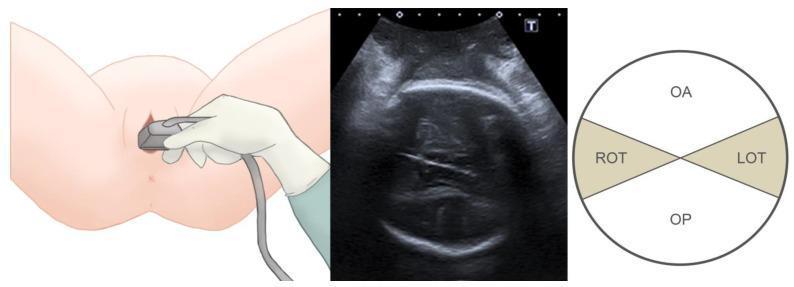
- Intrapartum ultrasound (transperineal probe, transverse plane) is now the gold standard for confirming fetal head position when clinical examination is uncertain
- Rotation is less than or equal to 45 degrees (left or right occiput anterior to OA, or left or right OP to OP) on classification
- Roberts and Hedges' Clinical Procedures in Emergency, p.1219; Pfenninger & Fowler's Procedures for Primary Care, p.1219
2. Conservative / Expectant Management
Most OP positions (up to 90%) will spontaneously rotate to OA during labor. Expectant management is appropriate when:
- Fetal heart rate is reassuring
- Labor is progressing (even if slowly)
- No indication for immediate intervention
Maternal Positioning
Any position that causes the mother to curl forward from the hips may encourage the fetus to rotate spontaneously. Options include:
| Position | Rationale |
|---|---|
| Hands and knees | Gravity shifts fetal weight anteriorly; most commonly recommended |
| Squatting | Opens the pelvic outlet; encourages descent and rotation |
| Lateral (side-lying) | Can promote rotation toward OA |
| Ambulating | Encourages fetal movement and rotation |
| Back arched | Theoretically creates discomfort for the fetus, encouraging it to turn |
The underlying principle is that these positions make the fetus "uncomfortable" and encourage self-rotation. However, a 2024 Cochrane review (Hofmeyr & Moreri-Ntshabele, 2024 - PMID 38329185) found that maternal postures for fetal malposition in late pregnancy did not consistently show clear benefit for reducing adverse outcomes - so expectant observation alongside positional changes is reasonable.
- Pfenninger & Fowler's Procedures for Primary Care, p.1220
3. Manual Rotation
If positional changes fail, manual rotation can be attempted:
Technique:
- Place mother in lithotomy, lateral Sims', or hands and knees position
- Insert the dominant hand into the posterior pelvis behind the occiput
- During a contraction with maternal pushing, attempt to rotate and flex the head toward OA
- If the fetus is direct (straight) OP - use the dominant hand
- If the fetus is partially rotated - use whichever hand most easily rotates it in the direction of shortest distance to OA
Manual rotation is generally attempted before considering instrumental delivery. Rotation should also ideally be attempted before amniotomy if the head is not deeply engaged, to reduce cord prolapse risk.
- Pfenninger & Fowler's Procedures for Primary Care, p.1220
4. Instrumental Delivery
Vacuum Extraction
- Apply vacuum cup over the posterior fontanelle (or over the sagittal suture up to 3 cm anterior to the posterior fontanelle)
- The vacuum can assist rotation from OP to OA during traction
- For OP deliveries specifically, the vacuum handle may point toward the floor during traction (due to altered angles compared to OA deliveries)
- Do not rock or torque the cup - only steady, gentle traction
Steps (ABCDEFG mnemonic):
- A - Adequate anesthesia
- B - Bladder empty
- C - Cervix completely dilated
- D - Determine position (confirm OP by palpation/ultrasound)
- E - Equipment ready
- F - Fix cup over posterior fontanelle
- G - Gentle traction with contractions
Forceps Delivery
- For OP, rotation forceps (e.g., Kielland's) can be used to rotate from OP to OA before traction
- Classification: OP is rotation ≤45 degrees from posterior to posterior, or the operator may rotate to OA
- Outlet forceps may also be used for face-to-pubis (direct OP) delivery - the fetus delivers with the face facing upward
- Pfenninger & Fowler's Procedures for Primary Care, p.1177; Creasy & Resnik's Maternal-Fetal Medicine
5. Delivery in Persistent OP ("Face-to-Pubis")
If rotation cannot be achieved, delivery in the persistent OP position is possible:
- The fetal occiput descends toward the perineum and the face sweeps under the symphysis
- A larger presenting diameter (occipito-frontal, ~11.5 cm vs. suboccipito-bregmatic ~9.5 cm in OA) passes through the pelvis
- This is associated with a higher rate of perineal tears (including 3rd and 4th degree)
- Episiotomy may be considered to reduce the risk of severe perineal lacerations, though evidence is mixed
6. Cesarean Section
Cesarean delivery is indicated when:
- Labor arrest persists: no cervical change for 2 hours with adequate contractions (or 2-4 hours of oxytocin augmentation without progress)
- Instrumental delivery is not feasible or fails
- Fetal distress (non-reassuring CTG)
- Absolute cephalopelvic disproportion (CPD)
- Failed manual/instrumental rotation
- Pfenninger & Fowler's Procedures for Primary Care, p.1219
7. Augmentation
- Oxytocin augmentation can be used if labor arrest occurs during either the first or second stage
- An intrauterine pressure catheter (IUPC) may be inserted to objectively assess contraction adequacy
- Arrest = no cervical change with adequate contractions for 2 hours
Summary Algorithm
OP Diagnosed
     │
     ├─► Fetal heart rate reassuring?
     │         YES → Expectant management + maternal positioning
     │         NO  → Expedite delivery
     │
     ├─► Labor progressing?
     │         YES → Continue monitoring, encourage positions
     │         NO  → Augment with oxytocin
     │
     ├─► Second stage - attempt manual rotation
     │         Success → Continue to vaginal delivery (OA)
     │         Fail    → Instrumental delivery (vacuum/forceps)
     │                        └── Fail or not feasible → Cesarean
     │
     └─► Persistent OP with descent → Face-to-pubis delivery
                                        (higher perineal tear risk)
Key Points to Remember:
- Most OP positions rotate spontaneously to OA - patience is key
- Back pain in labor is a classic symptom
- Maternal repositioning (hands and knees) is the first-line conservative approach
- Manual rotation should be attempted before instrumental delivery
- If all else fails, direct OP delivery face-to-pubis is possible but carries greater maternal morbidity
- Cesarean is indicated for labor arrest, failed instrumental delivery, or fetal compromise
This is a shared conversation. Sign in to Orris to start your own chat.