
ABG analysis
Reading File
ABG (Arterial Blood Gas) analysis is a systematic approach to interpreting pH, PaCO2, PaO2, HCO3-, and base excess to identify acid-base disorders and oxygenation status.
Searching sources...
Finding Sources
Finding Sources
Reading File
Reading File
Reading File
Reading File
Reading File
Reading File
Loading Image
Reading File
Loading Image
Reading File
Now I have comprehensive information from authoritative textbooks. Let me compile a thorough ABG analysis guide.
Arterial Blood Gas (ABG) Analysis
Normal Values
| Parameter | Normal Range |
|---|---|
| pH | 7.35 - 7.45 |
| PaCO2 | 35 - 45 mm Hg |
| PaO2 | 70 - 95 mm Hg (age-dependent) |
| HCO3- | 22 - 26 mEq/L |
| SaO2 | 95 - 100% |
| Base Excess | -2 to +2 mEq/L |
PaO2 (sitting) = 104.2 - (0.27 × age in years) - Goldman-Cecil Medicine
Step-by-Step ABG Interpretation
Step 1 - Assess pH
- < 7.35 = Acidemia
- 7.35 - 7.45 = Normal (but a mixed disorder may still be present)
- > 7.45 = Alkalemia
Step 2 - Determine the Primary Disorder
Look at PaCO2 and HCO3- to identify what's driving the pH change:
| Disorder | pH | PaCO2 | HCO3- |
|---|---|---|---|
| Respiratory Acidosis | ↓ | ↑ (primary) | ↑ (compensation) |
| Respiratory Alkalosis | ↑ | ↓ (primary) | ↓ (compensation) |
| Metabolic Acidosis | ↓ | ↓ (compensation) | ↓ (primary) |
| Metabolic Alkalosis | ↑ | ↑ (compensation) | ↑ (primary) |
Key rule: If PaCO2 and pH move in opposite directions, it's respiratory. If they move in the same direction, it's metabolic.
Step 3 - Check for Compensation (Are "Renal Rules" Met?)
If the measured compensatory value matches the predicted value, it's a simple disorder. If it doesn't match, a mixed disorder is present.
Compensation Formulas (Costanzo Physiology, 7th ed., Table 7.3):
| Disorder | Predicted Compensation |
|---|---|
| Metabolic Acidosis | ↓ PaCO2 = 1.3 × (24 - HCO3-) [Winter's Formula: PaCO2 = 1.5(HCO3-) + 8 ± 2] |
| Metabolic Alkalosis | ↑ PaCO2 = 0.7 × (HCO3- - 24) |
| Acute Respiratory Acidosis | ↑ HCO3- = 0.1 × (PaCO2 - 40) |
| Chronic Respiratory Acidosis | ↑ HCO3- = 0.4 × (PaCO2 - 40) |
| Acute Respiratory Alkalosis | ↓ HCO3- = 0.2 × (40 - PaCO2) |
| Chronic Respiratory Alkalosis | ↓ HCO3- = 0.4 × (40 - PaCO2) |
"The compensatory response is always in the same direction as the original disturbance." - Costanzo Physiology, 7th ed.
Step 4 - Calculate Anion Gap (if metabolic acidosis present)
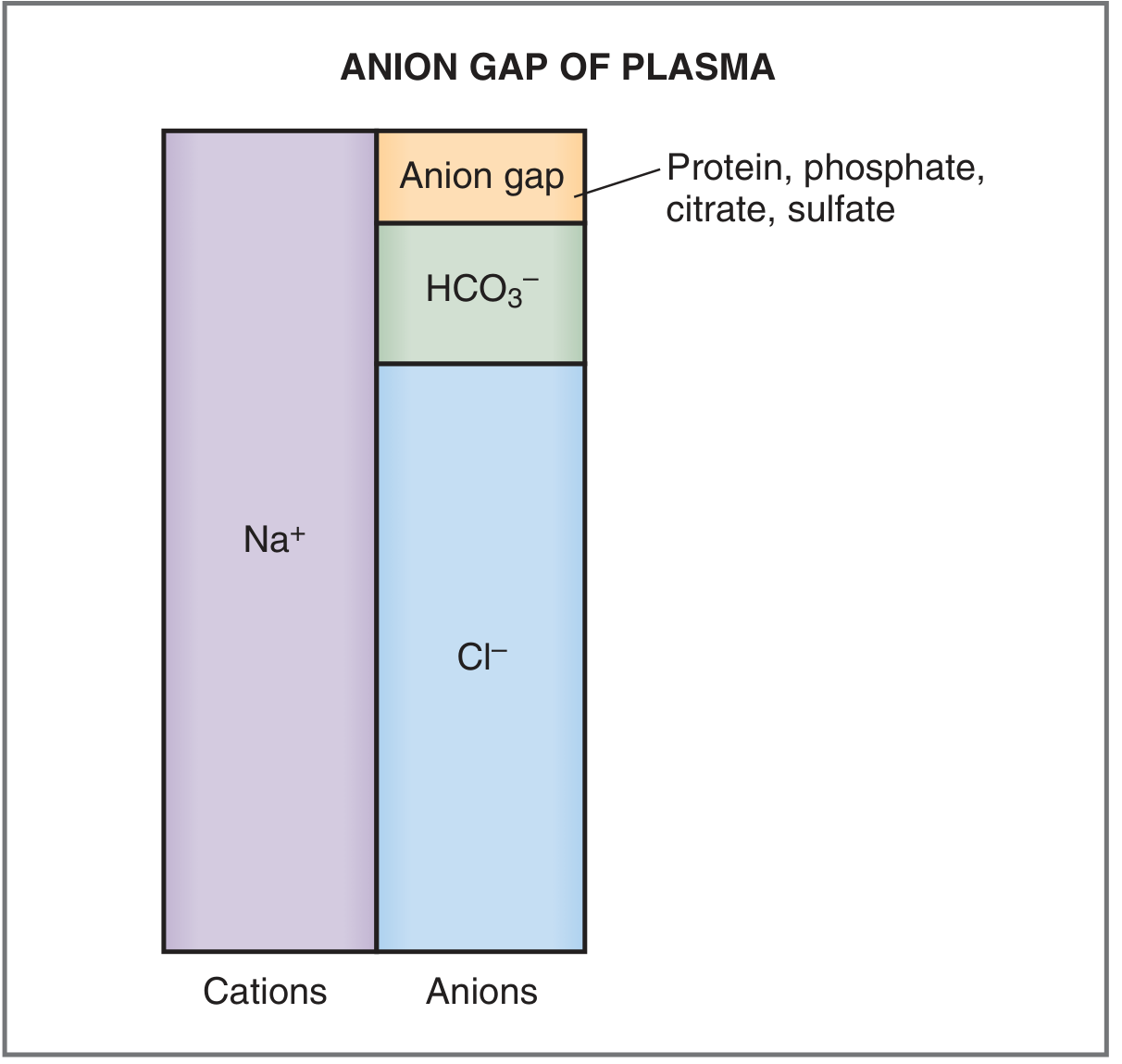
Anion Gap (AG) = [Na+] - ([HCO3-] + [Cl-])
- Normal AG = 8-16 mEq/L (often cited as ~12 ± 4)
- The gap represents unmeasured anions: plasma proteins, phosphate, citrate, sulfate
High Anion Gap Metabolic Acidosis (HAGMA)
Mnemonic: MUDPILES
- Methanol
- Uremia (chronic renal failure)
- Diabetic ketoacidosis
- Propylene glycol / Paraldehyde
- Isoniazid / Iron
- Lactic acidosis
- Ethylene glycol
- Salicylates
Normal Anion Gap Metabolic Acidosis (NAGMA) - Hyperchloremic
Mnemonic: HARDUP
- Diarrhea, RTA (renal tubular acidosis), Addison's disease, pancreatic fistula, ureteral diversions
Step 5 - Assess Oxygenation
A-a Gradient
P(A-a)O2 = FiO2(PB - PH2O) - (PaO2 + PaCO2/0.8)
Simplified at room air (sea level):
P(A-a)O2 = 150 - PaO2 - (PaCO2/0.8)
Normal P(A-a)O2 = Age/4 + 4
| Mechanism of Hypoxemia | A-a Gradient |
|---|---|
| V/Q mismatch (pneumonia, PE) | Increased |
| Diffusion impairment (ILD) | Increased |
| R-to-L shunt | Increased |
| Hypoventilation | Normal |
| High altitude / low FiO2 | Normal |
- Goldman-Cecil Medicine, Table 89-1
Acid-Base Map
This map plots PCO2 (y-axis) vs. [HCO3-] (x-axis) with pH isopleths. Each shaded band represents a simple disorder:
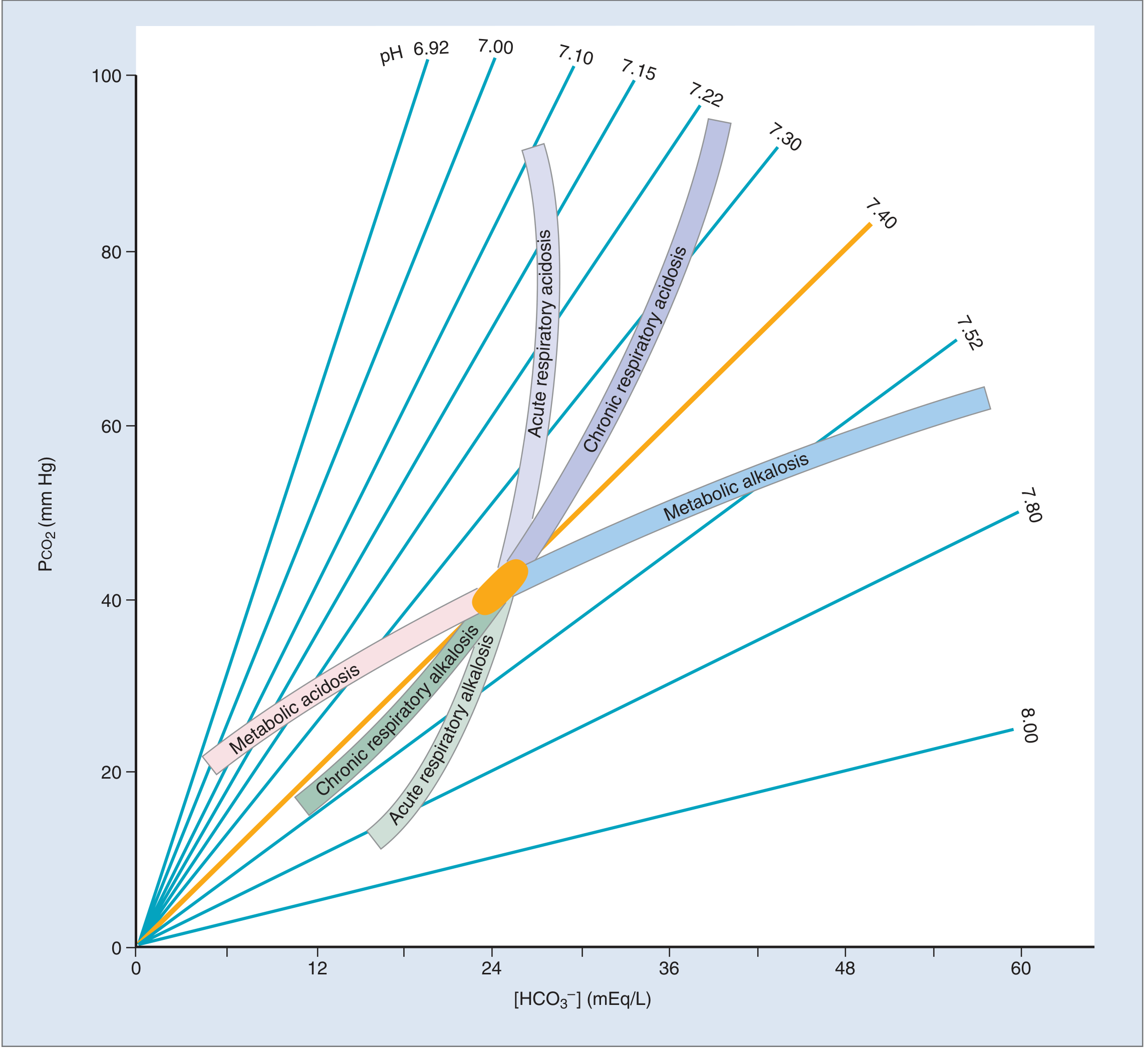
- If the patient's values fall within a shaded band: single simple disorder
- If values fall between bands: mixed acid-base disorder
- Costanzo Physiology, 7th ed., Fig. 7.10
Summary Table of the 4 Simple Disorders
| Disorder | pH | PaCO2 | HCO3- | Resp. Compensation | Renal Compensation |
|---|---|---|---|---|---|
| Metabolic Acidosis | ↓ | ↓ | ↓ (1°) | Hyperventilation | ↑ HCO3- reabsorption |
| Metabolic Alkalosis | ↑ | ↑ | ↑ (1°) | Hypoventilation | ↑ HCO3- excretion |
| Respiratory Acidosis | ↓ | ↑ (1°) | ↑ | None | ↑ HCO3- reabsorption |
| Respiratory Alkalosis | ↑ | ↓ (1°) | ↓ | None | ↓ HCO3- reabsorption |
Quick Clinical Approach at the Bedside
- pH acidemia or alkalemia?
- Which parameter is most abnormal and consistent with the pH change? (That's the primary disorder)
- Is compensation appropriate? (Use the formulas above)
- If metabolic acidosis: calculate AG
- If high AG: calculate delta-delta ratio = (AG - 12) / (24 - HCO3-): ratio 1-2 = pure HAGMA; <1 = NAGMA coexisting; >2 = concurrent metabolic alkalosis
- Assess oxygenation: PaO2, SaO2, A-a gradient
Sources:
- Goldman-Cecil Medicine, Systemic ABG Analysis section
- Costanzo Physiology, 7th Edition, Acid-Base Disorders, pp. 330-335
- Tintinalli's Emergency Medicine, ABG Analysis chapter
This is a shared conversation. Sign in to Orris to start your own chat.