
Cranial nerves from zero to master
cranial nerves complete guide anatomy function clinical testing
cranial nerves overview diagram all 12 brain
The Cranial Nerves: Zero to Master
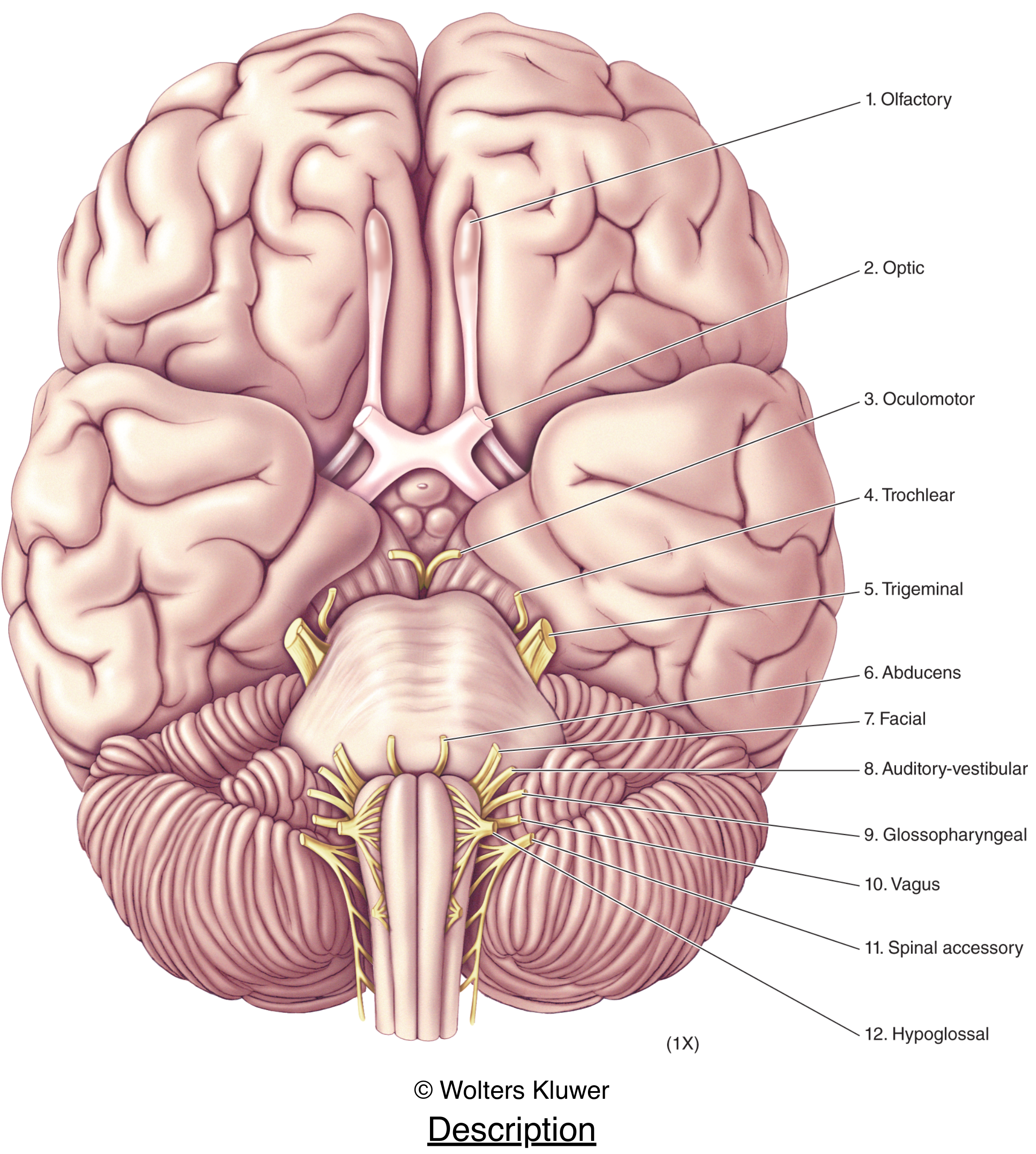
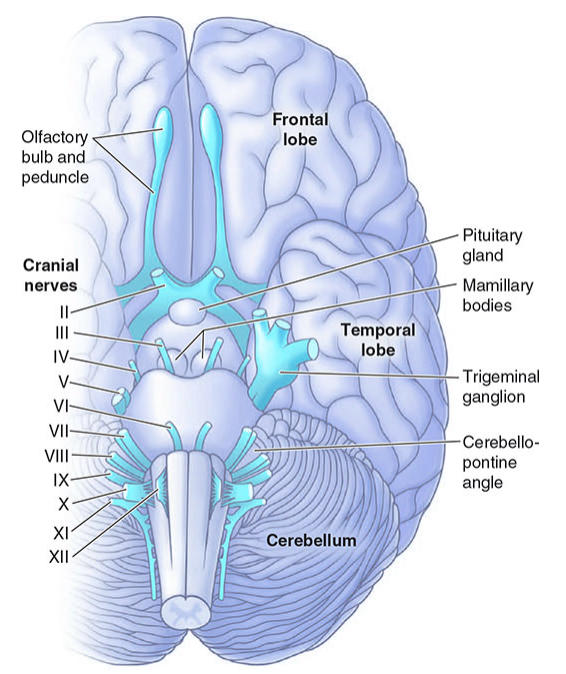
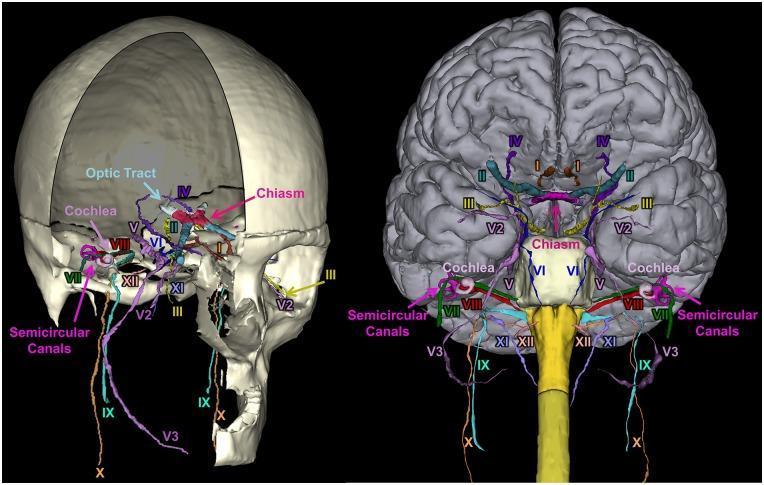
The Big Picture
Mnemonic: Names
Oh Oh Oh To Touch And Feel Very Good Velvet, Ah Heavens! (Olfactory, Optic, Oculomotor, Trochlear, Trigeminal, Abducens, Facial, Vestibulocochlear, Glossopharyngeal, Vagus, Accessory, Hypoglossal)
Mnemonic: Fiber Types (Sensory/Motor/Both)
Some Say Marry Money But My Brother Says Big Brains Matter More (S, S, M, M, B, M, B, S, B, B, M, M)
CN 0 — Nervus Terminalis (Terminal Nerve)
CN I — Olfactory Nerve
- Fiber type: Special sensory (SVA)
- Origin: Olfactory receptor neurons (bipolar) in the olfactory epithelium (roof of nasal cavity)
- Pathway: Axons form the olfactory fila → pass through the cribriform plate of the ethmoid → synapse in the olfactory bulb → olfactory tract → primary olfactory cortex (piriform cortex, amygdala)
- Key fact: Only cranial nerve that does NOT relay through the thalamus before reaching cortex
- Foramen: Cribriform plate (numerous small foramina)
- Clinical test: Each nostril tested separately with familiar non-pungent odors (coffee, peppermint); avoid ammonia (CN V stimulation)
- Lesions: Anosmia (fracture of cribriform plate, meningioma of olfactory groove, head trauma, COVID-19); parosmia or phantosmia with partial lesions; Foster Kennedy syndrome = ipsilateral optic atrophy + anosmia + contralateral papilledema (frontal lobe/olfactory groove meningioma)
CN II — Optic Nerve
- Fiber type: Special sensory (SSA) — actually a CNS white matter tract
- Origin: Retinal ganglion cells → optic nerve → optic chiasm (nasal fibers decussate) → optic tract → lateral geniculate nucleus (thalamus) → optic radiations → primary visual cortex (V1, calcarine sulcus)
- Foramen: Optic canal (with ophthalmic artery)
- Clinical test: Visual acuity (Snellen chart), visual fields (confrontation testing), color vision, fundoscopy (disc, vessels, macula)
- Pupillary pathway: CN II afferent → pretectal nucleus → bilateral Edinger-Westphal nuclei → CN III efferent → sphincter pupillae (consensual + direct reflex)
- Key lesions by location:
| Location | Defect |
|---|---|
| Optic nerve (prechiasm) | Monocular blindness; RAPD (Marcus Gunn pupil) |
| Optic chiasm (midline compression — pituitary adenoma) | Bitemporal hemianopia |
| Optic tract | Contralateral homonymous hemianopia |
| Meyer's loop (temporal lobe) | "Pie in the sky" — contralateral superior quadrantanopia |
| Parietal lobe (dorsal optic radiation) | Contralateral inferior quadrantanopia |
| Occipital cortex | Contralateral homonymous hemianopia with macular sparing |
CN III — Oculomotor Nerve
- Fiber types: Somatic motor (GSE) + parasympathetic (GVE)
- Nucleus: Oculomotor nucleus (midbrain, at level of superior colliculus); Edinger-Westphal nucleus (parasympathetic)
- Muscles supplied: Superior rectus, inferior rectus, medial rectus, inferior oblique, levator palpebrae superioris
- Parasympathetic: Pre-ganglionic → ciliary ganglion → post-ganglionic → sphincter pupillae (miosis) + ciliary muscle (accommodation)
- Foramen: Superior orbital fissure (with IV, V1, VI)
- Course: Exits midbrain between PCA and SCA → travels in the lateral wall of the cavernous sinus → enters orbit through SOF
- Clinical test: Inspect ptosis, eye position; test H-pattern of gaze; pupil reaction
- Lesions:
- Complete CN III palsy: Eye is "down and out," ptosis, dilated non-reactive pupil (mydriasis — because parasympathetic fibers travel on the OUTSIDE of the nerve)
- Surgical CN III = posterior communicating artery (PCoA) aneurysm — pupil INVOLVED (compressed parasympathetics)
- Medical CN III = diabetes/hypertension (ischemic) — pupil SPARED (internal fibers spared by ischemia)
CN IV — Trochlear Nerve
- Fiber type: Somatic motor (GSE)
- Unique features: Only CN to exit the dorsal brainstem; longest intracranial course; thinnest CN; fully decussates before emerging
- Nucleus: Trochlear nucleus (midbrain, at level of inferior colliculus)
- Muscle supplied: Superior oblique (intorts, depresses, abducts the eye)
- Action: Depresses the eye when adducted ("looking at your nose tip")
- Foramen: Superior orbital fissure
- Clinical test: Head tilt test (Bielschowsky) — patient tilts head away from affected side to compensate
- Lesions: Vertical diplopia worse on looking down and in (e.g., reading, walking downstairs); head tilt toward opposite shoulder. Most common cause of isolated vertical diplopia. Often from closed head trauma (dorsal midbrain vulnerable).
CN V — Trigeminal Nerve
- Fiber types: Somatic sensory (GSA) + branchial motor (SVE) — the largest CN
- Nuclei:
- Main (principal) sensory nucleus (pons): fine touch, pressure
- Nucleus of spinal tract (extends from pons → cervical C2–4): pain and temperature
- Mesencephalic nucleus (midbrain): proprioception from jaw muscles
- Motor nucleus (pons): mastication muscles
- Gasserian (semilunar) ganglion: Sensory ganglion at apex of petrous bone in Meckel's cave
- Three divisions:
| Division | Foramen | Sensory Supply | Motor |
|---|---|---|---|
| V1 (Ophthalmic) | Superior orbital fissure | Forehead, scalp, cornea, upper eyelid, nose bridge, meninges | None |
| V2 (Maxillary) | Foramen rotundum | Cheek, lower eyelid, upper lip, upper teeth, palate | None |
| V3 (Mandibular) | Foramen ovale | Chin, lower lip, lower teeth, tongue, TMJ, EAC | Masseter, temporalis, pterygoids, tensor tympani, tensor veli palatini, mylohyoid, ant. digastric |
- Parasympathetics: CN III, VII, IX all hitch-hike on V branches (ciliary, pterygopalatine, submandibular, otic ganglia)
- Reflexes: Corneal reflex (V1 afferent, VII efferent), jaw-jerk reflex (V3 afferent + efferent)
- Clinical test: Facial sensation (V1/V2/V3 zones with cotton and pinprick), corneal reflex, jaw deviation (toward side of lesion if motor affected)
- Key lesions: Trigeminal neuralgia (tic douloureux — lancinating pain V2/V3, usually vascular compression), herpes zoster (ophthalmic division → rash on forehead + keratitis), acoustic neuroma (compresses at CPA), Meckel's cave tumors
CN VI — Abducens Nerve
- Fiber type: Somatic motor (GSE)
- Nucleus: Abducens nucleus (pons, floor of 4th ventricle) — also contains interneurons crossing to contralateral CN III for conjugate gaze
- Muscle supplied: Lateral rectus (abducts the eye)
- Foramen: Superior orbital fissure
- Course: Longest intracranial course running along the clivus → enters Dorello's canal → cavernous sinus → SOF. Most vulnerable CN to raised intracranial pressure (false localizing sign).
- Clinical test: Lateral gaze; horizontal diplopia (worse on ipsilateral gaze)
- Lesions: Esotropia, inability to abduct eye. Foville syndrome (pontine lesion = ipsilateral CN VI + VII + ipsilateral gaze palsy). Gradenigo syndrome (petrous apex infection = CN VI palsy + ipsilateral facial pain + otitis media).
CN VII — Facial Nerve
-
Fiber types: Branchial motor (SVE), somatic sensory (GSA), special sensory taste (SVA), parasympathetic (GVE) — "tears, snots, tastes, salivates, moves the face, and dampens sounds" (Localization in Clinical Neurology, 8e)
-
Nucleus: Facial motor nucleus (caudal pons, ventrolateral tegmentum)
-
Segments: (1) nucleus & fascicles, (2) cisternal, (3) intratemporal (fallopian canal), (4) peripheral
-
Motor branches (peripheral): Temporal, Zygomatic, Buccal, Marginal mandibular, Cervical (To Zanzibar By Motor Car)
-
Nervus intermedius (Wrisberg): Carries taste (anterior 2/3 tongue via chorda tympani → submandibular ganglion → sublingual & submandibular glands), lacrimation (via greater petrosal nerve → pterygopalatine ganglion → lacrimal gland), and sensation to external auditory canal
-
Foramen: Internal auditory meatus → facial canal in petrous bone → stylomastoid foramen
-
Critical anatomy: Facial nerve wraps around the abducens nucleus (genu) in the pons → lesion there = combined VI + VII palsy
-
LMN vs UMN facial palsy (HIGH-YIELD):
| Feature | LMN (e.g., Bell's palsy) | UMN (e.g., stroke) |
|---|---|---|
| Forehead spared? | No — entire face paralyzed | Yes — forehead spared (bilateral cortical supply) |
| Hyperacusis? | Yes (stapedius branch) | No |
| Taste affected? | Yes (if lesion proximal to chorda tympani) | No |
| Lacrimation affected? | Yes (if proximal) | No |
- Key lesions: Bell's palsy (idiopathic LMN, HSV-1 reactivation), Ramsay Hunt syndrome (herpes zoster, VZV, ear pain + vesicles + facial palsy), acoustic neuroma (CPA), parotid tumor (peripheral), Lyme disease, sarcoidosis, Guillain-Barré
CN VIII — Vestibulocochlear Nerve
- Fiber type: Special sensory (SSA) — two distinct components
- Foramen: Internal auditory meatus (with CN VII)
Cochlear Division (Hearing)
- Pathway: Hair cells of organ of Corti → spiral ganglion → cochlear nuclei (medullopontine junction) → dorsal/ventral acoustic striae → bilateral projections via lateral lemniscus → inferior colliculus → medial geniculate nucleus (thalamus) → auditory cortex (Heschl's gyri, superior temporal gyrus)
- Tonotopy: Low frequency = cochlear apex; high frequency = base
- Clinical test: Whisper test, Weber (tuning fork to vertex), Rinne (AC vs BC)
| Conductive loss | Sensorineural loss | |
|---|---|---|
| Weber | Lateralizes to affected ear | Lateralizes to unaffected ear |
| Rinne | BC > AC (negative Rinne) | AC > BC (positive Rinne, reduced) |
Vestibular Division (Balance)
- Receptors: Utricle & saccule (linear acceleration), cristae of semicircular canals (angular acceleration)
- Pathway: Scarpa's ganglion → vestibular nuclei (medulla/pons) → cerebellum, spinal cord (VST), MLF (conjugate eye movements), thalamus → cortex
- Clinical test: Head impulse test (HIT), Dix-Hallpike (BPPV), Romberg, gait
- Key lesions: Acoustic neuroma (vestibular schwannoma), Ménière's disease (episodic vertigo + tinnitus + fluctuating hearing loss + aural fullness), BPPV, labyrinthitis, presbycusis
CN IX — Glossopharyngeal Nerve
- Fiber types: Branchial motor (SVE), visceral motor parasympathetic (GVE), visceral sensory (GVA), general sensory (GSA), special sensory taste (SVA) — truly mixed
- Nuclei: Nucleus ambiguus (rostral, motor), inferior salivatory nucleus (parasympathetic), nucleus solitarius (taste/visceral sensory), spinal nucleus V (exteroception)
- Foramen: Jugular foramen (with X and XI)
- Ganglia: Superior and petrous (inferior) ganglia
- Key functions:
- Motor: stylopharyngeus muscle (pharyngeal elevator)
- Parasympathetic: inferior salivatory nucleus → tympanic nerve (Jacobson's nerve) → lesser petrosal nerve → otic ganglion → auriculotemporal nerve → parotid gland
- Sensory: posterior 1/3 tongue (taste + sensation), oropharynx, tonsils, tympanic membrane (Eustachian tube, mastoid via Jacobson's nerve)
- Carotid sinus nerve (nerve of Hering): Carries chemoreceptors from carotid body and baroreceptors from carotid sinus → nucleus solitarius → cardiovascular regulation
- Reflexes: Gag reflex (IX afferent, X efferent)
- Clinical test: Gag reflex, soft palate sensation, taste posterior tongue
- Key lesions: Glossopharyngeal neuralgia (lancinating throat/ear pain triggered by swallowing), jugular foramen syndrome (IX+X+XI), parotid gland surgery complications
CN X — Vagus Nerve
- Fiber types: Visceral motor parasympathetic (GVE), visceral sensory (GVA), branchial motor (SVE), somatic sensory (GSA)
- Nuclei:
- Dorsal motor nucleus of vagus (floor of 4th ventricle): preganglionic parasympathetics to thoracic/abdominal viscera (heart, lungs, gut to splenic flexure)
- Nucleus ambiguus: Motor to striated muscles of pharynx/larynx/soft palate
- Nucleus solitarius: Taste (epiglottis), visceral afferents
- Spinal nucleus V: Somatic sensation (external ear — nerve of Arnold)
- Foramen: Jugular foramen (in same dural sheath as CN XI)
- Ganglia: Jugular (somatic afferent) and nodose (visceral afferent)
- Key branches:
- Auricular branch (Arnold's nerve): skin of external ear + EAC → explains Arnold's reflex cough
- Pharyngeal ramus → pharyngeal plexus (motor to pharynx + soft palate except tensor veli palatini)
- Superior laryngeal nerve: external branch (cricothyroid motor) + internal branch (laryngeal sensory above vocal cords)
- Recurrent laryngeal nerve (RLN): All intrinsic laryngeal muscles except cricothyroid; left RLN loops under aortic arch (vulnerable to mediastinal pathology); right RLN loops under subclavian artery
- Clinical test: Palate elevation symmetry ("say aah" — uvula deviates away from lesion), hoarseness, gag reflex, voice quality
- Key lesions: Hoarseness (RLN palsy — thyroid surgery, lung cancer, aortic aneurysm), dysphagia, nasal regurgitation; autonomic dysfunction (cardiac, GI); vagal syncope
CN XI — Spinal Accessory Nerve
- Fiber type: Branchial motor (SVE) — purely motor
- Unique anatomy: Has spinal and cranial roots:
- Cranial root: nucleus ambiguus in medulla → exits skull via jugular foramen → joins vagus (contributes to pharyngeal/laryngeal muscles)
- Spinal root: anterior horn cells C1–C5/6 → ascends through foramen magnum → exits through jugular foramen → descends in neck
- Foramen: Jugular foramen
- Muscles supplied:
- Sternocleidomastoid (SCM): head rotation toward opposite side, ipsilateral flexion
- Trapezius (upper): shoulder shrug, scapular elevation
- Clinical test: Resist shoulder shrug (trapezius), resist head turning against resistance (SCM); note asymmetric trapezius bulk
- Lesions: Shoulder droop, winging of scapula, inability to shrug, weakness turning head to contralateral side; common cause = iatrogenic (posterior triangle lymph node biopsy, carotid endarterectomy)
CN XII — Hypoglossal Nerve
- Fiber type: Somatic motor (GSE) — purely motor
- Nucleus: Hypoglossal nucleus (paramedian medulla, beneath hypoglossal trigone, 4th ventricle floor); extends from caudal medulla to pontomedullary junction
- Course: Fibers emerge as 10–12 rootlets in the preolivary sulcus → hypoglossal canal (anterior condylar foramen) → descends in neck near internal carotid/IJ → turns medially toward tongue
- Ansa hypoglossi (ansa cervicalis): Descending ramus (C1 hitchhiking on CN XII) + descending cervical ramus (C2–C3) → supplies infrahyoid (strap) muscles
- Supranuclear control: Crossed corticobulbar fibers (mainly from contralateral cortex); genioglossus has crossed control (tongue deviates toward lesion in UMN injury)
- Muscles: All intrinsic tongue muscles + hyoglossus, styloglossus, genioglossus, geniohyoid
- Clinical test: Tongue at rest (fasciculations = LMN), tongue protrusion (deviates toward side of LMN lesion; deviates away from side of UMN lesion), tongue strength
- Lesions: LMN = ipsilateral atrophy + fasciculations + deviation toward lesion (e.g., skull base tumor, carotid dissection); UMN = deviation away from lesion (contralateral hemisphere lesion)
Master Summary Table
| CN | Name | Foramen | Fiber Types | Key Function | Clinical Test |
|---|---|---|---|---|---|
| 0 | Nervus terminalis | Cribriform plate | — | Unknown/pheromonal | None established |
| I | Olfactory | Cribriform plate | SVA | Smell | Coffee/peppermint test |
| II | Optic | Optic canal | SSA (CNS tract) | Vision | VA, fields, fundoscopy |
| III | Oculomotor | SOF | GSE, GVE | Most eye movements, lid, pupil | H-pattern, pupil light reflex |
| IV | Trochlear | SOF | GSE | Superior oblique (depression in adduction) | Vertical diplopia, Bielschowsky |
| V | Trigeminal | SOF (V1), FR (V2), FO (V3) | GSA, SVE | Face sensation, mastication | Cotton/pin face, jaw, corneal reflex |
| VI | Abducens | SOF | GSE | Lateral rectus (abduction) | Lateral gaze |
| VII | Facial | IAM → stylomastoid F | SVE, GVE, SVA, GSA | Facial expression, taste ant 2/3, lacrimation, salivation | Facial symmetry, taste |
| VIII | Vestibulocochlear | IAM | SSA | Hearing, balance | Weber, Rinne, HIT, Dix-Hallpike |
| IX | Glossopharyngeal | Jugular F | SVE, GVE, GVA, GSA, SVA | Taste post 1/3, gag, parotid, carotid sinus | Gag reflex |
| X | Vagus | Jugular F | GVE, GVA, SVE, GSA | Palate/larynx motor, visceral parasymp. | Palate elevation, voice |
| XI | Spinal accessory | Jugular F | SVE | SCM, trapezius | Shrug, head turn |
| XII | Hypoglossal | Hypoglossal canal | GSE | Tongue motor | Tongue protrusion |
Parasympathetic Ganglia (High-Yield)
| CN | Pre-ganglionic nucleus | Ganglion | Target |
|---|---|---|---|
| III | Edinger-Westphal | Ciliary | Sphincter pupillae (miosis), ciliary muscle (accommodation) |
| VII | Superior salivatory | Pterygopalatine | Lacrimal gland, nasal/palatine glands |
| VII | Superior salivatory | Submandibular | Sublingual + submandibular salivary glands |
| IX | Inferior salivatory | Otic | Parotid gland |
| X | Dorsal motor nucleus | Terminal ganglia (in/near organs) | Heart, lungs, esophagus → transverse colon |
Key Brainstem Syndromes Involving Cranial Nerves
| Syndrome | Location | CNs Affected | Other Features |
|---|---|---|---|
| Weber | Midbrain (cerebral peduncle) | III (ipsilateral) | Contralateral hemiplegia |
| Claude | Midbrain (tegmentum) | III (ipsilateral) | Contralateral ataxia (red nucleus) |
| Benedikt | Midbrain | III (ipsilateral) | Contralateral ataxia + tremor |
| Millard-Gubler | Pons (ventral) | VI, VII (ipsilateral) | Contralateral hemiplegia |
| Foville | Pons (tegmentum) | VI, VII + gaze palsy (ipsilateral) | Contralateral hemiplegia |
| Gradenigo | Petrous apex | VI | Ipsilateral V1/V2 pain, otitis media |
| Lateral medullary (Wallenberg) | Medulla (PICA) | V, IX, X, XI (ipsilateral) | Ipsilateral Horner, contralateral spinothalamic loss, ataxia |
| Medial medullary (Dejerine) | Medulla (ASA) | XII (ipsilateral) | Contralateral hemiplegia + proprioceptive loss |
| Jugular foramen (Vernet) | Jugular foramen | IX, X, XI | Dysphagia, hoarseness, shoulder weakness |
| Collet-Sicard | Jugular + hypoglossal | IX, X, XI, XII | Above + tongue palsy |
Cavernous Sinus
Clinical Approach to Cranial Nerve Examination (Sequential)
- CN I — Smell each nostril; note anosmia
- CN II — VA (Snellen), color vision (Ishihara), fields (confrontation), pupils (direct/consensual, RAPD), fundoscopy
- CN II + III — Pupillary light reflex
- CN III, IV, VI — Eye position at rest, H-pattern pursuits (look for diplopia, ptosis, nystagmus)
- CN V — Face sensation (V1/V2/V3), corneal reflex, jaw open/clench/deviation
- CN VII — Raise eyebrows, close eyes tight, show teeth, puff cheeks, taste (anterior tongue)
- CN VIII — Whisper test, Weber/Rinne; vestibular: HIT, Dix-Hallpike, Romberg
- CN IX, X — Gag reflex, palate symmetry on phonation, voice quality (nasal, hoarse, breathy)
- CN XI — Shoulder shrug (trapezius), head rotation against resistance (SCM)
- CN XII — Tongue rest (fasciculations?), protrusion (deviation?), rapid side-to-side
Create on summary image for fmge exam
A comprehensive medical study summary poster for FMGE exam on all 12 cranial nerves. Dark navy blue background with clean white and colored text. Title at top: "CRANIAL NERVES — FMGE MASTER SUMMARY" in bold yellow. Layout: A large organized table/chart with the following columns: CN number (Roman numeral), Name, Foramen, Fiber Type, Key Function, Clinical Test, Key Lesion/Syndrome. All 12 nerves listed in rows with alternating dark blue and slightly lighter blue rows. Row data: I Olfactory | Cribriform plate | SVA | Smell | Coffee/peppermint | Anosmia, Foster Kennedy II Optic | Optic canal | SSA (CNS) | Vision | VA, fields, fundoscopy | Bitemporal hemianopia (pituitary) III Oculomotor | SOF | GSE+GVE | Eye movement, pupil, lid | H-pattern, pupil | Down-and-out, PCoA aneurysm IV Trochlear | SOF | GSE | Superior oblique | Bielschowsky test | Vertical diplopia, head tilt V Trigeminal | SOF/FR/FO | GSA+SVE | Face sensation, mastication | Cotton/pin, corneal reflex | TN, herpes zoster ophthalmicus VI Abducens | SOF | GSE | Lateral rectus | Lateral gaze | Esotropia, raised ICP (false localizing) VII Facial | IAM→Stylomastoid | SVE+GVE+SVA | Facial expression, taste ant 2/3 | Facial symmetry | Bell's palsy, Ramsay Hunt VIII Vestibulocochlear | IAM | SSA | Hearing, balance | Weber/Rinne, HIT | Acoustic neuroma, Meniere's IX Glossopharyngeal | Jugular F | Mixed | Taste post 1/3, gag, parotid, carotid sinus | Gag reflex | GPN, jugular foramen syndrome X Vagus | Jugular F | Mixed | Palate/larynx, visceral parasymp | Palate elevation | Hoarseness (RLN), dysphagia XI Spinal Accessory | Jugular F | SVE | SCM, Trapezius | Shrug, head turn | Shoulder drop, post-triangle surgery XII Hypoglossal | Hypoglossal canal | GSE | Tongue motor | Tongue protrusion | LMN: deviates TO side; UMN: deviates AWAY Below the table, three compact colored boxes side by side: Box 1 (orange): "PARASYMPATHETIC CNs: III VII IX X — Ganglia: Ciliary / Pterygopalatine / Submandibular / Otic / Terminal" Box 2 (green): "MNEMONICS: Names: Oh Oh Oh To Touch And Feel Very Good Velvet Ah Heavens | Types: S S M M B M B S B B M M" Box 3 (red): "KEY SYNDROMES: Weber=III+contralat hemiplegia | Wallenberg=V,IX,X,XI+Horner | Foville=VI,VII+gaze palsy | Jugular F=IX,X,XI | Medial medulla=XII+contralat hemiplegia | UMN VII=forehead SPARED | Bell's palsy=forehead INVOLVED" Small footer: "SOF=Superior Orbital Fissure | FR=Foramen Rotundum | FO=Foramen Ovale | IAM=Internal Auditory Meatus | LMN deviates TO lesion | UMN deviates AWAY" Professional medical infographic style, highly legible, compact, exam-ready. All text clearly readable.
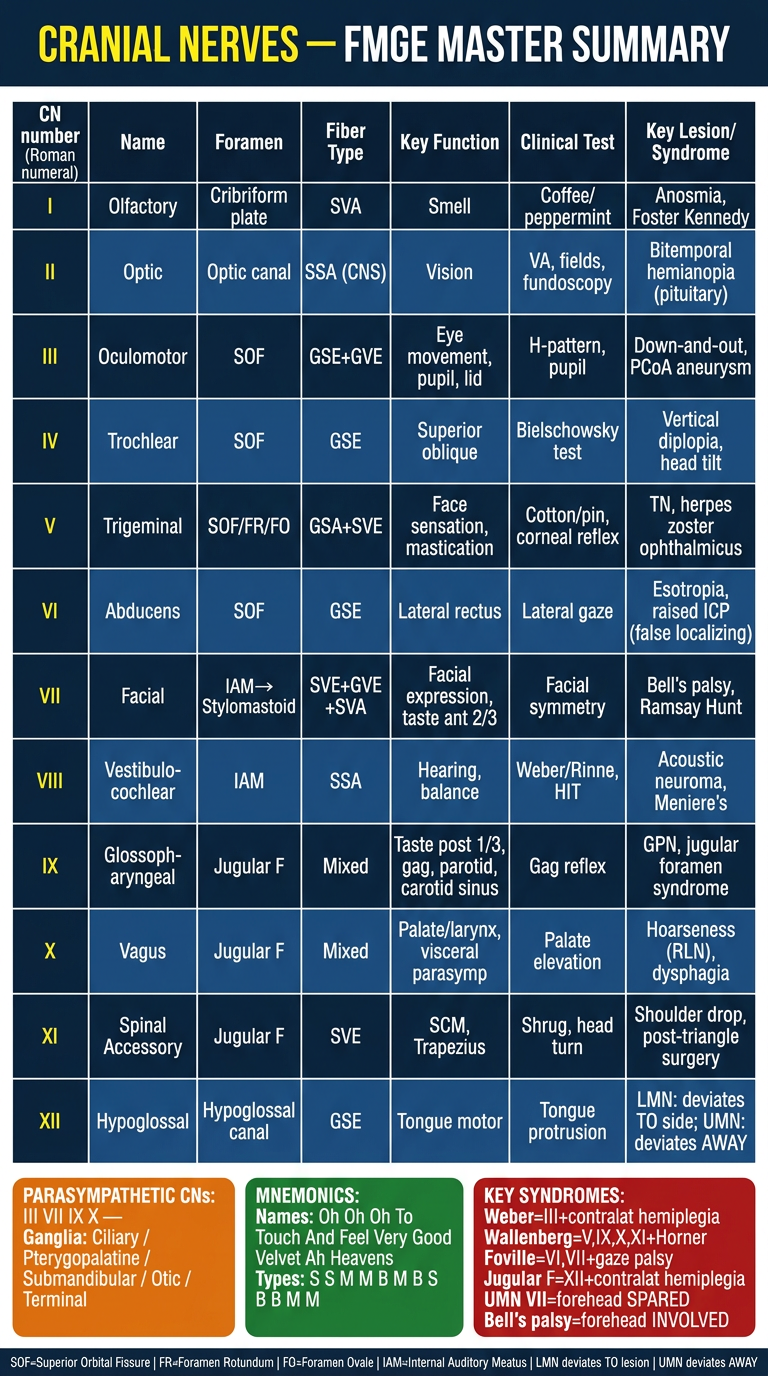
- Full table — CN number, name, foramen, fiber type, function, clinical test, and key lesion for every nerve
- Parasympathetic 4 — III, VII, IX, X with their ganglia
- Mnemonics — names and sensory/motor types
- High-yield syndromes — Weber, Wallenberg, Foville, Bell's palsy vs UMN facial, tongue deviation rules
- Foramen quick-reference footer
Create summary image with diagrams and everything in detail
Detailed medical anatomy poster titled "CRANIAL NERVES — COMPLETE OVERVIEW" on dark navy background. TOP SECTION: A clean anatomical diagram of the inferior (bottom) view of the brain showing all 12 cranial nerves emerging in order. Label each nerve with its Roman numeral and name. Show the brainstem (midbrain, pons, medulla), cerebellum, temporal lobes, frontal lobes, olfactory bulbs, optic chiasm, and pituitary. Draw each nerve as a yellow line exiting from the correct location. CN I from olfactory bulb, CN II from optic chiasm, CN III-IV from midbrain, CN V-VIII from pons, CN IX-XII from medulla. MIDDLE SECTION: Two columns Left column — "FIBER TYPE LEGEND" with colored icons: - SVA (Special Visceral Afferent) = smell/taste — purple - SSA (Special Somatic Afferent) = vision/hearing — blue - GSA (General Somatic Afferent) = touch/pain — green - GSE (General Somatic Efferent) = skeletal muscle — orange - SVE (Special Visceral Efferent) = branchial arch muscles — red - GVE (General Visceral Efferent) = parasympathetic — teal - GVA (General Visceral Afferent) = visceral sensation — pink Right column — "FORAMINA TABLE": CN I → Cribriform plate (ethmoid) CN II → Optic canal CN III, IV, V1, VI → Superior Orbital Fissure CN V2 → Foramen Rotundum CN V3 → Foramen Ovale CN VII, VIII → Internal Auditory Meatus CN IX, X, XI → Jugular Foramen CN XII → Hypoglossal Canal (Anterior Condylar Foramen) BOTTOM SECTION: Mnemonic boxes in bright colors: Box 1 yellow: "NAMES MNEMONIC: Oh Oh Oh To Touch And Feel Very Good Velvet Ah Heavens" with each word mapped to a nerve name Box 2 green: "FIBER TYPES: Some Say Marry Money But My Brother Says Big Brains Matter More (S=Sensory M=Motor B=Both)" Box 3 orange: "PARASYMPATHETIC 4: CN III (Ciliary ganglion→pupil) | CN VII (Pterygopalatine→lacrimal; Submandibular→salivary) | CN IX (Otic ganglion→parotid) | CN X (terminal ganglia→thorax/abdomen)" Professional medical education style, bright colors on dark navy, all text legible and well-spaced
Detailed medical study poster titled "CRANIAL NERVES III IV VI — EYE MOVEMENT MASTER" on deep dark background. TOP: Large diagram of the RIGHT EYE showing the 6 extraocular muscles with labeled arrows showing their actions: - Medial Rectus (CN III) → adduction (arrow pointing medially) - Lateral Rectus (CN VI) → abduction (arrow pointing laterally) - Superior Rectus (CN III) → elevation when abducted - Inferior Rectus (CN III) → depression when abducted - Superior Oblique (CN IV) → depression + intorsion when adducted (mnemonic: SO4 = Superior Oblique depresses in adduction, CN IV) - Inferior Oblique (CN III) → elevation + extorsion when adducted Draw eye in center with 6 labeled muscles as colored lines, arrows showing direction of pull MIDDLE LEFT: "H-PATTERN GAZE DIAGRAM" — Draw the letter H showing which nerve controls each direction: - Right: CN VI right (lateral rectus) - Left: CN VI left (lateral rectus) - Up-right: CN III right (superior rectus) - Down-right: CN III right (inferior rectus) - Up-left: CN III left (superior rectus) - Down-left: CN III left (inferior rectus) - All adduction: CN III (medial rectus) - Up in adduction: CN III (inferior oblique) - Down in adduction: CN IV (superior oblique) MIDDLE RIGHT: Two clinical scenario boxes: Red box "CN III COMPLETE PALSY": eye looks DOWN and OUT, ptosis (levator palpebrae), pupil DILATED fixed (parasympathetic on outside of nerve). Causes: PCoA aneurysm (pupil involved = SURGICAL) vs Diabetes/HTN (pupil spared = MEDICAL). Small diagram showing down-and-out eye with drooping lid. Blue box "CN IV PALSY": Vertical diplopia, worse looking DOWN and IN (reading, stairs). Head tilts to opposite shoulder to compensate. Bielschowsky test positive. Most common cause: closed head trauma. Diagram showing head tilt compensation. Purple box "CN VI PALSY": Eye stuck in esotropia (adducted), cannot abduct. Horizontal diplopia worse on ipsilateral gaze. Most vulnerable CN to raised ICP (longest intracranial course along clivus) = FALSE LOCALIZING SIGN. BOTTOM: "CAVERNOUS SINUS" cross-section diagram showing contents from top to bottom inside the sinus: CN III (top), CN IV, CN V1, CN V2 (in lateral wall), CN VI (free in venous blood — most vulnerable), Internal Carotid Artery (with sympathetic fibers). Note: cavernous sinus thrombosis = multiple ophthalmoplegia + V1/V2 loss + Horner Professional neurology textbook style, dark background, color coded, anatomically accurate diagrams
Detailed medical study poster titled "CRANIAL NERVE VII — FACIAL NERVE COMPLETE MAP" on dark background. TOP SECTION: Large detailed anatomical diagram of the facial nerve course from brainstem to face: Draw the following pathway with labeled segments: 1. FACIAL MOTOR NUCLEUS in pons (label: "wraps around CN VI nucleus = genu") → 2. Exits pons at cerebellopontine angle (CPA) with CN VIII → 3. Enters INTERNAL AUDITORY MEATUS (IAM) → 4. INTRATEMPORAL course in facial (fallopian) canal within petrous bone: - Greater petrosal nerve branches off (→ pterygopalatine ganglion → lacrimal gland + nasal glands) - Nerve to stapedius branches off (→ dampens loud sounds) - Chorda tympani branches off (→ taste anterior 2/3 tongue + submandibular/sublingual glands) 5. Exits at STYLOMASTOID FORAMEN → 6. PERIPHERAL BRANCHES on face: label the 5 branches going to face: Temporal (frontalis, orbicularis oculi) | Zygomatic (orbicularis oculi) | Buccal (buccinator, orbicularis oris) | Marginal Mandibular (depressors of lip) | Cervical (platysma) Mnemonic label: "To Zanzibar By Motor Car" Include the parotid gland shown where peripheral branches pass through it. MIDDLE: Two side-by-side comparison boxes: LEFT box (red) "LOWER MOTOR NEURON (Bell's Palsy)": Draw a face with ENTIRE side paralyzed — forehead wrinkles gone, eye cannot close, mouth drooping Features: forehead INVOLVED, hyperacusis (stapedius), taste affected, lacrimation affected Cause: HSV-1 reactivation Treatment: Prednisolone + eye protection RIGHT box (green) "UPPER MOTOR NEURON (Stroke)": Draw a face with LOWER face paralyzed, forehead SPARED (bilateral cortical representation) Features: forehead SPARED, no taste loss, no hyperacusis Cause: contralateral hemisphere lesion BOTTOM: Clinical lesion localization table: Lesion at CPA (acoustic neuroma) → all components affected Lesion in petrous bone proximal to geniculate ganglion → all + lacrimation affected Lesion distal to stapedius but proximal to chorda tympani → no hyperacusis, taste affected Lesion at stylomastoid foramen → only motor (facial expression) affected Ramsay Hunt syndrome → VZV, ear pain, vesicles in ear canal (herpes zoster oticus) Color coded, clear anatomical drawings, dark blue/navy background, professional medical education style
Detailed medical study poster titled "CRANIAL NERVE V — TRIGEMINAL NERVE + BRAINSTEM SYNDROMES" on dark navy background. TOP LEFT: Large diagram of a human face showing the THREE DIVISIONS of the trigeminal nerve as colored zones: - V1 OPHTHALMIC (blue zone): forehead, scalp to vertex, upper eyelid, cornea, nose bridge, tip of nose. Label: "Foramen: Superior Orbital Fissure" - V2 MAXILLARY (green zone): cheek, lower eyelid, upper lip, upper teeth, upper gum, hard palate, nasal mucosa. Label: "Foramen: Foramen Rotundum" - V3 MANDIBULAR (orange zone): lower lip, chin, lower teeth, lower gum, anterior 2/3 tongue (sensation only, not taste), TMJ, external auditory canal, temple. Label: "Foramen: Foramen Ovale" Show the Gasserian (semilunar) ganglion at the center where all 3 divisions meet, labeled "Meckel's Cave, petrous apex" TOP RIGHT: Trigeminal brainstem nuclei diagram showing a side view of brainstem with 4 nuclei labeled at correct levels: - Mesencephalic nucleus (midbrain) = proprioception jaw - Main/Principal sensory nucleus (pons) = fine touch, pressure - Motor nucleus (pons, medial to main sensory) = mastication - Spinal nucleus (extends from pons down to C2-4 spinal cord) = pain and temperature MIDDLE: Motor supply box — muscles supplied by V3: Muscles of mastication: Masseter, Temporalis, Medial pterygoid, Lateral pterygoid Plus: Tensor tympani, Tensor veli palatini, Mylohyoid, Anterior belly of digastric Mnemonic: "My Teeth Matter Too" (Masseter, Temporalis, Medial/lateral pterygoid, Tensor tympani, Mylohyoid, Tensor veli palatini) BOTTOM LEFT: "BRAINSTEM SYNDROMES" table with colored rows: WEBER (midbrain, ventral) = CN III ipsilateral + contralateral hemiplegia (corticospinal tract) CLAUDE (midbrain tegmentum) = CN III ipsilateral + contralateral ataxia (red nucleus) BENEDIKT = CN III ipsilateral + contralateral ataxia + tremor MILLARD-GUBLER (pons, ventral) = CN VI + VII ipsilateral + contralateral hemiplegia FOVILLE (pons, tegmentum) = CN VI + VII + ipsilateral gaze palsy + contralateral hemiplegia LATERAL MEDULLARY / WALLENBERG (PICA) = ipsilateral V,IX,X,XI + Horner + cerebellar ataxia + contralateral spinothalamic loss MEDIAL MEDULLARY / DEJERINE (ASA) = CN XII ipsilateral + contralateral hemiplegia + contralateral proprioceptive loss JUGULAR FORAMEN / VERNET = CN IX, X, XI (dysphagia, hoarseness, shoulder weakness) COLLET-SICARD = CN IX, X, XI, XII (adds tongue palsy) BOTTOM RIGHT: Corneal reflex arc diagram: Afferent: V1 (nasociliary branch) → trigeminal sensory nucleus → Efferent: bilateral CN VII facial nuclei → bilateral orbicularis oculi (blink) Clinical note: Corneal reflex tests both V1 AND VII simultaneously Professional medical poster, color coded anatomical zones, dark background, exam-ready
Detailed medical study poster titled "CRANIAL NERVES IX X XI XII — LOWER CRANIAL NERVES" on dark navy background. TOP SECTION: Anatomy diagram of medulla oblongata posterior view showing the lower cranial nerve nuclei positions: - Hypoglossal nucleus (CN XII) — paramedian, under floor of 4th ventricle - Dorsal motor nucleus of vagus (CN X) — lateral to hypoglossal nucleus - Nucleus ambiguus — in reticular formation (supplies CN IX, X, XI motor) - Nucleus solitarius — receives taste and visceral afferents (CN VII, IX, X) - Inferior salivatory nucleus — CN IX parasympathetic Show CN IX, X, XI rootlets exiting posterolateral sulcus and passing together through JUGULAR FORAMEN. Show CN XII rootlets exiting preolivary sulcus and passing through HYPOGLOSSAL CANAL. Include jugular and hypoglossal canal labeled on skull base outline. MIDDLE LEFT — CN IX GLOSSOPHARYNGEAL detailed box (teal colored): Functions listed: • Motor: Stylopharyngeus (pharyngeal elevator) • Parasympathetic: Inferior salivatory → tympanic nerve (Jacobson's nerve) → lesser petrosal → otic ganglion → parotid gland • Taste: posterior 1/3 tongue • Sensation: oropharynx, tonsils, tympanic membrane, Eustachian tube • Carotid sinus nerve (Hering's nerve): carotid body chemoreceptors + carotid sinus baroreceptors Clinical: Gag reflex (CN IX afferent, CN X efferent). Glossopharyngeal neuralgia = lancinating throat/ear pain on swallowing. MIDDLE CENTER — CN X VAGUS detailed box (orange colored): KEY BRANCHES diagram showing: → Auricular branch (Arnold's nerve): external ear skin → Arnold's reflex cough → Pharyngeal ramus: pharyngeal plexus (palate, pharynx motor except tensor veli palatini = V3) → Superior laryngeal nerve: external branch (cricothyroid motor) + internal branch (laryngeal sensation above cords) → RIGHT Recurrent Laryngeal Nerve: loops under right subclavian artery → LEFT Recurrent Laryngeal Nerve: loops under aortic arch (longer, more vulnerable to lung cancer, aortic aneurysm, mediastinal masses) → RLN supplies: ALL intrinsic laryngeal muscles EXCEPT cricothyroid Clinical: RLN palsy = hoarseness; bilateral RLN = stridor. Palate deviation AWAY from lesion on phonation. MIDDLE RIGHT — CN XI ACCESSORY box (purple): Two roots diagram: • Cranial root: nucleus ambiguus → joins vagus → pharyngeal/laryngeal muscles • Spinal root: C1-C5 anterior horn → ascends through foramen magnum → exits jugular foramen → → Sternocleidomastoid (SCM): turns head to OPPOSITE side → Trapezius (upper): shoulder shrug, scapular elevation Clinical: shoulder drooping, inability to shrug, scapular winging; iatrogenic injury during posterior cervical triangle lymph node biopsy BOTTOM — CN XII HYPOGLOSSAL box (red) with tongue diagram: Tongue diagram showing: LEFT SIDE: LMN lesion (CN XII palsy) → tongue deviates TO lesion side (weak genioglossus on that side cannot push tongue across). Shows atrophy + fasciculations on affected side. RIGHT SIDE: UMN lesion (contralateral cortex) → tongue deviates AWAY from lesion (deviates toward WEAK side, but weak side is contralateral to lesion) Key rule box: "TONGUE DEVIATION: LMN = toward lesion | UMN = away from lesion (toward weak side)" Ansa cervicalis: CN XII (C1 hitchhike) + C2,C3 → infrahyoid (strap) muscles Dark navy professional medical education style, color coded boxes, anatomical diagrams, exam-focused
Detailed medical study poster titled "CRANIAL NERVE VIII — HEARING & BALANCE + CN I II OLFACTORY OPTIC" on dark navy background. TOP HALF — CN VIII VESTIBULOCOCHLEAR: LEFT: AUDITORY PATHWAY diagram — vertical flowchart with arrows: Hair cells (Organ of Corti, cochlea) → Spiral ganglion [1st order neurons] → Cochlear nuclei at medullopontine junction [2nd order] → (most fibers CROSS) via trapezoid body / dorsal acoustic striae → Inferior colliculus (midbrain) [integration] → Medial Geniculate Nucleus, thalamus [3rd order] → Primary Auditory Cortex (Heschl's gyri, superior temporal gyrus) Label: "BILATERAL representation at cortex — unilateral cortical lesion does NOT cause deafness" Tonotopy note: Low frequency = cochlear APEX | High frequency = BASE CENTER: HEARING TEST COMPARISON TABLE: Two colored rows: CONDUCTIVE HEARING LOSS (orange): Weber lateralizes TO affected ear | Rinne NEGATIVE (BC>AC) | Causes: wax, otitis media, otosclerosis SENSORINEURAL HEARING LOSS (blue): Weber lateralizes AWAY from affected ear (to good ear) | Rinne POSITIVE but reduced (AC>BC) | Causes: acoustic neuroma, Meniere's, presbycusis, noise damage, aminoglycosides RIGHT: VESTIBULAR PATHWAY + BPPV diagram: Semicircular canals (angular) + Utricle/Saccule (linear) → Scarpa's ganglion → Vestibular nuclei (pons/medulla) → Cerebellum + spinal cord (VST) + MLF (eye movements) BPPV box: posterior semicircular canal most common. Dix-Hallpike test: head turn + extension → torsional upbeating nystagmus (geotropic). Treat: Epley maneuver. Meniere's disease: triad = episodic vertigo + fluctuating SNHL + tinnitus + aural fullness. Cause: endolymphatic hydrops. BOTTOM HALF — CN I AND CN II: LEFT — CN I OLFACTORY: Diagram: Olfactory receptor neurons in nasal epithelium (roof of nasal cavity) → axons form olfactory fila → pierce CRIBRIFORM PLATE of ethmoid → synapse in OLFACTORY BULB → olfactory tract → primary olfactory cortex (piriform cortex, uncus, amygdala) Special feature: ONLY CN that does NOT relay through thalamus Clinical box: • Anosmia: cribriform plate fracture, COVID-19, olfactory groove meningioma • Foster Kennedy Syndrome: ipsilateral optic atrophy + anosmia + contralateral papilledema = olfactory groove / frontal meningioma • Uncinate fits: olfactory hallucinations (temporal lobe seizure involving uncus) RIGHT — CN II OPTIC — VISUAL FIELD DEFECTS diagram: Draw a top-down diagram of the visual pathway with eyes, optic nerves, chiasm, tracts, LGN, radiations, occipital cortex. Mark 6 lesion points A-F with the resulting visual field defects shown as black diagrams next to each: A. Optic nerve → monocular blindness (ipsilateral) B. Optic chiasm (center) → bitemporal hemianopia (pituitary adenoma, craniopharyngioma) C. Lateral chiasm → ipsilateral nasal hemianopia D. Optic tract → contralateral homonymous hemianopia (incongruous) E. Meyer's loop (temporal) → contralateral superior quadrantanopia "pie in the sky" F. Parietal radiation → contralateral inferior quadrantanopia G. Occipital cortex → contralateral homonymous hemianopia with MACULAR SPARING (dual blood supply from MCA+PCA) RAPD (Marcus Gunn pupil): afferent defect → swinging flashlight test → paradoxical dilation of affected pupil Professional medical poster, dark navy background, color-coded, anatomical diagrams, exam-focused FMGE style