
Tell me the cause and treatment of the itching in groin area no swelling,no redness no warmth just itching in groin area and very very small raised nodules white color I used clotrimazole and hydrocortisone cream but it just relieve at that moment then again it starts what is this tell me
Reading File
Now let me search the medical library and web simultaneously for this presentation.
Finding Sources
Finding Sources
Searching the Web
itching groin area small white raised nodules no redness no swelling diagnosis treatment
The first result about ULE (Unilateral Lymphedema? - no, likely Eosinophilic rash) and the Fitzpatrick hit on pinpoint pruritic papules with pale halo in groin is very relevant. Let me read those sections and also look at folliculitis and Fox-Fordyce disease (which fits perfectly - white papules, groin, itching, no inflammation signs).
Reading File
Finding Sources
Finding Sources
Fox-Fordyce disease is a strong match. Let me read the full Fox-Fordyce section from both Fitzpatrick's and Andrews'.
Reading File
Reading File
Finding Sources
I now have excellent textbook information. Let me also read a bit more of the Fitzpatrick section on treatment, and also consider miliaria/Fordyce spots as differentials.
Reading File
Finding Sources
Reading File
Reading File
I now have comprehensive information. Let me also fetch the Fox-Fordyce clinical image for the user.
Loading Image
I now have everything needed for a thorough, accurate answer. Here is the full response:
Most Likely Diagnosis: Fox-Fordyce Disease (Apocrine Miliaria)
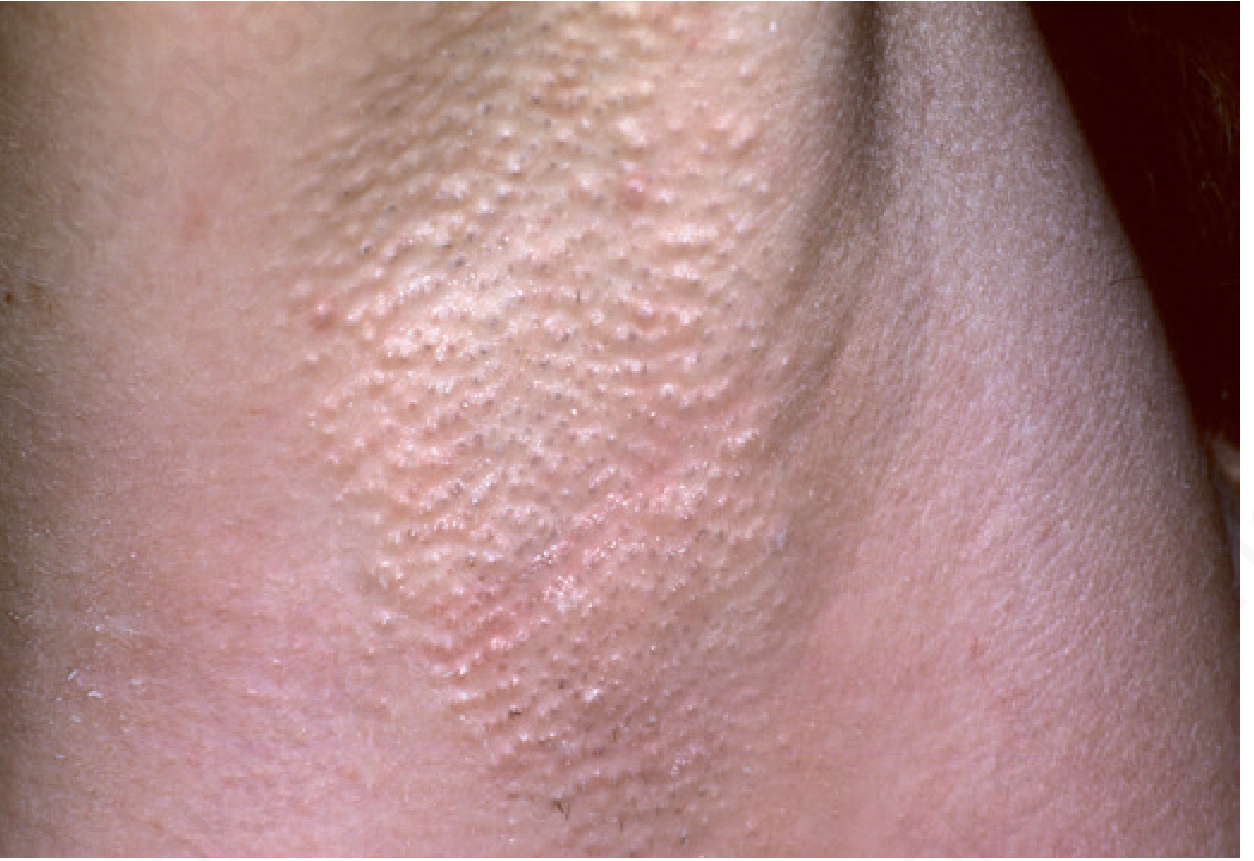
Your description - groin itching, very small raised white/flesh-colored nodules, no redness, no swelling, no warmth, temporary relief with hydrocortisone that returns - is a textbook match for Fox-Fordyce disease, also called apocrine miliaria.
Here is what the skin looks like in a typical case (axillary region shown, but groin presentation is identical):
What Is It?
Fox-Fordyce disease is a chronic, itchy papular eruption that affects areas rich in apocrine sweat glands - the groin/pubic area, armpits, areolae, perineum, umbilicus, and labia majora. It is not a fungal infection, not a bacterial infection, and not an allergy - which is why clotrimazole (antifungal) and hydrocortisone (anti-inflammatory) only temporarily relieve the itch but do not cure it.
- Fitzpatrick's Dermatology, p. 1506
- Andrews' Diseases of the Skin, p. 895
Cause
The underlying mechanism involves blockage of the follicular opening at the point where the apocrine duct enters the hair follicle. This causes the gland to become distended, eventually rupture, and spill its contents into the surrounding skin, triggering an inflammatory response that feels intensely itchy.
Key triggers that make it worse:
- Sweating (heat, exercise, warm weather)
- Emotional stress or excitement
- Sympathetic nervous stimulation (basically anything that would normally make you sweat)
It is strongly influenced by hormones - it almost exclusively begins at puberty and typically improves after menopause or during pregnancy. About 90% of cases occur in women between ages 13-35, though men can be affected too.
Why Clotrimazole + Hydrocortisone Don't Work Long-Term
- Clotrimazole is an antifungal - Fox-Fordyce is not fungal, so it does nothing for the cause
- Hydrocortisone gives temporary itch relief but does not fix the ductal obstruction, so the itch returns when you stop. Also, prolonged steroid use in this area can thin the skin and cause stretch marks (striae)
Differential Diagnoses to Consider
Before concluding it is Fox-Fordyce, a dermatologist will also consider:
| Condition | Key difference |
|---|---|
| Folliculitis | Usually has pustules or tender papules |
| Scabies | Intense nocturnal itch, burrows, affects multiple people in household |
| Lichen nitidus | Tiny flat-topped papules, usually no itch |
| Eruptive syringoma | Similar location but papules are softer, yellowish |
| Contact dermatitis | Usually has redness, history of new product use |
| Miliaria (heat rash) | Clear/white vesicles, strongly linked to heat exposure |
What Actually Works (Treatment Options)
There is no single universal cure, but these are the evidence-based options used by dermatologists:
Topical (first-line)
- Topical calcineurin inhibitors - pimecrolimus 1% cream (e.g., Elidel) or tacrolimus 0.1% applied twice daily - this is currently the best option. Unlike steroids, they do not thin the skin. Pimecrolimus induced complete remission in some patients over 8 weeks.
- Topical tretinoin or adapalene 0.1% gel - helps unplug the follicular obstruction. Adapalene every other day is better tolerated than tretinoin. Expect some initial irritation.
- Topical clindamycin solution in propylene glycol - has anti-inflammatory properties beyond just antibacterial
Oral (for more severe or resistant cases)
- Oral antihistamines (especially first-generation, e.g. chlorpheniramine, hydroxyzine) - help reduce itch, especially at night
- Low-dose doxepin (under 10 mg, up to 3x/day) - an antihistamine/antidepressant useful for itch
- Oral isotretinoin - reduces apocrine gland activity
- Oral contraceptives (in women) - hormonal control often significantly reduces symptoms
Procedural (for stubborn cases)
- Intralesional triamcinolone injections - for acute flares
- Botulinum toxin (Botox) injections - stops sweating in the area, produces good improvement
- Fractional CO2 laser or fractionated erbium glass laser - laser options showing good results
- Surgical excision or liposuction-assisted curettage (last resort)
Lifestyle measures
- Wear loose, breathable cotton underwear - avoid tight-fitting clothes that trap heat and sweat
- Avoid thick creams and heavy lotions in the area - these can worsen follicular plugging
- Reduce stress where possible
- Avoid heat triggers - hot baths, excessive exercise in hot environments
What You Should Do Next
You need to see a dermatologist for a proper diagnosis. Fox-Fordyce is a clinical diagnosis (no blood test or biopsy is usually needed), but a dermatologist needs to confirm it and rule out the conditions in the table above. Once confirmed, they can prescribe pimecrolimus cream or adapalene, which are far more effective than what you have been using.
Important note: This information is for educational purposes. The correct diagnosis and treatment plan must come from a qualified healthcare provider who examines you in person. Do not continue using hydrocortisone cream long-term in the groin area without medical supervision, as it can cause significant skin thinning.
This is a shared conversation. Sign in to Orris to start your own chat.