
Parenteral administration of drug note daou
Reading File
Searching sources...
Finding Sources
Finding Sources
Reading File
Finding Sources
Reading File
Reading File
Now let me fetch the two key diagrams from the Lippincott textbook:
Loading Image
Loading Image
Here is a complete note on Parenteral Administration of Drugs, based on Lippincott Illustrated Reviews: Pharmacology and Katzung's Basic and Clinical Pharmacology.
Parenteral Administration of Drugs
Definition
The parenteral route introduces drugs directly into the systemic circulation, bypassing the gastrointestinal tract entirely. "Parenteral" literally means "outside the intestine."
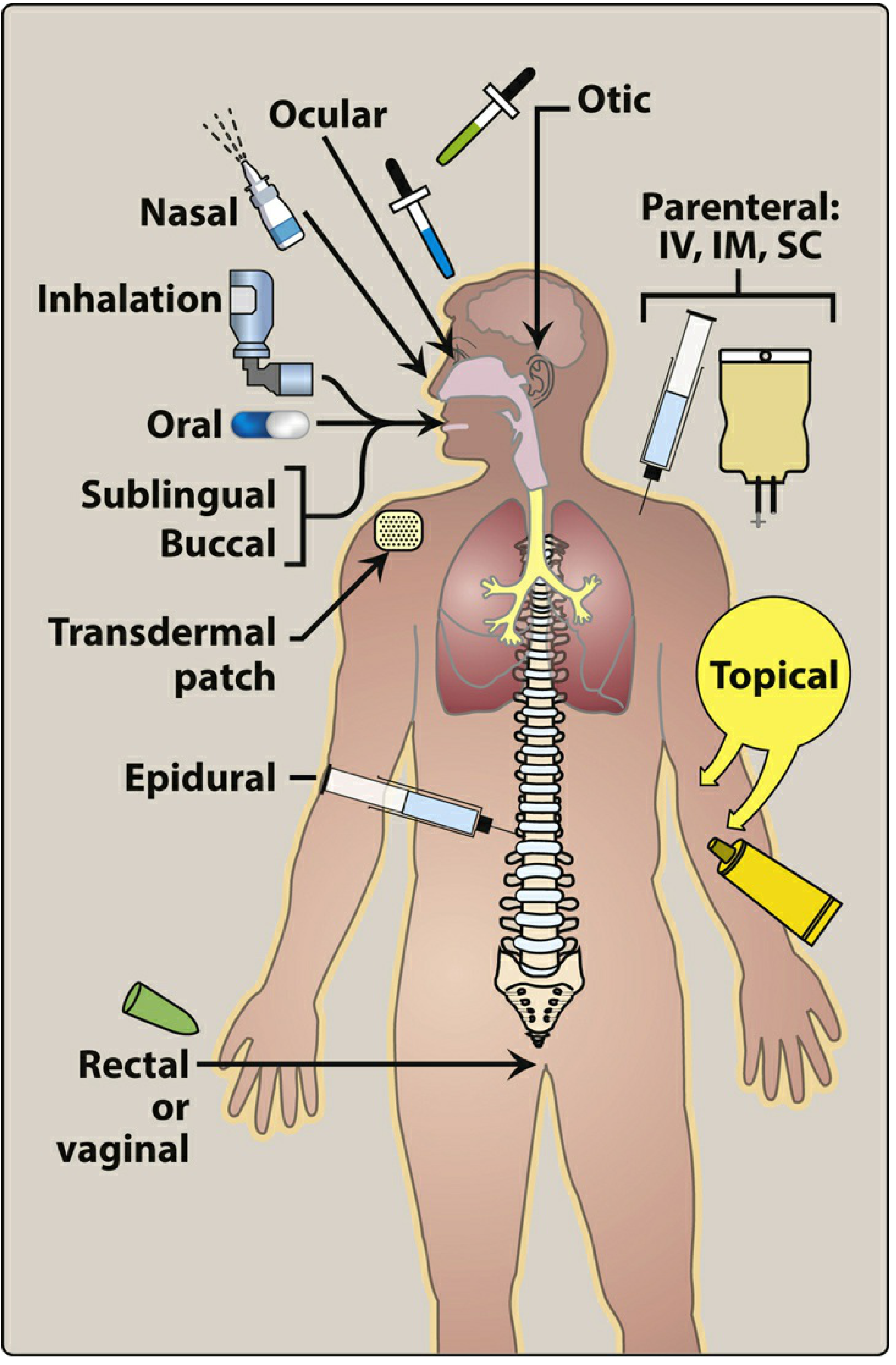
Indications / When to Use Parenteral Administration
| Situation | Reason |
|---|---|
| Drug poorly absorbed from GI tract | e.g., heparin |
| Drug unstable in GI tract | e.g., insulin |
| Patient cannot take oral medications | e.g., unconscious patient |
| Rapid onset of action required | e.g., emergencies |
| Precise dose control needed | Maximum bioavailability (100% for IV) |
Advantages
- Provides the most control over the dose delivered to the body
- Achieves 100% bioavailability (intravenous route) - no first-pass metabolism
- Allows rapid onset of action
- Suitable when oral route is unavailable or unreliable
Disadvantages
- Irreversible - once given, cannot be recalled
- May cause pain, fear, local tissue damage, and infections
- Requires sterile technique and trained personnel
- More expensive and less convenient than oral route
The Four Major Parenteral Routes
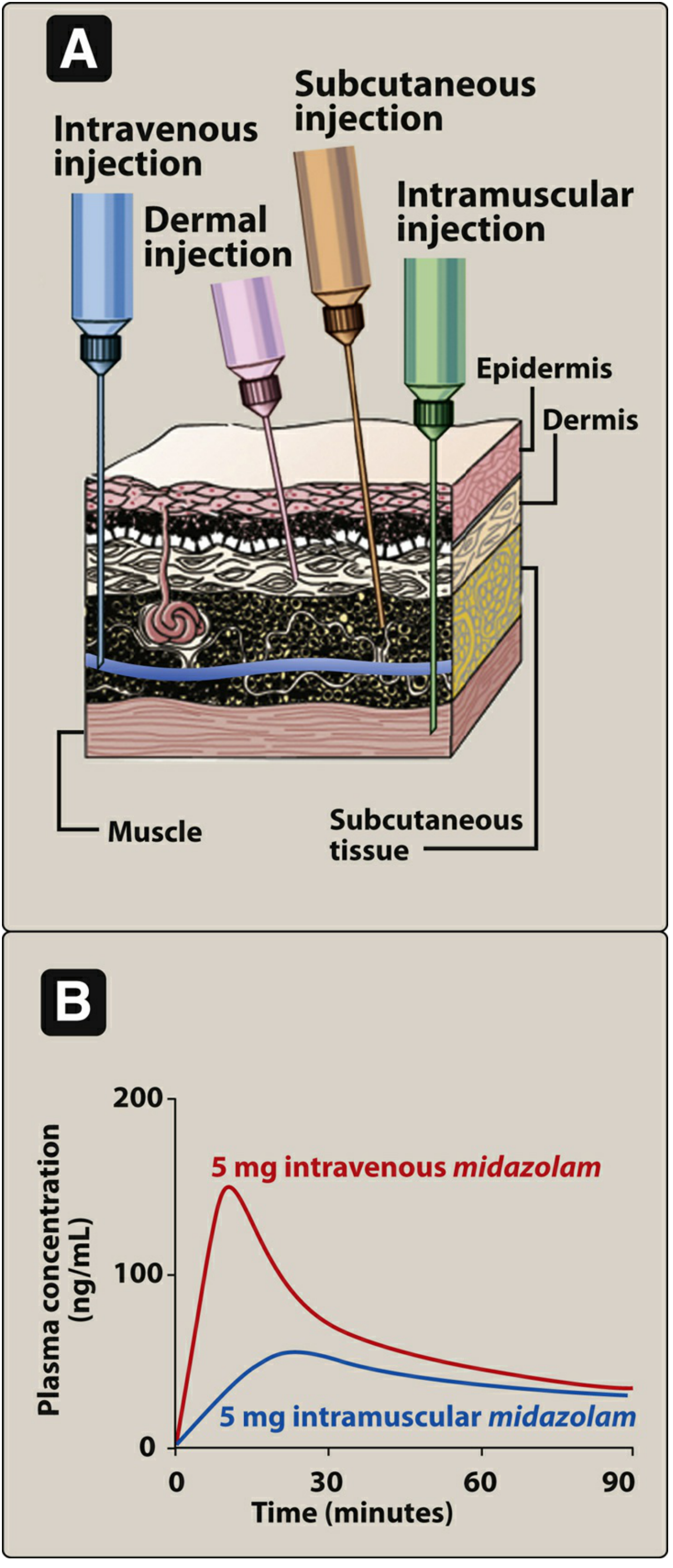
1. Intravenous (IV)
- Most common parenteral route
- Drug is delivered directly into a vein
- Bolus: entire dose enters systemic circulation almost immediately - fastest onset
- Infusion: drug is given over a longer period - lower peak concentration, longer duration
- Useful for drugs not absorbed orally (e.g., rocuronium)
- Bioavailability = 100%
- Risks: thrombophlebitis, infection, air embolism, speed shock (if given too rapidly)
Note: Intra-arterial injection is a sub-type of intravascular administration - used for local delivery (e.g., chemotherapy to tumors).
2. Intramuscular (IM)
- Drug is injected deep into a muscle (e.g., deltoid, gluteus, vastus lateralis)
- Aqueous solutions: absorbed rapidly
- Depot preparations: suspended in non-aqueous vehicle (e.g., polyethylene glycol, oil)
- Vehicle diffuses out of muscle - drug precipitates at injection site
- Drug then dissolves slowly - provides sustained release over an extended interval
- Examples: depot antipsychotics (haloperidol decanoate), benzathine penicillin
- Absorption by simple diffusion - slower than IV, faster than SC
- Bioavailability typically 75-100%
3. Subcutaneous (SC)
- Drug is injected into the subcutaneous tissue (beneath the dermis, above the muscle)
- Absorption by simple diffusion - slower than IV and IM
- Provides constant, slow, sustained drug effect
- Minimizes risks of hemolysis or thrombosis associated with IV
- Do not use for drugs that cause tissue irritation - can cause severe pain and necrosis
- Examples: insulin, heparin, vaccines
4. Intradermal (ID)
- Drug is injected into the dermis (the vascular layer beneath the epidermis)
- Very slow absorption due to low vascularity at the injection site
- Used for:
- Diagnostic testing (e.g., tuberculin skin test / Mantoux test)
- Allergy testing and desensitization
- Some vaccines (e.g., BCG)
- Volume injected: very small (0.1 mL)
Comparison Table
| Feature | IV | IM | SC | ID |
|---|---|---|---|---|
| Onset | Fastest (seconds) | Moderate (minutes) | Slow (minutes-hours) | Very slow |
| Bioavailability | 100% | 75-100% | 75-100% | Low |
| Depot possible? | No | Yes | Yes | No |
| Volume | Large volumes possible | Up to 5 mL | Up to 2 mL | 0.1 mL |
| Main use | Emergencies, large doses | Antibiotics, vaccines, depots | Insulin, heparin, vaccines | Allergy/TB testing |
Special Considerations
- First-pass effect: parenteral routes (especially IV) completely bypass hepatic first-pass metabolism, resulting in higher plasma concentrations compared to the same oral dose
- Bioavailability of IV = 100% - used as the reference standard
- Lung may serve as a site of first-pass loss for some parenterally administered drugs (by excretion and possibly metabolism)
- Serum drug concentrations show wider variability with IM than IV due to variable absorption rates at the injection site
Sources: Lippincott Illustrated Reviews: Pharmacology, p. 22-26 | Katzung's Basic and Clinical Pharmacology, 16th Ed., p. 50-52
মালিস করে ইঞ্জিলস
আপনি কি "মালিশ করে ইঞ্জেকশন" বোঝাতে চাইছেন? অর্থাৎ ইঞ্জেকশন দেওয়ার পর মালিশ করার বিষয়ে জানতে চাইছেন?
একটু পরিষ্কার করুন - আপনি কি জানতে চাইছেন:
Asking for Preferences
আপনি কি বিষয়ে জানতে চাইছেন?
This is a shared conversation. Sign in to Orris to start your own chat.