
Regulation of gastric emptying flow chart MBBS physiology
A detailed medical physiology flowchart titled "Regulation of Gastric Emptying" for MBBS students. The chart shows two main categories: FACTORS THAT ACCELERATE gastric emptying and FACTORS THAT DELAY gastric emptying. ACCELERATING side (left, green arrows going down): - Gastric distension (stretch receptors activated) - Gastrin (from G-cells, stimulates antral contractions) - Liquid meal / isotonic contents - Motilin (during fasting, triggers MMC Phase III) - Parasympathetic stimulation (vagus nerve - increases antral motility) - Small particle size (<2mm) DELAYING side (right, red arrows going down): - Duodenal factors (feedback loop label) - Fat/fatty acids in duodenum → CCK from I-cells → inhibits antral motility, contracts pyloric sphincter - Acid (low pH) in duodenum → Secretin from S-cells → inhibits gastric motility + contracts pylorus - Hypertonic/hypotonic solutions → GIP from K-cells → inhibits emptying - Amino acids/peptides → CCK release - Enterogastric reflex (neural reflex via enteric nervous system / myenteric plexus) - Sympathetic stimulation (splanchnic nerves - inhibits motility) - Ileal brake (fat in ileum → peptide YY → delays emptying) - Duodenal distension - Pain, fear, stress (via CRF pathway) - Leptin Center shows the STOMACH with arrows: - Fundus (receptive relaxation / accommodation) - Antrum (propulsion, grinding, retropulsion) - Pyloric sphincter (gatekeeping) Bottom shows: NET RATE OF GASTRIC EMPTYING = ~3 hours for mixed meal | Liquids empty faster than solids | Isotonic > hypo/hypertonic Use clear boxes, colored arrows (green for stimulatory, red for inhibitory), clean medical diagram style, white background, well-organized and easy to read for exam study.
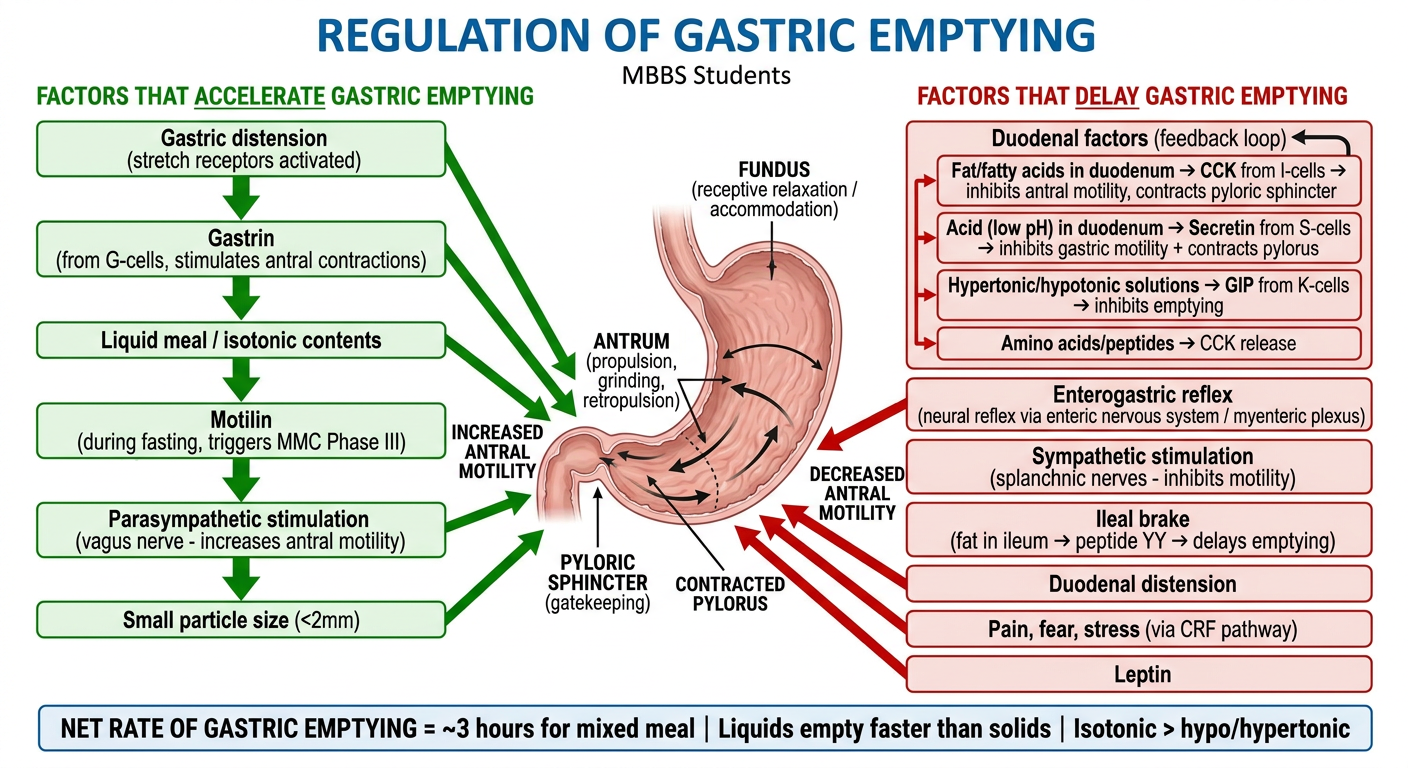
Regulation of Gastric Emptying - MBBS Physiology
Normal Gastric Emptying - Key Facts
- After a mixed meal (~1.5 L), emptying takes approximately 3 hours
- Liquids empty faster than solids
- Isotonic contents empty faster than hypotonic or hypertonic
- Only particles <2 mm pass through the pylorus; larger particles are retained and ground (retropulsion)
- During fasting, the migrating myoelectric complex (MMC) sweeps residue every 90 minutes
FACTORS THAT ACCELERATE Gastric Emptying
| Factor | Mechanism |
|---|---|
| Gastric distension | Stretch receptors in stomach wall trigger antral peristalsis (vagovagal reflex) |
| Gastrin | Released by G-cells in response to food; stimulates antral contractions |
| Motilin | Released during fasting; drives MMC Phase III ("housekeeper wave") |
| Parasympathetic (vagus) | Increases antral motor activity |
| Liquid meals | Follow first-order kinetics; ~200 mL emptied per 12 min for water |
| Small particle size | Particles <2 mm pass pylorus without resistance |
FACTORS THAT DELAY Gastric Emptying
Hormonal (Duodenal-Enterogastric Reflex)
| Stimulus in Duodenum | Hormone Released | Effect on Stomach |
|---|---|---|
| Fat / fatty acids | CCK (from I-cells, duodenum/jejunum) | Inhibits antral motility, contracts pyloric sphincter, delays emptying |
| Acid (low pH) | Secretin (from S-cells) | Inhibits gastric motility, contracts pylorus, stimulates pancreatic HCO3- |
| Hyper/hypotonic solutions | GIP (from K-cells) | Inhibits gastric emptying, stimulates insulin |
| Amino acids / peptides | CCK (also) | Same as fat effect |
| Fat in ileum | Peptide YY (ileal brake) | Delays gastric emptying further |
Neural (Enterogastric Reflex)
- Chemoreceptors and mechanoreceptors in the duodenal mucosa detect low pH, fat, high osmolarity
- Relay signals via interneurons in the myenteric plexus to inhibit antral contractions and contract the pylorus
- Delayed emptying involves: (1) fundic relaxation, (2) inhibition of antral motor activity, (3) isolated phasic pyloric contractions, (4) altered intestinal motor activity
Other Inhibitory Factors
- Sympathetic stimulation (splanchnic nerves) - inhibits GI motility
- Pain, stress, fear - via corticotrophin-releasing factor (CRF) and central dopaminergic pathways
- Duodenal distension
- Leptin (acts via same pathway as CCK)
- Supine position (delays liquid emptying)
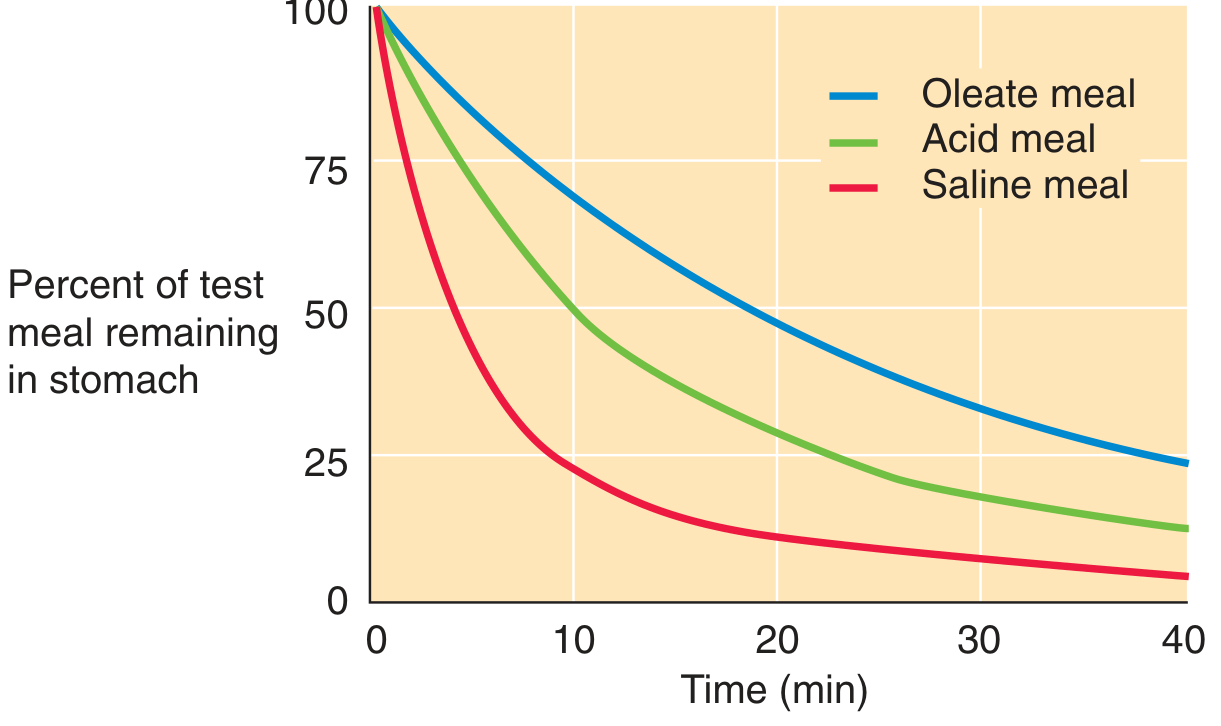
Gastric Emptying Rate by Meal Type (from Medical Physiology graph)
Pyloric Sphincter Role
- Acts as a gatekeeper - allows particles <2 mm to pass
- Relaxes with: nitric oxide, VIP, serotonin, prostaglandin E1
- Contracts with: CCK, secretin, histamine (slows delivery to duodenum)
Quick Memory Trick for MBBS Exams
- Fat → CCK → slows emptying
- Acid → Secretin → slows emptying
- Hypertonic solution → GIP → slows emptying