
Introduction, definitions and scope of pharmacology
Reading File
Finding Sources
Finding Sources
Finding Sources
Finding Sources
Finding Sources
Finding Sources
Finding Sources
Finding Sources
Reading File
Finding Sources
Reading File
Reading File
I now have comprehensive content from Katzung's textbook. Let me also fetch the pharmacology diagram image referenced in the text.
Loading Image
I now have everything needed to write a comprehensive answer. Here is a structured overview of the introduction, definitions, and scope of pharmacology, drawn from Katzung's Basic and Clinical Pharmacology, 16th Edition (Katzung & Vanderah).
Introduction, Definitions, and Scope of Pharmacology
1. Definition of Pharmacology
Pharmacology is the study of substances that interact with living systems through chemical processes. These interactions occur by binding of the substance to regulatory molecules and activating or inhibiting normal body processes.
"Pharmacology can be defined as the study of substances that interact with living systems through chemical processes… These substances may be chemicals administered to achieve a beneficial therapeutic effect on some process within the patient or for their toxic effects on regulatory processes in parasites infecting the patient." — Katzung's Basic and Clinical Pharmacology, 16th ed.
Medical pharmacology is the narrower clinical definition: the science of substances used to prevent, diagnose, and treat disease.
2. Relationship to Toxicology
Toxicology is the branch of pharmacology that deals with the undesirable effects of chemicals on living systems — from individual cells to humans to complex ecosystems. Every drug is potentially toxic; the distinction between a therapeutic agent and a poison is largely one of dose and context.
3. Major Areas within Pharmacology
The diagram below (Figure 1-1 from Katzung) illustrates the two large domains of pharmacology:
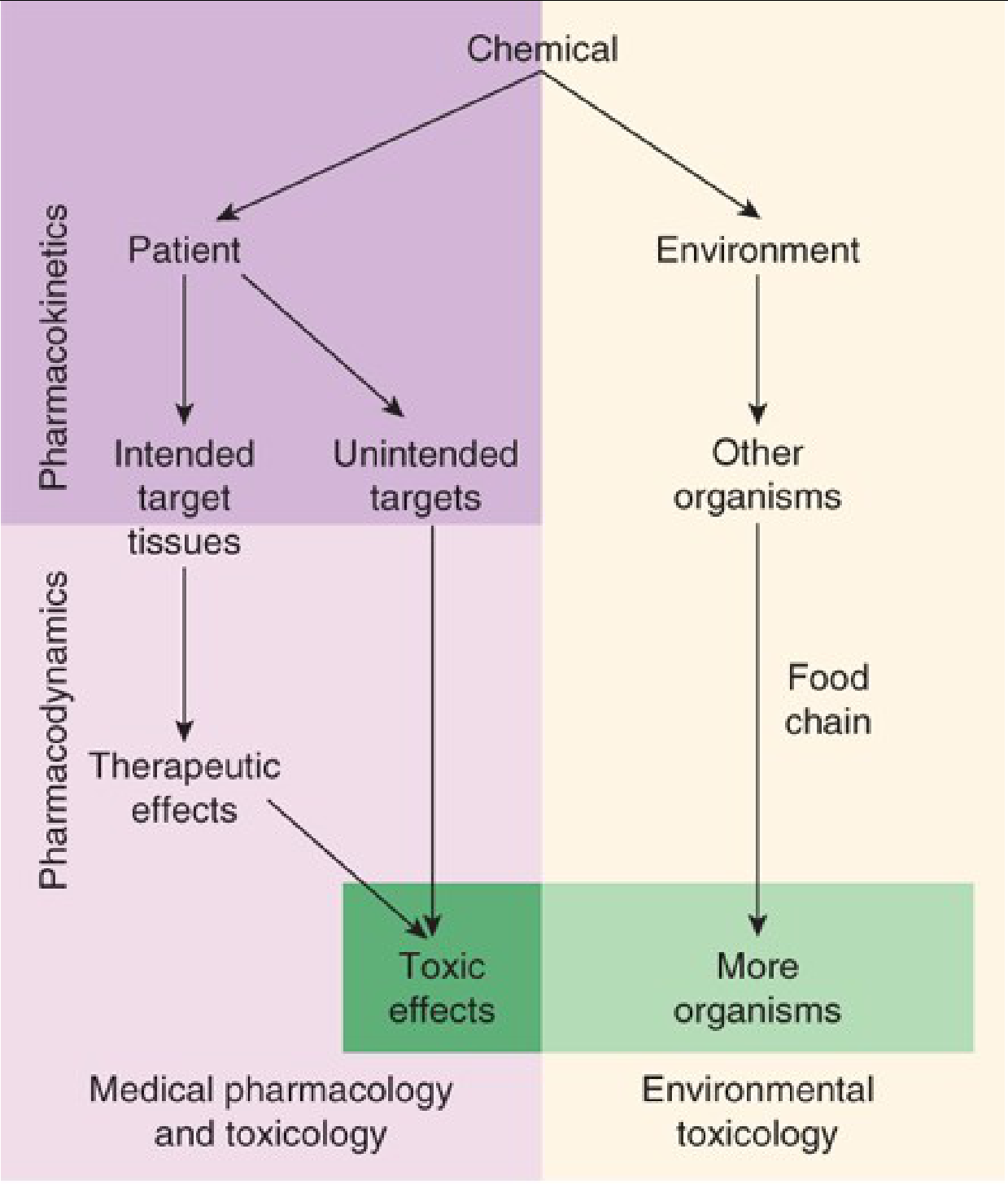
| Domain | Focus |
|---|---|
| Medical pharmacology & toxicology | Actions of drugs on individual organisms (humans, domestic animals); includes intended and unintended effects |
| Environmental toxicology | Effects of chemicals on all organisms, ecosystems, and the food chain |
Within medical pharmacology, two fundamental sub-disciplines govern all drug–body interactions:
a. Pharmacokinetics ("what the body does to the drug")
Governs absorption, distribution, and elimination of drugs. Of great practical importance in choosing dose and route of administration — especially in patients with organ impairment (e.g., renal failure affecting drug clearance).
b. Pharmacodynamics ("what the drug does to the body")
Describes the actions and mechanisms of drugs on the body. Determines the therapeutic group a drug belongs to and its appropriateness for a given disease.
4. Scope of Pharmacology
Pharmacology is a broad, integrative science that sits at the intersection of:
- Anatomy
- Biochemistry
- Genetics
- Physiology
- Pathology
- Clinical medicine
- Environmental science
Its scope has expanded dramatically, particularly in the last 60 years, and now includes:
| Subfield | Description |
|---|---|
| Pharmacogenomics | How an individual's genetic makeup affects drug response; ties to personalized medicine |
| Epigenetics | Regulation by noncoding DNA regions and chromosomal neighbors that control pharmacologic responses |
| Molecular pharmacology | Molecular mechanisms of receptor–drug interaction; receptor cloning and structural characterization |
| Clinical pharmacology | Application of pharmacological principles to therapeutic decision-making in patients |
| Toxicology | Adverse chemical effects on living systems |
| Materia medica (historical precursor) | Drug preparation and medical uses of drugs — the foundation from which pharmacology emerged |
5. Brief History
- Prehistoric era: Empirical recognition of beneficial/toxic plant and animal materials
- ~17th century: Observation and experimentation replaced speculation; materia medica emerged
- Late 18th–19th century: François Magendie and Claude Bernard developed experimental physiology and pharmacology; advances in chemistry enabled understanding of drug mechanisms
- Mid-20th century (1940s–50s): Rapid expansion of research; discovery of the drug receptor concept
- Last 30 years: Explosive growth in molecular mechanisms; receptors isolated, cloned, and structurally characterized; discovery of orphan receptors (receptors with no known ligand)
- Recent additions: RNA interference (siRNAs, miRNAs), antisense oligonucleotides, biologics (monoclonal antibodies), and space medicine as new frontiers
6. Drug–Receptor Interactions: Core Concepts
At the heart of pharmacodynamics are four types of drug–receptor interactions:
| Interaction Type | Mechanism |
|---|---|
| Agonist | Binds and activates the receptor → produces the effect |
| Antagonist | Binds the receptor but blocks agonist access; effect can be overcome by increasing agonist dose (competitive) or not (irreversible) |
| Allosteric enhancer | Binds a different site on the receptor, enhancing agonist action |
| Allosteric inhibitor | Binds a different site, inhibiting agonist action; not overcome by increasing agonist dose |
7. What Is a Drug?
In pharmacological context, a drug is any chemical substance that, when introduced into or applied to a living system, alters biological function through chemical interaction — whether that effect is intended (therapeutic) or unintended (toxic).
Source: Katzung's Basic and Clinical Pharmacology, 16th Edition — Chapter 1: Introduction: The Nature of Drugs & Drug Development & Regulation (Vanderah & Katzung)
This is a shared conversation. Sign in to Orris to start your own chat.