
Describe About Components Of Lymphatic System. 5 marks
Reading File
Finding Sources
Finding Sources
Reading File
Reading File
Reading File
Finding Sources
Reading File
Finding Sources
Loading Image
Finding Sources
Finding Sources
Reading File
Reading File
I now have comprehensive information from multiple authoritative textbooks. Here is a detailed answer suitable for a 5-mark response:
Components of the Lymphatic System
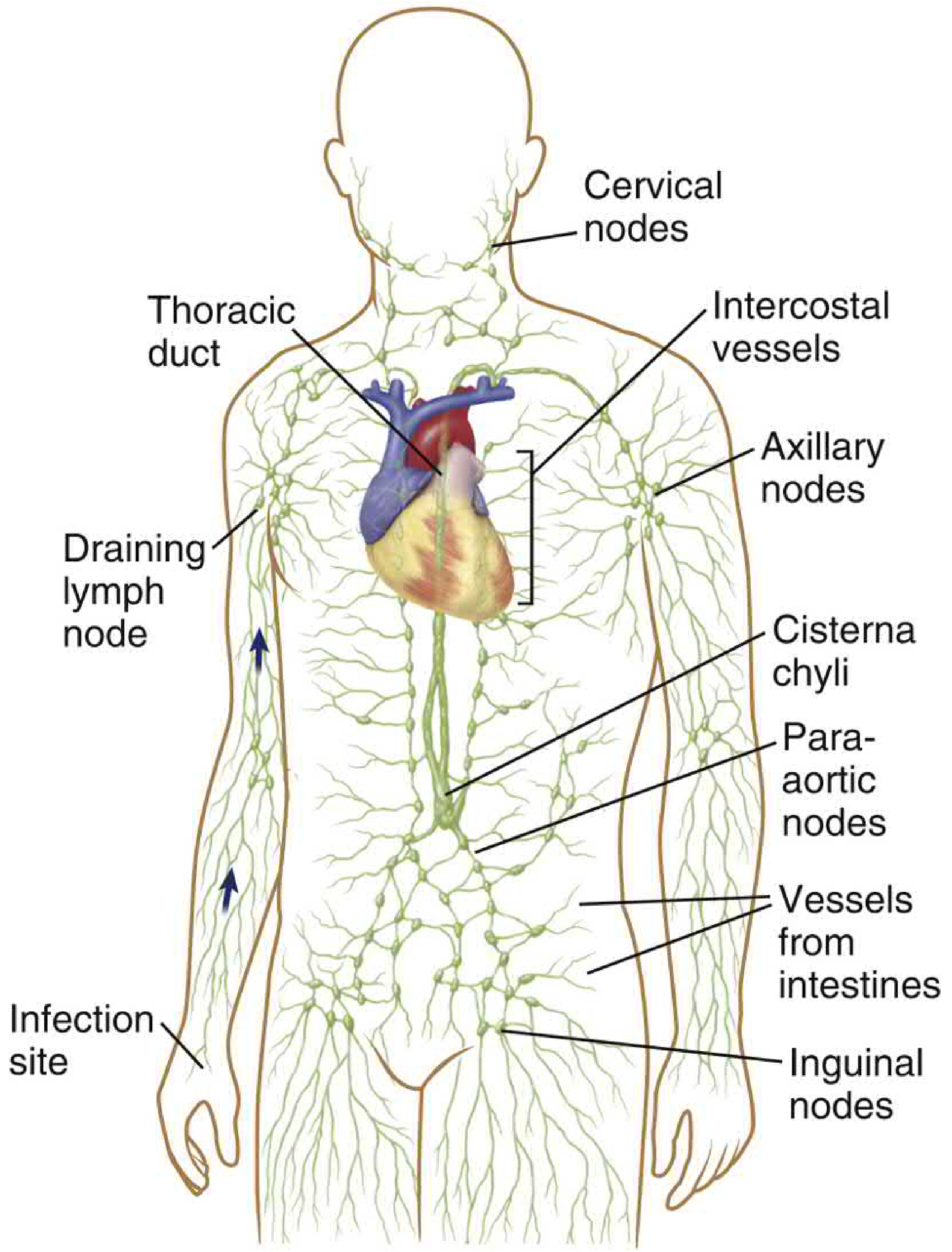
The lymphatic system is a one-way, accessory drainage network that runs parallel to the cardiovascular system. It returns interstitial fluid and proteins to the blood, transports dietary fats, and provides immune surveillance. It has five main components.
1. Lymphatic Capillaries
These are the blind-ended, microscopic vessels that form the origin of the lymphatic system within tissues.
- Lined by overlapping endothelial cells without tight junctions or a continuous basement membrane — this allows free uptake of large proteins, cells, and particulate matter that cannot re-enter blood capillaries.
- Attached to the extracellular matrix by elastin (anchoring) filaments that pull them open during tissue swelling.
- Overlapping endothelial cell flaps act as one-way valves, permitting inflow of interstitial fluid but preventing backflow.
- The absorbed fluid is called lymph, which has nearly the same composition as interstitial fluid.
- Absent from: avascular structures (cartilage, cornea), CNS parenchyma (cleared instead by the glymphatic system via perivascular spaces), endomysium of muscles, and bone.
Approximately 2–3 L of lymph are returned to the circulation daily. — Guyton and Hall Textbook of Medical Physiology
2. Lymphatic Vessels (Collecting Vessels)
As lymphatic capillaries converge, they form progressively larger collecting vessels.
- Contain smooth muscle in their walls; contraction propels lymph forward.
- Equipped with internal bicuspid valves at regular intervals to ensure one-way (unidirectional) flow.
- Classified as:
- Superficial (epifascial) — run in the subcutaneous tissue alongside superficial veins.
- Deep — accompany arteries and deep veins.
- Numerous anastomoses exist between superficial and deep systems.
- Afferent vessels carry lymph into a lymph node; efferent vessels carry it out. Because nodes are connected in series, an efferent vessel from one node becomes the afferent vessel for the next.
3. Lymph Nodes
Lymph nodes are small, bean-shaped, encapsulated organs (1–25 mm) interspersed along lymphatic vessels that filter lymph and mount immune responses.
Structure
A lymph node has three functional regions:
| Region | Contents | Function |
|---|---|---|
| Cortex | B-cell lymphoid follicles (primary = resting; secondary = active germinal centres); subcapsular sinus | Humoral immunity; B cell activation & proliferation |
| Paracortex | T helper cells; high endothelial venules (HEVs) | Cell-mediated immunity; lymphocyte recirculation |
| Medulla | Medullary cords (plasma cells, macrophages); medullary sinuses | Antibody secretion; final lymph filtration |
The capsule sends trabeculae into the node; reticular fibers and cells form the internal stroma. Lymph flows: afferent lymphatic → subcapsular sinus → cortical sinuses → medullary sinuses → efferent lymphatic.
Major node groups include: cervical, axillary, inguinal, para-aortic, and mesenteric nodes.
4. Lymphoid Organs
Beyond lymph nodes, several specialized organs are part of the lymphatic system:
a) Spleen (largest lymphoid organ)
- Filters blood (not lymph).
- Two regions:
- White pulp (~20%): secondary lymphoid tissue around central arterioles, with periarteriolar lymphoid sheaths (PALS) of T cells and adjacent B-cell follicles — immune surveillance.
- Red pulp (~80%): splenic cords + venous sinusoids lined by stave cells; removes old/defective erythrocytes and recycles hemoglobin iron.
b) Thymus (primary lymphoid organ)
- Site of T-cell maturation (positive and negative selection).
- Has an outer cortex (dense thymocytes) and inner medulla (looser, contains Hassall's corpuscles).
- Involutes after puberty.
c) Bone Marrow
- Primary lymphoid organ; site of B-cell maturation and origin of all lymphocytes.
d) Mucosa-Associated Lymphoid Tissue (MALT)
- Includes tonsils (Waldeyer's ring), Peyer's patches (ileum), and appendix.
- Provides immune surveillance at mucosal surfaces.
5. Lymphatic Ducts (Terminal Vessels)
All collecting vessels ultimately drain into one of two large ducts:
| Duct | Drains | Empties into |
|---|---|---|
| Thoracic duct (largest) | Lower limbs, abdomen, left thorax, left arm, left head & neck | Left subclavian–jugular junction |
| Right lymphatic duct | Right head & neck, right arm, right thorax | Right subclavian–jugular junction |
The thoracic duct begins as the cisterna chyli, a dilated sac at the L1–L2 level that collects lymph from the intestines and lower limbs. Intestinal lymph (chyle) is rich in dietary lipids (chylomicrons), giving it a milky appearance after meals.
Summary Table
| Component | Key Role |
|---|---|
| Lymphatic capillaries | Absorb interstitial fluid and large proteins |
| Collecting vessels | Transport lymph; prevent backflow via valves |
| Lymph nodes | Filter lymph; mount B and T cell responses |
| Lymphoid organs (spleen, thymus, MALT) | Immune maturation, blood filtration |
| Thoracic & right lymphatic ducts | Return lymph to venous circulation |
"The lymphatic system represents an accessory route through which fluid can flow from the interstitial spaces into the blood… without which we would die within about 24 hours." — Guyton and Hall Textbook of Medical Physiology
Sources: Cellular and Molecular Immunology (Abbas & Lichtman) | Guyton and Hall Textbook of Medical Physiology | Junqueira's Basic Histology | General Anatomy and Musculoskeletal System (THIEME Atlas)
This is a shared conversation. Sign in to Orris to start your own chat.