
Mechanisms of baroreceptor and reflex heart rate
Reading File
Baroreceptors are stretch-sensitive mechanoreceptors in the carotid sinus and aortic arch that detect arterial wall tension and send signals to the brainstem to regulate heart rate via the autonomic nervous system.
Searching sources...
Finding Sources
Finding Sources
Reading File
Reading File
Reading File
Loading Image
Reading File
Now I have comprehensive information from Costanzo Physiology and Miller's Anesthesia. Let me compile the full answer.
Baroreceptor Mechanism and Reflex Heart Rate
Overview
The baroreceptor reflex is a fast, neurally mediated negative feedback system that maintains arterial pressure (Pa) constant by adjusting the output of the sympathetic and parasympathetic nervous systems to the heart and blood vessels. It acts within seconds. - Costanzo Physiology 7th Edition, p. 169
1. The Baroreceptors (Sensors)
Baroreceptors are mechanoreceptors (stretch receptors) located in:
- Carotid sinus - at the bifurcation of the common carotid artery into internal and external carotid arteries. Responsive to both increases and decreases in arterial pressure.
- Aortic arch - primarily responsive to increases in arterial pressure.
Transduction mechanism:
- Changes in arterial pressure alter the stretch on the vessel wall.
- Stretch produces a receptor (generator) potential in the mechanoreceptor membrane.
- A depolarizing receptor potential increases action potential frequency in the afferent nerve; a hyperpolarizing potential decreases it.
- Increased Pa → increased stretch → increased firing rate in afferent nerves.
- Decreased Pa → decreased stretch → decreased firing rate.
Key property: Baroreceptors are most sensitive to rapid changes in pressure, not just absolute levels. The strongest stimulus is a fast rate of change of arterial pressure. - Costanzo Physiology 7th Edition, p. 170
2. Afferent Pathways
| Baroreceptor Location | Afferent Nerve | Cranial Nerve |
|---|---|---|
| Carotid sinus | Carotid sinus nerve (Hering's nerve) | Glossopharyngeal (CN IX) |
| Aortic arch | Vagus nerve afferents | Vagus (CN X) |
Both converge on the nucleus tractus solitarius (NTS) in the medulla. - Costanzo Physiology 7th Edition, p. 170; Miller's Anesthesia 10th Edition, p. 1428
3. Central Integration: Brainstem Cardiovascular Centers
The NTS receives afferent pressure signals and coordinates output through three tonically active medullary centers:
| Center | Division | Effects |
|---|---|---|
| Vasoconstrictor center (C1) | Sympathetic | Constricts arterioles and venules; increases TPR |
| Cardiac accelerator center | Sympathetic | Increases SA node firing rate (HR), AV conduction velocity, and contractility |
| Cardiac decelerator center | Parasympathetic (via vagus) | Decreases SA node firing rate (HR) |
The NTS drives the cardiac decelerator center via an excitatory pathway, and inhibits the cardiac accelerator and vasoconstrictor centers (shown as dashed inhibitory pathways in the diagram below). - Costanzo Physiology 7th Edition, p. 171
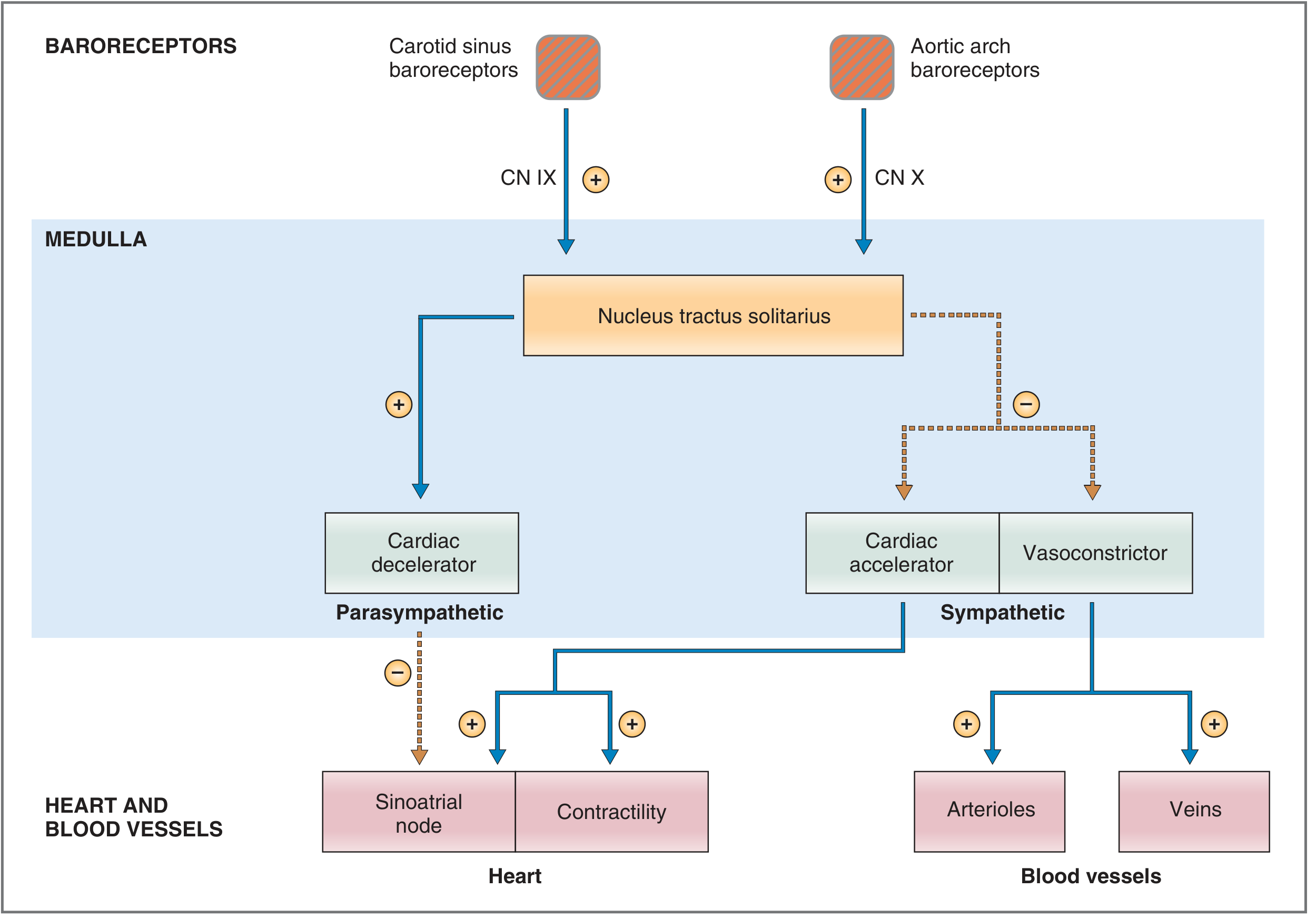
4. Integrated Reflex Response: Response to Increased Arterial Pressure (Step-by-Step)
- Increased Pa → increased stretch on carotid sinus and aortic arch baroreceptors
- Increased firing rate in CN IX (glossopharyngeal) and CN X (vagus) afferents
- Signals arrive at the NTS; NTS detects Pa > set-point
- NTS produces a coordinated response:
- Increases parasympathetic outflow (via vagus) to the SA node → decreases heart rate
- Decreases sympathetic outflow to the SA node (complements parasympathetic) → further decreases heart rate
- Decreased sympathetic outflow to cardiac muscle → decreased contractility → decreased stroke volume
- Together: decreased cardiac output → Pa falls
- Decreased sympathetic outflow to arterioles → arteriolar vasodilation → decreased TPR → Pa falls further
- Decreased sympathetic outflow to veins → venodilation → increased venous compliance → increased unstressed volume → decreased stressed volume → reduced venous return
- Once Pa returns to set-point (~100 mmHg), baroreceptor firing and cardiovascular centers return to tonic baseline
- Costanzo Physiology 7th Edition, p. 171
5. Response to Decreased Arterial Pressure (e.g., Hemorrhage)
The response is the mirror image:
- Decreased Pa → decreased baroreceptor stretch → decreased afferent firing
- NTS detects Pa < set-point
- Decreased parasympathetic outflow + increased sympathetic outflow:
- Heart rate increases
- Contractility increases → cardiac output rises
- Arteriolar vasoconstriction → increased TPR
- Venoconstriction → decreased unstressed volume → increased venous return (Frank-Starling mechanism) → increased cardiac output
Net result: Pa is restored toward normal. - Costanzo Physiology 7th Edition, p. 171
6. Heart Rate Specifically: Dual ANS Control
The reflex heart rate response results from simultaneous, reciprocal changes in both limbs of the ANS:
| Stimulus | Parasympathetic to SA | Sympathetic to SA | Heart Rate Effect |
|---|---|---|---|
| High Pa | ↑ (vagal tone) | ↓ | ↓ HR (bradycardia) |
| Low Pa | ↓ | ↑ | ↑ HR (tachycardia) |
The parasympathetic (vagal) limb acts faster - it can slow the heart within one beat, because acetylcholine hyperpolarizes the SA node via M2 receptors / IKACh channels. The sympathetic limb (norepinephrine, β1 receptors, cAMP, HCN channel upregulation) acts over several seconds.
7. Clinical Modifications of the Reflex
- Chronic hypertension: Baroreceptors reset to a higher set-point - they no longer perceive elevated pressure as abnormal, so hypertension is maintained rather than corrected. - Costanzo Physiology 7th Edition, p. 170
- Reflex loses efficacy when Pa < 50 mmHg (severe shock). - Miller's Anesthesia 10th Edition, p. 1430
- Volatile anesthetics (particularly halothane) inhibit the heart rate component of the reflex.
- Ca²⁺-channel blockers, ACE inhibitors, phosphodiesterase inhibitors attenuate the reflex by direct peripheral vascular effects or CNS signaling interference.
- Bainbridge reflex counterbalance: At high circulating volumes, the Bainbridge reflex (atrial stretch → increased HR) opposes the baroreceptor reflex; at low volumes, the baroreceptor reflex dominates. - Medical Physiology (Boron & Boulpaep)
Summary Diagram of the Full Arc
↑ Arterial Pressure
       ↓
Baroreceptors (carotid sinus + aortic arch) — stretch ↑ → firing ↑
       ↓
CN IX / CN X → Nucleus Tractus Solitarius (medulla)
       ↓
   ┌──────────────────────────────────┐
   ↑ Parasympathetic               ↓ Sympathetic
   (cardiac decelerator)     (cardiac accelerator + vasoconstrictor)
       ↓                              ↓
   ↓ Heart rate (vagus/SA node)    ↓ HR, ↓ contractility, ↓ TPR, ↓ venous tone
       ↓
   ↓ Cardiac output + ↓ TPR → ↓ Pa → restored to set-point
This is a shared conversation. Sign in to Orris to start your own chat.