
Mechanism of gene transfer in bacteria
Reading File
Bacteria transfer genetic material through three main mechanisms: transformation (uptake of naked DNA from the environment), transduction (phage-mediated transfer), and conjugation (direct cell-to-cell transfer via a pilus). A fourth process, transposition, involves mobile genetic elements moving within or between genomes.
Searching sources...
Finding Sources
Finding Sources
Finding Sources
Finding Sources
Good - I found relevant sections in Jawetz, Medical Microbiology 9e, and Sherris. Let me read these in parallel.
Reading File
Reading File
Reading File
Now let me read more content - specifically transformation and transduction sections from Jawetz, and the Sherris block for a broader overview:
Reading File
Finding Sources
Reading File
Finding Sources
Reading File
Finding Sources
I now have rich content from multiple authoritative textbooks. Let me fetch the key diagram image and compile the full answer.
Loading Image
Loading Image
Excellent - I now have comprehensive textbook content and two high-quality diagrams. Here is the full, detailed answer:
Mechanisms of Gene Transfer in Bacteria
Bacteria can transfer genetic material both within a species and across species boundaries - a process collectively called horizontal gene transfer (HGT). There are four main mechanisms: transformation, transduction, conjugation, and transposition.
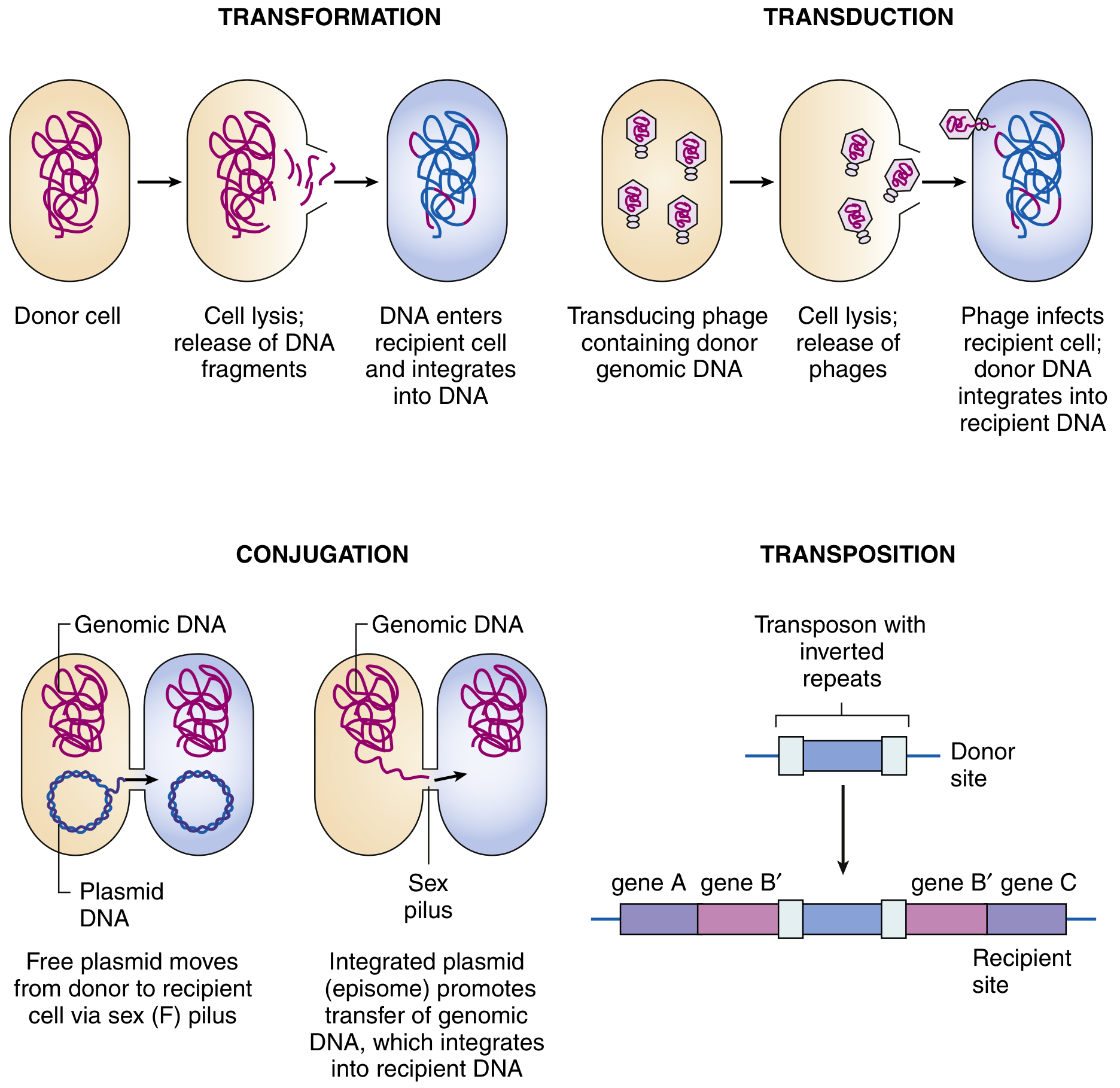
1. Transformation
Definition: Uptake of naked, exogenous DNA fragments directly from the surrounding environment and their incorporation into the bacterial genome.
Historical note: First described by Griffith in 1928, who showed that extracts of encapsulated (smooth) Streptococcus pneumoniae could transmit virulence to non-encapsulated (rough) strains. This laid the groundwork for Avery, MacLeod, and McCarty's 1944 identification of DNA as the "transforming principle."
Mechanism:
- The recipient bacterium must be in a state of competence - able to take up exogenous DNA
- Competence typically develops toward the end of logarithmic growth
- Competent cells bind, internalize, and recombine fragments of donor DNA into their chromosome
Naturally competent species include:
- Haemophilus influenzae
- Streptococcus pneumoniae
- Bacillus spp.
- Neisseria spp.
Induced competence: E. coli and most other bacteria lack natural competence; it must be artificially induced by chemical methods (CaCl₂ treatment) or electroporation (high-voltage pulses that transiently permeabilize the membrane).
Clinical relevance: Low-frequency HGT via transformation has been responsible for widespread antibiotic resistance across diverse species - particularly in dense microbial communities like gut flora and dental biofilms.
2. Transduction
Definition: Gene transfer mediated by bacteriophages (bacterial viruses), which accidentally package bacterial DNA and deliver it to a new host cell.
Mechanism:
- A phage infects a bacterium and replicates inside it
- During packaging, some phage particles mistakenly package bacterial chromosomal DNA instead of (or in addition to) phage DNA, creating transducing particles
- These particles infect a new bacterium and inject the donor bacterial DNA
- The transferred DNA may recombine with the recipient's chromosome
Two types:
| Type | Mechanism | DNA transferred |
|---|---|---|
| Generalized transduction | Random packaging of any host DNA fragment (e.g., P1 phage of E. coli degrades chromosomal DNA; fragments are accidentally packaged) | Any gene; random |
| Specialized (restricted) transduction | Temperate phage integrates into chromosome; upon excision, it takes flanking bacterial genes with it | Specific genes adjacent to phage integration site |
Limitations: The size of DNA in transducing particles is usually no more than a few percent of the bacterial chromosome, so co-transduction of multiple genes is limited to closely linked genes.
Clinical example: Two phages carry pathogenicity islands responsible for converting benign Vibrio cholerae into a pathogenic form - encoding cholera toxin and toxin co-regulated pili (TCP). - Jawetz, Melnick & Adelberg's Medical Microbiology 28e
3. Conjugation
Definition: Direct, contact-dependent transfer of DNA from a donor (male) cell to a recipient (female) cell through a sex pilus (conjugation tube).
Requirements:
- The donor must carry a conjugative plasmid (e.g., the F plasmid in E. coli)
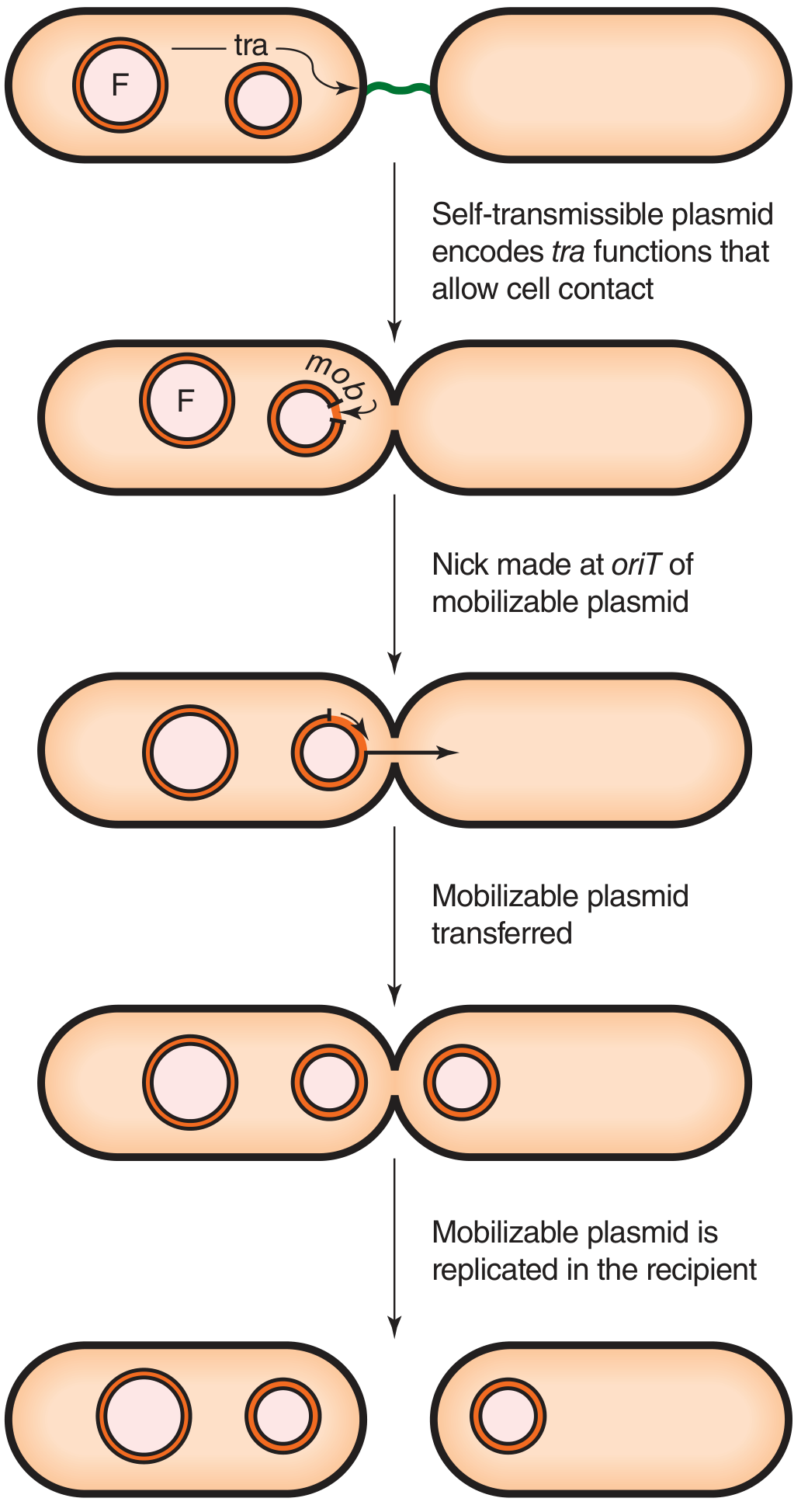
- Conjugative plasmids carry tra genes that encode all transfer functions including sex pilus formation and initiation of replication at the oriT (origin of transfer)
- The sex pilus is a type IV secretion device
Mechanism (step by step):
- Donor cell extends a sex pilus that contacts the recipient cell
- Cells are drawn together for direct membrane contact
- A plasmid-encoded relaxase makes a single-stranded nick at oriT
- This initiates rolling circle replication; the displaced linear single strand is transferred to the recipient
- The transferred ssDNA is re-circularized and its complementary strand is synthesized in the recipient
- Both donor and recipient now carry the plasmid; recipients become F⁺ (male) cells
Key variants:
| State | Description |
|---|---|
| F⁺ (donor) | Carries autonomous F plasmid; transfers plasmid only |
| F' (F prime) | F plasmid carrying a fragment of chromosomal DNA; transfers that chromosomal fragment |
| Hfr (High-frequency recombination) | F plasmid integrated into the chromosome; can transfer chromosomal genes at high frequency but full chromosome transfer is rare, so recipient usually stays F⁻ |
Important notes:
- Transfer is usually aborted before completion due to fragile mating pairs, so complete chromosome transfer rarely occurs
- Conjugation can cross species lines - some "promiscuous" plasmids promote transfer across a wide variety of Gram-negative species
- Antibiotic concentrations (especially tetracyclines) can enhance conjugation frequency in some organisms (e.g., Bacteroidetes)
- This is the most clinically significant mechanism for spread of antibiotic resistance (e.g., the vanA transposon on a conjugative plasmid transferring from E. faecalis to MRSA)
4. Transposition
Definition: Movement of mobile genetic elements called transposons (or "jumping genes") from one location to another within the same genome, or between genomes (often facilitated by conjugation or transduction).
Structure of a transposon:
- Core genes (e.g., antibiotic resistance, virulence factors)
- Flanked by inverted terminal repeats
- Encodes a transposase enzyme that catalyzes the cut-and-paste or replicative transposition
Mechanism:
- Transposase recognizes inverted repeats and cuts the element out of the donor site
- The transposon inserts at a new target site (often creating short target site duplications)
- The target site DNA is disrupted, which can inactivate a gene at the insertion site
Clinical significance: Transposons are responsible for mobilizing resistance genes onto plasmids (making them conjugatively transferable) and for spread of pathogenicity islands.
Summary Comparison
| Feature | Transformation | Transduction | Conjugation | Transposition |
|---|---|---|---|---|
| Vector | None (naked DNA) | Bacteriophage | Sex pilus (direct contact) | Transposase enzyme |
| DNA source | Environment | Phage particle | Donor cell plasmid/chromosome | Within/between cells |
| Cell contact required | No | No | Yes | No |
| DNA transferred | Any chromosomal/plasmid DNA | Small fragments of donor DNA | Plasmid ± chromosomal DNA | Mobile element |
| Frequency | Low (requires competence) | Low | High (efficient) | Variable |
| Cross-species transfer | Possible | Limited by phage host range | Wide range (some plasmids) | Yes, when combined with conjugation |
Clinical Importance
All three inter-cellular transfer mechanisms (transformation, transduction, conjugation) contribute to the spread of antibiotic resistance, virulence genes, and pathogenicity islands among bacteria. Conjugation is by far the most efficient and clinically significant pathway - it underlies the rapid dissemination of multidrug resistance in hospital-acquired pathogens.
Sources: Medical Microbiology 9e p.163 | Jawetz, Melnick & Adelberg's Medical Microbiology 28e pp.118-120 | Sherris & Ryan's Medical Microbiology 8e
This is a shared conversation. Sign in to Orris to start your own chat.