
Estrogen drug
Reading File
Estrogen drugs are female sex hormones used in hormone replacement therapy, contraception, and several other clinical conditions. They act on estrogen receptors (ER-alpha and ER-beta) to produce their effects.
Searching sources...
Finding Sources
Searching PubMed
"estrogen" AND "pharmacology"
Finding Sources
Finding Sources
Goodman & Gilman's has the most relevant sections. Let me read the key pharmacology content.
Reading File
Reading File
Reading File
Reading File
Reading File
Reading File
I now have comprehensive information. Let me also fetch the key mechanism diagram and read about adverse effects and SERMs.
Reading File
Reading File
I now have enough content for a thorough answer. Let me fetch the mechanism diagram image.
Loading Image
Here is a thorough overview of estrogen drugs based on Goodman & Gilman's Pharmacological Basis of Therapeutics.
Estrogen Drugs - Complete Pharmacology
1. What Are Estrogens?
Estrogens are female sex hormones - both endogenous and synthetic - that act on estrogen receptors (ERs) to regulate reproduction, metabolism, bone density, cardiovascular function, and many other physiological processes. The most potent naturally occurring estrogen is 17β-estradiol, followed by estrone and estriol. Each contains a phenolic A ring with a hydroxyl group at carbon 3, which is the key structural feature for receptor binding. - Goodman & Gilman's, Chapter 48
2. Endogenous Estrogens
| Estrogen | Relative Potency | Source |
|---|---|---|
| 17β-Estradiol (E2) | Most potent | Ovarian granulosa cells (premenopausal) |
| Estrone (E1) | Intermediate | Conversion from androstenedione (postmenopausal) |
| Estriol (E3) | Weakest | Fetoplacental unit (dominant in pregnancy) |
Biosynthesis requires aromatase (CYP19), which converts androgens (androstenedione, testosterone) into estrogens by aromatizing the A ring.
3. Mechanisms of Action
Estrogens act via two main pathways:
Genomic (Nuclear Receptor) Pathway - Primary Mechanism
Estrogens bind to nuclear ERα or ERβ receptors, causing:
- Receptor dimerization
- Binding to Estrogen Response Elements (EREs) on DNA (consensus sequence: GGTCAnnnTGACC)
- Recruitment of coactivators (SRC-1, SWI/SNF, p300, TRAP complex) → chromatin remodeling → gene transcription
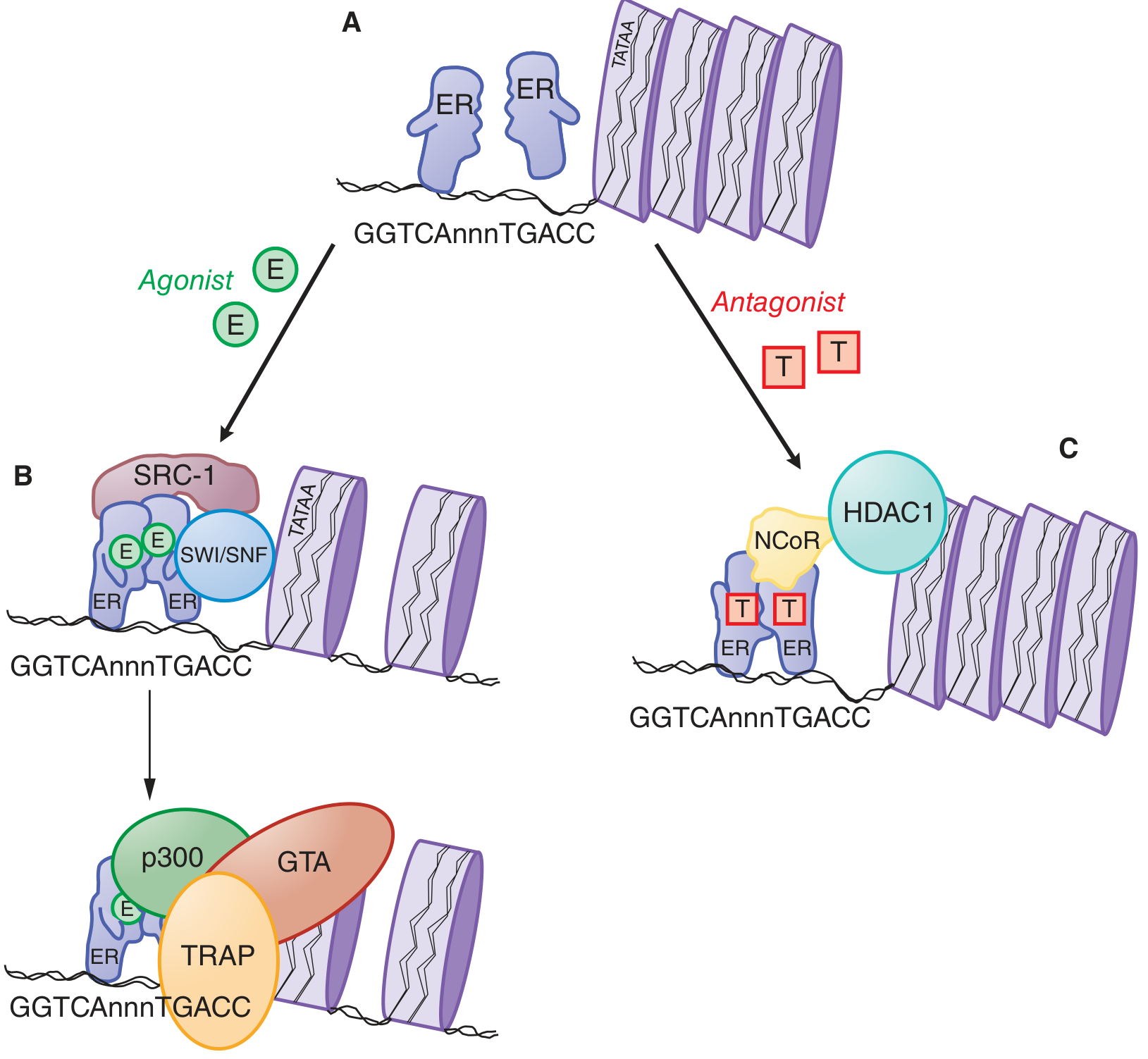
Figure: (A) Unliganded ER monomers. (B) Agonist (E2) binding causes dimerization, ERE binding, and coactivator recruitment (SRC-1, SWI/SNF, p300, TRAP) leading to gene transcription. (C) Antagonist (T = tamoxifen) produces a different ER conformation that recruits corepressors (NCoR, HDAC1) and silences transcription.
Non-genomic (Rapid) Signaling
- Membrane-associated ERα and GPER (GPR30, a G protein-coupled receptor) mediate rapid effects
- Crosstalk with EGF/IGF-1 pathways via MAPK and PI3K-Akt → phosphorylation of ERα at serine 118 causes ligand-independent activation
Receptor Isoforms
- ERα: Predominant in uterus, vagina, ovaries, mammary gland, hypothalamus, vascular endothelium
- ERβ: Predominant in prostate, ovaries, lung, bone, brain
- Both can form homodimers or heterodimers; ERβ can inhibit ERα-mediated transcription when co-expressed
4. Pharmacological Preparations & Routes
| Preparation | Route | Examples |
|---|---|---|
| Oral | Tablets | Micronized estradiol, conjugated equine estrogens (CEE), ethinyl estradiol, estropipate |
| Transdermal | Patch (1-2x/week) | Estradiol patches - avoids first-pass hepatic metabolism |
| Topical | Gel, emulsion (daily) | Estradiol gel (arm), emulsion (thigh/calf) |
| Intramuscular | Oil-based injection | Estradiol valerate, estradiol cypionate (every 1-4 weeks) |
| Vaginal | Cream, ring, tablet | Estradiol cream/ring, conjugated estrogen cream |
| Intravenous/IM | Injection | Conjugated estrogens (acute use) |
Key note: Ethinyl substitution at C17 (ethinyl estradiol) greatly increases oral potency by blocking first-pass hepatic metabolism - making it much more potent than conjugated estrogens orally. Transdermal route bypasses hepatic first-pass, minimizing effects on hepatic protein synthesis and lipids.
5. Therapeutic Uses
A. Hormonal Contraception
Ethinyl estradiol (combined with a progestin) suppresses LH/FSH surges, preventing ovulation. Available as combined oral contraceptive pills (COCPs), patches, and vaginal rings.
B. Menopausal Hormone Therapy (MHT)
- Relieves hot flashes, urogenital atrophy, mood changes
- Prevents postmenopausal osteoporosis
- Women with intact uterus must have a progestin added (to prevent endometrial hyperplasia)
- Preferred: Lowest effective dose for shortest duration
C. Induction of Sexual Maturation
Used in Turner syndrome and other causes of primary hypogonadism to induce puberty.
D. Osteoporosis Prevention
Estrogens maintain bone density by inhibiting osteoclast activity.
E. Genitourinary Syndrome of Menopause
Low-dose vaginal estrogens for vaginal atrophy, dryness, dyspareunia.
F. Palliative Cancer Treatment
High-dose estrogens used in some hormone-responsive breast and prostate cancers.
6. Estrogen Agonists/Antagonists: SERMs and Antiestrogens
These are drugs that modulate estrogen receptors in a tissue-selective manner.
Selective Estrogen Receptor Modulators (SERMs)
They produce different ER conformations that recruit different coactivators/corepressors depending on the tissue:
| Drug | Agonist at | Antagonist at | Main Use |
|---|---|---|---|
| Tamoxifen | Bone, liver (lipids) | Breast | Breast cancer treatment/prevention |
| Raloxifene | Bone | Breast, uterus | Osteoporosis + breast cancer prevention |
| Toremifene | Bone | Breast | Breast cancer (similar to tamoxifen) |
| Clomiphene | Hypothalamus/pituitary (antagonism → increases GnRH/FSH/LH) | - | Ovulation induction (infertility) |
Pure Antiestrogens
- Fulvestrant: 7α-alkylamide derivative of estradiol; pure ER antagonist in all tissues; causes receptor downregulation. Used for breast cancer after tamoxifen failure.
7. Estrogen Synthesis Inhibitors (Aromatase Inhibitors)
These block conversion of androgens to estrogens by inhibiting aromatase (CYP19):
| Type | Drug | Mechanism | Use |
|---|---|---|---|
| Steroidal (Type I) | Exemestane | Suicide (irreversible) inhibitor | Breast cancer |
| Non-steroidal (Type II) | Anastrozole, Letrozole | Reversible (heme binding) | Breast cancer |
Aromatase inhibitors are superior to tamoxifen in postmenopausal adjuvant breast cancer treatment. They do NOT increase uterine cancer or VTE risk (unlike tamoxifen) but do cause bone loss and hot flashes.
8. Physiological Effects of Estrogens
| System | Effect |
|---|---|
| Reproductive tract | Endometrial proliferation, cervical mucus thinning, vaginal epithelium thickening |
| Breast | Ductal development, promotes growth |
| Bone | Inhibits osteoclast activity; maintains bone density |
| Cardiovascular | Improves lipid profile (↑ HDL, ↓ LDL); vasodilation |
| Coagulation | ↑ Factors II, VII, IX, X, XII; ↓ Protein C, S, antithrombin III; ↑ fibrinolysis |
| CNS | Thermoregulation, mood, neuroprotection |
| Liver | Increases production of SHBG, TBG, coagulation factors, angiotensinogen |
| Metabolism | Affects carbohydrate and fat metabolism; slight increase in TG with oral estrogens |
9. Adverse Effects & Contraindications
| Adverse Effect | Notes |
|---|---|
| Venous thromboembolism (VTE) | Due to procoagulant effects; higher risk with oral vs. transdermal |
| Breast cancer | Risk increased with prolonged combined HRT (estrogen + progestin) |
| Endometrial cancer | Risk with unopposed estrogen in women with intact uterus |
| Cardiovascular events | Timing hypothesis: protective if started early in menopause; harmful if started >10 years post-menopause |
| Nausea, bloating | Common at initiation |
| Hypertension | Via ↑ angiotensinogen |
| Gallbladder disease | Increased risk with oral estrogens |
Absolute contraindications: Estrogen-dependent cancers (breast, endometrial), active thromboembolism, unexplained vaginal bleeding, liver disease, pregnancy.
10. Summary: Drug Classes at a Glance
ESTROGEN DRUGS
├── Estrogen Agonists (Replacement/Contraception)
│ ├── 17β-Estradiol (natural, patches, gels, IM)
│ ├── Ethinyl estradiol (oral contraceptives)
│ └── Conjugated equine estrogens (CEE - Premarin)
│
├── SERMs (Selective Estrogen Receptor Modulators)
│ ├── Tamoxifen (breast CA treatment)
│ ├── Raloxifene (osteoporosis + breast CA prevention)
│ ├── Toremifene (breast CA)
│ └── Clomiphene (ovulation induction)
│
├── Pure Antiestrogens
│ └── Fulvestrant (breast CA after tamoxifen failure)
│
└── Estrogen Synthesis Inhibitors (Aromatase Inhibitors)
├── Exemestane (steroidal, irreversible)
├── Anastrozole (non-steroidal, reversible)
└── Letrozole (non-steroidal, reversible)
Source: Goodman & Gilman's The Pharmacological Basis of Therapeutics, Chapter 48 (Estrogens and Progestins)
Estrogen
Asking for Preferences
What aspect of estrogen are you interested in?
Estrogen drugs
The previous response already covered estrogen drugs in detail. Here is a clean, well-organized summary of everything covered:
Estrogen Drugs - Complete Overview
1. Endogenous Estrogens (Natural)
| Estrogen | Potency | Main Source |
|---|---|---|
| 17β-Estradiol (E2) | Most potent | Ovaries (premenopausal) |
| Estrone (E1) | Intermediate | Peripheral conversion (postmenopausal) |
| Estriol (E3) | Weakest | Fetoplacental unit (pregnancy) |
All share a phenolic A ring with -OH at C3. Biosynthesis requires aromatase (CYP19) to convert androgens to estrogens.
2. Mechanism of Action
Genomic Pathway (Primary)
- Estrogen binds ERα or ERβ in the nucleus
- Receptor dimerizes → binds Estrogen Response Elements (EREs) on DNA
- Recruits coactivators (SRC-1, SWI/SNF, p300) → gene transcription
Non-Genomic (Rapid)
- Membrane-associated ER and GPER (GPR30) → fast signaling via MAPK, PI3K-Akt
Receptor Distribution
- ERα: Uterus, vagina, ovaries, breast, hypothalamus, vascular endothelium
- ERβ: Prostate, ovaries, lung, bone, brain
3. Pharmacological Preparations
| Preparation | Route | Key Examples |
|---|---|---|
| Micronized estradiol | Oral | Estrace |
| Conjugated equine estrogens | Oral / IV / IM | Premarin (CEE) |
| Ethinyl estradiol | Oral | Combined OCP (most potent oral form) |
| Estropipate | Oral | Ogen |
| Estradiol patch | Transdermal | Vivelle, Climara (1-2x/week) |
| Estradiol gel/emulsion | Topical | Estrogel, Estrasorb |
| Estradiol valerate / cypionate | IM injection | Given every 1-4 weeks |
| Estradiol cream / ring / tablet | Vaginal | Vagifem, Estring |
Ethinyl estradiol has a C17 ethinyl group that blocks first-pass hepatic metabolism, making it far more potent orally than conjugated estrogens. Transdermal routes avoid first-pass and minimize hepatic effects (lipids, coagulation factors).
4. Therapeutic Uses
| Indication | Drug/Approach |
|---|---|
| Combined oral contraception | Ethinyl estradiol + progestin |
| Menopausal HRT (hot flashes, atrophy) | Estradiol or CEE ± progestin |
| Osteoporosis prevention | Estradiol (maintains bone density) |
| Genitourinary syndrome of menopause | Low-dose vaginal estradiol |
| Primary hypogonadism / Turner syndrome | Estradiol (induces puberty) |
| Hormone-responsive cancers (palliative) | High-dose estrogens |
5. SERMs - Selective Estrogen Receptor Modulators
Tissue-selective agonist/antagonist activity based on differential coactivator recruitment:
| Drug | Agonist at | Antagonist at | Use |
|---|---|---|---|
| Tamoxifen | Bone, liver | Breast | Breast cancer treatment/prevention |
| Raloxifene | Bone | Breast, uterus | Osteoporosis + breast cancer prevention |
| Toremifene | Bone | Breast | Breast cancer |
| Clomiphene | Hypothalamus (blocks feedback → ↑FSH/LH) | - | Ovulation induction (infertility) |
6. Pure Antiestrogens
| Drug | Mechanism | Use |
|---|---|---|
| Fulvestrant | Pure ER antagonist + receptor downregulation | Breast cancer after tamoxifen failure |
7. Aromatase Inhibitors (Estrogen Synthesis Inhibitors)
Block CYP19 (aromatase), stopping androgen → estrogen conversion:
| Type | Drug | Mechanism | Use |
|---|---|---|---|
| Steroidal (Type I) | Exemestane | Irreversible suicide inhibitor | Breast cancer |
| Non-steroidal (Type II) | Anastrozole, Letrozole | Reversible heme binding | Breast cancer |
Superior to tamoxifen in postmenopausal adjuvant breast cancer. No uterine cancer or VTE risk (unlike tamoxifen), but cause bone loss and hot flashes.
8. Physiological Effects
| System | Effect |
|---|---|
| Reproductive tract | Endometrial proliferation, cervical mucus thinning, vaginal epithelium thickening |
| Breast | Ductal development |
| Bone | Inhibits osteoclasts → maintains bone density |
| Cardiovascular | ↑ HDL, ↓ LDL; vasodilation |
| Coagulation | ↑ Factors II, VII, IX, X, XII; ↓ Protein C, S, antithrombin III |
| Liver | ↑ SHBG, TBG, angiotensinogen, coagulation proteins |
| CNS | Thermoregulation, mood, neuroprotection |
9. Adverse Effects & Contraindications
| Adverse Effect | Mechanism / Note |
|---|---|
| VTE (DVT/PE) | Procoagulant effect; oral > transdermal |
| Breast cancer | Long-term combined HRT (estrogen + progestin) |
| Endometrial cancer | Unopposed estrogen in women with intact uterus |
| Cardiovascular risk | Harmful if started >10 yrs post-menopause |
| Nausea, bloating | Common at initiation |
| Hypertension | ↑ angiotensinogen |
| Gallbladder disease | Increased with oral estrogens |
Absolute contraindications: Estrogen-dependent cancers, active VTE, unexplained vaginal bleeding, active liver disease, pregnancy.
10. Quick Summary Diagram
ESTROGEN DRUGS
├── Agonists (Replacement / Contraception)
│ ├── 17β-Estradiol (patches, gels, IM, vaginal)
│ ├── Ethinyl estradiol (oral contraceptives)
│ └── Conjugated equine estrogens - CEE (Premarin)
│
├── SERMs
│ ├── Tamoxifen → breast cancer Rx
│ ├── Raloxifene → osteoporosis + breast CA prevention
│ ├── Toremifene → breast cancer
│ └── Clomiphene → ovulation induction
│
├── Pure Antiestrogen
│ └── Fulvestrant → breast CA (post-tamoxifen)
│
└── Aromatase Inhibitors (stop estrogen synthesis)
├── Exemestane (irreversible)
├── Anastrozole (reversible)
└── Letrozole (reversible)
Source: Goodman & Gilman's The Pharmacological Basis of Therapeutics, Chapter 48
Progesterone from lippincot
Progesterone is a steroid hormone essential for maintaining pregnancy and regulating the menstrual cycle. Lippincott's pharmacology covers progestins in detail.
Searching sources...
Reading File
Finding Sources
Finding Sources
Finding Sources
Finding Sources
Found it. The Lippincott Pharmacology book has progesterone content in block3.md. Let me read the full relevant sections.
Finding Sources
Reading File
Reading File
Reading File
Now let me read the progestogens/progesterone section specifically:
Reading File
Reading File
Reading File
Loading Image
Now let me get the adverse effects and mifepristone/ulipristal sections:
Reading File
I now have all the content needed from Lippincott. Here is the complete, well-organized answer:
Progesterone & Progestogens - Lippincott Illustrated Reviews: Pharmacology
1. Overview of Progestogens
The term progestogens includes both:
- Progesterone - the naturally occurring hormone (secreted by corpus luteum)
- Progestins - synthetic compounds with progesterone-like activity (more stable, better oral bioavailability)
2. Mechanism of Action
Progestogens act like all steroid hormones - they diffuse across the cell membrane and bind to specific nuclear progesterone receptors. The activated hormone-receptor complex interacts with nuclear chromatin to initiate specific RNA synthesis, producing proteins that mediate physiological effects.
Key physiological actions of progesterone:
| Phase | Action |
|---|---|
| Luteal phase | Promotes secretory transformation of endometrium to accommodate embryo implantation |
| During pregnancy | Maintains endometrium favorably; reduces uterine contractions (prevents preterm labor) |
| Negative feedback | High progesterone from corpus luteum inhibits gonadotropins (LH, FSH) → prevents further ovulation |
| Menstruation trigger | Corpus luteum regresses → progesterone falls abruptly → menstruation begins |
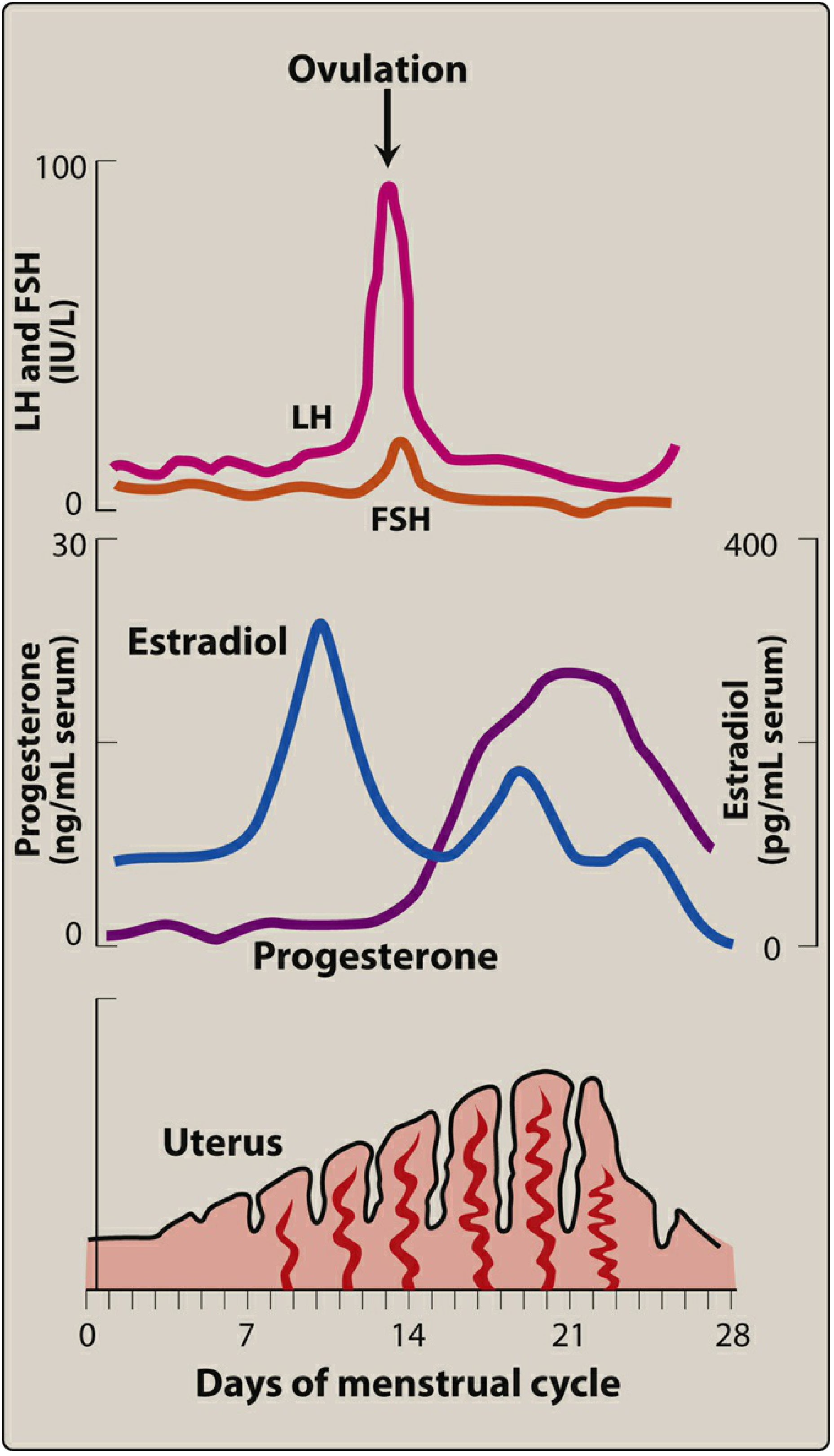
Figure 25.6 (Lippincott): The menstrual cycle - progesterone rises sharply after ovulation (day 14), peaks around day 21 in the luteal phase, then falls to trigger menstruation.
3. Synthetic Progestins (Drugs Used Clinically)
Natural progesterone is NOT used as a contraceptive because of its rapid first-pass hepatic metabolism and low oral bioavailability. Synthetic progestins are more stable.
Progestins for Contraception
| Drug | Route / Form | Brand |
|---|---|---|
| Levonorgestrel | Oral (emergency) | Plan B One-Step |
| Levonorgestrel | IUD | Mirena, Kyleena, Liletta, Skyla |
| Levonorgestrel | With EE - oral | Generic |
| Levonorgestrel | With EE - transdermal | Twirla |
| Etonogestrel | Subdermal implant | Nexplanon |
| Etonogestrel | With EE - vaginal ring | NuvaRing |
| Norethindrone | Oral (progestin-only pill) | Generic |
| Norethindrone acetate | With EE - oral | Loestrin |
| Drospirenone | Progestin-only pill | Slynd |
| Drospirenone | With EE - oral | Yasmin, Yaz |
| Norgestimate | With EE - oral | Ortho Tri-Cyclen, Sprintec |
| Desogestrel | In combination OCP | Generic |
| Dienogest | With estradiol valerate | Natazia |
| Norelgestromin | With EE - transdermal patch | Xulane |
| Medroxyprogesterone acetate | Injectable (IM/SC) | Depo-Provera |
Progestins for Hormone Therapy (HT)
| Drug | Route | Brand |
|---|---|---|
| Progesterone (micronized) | Oral | Prometrium |
| Medroxyprogesterone acetate | Oral | Provera |
| Medroxyprogesterone acetate | With CEE - oral | Prempro |
| Norethindrone acetate | With estradiol - oral | Activella |
| Norethindrone acetate | With estradiol - transdermal | CombiPatch |
| Levonorgestrel | With estradiol - transdermal | Climara Pro |
| Drospirenone | With estradiol - oral | Angeliq |
4. Therapeutic Uses
- Contraception - oral, injectable, transdermal, implant, IUD
- Menopausal hormone therapy (HT) - combined with estrogen to protect endometrium from unopposed estrogen-induced hyperplasia
- Control of heavy menstrual bleeding (menorrhagia) - levonorgestrel IUD especially effective
- Dysmenorrhea - reduce uterine contractions
- Endometriosis - suppress endometrial growth
- Infertility management - luteal phase support
5. Pharmacokinetics
| Drug | Key PK Feature |
|---|---|
| Progesterone (micronized, oral) | Short plasma half-life; metabolized in liver to pregnanediol → glucuronide/sulfate conjugates → excreted in urine |
| Medroxyprogesterone (oral) | Half-life 16-30 hours |
| Medroxyprogesterone (IM/SC) | Half-life ~40-50 days; provides contraception for ~3 months (Depo-Provera) |
| Other progestins | Half-lives 7-30 hours; allow once-daily dosing |
Synthetic progestins are less rapidly metabolized than natural progesterone, making them suitable for once-daily oral dosing.
6. Adverse Effects
| Adverse Effect | Notes |
|---|---|
| Headache | Common |
| Depression | Common |
| Weight gain | Common |
| Changes in libido | Common |
| Acne & hirsutism | Progestins derived from 19-nortestosterone (norethindrone, levonorgestrel) have androgenic activity due to structural similarity to testosterone |
| Hyperkalemia | Drospirenone (an analog of spironolactone) has anti-mineralocorticoid effects → ↑ serum K⁺; risk increases with ACE inhibitors or K⁺-sparing drugs |
Less androgenic progestins (norgestimate, drospirenone) are preferred in women with acne.
7. Progesterone Antagonist - Mifepristone (RU-486)
Mifepristone [mih-feh-PRIH-stone]
- Pure progesterone receptor antagonist
- Terminates pregnancy by blocking progesterone needed to maintain the endometrium
- Usually combined with misoprostol (prostaglandin analog) to induce uterine contractions
- Brand: Mifeprex
- Adverse effects: abdominal pain, uterine bleeding, risk of incomplete termination
8. Progesterone Agonist/Antagonist - Ulipristal
Ulipristal acetate [ue-li-PRIS-tal]
- A selective progesterone receptor modulator (acts as agonist/antagonist)
- Used as emergency contraception (up to 120 hours after unprotected intercourse)
- Brand: Ella
- Better tolerated than estrogen-progestin combination emergency contraceptives
9. Contraceptive Mechanisms (Summary)
In combination hormonal contraceptives:
- Estrogen → negative feedback → blunts FSH release → prevents follicle development
- Progestin → inhibits LH surge → prevents ovulation; also thickens cervical mucus to prevent sperm penetration
- Withdrawal of progestin (pill-free week) → withdrawal bleeding
10. Drug Interactions
| Interacting Drug | Effect |
|---|---|
| CYP3A4 inducers (rifampin, carbamazepine, phenytoin) | Reduce contraceptive efficacy - use alternate barrier method |
| Antibiotics (broad-spectrum) | Alter GI flora → reduce enterohepatic recycling of estrogen in combination pills → may reduce efficacy |
| ACE inhibitors / K⁺-sparing drugs | Combined with drospirenone → risk of hyperkalemia |
Source: Lippincott Illustrated Reviews: Pharmacology, Chapter 25 - Estrogens, Progestogens, and Contraceptives
Progesterone from lip Pinchot
"Lip Pinchot" is your autocorrect for Lippincott - the full answer was just provided above from Lippincott Illustrated Reviews: Pharmacology, Chapter 25.
Here's a quick recap of the key points:
Progesterone - Lippincott Summary
Mechanism
- Binds nuclear progesterone receptors → activates gene transcription
- Promotes secretory endometrium for implantation
- Inhibits LH/FSH (negative feedback) → prevents ovulation in luteal phase
- Maintains pregnancy + reduces uterine contractions
- Fall in progesterone → triggers menstruation
Key Drugs (Progestins)
| Drug | Use | Route |
|---|---|---|
| Progesterone micronized (Prometrium) | HRT | Oral |
| Medroxyprogesterone (Depo-Provera) | Contraception | IM injection (3 months) |
| Levonorgestrel (Mirena, Plan B) | Contraception | IUD / Oral |
| Norethindrone | Contraception | Oral |
| Drospirenone (Yaz) | Contraception | Oral |
| Etonogestrel (Nexplanon, NuvaRing) | Contraception | Implant / Vaginal ring |
| Mifepristone (Mifeprex) | Medical abortion | Oral (+ misoprostol) |
| Ulipristal (Ella) | Emergency contraception | Oral |
Adverse Effects
- Headache, depression, weight gain, libido changes
- Acne/hirsutism - 19-nortestosterone-derived progestins (norethindrone, levonorgestrel) have androgenic activity
- Hyperkalemia - drospirenone (spironolactone analog) - caution with ACE inhibitors
Pharmacokinetics
- Natural progesterone: rapid first-pass metabolism - NOT used for contraception
- Synthetic progestins: more stable, once-daily oral dosing
- Depo-Provera (IM): half-life ~40-50 days, lasts 3 months
Source: Lippincott Illustrated Reviews: Pharmacology, Chapter 25
Give me full answer
The full answer was already provided two responses ago. Here it is again in complete form, directly from Lippincott Illustrated Reviews: Pharmacology, Chapter 25:
Progesterone & Progestogens
Lippincott Illustrated Reviews: Pharmacology - Chapter 25
1. What Are Progestogens?
The term progestogens covers two categories:
- Progesterone - the natural hormone secreted by the corpus luteum
- Progestins - synthetic analogs with progesterone-like activity (more stable, better oral bioavailability)
Natural progesterone is NOT used as a contraceptive because of its rapid first-pass hepatic metabolism resulting in low bioavailability when taken orally.
2. Mechanism of Action
Progestogens act like all steroid hormones:
- Diffuse across the cell membrane
- Bind to specific nuclear progesterone receptors
- Activated hormone-receptor complex binds nuclear chromatin
- Initiates specific RNA synthesis → specific protein production → physiological effects
Physiological Actions of Progesterone
| Situation | Action |
|---|---|
| Luteal phase (days 15-28) | Promotes secretory endometrium to accommodate embryo implantation |
| Negative feedback | High levels from corpus luteum inhibit LH/FSH → prevents further ovulation |
| If conception occurs | Continues to maintain endometrium; reduces uterine contractions to preserve pregnancy |
| If no conception | Corpus luteum regresses → progesterone falls abruptly → menstruation begins |
Figure 25.6: The menstrual cycle. Progesterone rises sharply after ovulation (~day 14), peaks in the luteal phase (~day 21), then falls to trigger menstruation at day 28.
3. Classification of Progestogen Drugs
A. Natural Progesterone
| Drug | Brand | Route |
|---|---|---|
| Progesterone (micronized) | Prometrium | Oral |
| Progesterone | Various | Vaginal gel/suppository |
Micronized form has larger surface area for better absorption, but still undergoes significant first-pass metabolism.
B. Synthetic Progestins - For Contraception
Derived from two structural classes:
19-Nortestosterone derivatives (have some androgenic activity - can cause acne/hirsutism):
| Drug | Route / Delivery | Brand |
|---|---|---|
| Norethindrone | Oral (progestin-only pill) | Generic |
| Norethindrone acetate | With EE - oral | Loestrin |
| Norethindrone acetate | With estradiol - oral | Activella |
| Norethindrone acetate | With estradiol - transdermal | CombiPatch |
| Levonorgestrel | Oral (emergency contraception) | Plan B One-Step |
| Levonorgestrel | IUD | Mirena, Kyleena, Liletta, Skyla |
| Levonorgestrel | With EE - oral | Generic |
| Levonorgestrel | With EE - transdermal | Twirla |
| Levonorgestrel | With estradiol - transdermal | Climara Pro |
| Etonogestrel | Subdermal implant | Nexplanon |
| Etonogestrel | With EE - vaginal ring | NuvaRing |
| Norelgestromin | With EE - transdermal patch | Xulane |
Less androgenic / newer progestins (preferred in women with acne):
| Drug | Route / Delivery | Brand |
|---|---|---|
| Norgestimate | With EE - oral | Ortho Tri-Cyclen, Sprintec |
| Desogestrel | In combination OCP | Generic |
| Dienogest | With estradiol valerate - oral | Natazia |
| Drospirenone | Progestin-only pill | Slynd |
| Drospirenone | With EE - oral | Yasmin, Yaz |
| Drospirenone | With estradiol - oral (HT) | Angeliq |
Pregnane derivatives:
| Drug | Route / Delivery | Brand |
|---|---|---|
| Medroxyprogesterone acetate | Oral (HT) | Provera |
| Medroxyprogesterone acetate | IM injection | Depo-Provera |
| Medroxyprogesterone acetate | With CEE - oral (HT) | Prempro |
4. Therapeutic Uses
| Use | Drug(s) of Choice |
|---|---|
| Oral contraception | Norethindrone, levonorgestrel, norgestimate, drospirenone + EE combinations |
| Long-acting injectable contraception | Medroxyprogesterone acetate IM (Depo-Provera) - 3 months |
| Subdermal implant contraception | Etonogestrel (Nexplanon) - up to 3 years |
| Intrauterine contraception | Levonorgestrel IUD (Mirena etc.) - 3-8 years |
| Emergency contraception | Levonorgestrel (Plan B), ulipristal (Ella) |
| Menopausal hormone therapy (HT) | Progesterone (Prometrium), MPA (Prempro), norethindrone acetate - added to estrogen to protect endometrium |
| Heavy menstrual bleeding | Levonorgestrel IUD; MPA |
| Dysmenorrhea | Combined OCP or progestin-only |
| Endometriosis | Progestins suppress endometrial growth |
| Infertility / luteal phase support | Progesterone vaginal gel |
5. Pharmacokinetics
| Drug | Half-life | Notes |
|---|---|---|
| Progesterone (micronized, oral) | Short | Extensive first-pass metabolism → pregnanediol → glucuronide/sulfate conjugates → excreted in urine |
| Medroxyprogesterone (oral) | 16-30 hours | Once daily dosing |
| Medroxyprogesterone (IM/SC - Depo-Provera) | ~40-50 days | Provides contraception for ~3 months per injection |
| Other progestins | 7-30 hours | Once-daily oral dosing |
6. Contraceptive Mechanism of Action (How Progestins Prevent Pregnancy)
In combination hormonal contraceptives (pill, patch, ring):
- Estrogen → negative feedback → blunts FSH release from pituitary → prevents follicle development
- Progestin → inhibits LH surge → prevents ovulation
- Progestin also thickens cervical mucus → blocks sperm from reaching the egg
- Withdrawal of progestin (during the pill-free / patch-free week) → withdrawal bleeding (not true menstruation)
In progestin-only methods (mini-pill, implant, injection, IUD):
- Primary mechanism: thickening of cervical mucus + thinning of endometrium
- Ovulation may still occur
7. Adverse Effects
| Adverse Effect | Details |
|---|---|
| Headache | Common |
| Depression | Common - especially with 19-nortestosterone derivatives |
| Weight gain | Common |
| Changes in libido | Common |
| Acne & hirsutism | Due to androgenic activity of 19-nortestosterone progestins (norethindrone, levonorgestrel) - structural similarity to testosterone |
| Hyperkalemia | Drospirenone only - spironolactone analog with anti-mineralocorticoid activity → raises serum K⁺; risk ↑ with ACE inhibitors, ARBs, K⁺-sparing diuretics |
| Breakthrough bleeding | Especially with progestin-only pills and new users |
Tip: For women with acne, prefer norgestimate or drospirenone - less androgenic than norethindrone or levonorgestrel.
8. Progesterone Antagonist - Mifepristone (RU-486)
Mifepristone [mih-feh-PRIH-stone] | Brand: Mifeprex
- Pure progesterone receptor antagonist
- Blocks the progesterone required to maintain the endometrium
- Results in termination of early pregnancy
- Almost always combined with misoprostol (a prostaglandin E1 analog) to:
- Induce uterine contractions
- Complete evacuation of uterine contents
Adverse effects:
- Abdominal/uterine cramping
- Uterine bleeding (expected)
- Risk of incomplete termination of pregnancy
9. Progesterone Agonist/Antagonist - Ulipristal
Ulipristal acetate [ue-li-PRIS-tal] | Brand: Ella
- Selective progesterone receptor modulator (partial agonist/antagonist)
- Mechanism: delays or inhibits ovulation; may also affect endometrial receptivity
- Used as emergency contraception - effective up to 120 hours (5 days) after unprotected intercourse
- Better tolerated than levonorgestrel + estrogen combination regimens
10. Drug Interactions with Progestin-Containing Contraceptives
| Interacting Drug | Mechanism | Clinical Action |
|---|---|---|
| Rifampin, carbamazepine, phenytoin | CYP3A4 inducers → increased progestin/estrogen metabolism | Avoid or add barrier method |
| Broad-spectrum antibiotics | Alter GI flora → reduce enterohepatic recycling of estrogen in combined pills | Warn patients; consider backup contraception |
| ACE inhibitors, ARBs, K⁺-sparing diuretics | Combined with drospirenone → additive hyperkalemia risk | Monitor serum potassium |
11. Contraindications
- Active or history of thromboembolic disease
- Estrogen-dependent cancers (for combined products)
- Liver disease
- Pregnancy
- Undiagnosed abnormal vaginal bleeding
- Women >35 years who smoke - avoid estrogen-containing contraceptives (progestin-only preferred)
Summary Diagram
PROGESTOGEN DRUGS (Lippincott Ch. 25)
│
├── NATURAL
│ └── Progesterone (Prometrium, vaginal gel)
│ - Short half-life, first-pass metabolism
│ - Used for HRT & luteal phase support
│
├── SYNTHETIC PROGESTINS
│ ├── 19-Nortestosterone derivatives (androgenic)
│ │ ├── Norethindrone / Norethindrone acetate
│ │ ├── Levonorgestrel (Plan B, Mirena IUD, Twirla)
│ │ ├── Etonogestrel (Nexplanon, NuvaRing)
│ │ └── Norelgestromin (Xulane patch)
│ │
│ ├── Less androgenic
│ │ ├── Norgestimate (Ortho Tri-Cyclen)
│ │ ├── Desogestrel
│ │ ├── Dienogest (Natazia)
│ │ └── Drospirenone (Yaz, Yasmin) ← anti-mineralocorticoid
│ │
│ └── Pregnane derivatives
│ └── Medroxyprogesterone (Provera, Depo-Provera)
│ - Depo: 3-month injection
│
├── PROGESTERONE ANTAGONIST
│ └── Mifepristone (Mifeprex / RU-486)
│ - Medical abortion (+ misoprostol)
│
└── PROGESTERONE AGONIST/ANTAGONIST
└── Ulipristal (Ella)
- Emergency contraception (up to 120 hrs)
Source: Lippincott Illustrated Reviews: Pharmacology, Chapter 25 - Estrogens, Progestogens, and Contraceptives
Parkinsonism pharmacology
Parkinsonism pharmacology centers on restoring the dopamine/acetylcholine balance in the striatum. The main drug classes are levodopa combinations, dopamine agonists, MAO-B inhibitors, COMT inhibitors, and anticholinergics.
Searching sources...
Finding Sources
Finding Sources
Finding Sources
Finding Sources
Finding Sources
Finding Sources
Lippincott has a dedicated Parkinson chapter. Let me read it fully.
Reading File
Reading File
Reading File
Loading Image
Excellent content. Let me now read the levodopa, dopamine agonists, anticholinergics, and amantadine sections:
Reading File
Loading Image
I have all the content I need. Now let me compile the full, complete answer.
Parkinsonism Pharmacology
Lippincott Illustrated Reviews: Pharmacology - Chapter 15
1. What is Parkinsonism?
Parkinsonism is a progressive neurological disorder of muscle movement characterized by:
- Tremors (resting tremor - "pill-rolling")
- Muscular rigidity
- Bradykinesia (slowness of movement)
- Postural and gait abnormalities
Most cases occur in people over 65 years of age.
2. Pathophysiology
The Core Problem
Destruction of dopaminergic neurons in the substantia nigra → reduced dopamine in the neostriatum (basal ganglia)
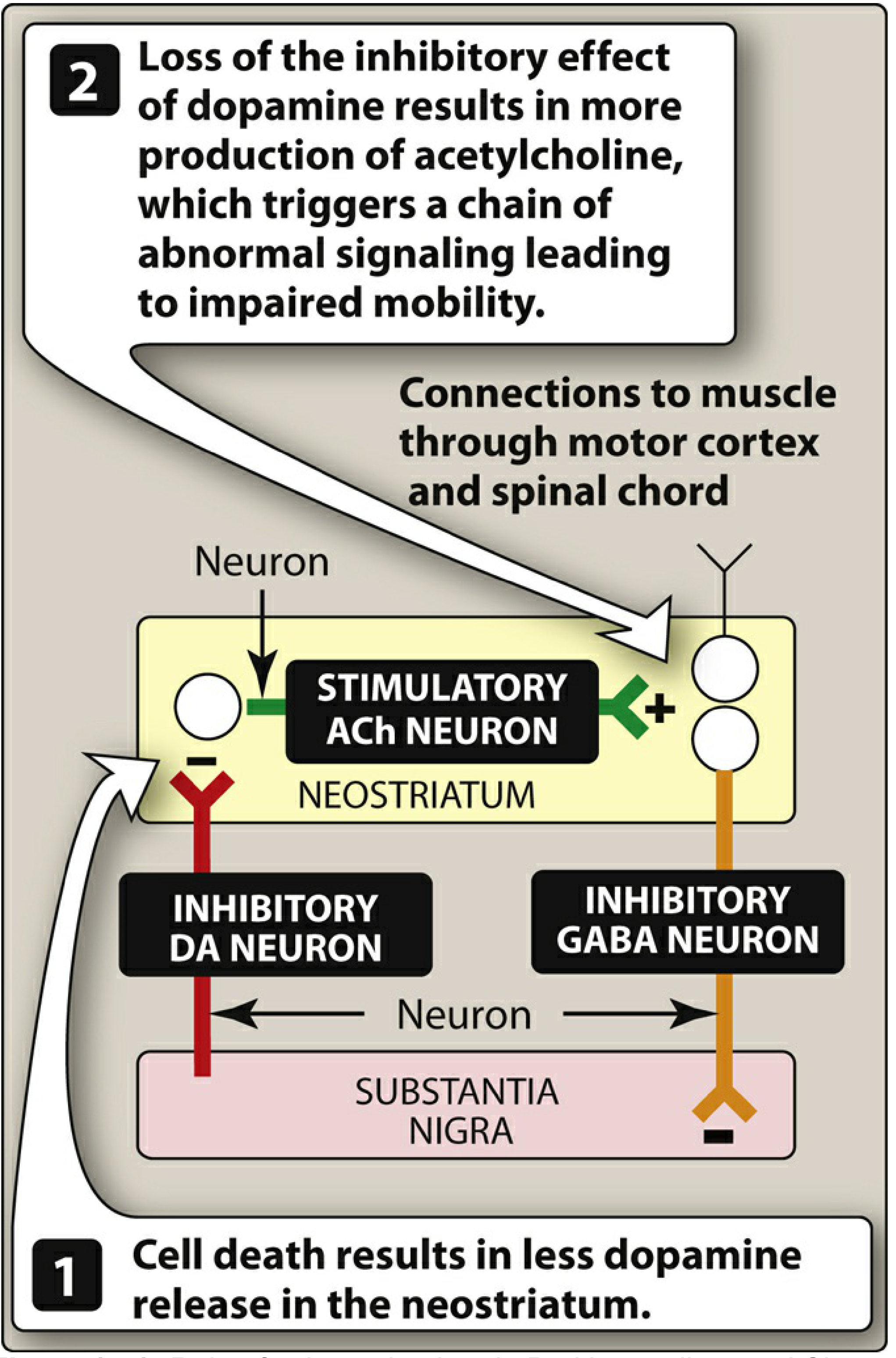
Figure 15.4 (Lippincott): (1) Cell death in substantia nigra → less dopamine released in neostriatum. (2) Loss of dopamine's inhibitory effect → overproduction of ACh by stimulatory cholinergic neurons → abnormal signaling → impaired mobility.
Normal Circuit
- Substantia nigra → Neostriatum: dopaminergic neurons (inhibitory - suppresses ACh)
- Neostriatum → Substantia nigra: GABAergic neurons (inhibitory)
- This mutual inhibition maintains balanced motor control
In Parkinson Disease
- Substantia nigra cells die → dopamine ↓ in neostriatum
- Without dopamine's inhibition → ACh neurons become overactive
- Result: dopamine/ACh imbalance → loss of muscle movement control
Secondary (Drug-Induced) Parkinsonism
Drugs that block dopamine receptors - phenothiazines, haloperidol, and other antipsychotics - produce pseudoparkinsonism. All dopamine receptor blockers carry some risk; use with extreme caution or avoid in PD patients.
3. Treatment Strategy
Two approaches to restore DA/ACh balance:
- Increase dopaminergic activity (main approach) - using levodopa, dopamine agonists, MAO-B inhibitors, COMT inhibitors, amantadine
- Decrease cholinergic activity - using anticholinergics
Current drugs only offer symptomatic relief - they do NOT arrest or reverse neuronal degeneration.
4. Drug Classes
CLASS 1: Levodopa + Carbidopa (FIRST-LINE)
Levodopa [lee-voe-DOE-pa] | Brand: Sinemet (with carbidopa)
Why Levodopa, not Dopamine?
Dopamine does NOT cross the blood-brain barrier (BBB). Levodopa is its metabolic precursor - it is actively transported across the BBB and converted to dopamine by residual neurons in the substantia nigra.
Why Add Carbidopa?
Without carbidopa, most levodopa is decarboxylated to dopamine peripherally before reaching the brain:
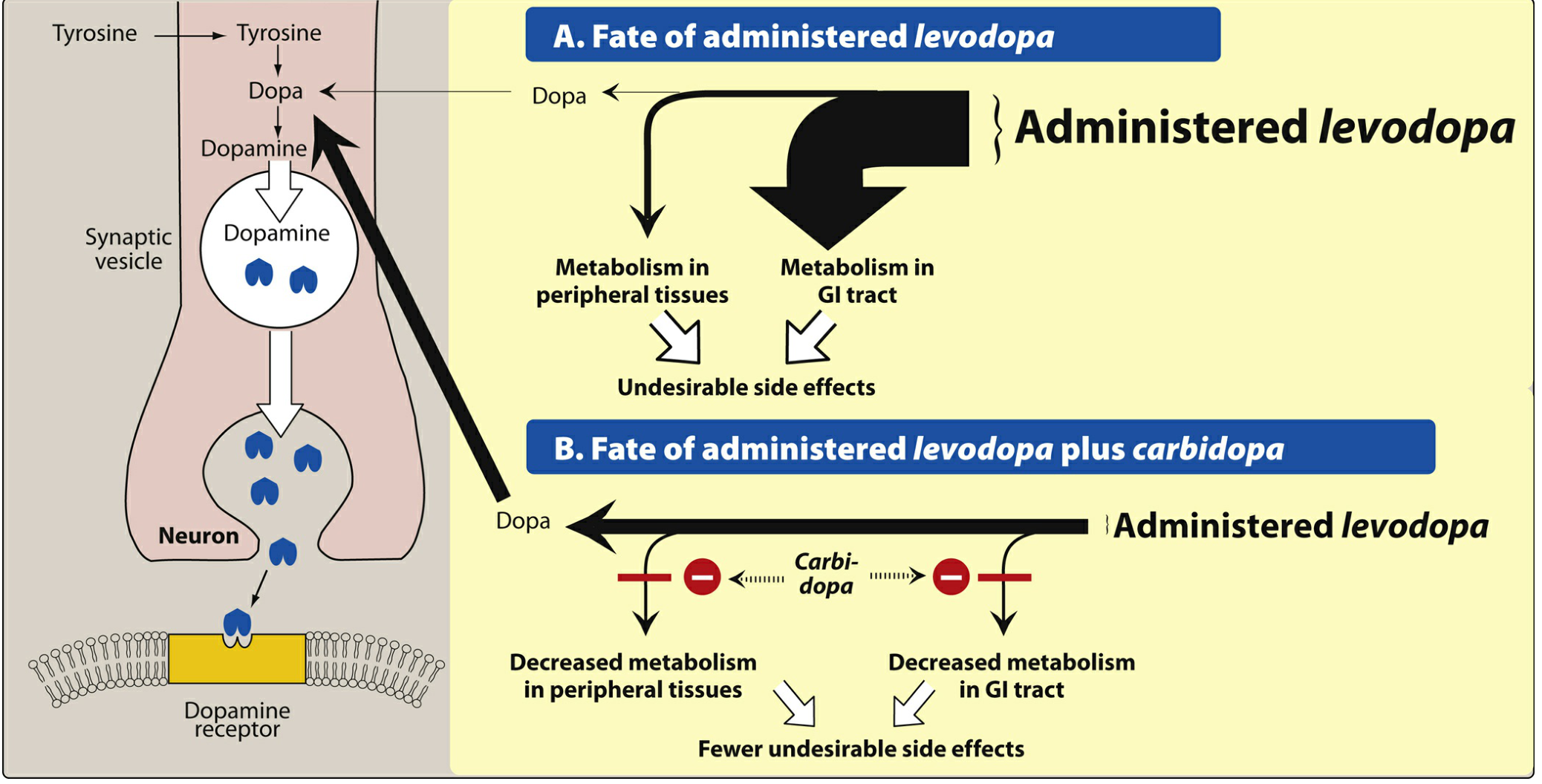
Figure 15.5 (Lippincott): Carbidopa inhibits peripheral dopa decarboxylase → prevents peripheral conversion of levodopa → more levodopa reaches the CNS → more brain dopamine + fewer peripheral side effects.
Carbidopa benefits:
- Reduces levodopa dose by 4-5 fold
- Reduces nausea, vomiting, cardiac arrhythmias, hypotension (from peripheral dopamine)
- Does NOT cross BBB itself - only acts peripherally
Pharmacokinetics
- Absorbed rapidly from small intestine (best on empty stomach - food delays/reduces absorption)
- Short half-life: 1-2 hours → plasma fluctuations → motor fluctuations
- Motor fluctuations include "wearing off" (end-of-dose) and "on-off" phenomenon
Adverse Effects
| Adverse Effect | Mechanism |
|---|---|
| Nausea, vomiting | Peripheral dopamine stimulating CTZ |
| Cardiac arrhythmias | Peripheral dopamine on heart |
| Orthostatic hypotension | Peripheral dopaminergic vasodilation |
| Dyskinesias (involuntary movements) | Excess dopamine; common after long-term use |
| "On-off" phenomenon | Unpredictable oscillation between mobility and immobility |
| Wearing off | Declining response before next dose |
| Hallucinations, psychosis | Central dopamine excess in non-motor areas |
Drug Interactions
- Pyridoxine (Vit B6): accelerates peripheral levodopa metabolism → reduces CNS availability (less relevant when carbidopa is co-administered)
- MAOIs (non-selective): risk of hypertensive crisis - contraindicated
- Antipsychotics: block dopamine receptors - antagonize levodopa
- High-protein diet: amino acids compete for intestinal absorption and BBB transport
Clinical Note
- Effective for ~3-5 years; then motor fluctuations develop as neurons continue to die
- In early disease: ~20% residual substantia nigra neurons still convert levodopa to dopamine adequately
- Withdrawal must be gradual (abrupt withdrawal → neuroleptic malignant-like syndrome)
CLASS 2: Dopamine Agonists
These directly stimulate dopamine receptors - they do NOT require conversion and have longer duration of action than levodopa.
| Drug | Brand | Route |
|---|---|---|
| Pramipexole [pra-mi-PEX-ole] | Mirapex | Oral |
| Ropinirole [roe-PIN-i-role] | Requip | Oral |
| Rotigotine | Neupro | Transdermal patch |
| Bromocriptine [broe-moe-KRIP-teen] | Parlodel | Oral |
| Apomorphine [ay-poe-MOR-feen] | Apokyn, Kynmobi | SC injection / sublingual |
Mechanism
Direct agonists at D2 (and D3) dopamine receptors in the striatum.
Therapeutic Use
- Used as monotherapy in early PD or as adjuncts to levodopa in advanced PD
- Allow reduction of levodopa dose and smooth out motor fluctuations
- Apomorphine: used as rescue therapy for acute "off" episodes
Adverse Effects
- Nausea, vomiting, orthostatic hypotension (like levodopa, but often less severe)
- Hallucinations, confusion (more common than with levodopa, especially in elderly)
- Impulse control disorders: compulsive gambling, hypersexuality, binge eating (especially pramipexole, ropinirole)
- Somnolence (sudden "sleep attacks" while driving - important warning)
- Bromocriptine: ergot-derived - can cause fibrotic reactions (pleuropulmonary, retroperitoneal)
CLASS 3: MAO-B Inhibitors
Block monoamine oxidase type B → reduce dopamine breakdown → increase dopamine in striatum.
| Drug | Brand | Key Features |
|---|---|---|
| Selegiline (Deprenyl) | Eldepryl, Zelapar | Irreversible MAO-B inhibitor; metabolized to methamphetamine + amphetamine → insomnia if taken after midday |
| Rasagiline | Azilect | Irreversible MAO-B inhibitor; 5× more potent than selegiline; NOT metabolized to amphetamine |
| Safinamide | Xadago | Reversible MAO-B inhibitor; adjunct to levodopa-carbidopa |
Selectivity
- At recommended doses: selective for MAO-B only → safe, no tyramine interaction ("cheese effect")
- At high doses: lose selectivity → inhibit MAO-A → risk of hypertensive crisis with tyramine-containing foods
Use
- As adjuncts to levodopa to enhance and prolong its effect; allow levodopa dose reduction
- Selegiline may also have neuroprotective properties (debated)
Adverse Effects
- Nausea, headache, confusion
- Insomnia (selegiline - from amphetamine metabolites - do not give after midday)
- Serotonin syndrome if combined with SSRIs, SNRIs, TCAs, meperidine - avoid concurrent use
CLASS 4: COMT Inhibitors
When carbidopa blocks peripheral dopa decarboxylase, levodopa is instead metabolized by COMT to 3-O-methyldopa (3-OMD), which:
- Competes with levodopa for BBB transport
- Reduces CNS uptake of levodopa
COMT inhibitors block this pathway → more levodopa reaches the brain.
| Drug | Brand | Key Features |
|---|---|---|
| Entacapone | Comtan | Peripheral COMT inhibitor only; short-acting; given with each levodopa dose |
| Opicapone | Ongentys | Once-daily peripheral COMT inhibitor |
| Tolcapone | Tasmar | Peripheral + central COMT inhibition; most potent, but hepatotoxic - reserved for refractory cases; requires LFT monitoring |
Stalevo = levodopa + carbidopa + entacapone (triple combination pill)
Adverse Effects
- Dyskinesias (from increased levodopa effect - may need to reduce levodopa dose)
- Diarrhea, nausea
- Urine discoloration (orange-brown) - harmless
- Tolcapone only: hepatotoxicity (fatal cases reported) - monitor LFTs
CLASS 5: Adenosine A2A Receptor Antagonist
| Drug | Brand | Mechanism |
|---|---|---|
| Istradefylline | Nourianz | Blocks adenosine A2A receptors in striatum → enhances dopaminergic signaling |
- Adjunct to levodopa-carbidopa for "off" episodes
- Adverse effects: dyskinesia, dizziness, nausea, insomnia
CLASS 6: Anticholinergics (for Tremor)
Block muscarinic ACh receptors → reduce the relative excess of cholinergic activity in the striatum.
| Drug | Brand |
|---|---|
| Trihexyphenidyl [try-hex-ee-FEN-ih-dill] | Generic |
| Benztropine [BENZ-troe-peen] | Cogentin |
Use
- Most useful for controlling tremor and rigidity
- Less effective for bradykinesia and postural instability
- Useful for drug-induced (pseudoparkinsonism) caused by antipsychotics
Adverse Effects (Anticholinergic = "Dry" effects)
- Dry mouth, constipation, urinary retention
- Blurred vision (cycloplegia)
- Tachycardia
- Confusion, memory impairment (especially in elderly - use with caution)
- Contraindicated in glaucoma, BPH
CLASS 7: Amantadine
Amantadine [a-MAN-ta-deen] | Brand: Gocovri
Mechanism (Multiple)
- Increases presynaptic dopamine release
- Inhibits dopamine reuptake
- Weak NMDA glutamate receptor antagonist → reduces dyskinesias
- Some anticholinergic activity
Use
- Mild early PD as monotherapy
- Adjunct to levodopa to smooth motor fluctuations
- Treatment of levodopa-induced dyskinesias (extended-release form - Gocovri)
Adverse Effects
- Livedo reticularis (mottled skin discoloration - characteristic side effect)
- Ankle edema
- Confusion, hallucinations
- Insomnia
5. PD Psychosis Management
A major challenge: most PD drugs increase dopamine → can cause hallucinations and psychosis. Yet treating psychosis with dopamine blockers worsens motor symptoms.
Solution:
- Pimavanserin - serotonin 5-HT2A inverse agonist (no dopamine blockade) → treats PD psychosis without worsening motor function
- Antipsychotics with very weak dopamine antagonism (e.g., quetiapine, clozapine) may also be used
6. Complete Drug List (Lippincott Ch. 15)
PARKINSON DISEASE DRUGS
│
├── LEVODOPA COMBINATIONS (First-line)
│ ├── Levodopa + Carbidopa (Sinemet)
│ └── Levodopa + Carbidopa + Entacapone (Stalevo)
│
├── DOPAMINE AGONISTS
│ ├── Pramipexole (Mirapex) - D2/D3 agonist
│ ├── Ropinirole (Requip) - D2/D3 agonist
│ ├── Rotigotine (Neupro) - transdermal patch
│ ├── Bromocriptine (Parlodel) - ergot-derived
│ └── Apomorphine (Apokyn) - rescue SC injection
│
├── MAO-B INHIBITORS
│ ├── Selegiline/Deprenyl (Eldepryl) - → amphetamine metabolites
│ ├── Rasagiline (Azilect) - 5× more potent; no amphetamine
│ └── Safinamide (Xadago) - reversible; adjunct to levodopa
│
├── COMT INHIBITORS
│ ├── Entacapone (Comtan) - peripheral only; per-dose
│ ├── Opicapone (Ongentys) - peripheral only; once-daily
│ └── Tolcapone (Tasmar) - central + peripheral; hepatotoxic
│
├── ADENOSINE A2A ANTAGONIST
│ └── Istradefylline (Nourianz) - adjunct for "off" episodes
│
├── ANTICHOLINERGICS (for tremor/rigidity)
│ ├── Trihexyphenidyl
│ └── Benztropine (Cogentin)
│
└── AMANTADINE (Gocovri)
- Multiple mechanisms: ↑ DA release, blocks reuptake, NMDA antagonist
- Also treats levodopa-induced dyskinesias
7. Summary Table - Mechanisms at a Glance
| Drug Class | Mechanism | Key Drugs |
|---|---|---|
| Levodopa + Carbidopa | DA precursor + peripheral decarboxylase inhibitor | Sinemet, Stalevo |
| Dopamine agonists | Direct D2/D3 receptor stimulation | Pramipexole, Ropinirole, Apomorphine |
| MAO-B inhibitors | Block dopamine breakdown | Selegiline, Rasagiline, Safinamide |
| COMT inhibitors | Block levodopa peripheral metabolism | Entacapone, Tolcapone, Opicapone |
| A2A antagonist | Enhance dopaminergic signaling indirectly | Istradefylline |
| Anticholinergics | Reduce excess ACh activity | Benztropine, Trihexyphenidyl |
| Amantadine | ↑ DA release + NMDA block + anticholinergic | Gocovri |
Source: Lippincott Illustrated Reviews: Pharmacology, Chapter 15 - Drugs for Parkinson Disease and Alzheimer Disease
Parkinsonism
The complete pharmacology of Parkinsonism was covered in detail in the previous response. Here is the full answer again:
Parkinsonism Pharmacology
Lippincott Illustrated Reviews: Pharmacology - Chapter 15
1. Definition & Features
Parkinsonism is a progressive neurological disorder characterized by the classic tetrad:
- Tremor - resting "pill-rolling" tremor
- Rigidity - cogwheel or lead-pipe
- Bradykinesia - slowness of movement
- Postural instability - gait and balance abnormalities
Most common in people >65 years.
2. Pathophysiology
Core Mechanism
Destruction of dopaminergic neurons in the substantia nigra → ↓ dopamine in the neostriatum (basal ganglia)
Fig 15.4: (1) Cell death in substantia nigra → less dopamine in neostriatum. (2) Loss of dopamine's inhibitory effect → ACh neurons overactive → chain of abnormal signaling → impaired mobility.
Normal Circuit
| Pathway | Transmitter | Effect |
|---|---|---|
| Substantia nigra → Neostriatum | Dopamine (DA) | Inhibitory (suppresses ACh) |
| Neostriatum → Substantia nigra | GABA | Inhibitory |
In PD
- DA neurons die → DA ↓
- ACh neurons lose inhibition → ACh ↑ (relatively)
- DA/ACh imbalance → motor dysfunction
Secondary (Drug-Induced) Parkinsonism
Drugs blocking dopamine receptors (phenothiazines, haloperidol, antipsychotics) → pseudoparkinsonism. All DA receptor blockers carry this risk. Avoid or use with extreme caution in PD.
3. Treatment Strategy
| Approach | Goal |
|---|---|
| ↑ Dopaminergic activity | Replace/mimic dopamine (main approach) |
| ↓ Cholinergic activity | Reduce relative ACh excess |
All current drugs give symptomatic relief only - none arrest or reverse neuronal degeneration.
4. Drug Classes
🔵 CLASS 1: Levodopa + Carbidopa — FIRST-LINE
Levodopa | Brand: Sinemet (levodopa/carbidopa), Stalevo (levodopa/carbidopa/entacapone)
Why Levodopa?
Dopamine cannot cross the BBB. Levodopa (its precursor) is actively transported across the BBB → converted to dopamine by residual substantia nigra neurons.
Why Add Carbidopa?
Without carbidopa, levodopa is converted to dopamine peripherally → nausea, vomiting, arrhythmias, hypotension, and very little reaches the brain.
Fig 15.5: Carbidopa inhibits peripheral dopa decarboxylase → less peripheral dopamine → fewer peripheral side effects + 4-5× less levodopa needed.
Key PK Facts
- Absorbed from small intestine - best on empty stomach
- Half-life: 1-2 hours → plasma fluctuations → motor fluctuations
- Effective for 3-5 years, then declines as more neurons die
- Withdrawal must be gradual
Adverse Effects
| Effect | Notes |
|---|---|
| Nausea, vomiting | Peripheral DA at CTZ |
| Orthostatic hypotension | Peripheral DA vasodilation |
| Cardiac arrhythmias | Peripheral DA on heart |
| Dyskinesias | Involuntary movements; dose-related |
| "Wearing off" | Response fades before next dose |
| "On-off" phenomenon | Unpredictable fluctuations unrelated to plasma level |
| Hallucinations, psychosis | Central DA excess in non-motor areas |
Drug Interactions
- Non-selective MAOIs → hypertensive crisis (contraindicated)
- Pyridoxine (Vit B6) → accelerates peripheral metabolism (less relevant with carbidopa)
- Antipsychotics → block DA receptors, antagonize levodopa
- High-protein diet → amino acids compete for intestinal absorption and BBB transport
🟢 CLASS 2: Dopamine Agonists
Directly stimulate DA receptors - do not require metabolic conversion, longer acting than levodopa.
| Drug | Brand | Route |
|---|---|---|
| Pramipexole | Mirapex | Oral |
| Ropinirole | Requip | Oral |
| Rotigotine | Neupro | Transdermal patch |
| Bromocriptine | Parlodel | Oral (ergot-derived) |
| Apomorphine | Apokyn, Kynmobi | SC injection / sublingual |
Mechanism: Direct D2/D3 receptor agonists in striatum
Use: Monotherapy (early PD) or adjunct to levodopa (advanced PD); apomorphine = rescue for acute "off" episodes
Adverse Effects:
- Nausea, hypotension
- Hallucinations/confusion (more than levodopa, especially elderly)
- Impulse control disorders - compulsive gambling, hypersexuality, binge eating (pramipexole/ropinirole)
- Sudden sleep attacks - risk while driving
- Bromocriptine: ergot fibrotic reactions (pulmonary, retroperitoneal)
🟡 CLASS 3: MAO-B Inhibitors
Block monoamine oxidase type B → reduce dopamine breakdown → ↑ synaptic DA.
| Drug | Brand | Key Feature |
|---|---|---|
| Selegiline (Deprenyl) | Eldepryl, Zelapar | Metabolized to methamphetamine + amphetamine → insomnia (don't give after midday) |
| Rasagiline | Azilect | 5× more potent than selegiline; no amphetamine metabolites |
| Safinamide | Xadago | Reversible MAO-B inhibitor; adjunct to levodopa-carbidopa |
Selectivity: At normal doses = MAO-B selective (safe). At high doses = loses selectivity → inhibits MAO-A → hypertensive crisis risk
Adverse Effects:
- Nausea, headache, confusion
- Selegiline: insomnia (amphetamine metabolites)
- Serotonin syndrome with SSRIs, SNRIs, TCAs, meperidine → avoid combination
🟠 CLASS 4: COMT Inhibitors
When carbidopa blocks peripheral decarboxylase, levodopa is instead converted by COMT to 3-O-methyldopa (3-OMD) which competes with levodopa for BBB transport. COMT inhibitors block this → more levodopa enters the CNS.
| Drug | Brand | Key Feature |
|---|---|---|
| Entacapone | Comtan | Peripheral COMT only; short-acting; one tablet per levodopa dose |
| Opicapone | Ongentys | Peripheral COMT only; once-daily |
| Tolcapone | Tasmar | Peripheral + central COMT; most potent; hepatotoxic → monitor LFTs |
Stalevo = levodopa + carbidopa + entacapone (all-in-one pill)
Adverse Effects:
- Dyskinesias (↑ levodopa effect - may need dose reduction)
- Diarrhea
- Orange-brown urine discoloration (harmless)
- Tolcapone: fatal hepatotoxicity reported - reserved for refractory patients
🔴 CLASS 5: Adenosine A2A Receptor Antagonist
| Drug | Brand | Mechanism |
|---|---|---|
| Istradefylline | Nourianz | Blocks adenosine A2A receptors in striatum → enhances dopaminergic tone |
- Adjunct to levodopa-carbidopa for "off" episodes
- Adverse effects: dyskinesia, dizziness, nausea, insomnia
⚪ CLASS 6: Anticholinergics
Block muscarinic ACh receptors → reduce excess cholinergic activity in striatum.
| Drug | Brand |
|---|---|
| Trihexyphenidyl | Generic |
| Benztropine | Cogentin |
Best for: Tremor and rigidity (less effective for bradykinesia)
Also used for: Drug-induced pseudoparkinsonism from antipsychotics
Adverse Effects (classic anticholinergic "ABCDE"):
- Anhydrosis (dry skin)
- Bladder retention (urinary retention)
- Constipation
- Dry mouth / blurred vision / Dysphoria
- Elevated heart rate (tachycardia)
- Confusion and memory impairment - especially dangerous in elderly
Contraindications: Glaucoma, benign prostatic hyperplasia (BPH)
🟣 CLASS 7: Amantadine
Amantadine | Brand: Gocovri
Mechanism (multiple):
- ↑ Presynaptic dopamine release
- Inhibits dopamine reuptake
- NMDA glutamate receptor antagonist → reduces dyskinesias
- Weak anticholinergic activity
Uses:
- Mild early PD (monotherapy)
- Adjunct to levodopa
- Treatment of levodopa-induced dyskinesias (ER formulation - Gocovri)
Adverse Effects:
- Livedo reticularis - mottled purplish skin discoloration (characteristic!)
- Ankle edema
- Confusion, hallucinations
- Insomnia
5. PD Psychosis - Special Consideration
| Problem | Solution |
|---|---|
| PD drugs ↑ DA everywhere → hallucinations, psychosis | Can't easily use standard antipsychotics (they block DA → worsen motor function) |
| Pimavanserin | 5-HT2A inverse agonist - NO dopamine blockade → treats psychosis WITHOUT worsening motor symptoms |
| Quetiapine, Clozapine | Very weak DA blockade - relatively safer than typical antipsychotics |
6. Complete Summary Diagram
PARKINSONISM DRUGS (Lippincott Ch. 15)
│
├── LEVODOPA + CARBIDOPA ──── FIRST-LINE
│ ├── Sinemet (levodopa/carbidopa)
│ └── Stalevo (levodopa/carbidopa/entacapone)
│
├── DOPAMINE AGONISTS ──── D2/D3 direct stimulation
│ ├── Pramipexole (Mirapex) ← impulse control disorders
│ ├── Ropinirole (Requip) ← impulse control disorders
│ ├── Rotigotine (Neupro patch)
│ ├── Bromocriptine (Parlodel) ← ergot - fibrosis risk
│ └── Apomorphine (Apokyn) ← rescue SC injection
│
├── MAO-B INHIBITORS ──── ↓ dopamine breakdown
│ ├── Selegiline (Eldepryl) ← amphetamine metabolite → insomnia
│ ├── Rasagiline (Azilect) ← 5× potent, no amphetamine
│ └── Safinamide (Xadago) ← reversible; adjunct to LD/CD
│
├── COMT INHIBITORS ──── ↑ levodopa CNS availability
│ ├── Entacapone (Comtan) ← per-dose; peripheral only
│ ├── Opicapone (Ongentys) ← once-daily; peripheral only
│ └── Tolcapone (Tasmar) ← central+peripheral; hepatotoxic
│
├── A2A ANTAGONIST ──── indirect DA enhancement
│ └── Istradefylline (Nourianz)
│
├── ANTICHOLINERGICS ──── ↓ ACh excess; best for tremor
│ ├── Trihexyphenidyl
│ └── Benztropine (Cogentin)
│
└── AMANTADINE (Gocovri)
└── ↑ DA release + ↓ reuptake + NMDA block
→ also treats levodopa-induced dyskinesias
7. Quick Comparison Table
| Drug Class | Mechanism | Best For | Key Side Effect |
|---|---|---|---|
| Levodopa/Carbidopa | DA precursor + peripheral decarboxylase inhibitor | Bradykinesia, rigidity, tremor | Dyskinesias, on-off |
| Dopamine agonists | Direct D2/D3 stimulation | Early PD or adjunct | Impulse control, sleep attacks |
| MAO-B inhibitors | ↓ DA metabolism | Adjunct, prolong levodopa | Serotonin syndrome |
| COMT inhibitors | ↓ levodopa peripheral conversion | Reduce off-time | Diarrhea; tolcapone → hepatotoxicity |
| A2A antagonists | Indirect DA enhancement | "Off" episodes | Dyskinesia |
| Anticholinergics | ↓ ACh excess | Tremor, drug-induced parkinsonism | Confusion in elderly, dry effects |
| Amantadine | Multi-mechanism DA + NMDA block | Dyskinesias, mild PD | Livedo reticularis |
Source: Lippincott Illustrated Reviews: Pharmacology, Chapter 15
Sedative hypnotics from Katzung
Sedative-hypnotics include benzodiazepines, barbiturates, and newer non-BZD agents that act primarily via GABA-A receptors to produce CNS depression.
Searching sources...
Finding Sources
Finding Sources
Finding Sources
Reading File
Reading File
Reading File
Excellent, the truncated output has rich content. Let me read the remaining sections on pharmacokinetics, specific drugs, adverse effects, and clinical uses.
Reading File
Reading File
Reading File
Reading File
Loading Image
I now have comprehensive content from Katzung. Here is the complete, well-structured answer:
Sedative-Hypnotic Drugs
Katzung's Basic & Clinical Pharmacology, 16th Edition - Chapter 22
1. Definition
- Sedative: Reduces anxiety and exerts a calming effect at low doses
- Hypnotic: Produces drowsiness and encourages sleep onset/maintenance at higher doses
Classification is based on clinical use, not chemical structure. Both effects can usually be achieved with the same drug - just at different doses.
2. Dose-Response Concept (Key Katzung Concept)
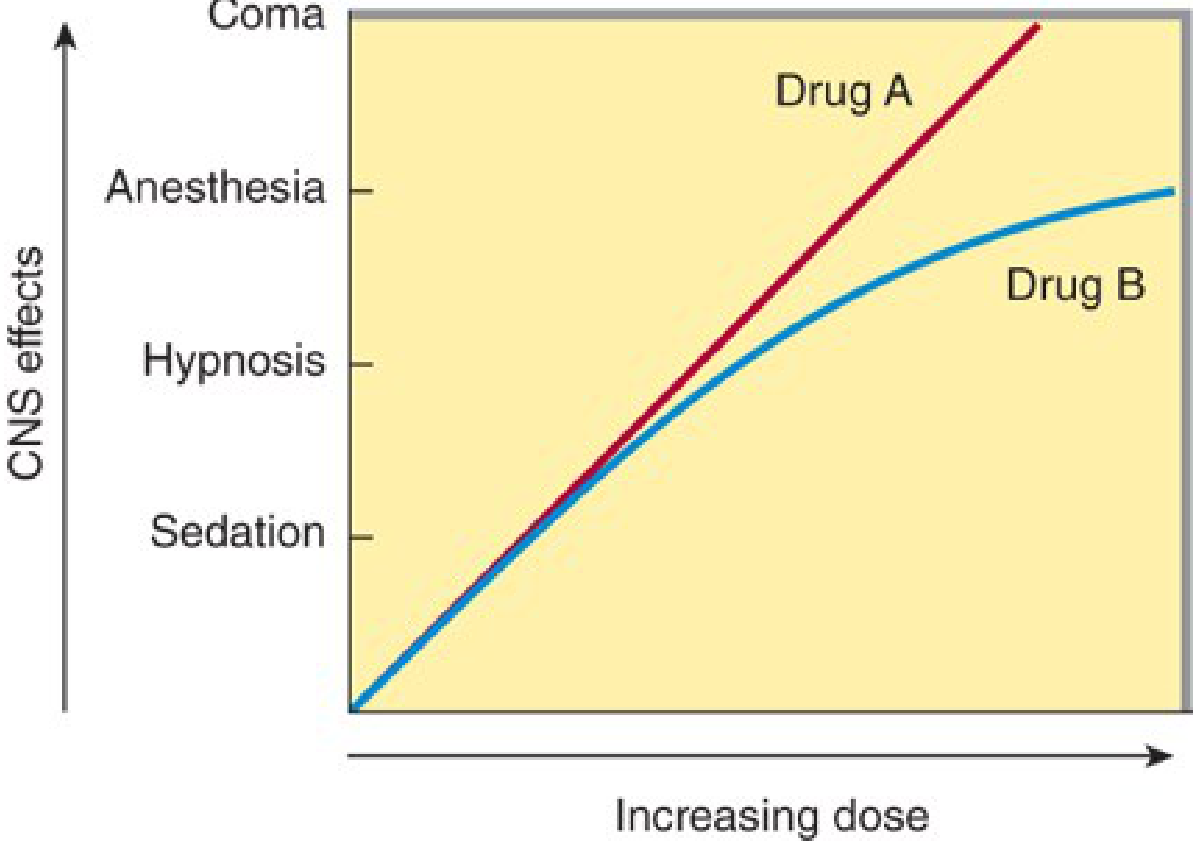
Fig 22-1 (Katzung): Drug A (barbiturates/alcohols) = linear steep curve - increasing dose rapidly progresses from sedation → hypnosis → anesthesia → coma → death. Drug B (benzodiazepines) = flattened curve - proportionately greater doses needed to go beyond hypnosis; much safer.
This explains why benzodiazepines have a higher therapeutic index and are far safer in overdose than barbiturates.
3. Chemical Classification
A. Benzodiazepines
- 1,4-benzodiazepine structure with a carboxamide group
- Substituent at position 7 (halogen or nitro group) required for sedative-hypnotic activity
- Triazolam and alprazolam have an additional triazole ring at the 1,2 position
B. Barbiturates
- Barbituric acid nucleus (not itself active)
- Activity depends on substituents at C5 position
- Steeper, more dangerous dose-response curve than benzodiazepines
C. Newer "Z-drugs" (Non-BZD GABA-A modulators)
- Zolpidem - imidazopyridine
- Zaleplon - pyrazolopyrimidine
- Eszopiclone - cyclopyrrolone (S-enantiomer of zopiclone)
- Structurally unrelated to BZDs but share similar mechanism
D. Melatonin Receptor Agonists
- Ramelteon, Tasimelteon - MT1/MT2 agonists
E. Orexin Receptor Antagonists
- Suvorexant, Lemborexant
F. Anxiolytic with different mechanism
- Buspirone - 5-HT1A partial agonist
4. Mechanism of Action
Benzodiazepines, Barbiturates, and Z-drugs - All act on GABA-A receptors
GABA-A receptor is a ligand-gated Cl⁻ ion channel. When GABA binds → Cl⁻ influx → hyperpolarization → CNS depression.
| Drug Class | Binding Site | Effect on Cl⁻ channel | Mechanism |
|---|---|---|---|
| Benzodiazepines | Between α and γ2 subunits (BZ site) | ↑ frequency of Cl⁻ channel opening | Allosteric GABA potentiation - no effect without GABA |
| Barbiturates | Separate site on GABA-A | ↑ duration of Cl⁻ channel opening | Potentiate GABA; at high doses can directly open channel (without GABA) |
| Z-drugs (zolpidem, zaleplon, eszopiclone) | Same BZ site but selectively bind α1-containing subunits only | ↑ frequency of Cl⁻ channel opening | Like BZDs but more selective → predominantly sedative, less anxiolytic/muscle relaxant |
Key distinction: Barbiturates can open Cl⁻ channels directly at high doses (no GABA needed) → explains their higher lethality. Benzodiazepines cannot open channels without GABA → ceiling effect → safer.
GABA-A Subunit Pharmacology (Katzung Box)
| Subunit | Pharmacologic Effect Mediated |
|---|---|
| α1 | Sedation, amnesia, ataxia (also target of Z-drugs) |
| α2, α3 | Anxiolytic and muscle-relaxing effects |
| α5 | Memory impairment |
This explains why Z-drugs (α1-selective) are primarily hypnotic with minimal anxiolytic or muscle-relaxant activity.
Benzodiazepine Potentiation - Electrophysiology
- BZDs increase the frequency of Cl⁻ channel opening events
- They do NOT substitute for GABA - they enhance GABA's effect allosterically
- They potentiate GABAergic inhibition at all levels of the neuraxis: spinal cord, hypothalamus, hippocampus, substantia nigra, cerebellar cortex, cerebral cortex
5. Pharmacokinetics
Benzodiazepines - Classified by Duration of Action
| Duration | Drug | Half-life | Key Feature |
|---|---|---|---|
| Long-acting | Diazepam | 20-100 h (active metabolite desmethyldiazepam: 36-200 h) | Active metabolites accumulate; good for alcohol withdrawal |
| Long-acting | Chlordiazepoxide | 5-30 h (active metabolites longer) | Alcohol withdrawal |
| Long-acting | Flurazepam | 2-3 h (active metabolite: 47-100 h) | Hypnotic; hangover effect |
| Intermediate | Lorazepam | 10-20 h | No active metabolites; good for elderly/liver disease |
| Intermediate | Oxazepam | 5-15 h | No active metabolites; good for elderly/liver disease |
| Intermediate | Temazepam | 10-20 h | Hypnotic |
| Short-acting | Triazolam | 1.5-5 h | Hypnotic; rebound insomnia, behavioral disinhibition |
| Short-acting | Midazolam | 1-4 h | IV sedation, anesthesia premedication |
| Short-acting | Alprazolam | 6-12 h | Anxiety/panic disorder; more toxic in overdose than other BZDs |
Absorption: Most BZDs are lipid-soluble and well absorbed orally. IM absorption is erratic (except lorazepam and midazolam).
Distribution: Highly lipophilic → rapid CNS entry; redistributed to fat stores
Metabolism: Most by hepatic CYP enzymes → many have active metabolites (except lorazepam, oxazepam, temazepam - "LOT" - conjugated directly, no active metabolites → safe in liver disease and elderly)
Barbiturates - Classified by Duration
| Duration | Drug | Use |
|---|---|---|
| Ultra-short | Thiopental, Methohexital | IV anesthesia induction (highly lipophilic) |
| Short | Secobarbital, Pentobarbital | Insomnia (rarely used now) |
| Intermediate | Amobarbital, Butabarbital | Sedation |
| Long | Phenobarbital, Mephobarbital | Epilepsy; t½ = 60-100 h; 20% renal excretion |
Ultra-short barbiturates (thiopental): Highly lipophilic → very rapid onset (seconds IV) but brief duration because of rapid redistribution to fat. NOT due to rapid metabolism.
Z-drugs - Pharmacokinetics
| Drug | Half-life | Key Feature |
|---|---|---|
| Zolpidem | 1.5-2.5 h | Short-acting; decreases REM sleep; minimal slow-wave sleep effect |
| Zaleplon | ~1 h | Ultra-short; can be taken in the middle of the night; minimal effect on sleep architecture |
| Eszopiclone | 5-7 h | Longer-acting Z-drug; increases total sleep time (mainly stage 2 NREM); approved for long-term use |
All Z-drugs are CYP substrates; food delays absorption.
6. Pharmacological Effects
A. Anxiolysis (Sedation)
- Reduce anxiety and exert calming effect at low doses
- Cause anterograde amnesia in dose-dependent fashion
- Behavioral disinhibition (euphoria, impaired judgment) - especially at higher doses
- May cause paradoxical excitement (especially in elderly)
B. Hypnosis - Effects on Sleep Architecture
| Effect | BZDs | Barbiturates | Zolpidem | Zaleplon | Eszopiclone |
|---|---|---|---|---|---|
| ↓ Sleep latency | ✓ | ✓ | ✓ | ✓ | ✓ |
| ↑ Stage 2 NREM | ✓ | ✓ | - | - | ✓ |
| ↓ REM sleep | ✓ | ✓ | ↓ | - | ↓ (high dose) |
| ↓ Slow-wave (Stage 3) | ✓ | ✓ | minimal | - | - |
| REM rebound on stopping | ✓ | ✓ | minimal | minimal | minimal |
C. Anesthesia
- High doses of barbiturates → stage III general anesthesia
- Thiopental - IV induction agent; ultra-short acting
- Benzodiazepines (midazolam, diazepam) used for premedication and conscious sedation
D. Anticonvulsant
- Most BZDs and barbiturates elevate seizure threshold
- Diazepam/lorazepam IV: first-line for status epilepticus
- Phenobarbital: chronic seizure management
- Clonazepam: absence seizures, myoclonic seizures
E. Muscle Relaxation
- BZDs (via α2/α3 subunits) → central muscle relaxation
- Diazepam: used for skeletal muscle spasm
F. Respiratory Depression
- Dose-dependent depression of respiratory centers in medulla
- Barbiturates > Benzodiazepines (BZDs only significant when combined with other CNS depressants or in very high doses)
- Greatest risk in COPD patients
7. Clinical Uses
| Indication | Drug of Choice |
|---|---|
| Insomnia - sleep onset | Zolpidem, zaleplon, ramelteon, triazolam |
| Insomnia - sleep maintenance | Eszopiclone, temazepam, suvorexant |
| Anxiety disorders | Diazepam, lorazepam, alprazolam, clonazepam |
| Panic disorder | Alprazolam, clonazepam |
| Status epilepticus | Diazepam or lorazepam IV (first-line) |
| Chronic epilepsy | Phenobarbital, clonazepam |
| Alcohol/sedative withdrawal | Diazepam, chlordiazepoxide, lorazepam |
| IV anesthesia induction | Midazolam, thiopental |
| Procedural sedation | Midazolam IV |
| Muscle spasm | Diazepam |
| Night terrors / sleepwalking | Benzodiazepines |
| Circadian rhythm disorders | Ramelteon, tasimelteon |
8. Adverse Effects
CNS Effects
| Effect | Notes |
|---|---|
| Sedation/drowsiness | Most common; impairs performance, driving |
| Anterograde amnesia | Dose-dependent; triazolam notable |
| Psychomotor impairment | Especially long-acting drugs |
| "Hangover" | Next-day sedation (long t½ drugs: flurazepam) |
| Behavioral disinhibition | Euphoria, aggression, violence - especially triazolam at high doses |
| Paradoxical excitement | Especially in children and elderly |
| Ataxia | Dose-dependent; risk of falls in elderly |
Tolerance & Dependence
- Tolerance develops to sedative and hypnotic effects with repeated use (1-2 weeks)
- Physical dependence: withdrawal syndrome = anxiety, insomnia, tremors, convulsions
- Abrupt discontinuation of short-acting BZDs → rebound insomnia and anxiety
- Dependence liability: Barbiturates > Benzodiazepines > Z-drugs
Respiratory Depression
- Particularly dangerous in COPD, obstructive sleep apnea
- Barbiturates: severe respiratory depression even at modest overdose
- BZDs: respiratory depression mainly with IV use or in combination with opioids/alcohol
Teratogenicity
| Drug | FDA Pregnancy Category |
|---|---|
| Most benzodiazepines | Category D (some Category X) |
| Most barbiturates | Category D |
| Zolpidem, zaleplon, eszopiclone, suvorexant, ramelteon | Category C |
| Buspirone | Category B (safest) |
Barbiturate-Specific
- Hepatic enzyme induction (CYP inducers) → accelerate metabolism of many other drugs (oral contraceptives, warfarin, steroids)
- Porphyria: barbiturates enhance porphyrin synthesis → absolutely contraindicated in acute intermittent porphyria, variegate porphyria, hereditary coproporphyria
9. Drug Interactions
| Interaction | Effect |
|---|---|
| Ethanol + BZDs or barbiturates | Additive CNS depression; most common and dangerous combination |
| Opioids + BZDs | Synergistic respiratory depression (major risk - FDA black box warning) |
| Barbiturates + warfarin, OCP, steroids | Barbiturates induce CYP → reduce efficacy of co-administered drugs |
| Ramelteon + fluvoxamine (CYP1A2 inhibitor) | Greatly increases ramelteon plasma levels - contraindicated |
| Ciprofloxacin + ramelteon | CYP1A2 inhibition → avoid |
10. Overdose
| Feature | Barbiturates | Benzodiazepines |
|---|---|---|
| Dose-response | Steep linear | Flat curve (safer ceiling) |
| Fatality rate | High (10× hypnotic dose may be fatal) | Low (0.3 deaths/million diazepam vs 11.6/million secobarbital) |
| Mechanism of death | Respiratory + cardiovascular depression | Respiratory depression mainly with polypharmacy |
| Antidote | None specific; supportive care | Flumazenil (competitive BZD antagonist) |
Flumazenil (BZD Antidote)
- Competitive BZ receptor antagonist
- Also reverses eszopiclone, zaleplon, and zolpidem
- Limitations: Short duration (re-sedation common), unpredictable reversal of respiratory depression, may precipitate withdrawal in BZD-dependent patients
- Use remains controversial; requires careful monitoring
11. Tolerance, Dependence, Withdrawal
Withdrawal Syndrome (Severity depends on dose, duration, and drug half-life)
- Short-acting BZDs (triazolam, alprazolam): rapid and intense withdrawal
- Long-acting BZDs (diazepam): delayed onset, more gradual withdrawal
Symptoms: Anxiety, insomnia, tremor, sweating, nausea, seizures (severe cases)
Management of withdrawal:
- Substitute long-acting BZD (e.g., diazepam, chlordiazepoxide) → taper gradually
- Phenobarbital can also be used for BZD or ethanol withdrawal
12. Special Agents
Buspirone (Katzung Box)
- Mechanism: Partial agonist at 5-HT1A receptors (NOT a GABA modulator)
- Onset: Slow (2-4 weeks) - not useful for acute anxiety
- No sedation, no dependence, no withdrawal, no potentiation of CNS depressants
- Use: Generalized anxiety disorder (GAD) - not panic disorder or sleep
- FDA category B in pregnancy - safest anxiolytic
Ramelteon & Tasimelteon
- Mechanism: MT1/MT2 melatonin receptor agonists in suprachiasmatic nucleus
- No effect on GABAergic neurotransmission
- No dependence, no rebound insomnia, no significant withdrawal
- Ramelteon: metabolized by CYP1A2 and CYP2C9
- Tasimelteon: metabolized by CYP1A2 and CYP3A4
- Use: Ramelteon = difficulty falling asleep; Tasimelteon = non-24-hour sleep-wake disorder (especially blind patients)
Suvorexant & Lemborexant
- Mechanism: Block orexin (hypocretin) receptors (OX1R + OX2R) → reduce wakefulness-promoting signals
- Use: Insomnia - decrease time to sleep onset AND increase total sleep time
- Suvorexant: decreases REM sleep
- Risk of sleep paralysis, complex sleep behaviors, suicidal ideation at high doses
13. Complete Drug Summary Table
SEDATIVE-HYPNOTICS (Katzung Ch. 22)
│
├── BENZODIAZEPINES (GABA-A → ↑ Cl⁻ channel frequency)
│ ├── Long-acting: Diazepam, Chlordiazepoxide, Flurazepam
│ ├── Intermediate: Lorazepam*, Oxazepam*, Temazepam*
│ ├── Short-acting: Triazolam, Alprazolam, Midazolam
│ └── (*No active metabolites → safe in elderly/liver disease)
│
├── BARBITURATES (GABA-A → ↑ Cl⁻ channel duration)
│ ├── Ultra-short IV: Thiopental, Methohexital (anesthesia)
│ ├── Short: Secobarbital, Pentobarbital (insomnia)
│ └── Long: Phenobarbital (epilepsy), t½ 60-100h
│
├── Z-DRUGS (GABA-A α1 selective)
│ ├── Zolpidem - t½ 1.5-2.5h
│ ├── Zaleplon - t½ ~1h (ultra-short; mid-night use)
│ └── Eszopiclone - t½ 5-7h (long-term approved)
│
├── MELATONIN RECEPTOR AGONISTS (MT1/MT2)
│ ├── Ramelteon - sleep onset; CYP1A2 substrate
│ └── Tasimelteon - non-24h sleep-wake disorder
│
├── OREXIN ANTAGONISTS
│ ├── Suvorexant - insomnia (onset + maintenance)
│ └── Lemborexant - insomnia
│
└── BUSPIRONE (5-HT1A partial agonist)
└── GAD only; slow onset; no dependence
14. Benzodiazepines vs Barbiturates - Key Comparison
| Feature | Benzodiazepines | Barbiturates |
|---|---|---|
| GABA-A effect | ↑ Cl⁻ channel frequency | ↑ Cl⁻ channel duration |
| Opens channel without GABA? | No | Yes (at high doses) |
| Therapeutic index | High (safer) | Low (dangerous) |
| Dependence liability | Moderate | High |
| Overdose mortality | Low | High |
| Enzyme induction | No | Yes (major) |
| Antidote | Flumazenil | None |
| Porphyria risk | No | Contraindicated |
| Anticonvulsant | Yes | Yes (phenobarbital) |
Source: Katzung's Basic and Clinical Pharmacology, 16th Edition, Chapter 22 - Sedative-Hypnotic Drugs
Drug used Epilepsy from lippincot
Antiepileptic drugs work by stabilizing neuronal membranes or enhancing inhibitory GABA activity. Key classes include Na⁺ channel blockers, GABA enhancers, Ca²⁺ channel blockers, and newer agents.
Searching sources...
Finding Sources
Finding Sources
Finding Sources
Finding Sources
Finding Sources
Finding Sources
Found it - Chapter 19. Let me read the full chapter now.
Reading File
Reading File
Reading File
Reading File
Loading Image
I have comprehensive content from Lippincott Chapter 19. Here is the complete, full answer:
Drugs for Epilepsy
Lippincott Illustrated Reviews: Pharmacology - Chapter 19
1. Overview
- ~10% of the population has at least one seizure in their lifetime
- Epilepsy = 4th most common neurologic disorder (after migraine, stroke, Alzheimer)
- Epilepsy results from sudden, excessive, synchronous discharge of cerebral neurons
- ~75% of patients can be controlled with a single medication
- Medications are the most widely used treatment
2. Classification of Seizures
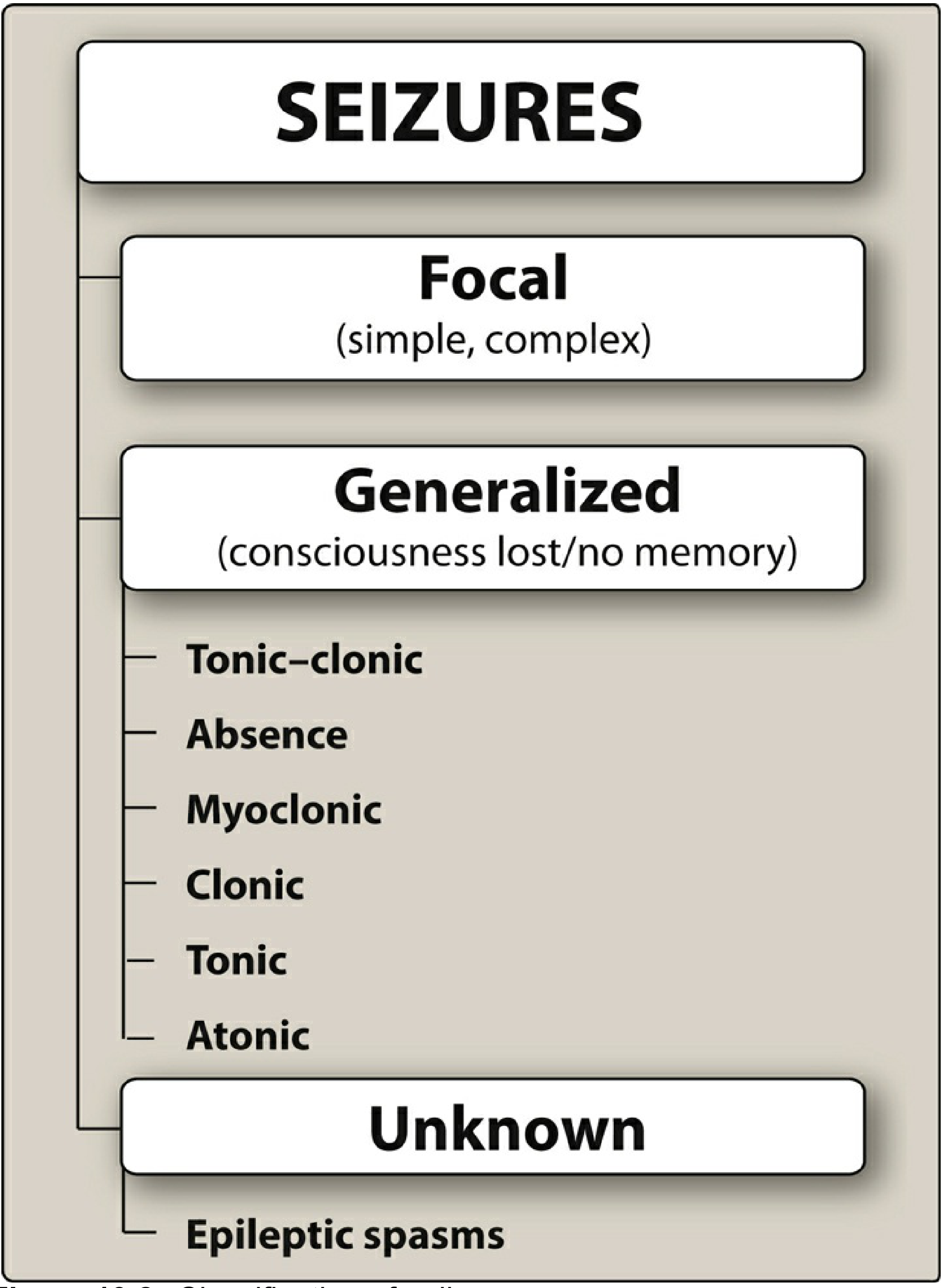
Figure 19.2 (Lippincott): ILAE classification of seizures
A. Focal Seizures
- Involve one hemisphere only
- May occur with or without loss of consciousness/awareness
- May progress to bilateral generalized tonic-clonic seizures
- Begin with motor or non-motor activity
B. Generalized Seizures (both hemispheres)
| Type | Key Features |
|---|---|
| Tonic-clonic | Loss of consciousness → tonic phase (sustained contraction) → clonic phase (rapid contraction-relaxation) → postictal confusion |
| Absence | Brief (3-5 sec) loss of consciousness; blank stare + rapid eye blinking; onset age 3-5 years; 3 Hz spike-and-wave on EEG |
| Myoclonic | Brief, sudden muscle jerks |
| Clonic | Rhythmic jerking movements |
| Tonic | Sustained muscle stiffness |
| Atonic | Sudden loss of muscle tone ("drop attacks") |
C. Unknown
- Epileptic spasms (e.g., infantile spasms)
3. Mechanisms of Antiseizure Drugs
Three major mechanisms:
| Mechanism | Effect | Drug Examples |
|---|---|---|
| Block voltage-gated Na⁺ channels | Stabilize neuronal membranes; prevent repetitive firing | Phenytoin, carbamazepine, valproate, lamotrigine, oxcarbazepine, lacosamide |
| Enhance GABA inhibition | Increase Cl⁻ influx → hyperpolarization | Phenobarbital, benzodiazepines, vigabatrin, tiagabine, gabapentin |
| Block T-type Ca²⁺ channels | Reduce pacemaker currents in thalamus | Ethosuximide, valproate |
| Block glutamate (NMDA/AMPA) | Reduce excitatory neurotransmission | Felbamate, perampanel, topiramate |
| SV2A binding | Modulate synaptic vesicle release | Levetiracetam, brivaracetam |
4. Individual Drug Profiles
A. Phenytoin (Dilantin) / Fosphenytoin (Cerebyx)
Mechanism: Blocks voltage-gated Na⁺ channels in a use-dependent manner (preferentially blocks rapidly firing neurons); also inhibits Ca²⁺ channels and chloride transport
Uses: Focal seizures, tonic-clonic seizures, status epilepticus (fosphenytoin IV)
Pharmacokinetics:
- Oral, IV (fosphenytoin is a prodrug, given IV/IM → converted to phenytoin)
- Zero-order (saturable) kinetics at therapeutic doses → small dose increases cause disproportionately large rises in plasma levels → toxicity risk
- Highly protein-bound (90%); CYP2C9 substrate
- Strong CYP inducer (CYP2C9, CYP3A4) → reduces many drug levels
Adverse Effects:
- Dose-related: Nystagmus, diplopia, ataxia, sedation, cognitive impairment (at increasing levels)
- Chronic: Gingival hyperplasia (characteristic), hirsutism, coarsening of facial features, peripheral neuropathy, folate deficiency, osteomalacia
- IV: Cardiovascular collapse with rapid IV administration; "Purple glove syndrome" with extravasation
- Teratogenic: Fetal hydantoin syndrome (cleft palate, cardiac defects)
- Hypersensitivity: Stevens-Johnson syndrome (rare)
B. Carbamazepine (Tegretol)
Mechanism: Blocks voltage-gated Na⁺ channels (use-dependent); reduces repetitive neuronal firing
Uses: Focal seizures, tonic-clonic seizures; also trigeminal neuralgia, bipolar disorder
Pharmacokinetics:
- Oral; auto-induction of its own metabolism (CYP3A4 inducer) → doses must be increased over first few weeks
- Active metabolite: carbamazepine-10,11-epoxide
Adverse Effects:
- Diplopia, dizziness, ataxia, nausea (common; dose-related)
- Hyponatremia (SIADH-like effect) - monitor sodium
- Bone marrow suppression (agranulocytosis, aplastic anemia - rare but serious)
- Steven-Johnson syndrome - associated with HLA-B*1502 allele (Asian populations - screen before use)
- Teratogenic (neural tube defects, craniofacial defects)
- Strong CYP inducer → reduces levels of many drugs including OCP, warfarin
Contraindicated in absence seizures (may worsen them)
C. Oxcarbazepine (Trileptal) / Eslicarbazepine (Aptiom)
Mechanism: Voltage-gated Na⁺ channel blocker (same as carbamazepine but different metabolism)
Advantages over carbamazepine:
- No auto-induction
- No active epoxide metabolite
- Less bone marrow toxicity
Uses: Focal seizures
Adverse Effects: Dizziness, somnolence, diplopia, hyponatremia (more common than carbamazepine), headache
D. Valproic Acid / Divalproex (Depakote)
Mechanism (multiple):
- Blocks voltage-gated Na⁺ channels
- Blocks T-type Ca²⁺ channels
- Increases brain GABA levels (increases synthesis, decreases degradation)
Uses: BROAD SPECTRUM - Effective for virtually all seizure types:
- Absence seizures
- Tonic-clonic seizures
- Myoclonic seizures
- Focal seizures
- Also: bipolar disorder, migraine prophylaxis
Pharmacokinetics:
- Oral; highly protein-bound
- Hepatic metabolism; CYP inhibitor (raises levels of phenytoin, phenobarbital, lamotrigine)
Adverse Effects:
- Nausea, vomiting, weight gain, alopecia (dose-related)
- Hepatotoxicity - especially in children <2 years on polypharmacy; monitor LFTs
- Pancreatitis (rare but serious)
- Thrombocytopenia, inhibition of platelet aggregation
- Teratogenicity - most teratogenic antiepileptic drug: neural tube defects (spina bifida), cognitive impairment in offspring
- Avoid in pregnancy if possible; supplement with folic acid
E. Lamotrigine (Lamictal)
Mechanism: Blocks voltage-gated Na⁺ channels; also inhibits release of glutamate
Uses: Broad spectrum - focal seizures, generalized seizures (including absence), Lennox-Gastaut syndrome; bipolar disorder
Pharmacokinetics:
- Oral; metabolized by UDP-glucuronosyltransferase (UGT)
- Valproate doubles lamotrigine levels (inhibits UGT) → must reduce lamotrigine dose
- Enzyme-inducing drugs (carbamazepine, phenytoin) halve lamotrigine levels
Adverse Effects:
- Skin rash - common; can progress to Stevens-Johnson syndrome (especially with rapid titration or combination with valproate)
- Dizziness, diplopia, ataxia, headache
- Relatively safer in pregnancy compared to valproate
F. Levetiracetam (Keppra) / Brivaracetam (Briviact)
Mechanism: Binds SV2A (synaptic vesicle protein 2A) → modulates neurotransmitter release from synaptic vesicles (unique mechanism)
Uses: Focal seizures, myoclonic seizures, tonic-clonic seizures - broad spectrum
Pharmacokinetics:
- Oral/IV; not significantly protein-bound; primarily renal excretion (dose-adjust in renal impairment)
- Minimal drug interactions (not a CYP inducer or inhibitor) → important advantage
Adverse Effects:
- Behavioral/psychiatric - irritability, aggression, depression, psychosis (notable side effect)
- Somnolence, dizziness
- Relatively safe in pregnancy
G. Phenobarbital / Primidone (Mysoline)
Mechanism: Enhances GABA-A receptor function (↑ duration of Cl⁻ channel opening) + blocks Na⁺ channels
- Primidone is metabolized to phenobarbital and phenylethylmalonamide (PEMA) - both active
Uses: Focal seizures, tonic-clonic seizures; status epilepticus (IV); neonatal seizures
Adverse Effects:
- Sedation, cognitive impairment, depression
- Tolerance and dependence develop
- Strong CYP inducer → many drug interactions
- Teratogenic (craniofacial defects, cardiac malformations)
- Avoid in pregnancy; avoid in acute porphyria
H. Benzodiazepines
Mechanism: Enhance GABA-A function (↑ frequency of Cl⁻ channel opening)
| Drug | Brand | Use |
|---|---|---|
| Diazepam | Valium | Status epilepticus (IV/rectal) - first-line |
| Lorazepam | Ativan | Status epilepticus (IV) - preferred in hospital |
| Clonazepam | Klonopin | Absence, myoclonic seizures (chronic) |
| Clobazam | Onfi | Lennox-Gastaut syndrome (adjunct) |
Adverse Effects: Sedation, tolerance, dependence, withdrawal seizures
I. Ethosuximide (Zarontin)
Mechanism: Blocks T-type (low-threshold) Ca²⁺ channels in thalamic neurons → reduces pacemaker oscillations generating 3 Hz spike-and-wave activity
Uses: ONLY absence seizures - drug of choice for pure absence seizures (if no concomitant tonic-clonic seizures)
If patient has both absence AND tonic-clonic seizures → use valproate (broad spectrum)
Adverse Effects: Nausea, vomiting, anorexia, hiccups, drowsiness; rare: bone marrow suppression
J. Gabapentin (Neurontin) / Pregabalin (Lyrica)
Mechanism: Bind α2δ subunit of voltage-gated Ca²⁺ channels → reduce excitatory neurotransmitter release; also enhance GABA activity
Uses: Focal seizures (adjunct); also neuropathic pain, anxiety, fibromyalgia
Pharmacokinetics:
- Oral; not metabolized - excreted unchanged in urine; no drug interactions (no CYP)
- Non-linear absorption (saturable transporter) for gabapentin; dose-dependent
Adverse Effects: Sedation, dizziness, weight gain, ataxia, peripheral edema
K. Topiramate (Topamax)
Mechanism (multiple):
- Blocks Na⁺ channels
- Enhances GABA activity
- Blocks AMPA/kainate glutamate receptors
- Inhibits carbonic anhydrase
Uses: Focal and generalized tonic-clonic seizures; Lennox-Gastaut; also migraine prophylaxis, weight loss
Adverse Effects:
- Cognitive impairment - word-finding difficulties ("Dope-a-max")
- Kidney stones (carbonic anhydrase inhibition → ↑ urinary pH, ↓ citrate)
- Weight loss (useful adverse effect)
- Metabolic acidosis
- Teratogenic (cleft palate)
L. Lacosamide (Vimpat)
Mechanism: Blocks voltage-gated Na⁺ channels via a unique mechanism - enhances slow inactivation (selectively stabilizes inactive state)
Uses: Focal seizures (adjunct); IV form available for status epilepticus
Adverse Effects: Dizziness, diplopia, nausea, headache, PR interval prolongation (cardiac monitoring if on anti-arrhythmics)
M. Vigabatrin (Sabril)
Mechanism: Irreversible inhibitor of GABA transaminase (the enzyme that breaks down GABA) → ↑↑ brain GABA levels
Uses: Infantile spasms (West syndrome), refractory focal seizures
Adverse Effects:
- Visual field defects (permanent, irreversible) - monitor visual fields every 3 months
- Sedation, weight gain
N. Tiagabine (Gabitril)
Mechanism: Blocks GABA reuptake transporter (GAT-1) → prolongs GABA action at synapse
Uses: Adjunct for focal seizures
Adverse Effects: Dizziness, asthenia, tremor, abnormal thinking; risk of seizures in non-epileptic patients
O. Felbamate (Felbatol)
Mechanism (multiple): Blocks Na⁺ channels, antagonizes NMDA-glycine site, blocks Ca²⁺ channels, potentiates GABA
Uses: Lennox-Gastaut syndrome (refractory epilepsy only) - reserved due to serious toxicity
Serious Adverse Effects:
- Aplastic anemia (~1:4000)
- Hepatic failure
- Only used when benefits outweigh serious risks
P. Zonisamide (Zonegran)
Mechanism: Blocks Na⁺ and T-type Ca²⁺ channels; carbonic anhydrase inhibitor
Uses: Focal seizures (adjunct)
Adverse Effects: Dizziness, anorexia, kidney stones (CA inhibition), oligohidrosis (decreased sweating - especially children), metabolic acidosis
Q. Perampanel (Fycompa)
Mechanism: Non-competitive AMPA glutamate receptor antagonist (unique mechanism)
Uses: Focal seizures and primary generalized tonic-clonic seizures (adjunct)
Adverse Effects: Dizziness, somnolence, aggression, hostility, psychiatric symptoms (FDA black box warning)
R. Cenobamate (Xcopri)
Mechanism: Voltage-gated Na⁺ channel blocker + modulates GABA-A ion channel
Uses: Focal seizures
Adverse Effects: Fatigue, headache, dizziness, diplopia
S. Cannabidiol (Epidiolex)
Mechanism: Modulates endocannabinoid system and multiple ion channels (exact mechanism in epilepsy not fully understood)
Uses: Dravet syndrome and Lennox-Gastaut syndrome (FDA-approved)
Adverse Effects: Somnolence, decreased appetite, diarrhea, elevated liver enzymes (especially with valproate)
T. Fenfluramine (Fintepla)
Mechanism: Releases serotonin; acts on serotonin receptors (5-HT2C); also sigma-1 receptor
Uses: Dravet syndrome (orphan drug)
Adverse Effects: Decreased appetite, somnolence; historically associated with cardiac valvulopathy (lower doses used in epilepsy - requires cardiac monitoring)
5. Status Epilepticus - Emergency Treatment
Definition: Seizure lasting >5 minutes or repeated seizures without recovery
Treatment (stepwise):
- Immediate: IV benzodiazepine (lorazepam or diazepam) - fast-acting
- Next: IV phenytoin/fosphenytoin, divalproex, or levetiracetam - longer acting
- Refractory: IV phenobarbital, propofol, or midazolam infusion
6. Drug Selection by Seizure Type
| Seizure Type | First-line Drug(s) | Drugs to Avoid |
|---|---|---|
| Absence | Ethosuximide, valproate | Carbamazepine, phenytoin (may worsen) |
| Tonic-clonic | Valproate, levetiracetam, lamotrigine | - |
| Focal | Carbamazepine, oxcarbazepine, levetiracetam, lamotrigine, lacosamide | - |
| Myoclonic | Valproate, levetiracetam, clonazepam | Carbamazepine, phenytoin |
| Lennox-Gastaut | Valproate, lamotrigine, clobazam, rufinamide, felbamate, cannabidiol | - |
| Infantile spasms (West) | ACTH, vigabatrin | - |
| Status epilepticus | Lorazepam/diazepam IV → fosphenytoin/levetiracetam IV | - |
7. Pregnancy Considerations
- Avoid if possible: Divalproex (valproate) - highest teratogenicity risk (neural tube defects, cognitive impairment)
- Avoid: Barbiturates (phenobarbital)
- Relatively safer: Levetiracetam, lamotrigine, oxcarbazepine
- All women of childbearing potential on antiepileptics should take folic acid supplements
- Drug interactions with oral contraceptives: CYP inducers (carbamazepine, phenytoin, phenobarbital) reduce OCP efficacy → use backup contraception
8. Drug Interactions Overview
CYP Inducers (reduce levels of co-administered drugs):
- Carbamazepine, phenytoin, phenobarbital, primidone → ↓ OCP, warfarin, other antiepileptics
CYP Inhibitors (raise levels of co-administered drugs):
- Valproate → ↑ lamotrigine, phenobarbital, phenytoin
- Felbamate → inhibits CYP2C19, induces CYP3A4
Drugs with Minimal Interactions (safest for polypharmacy):
- Levetiracetam, gabapentin, pregabalin (not significantly metabolized by CYP)
9. Complete Drug Summary
ANTIEPILEPTIC DRUGS (Lippincott Ch. 19)
│
├── Na⁺ CHANNEL BLOCKERS
│ ├── Phenytoin / Fosphenytoin - zero-order kinetics; gingival hyperplasia
│ ├── Carbamazepine - auto-induction; hyponatremia; SJS risk
│ ├── Oxcarbazepine / Eslicarbazepine - like CBZ, less toxicity
│ ├── Lamotrigine - broad spectrum; SJS risk; ↑ by valproate
│ ├── Lacosamide - enhances slow inactivation; IV available
│ ├── Cenobamate - Na⁺ block + GABA modulation
│ └── Valproate* - also T-Ca²⁺ block + GABA ↑
│
├── GABA ENHANCERS
│ ├── Phenobarbital / Primidone - CYP inducers; sedating
│ ├── Benzodiazepines (Diazepam, Lorazepam, Clonazepam, Clobazam)
│ ├── Vigabatrin - GABA transaminase inhibitor; visual field loss
│ ├── Tiagabine - GABA reuptake blocker
│ └── Gabapentin / Pregabalin - α2δ Ca²⁺ subunit; no drug interactions
│
├── T-TYPE Ca²⁺ CHANNEL BLOCKER
│ └── Ethosuximide - ONLY absence seizures; DOC for pure absence
│
├── GLUTAMATE BLOCKERS
│ ├── Perampanel - AMPA antagonist; psychiatric side effects
│ └── Topiramate - AMPA + Na⁺ + CA inhibitor; cognitive impairment
│
├── SV2A BINDERS
│ ├── Levetiracetam - minimal drug interactions; behavioral side effects
│ └── Brivaracetam - similar to levetiracetam
│
├── SPECIAL/ORPHAN DRUGS
│ ├── Felbamate - Lennox-Gastaut; aplastic anemia risk
│ ├── Rufinamide - Lennox-Gastaut
│ ├── Cannabidiol - Dravet, Lennox-Gastaut
│ ├── Fenfluramine - Dravet syndrome
│ ├── Stiripentol - Dravet syndrome
│ └── Zonisamide - focal; kidney stones
Source: Lippincott Illustrated Reviews: Pharmacology, Chapter 19 - Drugs for Epilepsy
This is a shared conversation. Sign in to Orris to start your own chat.