
Metronidazole
Reading File
Metronidazole is a nitroimidazole antibiotic/antiprotozoal used for anaerobic bacterial infections and protozoal diseases. It works by forming toxic free radicals that damage microbial DNA.
Searching sources...
Finding Sources
Finding Sources
Searching PubMed
metronidazole clinical pharmacology
Now let me read the most comprehensive pharmacology sections:
Reading File
Reading File
Reading File
The offset for Katzung was off. Let me read the correct sections for metronidazole pharmacology:
Reading File
Reading File
Reading File
Reading File
Reading File
I now have comprehensive information. Let me fetch the metronidazole structure image as well:
Loading Image
Here is a complete, textbook-based overview of metronidazole:
Metronidazole
Class: 5-Nitroimidazole | Antibiotic / Antiprotozoal
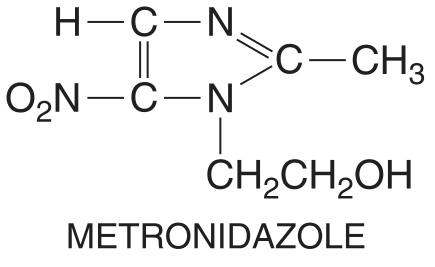
Mechanism of Action
Metronidazole is a prodrug that requires reductive activation of its nitro group by susceptible organisms. Anaerobic and microaerophilic pathogens (e.g., T. vaginalis, E. histolytica, G. lamblia, anaerobic bacteria) contain electron transport components with a sufficiently negative redox potential to donate electrons to metronidazole. This single-electron transfer forms a highly reactive nitro radical anion that kills organisms by radical-mediated mechanisms targeting DNA.
The key enzyme involved is pyruvate-ferredoxin oxidoreductase (PFOR), which catalyzes pyruvate decarboxylation, producing electrons that reduce ferredoxin, which in turn donates electrons to metronidazole.
Importantly, O2 competes with metronidazole for electrons - this is why aerobic organisms are resistant (O2 prevents reductive activation).
- Goodman & Gilman's Pharmacological Basis of Therapeutics, p. 1342
Spectrum of Activity
Protozoa:
- Trichomonas vaginalis
- Entamoeba histolytica (amebiasis)
- Giardia lamblia
Anaerobic bacteria:
- All anaerobic cocci
- Anaerobic gram-negative bacilli including Bacteroides spp. (including B. fragilis)
- Anaerobic spore-forming gram-positive bacilli: Clostridium spp.
- Microaerophilic bacteria: Helicobacter pylori, Campylobacter spp.
NOT active against: aerobic or facultatively anaerobic bacteria; nonsporulating gram-positive bacilli are often resistant.
Pharmacokinetics (ADME)
| Parameter | Details |
|---|---|
| Routes | Oral, IV, intravaginal, topical |
| Oral bioavailability | Essentially complete and prompt absorption |
| Volume of distribution | Approximates total body water |
| Protein binding | <20% |
| Half-life | ~8 hours (plasma); hydroxy metabolite ~12 h |
| Metabolism | Hepatic - oxidation of side chains to hydroxy derivative and acid |
| Excretion | >75% in urine (largely as metabolites); ~10% unchanged |
| CSF penetration | Excellent |
| Other distribution | Crosses into vaginal secretions, seminal fluid, saliva, breast milk |
| Placenta | Crosses placenta |
The hydroxy metabolite retains ~50% of the antitrichomonal activity of the parent drug. Urine may turn reddish-brown due to unidentified pigments.
Oxidative metabolism is induced by: phenobarbital, prednisone, rifampin, (possibly) ethanol.
Oxidative metabolism is inhibited by: cimetidine.
- Goodman & Gilman's, p. 1352-1354
Therapeutic Uses & Dosing
Trichomoniasis
- Single oral dose of 2 g - cures >90% of cases
- Both partners should be treated
- Alternative: 500 mg twice daily x 7 days
Amebiasis (intestinal and extraintestinal)
- Adults: 500-750 mg PO TID x 7-10 days
- Children: 35-50 mg/kg/day in 3 divided doses x 7-10 days (max 750 mg/dose)
- Drug of choice for all symptomatic forms including amebic colitis and amebic liver abscess
- Must follow with a luminal amebicide (e.g., paromomycin) as E. histolytica persists in the colon
Giardiasis
- Used widely though not FDA-approved; effective in practice
- Tinidazole (2 g single dose) is preferred first-line
Anaerobic bacterial infections
- Adults PO/IV: 30 mg/kg/24 hr divided Q6-8h; max 4 g/24 hr
- IV loading dose: 15 mg/kg over 1 hour, then maintenance 6 hours later
- Key infections: intra-abdominal infections, brain abscess, aspiration pneumonia, C. difficile (now second-line to vancomycin for severe CDI)
C. difficile Infection (CDI)
- Vancomycin is superior to metronidazole, especially for severe CDI (vancomycin 79% vs. metronidazole 66% success rate)
- Metronidazole: unlike vancomycin, is systemically absorbed so achieves colonic concentrations via systemic circulation
Helicobacter pylori Eradication
- Used in bismuth quadruple therapy: PPI + amoxicillin + metronidazole + bismuth x 14 days
Bacterial Vaginosis
- Oral or topical vaginal gel (0.75% or 1.3%)
Neonates (anaerobic infection)
- Loading dose: 15 mg/kg x 1
- Maintenance based on postmenstrual age (PMA): 7.5 mg/kg Q24h (PMA 24-25 wk) up to 7.5 mg/kg Q6h (PMA >40 wk)
Adverse Effects
| System | Effect |
|---|---|
| GI | Nausea, vomiting, dry mouth, metallic taste, diarrhea, abdominal distress |
| CNS | Headache, dizziness, vertigo; rarely encephalopathy, convulsions, ataxia, incoordination |
| Peripheral nervous system | Numbness, paresthesias - drug should be withdrawn; reversal may be slow or incomplete |
| GU | Dysuria, cystitis, sense of pelvic pressure |
| Skin | Urticaria, flushing, pruritus; rarely Stevens-Johnson syndrome (more common with high doses + mebendazole) |
| Urine | May turn reddish-brown |
Drug Interactions
| Interaction | Effect |
|---|---|
| Alcohol | Disulfiram-like reaction: flushing, vomiting, abdominal distress, headache (avoid alcohol during and for 3 days after therapy) |
| Disulfiram | Confusional and psychotic states - contraindicated together |
| Warfarin | Prolongs prothrombin time - monitor INR |
| Lithium | May precipitate CNS signs of lithium toxicity at high doses |
| CNS disease | Use with caution - potential neurotoxicity |
Resistance
Resistance involves:
- Impaired oxygen-scavenging - higher local O2 concentrations prevent reductive activation
- Lowered PFOR and ferredoxin levels - reduced drug activation
- Decreased drug uptake
Clinically documented for T. vaginalis, G. lamblia, and anaerobic/microaerophilic bacteria.
Contraindications / Cautions
- Pregnancy (first trimester): generally not advised
- Hepatic impairment: reduce dose (drug is hepatically metabolized)
- CNS disease: use cautiously due to neurotoxicity risk
Formulations
- Oral: Tabs 250 mg, 500 mg; Caps 375 mg; Oral suspension 50 mg/mL
- IV: 5 mg/mL (ready-to-use)
- Topical gel: 0.75%, 1% (for rosacea)
- Vaginal gel: 0.75%, 1.3%
- Topical cream/lotion: 0.75%, 1%
Brand names: Flagyl, MetroGel, MetroLotion, MetroCream, Rosadan, Noritate, Vandazole, Nuvessa
Related 5-Nitroimidazoles
Tinidazole, secnidazole, ornidazole - closely related in structure and activity. Tinidazole (longer t1/2) is available in the U.S. and may be preferred for trichomoniasis and giardiasis due to equivalent or better efficacy with simpler dosing.
Recent evidence note: A 2025 systematic review and meta-analysis on the clinical pharmacokinetics of metronidazole (PMID 40741956) has been published, which may update population PK parameters. A separate 2024 meta-analysis on H. pylori resistance in China (PMID 39245326) highlights rising metronidazole resistance rates, which may affect eradication regimen selection.
Sources: Goodman & Gilman's The Pharmacological Basis of Therapeutics | Harriet Lane Handbook 23rd ed. | Medical Microbiology 9e | Sleisenger and Fordtran's GI and Liver Disease
Prescription for loose motion
Reading File
Before I clarify: "loose motion" (acute diarrhea) management depends heavily on the context - cause, severity, age group. Let me ask a quick clarifying question to give you a precise, useful answer.
Asking for Preferences
What kind of prescription guidance are you looking for?
Searching sources...
Finding Sources
Finding Sources
Reading File
Reading File
Excellent - I now have all I need for a comprehensive, textbook-grounded prescription guide. Here it is:
Prescription for Acute Diarrhea (Loose Motion) in Adults
Key principle: Most acute diarrhea is viral or self-limited bacterial - it resolves without antibiotics. Treatment is primarily supportive. Antibiotics are reserved for specific indications.
Step 1 - Assess Severity First
| Feature | Action |
|---|---|
| Watery, no blood, no fever | Symptomatic treatment only |
| >6 stools/24 hr, signs of dehydration | Add oral/IV rehydration aggressively |
| Fever + bloody/mucoid stool (dysentery) | Consider empiric antibiotics; avoid loperamide |
| Severely ill, immunocompromised, elderly | Lower threshold for IV fluids + antibiotics |
Prescription (Standard Adult Acute Diarrhea)
1. Oral Rehydration - FIRST AND MOST IMPORTANT
ORS (Oral Rehydration Solution)
- Commercial sachets (e.g., Electral, WHO-ORS) dissolved in 1 L clean water
- OR home formula: ½ tsp salt + 6 tsp sugar in 1 L clean water
- Drink 200-400 mL after each loose stool
- Continue until diarrhea resolves
2. Symptomatic - Antimotility Agent
(Only for mild-to-moderate watery diarrhea WITHOUT fever, blood, or mucus in stool)
Tab. Loperamide (Imodium) 2 mg
- Initial dose: 4 mg (2 tabs) stat
- Then: 2 mg after each unformed stool
- Max: 16 mg/day
- Duration: Until diarrhea stops, typically 1-2 days
AVOID loperamide in: fever, bloody stool, suspected Shiga toxin-producing E. coli (STEC), children <12 years
Alternative: Bismuth subsalicylate 524 mg every 30-60 min as needed, up to 8 doses/day (reduces symptoms, mild antisecretory effect)
3. Antispasmodic (for cramps)
Tab. Dicyclomine (Cyclopam) 20 mg or Tab. Mebeverine 135 mg
- 1 tablet TID before meals
- For abdominal cramps/spasms
4. Empiric Antibiotic (if indicated - see below)
First-line:
Tab. Azithromycin 500 mg OD x 3 days
(or 1 g single dose for traveler's diarrhea)
Alternative:
Tab. Ciprofloxacin 500 mg BD x 3-5 days
(or Levofloxacin 500 mg OD x 3 days)
When to prescribe antibiotics:
- Fever with bloody/mucoid stool (dysentery picture)
-
6 stools/24 hr with systemic symptoms
- Immunocompromised patient
- Traveler's diarrhea with fever ≥38.5°C
- Suspected Shigella, Campylobacter, Salmonella (non-typhi with systemic features)
Per IDSA 2017 guidelines, empiric antibiotics do not dramatically alter the course of most diarrheal illness since the majority is viral or self-limited bacterial.
5. For Suspected Amoebic/Protozoal Cause
(mucoid stool, no fever initially, history of unhygienic food/water)
Tab. Metronidazole (Flagyl) 400 mg TID x 5-7 days
- Follow with a luminal amebicide (Tab. Diloxanide furoate 500 mg TID x 10 days) to eliminate cysts
6. Probiotics (adjunct only)
Saccharomyces boulardii or Lactobacillus-based probiotic
- May reduce duration by ~1 day
- Note: Evidence does not support probiotics as primary treatment
Sample Prescription Card (Uncomplicated Watery Diarrhea, Adult)
Rx

1. ORS sachets - dissolve 1 sachet in 1L water;
   drink 200 mL after each loose stool

2. Tab. Loperamide 2 mg
   - 2 tabs STAT, then 1 tab after each loose stool
   - Max 8 tabs/day x 2 days

3. Tab. Dicyclomine 20 mg
   - 1 tab TID x 3 days (for cramps)

4. Tab. Pantoprazole 40 mg (if nausea prominent)
   - 1 tab OD before breakfast

Advice:
- Light diet (rice, banana, toast, curd)
- Avoid dairy, spicy, fatty food
- Plenty of fluids
- Return if: blood in stool, high fever,
  no improvement in 48 hr, signs of dehydration
Red Flags - Refer/Admit Immediately
- Bloody diarrhea with high fever (dysentery)
- Signs of severe dehydration (dry mouth, sunken eyes, no urine output, postural hypotension)
- Immunocompromised or elderly with rapid deterioration
- Suspected cholera (rice-water stools, profuse volume loss)
- Diarrhea persisting >14 days (investigate for chronic cause)
Sources: Goldman-Cecil Medicine | Tintinalli's Emergency Medicine | Harrison's Principles of Internal Medicine 22E (2025) | Yamada's Textbook of Gastroenterology 7e - IDSA 2017 guidelines referenced throughout
This is a shared conversation. Sign in to Orris to start your own chat.