
Why walking post a meal is essential? Glucose spike?
Reading File
Now let me search the medical library and PubMed in parallel for the relevant content.
Finding Sources
Finding Sources
Searching PubMed
postprandial walking glucose insulin
Searching the Web
post meal walking glucose spike benefits physiology 2024
Now let me pull more detail from the textbook on the physiological mechanism and from the key RCT.
Reading File
Finding Sources
Reading Article
PMID: 38858835
Reading Article
PMID: 35147898
Now let me pull the exact physiology passage from Medical Physiology about GLUT4 and exercise.
Reading File
I now have everything needed for a comprehensive, evidence-based answer.
Why Walking After a Meal Matters: The Glucose Spike Story
What Actually Happens After You Eat
When you consume a carbohydrate-containing meal, glucose is absorbed from the small intestine into the bloodstream. Blood glucose typically peaks 30–90 minutes post-meal. Your pancreas responds by releasing insulin, which shuttles glucose into cells. In healthy individuals this rise and fall is smooth; in people with insulin resistance or type 2 diabetes (or even just metabolically suboptimal individuals), the spike is steeper and the recovery slower — a pattern increasingly linked to long-term vascular and metabolic harm.
The Core Mechanism: GLUT4, Muscle as a Glucose Sink
Here is where walking earns its reputation. Skeletal muscle is the largest glucose-consuming tissue in the body. During muscle contraction, contracting fibers trigger the translocation of GLUT4 transporters from the cell interior to the plasma membrane. Crucially:
"This process, which is insulin independent and is likely mediated by activation of AMP kinase, supports increased glucose uptake. Because exercise-induced translocation of GLUT4 does not depend on insulin, endurance exercise is an important adjunct in controlling elevated levels of blood glucose in patients with diabetes." — Medical Physiology (Boron & Boulpaep), p. 1769
This is the key insight: you don't need insulin to clear glucose during movement. The mechanical act of muscle contraction independently opens a glucose-uptake channel. Exercising muscle can increase circulating glucose uptake 7- to 40-fold compared to rest.
Walking after a meal deploys this mechanism precisely when glucose is flooding the bloodstream, blunting the spike before it peaks.
Additional Physiological Effects
| Mechanism | Effect |
|---|---|
| GLUT4 translocation (AMP kinase–mediated) | Insulin-independent glucose clearance into muscle |
| Suppressed hepatic glucose output | Liver slows glucose release during movement |
| Improved peripheral insulin sensitivity | Glucose uptake by skeletal muscle improves; GLUT4 impaired at rest in T2DM but enhanced by muscle contractions |
| Glycogen replenishment in muscle | Glucose is stored, not left circulating |
| GLP-1 and incretin effects | Light activity may modulate gut hormone signaling |
The Textbook of Family Medicine notes: "Physical activity decreases peripheral insulin resistance by improving glucose uptake by skeletal muscle cells. During muscle activity, glucose is transported into myocytes and used to replenish muscle glycogen stores... In T2DM, GLUT4 is impaired at rest but enhanced by the muscle contractions that occur during physical activity."
What the Research Actually Shows
Meta-analysis (Buffey et al., 2022 — Sports Med, [PMID 35147898]):
A systematic review and meta-analysis of 7 randomized crossover trials found that light-intensity walking breaks significantly reduced postprandial glucose (Cohen's d = −0.72, p<0.001) and postprandial insulin (d = −0.83, p<0.001) compared to prolonged sitting. Walking outperformed standing alone for both glucose and insulin reduction.
RCT (Brian et al., 2024 — J Sports Sci, [PMID 38858835]):
In physically inactive young women, three bouts of brisk post-meal walks reduced 3-hour average postprandial glucose (7.55 → 6.71 mmol/L, p=0.039), with the largest effect after dinner — when insulin sensitivity is naturally at its lowest. Notably, the improvement was in the post-meal peak rather than 24-hour glucose area — reinforcing that the mechanism is specifically tied to timing.
Key timing insight: A 10-minute walk immediately after eating blunts the glucose spike more effectively than a 30-minute walk starting 30+ minutes later. You want to be moving while glucose is entering the bloodstream.
Beyond Glucose
Post-meal walking also:
- Stimulates peristalsis — reduces bloating, speeds gastric emptying appropriately
- Reduces cardiovascular risk — postprandial glucose fluctuations drive oxidative stress and endothelial dysfunction; blunting spikes reduces vascular inflammation
- Improves mood — light activity post-meal has measurable effects on cortisol and mood regulation
- Long-term insulin sensitivity — moderate exercise (~350 kcal expenditure) improves peripheral insulin sensitivity over 24 hours (Newsom et al., 2013, cited in Textbook of Family Medicine 9e)
Practical Takeaway
| Recommendation | |
|---|---|
| When to walk | Within 10–15 minutes of finishing the meal |
| How long | Even 10 minutes is effective; 15–20 min is ideal |
| Intensity | Light-to-moderate (brisk, not strenuous) — you don't need to sweat |
| Who benefits most | People with type 2 diabetes, prediabetes, insulin resistance, or anyone prone to energy crashes after eating |
| Even without diabetes | Reduces post-meal sluggishness and chronic inflammatory load from repeated glucose spikes |
The bottom line: walking after a meal uses muscle contraction as an insulin-bypass mechanism to drain circulating glucose before it spikes — a simple, zero-cost metabolic intervention backed by solid physiology and clinical trial data.
Shorten it please.
Why Post-Meal Walking Works
After eating, blood glucose peaks ~30–90 minutes later. Walking during this window activates a key mechanism: muscle contractions trigger GLUT4 transporters to move to the cell surface, pulling glucose out of the bloodstream — without needing insulin. This is mediated by AMP kinase and is independent of your insulin response.
What this means practically:
- Exercising muscle can increase glucose uptake 7–40× above resting levels
- The liver also slows its own glucose output during movement
- Even 10 minutes of brisk walking immediately after eating blunts the spike more than a 30-minute walk taken later
The evidence: A 2022 meta-analysis (7 RCTs, PMID 35147898) found light-intensity walking reduced postprandial glucose (d = −0.72) and insulin (d = −0.83) significantly vs. sitting. A 2024 RCT (PMID 38858835) confirmed the biggest drop comes after dinner, when insulin sensitivity is naturally lowest.
Secondary benefits: Better digestion (peristalsis), reduced vascular inflammation from glucose swings, improved long-term insulin sensitivity.
Bottom line: Walk within 10–15 minutes of finishing your meal, even just 10 minutes at a brisk pace. Timing beats duration here.
Generate a related picture please.
Generating Image
A clean educational infographic showing a person walking after a meal and its effect on blood glucose. Split into two panels: left panel shows a person sitting after eating with a steep blood glucose spike curve graph; right panel shows a person brisk walking after a meal with a flattened glucose curve. Include a simple diagram of muscle cells with GLUT4 transporters absorbing glucose from the bloodstream during walking. Modern, minimal medical illustration style.
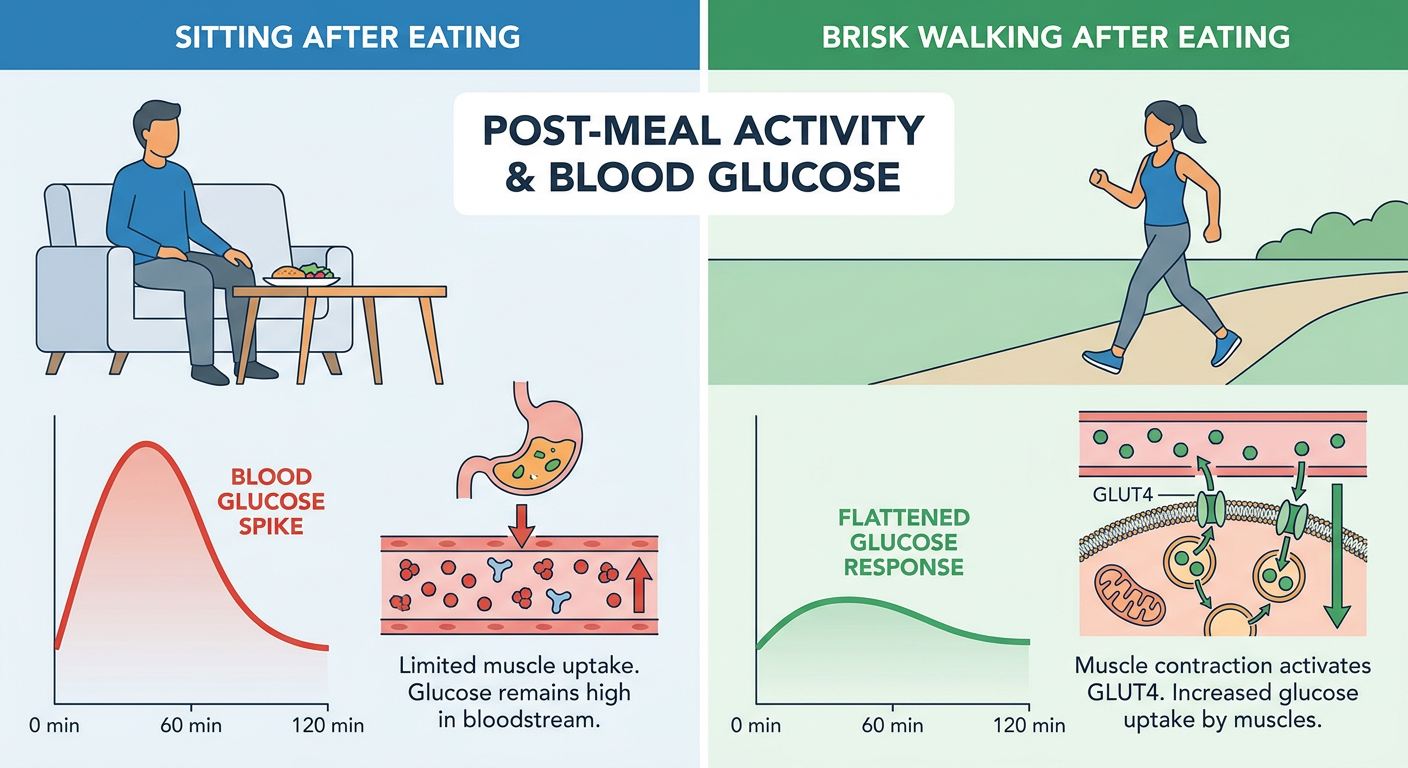
The infographic illustrates the core concept: sitting after a meal leads to a steep glucose spike, while walking activates GLUT4-mediated glucose uptake in muscle cells, flattening the curve.
This is a shared conversation. Sign in to Orris to start your own chat.