
Acromegaly
Reading File
Now let me search the medical library for comprehensive coverage of acromegaly.
Finding Sources
Searching PubMed
acromegaly treatment management
Now let me search for acromegaly in a dedicated endocrinology textbook, and also fetch the most relevant blocks.
Finding Sources
Finding Sources
Excellent - I can see Goldman-Cecil and Harrison's have dedicated content. Let me read those key sections now in parallel.
Reading File
Reading File
Finding Sources
Goldman-Cecil has excellent content. Let me continue reading it for diagnosis/treatment, and also read Harrison's dedicated section.
Reading File
Reading File
I have excellent content from both Goldman-Cecil and Harrison's. Let me read the continuation of Goldman-Cecil treatment section and Harrison's acromegaly section.
Reading File
Reading File
I have comprehensive content. Let me also fetch the clinical photo image and read a bit more of Harrison's on clinical features.
Loading Image
Loading Image
Reading File
I now have comprehensive content from both Goldman-Cecil Medicine and Harrison's 22nd edition to write a thorough response. Let me compose the full answer.
Acromegaly
Definition
Acromegaly is the syndrome caused by chronic excess growth hormone (GH) secretion in adults (i.e., after fusion of the epiphyseal growth plates). When GH excess occurs before puberty, the result is gigantism. The word comes from Greek: akron (extremity) + megas (large).
Epidemiology
- Incidence: 0.2-1.1 per 100,000 per year
- Prevalence: 8-14 per 100,000
- Median age at diagnosis: fifth decade of life
- Diagnostic delay is typically ~5 years, so most tumors are macroadenomas (>1 cm) at the time of presentation (~75%)
(Goldman-Cecil Medicine, Ch. 205)
Etiology and Pathophysiology
The cause is almost always a GH-secreting pituitary adenoma (somatotrope adenoma). The hypothalamic-pituitary axis normally balances GH release:
- GHRH (from hypothalamus) stimulates GH synthesis and release
- Somatostatin (somatotropin release-inhibiting factor, SRIF) inhibits GH release
- IGF-1 (produced by the liver) provides negative feedback, suppressing GH via somatostatin
In acromegaly, the adenoma secretes GH in an autonomous, uncontrolled fashion. GH then drives excess hepatic IGF-1 production, which mediates most of the tissue effects.
Causes (prevalence):
| Source | Prevalence |
|---|---|
| Pituitary somatotrope adenoma | ~98% |
| - Densely/sparsely granulated GH cell adenoma | 60% |
| - Mixed GH + PRL cell adenoma | 25% |
| - Mammosomatotrope adenoma | 10% |
| Extrapituitary GH-secreting tumor (pancreas, lymphoma) | <1% |
| Ectopic GHRH excess (bronchial carcinoid, small cell lung, medullary thyroid Ca, pheo) | <1% |
(Harrison's Principles of Internal Medicine, 22e)
Genetic associations:
- MEN1 (menin gene mutation) - pituitary adenomas in ~50% of patients; 10% secrete GH
- McCune-Albright syndrome (activating Gsα mutations - elevated cAMP, autonomous GH secretion)
- AIP mutations - familial isolated pituitary adenomas, often young onset
Clinical Features
The classic handshake - a large, doughy, enveloping hand with a rough, resonant voice - may be the physician's first clue. Features evolve insidiously over a decade and are only recognized in retrospect from old photographs.
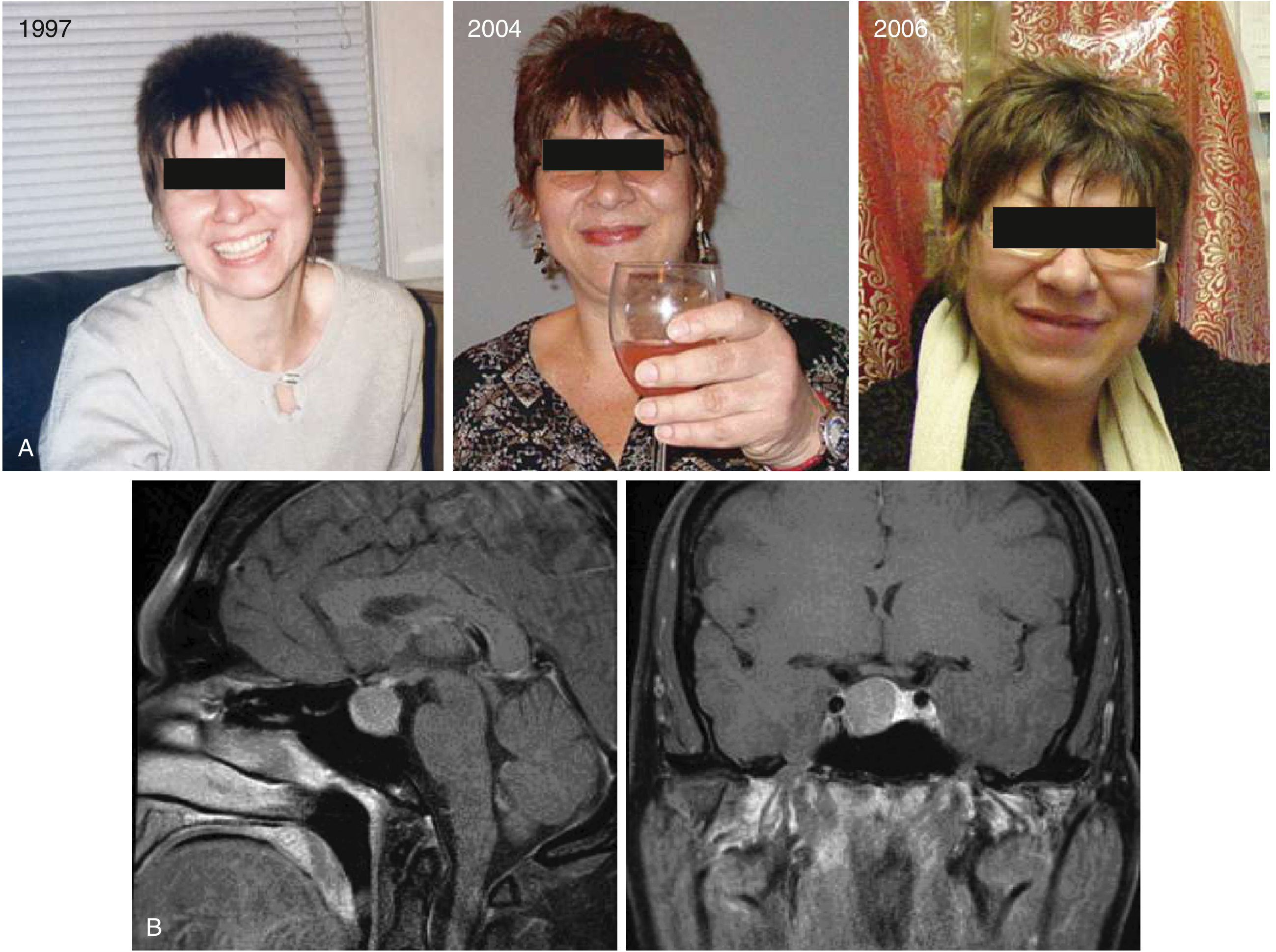
Facial and Skeletal Changes
- Frontal bossing, enlarged nose, macroglossia
- Prognathism (protruding lower jaw), splayed teeth, malocclusion, mandibular overbite
- Increased ring, shoe, and hat size
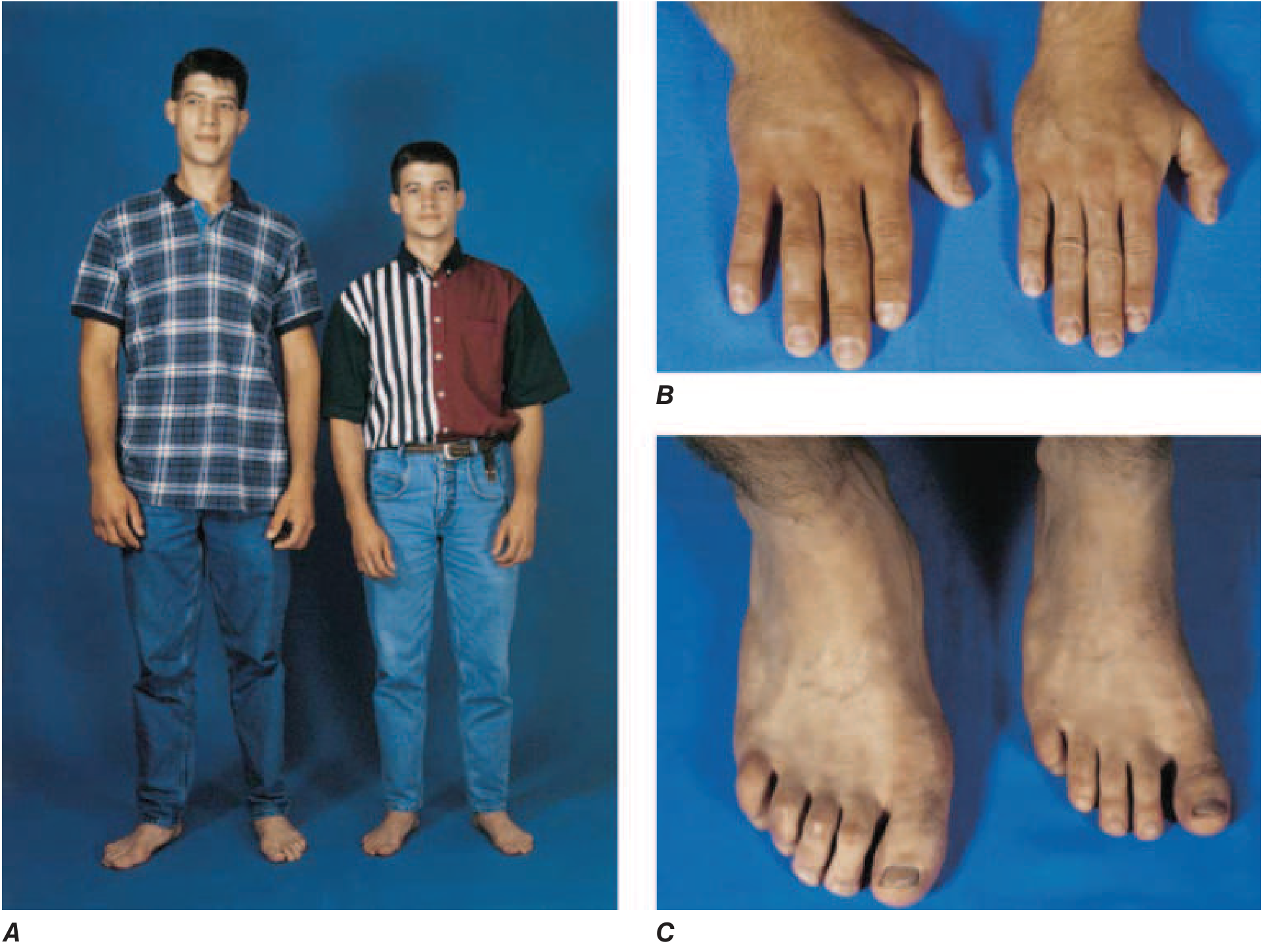
Soft Tissue and Metabolic
- Hyperhidrosis (very common at rest)
- Multiple skin tags (associated with colonic polyps and colon cancer risk)
- Obstructive sleep apnea (soft tissue hypertrophy of the pharynx)
- Neuropathy - carpal tunnel syndrome (50%) from nerve entrapment
Cardiovascular
- Hypertension
- Cardiomegaly / biventricular hypertrophy (acromegalic cardiomyopathy)
- Increased risk of ischemic heart disease and heart failure
Metabolic
- Diabetes mellitus / glucose intolerance (GH is anti-insulin)
- Hyperlipidemia
Musculoskeletal
- Atypical osteoarthritis in ~75% - knees, shoulders, hips, lumbosacral and cervical spine are most symptomatic; hands show widened joint spaces (cartilage hypertrophy) - unlike primary OA which narrows them
- Raynaud phenomenon (~33%)
- Diffuse idiopathic skeletal hyperostosis (20%)
- Proximal muscle weakness (normal CK)
Mass Effects from the Tumor
- Headache (up to 60%)
- Bitemporal hemianopia (10%) - compression of the optic chiasm
- Hypopituitarism from tumor compression
Hormonal Co-secretion
- Co-secretion of prolactin is common (mixed GH-PRL adenomas ~25%); causes hypogonadism and galactorrhea
(Goldman-Cecil Medicine, Ch. 205; Harrison's 22e)
Diagnosis
Biochemical
| Test | Details |
|---|---|
| Serum IGF-1 | Best screening test - correlates with 24-hr integrated GH secretion; age- and sex-matched norms required |
| Oral Glucose Tolerance Test (OGTT) + GH | 75g glucose over 2 hours; GH should suppress to <1 ng/mL (polyclonal assay) or <0.4 ng/mL (chemiluminescent IRMA). Failure to suppress confirms acromegaly |
| Random GH | Not useful - GH is pulsatile, can reach >50 ng/mL normally |
| Prolactin | Check for co-secretion (affects choice of medical therapy) |
Key point: Random GH is unreliable because GH is secreted in a pulsatile fashion. IGF-1 + OGTT are the diagnostic cornerstones.
Imaging
- MRI pituitary with gadolinium - after biochemical confirmation; ~90% show visible adenoma; 10% have an empty sella
- If MRI negative, consider ectopic sources - chest/abdomen imaging, selective venous GHRH sampling
(Goldman-Cecil Medicine, Ch. 205)
Treatment
The goals are: normalize GH/IGF-1 levels, remove or arrest tumor, alleviate mass effects, manage comorbidities, and restore normal life expectancy.
1. Surgery (First-line)
Transsphenoidal resection (endonasal endoscopic approach) by an experienced neurosurgeon is the primary treatment for most patients.
| Tumor type | Remission rate |
|---|---|
| Microadenoma (<1 cm) | ~70-90% |
| Macroadenoma (>1 cm) | <30-50% |
- GH normalizes within hours of tumor removal; IGF-1 normalizes within 3-4 days
- Hypopituitarism occurs in up to 15% post-surgery
- Recurrence in ~10% after apparent cure
2. Medical Therapy (Adjuvant or Primary)
Used when surgery fails, is incomplete, or is not possible (e.g., cavernous sinus invasion).
Somatostatin Receptor Ligands (SRLs) - First-line medical therapy
- Octreotide LAR - long-acting intramuscular injection every 4 weeks
- Lanreotide autogel - deep subcutaneous injection every 4 weeks
- Pasireotide LAR (40-60 mg IM q28 days) - broader receptor binding (SST1,2,3,5); superior GH suppression but higher rate of hyperglycemia
- Oral octreotide capsules (40 mg/day as 20 mg twice daily) - for patients with proven response to injectable forms
- Normalize IGF-1 in ~50-60% of patients; modestly shrink tumor in ~50%
- Side effects: diarrhea, cholelithiasis (gallstones)
Dopamine Agonist
- Cabergoline (0.5-1 mg 2x/week) - normalizes IGF-1 in only ~30% as monotherapy; useful as add-on, especially in mixed GH+PRL tumors
GH Receptor Antagonist
- Pegvisomant (SC daily injection) - biosynthetic GH analogue that blocks GH receptor, preventing IGF-1 generation; normalizes IGF-1 in >90% of patients
- Does not reduce tumor size
- Reserved for patients unresponsive to SRLs, or as combination therapy
- Monitor: liver enzymes (can elevate); GH levels rise (expected - it blocks the receptor, not secretion)
3. Radiotherapy (Adjuvant - third line)
- Stereotactic radiosurgery (Gamma Knife) or conventional fractionated radiotherapy
- Disadvantages: slow biochemical response (5-15 years), high rate of hypopituitarism (up to 50% long-term)
- Not used as primary therapy; reserved for residual/recurrent disease after surgery and medical failure
(Goldman-Cecil Medicine, Ch. 205; Harrison's Principles of Internal Medicine, 22e)
Prognosis
- Untreated or poorly controlled acromegaly carries 2-3x increased mortality vs. general population, mainly due to cardiovascular disease and malignancy
- Cure criteria: GH <1 ng/mL on OGTT AND normal age-matched IGF-1
- When these are achieved, mortality returns to that of the general population
- Arthropathy may persist or progress in ~1/3 of patients even after biochemical cure
- Soft tissue changes (swelling, hyperhidrosis) improve quickly after treatment; bony changes are irreversible
Summary
| Feature | Key Point |
|---|---|
| Cause | GH-secreting pituitary macroadenoma (98%) |
| GH mediator | IGF-1 (liver-derived) |
| Diagnosis | IGF-1 + OGTT GH suppression |
| Imaging | Pituitary MRI |
| First-line treatment | Transsphenoidal surgery |
| Medical therapy | SRLs (octreotide/lanreotide) → pegvisomant |
| Complication if untreated | CV disease, DM, colon cancer, 2-3x mortality |
Sources:
- Goldman-Cecil Medicine International Edition, Ch. 205 (Growth hormone excess: acromegaly and gigantism)
- Harrison's Principles of Internal Medicine, 22e (2025), Ch. 392 (Pituitary Disorders)
Recent Evidence Update: A 2025 network meta-analysis (PMID 41140134) on medical treatment in acromegaly and a 2025 CNS systematic review (PMID 40815128) on perioperative management of functioning pituitary adenomas are available for current guidelines - these are consistent with the treatment hierarchy described above.
This is a shared conversation. Sign in to Orris to start your own chat.