
Clubbing What is it. When will we see it what is it significance
finger clubbing digital clubbing clinical signs
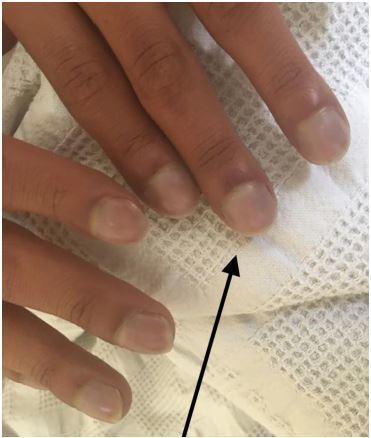
This clinical photograph shows a close-up of a patient's fingers demonstrating classic signs of digital clubbing and peripheral cyanosis. The distal phalanges exhibit a bulbous, 'drumstick' appearance with a noticeable loss of the normal Lovibond angle (the angle between the nail plate and the proximal nail fold). The nail beds appear convex and rounded. A distinct bluish-purple discoloration (cyanosis) is visible across the nail beds and distal fingertips, indicating poor blood oxygenation or circulation. A black arrow points to the most prominent area of clubbing on the index finger. These findings are clinically significant as they often indicate chronic hypoxemia secondary to congenital heart disease (such as Ebstein anomaly), pulmonary disease, or chronic inflammatory conditions. This image serves as a teaching tool for physical examination findings in cardiovascular and respiratory medicine.
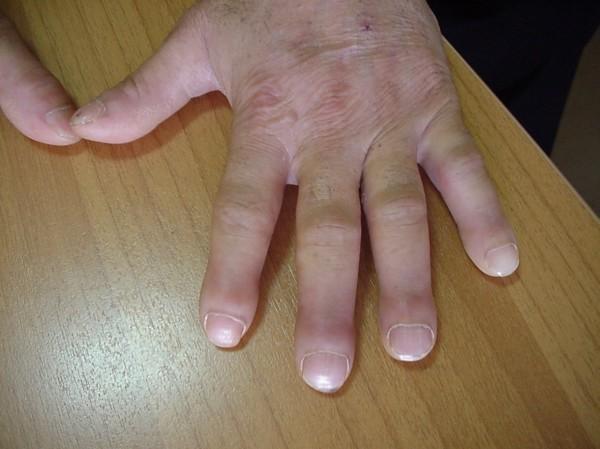
This clinical photograph displays a dorsal view of a human hand resting on a flat surface, illustrating classic features of digital clubbing. The distal phalanges of all visible fingers show significant bulbous enlargement and swelling, resulting in a 'drumstick' appearance. The nails exhibit increased longitudinal and transverse curvature (convexity), becoming rounded and broad. There is a visible loss of the normal angle between the nail plate and the proximal nail fold (Lovibond's angle), with the proximal nail fold appearing thickened and shiny. The skin over the hand is wrinkled, and an old linear scar is noted on the dorsal web space between the thumb and index finger. These findings are highly characteristic of digital clubbing, a clinical sign often associated with chronic hypoxemia, cardiovascular disease, or neoplastic pulmonary conditions such as bronchogenic carcinoma, particularly in patients with a significant smoking history.
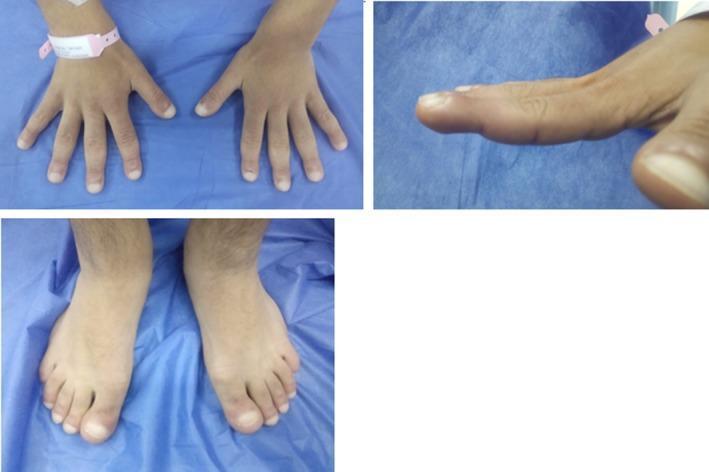
Clinical photograph composite demonstrating severe digital clubbing (Hippocratic fingers) of the hands and feet. The top left and bottom panels provide dorsal views of the bilateral hands and feet, showing significant bulbous enlargement of the distal phalanges. The fingertips and toes exhibit a characteristic 'drumstick' appearance with widening and hypertrophy of the soft tissue at the terminal ends. The top right panel displays a lateral profile view of a single finger, clearly illustrating the loss of the normal Lovibond angle (the angle between the nail base and the adjacent skin fold) and an increased longitudinal convexity of the nail bed. These visual findings are classic clinical indicators of chronic hypoxia, cyanotic heart disease, pulmonary disorders, or systemic conditions such as pachydermoperiostosis. The image serves as a high-quality educational resource for identifying grade 4 digital clubbing during a physical examination.
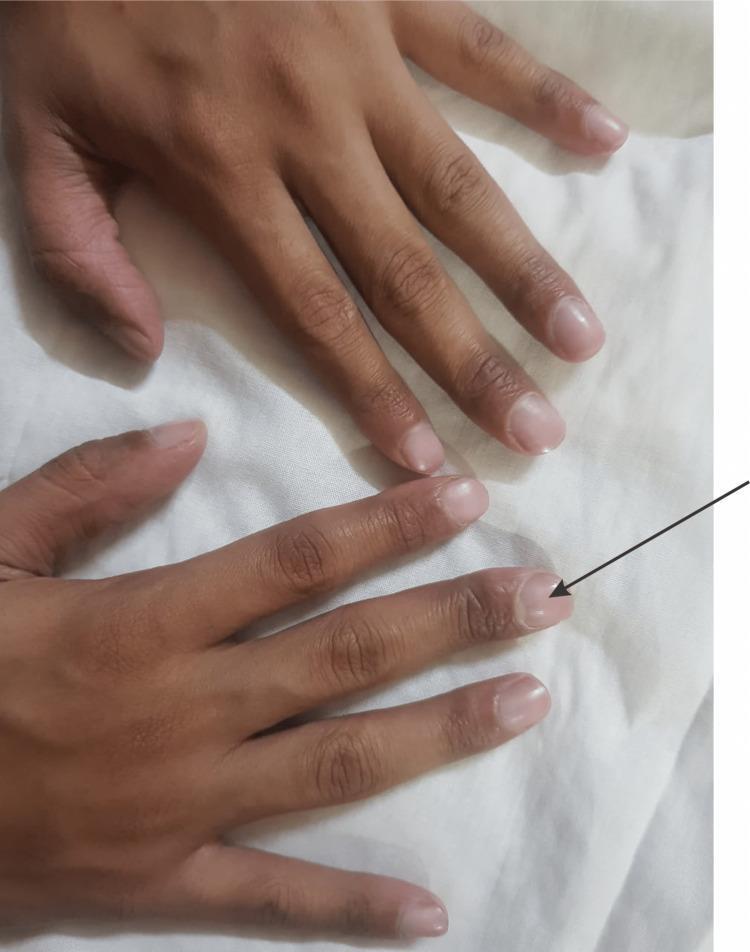
Clinical photograph of the dorsal aspect of both hands, demonstrating bilateral digital clubbing (acropachy). The primary visual findings include an increased convexity of the nail plates and bulbous swelling of the distal phalanges. The Lovibond angle is obliterated, and the nail beds exhibit a soft, spongy appearance characteristic of clubbing. An arrow highlights the prominent curvature of the nail on the right ring finger. The surrounding skin appears normal in texture and pigmentation, with no visible cyanosis. This clinical sign is an important diagnostic indicator for various systemic conditions, including chronic pulmonary diseases, congenital heart disease, or in this specific case, as a manifestation related to ectodermal dysplasia syndromes. The image serves as an educational example for physical examination techniques in dermatology, pulmonology, and internal medicine.
Digital Clubbing
What Is It?
- Loss of the Lovibond angle - the normal ~165° angle between the nail plate and the proximal nail fold is obliterated (flattened or reversed to >180°)
- Nail bed sponginess/floating - the nail feels soft and fluctuant at its base, like it is "floating"
- Periungual erythema - redness and warmth around the nail fold
- Curvature of the nails - increased convexity in both the longitudinal and transverse (coronal) planes
- Bulbous distal phalanx - the terminal digit becomes large, warm, and drum-stick-shaped
Pathogenesis
- Vasodilation of digital vessels - arteriovenous connections form in the fingertip, raising hydrostatic pressure and driving fluid into the interstitium, causing soft tissue proliferation
- Humoral/growth factor theory - normally, angiogenic substances (e.g., VEGF, platelet-derived growth factor, hypoxia-inducible factors HIF-1α and HIF-2α) are inactivated by the pulmonary capillary bed. When this filtration is bypassed (via right-to-left shunts, pulmonary AV fistulas, or hepatic shunting), these factors reach the peripheral digits and stimulate vascular proliferation and increased microvessel density
- Platelet precursor theory - megakaryocyte fragments that bypass pulmonary filtration lodge in digital capillaries and release platelet growth factors
When Will We See It? - Causes
Respiratory (most common category)
| Condition | Notes |
|---|---|
| Lung cancer (bronchogenic carcinoma) | Most common acquired cause overall |
| Mesothelioma | |
| Bronchiectasis | Including cystic fibrosis |
| Idiopathic pulmonary fibrosis / asbestosis | Interstitial lung diseases |
| Lung abscess / empyema | Can develop in ~2 weeks |
| Sarcoidosis / tuberculosis | |
| Pulmonary AV fistula / hereditary hemorrhagic telangiectasia |
Cardiac
| Condition | Notes |
|---|---|
| Cyanotic congenital heart disease | Classic cause (Tetralogy of Fallot, etc.) |
| Subacute bacterial endocarditis | |
| Infected aortic graft |
Special pattern: In patent ductus arteriosus with shunt reversal (Eisenmenger), clubbing affects only the toes (not the fingers) - a diagnostically telling distribution.
Gastrointestinal / Hepatic
- Inflammatory bowel disease (Crohn's, ulcerative colitis)
- Hepatic cirrhosis / biliary cirrhosis
- Hepatopulmonary syndrome
- Hepatoma / esophageal cancer
Miscellaneous
-
HIV-related (especially in children)
-
Thyroid acropachy (hyperthyroidism)
-
Secondary hyperparathyroidism
-
Hemoglobinopathies / congenital methemoglobinemia
-
Pachydermoperiostosis (primary hypertrophic osteoarthropathy - hereditary)
-
Idiopathic / hereditary (no associated disease)
-
Murray & Nadel, eTable 18.1; Harrison's 22E, p. 2602
Clinical Significance
1. It indicates serious disease
2. It can develop rapidly and also reverse
- Develops in as little as 2 weeks (e.g., new empyema)
- Can reverse within 2 weeks (e.g., after corrective cardiac surgery, or after lung transplantation for cystic fibrosis)
3. Hypertrophic Osteoarthropathy (HOA) - the associated syndrome
- Subperiosteal new bone formation at the distal diaphyses of long bones (radius, ulna, tibia, fibula)
- Painful symmetric periarthritis affecting shoulders, knees, ankles, wrists, elbows
- Confirmed by plain X-ray (periosteal reaction) or MRI/bone scan
-
Bronchogenic carcinoma (especially adenocarcinoma)
-
Other intrathoracic malignancies
-
Cystic fibrosis
-
(Less commonly) bronchiectasis, empyema, lung abscess
-
Fishman's Pulmonary Diseases, p. 4203-4215; Harrison's 22E, p. 2604
Quick Summary Table
| Feature | Detail |
|---|---|
| Definition | Bulbous distal digit enlargement, nail angle loss, nail bed sponginess |
| Earliest sign | Loss of Lovibond angle (hyponychial angle > 180°) |
| Most common cause | Lung cancer (acquired); cyanotic CHD (classic) |
| COPD | Does NOT cause clubbing - its presence should raise suspicion for lung cancer |
| Mechanism | Digital vasodilation via humoral growth factors (VEGF, PDGF) bypassing pulmonary filtration |
| Special distribution | Toes-only clubbing = PDA with reversed shunt |
| Associated syndrome | Hypertrophic osteoarthropathy (painful periosteal new bone) |
| Reversibility | Yes - can reverse in ~2 weeks after treating the cause |