
Nerves and branches from posterior cord of brachial plexus
Reading File
The posterior cord of the brachial plexus (C5-C8, T1) gives off several branches. Let me search the library for detailed coverage.
Searching sources...
Finding Sources
Finding Sources
Good hits. Let me read the key sections from Gray's Anatomy for Students and the THIEME Atlas.
Reading File
Reading File
Reading File
Now let me get the detailed posterior cord branches section from Gray's Anatomy for Students and fetch the key diagram image.
Reading File
Loading Image
Now let me read the posterior cord branches section from Gray's:
Reading File
Reading File
I now have comprehensive information. Here is the full answer:
Posterior Cord of the Brachial Plexus
Formation: The posterior cord is formed by the union of the posterior divisions of all three trunks (superior, middle, and inferior), giving it contributions from C5 to T1 (all roots). It lies posterior to the second part of the axillary artery.
Branches - "STAR" + 1 mnemonic (Superior subscapular, Thoracodorsal, Axillary, Radial + Inferior subscapular)
The posterior cord gives off 5 branches:
1. Superior Subscapular Nerve (C5, C6)
- Short nerve that passes directly into the subscapularis muscle
- Purely motor
- Supplies: Subscapularis (upper part)
2. Thoracodorsal Nerve (C6, C7, C8)
- Also called the middle subscapular nerve or nerve to latissimus dorsi
- Longest of the three posterior axillary wall nerves
- Passes vertically along the posterior axillary wall, penetrates and supplies latissimus dorsi
- Purely motor
- Function: latissimus dorsi - adduction, internal rotation, extension of arm; depression of raised arm
3. Inferior Subscapular Nerve (C5, C6)
- Passes inferiorly along the posterior axillary wall
- Supplies: Subscapularis (lower part) + Teres major
- Purely motor
4. Axillary Nerve (C5, C6)
- Passes inferiorly and laterally through the quadrangular space along with the posterior circumflex humeral artery
- Winds around the surgical neck of the humerus
- Motor branches:
- Deltoid (all three parts - anterior, middle, posterior)
- Teres minor
- Cutaneous branch:
- Superior lateral cutaneous nerve of the arm - loops around the posterior margin of the deltoid to supply skin over the deltoid region (regimental badge area)
Clinical note: Axillary nerve is at risk in fractures of the surgical neck of humerus and anterior shoulder dislocation - loss of deltoid power + sensory loss over the regimental badge area.
5. Radial Nerve (C5, C6, C7, C8, T1)
- The largest terminal branch of the posterior cord
- Exits the axilla via the triangular interval (between the inferior border of teres major, long head of triceps, and shaft of humerus)
- Accompanied by the profunda brachii artery
- Motor supply:
- All muscles of the posterior compartment of the arm (triceps brachii, anconeus)
- All muscles of the posterior compartment of the forearm (extensors of wrist, fingers, and thumb; brachioradialis; supinator)
- Cutaneous supply:
- Posterior cutaneous nerve of the arm
- Lower lateral cutaneous nerve of the arm
- Posterior cutaneous nerve of the forearm
- Skin over the lateral 3.5 digits on the dorsum of the hand (via superficial radial nerve)
Clinical note: Radial nerve is at risk in fractures of the mid-shaft of the humerus (spiral groove) - wrist drop (loss of wrist/finger extension) with sparing of triceps (supplied proximal to the groove).
Summary Table
| Branch | Roots | Muscles Supplied | Notes |
|---|---|---|---|
| Superior subscapular | C5, C6 | Subscapularis (upper) | Short, purely motor |
| Thoracodorsal | C6, C7, C8 | Latissimus dorsi | Longest, along posterior wall |
| Inferior subscapular | C5, C6 | Subscapularis (lower) + Teres major | Purely motor |
| Axillary | C5, C6 | Deltoid + Teres minor | + Superior lateral cutaneous N of arm |
| Radial | C5-T1 | All posterior compartment muscles of arm + forearm | Largest terminal branch |
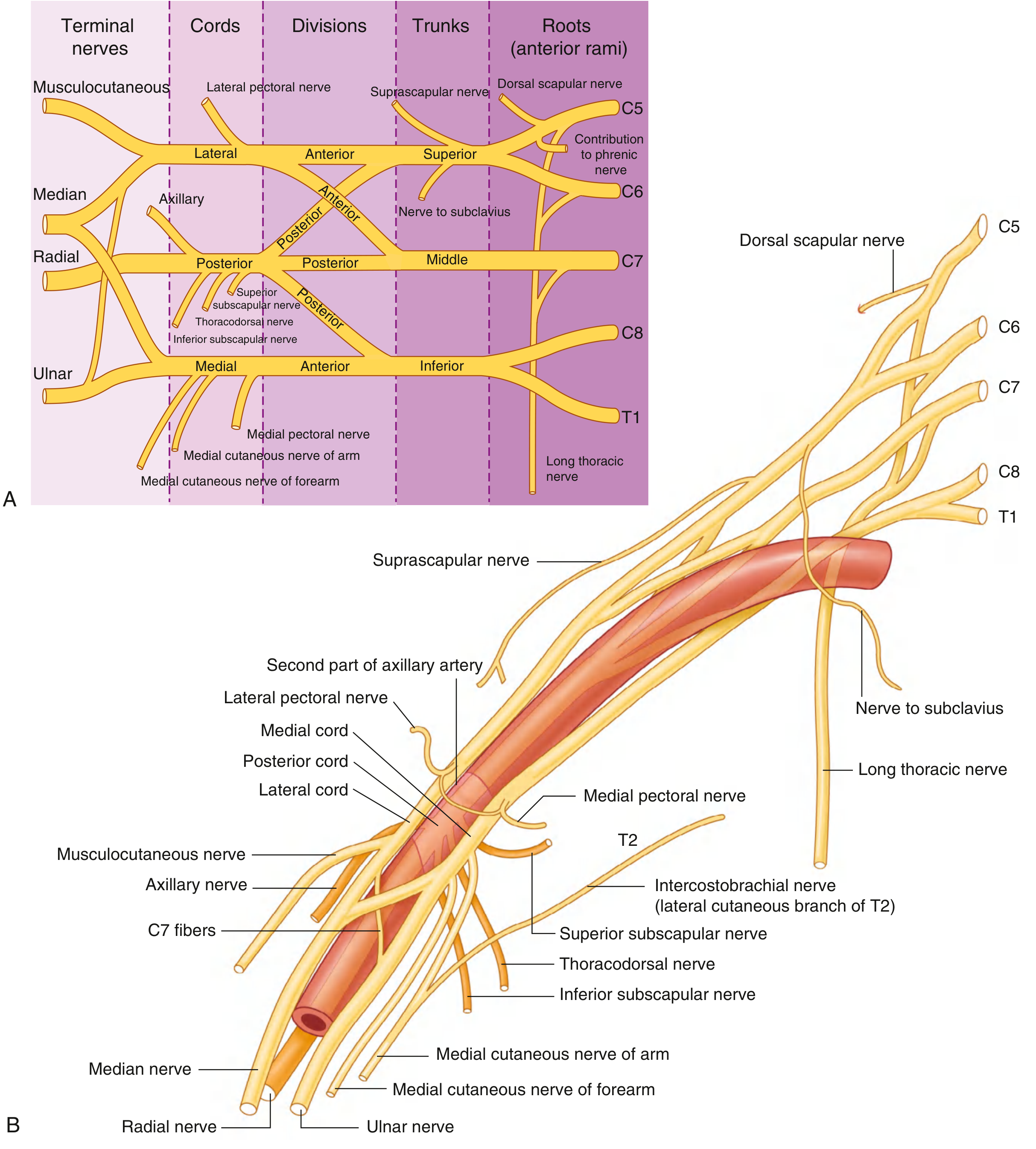
Brachial plexus - note the posterior cord (purple zone) giving off Superior subscapular, Thoracodorsal, Inferior subscapular, Axillary, and Radial nerves - Gray's Anatomy for Students
Memory aid: STAR - Superior subscapular, Thoracodorsal, Axillary, Radial - plus the Inferior subscapular (STARS).
- Gray's Anatomy for Students, p. 859-863
- Localization in Clinical Neurology, 8e, p. 85
This is a shared conversation. Sign in to Orris to start your own chat.