
Tolossa hunt syndrome
"Tolosa-Hunt syndrome"
Tolosa-Hunt syndrome diagnostic criteria treatment review
Tolosa Hunt syndrome MRI cavernous sinus enhancement
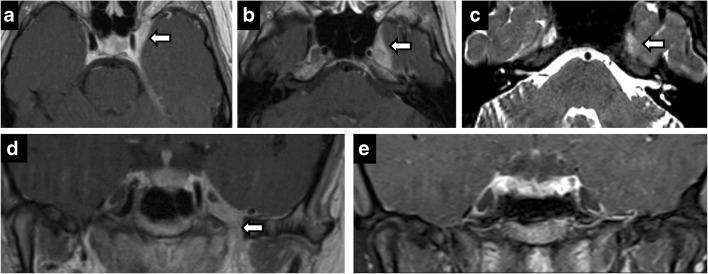
This composite of diagnostic images illustrates the radiological presentation and resolution of Tolosa-Hunt syndrome in a 23-year-old patient. The series includes axial T1-weighted contrast-enhanced (a, b), axial T2-weighted (c), and coronal contrast-enhanced (d) MRI scans. Arrows highlight abnormal, asymmetric enhancing soft tissue within the left cavernous sinus. This inflammatory tissue extends posteriorly into Meckel’s cave and inferiorly through the foramen ovale, indicative of the granulomatous inflammation characteristic of this condition. The coronal view (d) specifically demonstrates the extent of the enhancing phlegmon relative to the cranial nerve pathways. Frame (e) is a follow-up coronal contrast-enhanced T1 MRI showing complete resolution of the previously seen asymmetric enhancement and mass effect, demonstrating the typical rapid response of Tolosa-Hunt syndrome to corticosteroid therapy. This case serves as an educational example of painful ophthalmoplegia associated with non-specific inflammation of the cavernous sinus and its successful treatment progression.
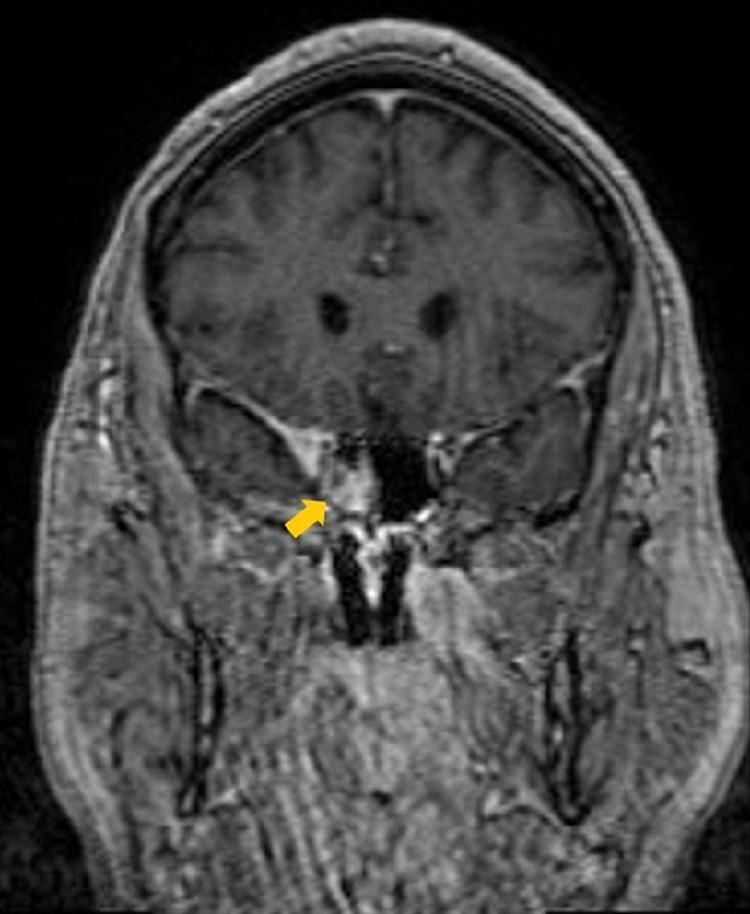
This diagnostic image is a coronal contrast-enhanced T1-weighted MRI of the brain and skull base. The primary finding is a focal area of increased signal intensity (hyperintensity) indicating abnormal contrast enhancement within the right cavernous sinus. A yellow arrow points specifically to the lateral margin of this enhancement where it extends anteriorly toward the right orbital apex. In contrast, the contralateral left cavernous sinus appears normal. The surrounding neuroanatomical structures, including the pituitary gland, sphenoid sinus, and temporal lobes, are visible as anatomical landmarks. This imaging is clinically significant for evaluating inflammatory or neoplastic processes of the cavernous sinus, such as Tolosa-Hunt syndrome or cavernous sinus thrombosis, as it demonstrates localized inflammation or tissue infiltration extending toward the orbital apex.
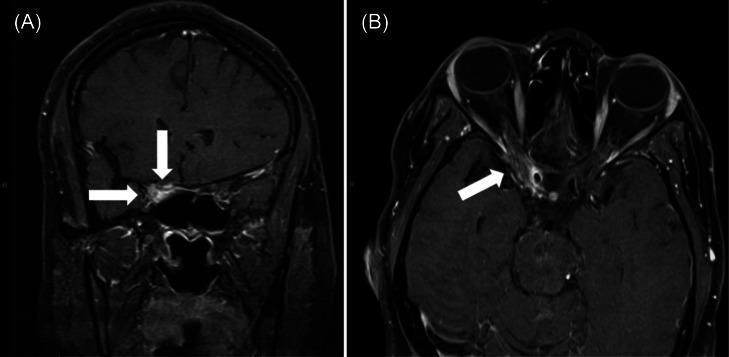
This diagnostic imaging composite features two magnetic resonance imaging (MRI) slices of the skull base and orbits in coronal (A) and axial (B) planes. The images are T1-weighted with contrast enhancement. White arrows indicate pathological findings concentrated in the right cavernous sinus and petrous apex regions. In the coronal view (A), hyperintense (bright) signal enhancement is visible within the right cavernous sinus, extending towards the orbital apex, contrasting with the normal appearance of the contralateral side. In the axial view (B), the arrow highlights abnormal enhancement and soft tissue thickening involving the right cavernous sinus and adjacent structures medial to the temporal lobe. Anatomical landmarks include the orbits, globe, sphenoid sinus, and brain parenchyma. The visual evidence of idiopathic granulomatous inflammation in this specific neuroanatomical location is highly characteristic of Tolosa-Hunt syndrome, a clinical entity associated with painful ophthalmoplegia. This educational material is relevant for neuroradiology and ophthalmology, illustrating diagnostic findings for cavernous sinus syndrome and cranial nerve palsies.
https://www.ncbi.nlm.nih.gov/books/NBK459225
Quick answer
Typical features
- Severe one-sided pain around/behind the eye
- Diplopia and restricted eye movements due to palsy of CN III, IV, and/or VI
- Ptosis is common
- May involve V1, causing reduced forehead/corneal sensation
- Less often optic nerve involvement or Horner syndrome
- Relapsing episodes can occur
Diagnosis
- Unilateral orbital/periorbital headache.
- Paresis of one or more ipsilateral ocular motor nerves, CN III, IV, or VI.
- Evidence of granulomatous inflammation on contrast MRI or biopsy in the cavernous sinus, superior orbital fissure, or orbit.
- Headache occurring with the palsy or within 2 weeks beforehand.
- No better alternative diagnosis.
Important differential diagnoses
- Cavernous sinus thrombosis, especially with fever, sinus/facial infection, proptosis, or chemosis
- Fungal infection such as rhino-orbital mucormycosis, especially in diabetes or immunosuppression
- Carotid aneurysm or carotid-cavernous fistula
- Pituitary apoplexy
- Meningioma, lymphoma, metastasis, nasopharyngeal carcinoma
- Sarcoidosis, granulomatosis with polyangiitis, IgG4-related disease
- Orbital cellulitis and orbital inflammatory disease
Treatment
Prognosis
Clinical features
- Severe unilateral periorbital or retro-orbital headache
- Painful limitation of eye movements and diplopia
- Ptosis
- Cranial nerve palsies, most often:
- CN III, IV, VI: ophthalmoplegia
- CN V1: reduced forehead/corneal sensation
- Less commonly CN II, causing visual impairment
- Symptoms may recur, sometimes on the opposite side.
Diagnosis
- Unilateral orbital or periorbital headache
- Paresis of one or more ipsilateral ocular motor nerves, CN III, IV, or VI
- Evidence of granulomatous inflammation in the cavernous sinus, superior orbital fissure, or orbit on MRI or biopsy
- Headache occurring with the palsy or within 2 weeks before it
- No better alternative diagnosis.
Adams and Victor's Principles of Neurology, 12th ed., p. 289.
Important differentials to exclude urgently
- Cavernous sinus thrombosis
- Carotid cavernous fistula or intracavernous carotid aneurysm
- Pituitary apoplexy
- Meningioma, lymphoma, metastasis, nasopharyngeal carcinoma
- Orbital cellulitis or orbital inflammatory disease
- Fungal infection, especially rhino-orbital mucormycosis in diabetes or immunosuppression
- Sarcoidosis, granulomatosis with polyangiitis, IgG4-related disease
- Diabetic cranial neuropathy and herpes zoster
Harrison's Principles of Internal Medicine, 22e, p. 1763.
Management
- After appropriate evaluation excludes infection, vascular lesions, and malignancy, treatment is usually high-dose systemic corticosteroids.
- Pain often improves dramatically within 24 to 72 hours.
- Ocular motor palsies usually improve more slowly, over weeks.
- Steroids are generally tapered gradually over weeks, individualized by a neurologist or neuro-ophthalmologist.
- Relapsing or steroid-dependent cases may need steroid-sparing immunosuppressive treatment, such as methotrexate, azathioprine, mycophenolate, or biologic therapy, under specialist care.
Adams and Victor's Principles of Neurology, 12th ed., p. 289.