
All about scabies every single point, non usual variants and treatments , and can i apply premethrin onto Penis shaft? Guide me properly
Reading File
Now let me search the medical library and PubMed in parallel for comprehensive scabies coverage.
Finding Sources
Searching PubMed
scabies treatment permethrin ivermectin
Searching the Web
permethrin application penis shaft scabies treatment genitalia safe
Now let me read the most comprehensive scabies sections from Fitzpatrick's, Harrison's, Tintinalli's, and Red Book in parallel.
Reading File
Reading File
Reading File
Reading File
Now let me read the Fitzpatrick's detailed section (the most comprehensive dermatology text) and the Tintinalli treatment section:
Reading File
Reading File
I now have extensive information from multiple authoritative textbooks. Let me compile the comprehensive answer.
Loading Image
Loading Image
Loading Image
I now have everything needed for a thorough, comprehensive answer. Let me write it up.
Scabies: Complete Guide
1. The Organism
Scabies is caused by Sarcoptes scabiei var. hominis - a pearl-like, translucent, white, oval mite of the class Arachnida. It is eyeless with 4 pairs of short stubby legs. The adult female measures 0.4 × 0.3 mm (barely below naked-eye visibility). It cannot fly or jump.
- Can survive 3 days off a host in a sterile container, 7 days in mineral oil
- Life cycle is completed entirely on human skin
- The female excavates a burrow at 0.5-5 mm/day in the stratum corneum down to the stratum granulosum boundary
- She lays 0-4 eggs/day, up to 50 eggs over her 30-day lifespan
- Eggs hatch in 10-14 days; larvae molt to nymphs then adults; full cycle: ~10-17 days
Mite burden by host type:
| Host | Mite count |
|---|---|
| Classic (immunocompetent) adult | 3-50 |
| Infants/elderly (poor scratchers) | 50-250 |
| Crusted scabies | Millions |
| HIV/leprosy/paraplegia | Millions, minimal itch |
- Fitzpatrick's Dermatology, p. 3304
2. Epidemiology & Transmission
- Worldwide, all ages, races, and socioeconomic classes
- Developing countries: 4-100% prevalence depending on region
- Primary route: prolonged close skin-to-skin contact (sexual and non-sexual)
- Fomite transmission: much less common in classic scabies, but live mites have been recovered from bedroom floors, chairs, and couches in every patient's home in one study
- Crusted scabies is highly contagious even from brief contact - up to 6,000 mites/g of skin debris detected on sheets, floors, and curtains
- Incubation: 4-6 weeks in first exposure (no prior immunity); 1-4 days on re-exposure (sensitized host)
- Can be transmitted throughout the entire presymptomatic period
- Red Book (AAP), p. 1030
3. Pathogenesis
The itching is not caused by the mite physically burrowing - it is a Type IV delayed hypersensitivity reaction to mite proteins, feces (scybala), and eggs. This is why:
- First infection: itch starts only after 4-6 weeks (sensitization phase)
- Re-infection: itch begins within 1-3 days
- Dead mites and debris continue to cause itch for weeks after successful treatment - this is NOT treatment failure
4. Classic Clinical Presentation
Cardinal features:
- Intense nocturnal pruritus - the defining symptom
- Burrows - thin, grey/white, serpiginous, thread-like lines 1-10 mm long (pathognomonic but often obliterated by scratching)
- Erythematous or brown papules
- Secondary excoriations and eczematous changes
Predilection sites in adults:
- Interdigital web spaces (fingers and toes)
- Flexor wrists
- Extensor elbows
- Anterior axillary folds
- Periumbilical area
- Waistband area
- Lower abdomen and thighs
- Genitalia (penis, scrotum in men; areolae in women)
- Intergluteal cleft
- Buttocks
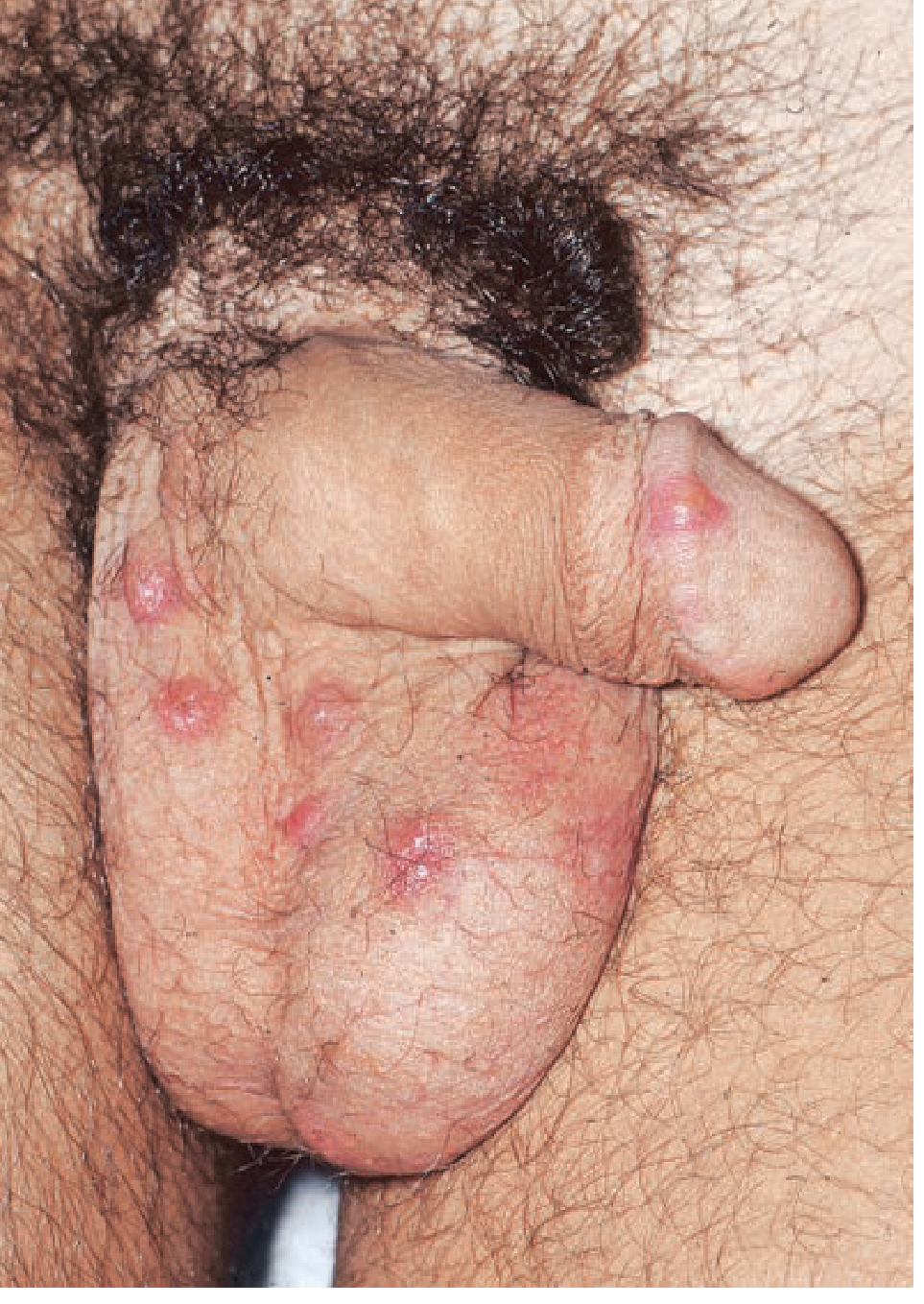
Men most frequently note penile and scrotal pruritic lesions. Red-brown papules and nodules on the penis and scrotum are a classic finding.
Head and neck are typically spared in adults (but NOT in infants, the elderly, or immunocompromised).
Scabies papules and burrows (Fitzpatrick's):
5. Unusual / Non-Classic Variants
A. Crusted (Norwegian) Scabies
The most important variant. Occurs in:
- Immunocompromised patients (HIV, transplant, biologic therapy)
- Patients with developmental disabilities or dementia
- Debilitated/institutionalized patients
- Patients on long-term topical corticosteroids (even otherwise healthy children)
- Leprosy, paraplegia, elderly
Features:
- Millions of mites (vs. 3-50 in classic)
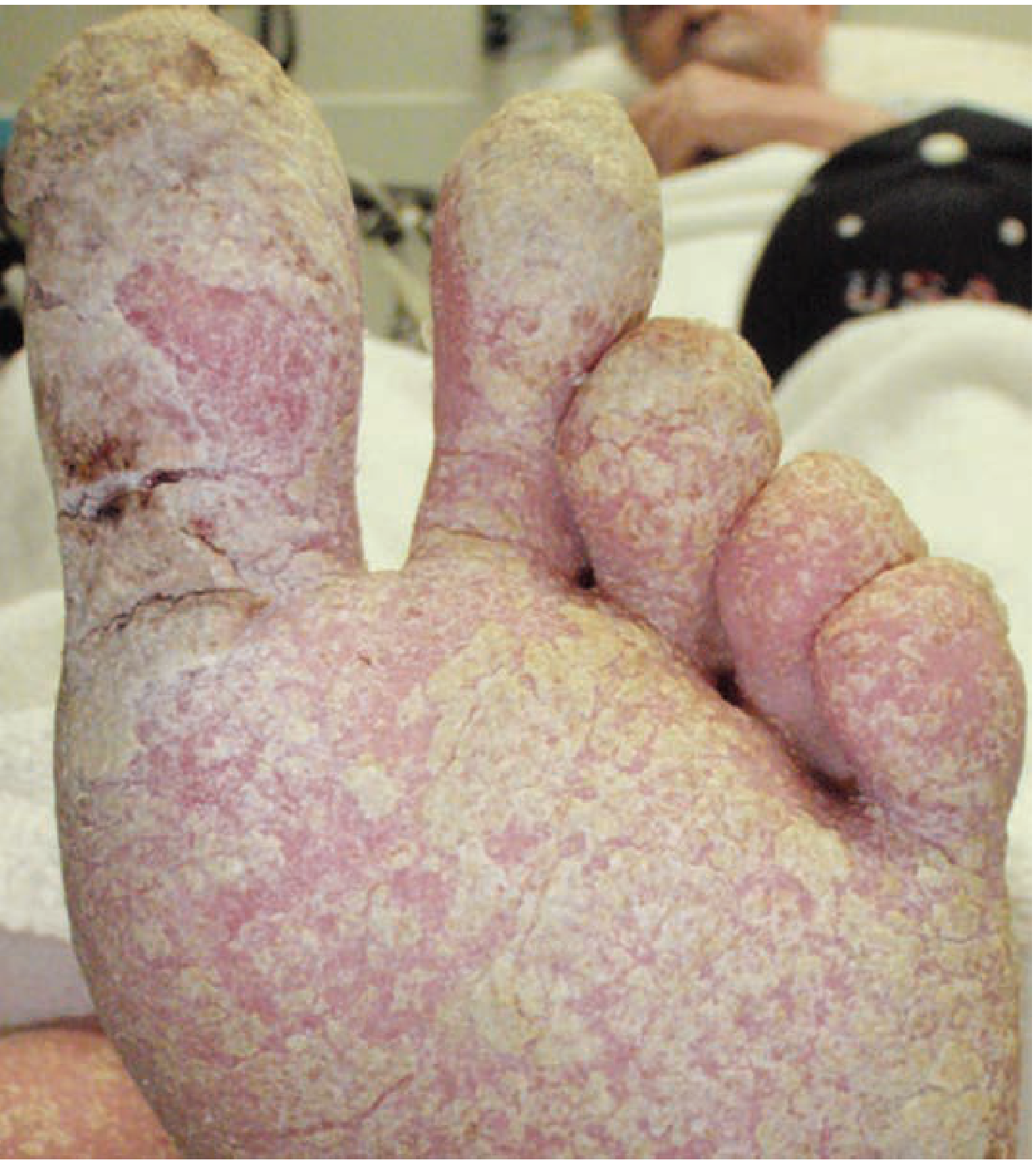
- Thick, hyperkeratotic, crusted, confluent plaques - especially on hands, feet, scalp, elbows, buttocks
- Pruritus is minimal or absent (paradoxically)
- Psoriasiform scaling under the nails; swollen, crusted fingertips
- Generalized distribution including face and scalp
- Extremely contagious even from brief contact or fomites
B. Nodular Scabies
- Persistent red-brown nodules, 2-5 mm, particularly on covered areas: genitalia, groin, axillae
- Represents a granulomatous reaction to dead mite antigens and feces
- Mites are usually absent from nodules
- Can persist for weeks to months after successful eradication
- Does NOT indicate treatment failure
- Management: topical corticosteroids, intralesional corticosteroid injections
C. Scabies in Infants (< 2 years)
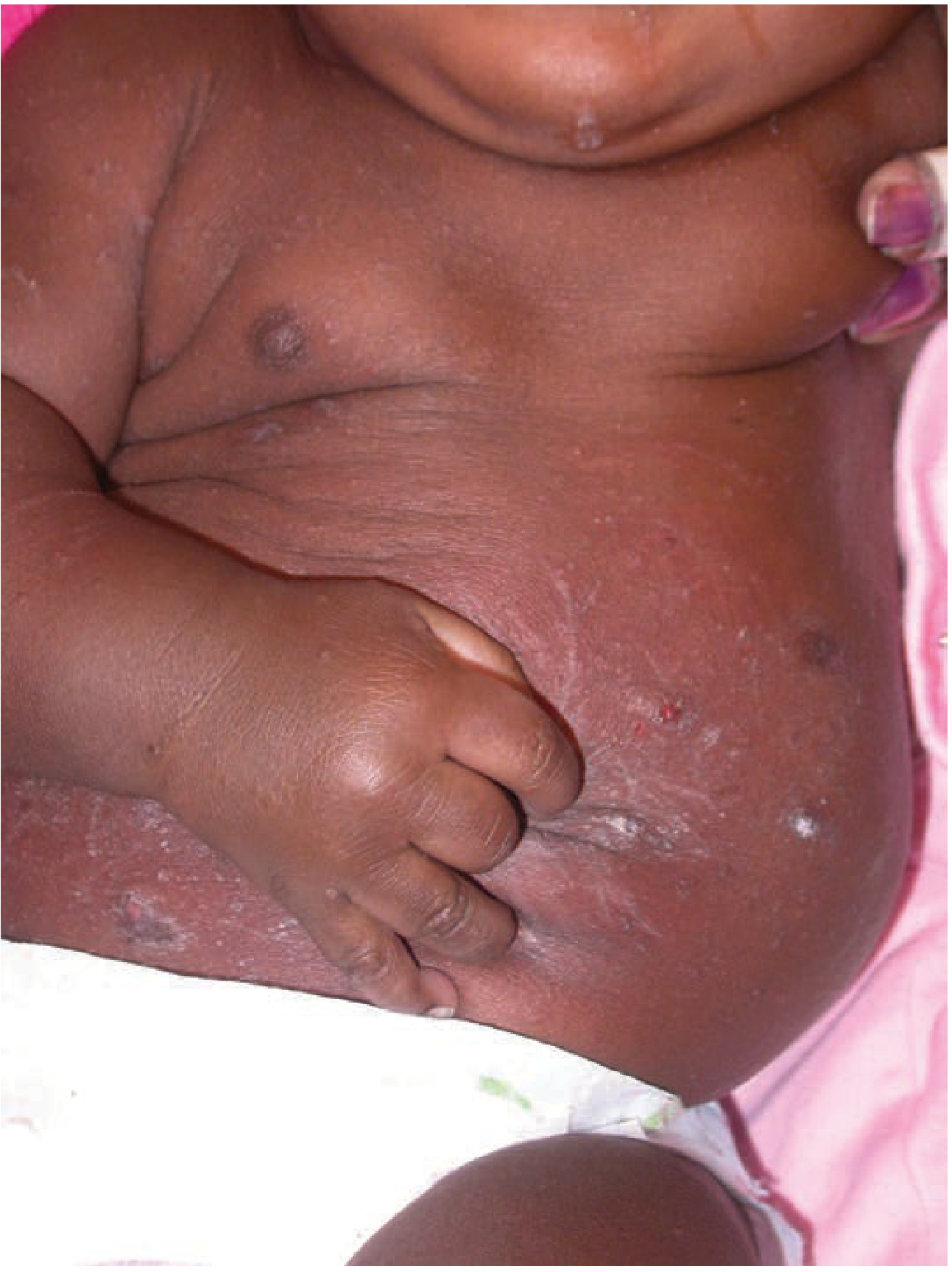
- Eruption is vesicular or pustular on palms and soles (unlike adults)
- Face, scalp, and neck are commonly involved (spared in adults)
- Bullous lesions may occur
- Classic web-space burrows may be absent
D. Scabies in the Elderly
- Atypical distribution - may involve scalp, face
- Intermediate mite burden (50-250)
- May be misdiagnosed as eczema or pruritus of aging
E. Bullous Scabies
- Vesicles and bullae, particularly in infants and the elderly
- Can mimic bullous pemphigoid
F. Scabietic "Id" Reaction (Autosensitization)
- Widespread urticarial papules predominantly on trunk and proximal extremities
- Represents a systemic hypersensitivity reaction
- Does NOT require additional acaricide treatment; manages like id reaction
G. Animal Scabies (Canine Mange)
- Sarcoptes scabiei var. canis from dogs
- Causes a self-limited, mild infestation - usually only the area in direct contact with the animal
- Mites cannot replicate in humans; resolves spontaneously when contact is removed
H. Postscabetic Pustulosis
- Reactive phenomenon after successful treatment - especially in infants and young children
- Episodic crops of sterile, pruritic papules and pustules - acral distribution predominantly
- Does NOT require re-treatment with scabicide
I. "7-Year Itch" (Chronic Undiagnosed Scabies)
-
Repeated sensitization with multiple infestations producing an eczematized, lichenified appearance
-
Tintinalli's Emergency Medicine, p. 1684; Red Book (AAP), p. 1030; Fitzpatrick's, p. 3305
6. Diagnosis
Clinical
- History + clinical pattern is usually sufficient
- Ask about nocturnal itch, household members with similar symptoms, recent close contact
Dermoscopy
- "Delta-wing jet" or "hang-glider" sign: triangular brown structure (mite's body) at end of burrow
Skin Scraping with Microscopy
- Scrape a burrow with a scalpel blade, transfer to glass slide with mineral oil and coverslip
- Look for mites, eggs, or fecal pellets (scybala)
- Low sensitivity - negative result does NOT rule out scabies
- In classic scabies only 3-50 mites present; easy to miss
PCR (in research/outbreak settings)
- High sensitivity, not widely available clinically
Differential Diagnosis
- Atopic dermatitis / eczema
- Contact dermatitis
- Dermatitis herpetiformis
- Bullous pemphigoid
- Lichen planus
- Urticaria
- Drug eruption
- Linear IgA bullous dermatosis
- Psoriasis
- Pediculosis infestation
- Systemic causes of pruritus (uremia, hypo/hyperparathyroidism)
- Delusions of parasitosis
7. Complications
-
Secondary bacterial infection (most common complication) - typically Staphylococcus aureus and/or Streptococcus pyogenes
- Can lead to: impetigo, cellulitis, invasive bacterial infections
- Poststreptococcal glomerulonephritis (rare but documented correlation with scabies-associated strep)
- Possibly acute rheumatic fever
-
Post-treatment persistent itch - dead mite debris continues causing hypersensitivity for weeks
-
Nodular scabies - persistent granulomatous nodules
-
Institutional outbreaks - especially with unrecognized crusted scabies index case
8. Treatment - Full Guide
General Principles
- Treat the patient AND all household members/intimate contacts simultaneously - even if asymptomatic, to prevent ping-pong reinfection
- Within 1 day of properly administered treatment, patient is considered non-communicable
- Dead mites continue to cause itch for 2-4 weeks post-treatment - do NOT retreat immediately
Environmental Decontamination
- Wash all clothing, bedding, and towels in hot water (60°C/140°F) and dry on high heat
- Items that cannot be washed: seal in a plastic bag for 2 weeks (mites starve off-host)
- Clean household environmental surfaces
Treatment Table (from Fitzpatrick's, p. 3306)
| Drug | Dose/Duration | Notes |
|---|---|---|
| Permethrin 5% cream | Neck down, 8-14 hours, repeat in 7 days; crusted scabies: daily × 7 days then twice weekly until cured | First-line; pregnancy category B; tolerance developing |
| Ivermectin 200 µg/kg oral | Days 1 and 8; crusted scabies: days 1, 2, 8, 9, 15 | Highly effective; avoid in <15 kg body weight and pregnancy/lactation |
| Benzyl benzoate 10-25% lotion | Apply for 24 hours | Not available in US; widely used globally |
| Crotamiton 10% cream | Apply 8 hours on days 1, 2, 3, and 8 | Has antipruritic properties; lower efficacy than permethrin |
| Precipitated sulfur 5-10% in petrolatum | Apply 8 hours on days 1, 2, and 3 | Safe in neonates and pregnancy; limited efficacy data; inexpensive |
| Lindane 1% lotion | Apply 8 hours, repeat day 7 | FDA black-box warning for neurotoxicity; banned in California; AVOID in children, pregnancy, elderly, <50 kg |
First-Line Treatments in Detail
Permethrin 5% Cream (Gold Standard)
- Synthetic pyrethroid; disrupts mite nerve cell membrane
- Cure rate >90% with single application
- Active against mites and eggs for several days post-application
- How to apply:
- Apply to cool, dry skin (not after a hot bath - hot skin increases absorption)
- Massage thoroughly into entire body from neck/jawline down to soles of feet
- Special attention: interdigital spaces, under nails, wrists, axillae, navel, buttocks, external genitalia
- Leave on 8-14 hours (typically overnight)
- Wash off with soap and water
- Reapply to hands if you wash them during the application period
- Repeat in 1 week (second application)
- Special populations:
- Infants (<2 years): apply to entire body including face, scalp, neck, and ears (avoid around mouth and eyes)
- Pregnant women, breastfeeding mothers, children <2 years: limit contact time to 2 hours per application
- Elderly/scalp involvement: include hairline, neck, temples, forehead
Oral Ivermectin 200 µg/kg
- Two doses: day 1 and day 8-14 (take with food/meal to increase bioavailability - contrary to strongyloidiasis instructions)
- Similar efficacy to permethrin at 2 weeks; may clear slightly slower in first week
- 2026 meta-analysis (BMC Infectious Diseases, 2026) confirms comparable effectiveness
- NOT FDA-approved for scabies (approved for strongyloidiasis), but widely used off-label
- Avoid: children <15 kg, pregnancy, lactation
- Preferred when: topical application is difficult, patient compliance issues, crusted scabies, institutional outbreaks
Crusted Scabies - Requires Combination Therapy
- Must combine topical permethrin + oral ivermectin
- Pre-treat with keratolytic (6% salicylic acid or 12% lactic acid) to debulk crusts before permethrin application
- Permethrin applied to entire body surface including scalp, face, and ears
- Permethrin schedule: daily × 7 days, then twice weekly until cured (Harrison's, p. 3773)
- Ivermectin: 3-7 doses over 8-30 days (days 1, 2, 8, 9, 15 minimum per Fitzpatrick's)
- Isolate patient; use gown and gloves when handling
Adjunctive Symptom Relief
- Oral antihistamines (cetirizine, hydroxyzine)
- Topical emollients
- Menthol 1-2% preparations, calamine lotion
- Topical corticosteroids (after treatment, for residual itch or nodular lesions)
- Intralesional triamcinolone for persistent nodular scabies
- Treat secondary bacterial infection with appropriate antibiotics if present
Treatment Failure
- A 2024 British Journal of Dermatology systematic review and meta-analysis (PMID 37625798) analyzed causes of treatment failure - most common causes: inadequate application, lack of simultaneous household treatment, re-exposure, and (emerging) reduced permethrin sensitivity
9. The Direct Answer: Can You Apply Permethrin to the Penis Shaft?
Yes - the penis shaft (external genital skin) MUST be treated.
The genitalia are one of the most common infestation sites in men, and permethrin is specifically instructed to be applied to the external genitalia as part of standard treatment. The penis shaft has keratinized skin (stratum corneum), which is exactly where the mite burrows.
Precise guidance (from multiple authoritative sources):
| Area | Apply permethrin? |
|---|---|
| Penis shaft (external skin) | ✅ YES - treat thoroughly |
| Scrotum | ✅ YES - treat thoroughly |
| Pubic/inguinal area | ✅ YES |
| Glans penis (tip/head) | ⚠️ AVOID - mucous membrane |
| Urethral meatus | ❌ NO - mucous membrane |
| Vaginal opening/vagina | ❌ NO - mucous membrane |
The VCU Student Health / standard clinical guidance specifically states: "Do not apply permethrin to the vagina, the tip of the penis, the eyes, the nose, the mouth, or to any areas of open skin."
The medicines.org.uk PIL for permethrin states: "the areas between the fingers and toes (also under the finger and toe-nails), the wrists, elbows, armpits, external genitalia and buttocks should be especially carefully treated."
StatPearls/NCBI confirms: "Patients should avoid contact with mucosal sites when applying topical permethrin."
Practical rule: If it has keratinized (regular) skin, apply permethrin. If it is a mucous membrane (moist, pink, non-keratinized tissue), do not apply.
10. Quick Reference Summary
| Feature | Detail |
|---|---|
| Cause | Sarcoptes scabiei var. hominis |
| Incubation | 4-6 weeks (first time); 1-4 days (re-infection) |
| Classic triad | Nocturnal itch + burrows + interdigital/genital papules |
| Mite burden | 3-50 in classic; millions in crusted |
| First-line treatment | Permethrin 5% cream (twice, 1 week apart) |
| Alternative | Oral ivermectin 200 µg/kg × 2 doses |
| Crusted scabies | Permethrin + ivermectin combination |
| Safe in pregnancy | Permethrin (category B), precipitated sulfur |
| Safe in neonates | Precipitated sulfur 5-10%; permethrin with caution |
| Avoid | Lindane (neurotoxic - especially children, elderly) |
| Persistent itch after treatment | Normal - up to 4 weeks; use antihistamines/corticosteroids |
| Treat contacts | All household + intimate contacts simultaneously |
| Nodules persisting post-treatment | Normal; treat with topical/intralesional steroids |
Sources: Fitzpatrick's Dermatology, p. 3304-3306 | Harrison's Principles 22e, p. 3772-3773 | Tintinalli's Emergency Medicine, p. 1684-1695 | Red Book (AAP) 2021, p. 1030-1035 | CDC Scabies Clinical Care | PMID 42098632 | PMID 37625798
This is a shared conversation. Sign in to Orris to start your own chat.