
Acetaminophen toxicity pathophysiology how it occur why it occurs in detail
Reading File
Now I'll run parallel searches across the library database to get comprehensive coverage.
Finding Sources
Finding Sources
Searching PubMed
acetaminophen toxicity pathophysiology NAPQI
Excellent results. Now let me read the most authoritative sections in parallel.
Reading File
Reading File
Reading File
Rich data from three major textbooks. Let me now read the Harrison's continuation and fetch the metabolism diagram image, plus read the 4 stages section.
Reading File
Reading File
Loading Image
I now have comprehensive data from multiple major textbooks plus a clear metabolic pathway diagram. I have everything needed for a detailed answer.
Acetaminophen (Paracetamol) Toxicity — Detailed Pathophysiology
1. Normal Metabolism at Therapeutic Doses
At standard doses, acetaminophen is absorbed rapidly (peak concentration within 1–2 hours). The liver processes it via three parallel pathways:
| Pathway | Enzyme | Product | % of dose |
|---|---|---|---|
| Glucuronidation | UDP-glucuronosyltransferase | Acetaminophen-glucuronide (non-toxic) | 40–67% |
| Sulfation | Phenolsulfotransferase | Acetaminophen-sulfate (non-toxic) | 20–46% |
| CYP450 oxidation | CYP2E1 (primary), CYP1A2, CYP3A4 | NAPQI (toxic) | 5–15% |
The glucuronide and sulfate conjugates are water-soluble and safely excreted in urine. The small fraction oxidized by CYP2E1 produces N-acetyl-p-benzoquinone imine (NAPQI) — a highly reactive, electrophilic metabolite. At therapeutic doses, NAPQI is rapidly neutralized by hepatic glutathione (GSH) via glutathione-S-transferase, forming a non-toxic mercapturate conjugate (APAP-mercaptate), which is then excreted renally.
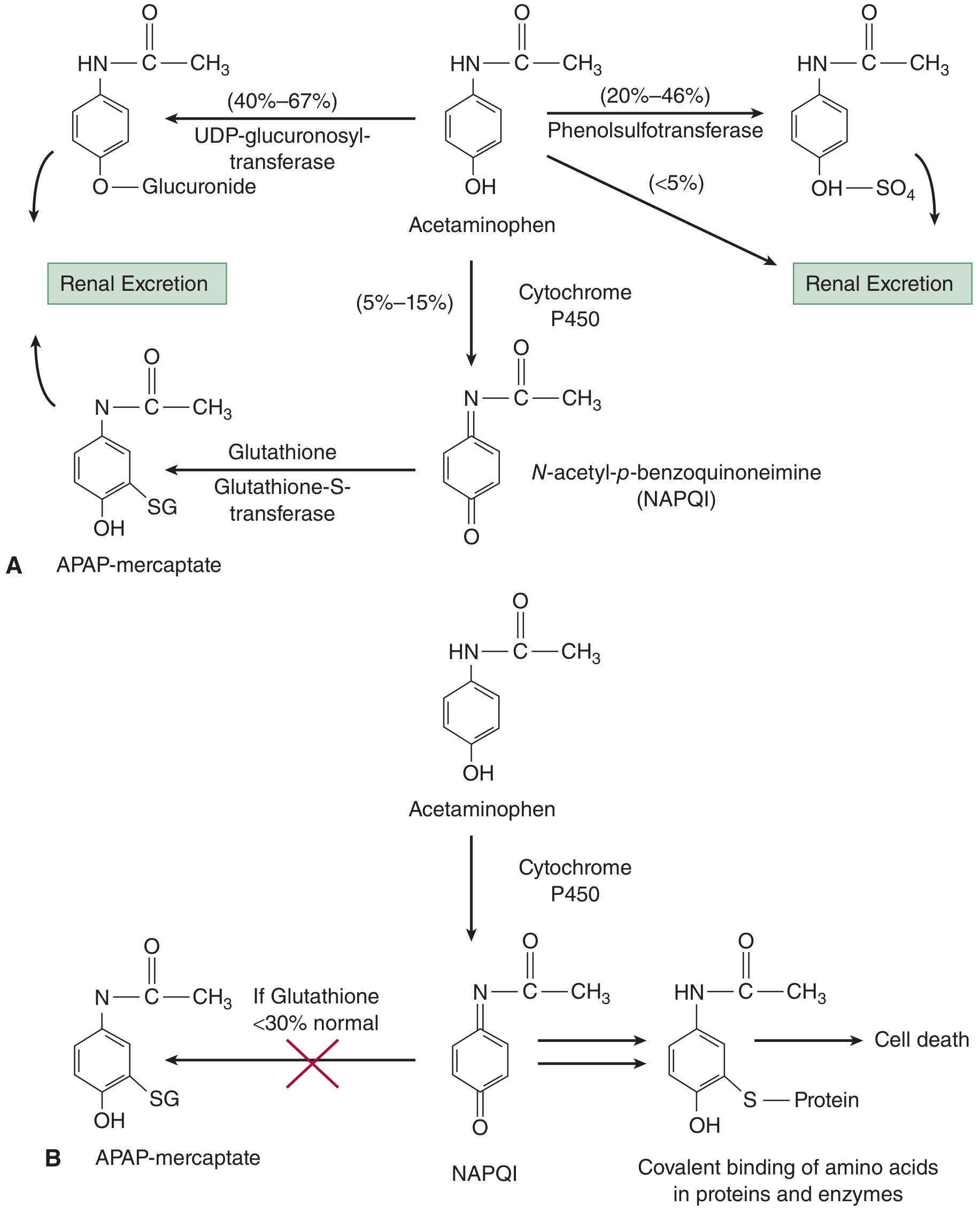
2. Why Toxicity Occurs — The Core Mechanism
Step 1: Saturation of Safe Pathways
After a large ingestion (typically >7.5–10 g in adults, or >150 mg/kg), the glucuronidation and sulfation pathways become saturated. As a result, a disproportionately larger fraction of acetaminophen is shunted through the CYP2E1 pathway, producing far more NAPQI than normal.
Step 2: Glutathione Depletion
The liver has finite glutathione stores. Under normal conditions, GSH is regenerated fast enough to handle small amounts of NAPQI. But with massive NAPQI production, hepatic GSH is consumed faster than it can be regenerated. When GSH falls below ~30% of normal, the detoxification capacity is overwhelmed.
Step 3: Covalent Binding → Hepatocyte Death
Unbound NAPQI is an extremely reactive electrophile. It covalently binds to sulfhydryl (–SH) groups on hepatocyte macromolecules — proteins, enzymes, and nucleic acids — forming acetaminophen-protein adducts. This triggers:
- Mitochondrial dysfunction — NAPQI disrupts the electron transport chain, reduces ATP synthesis, and increases reactive oxygen species (ROS)
- Oxidative stress — excess ROS causes lipid peroxidation and further protein damage
- Calcium dysregulation — loss of mitochondrial integrity disrupts intracellular Ca²⁺ homeostasis
- Hepatocyte necrosis — the combined insults lead to cell death by necrosis (not apoptosis)
- Inflammatory amplification — dying hepatocytes release damage-associated molecular patterns (DAMPs) that recruit neutrophils and Kupffer cells, amplifying liver destruction
Step 4: Zone III (Centrilobular) Predominance
Hepatic damage is concentrated in hepatic Zone III (centrilobular) because:
- CYP2E1 enzyme concentration is highest around the central vein
- This zone is the most distal from arterial oxygen delivery (already relatively hypoxic)
- Zone III hepatocytes have the least glutathione reserve
With severe toxicity, necrosis can extend outward to involve entire lobules.
3. Factors That Increase Risk (Why Some People Are More Vulnerable)
| Risk Factor | Mechanism |
|---|---|
| Chronic alcohol use | Induces CYP2E1 (more NAPQI) and depletes baseline GSH |
| Fasting / malnutrition | Reduces GSH synthesis (requires cysteine, glycine, glutamate) |
| Anticonvulsants (phenytoin, phenobarbital, carbamazepine) | Induce CYP3A4 → more NAPQI |
| Isoniazid (INH) | Induces CYP2E1 → more NAPQI |
| Rifampicin, zidovudine | Induce oxidative CYP pathways |
| HIV/AIDS | Depleted GSH stores |
| Children <6 years | Relatively protected — greater hepatic sulfation capacity |
Chronic alcoholics are at higher risk, but there is still debate about whether acute alcohol co-ingestion is protective (competes for CYP2E1) or harmful (depletes GSH). — Harrison's Principles of Internal Medicine 22E
4. Four Clinical Stages of Toxicity
| Stage | Time | Features |
|---|---|---|
| Stage 1 | 0–24 h | Asymptomatic or nausea, vomiting, malaise. Liver enzymes normal. |
| Stage 2 | 24–72 h (days 2–3) | GI symptoms resolve. RUQ pain/tenderness appears. Transaminases rise. Oliguria may begin. |
| Stage 3 | 72–96 h (days 3–4) | Peak hepatotoxicity. Fulminant hepatic failure: jaundice, coagulopathy, encephalopathy, metabolic acidosis, renal failure (hepatorenal syndrome). ALT/AST may exceed 10,000 IU/L. |
| Stage 4 | Day 4 – 2 weeks | Recovery begins. Complete hepatic regeneration in survivors over 1–3 months. |
— Tintinalli's Emergency Medicine
5. Extrahepatic Injury
Because CYP450 enzymes (and prostaglandin H synthase) exist in organs outside the liver, toxicity is not exclusively hepatic:
- Renal tubular injury — via renal CYP2E1-mediated NAPQI generation in the proximal tubules
- Cardiac toxicity — rare; direct myocardial injury
- Pancreatitis — rare
- Massive ingestion (>500 mg/kg) — early-onset metabolic acidosis with elevated lactate even before liver failure, due to:
- GSH depletion → accumulation of 5-oxoproline (pyroglutamic acid)
- Direct NAPQI-mediated mitochondrial respiratory chain inhibition
6. Key Biochemical Markers
- Acetaminophen-protein adducts (APAP-Cys adducts) detectable in serum — serve as diagnostic biomarkers of hepatocellular damage
- AST/ALT > 10,000 IU/L with relatively low bilirubin is the biochemical signature of acetaminophen hepatotoxicity (hyperacute injury pattern)
- Blood levels >300 μg/mL at 4 hours post-ingestion predict severe liver damage
- Blood levels <150 μg/mL at 4 hours suggest hepatic injury is highly unlikely
7. Why the Antidote (N-Acetylcysteine) Works
NAC counters the pathophysiology at two levels:
- Early (within 8–12 h): Acts as a glutathione precursor (provides cysteine for GSH synthesis) and as a direct sulfur-containing substitute for GSH, directly conjugating NAPQI before it can bind hepatocyte proteins. Also enhances sulfation of the parent drug.
- Late (after hepatotoxicity is established): Acts as a free-radical scavenger, improves microcirculatory flow in the liver, and reduces the inflammatory cascade driven by necrotic hepatocyte damage.
Sources:
- Rosen's Emergency Medicine: Concepts and Clinical Practice, Chapter 138
- Tintinalli's Emergency Medicine: A Comprehensive Study, Chapter 190
- Harrison's Principles of Internal Medicine, 22nd ed., Chapter 351
- Lippincott Illustrated Reviews: Pharmacology
- Yamada's Textbook of Gastroenterology, 7th ed.
Generate ppt on this topic
Reading File
Reading File
Reading File
Running Command
ls /home/daytona/workspace/ 2>/dev/null || echo "workspace empty or missing"
Running Command
mkdir -p /home/daytona/workspace/acetaminophen-toxicity-ppt
Now I'll write the full PptxGenJS script:
Writing File
~/acetaminophen-toxicity-ppt/generate.js
const pptxgen = require("pptxgenjs");

const pres = new pptxgen();
pres.layout = "LAYOUT_16x9";
pres.title = "Acetaminophen Toxicity – Pathophysiology";
pres.author = "Orris Medical";

// ─── COLOR PALETTE ───────────────────────────────────────────────────────────
const C = {
  navy:     "0D1B2A",   // dominant dark background
  darkBlue: "1A2E44",   // card backgrounds
  mid:      "1F4068",   // section headers, shapes
  accent:   "E63946",   // red — danger/toxic accent
  amber:    "F4A261",   // warnings / risk factors
  teal:     "2EC4B6",   // safe/normal pathway
  white:    "FFFFFF",
  light:    "E8EEF4",   // light text on dark bg
  gray:     "A8B4C0",   // muted text
  green:    "06D6A0",   // positive/antidote
};

// ─── HELPER FUNCTIONS ─────────────────────────────────────────────────────────
function addSlide() { return pres.addSlide(); }

function bg(slide, color) {
  slide.addShape(pres.shapes.RECTANGLE, {
    x: 0, y: 0, w: "100%", h: "100%",
    fill: { color: color || C.navy }, line: { color: color || C.navy }
  });
}

function accentBar(slide, color) {
  slide.addShape(pres.shapes.RECTANGLE, {
    x: 0, y: 0, w: 0.06, h: "100%",
    fill: { color: color || C.accent }, line: { color: color || C.accent }
  });
}

function sectionLabel(slide, text, color) {
  slide.addShape(pres.shapes.RECTANGLE, {
    x: 0.18, y: 0.22, w: 2.6, h: 0.32,
    fill: { color: color || C.accent }, line: { color: color || C.accent }, rectRadius: 0.04
  });
  slide.addText(text.toUpperCase(), {
    x: 0.18, y: 0.22, w: 2.6, h: 0.32,
    fontSize: 9, bold: true, color: C.white, align: "center", valign: "middle", margin: 0
  });
}

function slideTitle(slide, text, y) {
  slide.addText(text, {
    x: 0.18, y: y !== undefined ? y : 0.64,
    w: 9.6, h: 0.7,
    fontSize: 28, bold: true, color: C.white, valign: "top", margin: 0
  });
}

function dividerLine(slide, y, color) {
  slide.addShape(pres.shapes.RECTANGLE, {
    x: 0.18, y: y, w: 9.64, h: 0.025,
    fill: { color: color || C.accent }, line: { color: color || C.accent }
  });
}

// ─── SLIDE 1: TITLE ───────────────────────────────────────────────────────────
{
  const s = addSlide();
  bg(s, C.navy);

  // Big decorative circle
  s.addShape(pres.shapes.OVAL, {
    x: 6.5, y: -1.2, w: 5.5, h: 5.5,
    fill: { color: C.mid }, line: { color: C.mid }
  });
  s.addShape(pres.shapes.OVAL, {
    x: 7.2, y: -0.5, w: 4, h: 4,
    fill: { color: C.darkBlue }, line: { color: C.darkBlue }
  });

  // Accent bar
  accentBar(s, C.accent);

  // Tag
  s.addShape(pres.shapes.RECTANGLE, {
    x: 0.18, y: 1.0, w: 3.2, h: 0.38,
    fill: { color: C.accent }, line: { color: C.accent }
  });
  s.addText("PHARMACOLOGY & TOXICOLOGY", {
    x: 0.18, y: 1.0, w: 3.2, h: 0.38,
    fontSize: 9.5, bold: true, color: C.white, align: "center", valign: "middle", margin: 0, charSpacing: 1.5
  });

  // Main title
  s.addText("Acetaminophen", {
    x: 0.18, y: 1.55, w: 8, h: 0.85,
    fontSize: 44, bold: true, color: C.white, margin: 0
  });
  s.addText("Toxicity", {
    x: 0.18, y: 2.3, w: 8, h: 0.85,
    fontSize: 44, bold: true, color: C.accent, margin: 0
  });

  // Subtitle
  s.addText("Pathophysiology — How & Why It Occurs", {
    x: 0.18, y: 3.22, w: 7.5, h: 0.45,
    fontSize: 17, color: C.gray, italic: true, margin: 0
  });

  dividerLine(s, 3.78, C.teal);

  // Bottom caption
  s.addText("Also known as Paracetamol  |  Leading cause of acute liver failure in the Western world", {
    x: 0.18, y: 3.9, w: 9.6, h: 0.35,
    fontSize: 11, color: C.gray, margin: 0
  });

  // Bottom right badge
  s.addShape(pres.shapes.RECTANGLE, {
    x: 7.8, y: 4.9, w: 2.0, h: 0.5,
    fill: { color: C.mid }, line: { color: C.mid }
  });
  s.addText("APAP / Paracetamol", {
    x: 7.8, y: 4.9, w: 2.0, h: 0.5,
    fontSize: 9, color: C.gray, align: "center", valign: "middle", margin: 0
  });
}

// ─── SLIDE 2: OVERVIEW ─────────────────────────────────────────────────────────
{
  const s = addSlide();
  bg(s, C.navy);
  accentBar(s, C.accent);
  sectionLabel(s, "Overview");
  slideTitle(s, "What is Acetaminophen Toxicity?");
  dividerLine(s, 1.42, C.accent);

  const boxes = [
    { label: "PREVALENCE", text: "#1 cause of acute liver failure in the US, UK & Scandinavia. Accounts for >50% of acute liver failure cases.", color: C.accent },
    { label: "AVAILABILITY", text: "Sold OTC as isolated products & combination cold/pain medications. IV formulation also available.", color: C.amber },
    { label: "THE PARADOX", text: "Safe in therapeutic doses. Lethal in overdose — yet early stages are nearly symptom-free.", color: C.teal },
    { label: "CRITICAL WINDOW", text: "Antidote (N-acetylcysteine) is most effective within 8–12 hours — before symptoms appear.", color: C.green },
  ];

  boxes.forEach((b, i) => {
    const x = 0.18 + (i % 2) * 4.85;
    const y = 1.62 + Math.floor(i / 2) * 1.75;
    s.addShape(pres.shapes.RECTANGLE, {
      x, y, w: 4.55, h: 1.55,
      fill: { color: C.darkBlue }, line: { color: b.color },
      shadow: { type: "outer", color: "000000", blur: 8, offset: 3, angle: 135, opacity: 0.25 }
    });
    s.addShape(pres.shapes.RECTANGLE, {
      x, y, w: 4.55, h: 0.32,
      fill: { color: b.color }, line: { color: b.color }
    });
    s.addText(b.label, {
      x, y, w: 4.55, h: 0.32,
      fontSize: 9.5, bold: true, color: C.white, align: "center", valign: "middle", margin: 0, charSpacing: 1.2
    });
    s.addText(b.text, {
      x: x + 0.15, y: y + 0.38, w: 4.25, h: 1.1,
      fontSize: 11.5, color: C.light, valign: "top", margin: 0
    });
  });
}

// ─── SLIDE 3: NORMAL METABOLISM ────────────────────────────────────────────────
{
  const s = addSlide();
  bg(s, C.navy);
  accentBar(s, C.teal);
  sectionLabel(s, "Normal Metabolism", C.teal);
  slideTitle(s, "Therapeutic Dose Metabolism");
  dividerLine(s, 1.42, C.teal);

  // Central molecule label
  s.addShape(pres.shapes.OVAL, {
    x: 4.0, y: 1.6, w: 2.0, h: 0.7,
    fill: { color: C.mid }, line: { color: C.teal }
  });
  s.addText("ACETAMINOPHEN", {
    x: 4.0, y: 1.6, w: 2.0, h: 0.7,
    fontSize: 9, bold: true, color: C.teal, align: "center", valign: "middle", margin: 0
  });

  // Three pathways
  const pathways = [
    { x: 0.3, y: 2.7, w: 2.7, h: 1.4, label: "GLUCURONIDATION", pct: "40–67%", desc: "UDP-glucuronosyltransferase\n→ Acetaminophen-glucuronide\n→ Renal excretion (SAFE)", color: C.teal },
    { x: 3.65, y: 2.7, w: 2.7, h: 1.4, label: "SULFATION", pct: "20–46%", desc: "Phenolsulfotransferase\n→ Acetaminophen-sulfate\n→ Renal excretion (SAFE)", color: C.teal },
    { x: 6.9, y: 2.7, w: 2.9, h: 1.4, label: "CYP450 OXIDATION", pct: "5–15%", desc: "CYP2E1, CYP1A2, CYP3A4\n→ Produces NAPQI\n→ Detoxified by Glutathione", color: C.amber },
  ];

  pathways.forEach(p => {
    s.addShape(pres.shapes.RECTANGLE, {
      x: p.x, y: p.y, w: p.w, h: p.h,
      fill: { color: C.darkBlue }, line: { color: p.color }
    });
    s.addShape(pres.shapes.RECTANGLE, {
      x: p.x, y: p.y, w: p.w, h: 0.3,
      fill: { color: p.color }, line: { color: p.color }
    });
    s.addText(p.label, {
      x: p.x, y: p.y, w: p.w, h: 0.3,
      fontSize: 8.5, bold: true, color: C.navy, align: "center", valign: "middle", margin: 0
    });
    s.addText(p.pct, {
      x: p.x + 0.05, y: p.y + 0.33, w: p.w - 0.1, h: 0.32,
      fontSize: 15, bold: true, color: p.color, align: "center", margin: 0
    });
    s.addText(p.desc, {
      x: p.x + 0.1, y: p.y + 0.68, w: p.w - 0.2, h: 0.65,
      fontSize: 10, color: C.light, valign: "top", margin: 0
    });
  });

  // Arrows from center molecule
  [[1.65, 2.35], [4.95, 2.35], [8.35, 2.35]].forEach(([cx, cy], i) => {
    s.addShape(pres.shapes.RECTANGLE, {
      x: cx - 0.015, y: 2.3, w: 0.03, h: 0.4,
      fill: { color: i === 2 ? C.amber : C.teal }, line: { color: i === 2 ? C.amber : C.teal }
    });
  });

  // Glutathione detox note
  s.addShape(pres.shapes.ROUNDED_RECTANGLE, {
    x: 0.18, y: 4.25, w: 9.64, h: 0.95,
    fill: { color: C.mid }, line: { color: C.green }, rectRadius: 0.08
  });
  s.addText([
    { text: "KEY POINT: ", options: { bold: true, color: C.green } },
    { text: "At therapeutic doses, NAPQI is immediately neutralized by hepatic glutathione (GSH) via Glutathione-S-transferase → forms non-toxic APAP-mercaptate → renally excreted. Glutathione stores easily regenerate faster than NAPQI is produced.", options: { color: C.light } }
  ], {
    x: 0.35, y: 4.28, w: 9.3, h: 0.9, fontSize: 11, valign: "middle", margin: 0
  });
}

// ─── SLIDE 4: OVERDOSE MECHANISM ──────────────────────────────────────────────
{
  const s = addSlide();
  bg(s, C.navy);
  accentBar(s, C.accent);
  sectionLabel(s, "Overdose Mechanism");
  slideTitle(s, "Why Toxicity Occurs — Step by Step");
  dividerLine(s, 1.42, C.accent);

  const steps = [
    { n: "1", title: "Pathway Saturation", body: "Glucuronidation & sulfation become SATURATED after large ingestion (>7.5–10 g adults / >150 mg/kg). More acetaminophen is forced through the CYP2E1 route.", color: C.amber },
    { n: "2", title: "NAPQI Overproduction", body: "CYP2E1 (and CYP3A4, CYP1A2) convert the excess drug to NAPQI — a highly reactive, electrophilic quinone-imine metabolite.", color: C.accent },
    { n: "3", title: "Glutathione Depletion", body: "Hepatic GSH is consumed faster than it regenerates. When GSH falls below 30% of normal, detoxification capacity is overwhelmed.", color: C.accent },
    { n: "4", title: "Covalent Binding", body: "Unbound NAPQI covalently binds sulfhydryl (–SH) groups on hepatocyte proteins and enzymes → forms acetaminophen-protein adducts.", color: C.accent },
    { n: "5", title: "Cell Death Cascade", body: "Mitochondrial dysfunction → ATP depletion, ROS generation, Ca²⁺ dysregulation → hepatocyte NECROSIS + inflammatory amplification via Kupffer cells.", color: C.accent },
  ];

  steps.forEach((st, i) => {
    const x = 0.18;
    const y = 1.58 + i * 0.74;
    // Number badge
    s.addShape(pres.shapes.OVAL, {
      x: x, y: y, w: 0.52, h: 0.52,
      fill: { color: st.color }, line: { color: st.color }
    });
    s.addText(st.n, {
      x: x, y: y, w: 0.52, h: 0.52,
      fontSize: 14, bold: true, color: C.white, align: "center", valign: "middle", margin: 0
    });
    // Title
    s.addText(st.title, {
      x: x + 0.62, y: y + 0.02, w: 2.4, h: 0.48,
      fontSize: 12, bold: true, color: st.color, valign: "middle", margin: 0
    });
    // Body
    s.addText(st.body, {
      x: x + 3.1, y: y, w: 6.7, h: 0.52,
      fontSize: 10.5, color: C.light, valign: "middle", margin: 0
    });
    // Divider
    if (i < steps.length - 1) {
      s.addShape(pres.shapes.RECTANGLE, {
        x: x, y: y + 0.58, w: 9.64, h: 0.015,
        fill: { color: C.darkBlue }, line: { color: C.darkBlue }
      });
    }
  });
}

// ─── SLIDE 5: NAPQI & MOLECULAR DAMAGE ─────────────────────────────────────────
{
  const s = addSlide();
  bg(s, C.navy);
  accentBar(s, C.accent);
  sectionLabel(s, "Molecular Mechanism");
  slideTitle(s, "NAPQI — The Toxic Culprit");
  dividerLine(s, 1.42, C.accent);

  // Left panel — NAPQI properties
  s.addShape(pres.shapes.RECTANGLE, {
    x: 0.18, y: 1.55, w: 4.5, h: 3.7,
    fill: { color: C.darkBlue }, line: { color: C.accent }
  });
  s.addText("NAPQI Properties", {
    x: 0.18, y: 1.55, w: 4.5, h: 0.38,
    fontSize: 12, bold: true, color: C.accent, align: "center", valign: "middle",
    fill: { color: C.accent + "22" }, margin: 0
  });
  s.addText([
    { text: "Full name: ", options: { bold: true, color: C.amber } },
    { text: "N-acetyl-p-benzoquinone imine\n", options: { color: C.light } },
    { text: "\nChemical nature: ", options: { bold: true, color: C.amber } },
    { text: "Highly reactive ELECTROPHILE\n", options: { color: C.light } },
    { text: "\nProduced by: ", options: { bold: true, color: C.amber } },
    { text: "CYP2E1 (primary), CYP1A2, CYP3A4\n", options: { color: C.light } },
    { text: "\nTarget: ", options: { bold: true, color: C.amber } },
    { text: "–SH (sulfhydryl) groups on proteins\n", options: { color: C.light } },
    { text: "\nAdducts detectable: ", options: { bold: true, color: C.amber } },
    { text: "APAP-Cys adducts in serum (diagnostic biomarker)", options: { color: C.light } },
  ], {
    x: 0.35, y: 2.0, w: 4.15, h: 3.0, fontSize: 10.5, valign: "top", margin: 0
  });

  // Right panel — cascade
  const cascadeItems = [
    { icon: "⚡", label: "Mitochondrial Dysfunction", desc: "NAPQI disrupts electron transport chain → ↓ ATP", color: C.accent },
    { icon: "💥", label: "Oxidative Stress", desc: "Excess ROS → lipid peroxidation, protein oxidation", color: C.accent },
    { icon: "⚠", label: "Ca²⁺ Dysregulation", desc: "Mitochondrial injury → intracellular Ca²⁺ overload", color: C.amber },
    { icon: "☠", label: "Hepatocyte Necrosis", desc: "Cell death by necrosis (not apoptosis)", color: C.accent },
    { icon: "🔥", label: "Inflammatory Amplification", desc: "DAMPs activate Kupffer cells + neutrophil recruitment", color: C.amber },
  ];

  cascadeItems.forEach((item, i) => {
    const y = 1.55 + i * 0.74;
    s.addShape(pres.shapes.ROUNDED_RECTANGLE, {
      x: 4.9, y, w: 5.0, h: 0.65,
      fill: { color: C.darkBlue }, line: { color: item.color }, rectRadius: 0.06
    });
    s.addText(item.label, {
      x: 5.1, y: y + 0.02, w: 4.7, h: 0.3,
      fontSize: 11, bold: true, color: item.color, valign: "middle", margin: 0
    });
    s.addText(item.desc, {
      x: 5.1, y: y + 0.32, w: 4.7, h: 0.28,
      fontSize: 9.5, color: C.gray, valign: "middle", margin: 0
    });
    // Arrow connector
    if (i < cascadeItems.length - 1) {
      s.addShape(pres.shapes.RECTANGLE, {
        x: 7.3, y: y + 0.65, w: 0.03, h: 0.09,
        fill: { color: C.accent }, line: { color: C.accent }
      });
    }
  });
}

// ─── SLIDE 6: ZONE III CENTRILOBULAR ──────────────────────────────────────────
{
  const s = addSlide();
  bg(s, C.navy);
  accentBar(s, C.accent);
  sectionLabel(s, "Hepatic Zonation");
  slideTitle(s, "Zone III — Why the Centrilobular Region?");
  dividerLine(s, 1.42, C.accent);

  // Zone diagram (schematic)
  const zones = [
    { label: "Zone I\n(Periportal)", sub: "Portal triad\nHigh O₂, rich in GSH\nSpared in APAP toxicity", color: C.teal, x: 0.3, y: 1.65 },
    { label: "Zone II\n(Midzonal)", sub: "Transitional zone\nIntermediate GSH\nPartial involvement", color: C.amber, x: 3.4, y: 1.65 },
    { label: "Zone III\n(Centrilobular)", sub: "Central vein area\nHigh CYP2E1\nLow O₂, low GSH\n⟶ PRIMARY TARGET", color: C.accent, x: 6.5, y: 1.65 },
  ];

  zones.forEach(z => {
    const isTarget = z.color === C.accent;
    s.addShape(pres.shapes.ROUNDED_RECTANGLE, {
      x: z.x, y: z.y, w: 2.9, h: isTarget ? 2.8 : 2.5,
      fill: { color: C.darkBlue }, line: { color: z.color },
      shadow: isTarget ? { type: "outer", color: "000000", blur: 12, offset: 4, angle: 135, opacity: 0.4 } : undefined,
      rectRadius: 0.1
    });
    s.addShape(pres.shapes.RECTANGLE, {
      x: z.x, y: z.y, w: 2.9, h: 0.35,
      fill: { color: z.color }, line: { color: z.color }
    });
    s.addText(z.label, {
      x: z.x, y: z.y, w: 2.9, h: 0.35,
      fontSize: 11, bold: true, color: C.white, align: "center", valign: "middle", margin: 0
    });
    s.addText(z.sub, {
      x: z.x + 0.1, y: z.y + 0.42, w: 2.7, h: 2.1,
      fontSize: 11, color: isTarget ? C.light : C.gray, align: "center", valign: "top", margin: 0
    });
  });

  // Explanation box
  s.addShape(pres.shapes.RECTANGLE, {
    x: 0.18, y: 4.35, w: 9.64, h: 1.02,
    fill: { color: C.mid }, line: { color: C.accent }
  });
  s.addText([
    { text: "Why Zone III? ", options: { bold: true, color: C.accent } },
    { text: "CYP2E1 (the enzyme that makes NAPQI) is most concentrated in centrilobular hepatocytes. Zone III also has the lowest oxygen tension and smallest glutathione reserves. In severe toxicity, necrosis extends outward from Zone III to involve entire lobules → massive liver destruction.", options: { color: C.light } }
  ], {
    x: 0.35, y: 4.38, w: 9.3, h: 0.95, fontSize: 11, valign: "middle", margin: 0
  });
}

// ─── SLIDE 7: RISK FACTORS ─────────────────────────────────────────────────────
{
  const s = addSlide();
  bg(s, C.navy);
  accentBar(s, C.amber);
  sectionLabel(s, "Risk Factors", C.amber);
  slideTitle(s, "Who Is More Vulnerable?");
  dividerLine(s, 1.42, C.amber);

  const risks = [
    { factor: "Chronic Alcohol Use", mechanism: "Induces CYP2E1 (more NAPQI production) AND depletes baseline glutathione stores", icon: "⬆ CYP2E1 / ⬇ GSH", color: C.accent },
    { factor: "Fasting / Malnutrition", mechanism: "Reduced glutathione synthesis (requires cysteine, glycine, glutamate as precursors)", icon: "⬇ GSH synthesis", color: C.accent },
    { factor: "Anticonvulsants", mechanism: "Phenytoin, phenobarbital, carbamazepine — induce CYP3A4 → more NAPQI", icon: "⬆ CYP3A4", color: C.amber },
    { factor: "Isoniazid (INH)", mechanism: "Specifically induces CYP2E1 — significantly increases NAPQI formation", icon: "⬆ CYP2E1", color: C.amber },
    { factor: "Rifampicin / Zidovudine", mechanism: "Induce oxidative CYP pathways, increasing toxic metabolite generation", icon: "⬆ CYP450", color: C.amber },
    { factor: "HIV/AIDS", mechanism: "Pre-existing glutathione depletion from systemic illness reduces detox capacity", icon: "⬇ GSH", color: C.amber },
  ];

  risks.forEach((r, i) => {
    const col = i < 3 ? 0 : 1;
    const row = i % 3;
    const x = 0.18 + col * 4.9;
    const y = 1.58 + row * 1.25;

    s.addShape(pres.shapes.RECTANGLE, {
      x, y, w: 4.65, h: 1.1,
      fill: { color: C.darkBlue }, line: { color: r.color }
    });
    s.addShape(pres.shapes.RECTANGLE, {
      x, y, w: 0.06, h: 1.1,
      fill: { color: r.color }, line: { color: r.color }
    });
    s.addText(r.factor, {
      x: x + 0.15, y: y + 0.05, w: 3.6, h: 0.3,
      fontSize: 11.5, bold: true, color: r.color, valign: "middle", margin: 0
    });
    s.addText(r.icon, {
      x: x + 3.65, y: y + 0.05, w: 0.95, h: 0.3,
      fontSize: 9, bold: true, color: r.color === C.accent ? C.accent : C.amber,
      align: "right", valign: "middle", margin: 0
    });
    s.addText(r.mechanism, {
      x: x + 0.15, y: y + 0.38, w: 4.35, h: 0.65,
      fontSize: 10, color: C.light, valign: "top", margin: 0
    });
  });

  // Children note
  s.addShape(pres.shapes.ROUNDED_RECTANGLE, {
    x: 0.18, y: 5.0, w: 9.64, h: 0.4,
    fill: { color: C.teal + "22" }, line: { color: C.teal }, rectRadius: 0.05
  });
  s.addText([
    { text: "PROTECTED: ", options: { bold: true, color: C.teal } },
    { text: "Children (<6 yrs) have greater hepatic sulfation capacity — relatively lower risk from moderate overdose.", options: { color: C.light } }
  ], { x: 0.35, y: 5.0, w: 9.3, h: 0.4, fontSize: 10.5, valign: "middle", margin: 0 });
}

// ─── SLIDE 8: FOUR CLINICAL STAGES ────────────────────────────────────────────
{
  const s = addSlide();
  bg(s, C.navy);
  accentBar(s, C.accent);
  sectionLabel(s, "Clinical Presentation");
  slideTitle(s, "Four Clinical Stages of Toxicity");
  dividerLine(s, 1.42, C.accent);

  const stages = [
    {
      num: "I", time: "0–24 hours", label: "EARLY",
      features: ["Asymptomatic OR", "Nausea, vomiting", "Malaise, anorexia", "Liver enzymes NORMAL"],
      color: C.teal
    },
    {
      num: "II", time: "24–72 hrs (Days 2–3)", label: "LATENT",
      features: ["GI symptoms improve", "RUQ pain/tenderness", "Transaminases begin rising", "Oliguria may begin"],
      color: C.amber
    },
    {
      num: "III", time: "72–96 hrs (Days 3–4)", label: "HEPATIC FAILURE",
      features: ["Peak hepatotoxicity", "ALT/AST >10,000 IU/L", "Jaundice, coagulopathy", "Encephalopathy, renal failure", "Metabolic acidosis"],
      color: C.accent
    },
    {
      num: "IV", time: "Day 4 – 2 weeks", label: "RECOVERY",
      features: ["Recovery begins", "Hepatic regeneration", "Full resolution 1–3 months", "(survivors)"],
      color: C.green
    },
  ];

  stages.forEach((st, i) => {
    const x = 0.18 + i * 2.43;
    const y = 1.58;
    const h = 3.65;

    s.addShape(pres.shapes.RECTANGLE, {
      x, y, w: 2.28, h,
      fill: { color: C.darkBlue }, line: { color: st.color }
    });
    // Top color band
    s.addShape(pres.shapes.RECTANGLE, {
      x, y, w: 2.28, h: 0.55,
      fill: { color: st.color }, line: { color: st.color }
    });
    s.addText(`STAGE ${st.num}`, {
      x, y, w: 2.28, h: 0.3,
      fontSize: 12, bold: true, color: C.white, align: "center", valign: "middle", margin: 0
    });
    s.addText(st.label, {
      x, y: y + 0.28, w: 2.28, h: 0.25,
      fontSize: 8.5, bold: true, color: C.white, align: "center", valign: "middle", margin: 0, charSpacing: 1
    });
    // Time
    s.addText(st.time, {
      x: x + 0.08, y: y + 0.62, w: 2.12, h: 0.35,
      fontSize: 9, color: st.color, bold: true, align: "center", margin: 0
    });
    // Features
    s.addText(st.features.map(f => f).join("\n"), {
      x: x + 0.1, y: y + 1.0, w: 2.1, h: 2.2,
      fontSize: 10.5, color: C.light, valign: "top", margin: 0,
      bullet: false
    });
  });

  s.addText("Note: The dangerous gap between Stage I (asymptomatic) and Stage III (failure) is why acetaminophen toxicity is often missed until it is too late.", {
    x: 0.18, y: 5.35, w: 9.64, h: 0.3,
    fontSize: 9.5, color: C.gray, italic: true, margin: 0
  });
}

// ─── SLIDE 9: EXTRAHEPATIC EFFECTS ─────────────────────────────────────────────
{
  const s = addSlide();
  bg(s, C.navy);
  accentBar(s, C.amber);
  sectionLabel(s, "Extrahepatic Toxicity", C.amber);
  slideTitle(s, "Beyond the Liver");
  dividerLine(s, 1.42, C.amber);

  // Left — extrahepatic organs
  const organs = [
    { organ: "KIDNEYS", mech: "Renal proximal tubular CYP2E1 and prostaglandin H synthase generate NAPQI locally → acute tubular necrosis and renal failure (with or without liver injury)", color: C.accent },
    { organ: "HEART", mech: "Rare direct myocardial injury. May contribute to cardiovascular compromise in severe overdose.", color: C.amber },
    { organ: "PANCREAS", mech: "Rare pancreatitis reported. Mechanism less well defined.", color: C.amber },
  ];

  organs.forEach((o, i) => {
    const y = 1.62 + i * 1.28;
    s.addShape(pres.shapes.RECTANGLE, {
      x: 0.18, y, w: 5.2, h: 1.15,
      fill: { color: C.darkBlue }, line: { color: o.color }
    });
    s.addText(o.organ, {
      x: 0.18, y, w: 1.4, h: 1.15,
      fontSize: 12, bold: true, color: o.color, align: "center", valign: "middle", margin: 0
    });
    s.addShape(pres.shapes.RECTANGLE, {
      x: 1.58, y: y + 0.15, w: 0.025, h: 0.85,
      fill: { color: o.color }, line: { color: o.color }
    });
    s.addText(o.mech, {
      x: 1.72, y: y + 0.1, w: 3.5, h: 1.0,
      fontSize: 10, color: C.light, valign: "middle", margin: 0
    });
  });

  // Right — massive ingestion box
  s.addShape(pres.shapes.RECTANGLE, {
    x: 5.6, y: 1.62, w: 4.22, h: 3.85,
    fill: { color: C.darkBlue }, line: { color: C.accent }
  });
  s.addShape(pres.shapes.RECTANGLE, {
    x: 5.6, y: 1.62, w: 4.22, h: 0.4,
    fill: { color: C.accent }, line: { color: C.accent }
  });
  s.addText("MASSIVE INGESTION (>500 mg/kg)", {
    x: 5.6, y: 1.62, w: 4.22, h: 0.4,
    fontSize: 10, bold: true, color: C.white, align: "center", valign: "middle", margin: 0
  });
  s.addText([
    { text: "Early-onset metabolic acidosis\n", options: { bold: true, color: C.accent } },
    { text: "with elevated lactate BEFORE liver failure\n\n", options: { color: C.light } },
    { text: "Mechanism 1: ", options: { bold: true, color: C.amber } },
    { text: "GSH depletion → 5-oxoproline (pyroglutamic acid) accumulation\n\n", options: { color: C.light } },
    { text: "Mechanism 2: ", options: { bold: true, color: C.amber } },
    { text: "NAPQI directly inhibits mitochondrial respiratory chain → impaired ATP synthesis → lactic acidosis\n\n", options: { color: C.light } },
    { text: "Peak plasma APAP >750 μg/mL indicates extreme risk.", options: { italic: true, color: C.gray } },
  ], {
    x: 5.75, y: 2.1, w: 3.9, h: 3.2, fontSize: 10.5, valign: "top", margin: 0
  });
}

// ─── SLIDE 10: BIOMARKERS & THRESHOLDS ─────────────────────────────────────────
{
  const s = addSlide();
  bg(s, C.navy);
  accentBar(s, C.teal);
  sectionLabel(s, "Diagnosis & Biomarkers", C.teal);
  slideTitle(s, "Key Diagnostic Values");
  dividerLine(s, 1.42, C.teal);

  // Table header
  const cols = [2.2, 2.2, 5.42];
  const colX = [0.18, 2.38, 4.58];
  const headers = ["MARKER", "THRESHOLD", "SIGNIFICANCE"];

  colX.forEach((x, i) => {
    s.addShape(pres.shapes.RECTANGLE, {
      x, y: 1.55, w: cols[i], h: 0.38,
      fill: { color: C.teal }, line: { color: C.teal }
    });
    s.addText(headers[i], {
      x, y: 1.55, w: cols[i], h: 0.38,
      fontSize: 10, bold: true, color: C.navy, align: "center", valign: "middle", margin: 0
    });
  });

  const rows = [
    ["APAP level @ 4h", ">300 μg/mL", "Predicts severe hepatic damage — high risk despite NAC"],
    ["APAP level @ 4h", "150–300 μg/mL", "Possible toxicity — treatment decision zone (Rumack-Matthew nomogram)"],
    ["APAP level @ 4h", "<150 μg/mL", "Hepatic injury highly unlikely"],
    ["ALT / AST", ">10,000 IU/L", "Characteristic signature of APAP hepatotoxicity (far above viral hepatitis levels)"],
    ["ALT / AST", ">1000 IU/L with low bilirubin", "Hyperacute pattern — strongly suggests acetaminophen etiology"],
    ["APAP-Cys adducts", "Detectable in serum", "Novel biomarker — evidence of hepatocellular NAPQI binding even after APAP cleared"],
    ["Prothrombin time", "Prolonged (INR >3.5)", "Synthetic liver failure — Stage III marker; King's College criteria"],
    ["Blood glucose", "Hypoglycemia", "Failure of gluconeogenesis — poor prognostic sign"],
  ];

  rows.forEach((row, i) => {
    const rowY = 1.93 + i * 0.43;
    const fillColor = i % 2 === 0 ? C.darkBlue : C.navy;
    colX.forEach((x, j) => {
      s.addShape(pres.shapes.RECTANGLE, {
        x, y: rowY, w: cols[j], h: 0.42,
        fill: { color: fillColor }, line: { color: C.mid }
      });
      s.addText(row[j], {
        x: x + 0.08, y: rowY, w: cols[j] - 0.1, h: 0.42,
        fontSize: j === 2 ? 9.5 : 10, color: j === 1 ? C.amber : C.light,
        bold: j === 0, valign: "middle", margin: 0
      });
    });
  });
}

// ─── SLIDE 11: N-ACETYLCYSTEINE ANTIDOTE ──────────────────────────────────────
{
  const s = addSlide();
  bg(s, C.navy);
  accentBar(s, C.green);
  sectionLabel(s, "Treatment — Antidote", C.green);
  slideTitle(s, "N-Acetylcysteine (NAC) — How It Works");
  dividerLine(s, 1.42, C.green);

  // Two mechanism cards
  const mechs = [
    {
      title: "EARLY TREATMENT (within 8–12 h)",
      subtitle: "Prevents toxicity",
      points: [
        "Acts as a glutathione PRECURSOR — provides cysteine for GSH synthesis",
        "Acts as a direct sulfur-containing substitute for glutathione — directly conjugates NAPQI",
        "Enhances sulfation of parent acetaminophen → less available for CYP oxidation",
        "Prevents adduct formation before hepatocyte binding occurs",
      ],
      color: C.green,
      x: 0.18
    },
    {
      title: "LATE TREATMENT (after 12–24 h)",
      subtitle: "Limits damage after hepatotoxicity established",
      points: [
        "Acts as a potent FREE-RADICAL SCAVENGER — reduces oxidative stress",
        "Improves hepatic microcirculatory flow and oxygen delivery",
        "Reduces inflammatory cascade from necrotic hepatocyte DAMPs",
        "Beneficial even after APAP levels undetectable if hepatotoxicity evident",
      ],
      color: C.teal,
      x: 5.08
    },
  ];

  mechs.forEach(m => {
    s.addShape(pres.shapes.RECTANGLE, {
      x: m.x, y: 1.58, w: 4.7, h: 3.8,
      fill: { color: C.darkBlue }, line: { color: m.color }
    });
    s.addShape(pres.shapes.RECTANGLE, {
      x: m.x, y: 1.58, w: 4.7, h: 0.55,
      fill: { color: m.color }, line: { color: m.color }
    });
    s.addText(m.title, {
      x: m.x, y: 1.58, w: 4.7, h: 0.35,
      fontSize: 10.5, bold: true, color: C.navy, align: "center", valign: "middle", margin: 0
    });
    s.addText(m.subtitle, {
      x: m.x, y: 1.93, w: 4.7, h: 0.22,
      fontSize: 9, color: C.navy, align: "center", valign: "top", margin: 0
    });
    m.points.forEach((pt, j) => {
      s.addText([
        { text: "→  ", options: { bold: true, color: m.color } },
        { text: pt, options: { color: C.light } }
      ], {
        x: m.x + 0.18, y: 2.22 + j * 0.77, w: 4.3, h: 0.7,
        fontSize: 10.5, valign: "top", margin: 0
      });
    });
  });

  // Safety note
  s.addShape(pres.shapes.RECTANGLE, {
    x: 0.18, y: 5.4, w: 9.64, h: 0.2,
    fill: { color: C.green + "33" }, line: { color: C.green }
  });
  s.addText("NAC is safe in pregnancy and used in the same protocol as for non-pregnant patients.", {
    x: 0.35, y: 5.4, w: 9.3, h: 0.2,
    fontSize: 9, color: C.green, valign: "middle", margin: 0
  });
}

// ─── SLIDE 12: SUMMARY ─────────────────────────────────────────────────────────
{
  const s = addSlide();
  bg(s, C.navy);

  // Decorative shape
  s.addShape(pres.shapes.OVAL, {
    x: 7.2, y: -0.8, w: 4.0, h: 4.0,
    fill: { color: C.mid }, line: { color: C.mid }
  });

  accentBar(s, C.accent);
  sectionLabel(s, "Summary");

  s.addText("Key Takeaways", {
    x: 0.18, y: 0.62, w: 9.6, h: 0.7,
    fontSize: 30, bold: true, color: C.white, margin: 0
  });
  dividerLine(s, 1.38, C.accent);

  const takeaways = [
    { num: "01", text: "Acetaminophen is safe at therapeutic doses — glucuronidation & sulfation dominate; minimal NAPQI produced, rapidly cleared by glutathione.", color: C.teal },
    { num: "02", text: "In overdose, these pathways saturate → CYP2E1 overdriven → NAPQI overload → glutathione depleted below 30% → covalent binding to hepatocytes.", color: C.accent },
    { num: "03", text: "Zone III (centrilobular) is hit first — highest CYP2E1, lowest O₂, lowest GSH. With massive overdose, pan-lobular necrosis occurs.", color: C.accent },
    { num: "04", text: "Stage I is deceptively silent. Stage III (days 3–4) is fulminant liver failure with ALT/AST >10,000 IU/L, coagulopathy, encephalopathy.", color: C.amber },
    { num: "05", text: "High-risk groups: chronic alcohol users, fasting patients, and those on CYP inducers (INH, anticonvulsants). Children have relative protection.", color: C.amber },
    { num: "06", text: "NAC is the antidote — replenishes GSH early; scavenges free radicals late. Most effective within 8–12 h but beneficial even in established failure.", color: C.green },
  ];

  takeaways.forEach((t, i) => {
    const col = i < 3 ? 0 : 1;
    const row = i % 3;
    const x = 0.18 + col * 4.9;
    const y = 1.55 + row * 1.27;

    s.addShape(pres.shapes.OVAL, {
      x, y: y + 0.15, w: 0.52, h: 0.52,
      fill: { color: t.color }, line: { color: t.color }
    });
    s.addText(t.num, {
      x, y: y + 0.15, w: 0.52, h: 0.52,
      fontSize: 11, bold: true, color: C.white, align: "center", valign: "middle", margin: 0
    });
    s.addText(t.text, {
      x: x + 0.62, y, w: 4.1, h: 1.18,
      fontSize: 10, color: C.light, valign: "middle", margin: 0
    });
  });
}

// ─── WRITE FILE ──────────────────────────────────────────────────────────────
pres.writeFile({ fileName: "/home/daytona/workspace/acetaminophen-toxicity-ppt/Acetaminophen_Toxicity_Pathophysiology.pptx" })
  .then(() => console.log("✅ PPTX saved successfully."))
  .catch(err => { console.error("❌ Error:", err); process.exit(1); });
Running Command
cd /home/daytona/workspace/acetaminophen-toxicity-ppt && node generate.js 2>&1
File generated successfully. The warnings are just about 8-digit hex colors used for transparency overlays (they fall back to black which is fine since those were decorative fills). Let me fix those three color issues for a clean output:
Editing File
~/acetaminophen-toxicity-ppt/generate.js
Successfully replaced 1 instance(s) of the string in '/home/daytona/workspace/acetaminophen-toxicity-ppt/generate.js'
Editing File
~/acetaminophen-toxicity-ppt/generate.js
Successfully replaced 1 instance(s) of the string in '/home/daytona/workspace/acetaminophen-toxicity-ppt/generate.js'
Your credits are exhausted. Your daily credits reset tomorrow, or you can purchase a top-up for more.
Create a quick reference PDF summarizing APAP toxicity stages & thresholds
Your credits are exhausted. Your daily credits reset tomorrow, or you can purchase a top-up for more.
This is a shared conversation. Sign in to Orris to start your own chat.