
Wilsons transpalatal approach
I'll check the medical library skill first, then search for content on Wilson's transpalatal approach.
Reading File
Now I'll search the library and web in parallel.
Finding Sources
Finding Sources
Searching the Web
Wilson's transpalatal approach surgery procedure
Good - I found the dedicated section in Scott-Brown's. Let me read it along with the choanal atresia transpalatal content and the Cummings image block.
Reading File
Reading File
Reading File
Let me now search specifically for "Wilson" in the transpalatal context, and read more of the Scott-Brown's content to get the complete picture.
Finding Sources
Reading File
Let me search for "Wilson" specifically in the context of skull base surgery, as Wilson's approach may be a specific named variant described in a skull base surgery chapter.
Finding Sources
Searching the Web
Wilson transpalatal approach nasopharynx skull base 1966 incision technique
Let me read the full Entokey article on transpalatal access for nasopharyngectomy (which is likely where Wilson's approach is described), and also search for more specific content in the textbooks.
Reading Web Page
https://entokey.com/transpalatal-access-for-nasopharyngectom…
Finding Sources
I found a key reference in Scott-Brown's Vol 2 block 13 with a PROCEDURE section. Let me read that section.
Reading File
I now have comprehensive content. Let me fetch the key image from Cummings showing the transpalatal approach and compile the full answer.
Loading Image
I now have all the information needed. Here is a comprehensive answer on Wilson's Transpalatal Approach:
Wilson's Transpalatal Approach
Wilson's transpalatal approach (also called the transoral-transpalatal approach) is an inferior open surgical approach to the nasopharynx, clivus, and craniovertebral junction via the oral cavity by splitting and reflecting the hard and soft palate. It was described by Wilson (CB Wilson, 1966/1984) and represents the classic open transpalatal route to the central skull base.
Classification
It is classified as an inferior approach to the nasopharynx (as opposed to anterior/transnasal, anterolateral/transmaxillary, or lateral/infratemporal fossa approaches).
Indications
- Malignant tumours of the posterior nasopharyngeal wall (no larger than ~2 cm)
- Salvage nasopharyngectomy for recurrent/residual nasopharyngeal carcinoma (NPC) after radiotherapy
- Access to the lower clivus and craniovertebral junction
- Small benign nasopharyngeal tumours (e.g., juvenile nasopharyngeal angiofibroma, stage I JNA)
- Choanal atresia repair (historically, now largely replaced by endoscopic approaches)
Contraindications
- Tumours >2 cm
- Internal carotid artery encasement or extensive skull base infiltration
- Significant dural invasion or intracranial extension
- Lesions extending into the parapharyngeal space, cavernous sinus, or infratemporal fossa (limited lateral access)
- Tumours extending lateral to the nasopharyngeal sidewalls
Surgical Anatomy
The neurovascular supply to the palatal mucosa comes primarily from the greater palatine pedicles, which enter via the greater palatine foramina bilaterally at the posterior edge of the hard palate. These must be carefully preserved (or one can be sacrificed if necessary, with contralateral pedicle maintained) to prevent flap necrosis.
Operative Steps (Classic Technique)
Patient positioning and setup:
- Supine, head extended (Mayfield clamp or horseshoe rest)
- Preliminary tracheostomy to secure the airway and give unobstructed oropharyngeal access (patients develop significant lingual and oropharyngeal oedema postoperatively)
- Lumbar CSF drainage if dura may be opened
- Crockard wide-field retractors are commonly used
Opening:
- Mouth gag inserted; oral cavity retracted
- Soft and hard palate infiltrated with 1:200,000 adrenaline
- The soft palate is split to one side of the midline
- Hard palate mucosa incised along the ipsilateral junction of hard and soft palate, within 5 mm of maxillary dentition
- Incision extended along the palatal aspect of the alveolar ridge to the first molar, then arced across the palate to the opposite side (Figure 109.2a, Scott-Brown's)
- A mucoperiosteal flap is elevated, exposing the bony hard palate
- The greater palatine neurovascular bundle is coagulated and divided on the operative side (the contralateral pedicle is preserved for flap viability)
- Soft palate muscular insertions are dissected from the hard palate to increase nasopharyngeal exposure - great care taken to maintain the remaining contralateral vascular pedicle
- A self-retaining retractor keeps the two halves of soft palate out of field
- Posterior hard palate may be removed with rongeurs to increase exposure
- Dissection through the posterior nasopharyngeal wall gives access to the lower clivus
Nasopharyngeal exposure and resection:
- Transverse incision through nasal mucosa of the posterior floor of nose
- Tumour isolated and removed under direct vision
- If lesion extends toward sphenoid floor or upper clivus: removal of palatal vomerine bone, or a Le Fort I osteotomy with midline palate split displacing each maxilla laterally (extended access)
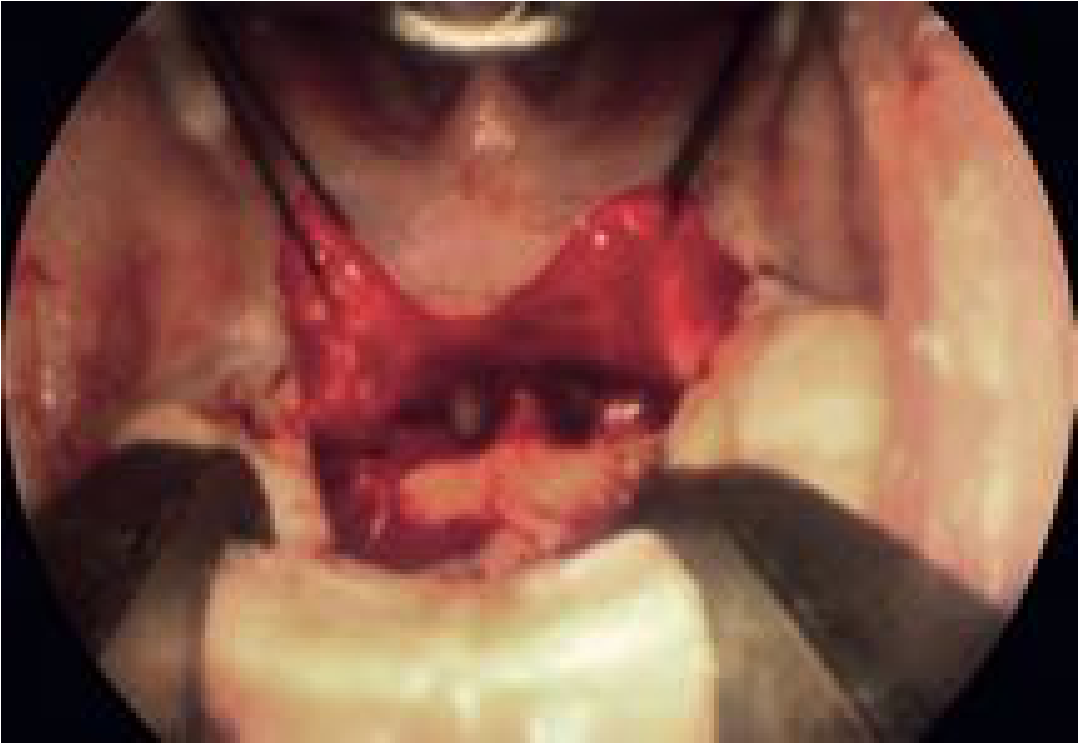
Intraoperative view: pedicled hard palate mucoperiosteal flap elevated to expose the choanae/nasopharynx (Cummings Otolaryngology)
Closure:
- Palatal flap re-sutured to anterior hard palate mucosa
- Nasal packing (Xeroform gauze)
- Palate closed with interdental vertical mattress sutures (3-0 or 4-0 Vicryl)
- Palatal splint secured (custom or reinforced silastic sheeting) with circumdental silk sutures or Woodruff screw technique
Variants
| Variant | Feature |
|---|---|
| Median transpalatal | Midline incision from incisive foramen to uvula - for midline posterior/roof lesions |
| Lateral transpalatal | For unilateral posterior/lateral wall lesions; incision follows gingival curve to ipsilateral tuberosity |
| Extended (Le Fort I + transpalatal) | Adds Le Fort I downfracture for upper clivus/sphenoid access |
| Transcervico-mandibulo-palatal (Morton) | Transpalatal + lip-splitting mandibulotomy - gives inferolateral access and parapharyngeal space reach |
Advantages
- No facial incision or scar
- Minimal bone removal
- Direct inferior approach with good visualization of posterior nasopharyngeal wall
- Straightforward technique
Disadvantages / Complications
- Limited lateral access - cannot easily reach the parapharyngeal space or lateral nasopharynx
- Risk of palatal fistula (a key morbidity)
- Velopharyngeal insufficiency / nasopharyngeal regurgitation
- Trismus (especially with mandibular extension)
- Dysphagia postoperatively due to oropharyngeal oedema
- Difficult assessment of margin status in malignancy
Oncological Outcomes (NPC Salvage)
Fee et al. reported a series of 37 patients treated with transpalatal nasopharyngectomy with:
- 5-year overall survival: 52%
- Local control: 67%
The approach has largely been replaced by endoscopic endonasal approaches (EEA) for most indications, which provide superior visualization without palatal morbidity. The transpalatal route remains relevant for lesions requiring inferior access or when endoscopic access is inadequate.
Sources: Scott-Brown's Otorhinolaryngology Head & Neck Surgery (7th ed.), pp. 148; Scott-Brown's Vol 2, pp. 1371-1372; Cummings Otolaryngology Head and Neck Surgery
This is a shared conversation. Sign in to Orris to start your own chat.