


Prepare notes of this in easy language and give It should cover all the points
📋 Management of Labour - Easy Notes
AIM of Management of Labour
- Watch carefully with minimum interference in the natural process
- Keep everything normal and catch any problem as early as possible
INDICATIONS for Vaginal Examination in Normal Labour
- At onset of labour - To confirm labour has started, find out the position of the baby's presenting part
- During progress of labour - Every 3-4 hours to check how much the cervix has opened (dilated) and how far the baby's head has come down (in relation to ischial spines = station)
- After the waters break (rupture of membranes) - To rule out cord prolapse
- To confirm the start of 2nd stage - Full dilatation of cervix
MANAGEMENT OF 1st STAGE OF LABOUR
Principles
- Non-interference - watchful expectancy for natural birth
- Monitor carefully - progress of labour, maternal condition (pulse/BP exam), fetal behaviour (FHR), and detect any intrapartum complications early
Preliminaries (Things to do when patient arrives)
- Basic check of the patient's current condition
- Ask about onset of labour pains, any leakage of water
- Do a full general + obstetrical examination including vaginal exam and record everything
- Review antenatal visit records, investigation reports, any specific medicines given
ACTUAL MANAGEMENT
A) General Care
- Antiseptic dressing
- Give emotional support, encouragement, and assurance to the mother
- Constant supervision throughout
B) Position
- In early normal labour, mother does NOT need to stay in bed
- If in bed - use the most comfortable position
- Avoid dorsal supine position (flat on back) - it compresses major blood vessels
C) Bowel
- Enema is NOT recommended
D) Ambulation (Walking)
- If the membranes are intact, patient is allowed to walk
E) Diet
- In early labour: Plain water or fruit juice is allowed
- In active labour: Food is withheld (in case surgery is needed)
F) Bladder Care
- Patient is encouraged to pass urine regularly
- If she cannot pass urine, especially in the late first stage → catheterization must be done
G) Pain Relief
- Epidural analgesia is recommended if the mother asks for pain relief (WHO recommendation)
ASSESSMENT OF PROGRESS OF LABOUR & PARTOGRAPH RECORDING
| Parameter | Frequency |
|---|---|
| Pulse | Every 30 min |
| Blood Pressure (BP) | Every 1 hour |
| Temperature | Every 2 hours |
| Urine Output | Volume, protein, acetone |
| Any drug given (e.g. oxytocin) | Recorded in partograph |
Abdominal Palpation
- Number of contractions in 10 minutes and duration of each contraction in seconds → recorded in partograph
- Labour progress = cervical dilatation from 5 cm to 10 cm
To Note Fetal Wellbeing
- FHR (Fetal Heart Rate) should be checked:
- Every ½ hour in 1st stage
- Every 15 minutes in 2nd stage or after rupture of membranes
- Continuous Electronic Fetal Monitoring (CTG) - Used for high-risk pregnancies only, NOT as a routine
Vaginal Examination Findings to Record
Signs of Maternal Distress (Warning Signs!)
- Anxious look
- Rising pulse rate ≥ 100 per minute
- Dehydration, dry tongue
- Hot, dry vagina
- Acetone smell in breath
- Scanty, high-coloured urine with acetone
MANAGEMENT OF 2nd STAGE OF LABOUR
Signs that 1st Stage is Over (Transition to 2nd Stage)
- Stronger uterine contractions
- Bearing down efforts (pushing urge)
- Urge to push or defecate with descent of presenting part
- Complete dilatation of cervix (10 cm) confirmed on vaginal exam
Principles
- Help the baby come out slowly and steadily (natural expulsion)
- Prevent perineal injuries (tears)
General Measures
- Patient must be in bed
- Constant supervision is mandatory
- FHR recorded every 5 minutes
- Give inhalation analgesics (like Entonox/gas) to relieve pain during contractions
- Vaginal exam at beginning of 2nd stage - to confirm onset, detect cord prolapse, and note progressive descent of head
Preparation for Delivery
- The attendant stands on the right side of the patient
- Clean (toilet) the external genitalia and inner thighs with cotton swabs soaked in Savlon/Dettol solution
- Place one sterile sheet under the buttocks and one over the abdomen
- Catheterize the bladder if it is full
CONDUCTION OF DELIVERY (3 Phases)
Phase 1: Delivery of Head
- Maintain flexion of the head
- Prevent early extension
- Regulate the slow escape of head through the vulval outlet
- Encourage mother to bear down during contractions
- When the scalp is visible for about 5 cm (crowning approaching):
- Maintain flexion by pushing the occiput downward & backward using thumb and index finger of left hand
- Simultaneously press the perineum with right palm and a sterile vulval pad (Ritgen's Manoeuvre) - to prevent perineal laceration
- Repeat until the sub-occiput is placed under the pubic symphysis
- At this stage - the maximum diameter of head (BPD) stretches the vulval outlet → Crowning occurs
- When the perineum is fully stretched - perform Episiotomy (after local anaesthesia with 10 ml of 1% Lignocaine)
- Slow delivery of head between contractions
- Forehead → nose → mouth → chin are delivered by extension
Care IMMEDIATELY After Delivery of Head
- Wipe mucus and blood from mouth and pharynx using sterile gauze on the little finger
- Wipe eyelids with sterile dry cotton swabs from medial to lateral canthus
- Palpate the neck to feel for any loop of cord (nuchal cord):
- If loose - slip it over the head
- If tight - cut between 2 Kocher's forceps placed 1 inch apart
Prevention of Perineal Laceration
- Avoid early extension of head
- Avoid forcible/spontaneous rapid delivery of head
- Deliver head between contractions
- Perform timely episiotomy when indicated
- Take care during delivery of shoulders
Phase 2: Delivery of Shoulders
- Do NOT rush - wait for the next uterine contraction
- Let restitution and external rotation of head occur naturally
- The bisacromial diameter comes in the ant-post diameter of pelvis
- During the next contraction, the anterior shoulder is born spontaneously
- If delayed: grasp head with both hands, gently draw posteriorly until anterior shoulder is released from under the pubis
- Then draw head upward → posterior shoulder delivered over the perineum
Phase 3: Delivery of Trunk
- After delivery of shoulders, forefingers of each hand are inserted under the axillae
- Trunk is delivered gently by lateral flexion
IMMEDIATE CARE OF NEWBORN
- Place baby on a tray covered with clean dry linen, head slightly down (15°)
- Tray is placed between mother's legs at a lower level than the uterus - to allow gravitational flow of blood from placenta to infant
- Clear the airway (air passage)
- Apgar score at 1 minute and 5 minutes is recorded
Clamping and Ligature of the Cord
- Cord is clamped with 2 Kocher's forceps - the nearer one placed 6-10 cm from the umbilicus and cut in between
- Check for any abnormality in cord vessels
- Delayed cord clamping: In preterm neonates
- Early cord clamping: In Rh incompatibility, asphyxiated baby
- Quick check for any gross abnormality in the baby
- Baby is wrapped in a dry, warm towel
- Identification tape tied on both wrist of baby AND mother
MANAGEMENT OF 3rd STAGE OF LABOUR
Most important stage of labour - highest risk of complications (PPH)
Principle
Two Methods
- Active Management (preferred) - AMTSL
- Expectant Management
1. Active Management of 3rd Stage of Labour (AMTSL)
- Minimizes blood loss in 3rd stage
- Shortens the duration of 3rd stage
- Reduces maternal anaemia
- Decreases incidence of PPH
Key Memory Points:
- Vaginal exam: minimum, indicated at specific times
- Maternal monitoring: Pulse every 30 min, BP every 1 hr, Temp every 2 hrs
- FHR: every 30 min in 1st stage, every 15 min in 2nd stage
- Delivery of head: Ritgen's manoeuvre, maintain flexion, episiotomy when needed
- Cord clamping: 6-10 cm from umbilicus, delayed in preterm
- AMTSL is the preferred method for 3rd stage
- Oxytocic injection must be given within 1 minute of delivery
Create a visual flowchart poster of the 3 stages of labour
A detailed medical education flowchart poster titled "Management of the 3 Stages of Labour" with a clean clinical design on a white background. The poster is divided into 3 vertical columns side by side, each representing one stage of labour. COLUMN 1 - "1st STAGE OF LABOUR" (blue theme): Header box: "1st Stage: Onset of Labour → Full Cervical Dilatation (10 cm)" Subheader: "Latent phase (0-4 cm) + Active phase (4-10 cm)" Flowchart boxes with downward arrows: → "Preliminaries: History, General + Obstetric Exam, Review ANC records" → "General Care: Antiseptic dressing, Emotional support, Constant supervision" → "Position: Ambulant if membranes intact. Avoid dorsal supine" → "Diet: Fluids in early labour. No food in active labour" → "Bladder Care: Encourage voiding. Catheterize if needed" → "Pain Relief: Epidural analgesia (WHO recommended)" → "Monitoring (Partograph): Pulse every 30 min | BP every 1 hr | Temp every 2 hrs | FHR every 30 min" → "Vaginal Exam every 3-4 hrs: Cervical dilation, Station, Position, Liquor color, Moulding" COLUMN 2 - "2nd STAGE OF LABOUR" (green theme): Header box: "2nd Stage: Full Dilatation (10 cm) → Delivery of Baby" Signs of entry box: "Stronger contractions, Bearing down urge, Complete dilatation" Flowchart boxes with downward arrows: → "Patient in bed | FHR every 5 min | Inhalation analgesia" → "Prepare for Delivery: Clean genitalia, Sterile drapes, Catheterize if bladder full" → "DELIVERY OF HEAD: Maintain flexion, Ritgen's Manoeuvre, Episiotomy if needed, Slow delivery between contractions" → "After Head: Clear airway, Wipe eyes, Check for nuchal cord" → "DELIVERY OF SHOULDERS: Wait for restitution, Anterior then posterior shoulder" → "DELIVERY OF TRUNK: Insert fingers under axillae, Lateral flexion" → "Immediate Newborn Care: Clear airway, Apgar at 1 & 5 min, Cord clamping at 6-10 cm" COLUMN 3 - "3rd STAGE OF LABOUR" (orange/red theme): Header box: "3rd Stage: Delivery of Baby → Delivery of Placenta" Warning banner: "⚠ Most Critical Stage — Risk of PPH" Flowchart boxes: → "2 Methods: Active Management (preferred) vs Expectant Management" → "AMTSL Steps: 1. Give oxytocin within 1 min of delivery 2. Controlled cord traction 3. Uterine massage" → "Advantages of AMTSL: Less blood loss, Shorter 3rd stage, Less maternal anaemia, Reduces PPH" → "Check Placenta: Completeness, Cord vessels" → "Identify Baby & Mother: Identification tape on both wrists" → "Post-delivery monitoring: BP, Pulse, Bleeding, Uterine contraction" At the bottom, a horizontal summary timeline bar showing: "Labour begins → 1st Stage (Cervical dilation) → 2nd Stage (Expulsion) → 3rd Stage (Placental delivery) → Complete" Use medical illustration style with icons, color-coded boxes, clear bold headings, arrows connecting each step, professional typography.
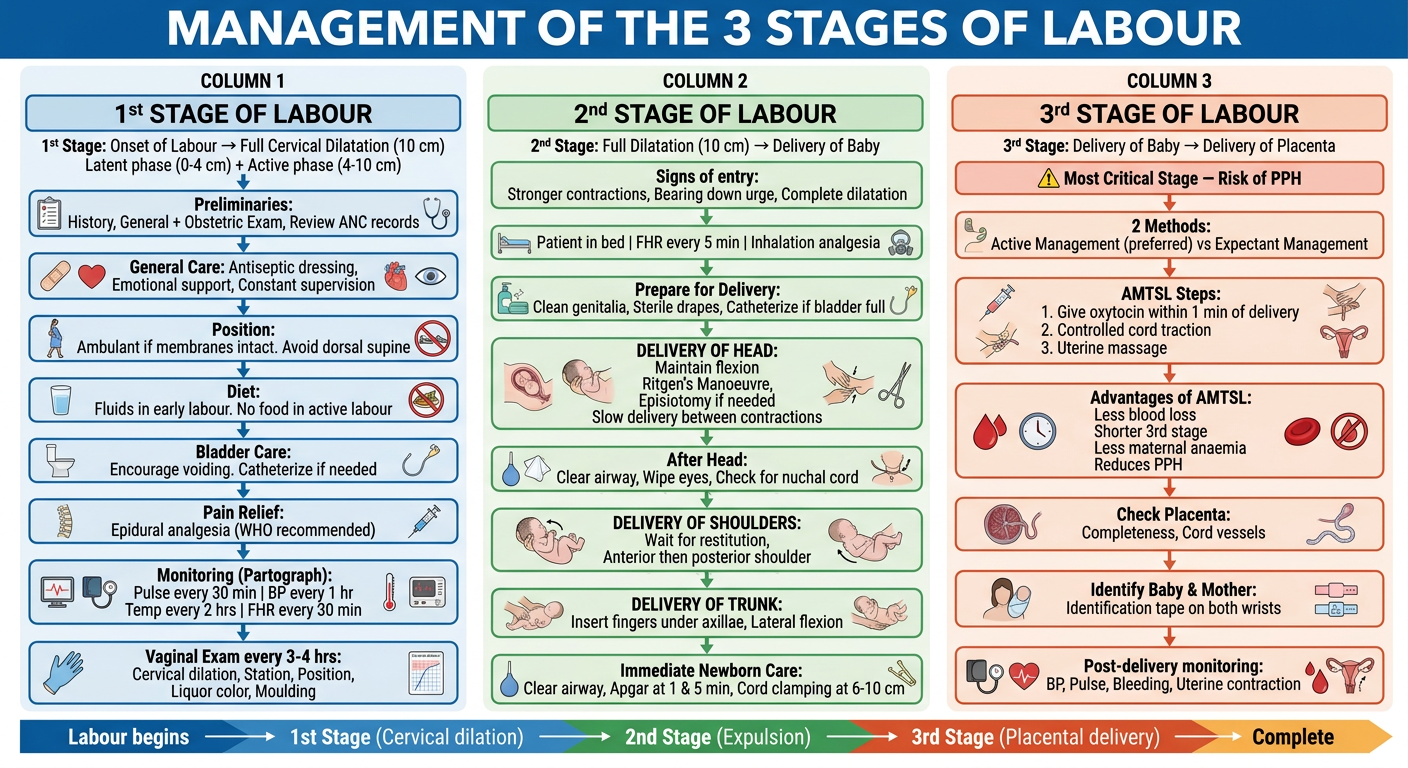
- 🔵 Blue - 1st Stage: Covers monitoring, care, diet, bladder, pain relief, partograph recording, and vaginal exam findings
- 🟢 Green - 2nd Stage: Covers preparation for delivery, delivery of head (with Ritgen's manoeuvre), shoulders, trunk, and immediate newborn care
- 🟠 Orange/Red - 3rd Stage: Highlights AMTSL steps, oxytocin administration within 1 minute, advantages of active management, and post-delivery monitoring
Can you make pdf of whatever u have given till now and give me
mkdir -p /tmp/workspace/labour-notes && ls /tmp/workspace/
cd /tmp/workspace/labour-notes && python3 -c " import urllib.request url = 'https://cdn.orris.care/image-gen/aef8b31185764920a3b9a0d02af0b29e.png' urllib.request.urlretrieve(url, 'flowchart.png') print('Downloaded flowchart image') import os print('File size:', os.path.getsize('flowchart.png'), 'bytes') "
~/labour-notes/create_pdf.py
from reportlab.lib.pagesizes import A4
from reportlab.lib.styles import getSampleStyleSheet, ParagraphStyle
from reportlab.lib.units import cm
from reportlab.lib import colors
from reportlab.platypus import (
SimpleDocTemplate, Paragraph, Spacer, Table, TableStyle,
HRFlowable, Image, PageBreak, KeepTogether
)
from reportlab.lib.enums import TA_CENTER, TA_LEFT, TA_JUSTIFY
from reportlab.platypus import ListFlowable, ListItem
PAGE_W, PAGE_H = A4
doc = SimpleDocTemplate(
"Management_of_Labour_Notes.pdf",
pagesize=A4,
leftMargin=1.8*cm, rightMargin=1.8*cm,
topMargin=2*cm, bottomMargin=2*cm
)
styles = getSampleStyleSheet()
# Custom styles
title_style = ParagraphStyle(
'MainTitle', fontSize=20, fontName='Helvetica-Bold',
textColor=colors.HexColor('#1a237e'), alignment=TA_CENTER,
spaceAfter=6, spaceBefore=4
)
subtitle_style = ParagraphStyle(
'SubTitle', fontSize=11, fontName='Helvetica',
textColor=colors.HexColor('#3949ab'), alignment=TA_CENTER,
spaceAfter=12
)
h1_style = ParagraphStyle(
'H1', fontSize=14, fontName='Helvetica-Bold',
textColor=colors.white, alignment=TA_LEFT,
spaceAfter=4, spaceBefore=10,
backColor=colors.HexColor('#1565c0'),
leftPadding=8, rightPadding=8, topPadding=5, bottomPadding=5
)
h2_style = ParagraphStyle(
'H2', fontSize=12, fontName='Helvetica-Bold',
textColor=colors.white, alignment=TA_LEFT,
spaceAfter=3, spaceBefore=8,
backColor=colors.HexColor('#1976d2'),
leftPadding=6, rightPadding=6, topPadding=4, bottomPadding=4
)
h3_style = ParagraphStyle(
'H3', fontSize=11, fontName='Helvetica-Bold',
textColor=colors.HexColor('#0d47a1'), alignment=TA_LEFT,
spaceAfter=3, spaceBefore=6,
borderPad=3
)
body_style = ParagraphStyle(
'Body', fontSize=9.5, fontName='Helvetica',
textColor=colors.HexColor('#212121'),
spaceAfter=3, spaceBefore=1, leading=14,
leftIndent=0
)
bullet_style = ParagraphStyle(
'Bullet', fontSize=9.5, fontName='Helvetica',
textColor=colors.HexColor('#212121'),
spaceAfter=2, spaceBefore=1, leading=13,
leftIndent=12, bulletIndent=0
)
note_style = ParagraphStyle(
'Note', fontSize=9, fontName='Helvetica-Oblique',
textColor=colors.HexColor('#e65100'),
spaceAfter=4, spaceBefore=4,
backColor=colors.HexColor('#fff8e1'),
leftPadding=8, rightPadding=8, topPadding=4, bottomPadding=4,
borderColor=colors.HexColor('#ffa000'), borderWidth=1, borderPad=4
)
green_h1 = ParagraphStyle(
'GreenH1', fontSize=14, fontName='Helvetica-Bold',
textColor=colors.white, alignment=TA_LEFT,
spaceAfter=4, spaceBefore=10,
backColor=colors.HexColor('#2e7d32'),
leftPadding=8, rightPadding=8, topPadding=5, bottomPadding=5
)
orange_h1 = ParagraphStyle(
'OrangeH1', fontSize=14, fontName='Helvetica-Bold',
textColor=colors.white, alignment=TA_LEFT,
spaceAfter=4, spaceBefore=10,
backColor=colors.HexColor('#e65100'),
leftPadding=8, rightPadding=8, topPadding=5, bottomPadding=5
)
def bullet(text, indent=12):
return Paragraph(f"• {text}", bullet_style)
def sub_bullet(text):
s = ParagraphStyle('subbullet', parent=bullet_style, leftIndent=24)
return Paragraph(f"– {text}", s)
def h1(text): return Paragraph(text, h1_style)
def h2(text): return Paragraph(text, h2_style)
def h3(text): return Paragraph(text, h3_style)
def body(text): return Paragraph(text, body_style)
def sp(n=6): return Spacer(1, n)
def hr(): return HRFlowable(width="100%", thickness=1, color=colors.HexColor('#bbdefb'), spaceAfter=4, spaceBefore=4)
content = []
# ─── COVER / TITLE ───
content.append(sp(20))
content.append(Paragraph("Management of Labour", title_style))
content.append(Paragraph("Complete Study Notes with Flowchart Poster", subtitle_style))
content.append(HRFlowable(width="100%", thickness=3, color=colors.HexColor('#1565c0'), spaceAfter=10, spaceBefore=2))
content.append(sp(8))
# AIM
content.append(h1("AIM OF MANAGEMENT OF LABOUR"))
content.append(sp(4))
content.append(bullet("Watch carefully with <b>minimum interference</b> in the natural process"))
content.append(bullet("Keep everything <b>normal</b> and catch any problem <b>as early as possible</b>"))
content.append(sp(4))
# INDICATIONS FOR VE
content.append(h1("INDICATIONS FOR VAGINAL EXAMINATION IN NORMAL LABOUR"))
content.append(sp(4))
content.append(body("<b>Keep vaginal exams to a minimum.</b> Do it only when:"))
content.append(sp(3))
content.append(bullet("<b>At onset of labour</b> – To confirm labour has started, find presenting part position"))
content.append(bullet("<b>During progress of labour</b> – Every <b>3–4 hours</b>: check cervical dilation and station"))
content.append(bullet("<b>After rupture of membranes</b> – To rule out cord prolapse"))
content.append(bullet("<b>To confirm 2nd stage</b> – Full dilatation (10 cm)"))
content.append(sp(6))
# 1ST STAGE
content.append(Paragraph("MANAGEMENT OF 1st STAGE OF LABOUR", h1_style))
content.append(sp(4))
content.append(h3("Principles"))
content.append(bullet("<b>Non-interference</b> – watchful expectancy for natural birth"))
content.append(bullet("<b>Monitor carefully</b> – labour progress, maternal (Pulse/BP), fetal (FHR), detect complications early"))
content.append(sp(4))
content.append(h2("PRELIMINARIES (On Admission)"))
content.append(bullet("Basic clinical evaluation of current condition"))
content.append(bullet("Ask about onset of labour pains / any leakage of liquor"))
content.append(bullet("Thorough general + obstetrical exam including vaginal exam – record all findings"))
content.append(bullet("Review antenatal visit records, investigation reports, medicines given"))
content.append(sp(4))
content.append(h2("ACTUAL MANAGEMENT"))
content.append(sp(3))
content.append(h3("A) General Care"))
content.append(bullet("Antiseptic dressing"))
content.append(bullet("Emotional support, encouragement and assurance to the mother"))
content.append(bullet("Constant supervision"))
content.append(sp(3))
content.append(h3("B) Position"))
content.append(bullet("In early normal labour, <b>mother need NOT stay in bed</b>"))
content.append(bullet("If in bed – use the <b>most comfortable position</b>"))
content.append(bullet("<b>Avoid dorsal supine position</b> (compresses major vessels)"))
content.append(sp(3))
content.append(h3("C) Bowel"))
content.append(bullet("<b>Enema is NOT recommended</b>"))
content.append(sp(3))
content.append(h3("D) Ambulation (Walking)"))
content.append(bullet("If membranes are intact → patient is <b>allowed to walk</b>"))
content.append(sp(3))
content.append(h3("E) Diet"))
content.append(bullet("<b>Early labour:</b> Plain water or fruit juice allowed"))
content.append(bullet("<b>Active labour:</b> Food is <b>withheld</b> (in case surgery is needed)"))
content.append(sp(3))
content.append(h3("F) Bladder Care"))
content.append(bullet("Encourage patient to pass urine regularly"))
content.append(bullet("If she cannot pass urine (esp. in late 1st stage) → <b>Catheterization</b>"))
content.append(sp(3))
content.append(h3("G) Pain Relief"))
content.append(bullet("<b>Epidural analgesia</b> recommended if mother asks for it (WHO recommendation)"))
content.append(sp(6))
# MONITORING TABLE
content.append(h2("ASSESSMENT OF PROGRESS & PARTOGRAPH RECORDING"))
content.append(sp(4))
monitor_data = [
['Parameter', 'Frequency / Details'],
['Pulse', 'Every 30 minutes'],
['Blood Pressure (BP)', 'Every 1 hour'],
['Temperature', 'Every 2 hours'],
['Urine Output', 'Volume, protein, acetone'],
['Any drug (e.g. Oxytocin)', 'Record immediately in partograph'],
['FHR (Fetal Heart Rate)', '1st stage: every 30 min | 2nd stage: every 15 min'],
]
t = Table(monitor_data, colWidths=[7*cm, 10.5*cm])
t.setStyle(TableStyle([
('BACKGROUND', (0,0), (-1,0), colors.HexColor('#1565c0')),
('TEXTCOLOR', (0,0), (-1,0), colors.white),
('FONTNAME', (0,0), (-1,0), 'Helvetica-Bold'),
('FONTSIZE', (0,0), (-1,-1), 9.5),
('ROWBACKGROUNDS', (0,1), (-1,-1), [colors.HexColor('#e3f2fd'), colors.white]),
('GRID', (0,0), (-1,-1), 0.5, colors.HexColor('#90caf9')),
('PADDING', (0,0), (-1,-1), 6),
('VALIGN', (0,0), (-1,-1), 'MIDDLE'),
]))
content.append(t)
content.append(sp(6))
content.append(h2("ABDOMINAL PALPATION"))
content.append(bullet("<b>a) Uterine contractions:</b> Frequency, intensity, duration – No. of contractions in 10 min and duration in seconds recorded in partograph"))
content.append(bullet("<b>Labour progress:</b> Cervical dilatation from 5 cm to 10 cm"))
content.append(bullet("<b>b) Pelvic grip:</b> Descent of fetal head in fifths above the brim"))
content.append(bullet("<b>c) Shifting of fetal heart beat:</b> Moves downward and medially = descending fetus"))
content.append(sp(4))
content.append(h2("VAGINAL EXAMINATION FINDINGS"))
content.append(bullet("<b>a)</b> Dilatation of cervix in cm"))
content.append(bullet("<b>b)</b> Position of head and degree of flexion"))
content.append(bullet("<b>c)</b> Station of head in relation to ischial spines"))
content.append(bullet("<b>d)</b> Colour of liquor – clear OR meconium-stained (if membranes ruptured)"))
content.append(bullet("<b>e)</b> Degree of moulding of the head"))
content.append(sp(4))
content.append(h2("SIGNS OF MATERNAL DISTRESS ⚠"))
content.append(Paragraph(
"Watch for: Anxious look | Pulse ≥ 100/min | Dehydration, dry tongue | Hot dry vagina | "
"Acetone smell in breath | Scanty high-coloured urine with acetone",
note_style
))
content.append(sp(8))
# 2ND STAGE
content.append(Paragraph("MANAGEMENT OF 2nd STAGE OF LABOUR", green_h1))
content.append(sp(4))
content.append(h3("Signs of Transition from 1st to 2nd Stage"))
content.append(bullet("Stronger / more intense uterine contractions"))
content.append(bullet("Bearing down efforts (involuntary pushing urge)"))
content.append(bullet("Urge to push or defecate with descent of presenting part"))
content.append(bullet("Complete dilatation of cervix (10 cm) on vaginal exam"))
content.append(sp(4))
content.append(h3("Principles"))
content.append(bullet("Help baby come out <b>slowly and steadily</b>"))
content.append(bullet("<b>Prevent perineal injuries</b>"))
content.append(sp(4))
content.append(h2("GENERAL MEASURES"))
content.append(bullet("Patient <b>must be in bed</b>"))
content.append(bullet("<b>Constant supervision</b> is mandatory; FHR recorded every <b>5 minutes</b>"))
content.append(bullet("Administer <b>inhalation analgesia</b> to relieve pain during contractions"))
content.append(bullet("<b>Vaginal exam at start of 2nd stage</b> – confirm onset, detect cord prolapse, note descent"))
content.append(sp(4))
content.append(h2("PREPARATION FOR DELIVERY"))
content.append(bullet("<b>Position:</b> Lateral, squatting or partial sitting (45°). Dorsal with <b>15° left lateral tilt</b> is commonly used"))
content.append(bullet("Attendant stands on the right side"))
content.append(bullet("Clean (toilet) external genitalia + inner thighs with cotton swabs in Savlon/Dettol"))
content.append(bullet("Place one sterile sheet under buttocks, one over abdomen"))
content.append(bullet("<b>Catheterize bladder</b> if full"))
content.append(sp(6))
content.append(h2("CONDUCTION OF DELIVERY – 3 PHASES"))
content.append(sp(4))
content.append(h3("Phase 1: Delivery of Head"))
content.append(body("<b>Principles:</b> Maintain flexion | Prevent early extension | Regulate slow escape through vulval outlet"))
content.append(sp(3))
content.append(bullet("Encourage mother to <b>bear down during contractions</b>"))
content.append(bullet("When scalp visible ~5 cm → maintain flexion using <b>thumb + index finger of left hand</b> on occiput"))
content.append(bullet("Press perineum with right palm + sterile vulval pad = <b>Ritgen's Manoeuvre</b> (prevents laceration)"))
content.append(bullet("Repeat until sub-occiput is under pubic symphysis → <b>Crowning</b>"))
content.append(bullet("When perineum fully stretched → <b>Episiotomy</b> after <b>10 ml of 1% Lignocaine</b>"))
content.append(bullet("<b>Slow delivery of head between contractions</b>"))
content.append(bullet("Forehead → nose → mouth → chin delivered by <b>extension</b>"))
content.append(sp(4))
content.append(h3("Care Immediately After Delivery of Head"))
content.append(bullet("Wipe <b>mucus and blood</b> from mouth and pharynx with sterile gauze on little finger"))
content.append(bullet("Wipe <b>eyelids</b> with dry sterile cotton swabs – medial to lateral canthus"))
content.append(bullet("Palpate <b>neck for nuchal cord:</b>"))
content.append(sub_bullet("Loose → slip it over the head"))
content.append(sub_bullet("Tight → cut between 2 Kocher's forceps placed 1 inch apart"))
content.append(sp(4))
content.append(h3("Prevention of Perineal Laceration"))
content.append(bullet("Avoid early extension of head"))
content.append(bullet("Avoid forcible/spontaneous rapid delivery"))
content.append(bullet("Deliver head <b>between contractions</b>"))
content.append(bullet("Perform <b>timely episiotomy</b> when indicated"))
content.append(bullet("Take care during delivery of shoulders"))
content.append(sp(4))
content.append(h3("Phase 2: Delivery of Shoulders"))
content.append(bullet("<b>Do NOT rush</b> – wait for next uterine contraction"))
content.append(bullet("Let <b>restitution and external rotation</b> of head occur naturally"))
content.append(bullet("Bisacromial diameter aligns with ant-post diameter of pelvis"))
content.append(bullet("Anterior shoulder born <b>spontaneously</b> with next contraction"))
content.append(bullet("If delayed → grasp head with both hands, draw <b>posteriorly</b> until anterior shoulder released from under pubis"))
content.append(bullet("Draw head <b>upward</b> → posterior shoulder delivered over perineum"))
content.append(sp(4))
content.append(h3("Phase 3: Delivery of Trunk"))
content.append(bullet("Insert <b>forefingers of each hand</b> under the axillae"))
content.append(bullet("Trunk delivered gently by <b>lateral flexion</b>"))
content.append(sp(6))
content.append(h2("IMMEDIATE CARE OF NEWBORN"))
content.append(bullet("Place baby on tray with clean dry linen, <b>head slightly down (15°)</b>"))
content.append(bullet("Tray at <b>lower level than uterus</b> – for gravitational blood flow from placenta to infant"))
content.append(bullet("<b>Clear the airway</b>"))
content.append(bullet("<b>Apgar score</b> at <b>1 minute</b> and <b>5 minutes</b>"))
content.append(sp(4))
content.append(h3("Clamping and Ligature of the Cord"))
content.append(bullet("Clamp with <b>2 Kocher's forceps</b> – nearer one <b>6–10 cm from umbilicus</b>, cut in between"))
content.append(bullet("Check for abnormality in cord vessels"))
content.append(bullet("<b>Delayed clamping:</b> Preterm neonates"))
content.append(bullet("<b>Early clamping:</b> Rh incompatibility, asphyxiated baby"))
content.append(bullet("Quick check for gross abnormalities"))
content.append(bullet("Wrap in <b>dry warm towel</b>"))
content.append(bullet("<b>Identification tape</b> on wrist of baby AND mother"))
content.append(sp(8))
# 3RD STAGE
content.append(Paragraph("MANAGEMENT OF 3rd STAGE OF LABOUR", orange_h1))
content.append(sp(4))
content.append(Paragraph(
"⚠ MOST CRITICAL STAGE OF LABOUR – Highest risk of PPH (Postpartum Haemorrhage)",
note_style
))
content.append(sp(4))
content.append(body("<b>Principle:</b> Strict vigilance + follow management guidelines to <b>prevent PPH</b>"))
content.append(sp(4))
content.append(h2("TWO METHODS OF MANAGEMENT"))
content.append(bullet("<b>1. Active Management (AMTSL) – Preferred</b>"))
content.append(bullet("2. Expectant Management"))
content.append(sp(4))
content.append(h3("Active Management of 3rd Stage of Labour (AMTSL)"))
content.append(body("<i>Involves: Separation of placenta → Controlled contraction → Delivery of placenta</i>"))
content.append(sp(3))
content.append(body("<b>Principle:</b> Stimulate powerful uterine contractions within <b>1 minute of baby's delivery</b> by giving <b>parenteral oxytocic drug</b>"))
content.append(sp(4))
amtsl_data = [
['AMTSL Steps'],
['1. Give oxytocin injection within 1 minute of delivery'],
['2. Controlled cord traction (Brandt-Andrews manoeuvre)'],
['3. Uterine massage after placental delivery'],
]
t2 = Table(amtsl_data, colWidths=[17.5*cm])
t2.setStyle(TableStyle([
('BACKGROUND', (0,0), (-1,0), colors.HexColor('#e65100')),
('TEXTCOLOR', (0,0), (-1,0), colors.white),
('FONTNAME', (0,0), (-1,0), 'Helvetica-Bold'),
('FONTSIZE', (0,0), (-1,-1), 9.5),
('ROWBACKGROUNDS', (0,1), (-1,-1), [colors.HexColor('#fff3e0'), colors.HexColor('#ffe0b2')]),
('GRID', (0,0), (-1,-1), 0.5, colors.HexColor('#ffb74d')),
('PADDING', (0,0), (-1,-1), 7),
]))
content.append(t2)
content.append(sp(6))
content.append(h3("Advantages of AMTSL"))
content.append(bullet("Minimizes <b>blood loss</b> in 3rd stage"))
content.append(bullet("Shortens the <b>duration</b> of 3rd stage"))
content.append(bullet("Reduces <b>maternal anaemia</b>"))
content.append(bullet("Decreases <b>incidence of PPH</b>"))
content.append(sp(8))
# QUICK REVISION BOX
content.append(HRFlowable(width="100%", thickness=2, color=colors.HexColor('#1565c0'), spaceAfter=6))
content.append(h2("⚡ QUICK REVISION – KEY POINTS"))
content.append(sp(4))
key_data = [
['Parameter', 'Value / Detail'],
['Vaginal exam interval (1st stage)', 'Every 3–4 hours'],
['Pulse monitoring', 'Every 30 minutes'],
['BP monitoring', 'Every 1 hour'],
['Temperature monitoring', 'Every 2 hours'],
['FHR – 1st stage', 'Every 30 minutes'],
['FHR – 2nd stage', 'Every 15 minutes (or after ROM)'],
['FHR – 2nd stage (delivery room)', 'Every 5 minutes'],
['Cord clamping distance', '6–10 cm from umbilicus'],
['Episiotomy anaesthesia', '10 ml of 1% Lignocaine'],
['Oxytocin timing (AMTSL)', 'Within 1 minute of baby delivery'],
['Apgar score timing', '1 minute and 5 minutes after birth'],
['Position in 2nd stage', 'Dorsal with 15° left lateral tilt'],
]
t3 = Table(key_data, colWidths=[9*cm, 8.5*cm])
t3.setStyle(TableStyle([
('BACKGROUND', (0,0), (-1,0), colors.HexColor('#283593')),
('TEXTCOLOR', (0,0), (-1,0), colors.white),
('FONTNAME', (0,0), (-1,0), 'Helvetica-Bold'),
('FONTSIZE', (0,0), (-1,-1), 9),
('ROWBACKGROUNDS', (0,1), (-1,-1), [colors.HexColor('#e8eaf6'), colors.white]),
('GRID', (0,0), (-1,-1), 0.5, colors.HexColor('#9fa8da')),
('PADDING', (0,0), (-1,-1), 6),
('FONTNAME', (0,1), (0,-1), 'Helvetica-Bold'),
]))
content.append(t3)
content.append(sp(8))
# FLOWCHART PAGE
content.append(PageBreak())
content.append(Paragraph("VISUAL FLOWCHART: 3 Stages of Labour", title_style))
content.append(HRFlowable(width="100%", thickness=3, color=colors.HexColor('#1565c0'), spaceAfter=16, spaceBefore=4))
# Insert image
from PIL import Image as PILImage
img_path = "flowchart.png"
pil_img = PILImage.open(img_path)
iw, ih = pil_img.size
available_w = PAGE_W - 3.6*cm
available_h = PAGE_H - 8*cm
ratio = min(available_w / iw, available_h / ih)
draw_w = iw * ratio
draw_h = ih * ratio
img = Image(img_path, width=draw_w, height=draw_h)
img.hAlign = 'CENTER'
content.append(img)
doc.build(content)
print("PDF created successfully!")
cd /tmp/workspace/labour-notes && python3 create_pdf.py 2>&1
ls -lh /tmp/workspace/labour-notes/Management_of_Labour_Notes.pdf
Management of Labour Notes
PDF Document · PDF
-
Page 1 onwards - Complete Notes covering:
- Aim of Management of Labour
- Indications for Vaginal Examination
- Full 1st Stage management (care, diet, bladder, pain, monitoring)
- Partograph recording table (pulse, BP, temp, FHR intervals)
- Vaginal exam findings + signs of maternal distress
- Full 2nd Stage (Ritgen's manoeuvre, episiotomy, delivery of head/shoulders/trunk)
- Immediate newborn care + cord clamping
- Full 3rd Stage with AMTSL steps and advantages
- Quick Revision Table with all key values at a glance
-
Last Page - Visual Flowchart Poster of all 3 stages (full page, colour-coded)