
id, ego, and superego with graphical interpretation
A clean educational diagram showing Freud's structural model of the psyche: id, ego, and superego. Show an iceberg metaphor with the ocean surface dividing conscious and unconscious mind. The superego and ego are partially above the waterline (conscious/preconscious), while the id is fully submerged below (unconscious). Label each section with its key traits: Id - pleasure principle, instincts, desires, libido; Ego - reality principle, rational thought, mediator; Superego - morality, conscience, ideals. Use a professional, textbook-style illustration with clear labels and a calm blue-white color scheme.
Freud id ego superego structural model explanation
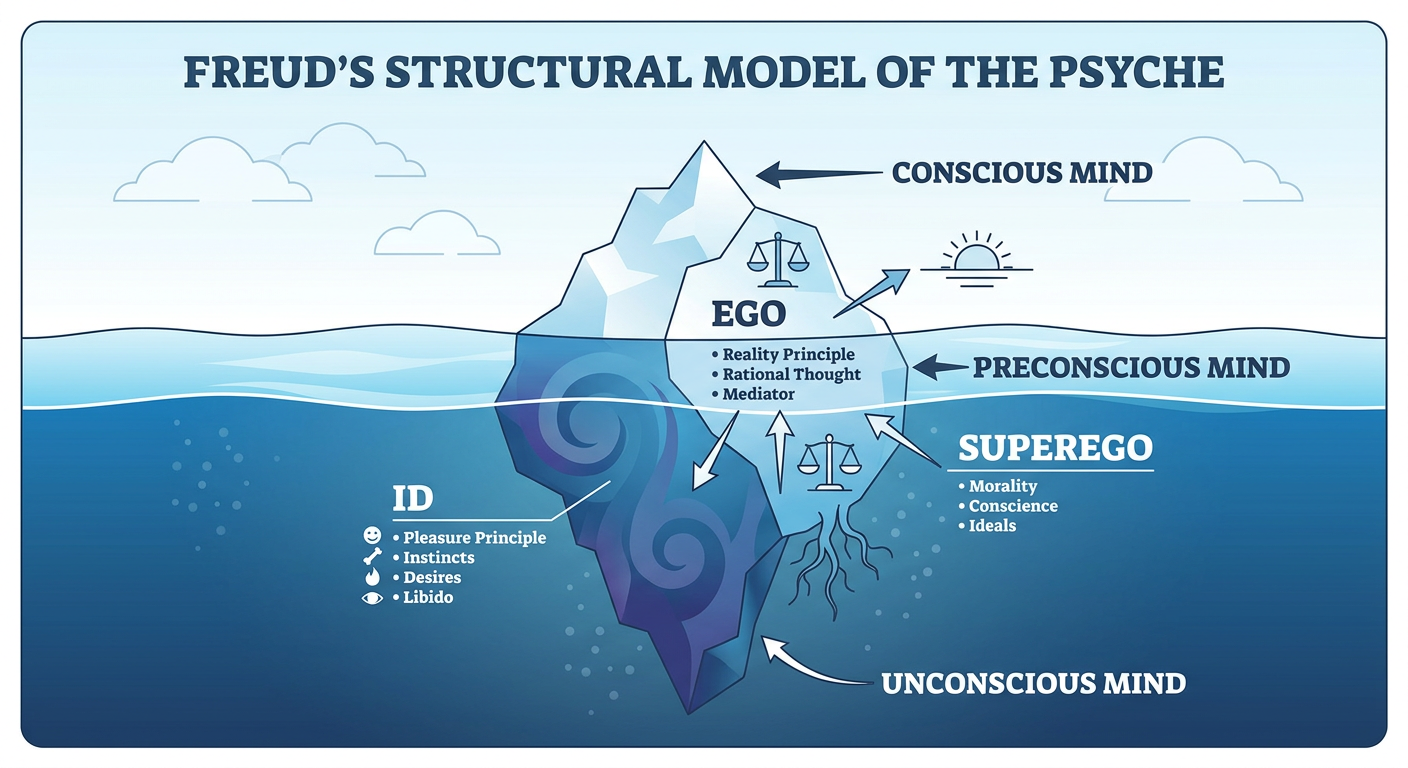
Freud's Structural Model of the Psyche
The ID
- What it is: The most primitive, instinctual part of the mind. Present from birth.
- Operates on: The pleasure principle - seek pleasure immediately, avoid pain at all costs.
- Location in psyche: Entirely unconscious.
- Content: Raw drives, libido (sexual/life instinct - Eros), and aggression (death instinct - Thanatos).
- Character: Irrational, impulsive, has no sense of time, no morality, no concept of "no."
- Analogy: A hungry infant screaming for food - it wants satisfaction now, with no regard for circumstances.
The EGO
- What it is: The rational, executive part of the mind that develops from the id through contact with reality.
- Operates on: The reality principle - delay gratification when necessary; find realistic ways to satisfy drives.
- Location in psyche: Spans conscious, preconscious, and unconscious (the tip of the iceberg and below).
- Function: Mediates between the id's demands, the superego's moral standards, and external reality.
- Tools: Uses defense mechanisms (repression, projection, rationalization, etc.) to manage anxiety when conflicts arise.
- Analogy: A skilled diplomat navigating between two demanding parties.
The SUPEREGO
- What it is: The internalized moral authority - the psyche's "inner parent" or conscience.
- Develops: Through childhood, by internalizing parental rules and societal norms (especially via resolution of the Oedipus complex).
- Location in psyche: Partly conscious (as guilt/shame), partly unconscious.
- Two components:
- Conscience - punishes bad behavior with guilt
- Ego ideal - rewards good behavior with pride; represents who we should be
- Analogy: A strict inner judge who holds you to an ideal standard.
How They Interact
     EXTERNAL REALITY
           ↕
    ┌─────────────┐
    │    EGO      │  ← Reality Principle (mediator)
    │  (referee)  │
    └──────┬──────┘
           │
   ┌───────┴────────┐
   ↓                ↓
  ID            SUPEREGO
(Pleasure      (Morality
 Principle)     Principle)
"I WANT IT"   "YOU SHOULDN'T"
Quick Comparison Table
| Feature | Id | Ego | Superego |
|---|---|---|---|
| Principle | Pleasure | Reality | Morality |
| Awareness | Unconscious | Conscious/preconscious/unconscious | Partly conscious |
| Origin | Present at birth | Develops in infancy | Develops in childhood (age 3-6) |
| Goal | Immediate gratification | Realistic compromise | Moral perfection |
| Failure leads to | Impulsivity, addiction | Neurosis | Guilt, rigidity, perfectionism |
| Voice sounds like | "I want it now" | "Let's find a way" | "You should/shouldn't" |
A Real-World Example
You're on a diet and see a slice of cake.
- Id: "Eat it. Eat it NOW."
- Superego: "You promised you wouldn't. You'll be weak and disgusting if you do."
- Ego: "One small slice won't hurt - enjoy it mindfully and go for a walk later."
Create a visual infographic poster comparing id, ego, and superego dynamics
A professional educational infographic poster titled "Freud's Structural Model of the Psyche" comparing the Id, Ego, and Superego. Layout: Vertical poster with three main columns, one for each component, plus a central interaction section. TOP SECTION: Bold title "Id · Ego · Superego" with subtitle "Freud's Structural Model of the Psyche (1923)" THREE COLUMNS with distinct colors: - Left column (deep red/crimson): THE ID — icon of a flame or primitive beast — "Pleasure Principle" — bullet points: Entirely Unconscious, Present at Birth, Raw Instincts & Drives, Seeks Immediate Gratification, No Sense of Time or Morality, Libido (Eros) & Aggression (Thanatos) — quote: "I WANT IT NOW" - Center column (deep blue/navy): THE EGO — icon of a balanced scale or compass — "Reality Principle" — bullet points: Conscious + Unconscious, Develops in Infancy, Rational Mediator, Delays Gratification Realistically, Uses Defense Mechanisms, Balances Id vs Superego vs Reality — quote: "LET'S FIND A WAY" - Right column (deep green/teal): THE SUPEREGO — icon of a judge's gavel or angel — "Morality Principle" — bullet points: Partly Conscious, Develops Age 3–6, Internalized Moral Rules, Conscience (guilt) + Ego Ideal (pride), Demands Perfection, Shaped by Parents & Society — quote: "YOU SHOULD NOT" MIDDLE SECTION: An iceberg diagram showing the waterline dividing CONSCIOUS (above) and UNCONSCIOUS (below). Superego and Ego partially above water, Id fully submerged. Label the iceberg zones. BOTTOM SECTION: A "Dynamic Conflict" diagram showing arrows between Id → Ego ← Superego with "ANXIETY" in the center, and three types: Neurotic Anxiety, Moral Anxiety, Realistic Anxiety. Below that, a small "Real World Example" box: cake/diet scenario showing each component's voice. Color scheme: Dark background (near black), rich jewel-tone columns (red, blue, green), white and gold typography. Modern, clean, textbook-quality design with icons and clear visual hierarchy.