
Cerebrum
Reading File
The cerebrum is the largest part of the brain, consisting of two hemispheres divided into lobes (frontal, parietal, temporal, occipital), responsible for conscious thought, voluntary movement, sensation, language, and memory. Let me pull comprehensive content from the medical library.
Searching sources...
Finding Sources
Finding Sources
Reading File
Finding Sources
Finding Sources
Finding Sources
Reading File
Finding Sources
Reading File
Loading Image
Reading File
Finding Sources
Finding Sources
Finding Sources
Reading File
I now have rich content to compose a thorough answer. Here is a comprehensive overview of the cerebrum:
The Cerebrum
The cerebrum is the rostral-most and largest part of the brain. It sits atop the brainstem and is the seat of conscious thought, voluntary movement, sensation, language, memory, and emotion.
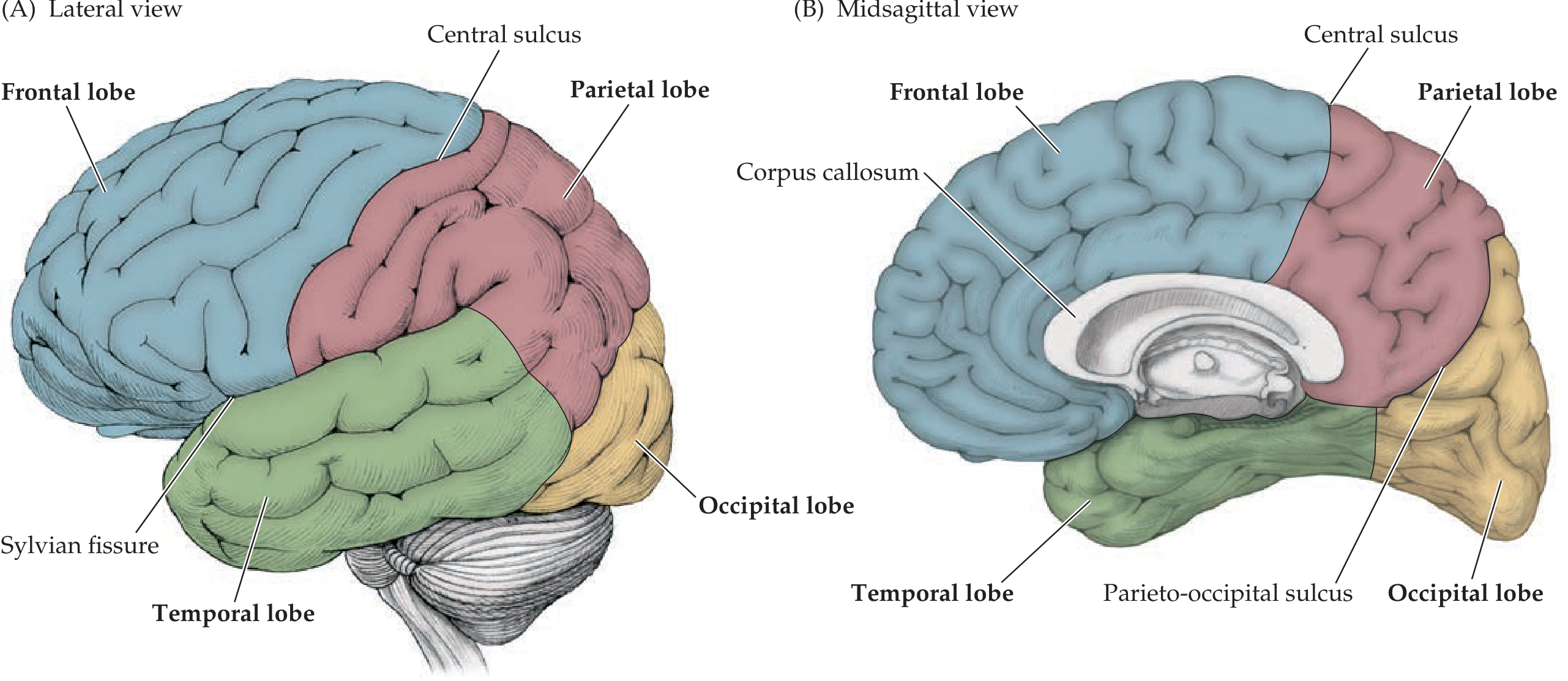
Overview and Hemispheres
The cerebrum is divided into two cerebral hemispheres separated by the deep interhemispheric (sagittal) fissure. In general:
- The right hemisphere receives sensory input from and controls movements of the left side of the body
- The left hemisphere handles sensations and movements of the right side
The two hemispheres are connected by the corpus callosum, a large C-shaped band of white matter that links both homologous and heterologous areas across the hemispheres.
- Neuroscience: Exploring the Brain, 5th Ed.
- Neuroanatomy through Clinical Cases, 3rd Ed.
Gross Anatomy: Sulci, Gyri, and Lobes
The surface of the cerebral cortex is not smooth - it is heavily folded, forming:
- Sulci (sing. sulcus) - crevices/infoldings
- Gyri (sing. gyrus) - ridges/bumps between sulci
- Fissures - especially deep sulci
This folding dramatically increases the surface area of cortex that can fit within the skull.
The Four Major Lobes
The cerebral hemispheres are divided into four major lobes, separated by key landmarks:
| Lobe | Location | Landmark Boundary |
|---|---|---|
| Frontal | Anterior; front of brain | Bounded posteriorly by the central sulcus (of Rolando); separated inferiorly from temporal lobe by the Sylvian (lateral) fissure |
| Parietal | Superior, posterior to frontal | Bounded anteriorly by central sulcus; separated from occipital lobe by parieto-occipital sulcus (visible medially) |
| Temporal | Lateral, inferior | Separated from frontal/parietal by the Sylvian fissure |
| Occipital | Posterior pole | Separated from parietal lobe by parieto-occipital sulcus |
In addition, the insular cortex lies buried within the depths of the Sylvian fissure, covered by the frontal and parietal opercula.
Key Gyri and Their Functions
On the lateral surface, important gyri include:
- Precentral gyrus (frontal lobe): Primary motor cortex - controls voluntary movement
- Postcentral gyrus (parietal lobe): Primary somatosensory cortex - processes touch, pressure, vibration, proprioception
- Superior, middle, and inferior frontal gyri: Divided by superior and inferior frontal sulci
- Superior temporal gyrus: Contains Wernicke's area (speech comprehension, dominant hemisphere) and primary auditory cortex
- Angular gyrus and supramarginal gyrus: Language and spatial processing
- Broca's area (inferior frontal gyrus, dominant hemisphere): Speech production
On the medial surface, the cingulate gyrus runs above the corpus callosum and is part of the limbic system.
Cortical Layers (Neocortex)
The neocortex - which makes up the vast majority of the cerebral cortex - is organized into six layers:
| Layer | Name | Main Connections |
|---|---|---|
| I | Molecular layer | Dendrites and axons from other layers |
| II | Small pyramidal layer (External granular) | Cortical-cortical connections |
| III | Medium pyramidal layer (External pyramidal) | Cortical-cortical connections |
| IV | Granular layer (Internal granular) | Receives inputs from thalamus |
| V | Large pyramidal layer (Internal pyramidal) | Sends outputs to subcortical structures (brainstem, spinal cord, basal ganglia) |
| VI | Polymorphic layer (Multiform) | Sends outputs to thalamus |
The relative thickness of these layers varies by cortical area:
- Primary motor cortex (precentral gyrus): Layer V is thick (large efferent output)
- Primary visual cortex: Layer IV is thick (heavy thalamic input)
- Association cortex: Intermediate between these
Brodmann's Cytoarchitectonic Map
Korbinian Brodmann (1909) divided the cortex into 52 numbered areas based on microscopic cell architecture. Key areas include:
| Brodmann Area(s) | Functional Area | Location | Function |
|---|---|---|---|
| 1, 2, 3 | Primary somatosensory cortex | Postcentral gyrus | Touch |
| 4 | Primary motor cortex | Precentral gyrus | Voluntary movement |
| 6 | Supplementary/premotor cortex | Rostral precentral gyrus | Movement planning |
| 17 | Primary visual cortex | Banks of calcarine fissure | Vision |
| 18, 19 | Secondary/tertiary visual cortex | Occipital gyri | Depth, color, motion |
| 22 | Higher-order auditory cortex (Wernicke's) | Superior temporal gyrus | Hearing, speech |
| 44, 45 | Broca's area | Inferior frontal gyrus | Speech production |
| 9, 10, 11 | Prefrontal association cortex | Superior/middle frontal gyrus | Thought, cognition |
| 23-32 | Limbic association cortex | Cingulate gyrus | Emotions |
- Neuroanatomy through Clinical Cases, 3rd Ed., p. 50-56
White Matter and Subcortical Structures
Beneath the cortex lies white matter - myelinated axon tracts that connect different cortical areas to each other and to subcortical structures. Key white matter connections include:
- Commissural fibers: Cross between hemispheres (corpus callosum, anterior commissure)
- Association fibers: Connect regions within the same hemisphere (e.g., uncinate fasciculus, arcuate fasciculus)
- Projection fibers: Connect cortex to/from subcortical structures via the internal capsule (e.g., corticospinal tract)
Deep within the cerebral white matter lie several important subcortical gray matter structures:
- Basal ganglia - motor control, habit formation
- Thalamus - the major relay station; nearly all inputs to the cortex synapse here first
- Hippocampus and amygdala (temporal lobe) - memory formation and emotional processing
Functional Summary by Lobe
| Lobe | Key Functions |
|---|---|
| Frontal | Voluntary movement, executive function (planning, judgment, working memory), language production (Broca's area, dominant), personality, social behavior |
| Parietal | Somatosensory processing, spatial awareness, integration of sensory inputs, reading/writing |
| Temporal | Auditory processing, language comprehension (Wernicke's area, dominant), memory (hippocampus), object recognition |
| Occipital | Primary and higher-order visual processing |
Contralateral Organization and Lateralization
- Motor and sensory functions are contralaterally organized - each hemisphere controls/receives input from the opposite side of the body
- Language functions are typically lateralized to the left hemisphere in right-handed individuals (and in most left-handed individuals as well)
- The right hemisphere tends to specialize in visuospatial tasks, prosody, and holistic processing
Sources: Neuroscience: Exploring the Brain, 5th Ed.; Neuroanatomy through Clinical Cases, 3rd Ed.
This is a shared conversation. Sign in to Orris to start your own chat.