
Hi
Hey! How can I help you today?
Scabies
Reading File
Scabies is a highly contagious skin infestation caused by the mite Sarcoptes scabiei, producing intense pruritus (especially at night) and a characteristic rash from burrows in the skin. Treatment is primarily with topical permethrin or oral ivermectin.
Searching sources...
Finding Sources
Searching PubMed
scabies treatment management
Good - I have several strong textbook sources. Let me read the most relevant ones: Fitzpatrick's Dermatology and Rosen's Emergency Medicine.
Reading File
Reading File
Now let me get more details on pathogenesis, diagnosis, and full treatment from Fitzpatrick's:
Reading File
Reading File
I now have comprehensive information. Let me also fetch the clinical images from the textbook to enhance the answer.
Loading Image
Loading Image
I now have all the information needed for a thorough response. Here is a complete overview of scabies:
Scabies
Overview
Scabies is a highly contagious skin infestation caused by Sarcoptes scabiei var. hominis, a host-specific mite of the class Arachnida. The mite lives its entire life cycle within the human epidermis. Over 100 million persons are affected worldwide annually. - Rosen's Emergency Medicine, p. 2411
The Mite
- Pearl-like, translucent, white, eyeless, oval arachnid - 0.4 x 0.3 mm (just below naked-eye visibility)
- Female burrows into the stratum corneum at 0.5-5 mm/day, laying 0-4 eggs/day (up to 50 in her 30-day lifespan)
- Eggs hatch in 10-12 days; larvae mature on the skin surface
- Can survive 3 days off the host (up to 7 days in mineral oil); cannot fly or jump
- A typical host harbors 3-50 mites; those with crusted scabies can harbor millions
Transmission
- Primarily through close personal contact (skin-to-skin), both sexual and non-sexual
- Fomites (sheets, furniture, clothing) - especially significant in crusted scabies
- More common in winter months
Clinical Presentation
Incubation: 4-6 weeks for first infestation; 2-3 days for re-infestation.
Cardinal symptom: Intense nocturnal pruritus - itching typically worse at night
Classic lesions:
- Small (<5 mm) papules, pustules, or vesicles
- Excoriations from scratching
- Burrows - thread-like lines in the skin (pathognomonic but uncommonly seen)
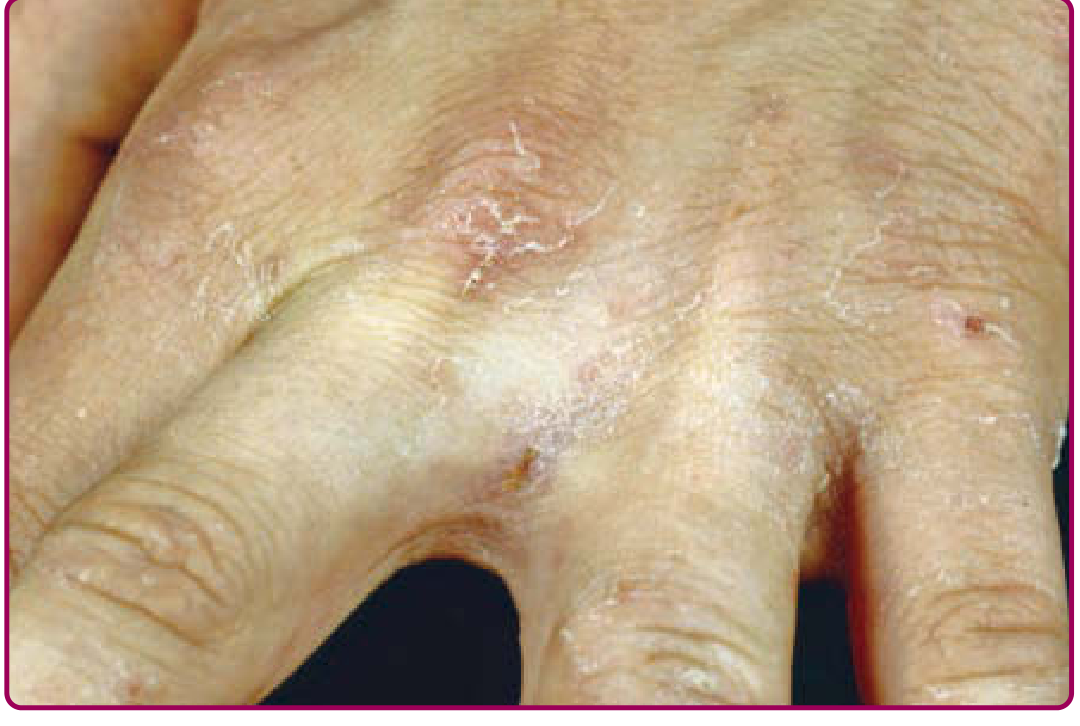
Classic distribution in adults:
- Interdigital web spaces (fingers)
- Volar wrists and lateral palms
- Elbows, axillae
- Scrotum, penis, labia, areolae in women
- Buttocks
Note: Head and neck are usually spared in healthy adults but are affected in infants, elderly, and immunocompromised patients.
Special Forms
Crusted (Norwegian) Scabies
Occurs in immunosuppressed individuals (HIV, elderly, dementia, neuropathy, leprosy, paraplegia).
- Hyperkeratotic plaques - diffuse, especially palms/soles
- Nail thickening and dystrophy
- Millions of mites - extremely contagious even via fomites
- Minimal or absent pruritus (due to impaired immune/sensory response)
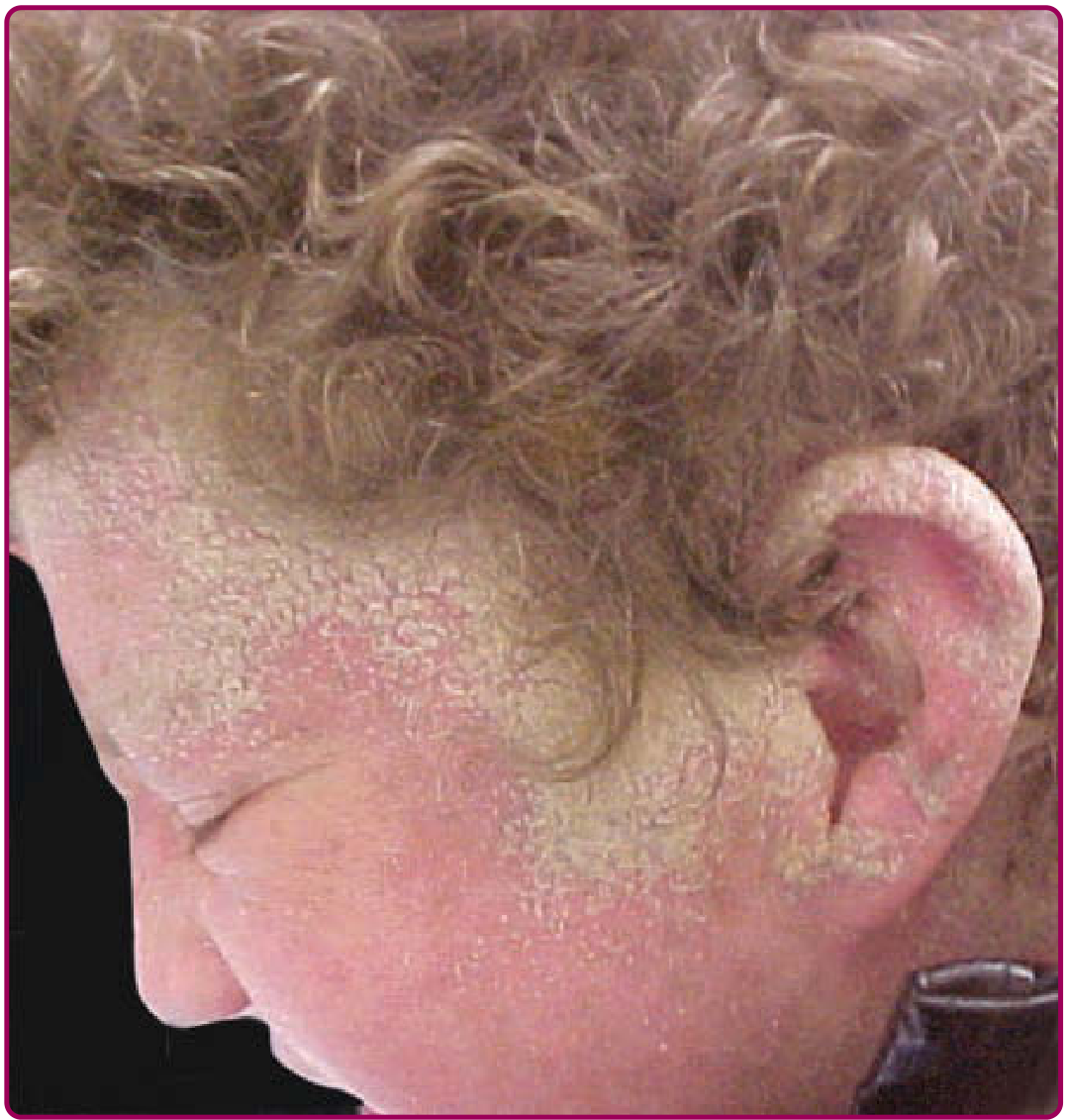
Scabies in Infants
- More generalized - involves face, scalp, palms, and soles
- Nodular and vesicopustular lesions predominate
Diagnosis
Scabies is primarily a clinical diagnosis based on history and examination.
Definitive: Microscopic identification of mites, eggs, or fecal pellets (scybala) from a skin scraping (longitudinal scraping of a burrow).
Practical approach: In the ED or clinic, treat based on clinical suspicion - scraping may be impractical. - Rosen's Emergency Medicine, p. 2411
Differential Diagnosis
| Must Rule Out | Consider |
|---|---|
| Atopic dermatitis | Dermatitis herpetiformis |
| Contact dermatitis | Psoriasis |
| Pityriasis rosea | Bullous pemphigoid |
| Secondary syphilis | Linear IgA bullous dermatosis |
| Folliculitis | Drug eruption |
| Papular urticaria | Delusions of parasitosis |
| Lichen planus | Systemic pruritus |
Treatment
All household members and close contacts must be treated simultaneously, even if asymptomatic (asymptomatic carriers are common).
| Drug | Dose | Notes |
|---|---|---|
| Permethrin 5% cream (first-line) | Apply neck-down for 8-14 hrs, wash off; repeat in 7 days. In crusted scabies: daily x7 days, then twice weekly until cured | Most effective topical agent; pregnancy category B; apply under nails, umbilicus, genitals, nipples. Treat face/scalp in infants |
| Ivermectin 200 mcg/kg (oral) | Days 1 and 8; crusted scabies: days 1, 2, 8, 9, and 15 | Highly effective; not recommended for <15 kg, pregnant, or lactating women |
| Crotamiton 10% cream | Days 1, 2, 3, and 8 | Has antipruritic properties; marginal effectiveness |
| Precipitated sulfur 5-10% | Days 1, 2, 3 (x8 hrs) | Safe in neonates and pregnancy; inexpensive; limited efficacy data |
| Benzyl benzoate 10% | Apply x24 hrs | Not available in the US |
| Lindane 1% | Avoid - FDA black box warning for neurotoxicity | Banned in California; avoid in infants, elderly, <50 kg |
Post-treatment symptom note: Pruritus and rash may persist for 2-4 weeks after successful treatment due to ongoing hypersensitivity to dead mite products. This does not indicate treatment failure. Oral antihistamines and emollients can help.
Environmental Decontamination
- Wash sheets and clothing at 60°C (140°F) and dry in a hot dryer
- Items that cannot be washed: seal in plastic bag in a warm area for 2 weeks
Key Pearls
- Always treat all household contacts at the same time
- Permethrin 5% cream is the standard first-line treatment
- Oral ivermectin is an effective alternative, especially for crusted scabies or outbreaks
- Crusted scabies requires combination therapy (permethrin + ivermectin) and environmental control
- Post-scabetic pruritus is common and does not mean treatment failed
- Lindane should be avoided due to neurotoxicity risk
Sources: Fitzpatrick's Dermatology, Vol. 1-2 | Rosen's Emergency Medicine, 10e | Goldman-Cecil Medicine
Can u find rook pdf
Finding Sources
Unfortunately, Rook's Textbook of Dermatology is not available in the medical library I have access to. The dermatology books currently in the library are:
Finding Sources
Rook's Textbook of Dermatology is not available in the medical library. The dermatology books currently in the library are:
| Title | Notes |
|---|---|
| Fitzpatrick's Dermatology (Vol. 1 & 2) | Major comprehensive reference |
| Dermatology 2-Volume Set, 5e (Bolognia) | Another top-tier dermatology text |
| Andrews' Diseases of the Skin - Clinical Dermatology | Classic clinical reference |
| Andrews' Clinical Atlas, 2e | Image-focused atlas |
These are all excellent alternatives to Rook's. If you have a specific dermatology topic in mind, I can look it up in any of these books for you.
This is a shared conversation. Sign in to Orris to start your own chat.