
Medial leminiscus
The medial lemniscus is a large ascending sensory tract in the brainstem that carries fine touch, vibration, and proprioception from the contralateral side of the body to the thalamus. It originates from the nucleus gracilis and nucleus cuneatus in the medulla, crosses (decussates) as internal arcuate fibers, then ascends through the brainstem to synapse in the ventral posterolateral (VPL) nucleus of the thalamus.
Searching sources...
Reading File
Finding Sources
Finding Sources
Reading File
Reading File
Reading File
Reading File
Reading File
Reading File
Now let me fetch the key pathway diagram to include visually:
Loading Image
Loading Image
Here is a thorough overview of the medial lemniscus based on authoritative neuroanatomy textbooks.
Medial Lemniscus
Overview
The medial lemniscus (ML) is the major second-order sensory tract of the dorsal column-medial lemniscal (DCML) pathway. It carries fine touch, vibration, proprioception, and kinesthesia from the contralateral body to the thalamus. The name comes from the Latin lemniscus meaning "ribbon" - an apt description of its flat, ribbon-like shape in brainstem cross sections.
The Complete Pathway (3-Neuron Arc)
Neuron 1 - Primary Sensory Neuron (Periphery → Medulla)
- Receptors: Meissner's corpuscles (light touch), Merkel discs (pressure/vibration 5-15 Hz), Pacinian corpuscles (vibration 200-300 Hz), Ruffini endings (stretch), muscle spindles/Golgi tendon organs (proprioception)
- Fiber type: Large-diameter, heavily myelinated A-alpha and A-beta fibers
- Cell body: Dorsal root ganglion (DRG)
- Course: Enters spinal cord via the medial dorsal root entry zone → ascends ipsilaterally in the posterior (dorsal) columns
- Fasciculus gracilis (medial): legs, lower trunk (below ~T6)
- Fasciculus cuneatus (lateral): upper trunk, arms, neck (above T6)
- 1st synapse: Nucleus gracilis and nucleus cuneatus in the caudal medulla
Neuron 2 - Second-Order Neuron (Medulla → Thalamus)
- Origin: Nucleus gracilis and nucleus cuneatus
- Decussation: Axons sweep ventrally and medially as internal arcuate fibers, crossing the midline at the lower/caudal medulla
- Formation of the medial lemniscus: After crossing, fibers aggregate into the medial lemniscus on the contralateral side
- Course through the brainstem:
- Medulla: Vertical orientation, immediately dorsal to the pyramidal (corticospinal) tract, adjacent to the midline. Gracile fibers ventrolaterally, cuneate fibers dorsomedially
- Pons: Moves dorsolaterally, now horizontal in orientation
- Midbrain: Located in the tegmentum, lateral to the red nucleus
- 2nd synapse: Ventral posterolateral (VPL) nucleus of the thalamus
Additional input: The lateral cervical nucleus (LCN, C1-C2) and nucleus Z also send fibers to join the medial lemniscus. The face equivalent - the trigeminal lemniscus - runs in parallel and terminates in the VPM (ventral posteromedial) nucleus.
Neuron 3 - Thalamocortical Neuron (Thalamus → Cortex)
- From the VPL, axons pass through the posterior limb of the internal capsule (thalamic somatosensory radiations)
- Terminate in primary somatosensory cortex (S1), postcentral gyrus (Brodmann areas 3, 1, 2)
Somatotopic Organization
The ML maintains a precise somatotopic map throughout its course, but its orientation rotates as it ascends:
| Level | Orientation | Legs | Arms |
|---|---|---|---|
| Medulla | Vertical ("person stands up") | Ventral/lateral | Dorsal/medial |
| Pons/Midbrain | Horizontal ("person lies down") | Lateral | Medial |
This is the reverse of the posterior columns (where legs are medial). A useful mnemonic: the somatotopic map flips orientation when the ML rotates from its vertical medullary position into its horizontal pontine position.
Diagram - Dorsal Column-Medial Lemniscal Pathway
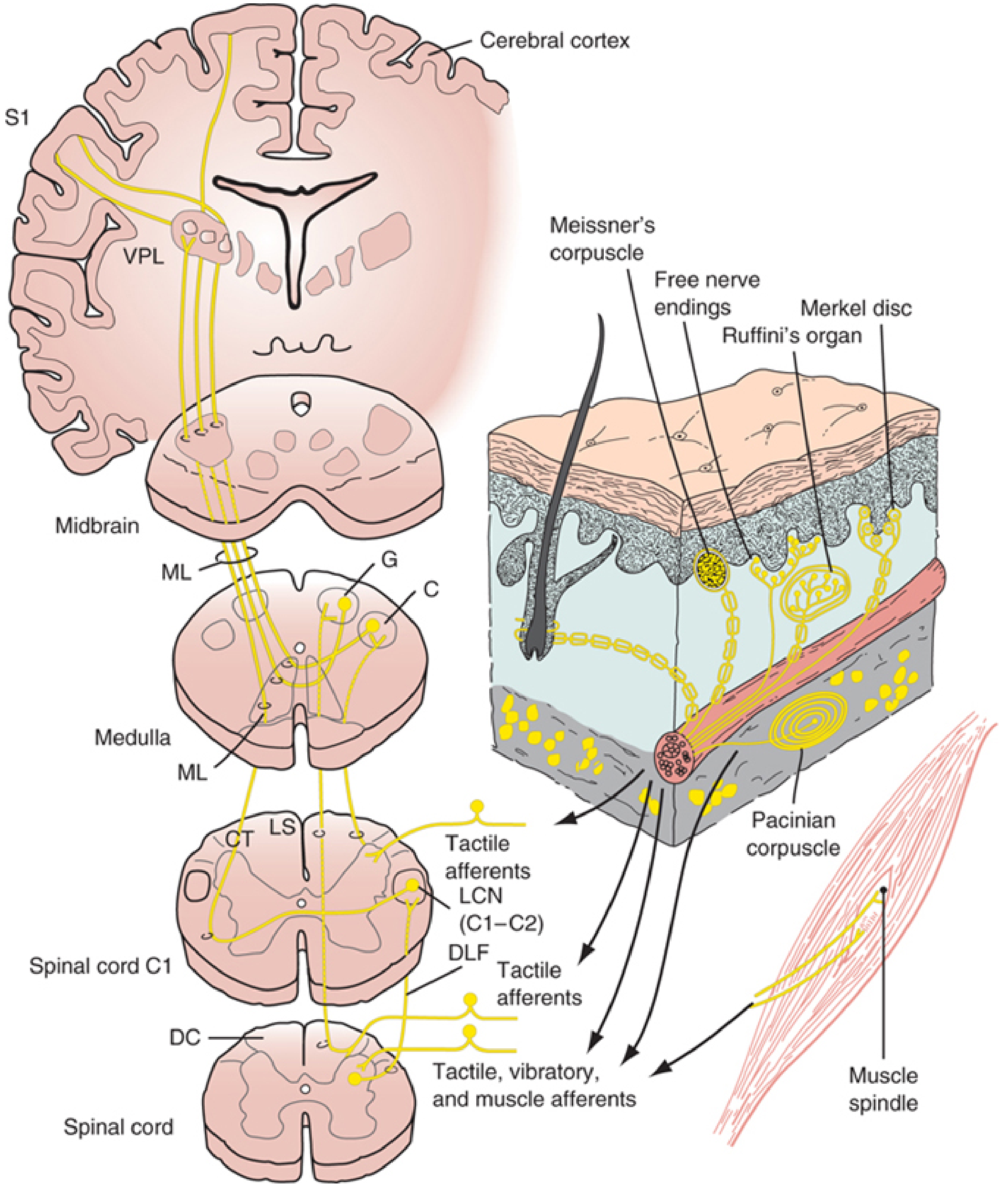
Figure: Central pathways of the DCML system. ML = medial lemniscus; G = nucleus gracilis; C = nucleus cuneatus; VPL = ventral posterolateral nucleus; S1 = primary somatosensory cortex; DC = dorsal columns; DLF = dorsolateral funiculus; LCN = lateral cervical nucleus. (From Localization in Clinical Neurology, 8e)
Blood Supply
The vascular supply of the ML varies by level and is clinically important:
| Level | Artery | Clinical Syndrome |
|---|---|---|
| Medulla | Anterior spinal artery (paramedian branches) | Medial medullary (Dejerine) syndrome |
| Pons | Paramedian branches of basilar artery | Pontine infarct |
| Midbrain | Paramedian branches of basilar / PCA | Weber or Claude syndrome |
Clinical Correlations
Lesion of the Medial Lemniscus
A pure ML lesion produces contralateral loss of:
- Vibration sense
- Joint position sense (proprioception)
- Discriminative (two-point) touch
- Stereognosis and graphesthesia
Pain and temperature are spared (they travel in the spinothalamic tract, which is laterally located and has a different blood supply).
Key Syndromes
Medial Medullary (Dejerine) Syndrome - anterior spinal artery occlusion:
- Contralateral loss of position/vibration sense (ML involvement)
- Contralateral hemiparesis (pyramidal tract)
- Ipsilateral CN XII palsy (hypoglossal nucleus/fibers)
- Pain and temperature spared (lateral spinothalamic tract unaffected)
Lateral Medullary (Wallenberg) Syndrome - PICA occlusion:
- ML spared (laterally located structures affected)
- Contralateral pain/temperature loss (spinothalamic tract)
- Ipsilateral face pain/temperature loss (spinal trigeminal nucleus/tract)
Thalamic (VPL) Lesion:
- Contralateral loss of all sensory modalities (face + body) including pain, temperature, touch, vibration, and proprioception
Brown-Sequard Syndrome (hemicord lesion):
- Ipsilateral loss of proprioception/vibration below the lesion (posterior column not yet crossed)
- Contralateral pain/temperature loss below the lesion (spinothalamic, already crossed)
Comparison: DCML vs. Spinothalamic Tract
| Feature | Dorsal Column-ML | Spinothalamic |
|---|---|---|
| Modalities | Fine touch, vibration, proprioception | Pain, temperature, crude touch |
| Where it crosses | Caudal medulla | At each spinal cord level (within 1-2 segments) |
| Brainstem position | Medial/paramedian | Lateral tegmentum |
| Thalamic relay | VPL | VPL (separate neurons) + intralaminar nuclei |
| Fiber type | A-alpha, A-beta (large, myelinated) | A-delta, C (small, thinly/unmyelinated) |
Sources: Neuroanatomy through Clinical Cases, 3rd Ed. (Blumenfeld); Localization in Clinical Neurology, 8e; Bradley and Daroff's Neurology in Clinical Practice
This is a shared conversation. Sign in to Orris to start your own chat.