
Describe Branches Of Brachial Artery With Their Course And Area Of Supply. 5 marks
Reading File
Finding Sources
Finding Sources
Reading File
Reading File
Reading File
Reading File
Reading File
Loading Image
Loading Image
I now have comprehensive information from multiple authoritative anatomy textbooks. Here is the complete answer:
Branches of the Brachial Artery — Course and Area of Supply
Overview
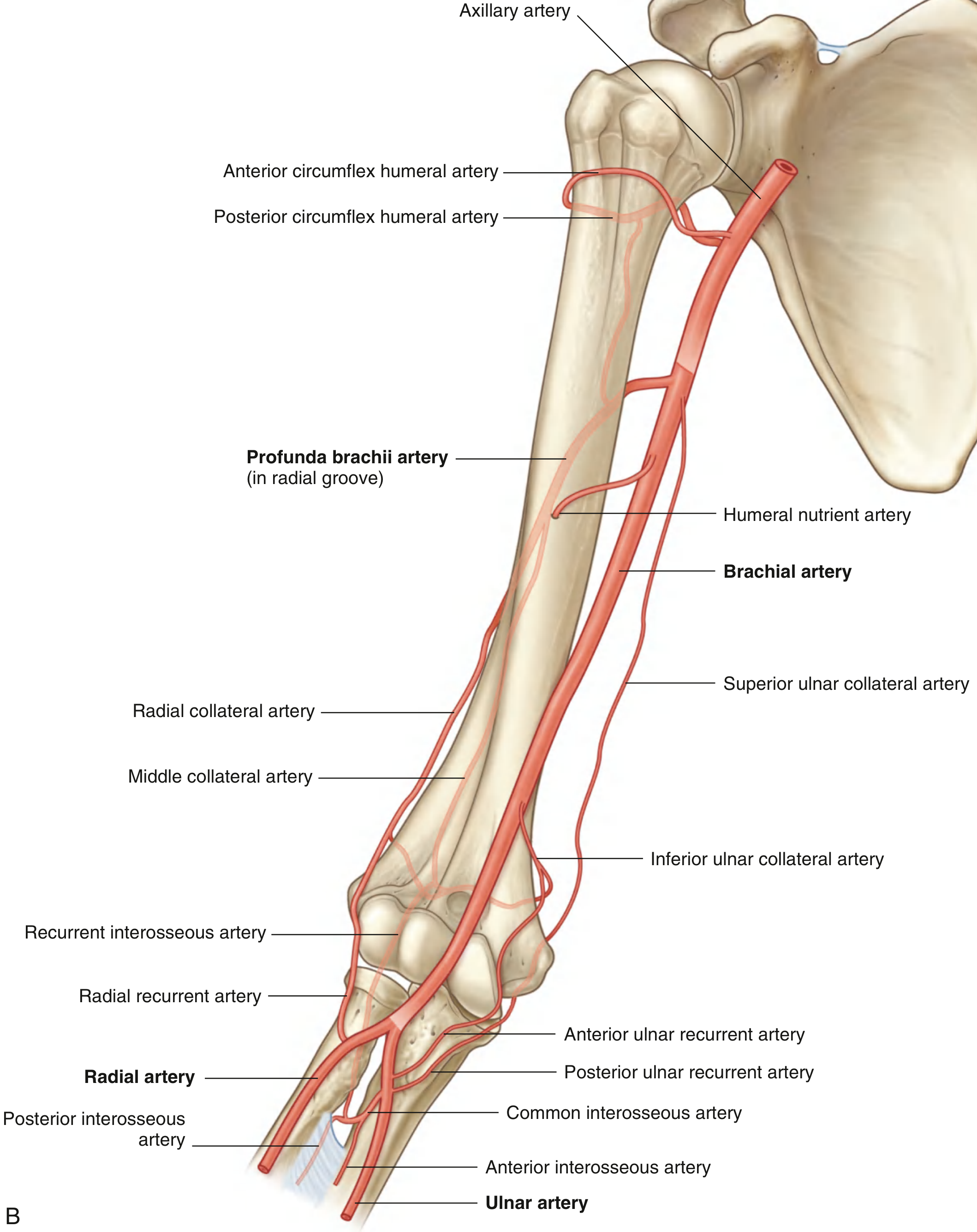
The brachial artery is the continuation of the axillary artery beginning at the lower border of teres major. It runs in the anterior compartment of the arm and terminates in the cubital fossa (at the level of the neck of the radius / antecubital fossa) by dividing into the radial and ulnar arteries — its two terminal branches.
Named Branches
1. Profunda Brachii Artery (Deep Artery of the Arm)
- Largest branch of the brachial artery; arises near the upper end of the arm.
- Course: Passes posteriorly with the radial nerve through the triangular interval (bounded by the shaft of humerus, inferior margin of teres major, and lateral margin of the long head of triceps). Runs in the radial (spiral) groove on the posterior surface of the humerus, deep to the lateral head of triceps.
- Terminates as two collateral vessels:
- Radial collateral artery — passes anterior to the lateral epicondyle; anastomoses with the radial recurrent artery (from radial artery).
- Middle collateral artery — passes posterior to the lateral epicondyle; anastomoses with the interosseous recurrent artery.
- Area of supply: Posterior compartment of the arm (all three heads of triceps brachii), deltoid muscle (via branches), and contributes to the arterial anastomosis around the elbow.
2. Nutrient Artery to the Humerus
- Course: Arises from the brachial artery (or profunda brachii) and enters the nutrient foramen on the anteromedial surface of the humeral shaft.
- Area of supply: Nutrient supply to the shaft of the humerus.
3. Superior Ulnar Collateral Artery
- Origin: Arises from the brachial artery approximately at the mid-arm level, just below the origin of the profunda brachii.
- Course: Descends along with the ulnar nerve, pierces the medial intermuscular septum, and passes posterior to the medial epicondyle.
- Anastomoses with the posterior ulnar recurrent artery (from ulnar artery).
- Area of supply: Muscles in the medial arm and contributes to the elbow anastomotic network.
4. Inferior Ulnar Collateral Artery
- Origin: Arises from the brachial artery approximately 5 cm above the elbow.
- Course: Passes medially between the median nerve and the brachialis, then divides — one branch passes anterior and another posterior to the medial epicondyle.
- Anastomoses with the anterior ulnar recurrent artery (from ulnar artery).
- Area of supply: Medial aspect of the elbow region; contributes to the elbow anastomotic network.
5. Muscular Branches
- Multiple small unnamed muscular branches arise throughout the course of the brachial artery.
- Area of supply: Muscles of the anterior compartment of the arm — coracobrachialis, biceps brachii, and brachialis.
6. Terminal Branches
a) Radial Artery
- Origin: One of two terminal branches at the cubital fossa (at the neck of radius).
- Course: Descends along the lateral side of the forearm, crosses the anatomical snuffbox, and enters the palm via the first dorsal interosseous muscle to form the deep palmar arch.
- Area of supply: Lateral forearm muscles, wrist, and hand (deep palmar arch → palmar metacarpal arteries).
b) Ulnar Artery
- Origin: Larger terminal branch, also at the cubital fossa.
- Course: Passes obliquely under the pronator teres, descends along the medial side of the forearm with the ulnar nerve, enters the hand via Guyon's canal, and forms the superficial palmar arch.
- Area of supply: Medial forearm muscles, wrist, and hand (superficial palmar arch → common and proper palmar digital arteries).
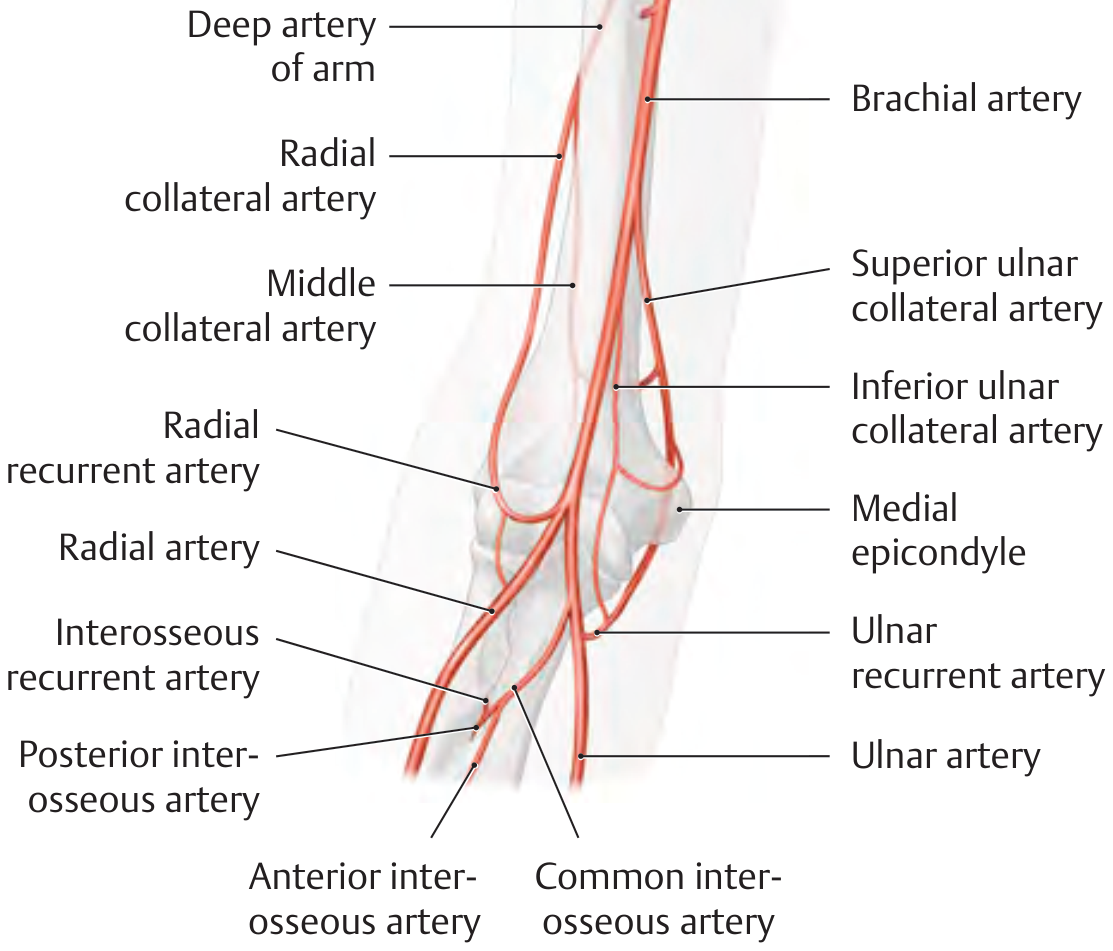
Elbow Anastomosis (Arterial Network of the Elbow)
The collateral branches of the brachial artery form a rich anastomosis around the elbow, ensuring continued blood supply even if the brachial artery is ligated distal to the origin of the profunda brachii:
| Brachial Side | Anastomoses With |
|---|---|
| Radial collateral artery | Radial recurrent artery (from radial artery) |
| Middle collateral artery | Interosseous recurrent artery |
| Superior ulnar collateral artery | Posterior ulnar recurrent artery |
| Inferior ulnar collateral artery | Anterior ulnar recurrent artery |
Summary Table
| Branch | Origin Level | Area of Supply |
|---|---|---|
| Profunda brachii | Upper arm (near teres major) | Posterior compartment of arm, humerus |
| Nutrient artery to humerus | Mid-arm | Humeral shaft |
| Superior ulnar collateral | Mid-arm | Medial arm, elbow network |
| Inferior ulnar collateral | ~5 cm above elbow | Elbow network |
| Muscular branches | Throughout | Anterior compartment muscles |
| Radial artery (terminal) | Cubital fossa | Lateral forearm, hand (deep palmar arch) |
| Ulnar artery (terminal) | Cubital fossa | Medial forearm, hand (superficial palmar arch) |
Sources: — Gray's Anatomy for Students, pp. 876–877 | — THIEME Atlas of General Anatomy and Musculoskeletal System, pp. 375, 412 | — Imaging Anatomy: Bones, Joints, Vessels and Nerves, p. 159
This is a shared conversation. Sign in to Orris to start your own chat.