
Vitriolage in foransic medicine
vitriolage acid attack forensic medicine medico-legal aspects
vitriolage acid attack facial burns disfigurement
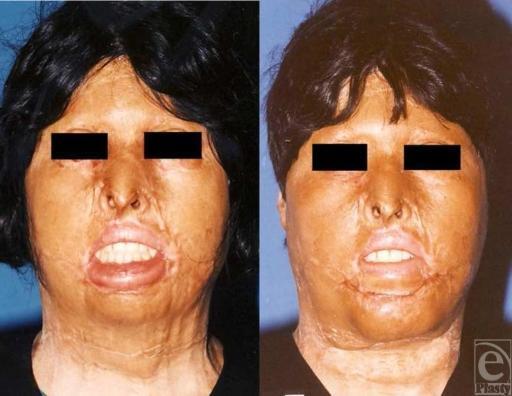
Clinical photograph showing a side-by-side preoperative (left) and postoperative (right) frontal view of a patient with extensive facial scarring and contractures resulting from childhood flame burns. The preoperative image demonstrates significant disfigurement of the mid- and lower face, characterized by lower lip retraction (ectropion), loss of the vermilion border, and obliteration of the natural labiomental and submental folds, leading to a retrusive chin appearance. Severe cicatricial changes affect the skin texture and symmetry of the oral commissures. The postoperative image shows the result of reconstructive plastic surgery involving hinge flaps from subcutaneous fat pads and skin grafting. Key improvements include the restoration of the labiomental crease, increased chin projection (correction of retrogenia), and improved lower lip competence and contour. Although some hypertrophic scarring remains, there is a marked improvement in facial harmony, skin texture, and anatomical landmark definition, specifically regarding the philtrum and chin protrusion.
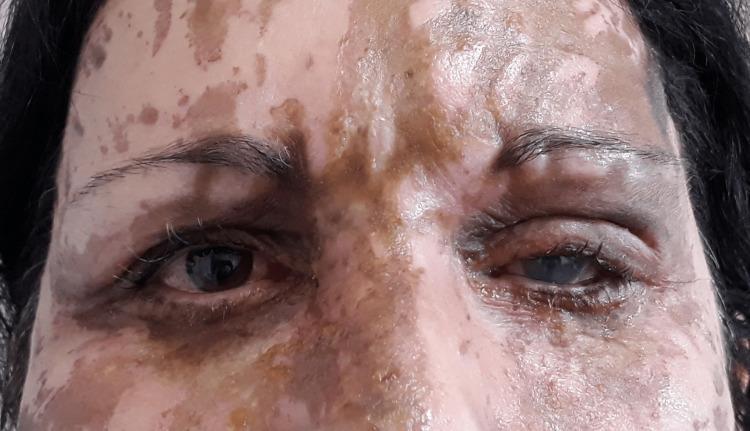
This clinical photograph displays chemical facial burns on a 45-year-old patient, captured on the third post-burn day. The cutaneous injury exhibits a characteristic 'marble cake' or 'trickle' pattern, with irregular, linear, and patchy hyperpigmented areas interspersed with islands of unaffected skin. The burn coloration ranges from light tan and golden-brown to dark brown and blackish-brown, typical of sulfuric acid-induced coagulation necrosis. The ocular region is significantly involved; the left eye shows marked corneal opacity (leukoma), conjunctival injection, and periocular edema with darkening of the eyelid skin. The right eye appears less severely affected but maintains periocular involvement. Key educational features include the visualization of mixed-depth chemical burns, where superficial and deep partial-thickness areas coexist, and the acute ophthalmic complications following acidic liquid exposure. This image is relevant for surgical burn assessment, emergency medicine, and ophthalmology, illustrating why chemical burns often require delayed depth reassessment due to their evolving nature and non-uniform distribution.
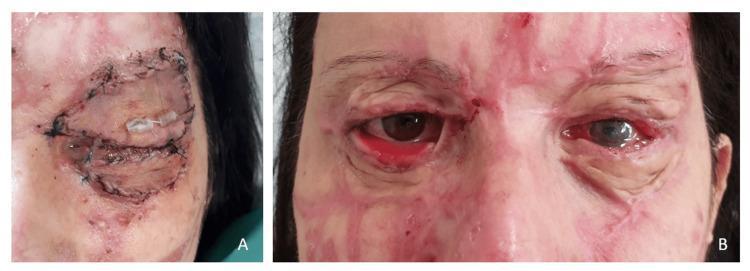
Two-panel clinical photograph illustrating the surgical management and complications of chemical burns to the face and eyelids. Image A shows the left eye of a 45-year-old patient following an initial reconstructive procedure for a severe sulfuric acid burn. Full-thickness skin grafts have been applied to both the upper and lower eyelids. The grafts are secured with visible peripheral sutures, and a clear plastic bolster (stent) is positioned on the upper eyelid to minimize graft contraction. The surrounding periorbital tissue shows significant erythema and hypertrophic scarring. Image B displays a later clinical stage showing bilateral eyelid malposition. The right lower eyelid exhibits severe cicatricial ectropion, characterized by the outward eversion of the eyelid margin and significant exposure of the hyperemic, inflamed palpebral conjunctiva. The left eye shows corneal opacity and further scarring. Extensive, multi-tonal facial scarring with 'trickle' patterns characteristic of liquid chemical burns is visible across the forehead, cheeks, and periorbital regions, demonstrating the long-term sequelae and complexity of managing cicatricial deformities following acid injuries.
Vitriolage in Forensic Medicine
Definition
- PC Dikshit's Textbook of Forensic Medicine and Toxicology
- Parikh's Textbook of Medical Jurisprudence, Forensic Medicine and Toxicology
- The Essentials of Forensic Medicine and Toxicology, 36th ed.
Substances Used
| Substance | Notes |
|---|---|
| Sulphuric acid (H2SO4) | Most common; causes blackish-brown stains |
| Nitric acid (HNO3) | Causes yellowish stains; volatile |
| Carbolic acid (Phenol) | Sometimes used |
| Caustic soda / Caustic potash | Alkalis occasionally used |
| Iodine (strong solution) | Recorded cases |
| Juice of marking nut / Calotropis | Botanical corrosives used in South Asia |
Mode & Motive
- Thrown by jealous, disgruntled, or vengeful persons against their enemies
- Common motives: rejected proposals, extramarital jealousy, family disputes, dowry-related violence
- Often targeted at the face to destroy vision and cause permanent disfigurement
- In some cases, acid is thrown on genitalia out of sexual jealousy
Local Effects on the Body
- Burning pain and corrosion of tissues with formation of brownish-black burned areas
- Characteristic trickle marks - linear streaks on face, chin, neck, and chest from running acid
- No vesication (blister formation) - unlike thermal burns
- No red line of demarcation at burn margins
- Penetrating burns - the acid devitalizes (kills) deep tissues
- Stain color difference:
- Sulphuric acid: black/dark brown stains on skin and clothing
- Nitric acid: yellow stains (xanthoproteic reaction)
- Blindness if eyes are involved - corneal opacity and leukoma
- Slow repair with formation of hypertrophic scar tissue and contractures
- Death may result from shock, toxaemia, or secondary infection if burns are extensive
Clinical Image - Characteristic Features of Vitriolage
Treatment
Skin
- Immediately wash with copious water and soap solution or dilute sodium/potassium bicarbonate
- Apply a thick paste of magnesium oxide or carbonate
- Cover raw surface with antibiotic ointment (soframycin, penicillin tulle gauze)
- Treat for shock and infection
Eyes
- Wash immediately with large amounts of water
- Irrigate with 1-5% sodium bicarbonate solution
- Instil a few drops of olive oil or castor oil
- Apply atropine ointment, hydrocortisone, and antibiotics for corneal ulcers
Medicolegal Aspects
Legal Classification (India)
| Section | Offence | Punishment |
|---|---|---|
| BNS Section 124(1) | Causing permanent/partial damage by throwing acid with intention/knowledge of causing injury | Imprisonment not less than 10 years (up to life) + fine (paid to victim as compensation) |
| BNS Section 124(2) | Throwing acid or attempting to throw any corrosive substance | Imprisonment 5 to 7 years + fine |
- The offence is cognizable and non-compoundable (cannot be compromised between parties)
- All public and private hospitals are legally bound to provide free emergency medical treatment to acid attack survivors without procedural delay
Injuries as "Grievous Hurt"
- Blindness from acid - amounts to grievous hurt (permanent privation of sight)
- Scar tissue formation after acid burn - amounts to grievous hurt
- Permanent disfigurement of face - amounts to grievous hurt
- Vitriolage as a whole - amounts to dangerous injury
Forensic Significance of Scars
- Establishing identity of victims
- Proving occurrence and nature of assault
- Assessing permanent disability for compensation claims
- Corroborating victim testimony in court
At Post-Mortem (if fatal)
- Corrosion and partial destruction of contacted tissues
- Externally: burnt lips and trickle marks from mouth to chin, neck, chest
- Internally: variable extent - localised patches to extensive areas in stomach and oesophagus
- Perforation of the stomach is common with sulphuric acid
- Respiratory tract irritation with volatile acids (nitric acid, hydrochloric acid)
Summary Mnemonics
- V - Vengeance / Violence (motive)
- I - Intense pain (delayed) + Initial painlessness
- T - Trickle marks (characteristic)
- R - Repair slow, scar formation + contractures
- I - Irreversible disfigurement
- O - Ocular damage (blindness)
- L - Legal: Grievous hurt under BNS 124
- A - Acid: H2SO4 most common
- G - Grievous injury (legally classified)
- E - Evidence: scar serves as forensic evidence