
from Guyton and Hall textbook of medical physiology, 4th South Asia edition, write a 5-mark short note on Lactation of ejection of milk-role of prolactin and oxytocin
Reading File
Finding Sources
Finding Sources
Reading File
Finding Sources
Loading Image
I have all the content needed. Here is the complete 5-mark short note directly from Guyton and Hall:
Short Note: Lactation - Role of Prolactin and Oxytocin
(Guyton and Hall Textbook of Medical Physiology, 4th South Asia Edition, Chapter 83)
Introduction
Lactation involves two distinct but interrelated processes: milk production (secretion) driven by prolactin, and milk ejection (let-down) driven by oxytocin.
1. Role of Prolactin in Milk Production
Prolactin is secreted by the anterior pituitary gland and is the primary hormone responsible for milk secretion by the alveolar cells of the breast.
During pregnancy:
- Prolactin levels rise steadily from the 5th week of pregnancy, reaching 10 to 20 times the normal nonpregnant level by the time of birth.
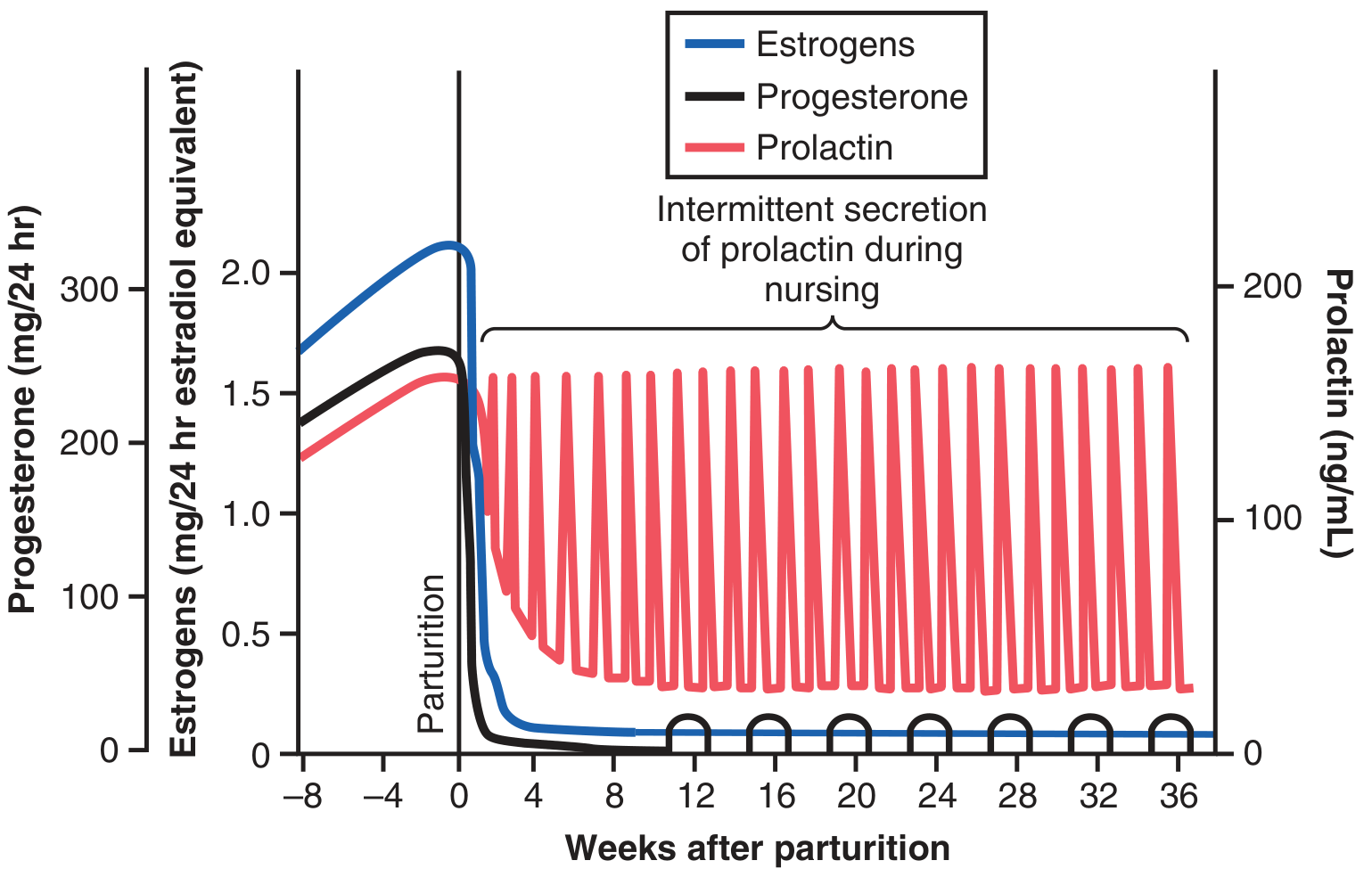
- Despite high prolactin levels, milk secretion is suppressed during pregnancy because estrogen and progesterone (from the placenta) inhibit milk secretion at the breast level.
- Only colostrum (a few mL/day) is produced near term - it contains proteins and lactose similar to milk but almost no fat.
- The placenta also secretes human chorionic somatomammotropin (hCS), which has lactogenic properties and supports prolactin's actions.
After parturition:
- The sudden fall of estrogen and progesterone after delivery of the placenta removes the inhibitory block.
- Prolactin's natural milk-promoting effect then takes over; within 1 to 7 days, the breasts begin to secrete copious quantities of milk instead of colostrum.
- Supporting hormones needed include: growth hormone, cortisol, parathyroid hormone, and insulin - to supply amino acids, fatty acids, glucose, and calcium for milk formation.
During nursing (suckling reflex):
- After birth, basal prolactin returns toward nonpregnant levels over a few weeks.
- However, each time the mother nurses, afferent nervous signals from the nipples travel to the hypothalamus, triggering a 10- to 20-fold surge in prolactin lasting about 1 hour (see Fig. 83.12 below).
- This surge keeps the mammary alveoli secreting milk for the next nursing period.
- If nursing is discontinued, milk production ceases within about 1 week.
Hypothalamic control:
- The hypothalamus secretes prolactin inhibitory hormone (PIH), now identified as dopamine, which normally keeps prolactin suppression in place.
- Suckling suppresses dopamine release, thereby allowing prolactin to surge.
2. Role of Oxytocin in Milk Ejection (Let-Down Reflex)
Milk, once secreted into the alveoli, cannot be directly removed by the baby's suckling - it must first be actively ejected into the ducts.
Mechanism of milk ejection:
- Suckling of the nipple sends afferent nervous impulses to the hypothalamus.
- The hypothalamus stimulates the posterior pituitary to release oxytocin into the bloodstream.
- Oxytocin acts on the myoepithelial cells surrounding the alveoli and the small milk ducts, causing them to contract.
- This contraction increases the intramammary pressure, forcing milk from the alveoli into larger ducts and sinuses, making it available for the baby to suckle - this is called the "let-down" or ejection reflex.
Psychogenic influences:
- This reflex can be conditioned - e.g., a mother may experience milk let-down simply by hearing her baby cry or thinking about feeding (psychological stimuli can also trigger oxytocin release).
- Conversely, stress, pain, or emotional upset can inhibit oxytocin release and block milk ejection, even when prolactin levels are adequate. This is the reason distressed or anxious mothers may struggle to breastfeed effectively.
Summary Table
| Feature | Prolactin | Oxytocin |
|---|---|---|
| Source | Anterior pituitary | Posterior pituitary |
| Trigger | Suckling (suppresses dopamine/PIH) | Suckling (direct neural reflex) |
| Target | Alveolar epithelial cells | Myoepithelial cells around alveoli |
| Effect | Milk production/secretion | Milk ejection (let-down) |
| Timing | Acts during suckling for next feed | Acts within seconds of suckling |
| Inhibition | Estrogen, progesterone, dopamine | Stress, pain, fear |
Source: Guyton and Hall Textbook of Medical Physiology, 4th South Asia Edition, Chapter 83, pp. 1044-1046.
This is a shared conversation. Sign in to Orris to start your own chat.