
International classification of diseases
The International Classification of Diseases (ICD) is a standardized system developed by the World Health Organization (WHO) for classifying diseases, health conditions, injuries, and causes of death. It provides a common language for reporting and monitoring diseases globally. The current version is ICD-11, which took effect January 1, 2022, replacing ICD-10. Codes are used for clinical documentation, billing, epidemiology, and health statistics worldwide.
Searching sources...
Reading File
Searching the Web
International Classification of Diseases ICD-11 2024 2025 updates overview
Finding Sources
Reading File
Reading File
Reading File
Reading File
Reading File
Reading File
Now I have comprehensive information from multiple authoritative sources. Here is a detailed overview:
International Classification of Diseases (ICD)
What Is the ICD?
The International Classification of Diseases (ICD) is the global standard created by the World Health Organization (WHO) for naming, classifying, and coding diseases, disorders, injuries, signs, symptoms, external causes, and other health-related conditions. It is used by physicians, nurses, health professionals, administrators, researchers, scientists, and insurance companies worldwide.
Its systematic use allows examination of the incidence and prevalence of diseases globally, enables reliable morbidity and mortality registries, and supports evidence-based health policy decisions.
The ICD defines the universe of diseases in a hierarchical fashion to enable:
- Easy storage, retrieval, and analysis of health information
- Sharing and comparing health data across hospitals, regions, and countries
- Data comparison at the same location across different time periods
Historical Development
| Year | Milestone |
|---|---|
| 1853 | First International Statistical Congress proposes a universal cause-of-death catalog |
| 1855 | William Farr presents a five-group disease classification (epidemic, constitutional, local, developmental, violence-caused) |
| 1893 | Alphonse Bertillon submits the International List of Causes of Death (ILCD) to the International Statistical Institute |
| 1929/1938 | Revisions by joint ISI/League of Nations Health Organization committees |
| 1946 | WHO commissioned to extend scope from death causes to morbidity (causes of illness) |
| 1948 | WHO takes over ICD maintenance; 6th revision expands scope to morbidity |
| 1975 | ICD-9 introduces the "ICD family" - ancillary classifications for procedures, impairments, primary care, and oncology; dagger/asterisk convention introduced |
| 1992 | ICD-10 approved (alphanumeric codes A00-Z99; three volumes) |
| 1993 | ICD-10 comes into effect (January 1) |
| 2019 | ICD-11 adopted by World Health Assembly |
| 2022 | ICD-11 officially comes into effect (January 1) |
The WHO's constitution explicitly identifies development of the ICD as one of its functions.
ICD-10 (Still in Transition)
ICD-10 was organized alphanumerically (A00-Z99) across three volumes:
- Volume 1 - Tabular list of all medical conditions
- Volume 2 - Instruction manual
- Volume 3 - Alphabetical index
Diagnostic codes did not go beyond the fourth character (e.g., F32.1 = Moderate Depressive Episode). Each character represented a hierarchical level:
- "F" = Mental and Behavioral Disorders
- "F3" = Mood (Affective) Disorders
- "F32" = Depressive Episode
- "F32.1" = Moderate Depressive Episode
ICD-10 also had specialized versions: a Primary Care version (ICD-10-PHC) covering 28 common mental disorders, and a Research version (DCR) with more precise, restrictive criteria.
ICD-11 - The Current Version
ICD-11 was built for the digital age, designed to work with electronic health systems, APIs, and natural language processing. It contains:
- Over 55,000 entities (diagnostic categories)
- Over 120,000 clinical terms (can code millions of conditions)
- Available as a free, online browser and downloadable digital platform
- Currently available in 14 languages (as of the 2025 edition)
Key Structural Changes from ICD-10
ICD-11 introduced five entirely new chapters not present in ICD-10:
- Chapter 3 - Diseases of the Blood or Blood-Forming Organs (split from combined chapter)
- Chapter 4 - Diseases of the Immune System (split from combined chapter)
- Chapter 7 - Sleep-Wake Disorders
- Chapter 17 - Conditions Related to Sexual Health
- Chapter 26 - Supplementary Chapter: Traditional Medicine Conditions
Notable Reclassifications
- Stroke moved from circulatory disorders to neurological disorders - a major long-overdue change
- Gender incongruence moved from mental disorders to the new sexual health chapter, reducing stigma
- HIV reclassified to better reflect it as a chronic, manageable condition
- Allergy coded under diseases of the immune system
- ADHD updated: symptoms no longer need to occur within a fixed age range for diagnosis
New Conditions Added
- Gaming disorder, hoarding disorder, compulsive sexual behaviour disorder
- Simplified PTSD diagnostic criteria (fewer criteria, easier access to treatment globally)
- Over 200 new codes for allergens (2024 update)
- Traditional medicine module (Ayurveda, Siddha, Unani - added February 2025)
ICD-11 Chapter List
| # | Chapter |
|---|---|
| 1 | Certain infectious and parasitic diseases |
| 2 | Neoplasms |
| 3 | Diseases of blood and blood-forming organs |
| 4 | Disorders of the immune system |
| 5 | Endocrine, nutritional and metabolic diseases |
| 6 | Mental, behavioural or neurodevelopmental disorders |
| 7 | Sleep-wake disorders |
| 8 | Diseases of the visual system |
| 9 | Diseases of the nervous system |
| 10 | Diseases of the ear and mastoid process |
| 11 | Diseases of the circulatory system |
| 12 | Diseases of the respiratory system |
| 13 | Diseases of the digestive system |
| 14 | Diseases of the skin |
| 15 | Diseases of the musculoskeletal system and connective tissue |
| 16 | Diseases of the genitourinary system |
| 17 | Conditions related to sexual health |
| 18 | Pregnancy, childbirth and the puerperium |
| 19 | Certain conditions originating in the perinatal and neonatal period |
| 20 | Developmental anomalies |
| 21 | Symptoms, signs or clinical findings, NEC |
| 22 | Injury, poisoning or certain other consequences of external causes |
| 23 | External causes of morbidity and mortality |
| 24 | Factors influencing health status or contact with health services |
| 25 | Codes for special purposes |
| 26 | Supplementary Chapter - Traditional Medicine Conditions (Module I) |
| V | Supplementary section for functioning assessment |
| X | Extension codes |
Linkages with Other Classifications
ICD-11 integrates with:
- ICD-O (Oncology)
- Orphanet (rare diseases)
- MedDRA (pharmacovigilance)
- SNOMED CT and other terminologies via the ICD-11 Foundation
ICD-11 vs. DSM-5 (Psychiatric Classification)
The ICD and DSM (Diagnostic and Statistical Manual) are the two major psychiatric classification systems. In DSM-5, each diagnosis carries an embedded ICD-10-CM code (prefixed by "F"). While there was hope that ICD-11 and DSM-5 would closely align, significant differences remain between the two systems in diagnostic criteria, category names, and boundaries.
2025 and 2026 Updates
According to WHO's February 2025 release:
- Advanced NLP and FHIR API integration for real-time data exchange
- Improved spell correction and language variation recognition
- Expanded to 14 languages, with 25 more in progress
- New Traditional Medicine Module 2 (TM2): Ayurveda, Siddha, Unani
- As of 2025, more than 45 countries have adopted or begun ICD-11 transition
A 2026 release was announced by WHO in February 2026.
Practical Uses
- Clinical coding and billing (diagnosis-related groups, insurance reimbursement)
- Epidemiology (tracking incidence, prevalence, disease burden)
- Mortality statistics (cause-of-death reporting)
- Public health surveillance (global disease monitoring)
- Research (standardized disease definitions for study populations)
- Health policy (resource allocation, program planning)
- Antimicrobial resistance tracking (aligned with GLASS - Global AMR Surveillance System)
Sources: Park's Textbook of Preventive and Social Medicine; Kaplan & Sadock's Comprehensive Textbook of Psychiatry; WHO ICD-11 (2025 update)
Determinants of health
Determinants of health are the broad range of personal, social, economic, and environmental factors that influence the health status of individuals and populations. They include biological factors (genetics, age, sex), lifestyle behaviors (diet, smoking, physical activity), social and economic conditions (income, education, employment), the physical environment, and access to healthcare services. The WHO framework also emphasizes "social determinants" - the conditions in which people are born, grow, live, work, and age.
Searching sources...
Finding Sources
Searching the Web
determinants of health WHO framework social biological environmental 2024
Reading File
Reading File
Reading File
Reading File
Reading File
Reading File
Now let me fetch the determinants of health diagram for visual inclusion.
Loading Image
Here is a comprehensive overview of the determinants of health, drawn from Park's Textbook of Preventive and Social Medicine and Harrison's Principles of Internal Medicine (22nd edition, 2025).
Determinants of Health
Health is multifactorial. The factors that influence health lie both within the individual and externally in the society in which they live. Conceptually, the health of individuals and whole communities is the result of many interactions between two broad sets of factors: genetic (internal) and environmental (external).
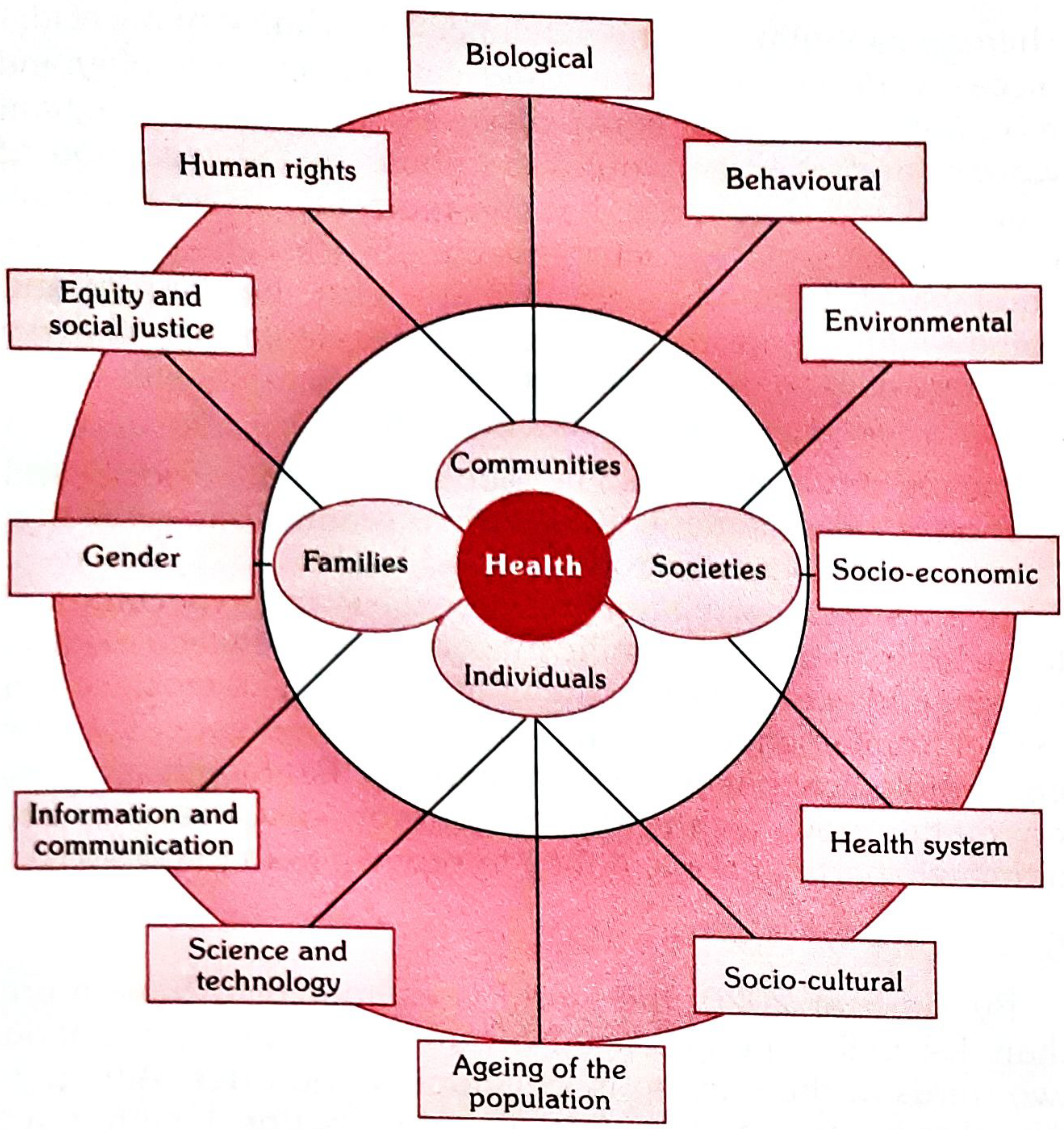
The diagram above shows Health at the center, surrounded by individuals, families, communities, and societies - all influenced by 12 key determinant categories radiating outward.
1. Biological Determinants
The physical and mental traits of every human being are, to some extent, determined by the genetic make-up at the moment of conception. This genetic constitution cannot be altered after conception.
Diseases of genetic origin include:
- Chromosomal anomalies
- Inborn errors of metabolism
- Mental retardation
- Certain types of diabetes
WHO's concept of "positive health" means a person should be able to express as completely as possible the potentialities of their genetic heritage - possible only when they live in a healthy relationship with their environment, which transforms genetic potentialities into phenotypic realities.
Modern advances in medical genetics now offer prospects for:
- Genetic screening
- Gene therapy
- Prevention and treatment of a wide spectrum of genetic diseases
2. Behavioural and Socio-Cultural Conditions (Lifestyle)
"Lifestyle" refers to the way people live - reflecting social values, attitudes, and activities. It is composed of cultural and behavioural patterns and lifelong personal habits developed through interaction with parents, peer groups, friends, siblings, school, and mass media.
Evidence shows a strong association between health and individual lifestyle. Examples:
| Harmful Lifestyle Factors | Health-Promoting Lifestyle Factors |
|---|---|
| Smoking, alcoholism | Adequate nutrition |
| Drug addiction | Sufficient sleep |
| Physical inactivity | Regular physical activity |
| Poor diet/obesity | Stress management |
- In developed countries: major diseases (coronary heart disease, obesity, lung cancer, drug addiction) are largely associated with lifestyle changes.
- In developing countries: risks are connected with lack of sanitation, poor nutrition, poor personal hygiene, and cultural patterns.
"Health is both a consequence of an individual's lifestyle and a factor in determining it."
3. Environment
Hippocrates first related disease to the environment (climate, water, air). The environment is classified as:
Internal Environment
Pertains to each tissue, organ, and organ system and their harmonious functioning within the body - the domain of internal medicine.
External (Macro) Environment
Everything external to the individual after conception. It has three components:
| Component | Examples |
|---|---|
| Physical | Climate, housing, water supply, sanitation, radiation |
| Biological | Pathogens, vectors, food contamination |
| Psychosocial | Family structure, community support, social stress |
Also includes:
- Micro-environment (domestic/personal): eating habits, smoking, drug use
- Occupational environment: workplace hazards
- Socio-economic environment: poverty, employment
- Moral environment: social norms and values
The environmental factors range from housing and water supply through psychosocial stress and family structure to the organization of health and social welfare services. If the environment is favourable, individuals can make full use of their physical and mental capabilities.
4. Socio-Economic Conditions
For the majority of the world's people, health status is primarily determined by their level of socio-economic development. The major components are:
(i) Economic Status
- Per capita GNP is the most widely accepted measure of general economic performance
- Economic progress has been the major factor in reducing morbidity, increasing life expectancy, and improving quality of life in developing countries
- Economic status determines purchasing power, standard of living, family size, and patterns of disease
- Ironically, affluence can also cause illness - exemplified by high rates of coronary heart disease, diabetes, and obesity in upper socio-economic groups
(ii) Education
- A second major factor influencing health status - especially female education
- The world map of illiteracy closely coincides with maps of poverty, malnutrition, ill-health, and high infant/child mortality
- Education compensates for the effects of poverty on health, irrespective of health facility availability
- Example: Kerala (India) has an infant mortality rate of ~10/1000 vs. 34/1000 nationally, largely attributed to its 97.9% female literacy rate (vs. 68.4% nationally)
(iii) Occupation
- Being employed in productive work promotes health; the unemployed show higher incidence of ill-health and death
- Loss of work can cause loss of income, status, and psychological/social damage
(iv) Political System
- Decisions on resource allocation, manpower policy, technology choice, and health service accessibility are all shaped by the political system
- WHO sets a target of at least 5% of GNP expenditure on health care
- Political commitment oriented toward social - not merely economic - development is needed to change poor health patterns
5. Health Services
Health and family welfare services cover a wide spectrum of personal and community services for:
- Treatment of disease
- Prevention of illness
- Promotion of health
Examples of how health services influence health:
- Immunization reduces incidence/prevalence of specific diseases
- Safe water provision prevents water-borne disease mortality
- Maternal and child care reduces maternal and child morbidity/mortality
For services to be effective, they must be:
- Accessible - reaching the social periphery
- Equitably distributed
- Affordable to both country and community
- Socially acceptable
These are the core ingredients of Primary Health Care.
Important note: "Health care does not produce good health." There is a strong correlation between GNP and life expectancy at birth, but no significant correlation between medical density and life expectancy. Health services, no matter how technically elegant, cannot by themselves produce health in a population.
6. Additional Determinants (WHO Framework)
As shown in the diagram, the WHO framework also recognizes:
| Determinant | Role in Health |
|---|---|
| Human Rights | Access to health as a fundamental right; non-discrimination |
| Equity and Social Justice | Fair distribution of health opportunities |
| Gender | Biological sex and social gender roles affect disease risk, healthcare access, and outcomes |
| Information and Communication | Health literacy, access to health information |
| Science and Technology | Advances in diagnostics, treatment, and prevention |
| Ageing of the Population | Shifts in disease burden toward chronic, non-communicable diseases |
| Socio-cultural Factors | Customs, beliefs, traditional practices, social norms |
7. Social Determinants of Health (SDOH) - Modern Framework
According to WHO, the social determinants of health are "the conditions in which people are born, grow, work, live, and age, and the wider set of forces and systems shaping the conditions of daily life."
Harrison's 22nd edition (2025) highlights the NIMHD SDOH Matrix, which classifies determinants across:
Domains of influence (Y-axis):
- Biological
- Behavioral
- Physical/built environment
- Sociocultural environment
- Healthcare system
Levels of influence (X-axis):
- Individual
- Interpersonal
- Community
- Societal
This model recognizes the life course dimension - that socioeconomic exposures during childhood, for example, can have long-lasting health effects decades later.
Health Disparities and SDOH
Evidence clearly shows racial/ethnic minorities experience poorer health outcomes from preventable and treatable conditions (cardiovascular disease, diabetes, asthma, cancer, HIV/AIDS). Underlying drivers include:
- Racism and systemic inequities
- Health system complexity (navigation barriers)
- Provider-patient communication gaps (language, cultural concordance)
- Geographic concentration of social vulnerability
- Differential access to quality care
8. Right to Health
Under international law, the right to health extends beyond medical care to the underlying determinants of health, including:
- Access to safe and potable water
- Adequate sanitation
- Safe food, nutrition, and housing
- Healthy occupational and environmental conditions
- Access to health-related education and information (including sexual and reproductive health)
- Supply of essential medicines
Key principles: Universality, Equity, Accountability, Transparency, and Participation.
Summary Table
| Category | Key Examples |
|---|---|
| Biological | Genetics, age, sex, chromosomal disorders |
| Behavioural/Lifestyle | Smoking, diet, physical activity, alcohol |
| Environment | Water, air, housing, sanitation, climate |
| Socio-economic | Income, education, employment, political system |
| Health services | Accessibility, affordability, quality, primary care |
| Social | Race, gender, equity, human rights, social support |
| Science & technology | Diagnostics, treatment innovations, vaccines |
Sources: Park's Textbook of Preventive and Social Medicine; Harrison's Principles of Internal Medicine, 22nd Edition (2025, McGraw Hill Medical); WHO Social Determinants of Health Framework; WHO SDOH
This is a shared conversation. Sign in to Orris to start your own chat.