
Pain and burning sensation over scrotum on examination erythema and local rise of temperature mild edema
Based on the clinical presentation - scrotal pain, burning, erythema, local warmth, and mild edema - this points toward scrotal cellulitis or epididymo-orchitis at minimum, but the key concern is ruling out Fournier's gangrene (necrotizing fasciitis of the perineum), which is a surgical emergency.
Searching sources...
Reading File
Now let me search the library and PubMed in parallel for this clinical scenario.
Finding Sources
Finding Sources
Searching PubMed
scrotal cellulitis epididymo-orchitis diagnosis management
Good results. Let me now read the relevant sections from both textbooks.
Reading File
Reading File
Finding Sources
Finding Sources
Excellent. Let me now read the Fournier's gangrene sections and the epididymitis treatment section from Tintinalli's.
Reading File
Reading File
Reading File
I now have rich material from multiple authoritative textbooks. Let me also fetch the clinical images and get the epididymitis treatment section from Rosen's and Tintinalli's adult section.
Loading Image
Loading Image
Finding Sources
Finding Sources
Let me read the full treatment table from Rosen's and also get the Bailey & Love section on epididymitis treatment.
Reading File
Reading File
I now have comprehensive information from multiple authoritative textbooks. Let me compile a thorough clinical answer.
Acute Scrotum - Clinical Analysis
The Presentation
Pain + burning sensation + erythema + local heat + mild edema over the scrotum constitutes the classic picture of an acute scrotum with inflammatory/infective etiology. The first and most time-critical task is to exclude life- and organ-threatening causes before settling on the likely diagnosis.
Priority Differential Diagnosis
"An acute scrotum is defined as acute pain or painful swelling of the scrotum or its contents, accompanied by local signs or general symptoms. Testicular torsion and Fournier's gangrene are the most time-sensitive diagnoses of the acute scrotum; the first priority in the evaluation of patients with scrotal pain is differentiation of these life- or testicular-threatening disorders from other entities."
- Tintinalli's Emergency Medicine, p. 634
| Condition | Features in Favor | Features Against |
|---|---|---|
| Epididymo-orchitis | Insidious onset, erythema, edema, dysuria/fever may be present, intact cremasteric reflex, Prehn's sign positive | - |
| Testicular torsion | Acute severe pain, absent cremasteric reflex, elevated/horizontal testis | More gradual onset, presence of warmth/erythema suggests longer duration |
| Scrotal cellulitis | Skin erythema, warmth, superficial infection signs | No deep organ involvement |
| Torsion of appendix testis | Gradual onset, "blue dot sign" at upper pole | Edema/erythema suggest more inflammation or longer duration |
| Fournier's gangrene (MUST EXCLUDE) | Pain + swelling + erythema are the exact early symptoms | No crepitus, no ecchymosis, no systemic toxicity mentioned - but must actively rule out |
| Idiopathic scrotal edema | Bilateral, common in boys 5-8 yrs, resolves in 1-4 days | Fever + warmth points toward cellulitis instead |
⚠️ MOST IMPORTANT: Fournier's Gangrene - Must Exclude First
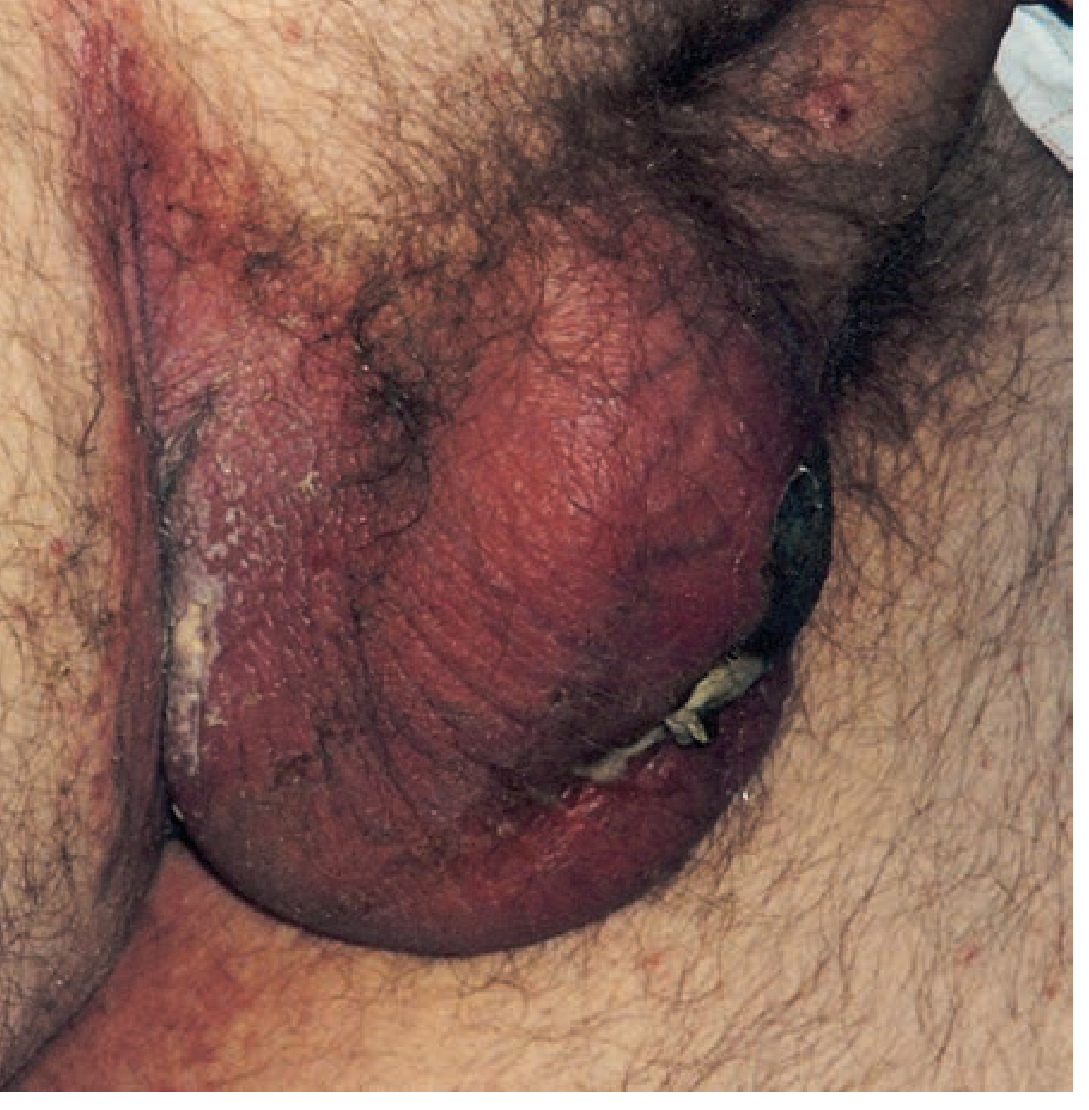
Fournier's gangrene with marked scrotal edema, erythema, and gangrenous demarcation (Tintinalli's Emergency Medicine, Fig. 93-4)
Fournier's gangrene is a polymicrobial synergistic necrotizing fasciitis of the perineal/genital/perianal anatomy. Its early symptoms are identical to the presentation described:
- Genital pain (65%)
- Swelling (65%)
- Erythema (35%)
- Prodrome of lethargy and fever
Red flags that push toward Fournier's:
- Systemic signs: fever, tachycardia, hypotension
- Crepitus on palpation (gas in tissues)
- Ecchymosis or skin discoloration/blistering
- Disproportionate pain to appearance
- Risk factors: diabetes (32-66%), alcohol abuse (25-50%), immunocompromised state
Imaging: Bedside US may show scrotal wall thickening and "dirty shadowing" (air in tissues). CT scan reveals extent of disease. Do not delay urologic consultation for imaging.
Mortality ranges from 12-30% in contemporary series. Age >60 and treatment complications are the strongest predictors of death. - Tintinalli's Emergency Medicine
Most Likely Diagnosis: Epididymo-orchitis / Scrotal Cellulitis
Epididymitis/epididymo-orchitis is the most common inflammatory cause of an acute scrotum in this age group.
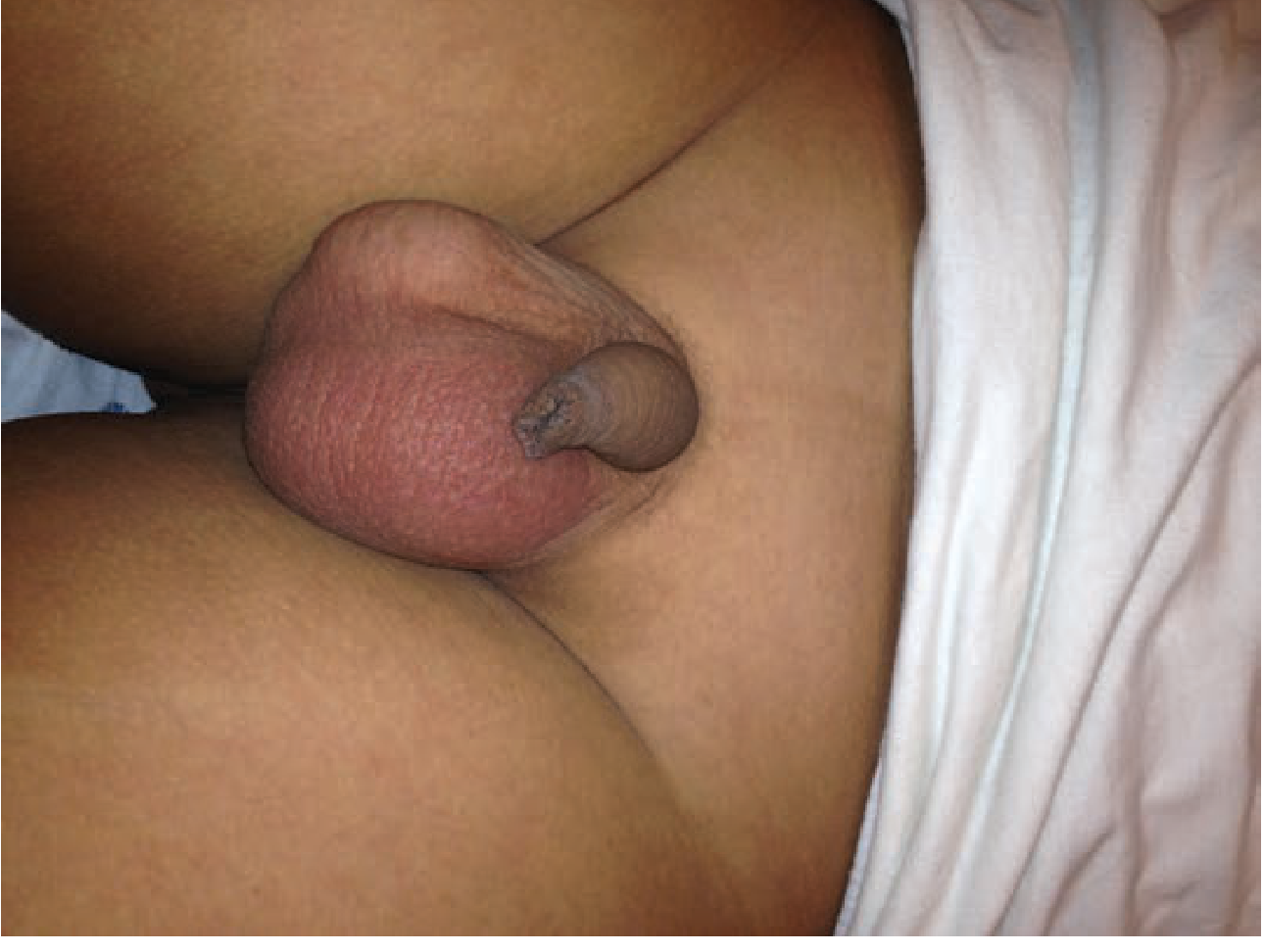
Epididymo-orchitis showing characteristic hemiscrotal erythema and swelling (Tintinalli's Emergency Medicine, Fig. 136-1)
Key exam findings pointing to epididymitis:
- Posterior epididymal tenderness on palpation
- Intact cremasteric reflex (absent in torsion)
- Prehn's sign: pain relief on scrotal elevation (not fully reliable)
- Enlarged, tender epididymis
- Progression from localized epididymal tenderness to massively swollen erythematous hemiscrotum
Causative organisms by patient profile:
| Patient Group | Likely Organisms |
|---|---|
| Sexually active (age <35) | Chlamydia trachomatis, Neisseria gonorrhoeae |
| Older men / non-sexually acquired | Enteric gram-negatives (E. coli, Klebsiella) |
| Men who have anal intercourse | STI + enteric organisms |
| Children | Often idiopathic; viral (enterovirus, adenovirus) |
Investigations
- Urine analysis + culture and sensitivity - pyuria/bacteriuria in 20-40% of epididymitis cases
- Urethral swab / NAAT for C. trachomatis and N. gonorrhoeae in sexually active males
- Scrotal Doppler ultrasound - gold standard:
- Epididymitis: increased epididymal blood flow, normal testicular flow
- Torsion: absent/reduced testicular flow
- Fournier's: thickened scrotal wall, echogenic foci (air)
- FBC, CRP, procalcitonin - assess systemic inflammation
- CT scan if Fournier's cannot be excluded clinically
Treatment
If Fournier's Gangrene Suspected / Cannot Be Excluded:
- Urgent urologic consultation - surgical emergency
- Aggressive IV fluid resuscitation
- Broad-spectrum antibiotics covering gram-positive, gram-negative, and anaerobes:
- Piperacillin-tazobactam 3.375-4.5 g IV every 6 hours, OR
- Imipenem 1 g IV every 24 hours, OR
- Meropenem 500 mg-1 g IV every 8 hours
- Plus vancomycin
- Consider adding clindamycin 600-900 mg IV every 8 hours or metronidazole 500 mg IV every 8 hours
- Wide surgical debridement - testes are often preserved (infection rarely penetrates tunica vaginalis)
- ICU admission postoperatively
(Tintinalli's Emergency Medicine, p. 634)
For Epididymo-orchitis:
Antibiotic regimens (per CDC 2021 STI Guidelines, as cited in Bailey & Love's 28th Edition and Rosen's Emergency Medicine):
| Likely Etiology | Regimen |
|---|---|
| Sexually acquired (chlamydia/gonorrhea) | Ceftriaxone 500 mg IM single dose + Doxycycline 100 mg PO twice daily for 10 days |
| Enteric organisms (older men) | Levofloxacin 500 mg PO once daily for 10 days |
| Both STI + enteric (MSM/anal sex) | Ceftriaxone 500 mg IM + Levofloxacin 500 mg PO daily for 10 days |
Supportive measures:
- Bed rest and scrotal elevation
- Ice packs
- NSAIDs for pain and inflammation
- Treat sexual partners if STI confirmed or suspected
Disposition:
- Patients with systemic toxicity (fever, chills, vomiting) - hospitalization + parenteral antibiotics
- Well-appearing, uncomplicated epididymitis - outpatient management
- Symptoms not improving within 72 hours - re-evaluate diagnosis and therapy
(Rosen's Emergency Medicine, p. 1406)
For Scrotal Cellulitis:
- If superficial/skin-only: antibiotics targeting Staphylococcus/Streptococcus (e.g., cephalexin or cloxacillin orally)
- Monitor closely for progression to abscess or Fournier's
- Incision and drainage for any abscess; urology consult if deep structures involved
Clinical Reminder
The described findings (pain, burning, erythema, warmth, mild edema) without crepitus, necrosis, or systemic toxicity favor early epididymo-orchitis or scrotal cellulitis. However, Fournier's gangrene begins exactly like this. Do not discharge without:
- Confirming absence of crepitus on exam
- Confirming intact scrotal skin with no blistering or ecchymosis
- Documenting baseline vitals and systemic assessment
- Obtaining US if any doubt remains
Sources: Tintinalli's Emergency Medicine (p. 634), Rosen's Emergency Medicine (p. 1406), Bailey & Love's Short Practice of Surgery 28th Ed., Campbell-Walsh-Wein Urology, Sabiston Textbook of Surgery
Which oral antibiotic can i give
Based on the prior workup (scrotal pain, erythema, warmth, mild edema - consistent with epididymo-orchitis or scrotal cellulitis), here are the oral antibiotic options by clinical scenario:
Searching sources...
Finding Sources
Finding Sources
The treatment data is already in our context from the previous session. Here is a direct, practical answer:
Oral Antibiotic Options for Scrotal Infection
The choice depends entirely on the likely etiology based on patient profile:
1. Sexually Active Male (age <35, likely Chlamydia / Gonorrhea)
Ceftriaxone is IM (not oral), but the oral component is:
Doxycycline 100 mg orally twice daily for 10 days
This covers Chlamydia trachomatis and Ureaplasma. It is given alongside a single IM dose of ceftriaxone 500 mg for gonorrhea coverage. There is no fully oral equivalent that replaces the ceftriaxone for gonorrhea.
2. Older Male / Enteric Organisms (non-sexually acquired, likely E. coli, Klebsiella)
Levofloxacin 500 mg orally once daily for 10 days
OR
Ofloxacin 300 mg orally every 12 hours for 10 days
These fluoroquinolones provide excellent gram-negative coverage and penetrate well into the epididymis. They are the first-line choice in older men or those with a urinary tract source.
3. Men Who Have Sex with Men / Both STI + Enteric Organisms Possible
Levofloxacin 500 mg orally once daily for 10 days + IM ceftriaxone 500 mg once
4. Scrotal Cellulitis (skin/soft tissue, Staph/Strep)
Cefalexin (cephalexin) 500 mg orally four times daily for 5-7 days
OR
Amoxicillin-clavulanate 625 mg orally twice daily for 5-7 days
If MRSA is suspected (pus, failed beta-lactam): Co-trimoxazole (TMP-SMX) DS orally twice daily.
Quick Decision Summary
| Patient Profile | Best Oral Antibiotic |
|---|---|
| Young sexually active | Doxycycline 100 mg BD x 10 days (+ IM ceftriaxone) |
| Older man, enteric source | Levofloxacin 500 mg OD x 10 days |
| MSM / mixed risk | Levofloxacin 500 mg OD x 10 days (+ IM ceftriaxone) |
| Skin cellulitis only | Cefalexin 500 mg QID x 5-7 days |
Duration: Minimum 10 days for epididymitis. Do not stop early even if symptoms improve within 3-4 days.
If no improvement in 72 hours - reassess the diagnosis and consider IV therapy or scrotal US to exclude abscess or Fournier's progression.
(Sources: Rosen's Emergency Medicine, Bailey & Love's 28th Ed., CDC 2021 STI Treatment Guidelines)
Can i give clotrimazole cream for local application
Based on the clinical picture described - scrotal pain, erythema, warmth, and edema - clotrimazole cream would not be appropriate here as the primary treatment.
Verifying details...
Finding Sources
Finding Sources
Short Answer: No - Not for This Presentation
Clotrimazole is an antifungal. This patient has a bacterial infection (epididymo-orchitis / scrotal cellulitis). Clotrimazole will have no effect on the underlying infection and should not replace systemic antibiotics.
When Clotrimazole IS Appropriate on the Scrotum
Clotrimazole cream is only useful if the diagnosis is a fungal condition, such as:
| Condition | Features That Would Point to It |
|---|---|
| Tinea cruris (jock itch) | Itchy, scaly, well-demarcated rash with central clearing; spreads from inner thigh to groin; minimal pain; no fever or deep tenderness |
| Candidal intertrigo | Moist, erythematous patches in skin folds; satellite lesions; common in diabetics/obese patients |
| Balanoposthitis (fungal) | Affects glans/foreskin primarily, not deep scrotal structures |
In those cases: Clotrimazole 1% cream applied twice daily for 2-4 weeks is appropriate.
Why It Does NOT Fit This Case
| This Patient's Findings | What They Indicate |
|---|---|
| Pain + burning | Deep tissue / epididymal inflammation |
| Erythema + local heat | Acute bacterial inflammation |
| Mild edema | Tissue response to infection |
These features point to an active bacterial process (epididymo-orchitis or cellulitis). Fungal infections typically cause itch more than pain, produce scaly skin changes, and do not cause the degree of warmth and edema seen here.
What You Can Apply Locally
If you want a topical adjunct for symptom relief alongside systemic antibiotics:
- Ice packs - reduce local inflammation and pain (supported by all guidelines)
- Scrotal elevation (scrotal support/jockstrap) - reduces edema and discomfort
- No topical antibiotics - they do not penetrate to the epididymis or deep scrotal tissues
One Caveat
If after antibiotic treatment the erythema partially resolves but scaling, itching, or satellite lesions appear - consider superimposed tinea cruris or candidiasis, especially in a diabetic or immunocompromised patient. In that scenario, clotrimazole cream would then be appropriate.
Bottom line: Treat this patient with oral levofloxacin or doxycycline (per the earlier regimen) plus supportive measures. Clotrimazole cream alone here would be inadequate and potentially dangerous if it delays proper antibiotic therapy.
Suggest Other topical application that i can give
For this presentation (scrotal pain, erythema, warmth, edema of bacterial origin), topical agents play only a supportive/symptomatic role - they do not treat the underlying infection. Here is what is evidence-supported and safe to use:
Searching sources...
Finding Sources
Finding Sources
Topical Applications for Scrotal Infection / Cellulitis
Important Principle First
No topical agent treats epididymo-orchitis because the infection is deep - inside the epididymis and testis. Systemic oral antibiotics are non-negotiable. Topicals work only on the scrotal skin surface layer.
Option 1 - Topical Antibiotic (for surface bacterial cellulitis)
Mupirocin 2% ointment (Bactroban)
- Covers Staphylococcus aureus (including MRSA) and Streptococcus
- Apply a thin layer to the erythematous scrotal skin twice to three times daily
- Best when cellulitis is clearly superficial/skin-only
- Do not use if skin is broken, weeping, or showing signs of necrosis
Fusidic acid 2% cream
- Excellent anti-staphylococcal topical agent
- Apply twice daily to the affected scrotal skin
- Useful when Staph is the suspected surface pathogen
- Widely used in skin fold and genital infections
Option 2 - Topical Anti-inflammatory (symptom relief)
Diclofenac 1% gel
- Topical NSAID - reduces local pain, swelling, and erythema
- Apply over the scrotal skin twice to three times daily
- Useful adjunct alongside systemic antibiotics for comfort
- Avoid on broken or macerated skin
Option 3 - Soothing / Barrier Agents
Zinc oxide cream / paste
- Mild antiseptic and barrier properties
- Reduces skin maceration in scrotal folds
- Helps prevent secondary fungal superinfection in moist areas
- Safe to apply generously as often as needed
Calamine lotion
- Soothing, mildly antiseptic, reduces local heat sensation
- Can be applied to relieve the burning sensation described
- Particularly useful in the early inflammatory/erythematous phase
Option 4 - Combined Topical (if uncertain about fungal co-infection)
Clotrimazole + Betamethasone cream (Lotriderm / Canesten HC)
- If you suspect a mixed picture - superficial bacterial/fungal + inflammation
- Covers fungal component (clotrimazole) and reduces inflammation (steroid)
- Short-term use only (max 7 days on genital skin) - prolonged steroid on scrotal skin causes atrophy
- Avoid if frank infection or broken skin
Practical Topical Regimen to Prescribe
| Purpose | Agent | Frequency |
|---|---|---|
| Surface bacterial infection | Mupirocin 2% ointment OR Fusidic acid 2% cream | 2-3x daily |
| Pain / burning relief | Calamine lotion or Diclofenac 1% gel | 2-3x daily |
| Prevent maceration | Zinc oxide cream | As needed |
What to Avoid on Scrotal Skin
- Povidone-iodine (Betadine) repeatedly - dries and irritates sensitive scrotal skin
- Hydrogen peroxide - too caustic
- Steroid creams alone (e.g. plain betamethasone) - will worsen a bacterial infection if used without antibacterial cover
- Alcohol-based antiseptics - extremely irritating to genital skin
Bottom line: Mupirocin or fusidic acid for the surface bacterial component, calamine or diclofenac gel for symptomatic relief, zinc oxide to protect the skin. These are adjuncts only - the oral antibiotic (levofloxacin or doxycycline) remains the backbone of treatment.
This is a shared conversation. Sign in to Orris to start your own chat.