
Is HPV vaccine helpful for children aged between 10 to 15, or should we consider taking it so we could prevent cancer and other genital warts? What are the side effects, and what should we do? Well, so we'll give you a choice to take a shot or not.
HPV vaccine children 10-15 years old benefits cancer prevention side effects 2025
HPV vaccine adolescents efficacy safety
PMID: 41276263
HPV vaccine schedule children adolescents cancer prevention
![Summary : This figure presents the 2024 recommended immunization schedule for children and adolescents in the United States, showing the timing and sequence of vaccines from birth through 18 years of age. It uses a Gantt-style chart to indicate when each vaccine dose should be administered, including notes for special circumstances and seasonal recommendations.
gantt chart:
# Title & Axes :
• Title: "Recommended Child and Adolescent Immunization Schedule for ages 18 years or younger, United States, 2024"
• X-axis: Age intervals (Birth, 1 mo, 2 mos, 4 mos, 6 mos, 9 mos, 12 mos, 15 mos, 18 mos, 19–23 mos, 2–3 yrs, 4–6 yrs, 7–10 yrs, 11–12 yrs, 13–15 yrs, 16 yrs, 17–18 yrs)
• Y-axis: Vaccine and other immunizing agents (listed in rows)
# Vaccine Rows :
• Respiratory syncytial virus (RSV-mAb, nirsevimab, clesrovimab)
• Hepatitis B (HepB)
• Rotavirus (RV: RV1, RV5)
• Diphtheria, tetanus, and acellular pertussis (DTaP <7 yrs)
• Haemophilus influenzae type b (Hib)
• Pneumococcal conjugate (PCV15, PCV20)
• Inactivated poliovirus (IPV)
• COVID-19 (1vCOV-mRNA, 1vCOV-aPS)
• Influenza
• Measles, mumps, and rubella (MMR)
• Varicella (VAR)
• Hepatitis A (HepA)
• Tetanus, diphtheria, and acellular pertussis (Tdap ≥7 yrs)
• Human papillomavirus (HPV)
• Meningococcal (MenACWY-CRM ≥2 mos, MenACWY-TT ≥2 years)
• Meningococcal B (MenB-4C, MenB-FHbp)
• Respiratory syncytial virus vaccine (RSV [Abrysvo])
• Dengue (DEN4CYD: 9–16 yrs)
• Mpox
# Dose Timing & Colour Coding :
• Blue ovals: Standard recommended doses (e.g., "1st dose", "2nd dose", "3rd dose", etc.)
• Purple bars: Time windows for additional or catch-up doses
• Orange bars/boxes: Special notes, seasonal recommendations, or age-specific guidance (e.g., "See Notes", "Seasonal administration during pregnancy if not previously vaccinated", "Seropositive in areas with endemic dengue")
• Dotted blue bars: Future or annual recommendations (e.g., COVID-19 vaccine for 2025–2026)
# Design Encodings :
• Each vaccine row uses a combination of blue, purple, and orange to distinguish standard, catch-up, and special/seasonal recommendations.
• Notes and exceptions are highlighted in orange for visibility.
• Overlapping bars indicate flexibility or alternative schedules for certain vaccines.
# Analysis :
• The schedule is densely packed in the first two years of life, with most vaccines administered in multiple doses during infancy and early childhood.
• Several vaccines (e.g., DTaP, Hib, PCV, IPV) have booster doses in later childhood.
• Annual or seasonal vaccines (e.g., Influenza, COVID-19) are indicated for ongoing administration.
• Special recommendations (e.g., RSV, Dengue, Meningococcal, HPV) are highlighted for specific age groups or risk factors.
• The chart visually emphasizes the importance of timely vaccination and provides clear guidance for catch-up and special circumstances.](https://cdn.orris.care/cdss_images/GLGCA_4802261_1766491599420_05de57df-13fd-42af-9913-177c639397d7_307cc31e-5982-4c25-bf7b-b39b10df59fc.png)
Summary : This figure presents the 2024 recommended immunization schedule for children and adolescents in the United States, showing the timing and sequence of vaccines from birth through 18 years of age. It uses a Gantt-style chart to indicate when each vaccine dose should be administered, including notes for special circumstances and seasonal recommendations. gantt chart: # Title & Axes : • Title: "Recommended Child and Adolescent Immunization Schedule for ages 18 years or younger, United States, 2024" • X-axis: Age intervals (Birth, 1 mo, 2 mos, 4 mos, 6 mos, 9 mos, 12 mos, 15 mos, 18 mos, 19–23 mos, 2–3 yrs, 4–6 yrs, 7–10 yrs, 11–12 yrs, 13–15 yrs, 16 yrs, 17–18 yrs) • Y-axis: Vaccine and other immunizing agents (listed in rows) # Vaccine Rows : • Respiratory syncytial virus (RSV-mAb, nirsevimab, clesrovimab) • Hepatitis B (HepB) • Rotavirus (RV: RV1, RV5) • Diphtheria, tetanus, and acellular pertussis (DTaP <7 yrs) • Haemophilus influenzae type b (Hib) • Pneumococcal conjugate (PCV15, PCV20) • Inactivated poliovirus (IPV) • COVID-19 (1vCOV-mRNA, 1vCOV-aPS) • Influenza • Measles, mumps, and rubella (MMR) • Varicella (VAR) • Hepatitis A (HepA) • Tetanus, diphtheria, and acellular pertussis (Tdap ≥7 yrs) • Human papillomavirus (HPV) • Meningococcal (MenACWY-CRM ≥2 mos, MenACWY-TT ≥2 years) • Meningococcal B (MenB-4C, MenB-FHbp) • Respiratory syncytial virus vaccine (RSV [Abrysvo]) • Dengue (DEN4CYD: 9–16 yrs) • Mpox # Dose Timing & Colour Coding : • Blue ovals: Standard recommended doses (e.g., "1st dose", "2nd dose", "3rd dose", etc.) • Purple bars: Time windows for additional or catch-up doses • Orange bars/boxes: Special notes, seasonal recommendations, or age-specific guidance (e.g., "See Notes", "Seasonal administration during pregnancy if not previously vaccinated", "Seropositive in areas with endemic dengue") • Dotted blue bars: Future or annual recommendations (e.g., COVID-19 vaccine for 2025–2026) # Design Encodings : • Each vaccine row uses a combination of blue, purple, and orange to distinguish standard, catch-up, and special/seasonal recommendations. • Notes and exceptions are highlighted in orange for visibility. • Overlapping bars indicate flexibility or alternative schedules for certain vaccines. # Analysis : • The schedule is densely packed in the first two years of life, with most vaccines administered in multiple doses during infancy and early childhood. • Several vaccines (e.g., DTaP, Hib, PCV, IPV) have booster doses in later childhood. • Annual or seasonal vaccines (e.g., Influenza, COVID-19) are indicated for ongoing administration. • Special recommendations (e.g., RSV, Dengue, Meningococcal, HPV) are highlighted for specific age groups or risk factors. • The chart visually emphasizes the importance of timely vaccination and provides clear guidance for catch-up and special circumstances.
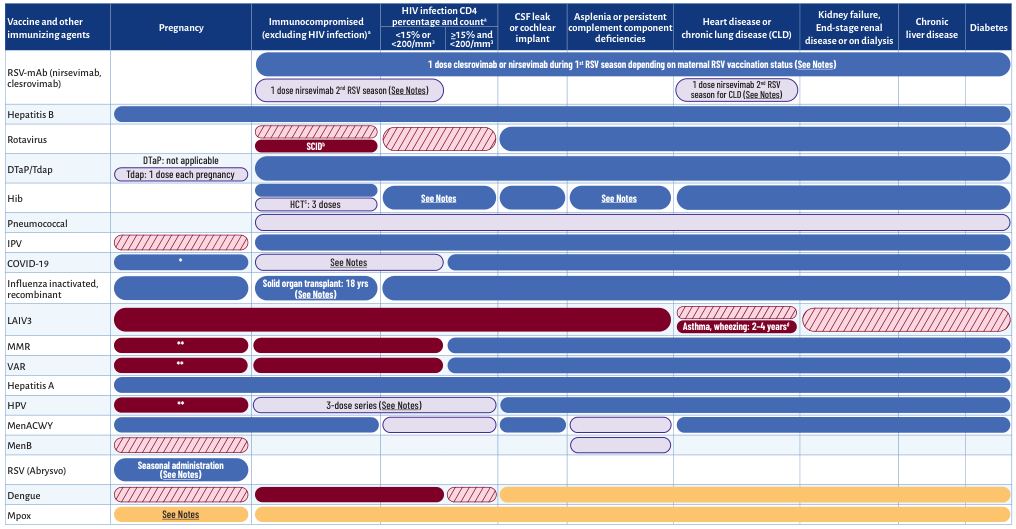
Summary : This figure is a comprehensive reference chart summarizing vaccine and immunizing agent recommendations for children and adolescents with various medical conditions and special situations. It uses color-coded bars and patterns to indicate which vaccines are recommended, contraindicated, or require special consideration for each condition. table: # Vaccine Recommendations for Children and Adolescents with Medical Conditions and Special Situations : ## Structure : • The leftmost column lists vaccines and other immunizing agents (e.g., RSV-mAb, Hepatitis B, Rotavirus, DTaP/Tdap, Hib, Pneumococcal, IPV, COVID-19, Influenza, LAIV3, MMR, VAR, Hepatitis A, HPV, MenACWY, MenB, RSV, Dengue, Mpox). • The top row lists medical conditions and special situations: Pregnancy, Immunocompromised (excluding HIV), HIV infection (with CD4 count subcategories), CSF leak or cochlear implant, Asplenia or persistent complement component deficiencies, Heart disease or chronic lung disease (CLD), Kidney failure/ESRD/on dialysis, Chronic liver disease, Diabetes. ## Color and Pattern Legend : • Solid blue bar: Recommended for all persons in this risk group. • Solid red bar: Contraindicated. • Red diagonal stripes: Precaution or special consideration. • Purple outline: Recommended for some persons in this risk group. • Orange bar: Recommended for persons with additional risk factors or in certain situations. • Notes and asterisks indicate further details or exceptions. ## Key Data Points : • RSV-mAb is recommended for most groups, with special notes for immunocompromised, HIV, and CLD. • Hepatitis B, DTaP/Tdap, Hib, Pneumococcal, IPV, COVID-19, Influenza (inactivated), Hepatitis A, HPV, MenACWY, MenB are broadly recommended (solid blue) for most risk groups. • Rotavirus, LAIV3, MMR, VAR are contraindicated (solid red) in immunocompromised and HIV-infected children with low CD4 counts. • LAIV3 is contraindicated in pregnancy, immunocompromised, and children with asthma/wheezing (2–4 years). • COVID-19, Influenza, and Dengue have special notes or are recommended only in certain situations. • Mpox is recommended for some groups (orange bar) with notes for details. ## Design Encodings : • Each cell uses a color or pattern to indicate recommendation status. • Asterisks and notes provide additional guidance for specific vaccines or conditions. • The chart is organized for quick cross-reference by vaccine and condition. Analysis : • Most inactivated vaccines are broadly recommended for children with chronic conditions or immunocompromised states. • Live vaccines (e.g., LAIV3, MMR, VAR, Rotavirus) are generally contraindicated in immunocompromised and certain HIV-infected children. • Pregnancy, immunocompromised status, and specific organ dysfunctions (e.g., asplenia, kidney failure) require special consideration for several vaccines. • The chart highlights the complexity of vaccine recommendations in special populations and the importance of individualized assessment.
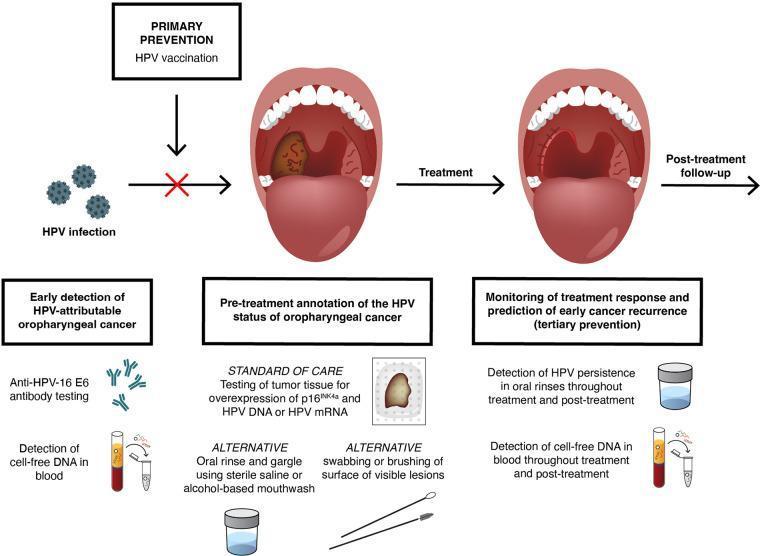
A multi-panel medical infographic illustrating the prevention, diagnosis, and monitoring of HPV-attributable oropharyngeal cancer (HPV-AOC). The top section features two anatomical illustrations of an open mouth: the first shows a brown, exophytic mass on the right palatine tonsil representing tumor presentation; the second shows the same region after treatment with the mass absent. Arrows indicate clinical progression from HPV infection to cancer development, inhibited by primary prevention via HPV vaccination. The bottom section details diagnostic pathways: (1) Early detection methods including Anti-HPV-16 E6 antibody testing and detection of cell-free DNA in blood. (2) Pre-treatment annotation protocols, identifying the standard of care as tumor tissue testing for p16 overexpression and HPV DNA/mRNA, alongside alternative methods like oral rinses and lesion swabbing. (3) Tertiary prevention and monitoring through the detection of HPV persistence in oral rinses and cell-free DNA in blood post-treatment to predict cancer recurrence. The diagram utilizes icons of blood vials, swabs, and histology slides to represent various diagnostic modalities.
HPV Vaccine for Children Aged 10-15: A Complete Guide
What is the HPV Vaccine?
- Types 16 and 18 - cause ~70% of cervical cancers
- Types 31, 33, 45, 52, and 58 - additional cancer-causing types (expanding coverage to ~90% of cervical cancers)
- Types 6 and 11 - cause ~90% of genital warts
Is the HPV Vaccine Helpful for Ages 10-15? (Short Answer: YES - Strongly)
1. Peak Immune Response
2. Only 2 Doses Needed (Before Age 15)
- Ages 9-14: Only 2 doses, given 6-12 months apart (IM injection)
- Ages 15 and older: Require 3 doses (at months 0, 1-2, and 6)
3. Vaccination Before Exposure is Most Effective
What Cancers and Diseases Does It Prevent?
- Cervical cancer (the 4th most common cause of cancer death in females worldwide)
- Vaginal and vulvar cancers
- Anal cancer
- Oropharyngeal (throat) cancer - increasingly common in males
- Genital warts (condyloma acuminata) - caused by types 6 and 11
- In 15-25 year old females, there was a 30% reduction in high-grade cervical precancers (CIN2+) regardless of HPV type after 6 years
- For vaccine-matched HPV types, the reduction was 60%
- Significant reductions in vaginal and vulvar precancers were also documented
Side Effects
Common (Injection Site)
- Pain, redness, swelling at the injection site - most frequent complaint
- Fatigue
- Headache
- Myalgia (muscle aches)
Less Common
- Mild fever
- Nausea
Rare/Serious
- Serious adverse events (new-onset chronic disease, medically significant conditions) occurred in the same proportion (3.5%) as in control groups receiving other vaccines - meaning the HPV vaccine did not add any extra serious risk
- Syncope (fainting) can occur shortly after any vaccination - patients are observed for 15 minutes post-injection as a precaution
Current Guidelines (ACIP / CDC 2024-2025)
| Age Group | Recommendation | Doses |
|---|---|---|
| 9-12 years | Routine vaccination (can start at 9) | 2 doses, 6-12 months apart |
| 13-15 years | Still 2 doses if started before 15th birthday | 2 doses |
| 15-26 years | Catch-up vaccination | 3 doses (0, 1-2, 6 months) |
| 27-45 years | Shared clinical decision-making | Not routinely recommended |
| >45 years | Not licensed | N/A |
2025 update note: The ACIP Working Group was reviewing whether to expand the routine age to 9-12 years (from 11-12) and possibly reduce to a single-dose regimen for 9-15 year olds, based on data from the ESCUDDO trial. The WHO already recommends single-dose for 9-15 year olds as a cost-saving measure. The single-dose strategy "appears to yield similar antibody titers to a two-dose regimen, but the level and duration of protection are not fully understood" and is not yet FDA-recommended. - Harrison's 22E; CIDRAP report 2025
Should You Give the Vaccine? The Decision
Reasons to Vaccinate
- Prevents up to 90% of cervical cancers and 90% of genital warts from vaccine-covered strains
- Only 2 doses needed in this age group (simpler, cheaper, complete)
- Protection lasts at least 16 years with strong evidence, likely lifelong
- Safety profile is excellent across tens of millions of doses globally
- Protects both girls and boys - boys benefit from throat, anal, and genital cancer protection, and vaccination interrupts transmission to future partners
Practical Notes
- The vaccine is given even if the child is already sexually active - it still protects against the types not yet encountered
- Vaccinated females should continue routine Pap smears and cervical screening from age 21, since the vaccine does not cover 100% of cancer-causing HPV types
- The vaccine is not recommended during pregnancy; if a child is pregnant, delay until after delivery
Key Sources
- Harrison's Principles of Internal Medicine, 22nd Edition (2025) - Prevention of HPV Infection and Disease
- Sherris & Ryan's Medical Microbiology, 8th Edition - HPV Prevention section
- Cochrane Network Meta-Analysis 2025 (PMID: 41276263) - 60 RCTs, 157,414 participants
- Frontiers in Public Health 2025 - Dose schedule and age optimization review