
What does it mean when aptt is high
Reading File
A high aPTT (activated Partial Thromboplastin Time) means the intrinsic coagulation pathway is taking longer than normal to clot. Normal aPTT is roughly 25-35 seconds; values above this signal a problem with clotting factors VIII, IX, XI, XII, or the common pathway (X, V, II, fibrinogen).
Searching sources...
Finding Sources
Finding Sources
Reading File
Reading File
Reading File
Loading Image
Here is a thorough breakdown of what a high aPTT means:
What is the aPTT?
The aPTT (activated Partial Thromboplastin Time) measures how long plasma takes to clot via the intrinsic and common coagulation pathways. It tests factors XII, XI, IX, VIII (intrinsic), and factors X, V, II (prothrombin), and fibrinogen (common).
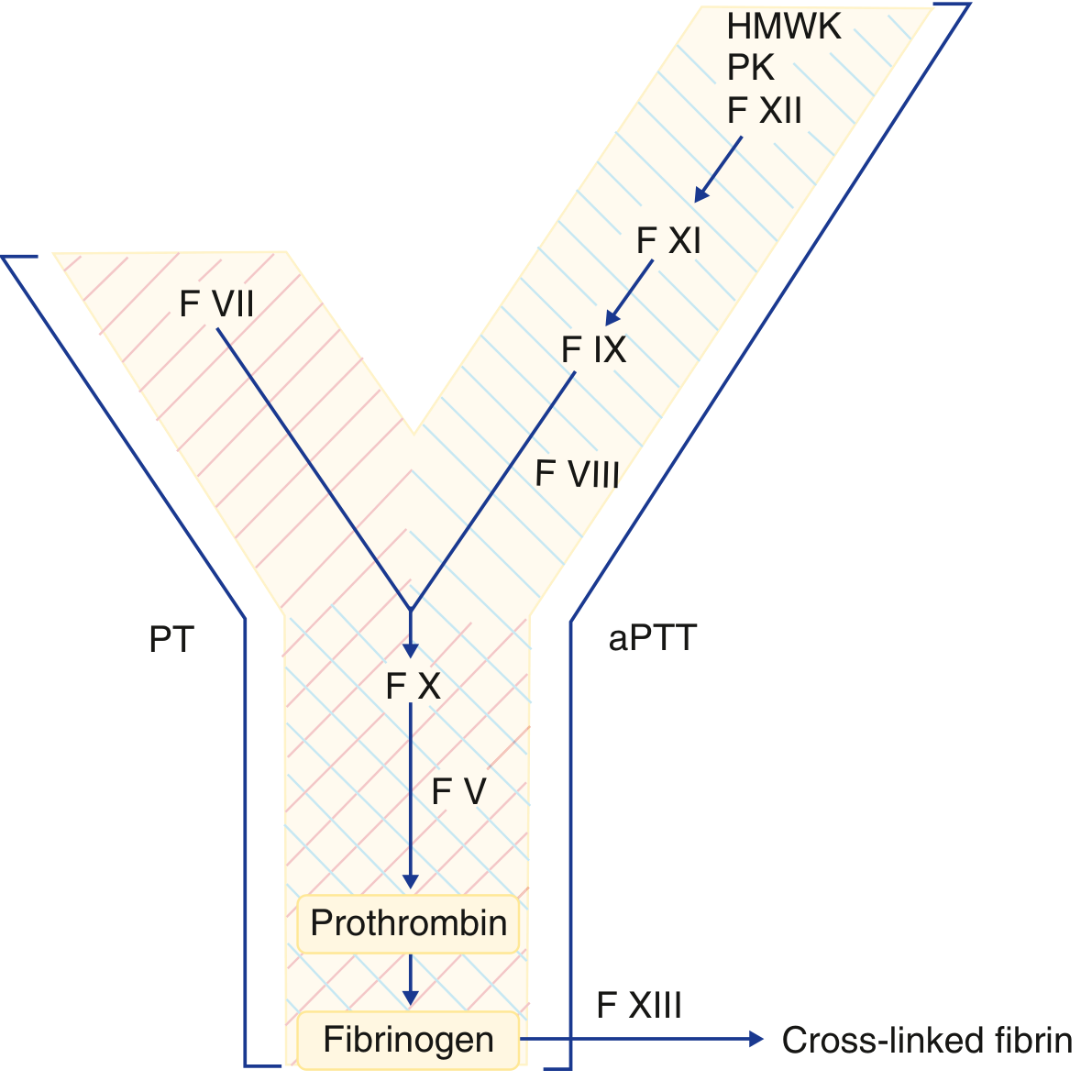
Classic coagulation cascade. aPTT measures the intrinsic and common pathways (right side). PT measures the extrinsic and common pathways (left side). - Goldman-Cecil Medicine
What a High aPTT Means
A prolonged (high) aPTT means clotting is taking longer than normal. This happens for two main reasons: factor deficiency or presence of an inhibitor. A factor generally must fall below 30% of normal activity before the aPTT is prolonged.
Causes - Organized by Clinical Pattern
1. High aPTT, Normal PT (intrinsic pathway problem)
| Cause | Notes |
|---|---|
| Hemophilia A (Factor VIII deficiency) | Most common hereditary cause; severe cases bleed frequently |
| Hemophilia B (Factor IX deficiency) | Similar presentation to Hemophilia A |
| Factor XI deficiency | Milder bleeding tendency |
| Heparin therapy (unfractionated) | Most common acquired cause; aPTT used to monitor it |
| Lupus anticoagulant | Paradoxically causes thrombosis, not bleeding; aPTT prolonged in vitro |
| Anti-Factor VIII antibody (acquired inhibitor) | Can occur spontaneously or post-transfusion |
| Factor XII, prekallikrein, HMWK deficiency | No clinical bleeding despite prolonged aPTT |
| Direct thrombin inhibitors (e.g. argatroban, dabigatran, bivalirudin) | Anticoagulant drugs |
| Von Willebrand disease (type 3, severe) | Low vWF causes secondary drop in Factor VIII |
2. High aPTT + High PT (common pathway or multi-factor problem)
| Cause | Notes |
|---|---|
| Factors II, V, or X deficiency | Common pathway affected |
| Liver disease | Impaired synthesis of multiple clotting factors |
| DIC (Disseminated Intravascular Coagulation) | Consumption of clotting factors; also low fibrinogen, low platelets |
| Vitamin K deficiency (late) | Early deficiency only prolongs PT; late/severe affects both |
| Hirudin / direct thrombin inhibitors | Both pathways affected |
Key Diagnostic Step: The 1:1 Mixing Test
When aPTT is prolonged, a mixing study (1:1 patient plasma + normal plasma) helps distinguish:
- Correction of aPTT after mixing → factor deficiency (the normal plasma provides the missing factor)
- No correction after mixing → inhibitor present (antibody or lupus anticoagulant interfering with clotting)
Specific factor assays are then ordered to pinpoint the deficiency. - Goldman-Cecil Medicine
Common Clinical Scenarios at a Glance
| aPTT | PT | Likely Cause |
|---|---|---|
| High | Normal | Hemophilia A/B, heparin, lupus anticoagulant |
| High | High | DIC, liver failure, vitamin K deficiency, factor II/V/X deficiency |
| Normal | Normal | Platelet disorder, Factor XIII deficiency (not detected by either test) |
Important Practical Points
-
Heparin is the single most common cause of a high aPTT seen in a hospitalized patient.
-
Lupus anticoagulant prolongs aPTT in the lab but causes clotting (thrombosis) in the patient, not bleeding - this is counterintuitive.
-
Factor XII, prekallikrein, and HMWK deficiency can give very prolonged aPTT values with absolutely no bleeding risk.
-
Lab artifacts can falsely prolong aPTT: underfilling the collection tube, very high hematocrit, or delayed testing.
-
Normal neonates have longer aPTT than adults.
-
Quick Compendium of Clinical Pathology, 5th ed.
-
Harrison's Principles of Internal Medicine, 22E
What medicine controls it
"Controlling" a high aPTT depends entirely on the underlying cause - treatment is aimed at fixing that cause, not the aPTT number itself.
Searching sources...
Finding Sources
Finding Sources
Finding Sources
Finding Sources
Reading File
Finding Sources
Reading File
Finding Sources
There is no single medicine that "controls" a high aPTT - the treatment is always directed at the specific cause. Here is a practical breakdown by cause:
Treatments Organized by Cause
1. Heparin (most common hospital cause)
The aPTT is intentionally elevated when a patient is on heparin - that is the goal of therapy. If reversal is needed:
- Protamine sulfate - 1 mg neutralizes 100 units of unfractionated heparin (given IV). It incompletely reverses low-molecular-weight heparin (LMWH). - Goldman-Cecil Medicine
2. Hemophilia A (Factor VIII deficiency)
| Severity | Treatment |
|---|---|
| Mild-moderate, minor bleeding | DDAVP (desmopressin) 0.3 mcg/kg IV - raises Factor VIII 3-5x temporarily |
| Moderate-severe, major bleeding | Factor VIII concentrate - every 1 IU/kg raises activity by ~2% |
| With Factor VIII inhibitors (antibodies) | Emicizumab (Hemlibra) - subcutaneous injection, weekly to monthly; >90% reduction in bleeding. Also rFVIIa (NovoSeven) or aPCC (FEIBA) as bypass agents |
Emicizumab is a bispecific monoclonal antibody that mimics Factor VIII function and is now first-line for many patients. - Washington Manual of Medical Therapeutics
3. Hemophilia B (Factor IX deficiency)
- Factor IX concentrate (e.g. BeneFIX, recombinant) - 1 IU/kg raises activity by ~1%
- DDAVP does NOT work for Hemophilia B
- Extended half-life Factor IX products allow dosing only 1-2x per week
- Gene therapy is emerging but still largely in research
4. Vitamin K Deficiency
- Vitamin K (phytonadione) - IM or IV; takes 18-24 hours to work
- Fresh Frozen Plasma (FFP) - used for acute/urgent bleeding because it contains all clotting factors and works immediately
- 4-factor Prothrombin Complex Concentrate (PCC) - faster and safer alternative to FFP in emergencies
5. Liver Disease
- FFP or PCC for acute bleeding
- Treating the underlying liver disease is the definitive approach
- Vitamin K can be tried but often has limited effect in severe liver failure
6. DIC (Disseminated Intravascular Coagulation)
- Treat the underlying cause (e.g. sepsis, trauma) first
- FFP - replaces consumed clotting factors
- Cryoprecipitate - if fibrinogen is very low (contains fibrinogen, Factor VIII, vWF)
- Platelet transfusion if platelets are critically low
7. Direct Thrombin Inhibitors (e.g. dabigatran, argatroban)
- Idarucizumab (Praxbind) - specific reversal agent for dabigatran
- Stopping the drug is often sufficient for shorter-acting agents
8. Lupus Anticoagulant
- The aPTT is elevated in the lab but this condition causes clotting, not bleeding
- Treatment is anticoagulation (often warfarin) to prevent thrombosis - the goal is NOT to lower the aPTT
Key General Products Used Across Causes
| Product | What it does |
|---|---|
| Fresh Frozen Plasma (FFP) | Replaces all coagulation factors; works immediately |
| Prothrombin Complex Concentrate (PCC) | Concentrated Factors II, VII, IX, X; faster/better than FFP in emergencies |
| Cryoprecipitate | Fibrinogen, Factor VIII, vWF - used when fibrinogen is low |
| Vitamin K | Restores Factors II, VII, IX, X production in the liver |
| Protamine sulfate | Reverses heparin |
The bottom line: a doctor must first identify why the aPTT is high, then treat that specific cause. Giving FFP or factor concentrates without knowing the cause can be ineffective or even harmful.
This is a shared conversation. Sign in to Orris to start your own chat.