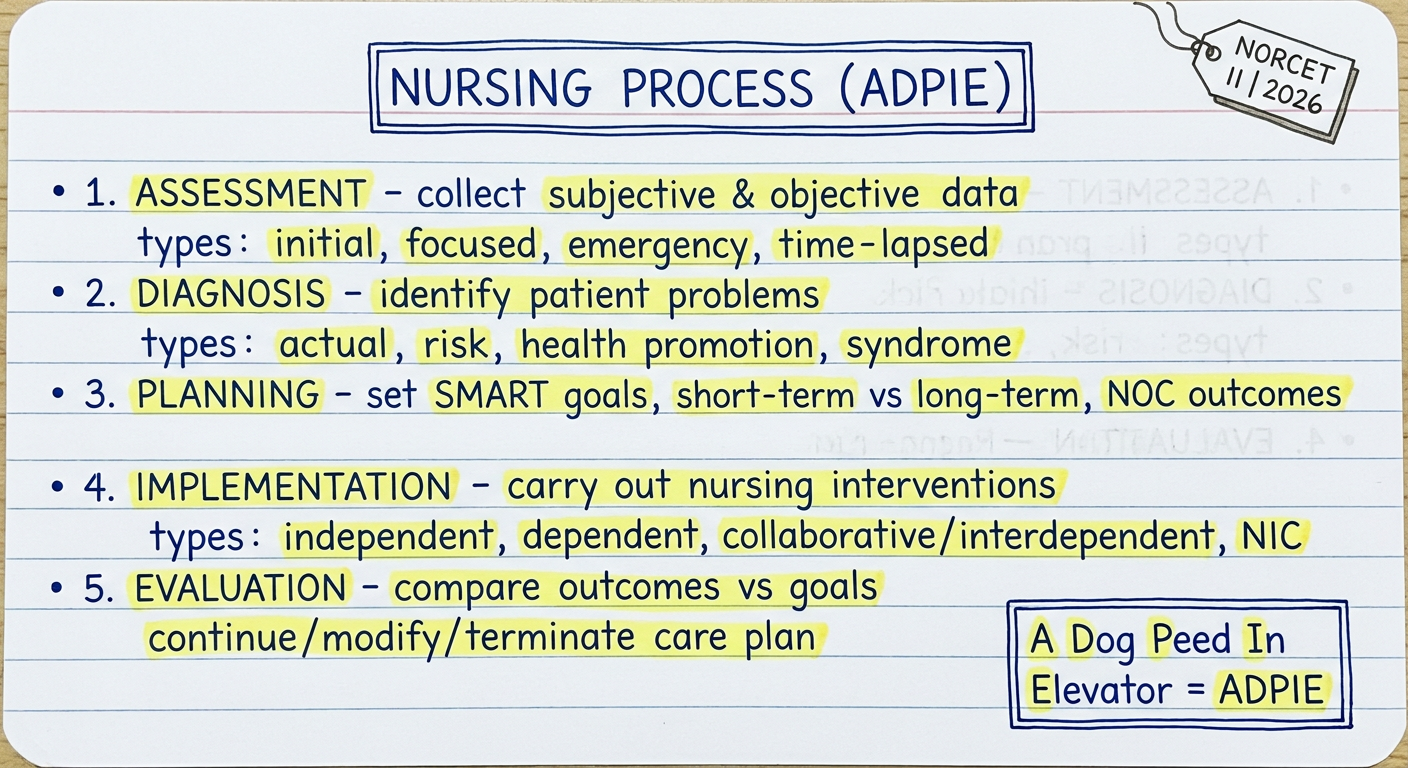
Nursing Process (ADPIE) - NORCET 11 | 2026
What is the Nursing Process?
A systematic, rational, 5-step method that guides all nursing actions to deliver holistic, patient-centered care. It requires critical thinking and is dynamic (ongoing, not one-time).
Mnemonic: Assessment - Diagnosis - Planning - Implementation - Evaluation = ADPIE
"A Dog Peed In Elevator"
Characteristics of Nursing Process
| Feature | Meaning |
|---|
| Systematic | Step-by-step approach |
| Dynamic | Continuous, not static |
| Interpersonal | Centres around patient |
| Goal-oriented | Focused on patient outcomes |
| Universally applicable | Any setting, any patient |
| Evidence-based | Uses best clinical evidence |
STEP 1 - ASSESSMENT ("What data is collected?")
First and most critical step. Involves collecting, organizing, and validating patient data.
Types of Data:
- Subjective data - What patient says/feels (symptoms, complaints) - also called "covert data"
- Objective data - What nurse observes/measures (signs, vitals, labs) - also called "overt data"
Types of Assessment:
| Type | When |
|---|
| Initial | On admission / first contact |
| Focused | For specific problem/complaint |
| Emergency | Life-threatening situation (ABC first) |
| Time-lapsed | After a period of time to compare |
Methods of Data Collection:
- Interview (health history)
- Physical examination (inspection, palpation, percussion, auscultation - IPPA)
- Observation
- Review of records/lab reports
NORCET TIP: Assessment always comes FIRST before any intervention. If a question asks "what should the nurse do FIRST?" - assess before acting.
STEP 2 - DIAGNOSIS ("What is the patient's problem?")
Nurse's clinical judgment about patient's response to health conditions. NOT a medical diagnosis.
Types of Nursing Diagnoses:
| Type | Description | Example |
|---|
| Actual | Problem exists NOW | "Acute Pain r/t surgical incision" |
| Risk | Problem may occur, no signs yet | "Risk for Infection r/t IV catheter" |
| Health Promotion | Desire to improve wellness | "Readiness for Enhanced Nutrition" |
| Syndrome | Cluster of related diagnoses | "Rape Trauma Syndrome" |
PES Format (3-part nursing diagnosis):
Problem + Etiology (related to) + Signs/Symptoms (as evidenced by)
Example: "Ineffective Airway Clearance r/t excessive secretions AEB productive cough"
- Risk diagnoses use only 2 parts (P + E) - no signs yet!
NORCET TIP: NANDA (North American Nursing Diagnosis Association) approves nursing diagnoses. Watch for "related to (r/t)" and "as evidenced by (AEB)" in options.
STEP 3 - PLANNING ("What will be done?")
Setting SMART goals and identifying nursing interventions to achieve outcomes.
Types of Goals:
- Short-term goals - Achieved in hours to days
- Long-term goals - Achieved over weeks/months (discharge planning)
SMART Goals must be:
- Specific
- Measurable
- Achievable
- Realistic
- Time-bound
Priority Setting (Maslow + ABC rule):
- Life-threatening problems (Airway, Breathing, Circulation) - ALWAYS first
- Safety needs
- Physiological needs (Maslow's hierarchy)
- Psychosocial needs
NOC - Nursing Outcomes Classification
- Standardized system for measuring patient outcomes
NORCET TIP: Planning is done WITH the patient, not FOR the patient. Patient must be involved in goal setting.
STEP 4 - IMPLEMENTATION ("Carry out the plan")
Putting the care plan into action.
Types of Nursing Interventions:
| Type | Who orders | Example |
|---|
| Independent | Nurse alone, no order needed | Repositioning, oral hygiene, counselling |
| Dependent | Physician orders required | Administering medications, IV fluids |
| Collaborative / Interdependent | Joint decision with team | Wound care with physiotherapy |
NIC - Nursing Interventions Classification
- Standardized language for nursing interventions
Key Activities in Implementation:
- Reassess patient before intervening
- Prioritize care
- Perform interventions safely
- Document all actions
NORCET TIP: Implementation is the DOING phase. Before implementing, always reassess the patient.
STEP 5 - EVALUATION ("Did the plan work?")
Comparing actual outcomes to expected goals.
Possible Outcomes:
- Goal met - Continue current plan
- Goal partially met - Modify the plan
- Goal not met - Reassess; revise completely
Steps in Evaluation:
- Collect current data
- Compare with desired outcomes
- Analyze patient response
- Identify success/failure factors
- Continue, Modify, or Terminate the care plan
- Plan for future care
NORCET TIP: Evaluation leads back to assessment - the process is cyclical, not linear.
Quick Revision Table
| Step | Key Word | Question to Ask |
|---|
| Assessment | COLLECT | "What data do I need?" |
| Diagnosis | ANALYZE | "What is the problem?" |
| Planning | PRIORITIZE | "What are the goals?" |
| Implementation | DO | "What actions will I take?" |
| Evaluation | JUDGE | "Were goals achieved?" |
High-Yield NORCET Points
- Nursing process was first introduced by Lydia Hall (1955), later expanded by Yura & Walsh (1967) into 4 steps, then ANA (1973) standardized 5 steps
- The nursing process is used in all settings (hospital, community, home care)
- Assessment is the foundation - never skip it
- Nursing diagnosis uses NANDA taxonomy
- NOC = Outcomes | NIC = Interventions
- Priority rule: ABC > Safety > Maslow (physiological before psychosocial)
- Documentation is part of implementation
- The process is cyclic and dynamic, not a one-time event
Best of luck for NORCET 11 - 2026!