
Hi
Management of acute mi
"myocardial infarction"[MeSH Terms] AND "management"[MeSH Terms]
"myocardial infarction" AND "reperfusion"
Management of Acute Myocardial Infarction (AMI)
Initial Assessment & Classification
- STEMI (ST-Elevation MI) - complete occlusion, requires immediate reperfusion
- NSTEMI / UA (Non-ST-Elevation MI / Unstable Angina) - partial occlusion, managed with early invasive strategy
Immediate General Measures (MONA-B)
| Intervention | Detail |
|---|---|
| M - Morphine | For pain relief. Note: morphine may delay/reduce the antiplatelet effect of P2Y12 inhibitors and has been associated with increased in-hospital mortality in some analyses (low-confidence evidence) |
| O - Oxygen | Supplemental O2 for SpO2 < 90%; routine O2 in normoxic patients is no longer recommended (Cochrane evidence) |
| N - Nitrates (Nitroglycerin) | For pain control; avoid in hypotension or RV infarction |
| A - Aspirin | 162-325 mg chewed immediately (stat) |
| B - Beta-blockers | Limit infarct size; begin early unless contraindicated (cardiogenic shock, AV block, severe bronchospasm) |
Reperfusion Strategy (The Core of STEMI Management)
1. Primary PCI (Gold Standard)
- Preferred method for all STEMI patients
- Target: within 90 minutes of first medical contact (door-to-balloon time)
- Effective if symptoms < 12 hours duration
- PCI with stenting is superior to balloon angioplasty alone
- Limitations: requires experienced interventionalist, complications higher than elective PCI, arrhythmias (especially with RCA), up to 5% require emergency CABG
2. Thrombolysis (Second-Line)
- Symptoms < 12 hours + ST elevation ≥ 1-2 mm in ≥ 2 contiguous limb leads
- New left bundle branch block (LBBB)
- ST depression in V1-V4 (posterior MI equivalent)
- Patients < 75 years with anterior wall MI within 6 hours particularly benefit
- Streptokinase: ~55% recanalization rate
- Alteplase (rt-PA): ~60% recanalization rate
- 5-15% risk of early/late reocclusion
- 1-2% risk of intracranial hemorrhage (40% mortality if occurs)
- Aortic dissection
- History of cerebral hemorrhage
- Cerebral aneurysm, AVM, or intracranial neoplasm
- Thromboembolic stroke within 6 months
- Active internal bleeding
If previously treated with streptokinase, use rt-PA (e.g., reteplase) for any future event.
Antiplatelet Therapy
- Aspirin: 162-325 mg stat (load), then daily
- Clopidogrel: 600 mg loading dose (or newer agents: ticagrelor 180 mg / prasugrel 60 mg loading)
- The ISIS-2 trial showed aspirin + streptokinase reduced mortality by 42% without increased stroke or major bleeding
Anticoagulation
- Unfractionated heparin (UFH) or Enoxaparin (LMWH)
- Enoxaparin throughout the index hospitalization is preferred in many guidelines
- Warfarin: reserved for patients at high risk for thromboembolism (e.g., large anterior MI, LV thrombus, AF)
Additional Pharmacotherapy
- Magnesium sulfate: may be considered as analgesic/anxiolytic adjunct
- Lidocaine prophylaxis: NOT indicated for prevention of dysrhythmias
Post-MI Management & Secondary Prevention
Before Discharge:
- Submaximal stress ECG test
- Echocardiogram (assess LV function, wall motion abnormalities)
Discharge Medications (all patients):
| Drug Class | Rationale |
|---|---|
| Aspirin (lifelong) | Antiplatelet |
| Clopidogrel (12 months minimum) | DAPT |
| Beta-blocker | Reduces remodeling, mortality |
| ACE inhibitor or ARB | Reduces afterload, prevents remodeling |
| Statin | Pleiotropic effects: plaque stabilization, reversal of endothelial dysfunction, reduced thrombogenicity and inflammation |
Activity & Rehabilitation:
- Exercise/cardiac rehab program: within 3-4 weeks
- Return to work: within 8 weeks
- Sexual intercourse: within 4 weeks
- Involve spouse/significant other in recovery plan
ECG Changes - Quick Reference (Ganong's)
| Phase | ECG Finding |
|---|---|
| Minutes after occlusion | ST elevation (rapid repolarization + decreased resting membrane potential + delayed depolarization) |
| Hours-days | T-wave inversion |
| Days-weeks | Q waves (marker of completed infarction) |
| Ongoing | ST resolves; Q waves may persist permanently |
Summary: The "90-Minute Rule"
"Time is muscle" - every 30 minutes of delay in reperfusion costs additional myocardium. The target of PCI within 90 minutes of first medical contact is the most important prognostic benchmark in STEMI management.
Generate a quick-reference pocket card for AMI management
A professional medical quick-reference pocket card for Acute MI (AMI) Management. Clean clinical design with a dark red and white color scheme. Card is portrait orientation, divided into clearly labeled sections: HEADER: "ACUTE MI MANAGEMENT" with "Quick Reference Pocket Card" subtitle and a small ECG/heart icon SECTION 1 - "INITIAL STEPS" with a clock icon: • ECG within 10 min of arrival • IV access, continuous monitoring • Oxygen if SpO2 <90% • Aspirin 162–325 mg (chew) • 12-lead ECG → STEMI or NSTEMI? SECTION 2 - "STEMI REPERFUSION" with lightning bolt icon, highlighted box: ★ PRIMARY PCI — GOLD STANDARD Door-to-Balloon: <90 min Symptoms <12 hours THROMBOLYSIS (if PCI >120 min away) • Alteplase / Reteplase (if prior SK) • Symptom onset <12 hrs • Absolute CI: hemorrhagic stroke, aortic dissection, active bleeding SECTION 3 - "MEDICATIONS" with pill icon, two columns: ACUTE PHASE: • Aspirin 325 mg stat • Clopidogrel 600 mg (load) • Heparin / Enoxaparin • Nitrates (pain, avoid if hypotension) • Beta-blocker (limit infarct size) • Morphine (use cautiously) DISCHARGE: • Aspirin (lifelong) • Clopidogrel (12 months) • Beta-blocker • ACE inhibitor / ARB • Statin SECTION 4 - "KEY TIME TARGETS" in a highlighted row: ECG: <10 min | PCI: <90 min | Lysis if PCI >120 min FOOTER: "TIME = MUSCLE — Every minute counts" in bold italic Clean sans-serif fonts, well-organized grid layout, professional medical card suitable for printing
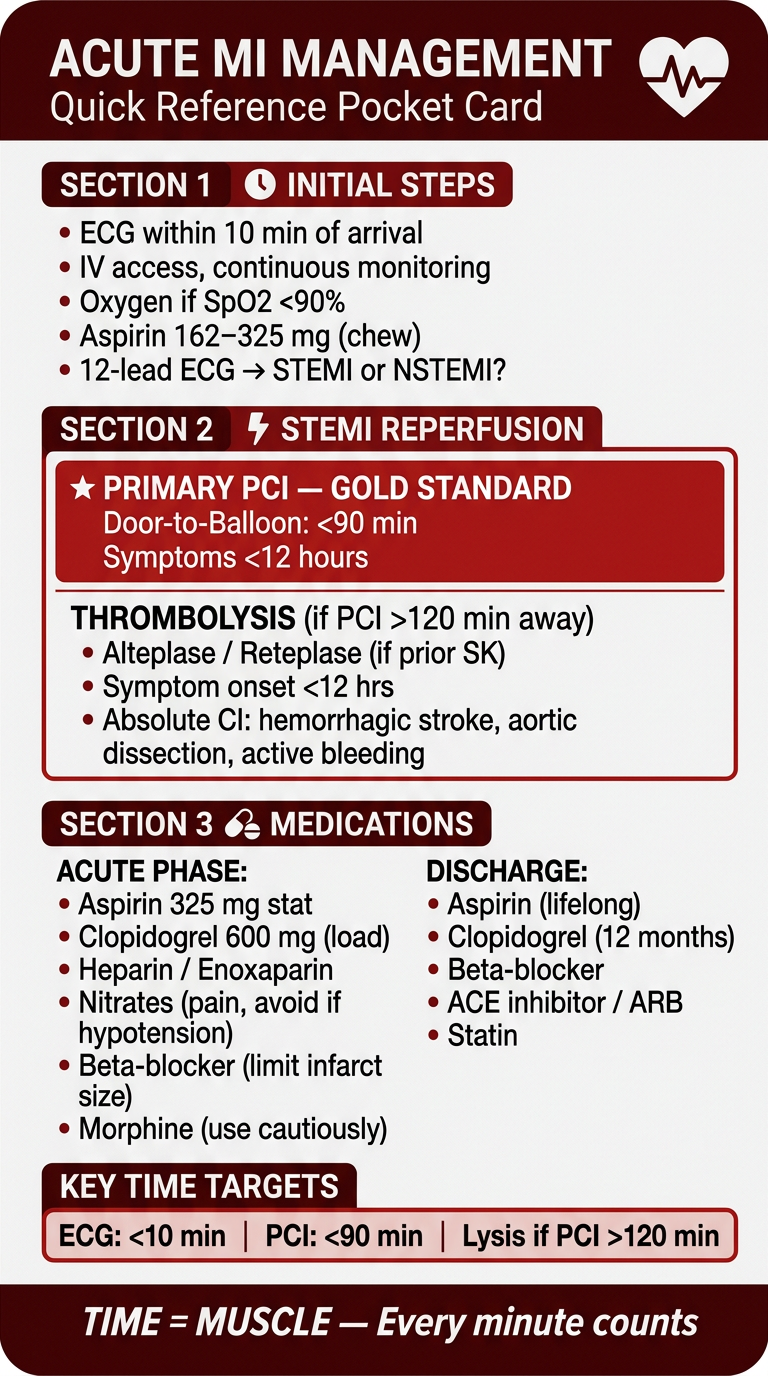
- Initial steps - ECG timing and triage
- Reperfusion strategy - PCI vs thrombolysis decision with time targets
- Medications - both acute-phase and discharge drugs
- Key time targets at a glance
- The reminder "TIME = MUSCLE" at the bottom