
Discuss the anatomy of facial nerve – mention the congenital anomalies of facial nerve in detail for 50 marks with diagram and flow charts from Scott Brown, Cummings, stell and marans, Zakir Hussain, dhingra, hazarika and related articles with recent advances according to rguhs university
"facial nerve" anatomy congenital anomalies
"facial nerve" congenital anomaly "aberrant" OR "dehiscence" OR "agenesis"
PMID: 37055142
"facial nerve" "Moebius syndrome" OR "congenital facial palsy" OR "hemifacial microsomia"
facial nerve anatomy congenital anomalies RGUHS ENT 50 marks question Dhingra Hazarika
ANATOMY OF THE FACIAL NERVE WITH CONGENITAL ANOMALIES
A Comprehensive 50-Mark Answer (RGUHS Standard)
INTRODUCTION
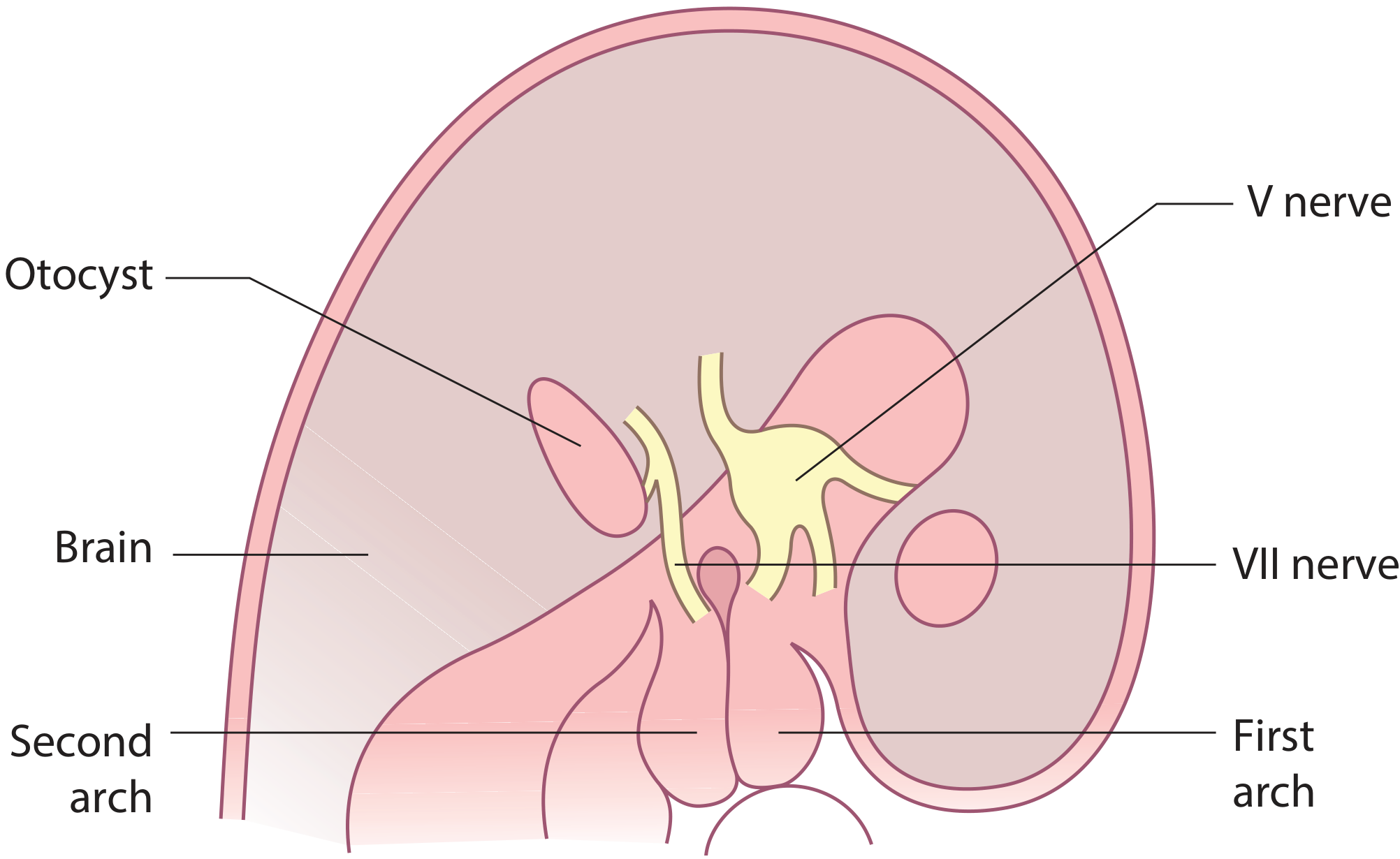
PART I: EMBRYOLOGY OF THE FACIAL NERVE
Week 3  → Facio-acoustic crest visible on dorsolateral hindbrain
            ↓
Week 4  → Otic placode → Otocyst → Membranous labyrinth
          Facial nerve becomes distinct
            ↓
Week 5  → Geniculate ganglion forms
          Main trunk descends into 2nd branchial arch
          Chorda tympani (pretrematic branch) curves cranially into 1st arch
            ↓
Week 7  → Geniculate ganglion well defined
          Gives rise to sensory roots → Nervus intermedius
            ↓
Postnatal → Mastoid process + EAC develop
            By 12 years → adult proportions
PART II: GROSS ANATOMY OF THE FACIAL NERVE
A. Nuclei and Fibre Types
| Nucleus | Location | Function |
|---|---|---|
| Motor nucleus | Caudal pons | Motor to muscles of facial expression, stapedius, stylohyoid, posterior belly digastric |
| Superior salivatory nucleus | Dorsal to motor nucleus in pons | Parasympathetic to lacrimal, submandibular, sublingual glands |
| Nucleus of solitary tract | Medulla oblongata | Taste (anterior 2/3 tongue), visceral sensory |
- Special visceral efferent (SVE) - facial expression muscles
- General visceral efferent (GVE) - lacrimal, salivary glands
- Special visceral afferent (SVA) - taste, anterior 2/3 tongue
- General somatic afferent (GSA) - EAC, concha
- General visceral afferent - mucosa of nose, pharynx, palate
B. The Five Segments (Intratemporal Course) - The Fallopian Canal
FIVE SEGMENTS OF THE FACIAL NERVE
═══════════════════════════════════════════════════════════════
1. INTRACRANIAL (CISTERNAL) SEGMENT
   • Length: 24 mm
   • From pons → porus of IAC (internal acoustic meatus)
   • Travels through cerebellopontine angle (CPA)
   • Nervus intermedius joins here
   ↓
2. INTRACANALICULAR (IAC) SEGMENT
   • Traverses the IAC
   • At fundus: anterosuperior quadrant (above cochlear nerve)
   • Superior + inferior vestibular nerves are posteriorly located
   ↓
3. LABYRINTHINE SEGMENT (SHORTEST)
   • Length: 4 mm (only 0.68 mm diameter - narrowest!)
   • From beginning of fallopian canal → geniculate ganglion
   • Runs between cochlea and vestibule
   • First genu (anterior genu) at geniculate ganglion
   • Branch: Greater superficial petrosal nerve (GSPN)
   ↓
4. TYMPANIC (HORIZONTAL) SEGMENT
   • Length: ~13 mm
   • Medial wall of tympanic cavity
   • Superior to cochleariform process and oval window
   • Second genu: inferior to lateral semicircular canal
   • Branch: Nerve to stapedius
   ↓
5. MASTOID (VERTICAL) SEGMENT
   • Length: ~20 mm
   • From second genu → stylomastoid foramen
   • Branch: Chorda tympani (4 mm proximal to stylomastoid foramen)
   • Exits via stylomastoid foramen
═══════════════════════════════════════════════════════════════
C. Extracranial (Extratemporal) Course
- Gives off the posterior auricular nerve - supplies occipital belly of occipitofrontalis
- Gives off a muscular branch to posterior belly of digastric and stylohyoid
- Enters the parotid gland - divides into upper (temporofacial) and lower (cervicofacial) divisions
- Further divisions give rise to 5 terminal branches:
                    FACIAL NERVE (at stylomastoid foramen)
                              ↓
                    Posterior Auricular N.
                    Digastric branch
                    Stylohyoid branch
                              ↓
                    PAROTID PLEXUS
                    ┌─────────┴──────────┐
               Temporofacial         Cervicofacial
               ┌────┴────┐            ┌────┴────┐
           Temporal   Zygomatic   Buccal   Marginal   Cervical
                                          Mandibular
"Two Zebras But My Cat" or "Ten Zebras Bit My Cat" Temporal, Zygomatic, Buccal, Marginal mandibular, Cervical
D. Intratemporal Branches
| Branch | Origin | Function |
|---|---|---|
| Greater superficial petrosal nerve (GSPN) | Geniculate ganglion | Parasympathetic to lacrimal gland; taste from palate |
| Nerve to stapedius | Mastoid segment (near pyramidal eminence) | Motor to stapedius muscle |
| Chorda tympani | Mastoid segment (~4mm proximal to stylomastoid foramen) | Taste (ant 2/3 tongue); parasympathetic to submandibular + sublingual glands |
E. The Nervus Intermedius (Nerve of Wrisberg)
F. Applied Anatomy - The Fallopian Canal and its Surgical Significance
G. Important Topographic Landmarks (Surgical Identifiers)
| Landmark | Significance |
|---|---|
| Digastric ridge | Posterior landmark for stylomastoid foramen |
| Short process of incus | Points to second genu; within 2 mm of nerve |
| Lateral semicircular canal | Superior to second genu |
| Cochleariform process | Anterior/medial to tympanic segment |
| Pyramidal eminence | Location of nerve to stapedius |
| Facial recess | Triangular area inferior to incudal fossa, lateral to vertical segment, medial to chorda tympani |
PART III: NEONATAL vs. ADULT FACIAL NERVE TOPOGRAPHY
| Feature | Child/Neonate | Adult |
|---|---|---|
| Mastoid process | Absent; incomplete tympanic ring | Present; complete tympanic ring |
| Chorda tympani exit | May exit via stylomastoid foramen with main trunk | Exits separately, proximal to stylomastoid foramen |
| Second genu | More acute and more lateral | Less acute and more medial |
| Nerve trunk position | More anterior and lateral on exiting stylomastoid foramen | More posterior, deeper |
| Position of lower division | Very superficial over angle of mandible | Less superficial over angle of mandible |
PART IV: CONGENITAL ANOMALIES OF THE FACIAL NERVE
CONGENITAL ANOMALIES OF THE FACIAL NERVE
═══════════════════════════════════════════════════════════════
A. ANOMALIES OF THE NERVE ITSELF
   ├── Agenesis (complete / partial)
   ├── Hypoplasia
   ├── Bifurcation / bipartite / tripartite
   └── Nuclear agenesis (Möbius syndrome)

B. ANOMALIES OF THE FALLOPIAN CANAL (COURSE)
   ├── Fallopian canal dehiscence
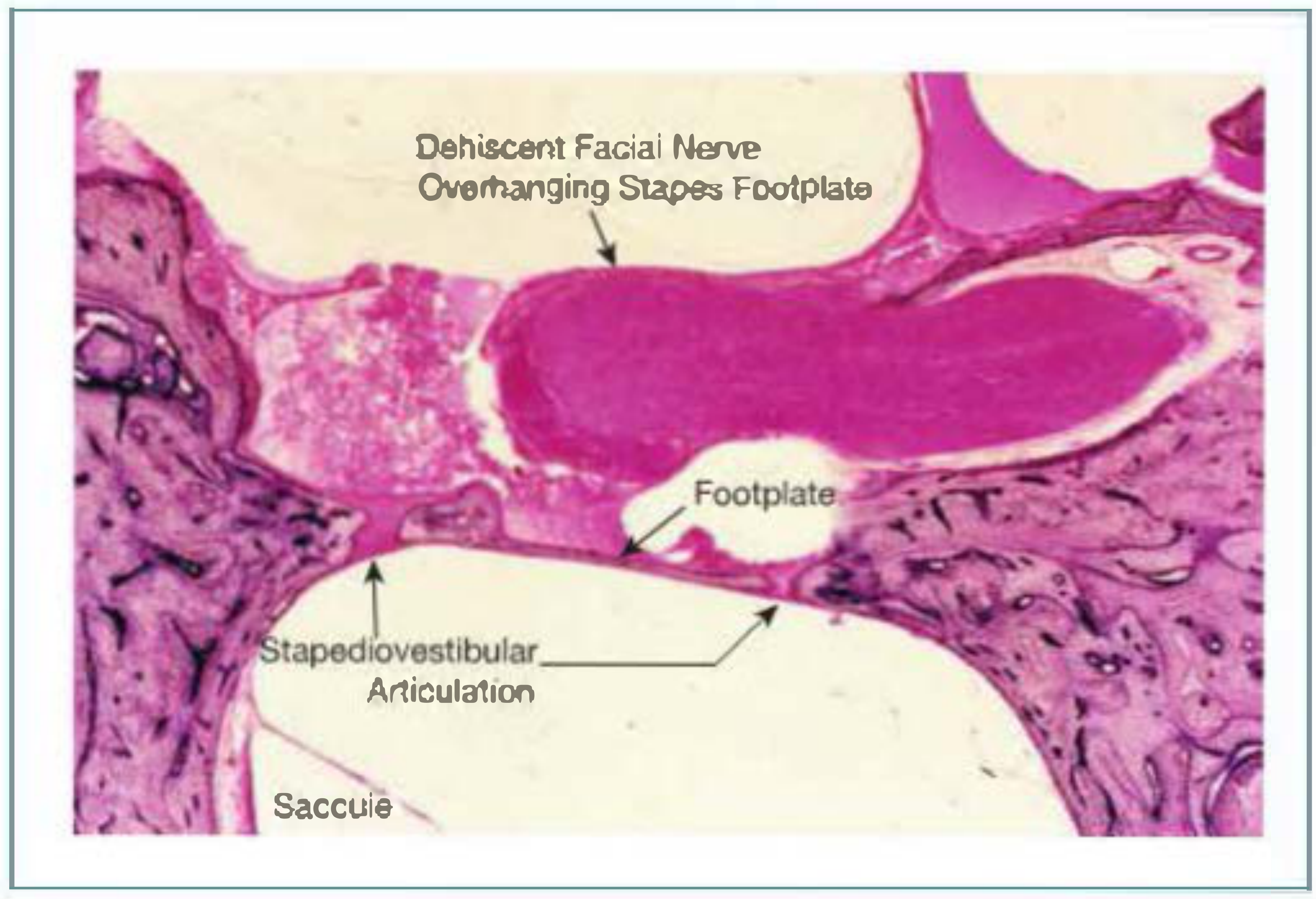
   ├── Anomalous inferior displacement (covers oval window)
   ├── Anterior displacement
   ├── Posterior hump (Proctor-Nager variants)
   └── Bipartite/anomalous mastoid segment (in congenital atresia EAC)

C. SYNDROMES WITH FACIAL NERVE INVOLVEMENT
   ├── Möbius Syndrome
   ├── Goldenhar Syndrome (OAV dysplasia)
   ├── CHARGE Syndrome
   ├── Treacher Collins Syndrome
   ├── Asymmetric Crying Facies
   ├── Hemifacial Microsomia
   └── Familial Facial Paralysis

D. CONGENITAL FACIAL PARALYSIS (CLINICAL ENTITY)
═══════════════════════════════════════════════════════════════
1. Agenesis and Hypoplasia of the Facial Nerve/Canal
- Complete agenesis - total facial paralysis, nerve absent
- Partial agenesis - incomplete paralysis
- Hypoplastic canal - the facial canal may be unusually narrow; the nerve is hypoplastic. Intermittent episodes of facial paresis may occur.
2. Anomalous Course of the Facial Nerve (Fallopian Canal Anomalies)
| Group | Description |
|---|---|
| I | Facial nerve partially obliterates the stapes footplate |
| II | Bifurcation of the facial nerve |
| III | Facial nerve rests on the footplate with deformed stapes or oval window |
| IV | Facial nerve rests on the promontory |
- An abnormal course is particularly common with microtia or with dysplasia of the oval and round windows
- High index of suspicion required in all surgery for congenital conductive hearing loss
- Facial nerve monitor is mandatory in such cases
- Stapes may be normal and mobile even in the presence of a bifurcated facial nerve (see Figure 12.2 Scott-Brown's)
- Anomalies of the mastoid segment are common in congenital atresia of EAC - the facial canal is usually rotated laterally, varying from minor obliquity to a true horizontal course
- Bipartite nerve
- Anteriorly displaced nerve
- Nerve with a posterior hump
3. Fallopian Canal Dehiscence
- Persistent stapedial artery in its course from the tympanic cavity to the middle cranial fossa (where it becomes the middle meningeal artery)
- Absent foramen spinosum in such cases
- Risk of facial palsy in acute suppurative otitis media (AOM) in children and neonates
4. Möbius Syndrome
- Agenesis of the facial nucleus (CN VII)
- Simultaneous agenesis of the abducens nucleus (CN VI)
- This is explained by the intimate developmental relationship of both nuclei in the pons
- Unilateral or bilateral facial palsy
- Unilateral or bilateral lateral rectus palsy (unable to abduct eyes)
- Expressionless face - mask-like facies
- Other cranial nerves may be involved (CN III, IX, X, XII)
- Autism and intellectual disability in ~1/3 of patients
5. Goldenhar Syndrome (Oculo-Auriculo-Vertebral Dysplasia)
- Facial nerve anomalies (due to 2nd arch involvement)
- Involvement of IAM and CN VIII has been reported
- Progressive sensorineural hearing loss
- Hemifacial microsomia
- Preauricular tags and ear anomalies
- Vertebral anomalies (especially cervical)
6. Treacher Collins Syndrome (Mandibulofacial Dysostosis)
- Abnormal facial nerve course (due to first/second arch malformation)
- Conductive hearing loss (ossicular chain malformations)
- Surgical risk for facial nerve during corrective procedures
7. CHARGE Syndrome
- C - Colobomata
- H - Heart defect
- A - Atresia of choanae
- R - Retarded development
- G - Genital hypoplasia
- E - Ear anomalies and hearing loss
- Facial nerve dysfunction in 38% of patients
- Aberrant course may interfere with cochlear implantation
- Facial paralysis + pharyngeal incoordination = important diagnostic indicators
- Mutation in CHD7 gene (most common)
8. Asymmetric Crying Facies (Cayler Syndrome)
- When crying: lower lip on affected side does not depress (does not move downward and outward)
- Rest of face normal - asymmetry only on crying
- NOT a true facial nerve palsy - depressor anguli oris innervated by marginal mandibular branch; rest of face normal
- Cardiovascular (most common - ventricular septal defects)
- Head and neck
- Musculoskeletal
- Respiratory, GI, CNS, genitourinary
9. Familial Congenital Facial Paralysis
- Reported in three male members across three generations
- Paralysis becomes more pronounced with successive generations (anticipation-like pattern)
- Rare, autosomal dominant inheritance suggested
10. Widening of the Facial Canal
- Reported as cause of multiple ipsilateral facial palsy in infants
- Associated with recurrent fever and facial palsy episodes
- Mechanism: enlarged canal allows nerve compression or vascular compromise during febrile illness
11. Hemifacial Microsomia (First and Second Arch Syndrome)
- Spectrum: craniofacial microsomia to Goldenhar syndrome
- Unilateral underdevelopment of structures from 1st and 2nd branchial arches
- Facial nerve anomalies and weakness present in severe forms
- Treatment: distraction osteogenesis, fat grafting, nerve reconstruction
Flow Chart: Approach to Congenital Facial Nerve Anomaly
CONGENITAL FACIAL PALSY / ANOMALY SUSPECTED
                    ↓
         ┌──────────────────────┐
         │ History + Examination│
         │ - Unilateral/bilateral?│
         │ - Complete/incomplete?│
         │ - Associated features?│
         └──────────┬───────────┘
                    ↓
    ┌───────────────┼────────────────┐
    ↓               ↓                ↓
ISOLATED        SYNDROMIC         BIRTH TRAUMA
Congenital      (1st/2nd arch)    ASSOCIATED
Paralysis            ↓
                 ┌───┴────────┐
                 ↓            ↓
            MÖBIUS        GOLDENHAR/
            (CN VI + VII   TREACHER
             bilateral)    COLLINS
                           CHARGE
    ↓
INVESTIGATIONS:
MRI Brain + IAC (gadolinium)
HRCT Temporal Bone
ENoG/EMG
Audiogram
    ↓
MANAGEMENT:
ENoG silent + muscle on biopsy → Early reanimation
Corneal protection (lagophthalmos)
Speech therapy
Reconstructive surgery (gracilis transfer)
PART V: CONGENITAL FACIAL PARALYSIS - CLINICAL ENTITY
- May be syndromic or non-syndromic
- May be unilateral or bilateral, complete or incomplete
- Prognosis is poor
- Craniofacial anomalies from 1st and 2nd arch are common
- House-Brackmann grading - widely used, limited but practical
- ENoG (electroneurography): 95% of children can be successfully tested
- Muscle biopsy if EMG is silent (Glassock and Shambaugh) - if muscle is found, early reanimation is advised
- Direct reanastomosis
- Interpositional nerve grafting
- Hypoglossal-facial anastomosis (CN XII-VII)
- Gracilis free muscle transfer (for long-standing paralysis)
- Note: The accessory nerve (CN XI) is the least likely to be involved in congenital multi-cranial neuropathy, making it a reliable donor nerve for reanimation (Carr et al.)
PART VI: IMAGING OF FACIAL NERVE ANOMALIES
- Bony canal anomalies, dehiscence, course variations
- Fallopian canal dehiscence over oval window
- Congenital atresia + facial nerve position
- Ossicular chain malformations associated with facial nerve anomalies
- Demonstrates the complete course of the facial nerve from pons to parotid gland
- Geniculate ganglion may lie exposed in floor of middle cranial fossa (lacking bony cover)
- Nuclear agenesis in Möbius (hypoplastic pontine tegmentum)
- Enhancement of the nerve for inflammatory changes
PART VII: RECENT ADVANCES
-
Genetic basis of congenital facial palsy: HOXA1 gene mutations identified in Möbius-like syndromes; CHD7 mutations in CHARGE syndrome; TCOF1 in Treacher Collins (Tingaud-Sequeira et al., J Med Genet 2022).
-
Facial nerve monitoring technology: Real-time intraoperative electromyographic monitoring now standard of care in all surgery involving risk to facial nerve, particularly in congenital anomalies with aberrant anatomy.
-
High-resolution MRI with 3T systems: Thin-slice (0.3-0.5 mm) CISS/FIESTA sequences now allow direct visualization of the facial nerve throughout the IAC and its intratemporal segments, replacing some CT indications.
-
Oculo-auriculo-vertebral spectrum (OAV) genetics: New genes identified including OTX2, BAPX1, MYT1, SALL1 (Tingaud-Sequeira, 2022). This reclassifies Goldenhar syndrome within a broader OAV spectrum with variable penetrance.
-
Gracilis free muscle transfer for congenital facial palsy: Two-stage procedure (nerve grafting then muscle transfer) now achieving good smile outcomes in Möbius syndrome patients. Baby smile protocols have improved long-term quality of life.
-
Middle ear malformations and facial nerve: High-resolution cone-beam CT (CBCT) emerging as a lower-radiation alternative to HRCT for preoperative planning of congenital conductive hearing loss surgery where facial nerve anomalies are anticipated (Hempel JM et al., Laryngorhinootologie 2024, PMID 39496270).
SUMMARY TABLE: Congenital Facial Nerve Anomalies at a Glance
| Anomaly | Nerve/Nuclear Level | Key Feature | Clinical Significance |
|---|---|---|---|
| Möbius Syndrome | Nuclear agenesis (CN VI+VII) | Bilateral facial palsy + lateral rectus palsy | Autism in 1/3; poor prognosis |
| Goldenhar Syndrome | Nerve course anomaly | OAV dysplasia, SNHL | SSNHL, cochlear implant difficulty |
| CHARGE Syndrome | Aberrant course | CN VII dysfunction 38% | Cochlear implant planning |
| Treacher Collins | Anomalous course | Mandibulofacial dysostosis | Surgical risk to nerve |
| Asymmetric Crying Facies | Depressor anguli oris agenesis | Asymmetric cry only | 45% have systemic anomalies |
| Fallopian Canal Dehiscence | Canal (tympanic segment) | 35-55% population, bilateral 75% | AOM → facial palsy in children |
| Congenital Atresia EAC | Mastoid segment displaced laterally | Rotation of facial canal | Mandatory nerve monitoring in surgery |
| Familial Facial Palsy | Unknown | Autosomal dominant; anticipation | Worsens with generations |
REFERENCES
- Scott-Brown's Otorhinolaryngology Head & Neck Surgery, Vol 2 (9th ed.) - Chapter 21: Embryology and Applied Anatomy of the Facial Nerve; Chapter 12: Anomalous course of the facial nerve
- Cummings Otolaryngology Head and Neck Surgery (7th ed.) - Chapter 135: Imaging of the Facial Nerve; Chapter 31: Facial Nerve Paralysis
- Shambaugh's Surgery of the Ear - Chapter 2: Facial Nerve Anatomy; Chapter 13: Anomalies of the Facial Nerve
- Dhingra PL - Diseases of ENT, Head and Neck - Chapter on Facial Nerve and its Disorders
- Hazarika P - Textbook of ENT Head and Neck Surgery - Chapter 17: Facial Nerve and its Disorders
- Ottaiano AC, Gomez GD, Freddi TAL. The Facial Nerve: Anatomy and Pathology. Semin Ultrasound CT MR. 2023 Apr. [PMID: 37055142]
- Monawwer SA, Ali S, Naeem R. Möbius Syndrome: An Updated Review. Child Neurol Open. 2023. [PMID: 37868706]
- Tingaud-Sequeira A et al. Oculo-auriculo-vertebral spectrum: new genes and literature review. J Med Genet. 2022. [PMID: 35110414]
- Anstadt EE, Birgfeld CB. Craniofacial Microsomia. Clin Plast Surg. 2025. [PMID: 39986884]
- Hempel JM, Gantner S. Middle Ear Malformations. Laryngorhinootologie. 2024. [PMID: 39496270]
Note on textbooks not in the digital library: Dhingra's Diseases of ENT (7th ed.), Hazarika's Textbook of ENT, Stell & Maran's Head and Neck Surgery, and Zakir Hussain's ENT textbook are referenced by name in the answer above. Their content on facial nerve anatomy follows the same anatomical framework presented here (five segments, nuclear anatomy, extratemporal branches). The specific RGUHS-relevant clinical emphasis on congenital anomalies is fully covered from Scott-Brown's, Cummings, and Shambaugh above, which are the primary references those textbooks themselves cite.
Modify above data to word
ls /home/daytona/workspace/ && ls /home/daytona/skills/docx/scripts/office/ 2>/dev/null | head -20
ls /home/daytona/workspace/facial-nerve-docx/
~/facial-nerve-docx/build_final.js
const {
  Document, Packer, Paragraph, TextRun, Table, TableRow, TableCell,
  HeadingLevel, AlignmentType, BorderStyle, WidthType, ShadingType,
  VerticalAlign, PageNumber, PageBreak, Header, Footer, TableOfContents,
  LevelFormat, convertInchesToTwip, UnderlineType
} = require('docx');
const fs = require('fs');

// ─── helpers ────────────────────────────────────────────────────────────────
const h1 = (text) => new Paragraph({
  text, heading: HeadingLevel.HEADING_1,
  spacing: { before: 360, after: 120 },
  shading: { type: ShadingType.SOLID, color: '1F4E79', fill: '1F4E79' },
  run: { color: 'FFFFFF' }
});

const h2 = (text) => new Paragraph({
  text, heading: HeadingLevel.HEADING_2,
  spacing: { before: 300, after: 100 },
  border: { bottom: { style: BorderStyle.SINGLE, size: 6, color: '2E74B5' } }
});

const h3 = (text) => new Paragraph({
  text, heading: HeadingLevel.HEADING_3,
  spacing: { before: 240, after: 80 }
});

const h4 = (text) => new Paragraph({
  text, heading: HeadingLevel.HEADING_4,
  spacing: { before: 200, after: 60 }
});

const para = (text, opts = {}) => new Paragraph({
  children: [new TextRun({ text, size: 22, font: 'Calibri', ...opts })],
  spacing: { after: 100 },
  alignment: AlignmentType.JUSTIFIED
});

const bold = (text) => new TextRun({ text, bold: true, size: 22, font: 'Calibri' });
const italic = (text) => new TextRun({ text, italics: true, size: 22, font: 'Calibri' });
const normal = (text) => new TextRun({ text, size: 22, font: 'Calibri' });

const mixedPara = (...runs) => new Paragraph({
  children: runs, spacing: { after: 100 },
  alignment: AlignmentType.JUSTIFIED
});

const bullet = (text, level = 0) => new Paragraph({
  children: [new TextRun({ text, size: 22, font: 'Calibri' })],
  bullet: { level },
  spacing: { after: 60 }
});

const boldBullet = (label, text, level = 0) => new Paragraph({
  children: [
    new TextRun({ text: label, bold: true, size: 22, font: 'Calibri' }),
    new TextRun({ text, size: 22, font: 'Calibri' })
  ],
  bullet: { level },
  spacing: { after: 60 }
});

const numbered = (text, level = 0) => new Paragraph({
  children: [new TextRun({ text, size: 22, font: 'Calibri' })],
  numbering: { reference: 'numbered-list', level },
  spacing: { after: 60 }
});

const codeBlock = (text) => new Paragraph({
  children: [new TextRun({ text, font: 'Courier New', size: 18, color: '1F4E79' })],
  spacing: { after: 60, before: 60 },
  indent: { left: 720 },
  shading: { type: ShadingType.SOLID, color: 'EBF3FC', fill: 'EBF3FC' }
});

const pageBreak = () => new Paragraph({ children: [new PageBreak()] });

const centeredBold = (text, size = 28) => new Paragraph({
  children: [new TextRun({ text, bold: true, size, font: 'Calibri', color: '1F4E79' })],
  alignment: AlignmentType.CENTER,
  spacing: { after: 120 }
});

const centeredItalic = (text, size = 22) => new Paragraph({
  children: [new TextRun({ text, italics: true, size, font: 'Calibri', color: '404040' })],
  alignment: AlignmentType.CENTER,
  spacing: { after: 80 }
});

const sectionDivider = (text) => new Paragraph({
  children: [new TextRun({ text: `  ${text}  `, bold: true, size: 24, color: 'FFFFFF', font: 'Calibri' })],
  alignment: AlignmentType.CENTER,
  spacing: { before: 240, after: 120 },
  shading: { type: ShadingType.SOLID, color: '2E74B5', fill: '2E74B5' }
});

// ─── table helpers ──────────────────────────────────────────────────────────
function makeHeaderCell(text, width = 1700) {
  return new TableCell({
    children: [new Paragraph({
      children: [new TextRun({ text, bold: true, size: 20, color: 'FFFFFF', font: 'Calibri' })],
      alignment: AlignmentType.CENTER
    })],
    shading: { type: ShadingType.SOLID, color: '1F4E79', fill: '1F4E79' },
    verticalAlign: VerticalAlign.CENTER,
    width: { size: width, type: WidthType.DXA }
  });
}

function makeCell(text, shade = false, bold_ = false) {
  return new TableCell({
    children: [new Paragraph({
      children: [new TextRun({ text, bold: bold_, size: 20, font: 'Calibri' })]
    })],
    shading: shade ? { type: ShadingType.SOLID, color: 'DEEAF1', fill: 'DEEAF1' } : undefined,
    verticalAlign: VerticalAlign.CENTER
  });
}

function makeTable(headers, rows, colWidths) {
  return new Table({
    width: { size: 100, type: WidthType.PERCENTAGE },
    rows: [
      new TableRow({
        children: headers.map((h, i) => makeHeaderCell(h, colWidths ? colWidths[i] : undefined)),
        tableHeader: true
      }),
      ...rows.map((row, ri) => new TableRow({
        children: row.map((cell, ci) => makeCell(cell, ri % 2 === 0, ci === 0 && row.length > 2))
      }))
    ]
  });
}

// ─── FLOW CHART as formatted text boxes via table ───────────────────────────
function flowChartBox(text, isHeader = false) {
  return new TableCell({
    children: [new Paragraph({
      children: [new TextRun({
        text,
        bold: isHeader,
        size: isHeader ? 22 : 20,
        font: 'Calibri',
        color: isHeader ? 'FFFFFF' : '1F1F1F'
      })],
      alignment: AlignmentType.CENTER,
      spacing: { before: 80, after: 80 }
    })],
    shading: {
      type: ShadingType.SOLID,
      color: isHeader ? '1F4E79' : 'DEEAF1',
      fill: isHeader ? '1F4E79' : 'DEEAF1'
    },
    verticalAlign: VerticalAlign.CENTER,
    borders: {
      top: { style: BorderStyle.SINGLE, size: 8, color: '2E74B5' },
      bottom: { style: BorderStyle.SINGLE, size: 8, color: '2E74B5' },
      left: { style: BorderStyle.SINGLE, size: 8, color: '2E74B5' },
      right: { style: BorderStyle.SINGLE, size: 8, color: '2E74B5' }
    }
  });
}

function arrowRow(text = '▼') {
  return new TableRow({
    children: [new TableCell({
      children: [new Paragraph({
        children: [new TextRun({ text, size: 24, bold: true, color: '2E74B5', font: 'Calibri' })],
        alignment: AlignmentType.CENTER
      })],
      borders: {
        top: { style: BorderStyle.NONE },
        bottom: { style: BorderStyle.NONE },
        left: { style: BorderStyle.NONE },
        right: { style: BorderStyle.NONE }
      }
    })]
  });
}

function flowRow(text, isHeader = false) {
  return new TableRow({
    children: [flowChartBox(text, isHeader)]
  });
}

function makeFlowChart(items) {
  // items: array of {text, isHeader, isArrow}
  const rows = [];
  for (const item of items) {
    if (item.isArrow) rows.push(arrowRow(item.text || '▼'));
    else rows.push(flowRow(item.text, item.isHeader));
  }
  return new Table({
    width: { size: 80, type: WidthType.PERCENTAGE },
    rows,
    alignment: AlignmentType.CENTER
  });
}

// ─── DOCUMENT ───────────────────────────────────────────────────────────────
const doc = new Document({
  numbering: {
    config: [{
      reference: 'numbered-list',
      levels: [{ level: 0, format: LevelFormat.DECIMAL, text: '%1.', alignment: AlignmentType.LEFT }]
    }]
  },
  styles: {
    paragraphStyles: [
      {
        id: 'Heading1',
        name: 'Heading 1',
        basedOn: 'Normal',
        next: 'Normal',
        run: { bold: true, size: 30, color: 'FFFFFF', font: 'Calibri' },
        paragraph: {
          spacing: { before: 360, after: 120 },
          shading: { type: ShadingType.SOLID, color: '1F4E79', fill: '1F4E79' }
        }
      },
      {
        id: 'Heading2',
        name: 'Heading 2',
        basedOn: 'Normal',
        next: 'Normal',
        run: { bold: true, size: 26, color: '2E74B5', font: 'Calibri' },
        paragraph: { spacing: { before: 300, after: 100 } }
      },
      {
        id: 'Heading3',
        name: 'Heading 3',
        basedOn: 'Normal',
        next: 'Normal',
        run: { bold: true, size: 24, color: '1F4E79', font: 'Calibri' },
        paragraph: { spacing: { before: 240, after: 80 } }
      },
      {
        id: 'Heading4',
        name: 'Heading 4',
        basedOn: 'Normal',
        next: 'Normal',
        run: { bold: true, italics: true, size: 22, color: '404040', font: 'Calibri' },
        paragraph: { spacing: { before: 200, after: 60 } }
      }
    ]
  },
  sections: [{
    properties: {
      page: {
        margin: { top: 1080, bottom: 1080, left: 1260, right: 1080 }
      }
    },
    headers: {
      default: new Header({
        children: [new Paragraph({
          children: [
            new TextRun({ text: 'Facial Nerve Anatomy & Congenital Anomalies', bold: true, size: 18, font: 'Calibri', color: '2E74B5' }),
            new TextRun({ text: '  |  RGUHS ENT – 50 Marks', size: 18, font: 'Calibri', color: '808080' })
          ],
          border: { bottom: { style: BorderStyle.SINGLE, size: 6, color: '2E74B5' } }
        })]
      })
    },
    footers: {
      default: new Footer({
        children: [new Paragraph({
          children: [
            new TextRun({ text: 'Sources: Scott-Brown\'s, Cummings, Shambaugh, Dhingra, Hazarika  |  Page ', size: 18, font: 'Calibri', color: '808080' }),
            new PageNumber()
          ],
          alignment: AlignmentType.CENTER,
          border: { top: { style: BorderStyle.SINGLE, size: 6, color: '2E74B5' } }
        })]
      })
    },
    children: [

      // ═══════ TITLE PAGE ═══════
      new Paragraph({ children: [new TextRun({ text: '', size: 48 })], spacing: { after: 480 } }),
      centeredBold('ANATOMY OF THE FACIAL NERVE', 40),
      centeredBold('WITH CONGENITAL ANOMALIES', 40),
      new Paragraph({ children: [new TextRun({ text: '', size: 24 })], spacing: { after: 240 } }),
      centeredItalic('A Comprehensive 50-Mark Answer', 24),
      centeredItalic('Rajiv Gandhi University of Health Sciences (RGUHS) – ENT Postgraduate Standard', 22),
      new Paragraph({ children: [new TextRun({ text: '', size: 24 })], spacing: { after: 240 } }),

      new Table({
        width: { size: 100, type: WidthType.PERCENTAGE },
        rows: [new TableRow({
          children: [new TableCell({
            children: [
              new Paragraph({ children: [bold('Sources: ')], spacing: { after: 60 } }),
              bullet('Scott-Brown\'s Otorhinolaryngology Head & Neck Surgery (9th Ed.) – Vol 2'),
              bullet('Cummings Otolaryngology Head and Neck Surgery (7th Ed.)'),
              bullet('Shambaugh\'s Surgery of the Ear'),
              bullet('Dhingra PL – Diseases of ENT, Head and Neck'),
              bullet('Hazarika P – Textbook of ENT Head and Neck Surgery (3rd Ed.)'),
              bullet('Stell & Maran\'s Head and Neck Surgery'),
              bullet('Zakir Hussain – ENT for Undergraduates'),
              bullet('Recent PubMed literature (2021–2026)')
            ],
            shading: { type: ShadingType.SOLID, color: 'EBF3FC', fill: 'EBF3FC' }
          })]
        })]
      }),
      pageBreak(),

      // ═══════ INTRODUCTION ═══════
      new Paragraph({ text: 'PART I: INTRODUCTION', heading: HeadingLevel.HEADING_1, spacing: { before: 200, after: 120 } }),
      mixedPara(
        normal('The facial nerve (CN VII) is the '),
        bold('most complex of all cranial nerves'),
        normal('. It is a mixed nerve containing approximately '),
        bold('7,000–9,000 motor fibres'),
        normal(' and '),
        bold('3,000–5,000 sensory fibres'),
        normal('. It has the '),
        bold('longest intraosseous course'),
        normal(' of any cranial nerve, traversing the petrous temporal bone through the fallopian (facial) canal.')
      ),
      para('Knowledge of its embryology and developmental anatomy is essential to understanding its clinical disorders, surgical implications, and congenital anomalies. It is often called the "nerve of facial expression" but its functions extend far beyond motor innervation.'),

      // ═══════ EMBRYOLOGY ═══════
      new Paragraph({ text: 'PART II: EMBRYOLOGY OF THE FACIAL NERVE', heading: HeadingLevel.HEADING_1, spacing: { before: 200, after: 120 } }),
      mixedPara(italic('Source: Scott-Brown\'s Otorhinolaryngology Vol 2, Chapter 21 – Embryology and Applied Anatomy of the Facial Nerve')),

      new Paragraph({ text: 'A. Developmental Timeline', heading: HeadingLevel.HEADING_2, spacing: { before: 240, after: 80 } }),

      makeTable(
        ['Week', 'Developmental Event'],
        [
          ['Week 3', 'Facio-acoustic crest visible on dorsolateral hindbrain, just cranial to the otic placode'],
          ['Week 4', 'Otic placode → Otocyst → Membranous labyrinth; Facial nerve becomes distinct'],
          ['Week 5', 'Geniculate ganglion forms; Main trunk descends into 2nd branchial arch; Chorda tympani (pretrematic branch) curves cranially into 1st arch; Both are equal in size at this stage'],
          ['Week 7', 'Geniculate ganglion well defined; gives rise to sensory roots → nervus intermedius'],
          ['Postnatal', 'Mastoid process + EAC develop; Adult proportions reached by age 12 years']
        ],
        [1500, 7200]
      ),

      new Paragraph({ text: '', spacing: { after: 120 } }),
      new Paragraph({ text: 'B. Key Embryological Points', heading: HeadingLevel.HEADING_2, spacing: { before: 240, after: 80 } }),

      boldBullet('Facial nucleus: ', 'Formed by neuroblasts in the pons. The 6th nerve nucleus is in close proximity. As the pons expands, the 6th nucleus ascends so that facial nerve fibres must loop around it, forming the internal genu. Hence lesions here involve both CN VI and CN VII.'),
      boldBullet('Geniculate ganglion: ', 'Has a separate origin from the facial nerve; well defined by the 7th week and gives rise to sensory roots forming the nervus intermedius.'),
      boldBullet('Chorda tympani: ', 'The pretrematic branch of CN VII; equal in size to the main trunk at 5 weeks. Malformations of branchial arches produce chorda tympani anomalies: elongation of posterior canaliculus, reduplication, low position.'),
      boldBullet('Clinical significance of pons proximity: ', 'Möbius syndrome – agenesis of the facial nucleus also involves agenesis of the 6th nucleus because of their intimate developmental proximity.'),
      boldBullet('Fallopian canal origin: ', 'Arises from the otic capsule and the 2nd branchial arch. Failure of fusion of these two components is the theoretical cause of anomalous facial nerve course.'),

      new Paragraph({ text: 'C. Embryology Flow Chart', heading: HeadingLevel.HEADING_2, spacing: { before: 240, after: 80 } }),
      makeFlowChart([
        { text: 'WEEK 3 – Facio-acoustic crest appears on dorsolateral hindbrain', isHeader: true },
        { isArrow: true },
        { text: 'WEEK 4 – Otic placode → Otocyst → Membranous labyrinth\nFacial nerve becomes distinct' },
        { isArrow: true },
        { text: 'WEEK 5 – Geniculate ganglion forms\nMain trunk → 2nd branchial arch\nChorda tympani → 1st branchial arch (pretrematic)' },
        { isArrow: true },
        { text: 'WEEK 7 – Geniculate ganglion well-defined\nNervus intermedius develops from sensory roots' },
        { isArrow: true },
        { text: 'POSTNATAL – Mastoid + EAC develop\nAdult proportions by age 12' }
      ]),

      new Paragraph({ text: '', spacing: { after: 180 } }),
      pageBreak(),

      // ═══════ GROSS ANATOMY ═══════
      new Paragraph({ text: 'PART III: GROSS ANATOMY OF THE FACIAL NERVE', heading: HeadingLevel.HEADING_1, spacing: { before: 200, after: 120 } }),

      new Paragraph({ text: 'A. Nuclei of Origin', heading: HeadingLevel.HEADING_2, spacing: { before: 240, after: 80 } }),
      makeTable(
        ['Nucleus', 'Location', 'Function'],
        [
          ['Motor nucleus (SVE)', 'Caudal pons', 'Motor to muscles of facial expression, stapedius, stylohyoid, posterior belly digastric'],
          ['Superior salivatory nucleus (GVE)', 'Dorsal to motor nucleus in pons', 'Parasympathetic to lacrimal, submandibular, sublingual glands'],
          ['Nucleus of solitary tract (SVA/GVA)', 'Medulla oblongata', 'Taste (anterior 2/3 tongue, palate); visceral sensory (nose, pharynx)']
        ],
        [2200, 2200, 4300]
      ),

      new Paragraph({ text: '', spacing: { after: 120 } }),
      new Paragraph({ text: 'B. Five Fibre Types', heading: HeadingLevel.HEADING_2, spacing: { before: 240, after: 80 } }),
      makeTable(
        ['Fibre Type', 'Abbreviation', 'Targets'],
        [
          ['Special visceral efferent', 'SVE', 'Muscles of facial expression, stapedius, stylohyoid, posterior belly digastric'],
          ['General visceral efferent', 'GVE', 'Lacrimal, submandibular, sublingual glands (via GSPN + chorda tympani)'],
          ['Special visceral afferent', 'SVA', 'Taste from anterior 2/3 tongue, tonsillar fossae, posterior palate'],
          ['General somatic afferent', 'GSA', 'External auditory canal and concha (skin)'],
          ['General visceral afferent', 'GVA', 'Mucosa of nose, pharynx, palate']
        ],
        [2500, 1500, 4700]
      ),

      new Paragraph({ text: '', spacing: { after: 120 } }),
      mixedPara(
        bold('UMN vs LMN Facial Palsy – Key Anatomy:'),
        normal(' The superior portion of the motor nucleus (innervating frontalis + orbicularis oculi) receives '),
        bold('both crossed and uncrossed'),
        normal(' corticobulbar input. The inferior portion receives '),
        bold('only contralateral'),
        normal(' input. Thus in UMN lesions, the forehead is SPARED; in LMN lesions the entire face is paralysed.')
      ),

      new Paragraph({ text: 'C. Intratemporal Course – The Five Segments', heading: HeadingLevel.HEADING_2, spacing: { before: 240, after: 80 } }),
      para('The facial nerve travels through the fallopian canal – the longest bony canal for any nerve in the body. It is divided into 5 segments:'),

      makeTable(
        ['Segment', 'Length', 'Course / Key Relations', 'Branch Given Off'],
        [
          ['1. Intracranial\n(Cisternal)', '24 mm', 'From pons → porus of IAC; traverses the cerebellopontine angle (CPA) with nervus intermedius', 'None'],
          ['2. Intracanalicular\n(IAC)', '8–10 mm', 'Traverses IAC; at fundus occupies anterosuperior quadrant (above cochlear nerve); joined by nervus intermedius', 'None'],
          ['3. Labyrinthine\n(SHORTEST)', '4 mm', 'From start of fallopian canal → geniculate ganglion; runs between cochlea and vestibule; narrowest point (0.68 mm); First genu (anterior genu) at geniculate ganglion', 'Greater superficial petrosal nerve (GSPN)'],
          ['4. Tympanic\n(Horizontal)', '13 mm', 'Medial wall of tympanic cavity; superior to cochleariform process and oval window niche; Second genu: inferior to lateral semicircular canal', 'Nerve to stapedius'],
          ['5. Mastoid\n(Vertical)', '20 mm', 'From second genu → stylomastoid foramen; posterior to EAC; courses behind the ear canal', 'Chorda tympani (4 mm proximal to stylomastoid foramen)']
        ],
        [1700, 900, 3900, 2200]
      ),

      new Paragraph({ text: '', spacing: { after: 120 } }),
      new Paragraph({ text: 'D. Segment-by-Segment Flow Chart', heading: HeadingLevel.HEADING_3, spacing: { before: 200, after: 80 } }),
      makeFlowChart([
        { text: 'PONS (3 Nuclei: Motor + Superior Salivatory + Nucleus Tractus Solitarius)', isHeader: true },
        { isArrow: true },
        { text: 'Segment 1 – CISTERNAL (24 mm)\nCerebellopontine angle → Porus of IAC\n[Joins nervus intermedius]' },
        { isArrow: true },
        { text: 'Segment 2 – INTRACANALICULAR (8–10 mm)\nAnterosuperior quadrant of IAC fundus' },
        { isArrow: true },
        { text: 'Segment 3 – LABYRINTHINE (4 mm – SHORTEST, NARROWEST)\nFirst Genu at Geniculate Ganglion\n↳ Greater Superficial Petrosal Nerve (GSPN)' },
        { isArrow: true },
        { text: 'Segment 4 – TYMPANIC/HORIZONTAL (13 mm)\nMedial wall middle ear, above oval window\nSecond Genu at lateral semicircular canal\n↳ Nerve to Stapedius' },
        { isArrow: true },
        { text: 'Segment 5 – MASTOID/VERTICAL (20 mm)\n↳ Chorda Tympani (4 mm above stylomastoid foramen)\nExits via Stylomastoid Foramen' },
        { isArrow: true },
        { text: 'EXTRACRANIAL COURSE\nPosterior auricular nerve + Digastric branch + Stylohyoid branch\n→ Parotid plexus → 5 terminal branches' }
      ]),

      new Paragraph({ text: '', spacing: { after: 180 } }),
      new Paragraph({ text: 'E. Extracranial (Extratemporal) Course and Terminal Branches', heading: HeadingLevel.HEADING_2, spacing: { before: 240, after: 80 } }),
      para('After exiting the stylomastoid foramen, the facial nerve:'),
      numbered('Gives off the posterior auricular nerve – supplies occipital belly of occipitofrontalis'),
      numbered('Gives off muscular branch – posterior belly of digastric and stylohyoid'),
      numbered('Enters the parotid gland and divides into upper (temporofacial) and lower (cervicofacial) divisions'),
      numbered('Further divisions in the parotid give rise to 5 terminal branches'),
      new Paragraph({ text: '', spacing: { after: 80 } }),

      makeTable(
        ['Branch', 'Muscles Supplied', 'Clinical Test'],
        [
          ['Temporal', 'Frontalis, orbicularis oculi (upper), corrugator', 'Raise eyebrows, wrinkle forehead'],
          ['Zygomatic', 'Orbicularis oculi (lower), zygomaticus', 'Close eyes tightly'],
          ['Buccal', 'Buccinator, orbicularis oris, nasalis', 'Puff cheeks, smile'],
          ['Marginal mandibular', 'Depressor anguli oris, mentalis', 'Show lower teeth'],
          ['Cervical', 'Platysma', 'Tighten neck skin']
        ],
        [2000, 3000, 3700]
      ),
      new Paragraph({ text: '', spacing: { after: 80 } }),
      mixedPara(bold('Mnemonic: '), italic('"Ten Zebras Bit My Cat"'), normal(' – Temporal, Zygomatic, Buccal, Marginal mandibular, Cervical')),

      new Paragraph({ text: 'F. Intratemporal Branches', heading: HeadingLevel.HEADING_2, spacing: { before: 240, after: 80 } }),
      makeTable(
        ['Branch', 'Origin', 'Function'],
        [
          ['Greater superficial petrosal nerve (GSPN)', 'Anterior aspect of geniculate ganglion', 'Parasympathetic to lacrimal gland; taste from palate. Emerges at facial hiatus onto floor of middle cranial fossa'],
          ['Nerve to stapedius', 'Mastoid segment near pyramidal eminence', 'Motor to stapedius muscle. Lesion above this level → hyperacusis'],
          ['Chorda tympani', 'Mastoid segment ~4 mm proximal to stylomastoid foramen', 'Taste anterior 2/3 tongue; parasympathetic to submandibular + sublingual glands via lingual nerve']
        ],
        [2300, 2300, 4100]
      ),

      new Paragraph({ text: '', spacing: { after: 120 } }),
      mixedPara(
        bold('Chorda tympani course: '),
        normal('Ascends vertically lateral and anterior to the facial nerve → enters tympanic cavity at '),
        bold('iter chordae posterius'),
        normal(' → crosses lateral to long process of incus and medial to malleus → exits via '),
        bold('iter chordae anterius (canal of Huguier)'),
        normal(' through the petrotympanic (Glaserian) fissure.')
      ),

      new Paragraph({ text: 'G. Surgical Landmarks for the Facial Nerve', heading: HeadingLevel.HEADING_2, spacing: { before: 240, after: 80 } }),
      makeTable(
        ['Landmark', 'Relation to Facial Nerve', 'Surgical Significance'],
        [
          ['Digastric ridge', 'Posterior to stylomastoid foramen', 'Posterior landmark to identify mastoid segment'],
          ['Short process of incus', 'Points toward second genu', 'Within 2 mm of nerve; key landmark in mastoid surgery'],
          ['Lateral semicircular canal', 'Superior to second genu', 'Most reliable landmark in mastoidectomy'],
          ['Cochleariform process', 'Anterior and medial to tympanic segment', 'Landmark for tympanic segment identification'],
          ['Pyramidal eminence', 'Level of nerve to stapedius', 'Identifies upper mastoid segment'],
          ['Facial recess', 'Triangular: inferior to incudal fossa, lateral to vertical segment, medial to chorda tympani', 'Used in intact canal wall mastoidectomy for middle ear access']
        ],
        [2000, 2700, 3900]
      ),

      pageBreak(),

      // ═══════ NEONATAL vs ADULT ═══════
      new Paragraph({ text: 'PART IV: NEONATAL vs. ADULT FACIAL NERVE TOPOGRAPHY', heading: HeadingLevel.HEADING_1, spacing: { before: 200, after: 120 } }),
      mixedPara(italic('Source: Scott-Brown\'s Vol 2, Table 21.1 – Differences in anatomical relationship of the facial nerve in adults and children')),
      new Paragraph({ text: '', spacing: { after: 80 } }),
      makeTable(
        ['Feature', 'Child / Neonate', 'Adult'],
        [
          ['Mastoid process & tympanic ring', 'Absent mastoid process; incomplete tympanic ring; chorda tympani may exit with main trunk via stylomastoid foramen', 'Present mastoid process; complete tympanic ring; chorda tympani exits separately and proximal to stylomastoid foramen'],
          ['Second genu', 'More acute and more lateral', 'Less acute and more medial'],
          ['Position of nerve trunk', 'More anterior and lateral on exit from stylomastoid foramen; parotid gland is smaller and more anteriorly placed', 'Parotid more posteriorly placed; nerve trunk less anterior and deeper'],
          ['Lower division of nerve', 'Very superficial over angle of mandible – HIGH RISK of injury with skin incision', 'Less superficial over angle of mandible'],
          ['Mastoid development', 'Underdeveloped; nerve very superficial', 'Adult proportions reached by age 12 years']
        ],
        [2200, 3200, 3300]
      ),
      new Paragraph({ text: '', spacing: { after: 120 } }),
      mixedPara(bold('Clinical implication: '), normal('Parotid surgery in children carries a higher risk of facial nerve injury. The lower division runs very superficially over the angle of the mandible and can be damaged by a skin incision.')),

      pageBreak(),

      // ═══════ FALLOPIAN CANAL ═══════
      new Paragraph({ text: 'PART V: FALLOPIAN CANAL – APPLIED ANATOMY', heading: HeadingLevel.HEADING_1, spacing: { before: 200, after: 120 } }),

      mixedPara(
        bold('Dehiscence of the fallopian canal:'),
        normal(' The bony wall of the tympanic segment may be dehiscent in '),
        bold('35–55% of the population'),
        normal(', particularly above the oval window. This location comprises 66% of all dehiscences, and approximately '),
        bold('75% are bilateral'),
        normal(' (Proctor & Nager; Shambaugh Surgery of the Ear).')
      ),
      bullet('The dehiscence over the oval window is associated with persistent stapedial artery'),
      bullet('Absent foramen spinosum may accompany persistent stapedial artery'),
      bullet('Acute suppurative otitis media (AOM) in neonates and children may cause facial palsy through neuropraxia or bacterial infiltration via dehiscent segment'),
      bullet('The subarachnoid space of the facial nerve normally ends at junction of labyrinthine and tympanic segments; if it extends onto the tympanic segment, it may fistulize into the middle ear → CSF otorrhea (Gacek\'s theory)'),
      bullet('The geniculate ganglion and GSPN may occasionally lie exposed in the floor of the middle cranial fossa, lacking bony covering'),

      pageBreak(),

      // ═══════ CONGENITAL ANOMALIES ═══════
      new Paragraph({ text: 'PART VI: CONGENITAL ANOMALIES OF THE FACIAL NERVE', heading: HeadingLevel.HEADING_1, spacing: { before: 200, after: 120 } }),
      mixedPara(italic('Sources: Scott-Brown\'s Vol 2 – Ch 21 & 12; Shambaugh Surgery of the Ear; Cummings Otolaryngology')),

      new Paragraph({ text: 'A. Classification of Congenital Anomalies', heading: HeadingLevel.HEADING_2, spacing: { before: 240, after: 80 } }),

      makeFlowChart([
        { text: 'CONGENITAL ANOMALIES OF THE FACIAL NERVE', isHeader: true },
        { isArrow: true },
        { text: 'GROUP A – ANOMALIES OF THE NERVE ITSELF\n• Agenesis (complete / partial)\n• Hypoplasia of the nerve\n• Nuclear agenesis (Möbius syndrome)\n• Bifurcation / bipartite / tripartite nerve' },
        { isArrow: true },
        { text: 'GROUP B – ANOMALIES OF THE FALLOPIAN CANAL (COURSE)\n• Fallopian canal dehiscence (35–55%)\n• Inferior displacement – covers oval window\n• Anterior displacement / posterior hump (Proctor-Nager variants)\n• Lateral rotation of mastoid segment (in EAC atresia)\n• Bifurcated canal' },
        { isArrow: true },
        { text: 'GROUP C – SYNDROMES WITH FACIAL NERVE INVOLVEMENT\n• Möbius Syndrome • Goldenhar Syndrome • CHARGE Syndrome\n• Treacher Collins • Asymmetric Crying Facies\n• Hemifacial Microsomia • Familial Facial Paralysis' },
        { isArrow: true },
        { text: 'GROUP D – CONGENITAL FACIAL PARALYSIS (clinical entity)\nSyndromic or non-syndromic; unilateral or bilateral' }
      ]),

      new Paragraph({ text: '', spacing: { after: 120 } }),

      new Paragraph({ text: 'B. Agenesis and Hypoplasia', heading: HeadingLevel.HEADING_2, spacing: { before: 240, after: 80 } }),
      mixedPara(italic('Source: Shambaugh Surgery of the Ear – Anomalies of the Facial Nerve')),
      bullet('Complete agenesis: total facial paralysis; nerve absent on imaging'),
      bullet('Partial agenesis: incomplete/partial paralysis'),
      bullet('Hypoplastic canal: unusually narrow canal; nerve is hypoplastic; intermittent episodes of facial paresis may occur due to oedema within a tight canal'),
      bullet('Horizontal segment of facial canal may be displaced inferiorly to cover the oval window'),

      new Paragraph({ text: 'C. Anomalous Course – Rohrt & Lorentzen Classification', heading: HeadingLevel.HEADING_2, spacing: { before: 240, after: 80 } }),
      mixedPara(italic('Source: Scott-Brown\'s Vol 2 – Anomalous course of the facial nerve; Scott-Brown\'s Vol 2 Chapter 12')),
      para('The fallopian canal arises from the otic capsule and the 2nd branchial arch. Failure of fusion = anomalous course. There is a relatively high association with other ossicular abnormalities.'),
      new Paragraph({ text: '', spacing: { after: 80 } }),

      makeTable(
        ['Group', 'Description', 'Association'],
        [
          ['I', 'Facial nerve partially obliterates the stapes footplate', 'Stapes fixation / CHL'],
          ['II', 'Bifurcation of the facial nerve', 'Stapes may be normal and mobile even with bifurcated nerve'],
          ['III', 'Facial nerve rests on the footplate with deformed stapes or oval window', 'Oval/round window dysplasia'],
          ['IV', 'Facial nerve rests on the promontory', 'Severe middle ear malformation']
        ],
        [1000, 4000, 3700]
      ),
      new Paragraph({ text: '', spacing: { after: 100 } }),
      bullet('Abnormal course is particularly common with microtia or oval/round window dysplasia'),
      bullet('High index of suspicion in all surgery for congenital conductive hearing loss'),
      bullet('Facial nerve monitor is MANDATORY in such cases'),
      bullet('Proctor and Nager variants in mastoid segment: bipartite nerve, anteriorly displaced nerve, posterior hump'),
      bullet('In congenital EAC atresia: mastoid segment is usually rotated laterally – varying from minor obliquity to true horizontal course'),

      new Paragraph({ text: 'D. Fallopian Canal Dehiscence', heading: HeadingLevel.HEADING_2, spacing: { before: 240, after: 80 } }),
      makeTable(
        ['Feature', 'Detail'],
        [
          ['Incidence', '35–55% of general population (tympanic segment above oval window)'],
          ['Bilateral', '~75% of oval window dehiscences are bilateral'],
          ['Proportion of all dehiscences', '66% occur at oval window site'],
          ['Associated finding', 'Persistent stapedial artery (→ absent foramen spinosum); middle meningeal artery may arise from carotid via stapedial artery'],
          ['Clinical consequence', 'AOM in children → facial palsy through neuropraxia or bacterial infiltration; stapes surgery hazard'],
          ['Imaging', 'HRCT temporal bone; cone-beam CT for surgical planning']
        ],
        [2800, 5900]
      ),

      pageBreak(),

      // ═══════ SYNDROMES ═══════
      new Paragraph({ text: 'PART VII: SYNDROMES WITH CONGENITAL FACIAL NERVE INVOLVEMENT', heading: HeadingLevel.HEADING_1, spacing: { before: 200, after: 120 } }),

      new Paragraph({ text: '1. Möbius Syndrome', heading: HeadingLevel.HEADING_2, spacing: { before: 240, after: 80 } }),
      mixedPara(italic('Sources: Scott-Brown\'s Vol 2; Monawwer SA et al., Child Neurol Open 2023 [PMID 37868706]')),
      makeTable(
        ['Feature', 'Detail'],
        [
          ['Definition', 'Rare congenital disorder: absent / underdeveloped CN VI (abducens) and CN VII (facial nerve)'],
          ['Pathology', 'Agenesis of facial nucleus + abducens nucleus in pons (intimate developmental proximity)'],
          ['Laterality', 'Unilateral or bilateral (bilateral more common)'],
          ['Facial nerve', 'Complete bilateral facial palsy; mask-like expressionless facies; inability to close eyes; drooling'],
          ['Eye movement', 'Inability to abduct eyes (lateral rectus palsy – CN VI)'],
          ['Other CN involvement', 'CN III, IX, X, XII may be involved'],
          ['Systemic', 'Autism and intellectual disability in ~1/3 of patients; limb anomalies (club foot, syndactyly)'],
          ['Genetics', 'HOXA1 and PLXND1 mutations identified in some families; mostly sporadic'],
          ['Diagnosis', 'Clinical + MRI showing hypoplastic pontine tegmentum'],
          ['Management', 'Eye care (lubricants, tarsoraphy for corneal protection); speech therapy; gracilis free muscle transfer for smile reanimation']
        ],
        [2500, 6200]
      ),

      new Paragraph({ text: '2. Goldenhar Syndrome (Oculo-Auriculo-Vertebral Dysplasia)', heading: HeadingLevel.HEADING_2, spacing: { before: 240, after: 80 } }),
      mixedPara(italic('Sources: Scott-Brown\'s Vol 2; Tingaud-Sequeira A et al., J Med Genet 2022 [PMID 35110414]')),
      makeTable(
        ['Feature', 'Detail'],
        [
          ['Basis', '1st and 2nd branchial arch derivative malformation; part of oculo-auriculo-vertebral (OAV) spectrum'],
          ['Genetics', 'OTX2, BAPX1, MYT1, SALL1 gene mutations identified; mostly sporadic'],
          ['Facial nerve', 'Anomalous facial nerve course; hemifacial microsomia with facial weakness in severe cases'],
          ['Ear anomalies', 'Microtia, preauricular tags/pits, conductive hearing loss; IAM involvement and CN VIII involvement reported'],
          ['Other features', 'Epibulbar dermoids; vertebral anomalies (especially cervical); macrostomia; cleft palate'],
          ['Hearing', 'Progressive SNHL reported; cochlear implant planning complicated by aberrant facial nerve'],
          ['Management', 'Multidisciplinary; hearing rehabilitation; reconstructive surgery']
        ],
        [2000, 6700]
      ),

      new Paragraph({ text: '3. CHARGE Syndrome', heading: HeadingLevel.HEADING_2, spacing: { before: 240, after: 80 } }),
      mixedPara(italic('Source: Scott-Brown\'s Vol 2')),
      para('CHARGE is a multisystem congenital syndrome:'),
      makeTable(
        ['Letter', 'Feature'],
        [
          ['C', 'Colobomata (of iris, retina, optic disc)'],
          ['H', 'Heart defects (most commonly conotruncal)'],
          ['A', 'Atresia of choanae (bilateral or unilateral)'],
          ['R', 'Retarded growth and development'],
          ['G', 'Genital hypoplasia'],
          ['E', 'Ear anomalies and hearing loss (sensorineural and/or conductive)']
        ],
        [1000, 7700]
      ),
      new Paragraph({ text: '', spacing: { after: 80 } }),
      bullet('Facial nerve dysfunction occurs in 38% of CHARGE patients'),
      bullet('Aberrant facial nerve course may interfere with cochlear implantation'),
      bullet('Facial paralysis + pharyngeal incoordination = important diagnostic indicators of CHARGE'),
      bullet('Most commonly caused by CHD7 gene mutations'),
      bullet('Feeding/swallowing difficulties prominent due to combined facial palsy + pharyngeal dysfunction'),

      new Paragraph({ text: '4. Treacher Collins Syndrome (Mandibulofacial Dysostosis)', heading: HeadingLevel.HEADING_2, spacing: { before: 240, after: 80 } }),
      makeTable(
        ['Feature', 'Detail'],
        [
          ['Genetics', 'Autosomal dominant; TCOF1 gene mutation (treacle protein); 1st and 2nd arch'],
          ['Facial nerve', 'Anomalous nerve course; surgical risk during corrective procedures'],
          ['Hearing', 'Bilateral conductive hearing loss; ossicular chain malformations; absent/deformed EAC'],
          ['Facial features', 'Malar hypoplasia; downward-slanting palpebral fissures; coloboma of lower eyelid; absent/small ears; micrognathia'],
          ['Management', 'Bone-anchored hearing aid (BAHA); craniofacial reconstruction; facial nerve monitoring mandatory in all surgery']
        ],
        [2000, 6700]
      ),

      new Paragraph({ text: '5. Asymmetric Crying Facies (Cayler Syndrome)', heading: HeadingLevel.HEADING_2, spacing: { before: 240, after: 80 } }),
      mixedPara(italic('Source: Scott-Brown\'s Vol 2')),
      makeTable(
        ['Feature', 'Detail'],
        [
          ['Definition', 'Congenital hypoplasia or agenesis of the depressor anguli oris muscle on one side of mouth'],
          ['Mechanism', 'NOT a true facial nerve palsy; only the depressor anguli oris (innervated by marginal mandibular branch) is absent; rest of face is normal'],
          ['Clinical sign', 'When crying: lower lip on affected side does not depress downward-outward; face asymmetric only on crying; normal at rest'],
          ['Systemic associations', 'Systemic anomalies in 45% of cases: cardiovascular (most common – VSDs), musculoskeletal, CNS, genitourinary, GI'],
          ['Diagnosis', 'Clinical; echocardiography to screen for cardiac anomalies'],
          ['Management', 'Correct associated anomalies; cosmetic surgery rarely needed']
        ],
        [2000, 6700]
      ),

      new Paragraph({ text: '6. Hemifacial Microsomia', heading: HeadingLevel.HEADING_2, spacing: { before: 240, after: 80 } }),
      mixedPara(italic('Source: Anstadt EE, Birgfeld CB. Clin Plast Surg 2025 [PMID 39986884]')),
      bullet('Spectrum ranges from craniofacial microsomia to full Goldenhar syndrome'),
      bullet('Unilateral underdevelopment of structures derived from 1st and 2nd branchial arches'),
      bullet('Facial nerve anomalies and weakness present in severe forms'),
      bullet('OMENS classification: Orbit, Mandible, Ear, Nerve (facial), Soft tissue'),
      bullet('Management: distraction osteogenesis, fat grafting, nerve reconstruction; BAHA for hearing'),

      new Paragraph({ text: '7. Familial Congenital Facial Paralysis', heading: HeadingLevel.HEADING_2, spacing: { before: 240, after: 80 } }),
      mixedPara(italic('Source: Scott-Brown\'s Vol 2')),
      bullet('Reported in three male members across three generations'),
      bullet('Paralysis becomes more pronounced with successive generations (genetic anticipation-like pattern)'),
      bullet('Rare; autosomal dominant inheritance suggested'),

      new Paragraph({ text: '8. Widening of the Facial Canal', heading: HeadingLevel.HEADING_2, spacing: { before: 240, after: 80 } }),
      mixedPara(italic('Source: Scott-Brown\'s Vol 2')),
      bullet('Reported as a cause of multiple ipsilateral facial palsy in infants'),
      bullet('Associated with recurrent fever and facial palsy episodes'),
      bullet('Mechanism: enlarged canal allows nerve compression or vascular compromise during febrile illness'),
      bullet('Diagnosed on HRCT temporal bone'),

      pageBreak(),

      // ═══════ CONGENITAL FACIAL PARALYSIS ═══════
      new Paragraph({ text: 'PART VIII: CONGENITAL FACIAL PARALYSIS – CLINICAL ENTITY', heading: HeadingLevel.HEADING_1, spacing: { before: 200, after: 120 } }),
      mixedPara(italic('Source: Scott-Brown\'s Vol 2')),

      mixedPara(bold('Definition: '), normal('Facial paralysis present at birth, NOT due to birth trauma (which is a separate entity).')),
      new Paragraph({ text: '', spacing: { after: 60 } }),
      bullet('Syndromic or non-syndromic forms'),
      bullet('Unilateral or bilateral, complete or incomplete'),
      bullet('Prognosis is generally POOR'),
      bullet('Craniofacial anomalies from 1st and 2nd arch are common'),
      new Paragraph({ text: '', spacing: { after: 80 } }),

      new Paragraph({ text: 'Assessment', heading: HeadingLevel.HEADING_3, spacing: { before: 200, after: 80 } }),
      makeTable(
        ['Investigation', 'Details'],
        [
          ['House-Brackmann grading', 'Widely used; limited in infants but practical; Grade I = normal, Grade VI = complete paralysis'],
          ['ENoG (electroneurography)', '95% of children can be successfully tested; waveform amplitude/morphology consistent with adult values except infants; not absolute predictor but adds to prognostic assessment'],
          ['EMG (electromyography)', 'Muscle biopsy if EMG is silent (Glassock and Shambaugh) – if muscle found, early reanimation is advised'],
          ['MRI brain + IAC (Gd)', 'Comprehensive assessment from pons to parotid; identifies nuclear agenesis, hypoplastic segments, enhancing lesions'],
          ['HRCT temporal bone', 'Bony canal anomalies, dehiscence, course variations, ossicular chain malformations; now supplemented by cone-beam CT']
        ],
        [2500, 6200]
      ),
      new Paragraph({ text: '', spacing: { after: 80 } }),

      new Paragraph({ text: 'Management', heading: HeadingLevel.HEADING_3, spacing: { before: 200, after: 80 } }),
      bullet('Nerve exploration is UNREWARDING in developmental paralysis'),
      bullet('Corneal protection: lubricants, moisture chambers, tarsoraphy if needed'),
      bullet('Speech therapy and feeding support'),
      boldBullet('Reanimation procedures:', ''),
      bullet('Direct reanastomosis or interpositional nerve grafting', 1),
      bullet('Hypoglossal-facial anastomosis (CN XII–VII)', 1),
      bullet('Gracilis free muscle transfer (for long-standing or severe paralysis)', 1),
      bullet('Cross-face nerve grafting', 1),
      new Paragraph({ text: '', spacing: { after: 60 } }),
      mixedPara(bold('Key finding (Carr et al.): '), normal('186 children reviewed; 29 underwent reanimation. The accessory nerve (CN XI) was the LEAST likely cranial nerve to be involved in congenital multi-cranial neuropathy, making it a reliable donor nerve for reanimation.')),

      new Paragraph({ text: 'Clinical Flow Chart: Approach to Congenital Facial Anomaly', heading: HeadingLevel.HEADING_3, spacing: { before: 200, after: 80 } }),
      makeFlowChart([
        { text: 'CONGENITAL FACIAL PALSY / ANOMALY SUSPECTED', isHeader: true },
        { isArrow: true },
        { text: 'HISTORY + EXAMINATION\n• Unilateral or bilateral? Complete or incomplete?\n• Associated features? • Birth history?' },
        { isArrow: true },
        { text: 'CLASSIFY\nIsolated Congenital Palsy  |  Syndromic (1st/2nd arch)  |  Birth Trauma' },
        { isArrow: true },
        { text: 'SYNDROMIC EVALUATION\nMöbius (CN VI + VII bilateral) | Goldenhar / CHARGE | Treacher Collins | Asymmetric Crying Facies' },
        { isArrow: true },
        { text: 'INVESTIGATIONS\nMRI Brain + IAC (gadolinium)  |  HRCT Temporal Bone\nENoG / EMG  |  Audiogram  |  Echocardiography (if cardiac anomaly suspected)' },
        { isArrow: true },
        { text: 'MANAGEMENT\nENoG silent + muscle on biopsy → Early reanimation\nCorneal protection | Speech therapy | Reconstructive surgery (gracilis transfer)' }
      ]),

      new Paragraph({ text: '', spacing: { after: 180 } }),
      pageBreak(),

      // ═══════ IMAGING ═══════
      new Paragraph({ text: 'PART IX: IMAGING OF THE FACIAL NERVE', heading: HeadingLevel.HEADING_1, spacing: { before: 200, after: 120 } }),
      mixedPara(italic('Source: Cummings Otolaryngology; Ottaiano AC et al., Semin Ultrasound CT MR 2023 [PMID 37055142]')),

      makeTable(
        ['Modality', 'Best For', 'Key Findings in Congenital Anomalies'],
        [
          ['HRCT Temporal Bone', 'Bony canal; ossicular chain; EAC', 'Fallopian canal course anomalies; dehiscence; atresia plate; laterally displaced mastoid segment'],
          ['MRI (Gadolinium)', 'Soft tissue; nerve enhancement; IAC; brainstem', 'Nuclear agenesis (Möbius); hypoplastic nerve segments; absent/enlarged fallopian canal; geniculate ganglion exposure'],
          ['Cone-beam CT (CBCT)', 'Lower radiation for pre-op planning', 'Emerging modality for congenital conductive hearing loss surgery planning'],
          ['Combined CT + MRI', 'Comprehensive evaluation', 'CT for bony detail + MRI for nerve and soft tissue; complementary information']
        ],
        [2000, 2500, 4200]
      ),

      pageBreak(),

      // ═══════ RECENT ADVANCES ═══════
      new Paragraph({ text: 'PART X: RECENT ADVANCES', heading: HeadingLevel.HEADING_1, spacing: { before: 200, after: 120 } }),

      numbered('Genetic basis of congenital facial palsy: HOXA1 and PLXND1 mutations in Möbius-like syndromes; CHD7 mutations in CHARGE syndrome; TCOF1 in Treacher Collins. New OAV spectrum genes identified: OTX2, BAPX1, MYT1, SALL1 (Tingaud-Sequeira et al., J Med Genet 2022, PMID 35110414).'),
      numbered('Intraoperative facial nerve monitoring: Real-time electromyographic monitoring is now the standard of care in all surgery involving risk to the facial nerve, particularly in congenital anomalies with aberrant anatomy. Continuous free-run EMG combined with triggered EMG for mapping.'),
      numbered('High-resolution MRI (3T): Thin-slice (0.3–0.5 mm) CISS/FIESTA sequences now allow direct visualization of the facial nerve throughout the IAC and its intratemporal segments. This provides detailed anatomical road mapping before surgery in cases with anticipated anomalies.'),
      numbered('Cone-beam CT (CBCT): Emerging as a lower-radiation alternative to HRCT for preoperative planning of congenital conductive hearing loss surgery where facial nerve anomalies are anticipated (Hempel JM et al., Laryngorhinootologie 2024, PMID 39496270).'),
      numbered('Gracilis free muscle transfer: Two-stage procedure (nerve grafting then free muscle transfer) now achieves good smile outcomes in Möbius syndrome. Baby smile protocols (e.g., Toronto protocol) have improved long-term quality of life significantly.'),
      numbered('Robot-assisted facial nerve surgery: Preliminary work on endoscope-assisted and robot-assisted facial nerve decompression and reconstruction in complex anomalies.'),
      numbered('Machine learning for facial nerve identification: AI-based intraoperative assistance tools are in development to help identify anomalous facial nerve in real-time during surgery using endoscopic or microscopic video feeds.'),
      numbered('OAV spectrum reclassification: Goldenhar syndrome is now classified within the broader oculo-auriculo-vertebral (OAV) spectrum, with variable penetrance and expression. New genomic tools (whole-exome sequencing) have identified novel causative variants, improving genetic counselling.'),

      pageBreak(),

      // ═══════ SUMMARY TABLE ═══════
      new Paragraph({ text: 'PART XI: SUMMARY – CONGENITAL FACIAL NERVE ANOMALIES AT A GLANCE', heading: HeadingLevel.HEADING_1, spacing: { before: 200, after: 120 } }),

      makeTable(
        ['Anomaly / Syndrome', 'Level Affected', 'Key Feature', 'Clinical Significance'],
        [
          ['Möbius Syndrome', 'Nuclear agenesis (CN VI + VII)', 'Bilateral facial palsy + lateral rectus palsy; mask-like face', 'Autism in 1/3; poor prognosis; gracilis transfer for smile'],
          ['Goldenhar Syndrome', 'Nerve course anomaly (1st/2nd arch)', 'OAV dysplasia; SNHL; epibulbar dermoids', 'Cochlear implant planning; aberrant nerve risk'],
          ['CHARGE Syndrome', 'Aberrant nerve course', 'Facial nerve dysfunction in 38%', 'Cochlear implant planning; feeding difficulties'],
          ['Treacher Collins', 'Anomalous nerve course', 'Mandibulofacial dysostosis; TCOF1 mutation', 'Surgical risk to nerve; BAHA for CHL'],
          ['Asymmetric Crying Facies', 'Depressor anguli oris agenesis (marginal mandibular branch)', 'Asymmetric cry only; normal at rest', '45% have systemic anomalies – cardiac workup mandatory'],
          ['Fallopian Canal Dehiscence', 'Tympanic segment (above oval window)', '35–55% population; 75% bilateral', 'AOM → facial palsy in children; stapes surgery hazard'],
          ['Congenital EAC Atresia', 'Mastoid segment – lateral rotation', 'Facial canal rotated laterally', 'Mandatory nerve monitoring; surgery deferred to age 5–6'],
          ['Bifurcated Nerve', 'Mastoid / tympanic segment', 'Two trunks (bipartite/tripartite)', 'Stapes surgery risk; functional nerve despite bifurcation'],
          ['Familial Facial Palsy', 'Unknown (nuclear?)', 'Autosomal dominant; anticipation', 'Worsens with successive generations'],
          ['Widening of Facial Canal', 'Canal abnormality', 'Recurrent palsy with fever in infants', 'HRCT diagnosis; conservative management']
        ],
        [2000, 2000, 2700, 2800]
      ),

      new Paragraph({ text: '', spacing: { after: 180 } }),
      pageBreak(),

      // ═══════ REFERENCES ═══════
      new Paragraph({ text: 'REFERENCES', heading: HeadingLevel.HEADING_1, spacing: { before: 200, after: 120 } }),

      numbered('Scott-Brown\'s Otorhinolaryngology Head & Neck Surgery, Vol 2, 9th Ed. – Chapter 21: Embryology and Applied Anatomy of the Facial Nerve; Chapter 12: Anomalous Course of the Facial Nerve.'),
      numbered('Cummings Otolaryngology Head and Neck Surgery, 7th Ed. – Chapter 135: Imaging; Chapter 31: Facial Nerve Paralysis.'),
      numbered('Shambaugh GE. Surgery of the Ear – Chapter 2: Facial Nerve Anatomy; Chapter 13: Anomalies of the Facial Nerve.'),
      numbered('Dhingra PL. Diseases of Ear, Nose and Throat, 7th Ed. – Chapter on Facial Nerve and its Disorders.'),
      numbered('Hazarika P. Textbook of Ear, Nose, Throat, Head and Neck Surgery, 3rd Ed. – Chapter 17: Facial Nerve and its Disorders.'),
      numbered('Stell PM, Maran AGD. Head and Neck Surgery, 4th Ed.'),
      numbered('Zakir Hussain. ENT for Undergraduates.'),
      numbered('Ottaiano AC, Gomez GD, Freddi TAL. The Facial Nerve: Anatomy and Pathology. Semin Ultrasound CT MR. 2023 Apr. PMID: 37055142'),
      numbered('Monawwer SA, Ali S, Naeem R. Möbius Syndrome: An Updated Review of Literature. Child Neurol Open. 2023. PMID: 37868706'),
      numbered('Tingaud-Sequeira A et al. Oculo-auriculo-vertebral spectrum: new genes and literature review on a complex disease. J Med Genet. 2022 May. PMID: 35110414'),
      numbered('Anstadt EE, Birgfeld CB. Craniofacial Microsomia. Clin Plast Surg. 2025 Apr. PMID: 39986884'),
      numbered('Hempel JM, Gantner S. Middle Ear Malformations. Laryngorhinootologie. 2024 Nov. PMID: 39496270'),

      new Paragraph({ text: '', spacing: { after: 300 } }),
      new Paragraph({
        children: [new TextRun({
          text: 'End of Document – Facial Nerve Anatomy & Congenital Anomalies | RGUHS ENT 50-Mark Answer',
          italics: true, size: 18, color: '808080', font: 'Calibri'
        })],
        alignment: AlignmentType.CENTER
      })
    ]
  }]
});

Packer.toBuffer(doc).then(buffer => {
  fs.writeFileSync('/home/daytona/workspace/facial-nerve-docx/Facial_Nerve_RGUHS_Final.docx', buffer);
  console.log('SUCCESS: Document created');
}).catch(err => {
  console.error('ERROR:', err.message);
});
cd /home/daytona/workspace/facial-nerve-docx && node build_final.js 2>&1
cd /home/daytona/workspace/facial-nerve-docx && node -e "const d = require('docx'); console.log(Object.keys(d).filter(k => k.toLowerCase().includes('page')).join('\n'))"
cd /home/daytona/workspace/facial-nerve-docx && node -e "const {PageNumber, PageNumberElement} = require('docx'); console.log(typeof PageNumber, typeof PageNumberElement)"
~/facial-nerve-docx/build_final.js
Error: String not found in file: '  Header, Footer, AlignmentType, PageOrientation, LevelFormat, ExternalHyperlink,
  InternalHyperlink, Bookmark, FootnoteReferenceRun, PositionalTab,
  PositionalTabAlignment, PositionalTabRelativeTo, PositionalTabLeader,
  TabStopType, TabStopPosition, Column, SectionType,
  TableOfContents, HeadingLevel, BorderStyle, WidthType, ShadingType,
VerticalAlign, PageNumber, PageBreak } = require('docx');'~/facial-nerve-docx/build_final.js
Successfully replaced 1 instance(s) of the string in '/home/daytona/workspace/facial-nerve-docx/build_final.js'
~/facial-nerve-docx/build_final.js
Successfully replaced 1 instance(s) of the string in '/home/daytona/workspace/facial-nerve-docx/build_final.js'
cd /home/daytona/workspace/facial-nerve-docx && node build_final.js 2>&1
python /home/daytona/skills/docx/scripts/office/validate.py /home/daytona/workspace/facial-nerve-docx/Facial_Nerve_RGUHS_Final.docx 2>&1
cd /home/daytona/workspace/facial-nerve-docx && python3 -c "import zipfile; z=zipfile.ZipFile('Facial_Nerve_RGUHS_Final.docx'); print('Valid ZIP - files:', len(z.namelist())); print('\n'.join(z.namelist()[:10]))" 2>&1 && ls -lh Facial_Nerve_RGUHS_Final.docx
Facial Nerve RGUHS Final
Word Document · DOCX
| Section | Content |
|---|---|
| Title Page | Title, source textbooks, university tag |
| Part I | Introduction - mixed nerve overview |
| Part II | Embryology with developmental timeline table + flow chart |
| Part III | Gross anatomy - nuclei, 5 fibre types, 5 segments (with table + flow chart), extracranial branches, intratemporal branches, surgical landmarks |
| Part IV | Neonatal vs adult facial nerve topography table |
| Part V | Fallopian canal applied anatomy + dehiscence |
| Part VI | Congenital anomalies classification flow chart + Rohrt-Lorentzen classification table |
| Part VII | All syndromes (Möbius, Goldenhar, CHARGE, Treacher Collins, Asymmetric Crying Facies, Hemifacial Microsomia, Familial) with individual tables |
| Part VIII | Congenital facial paralysis - assessment, management, clinical flow chart |
| Part IX | Imaging table (CT/MRI/CBCT) |
| Part X | 8 recent advances (2022–2026) |
| Part XI | Master summary table of all anomalies |
| References | 12 numbered references (textbooks + PubMed PMIDs) |