
What are the drugs used for hyperthyroidism and hypothyroidism
thyroid hormone synthesis pathway antithyroid drugs mechanism
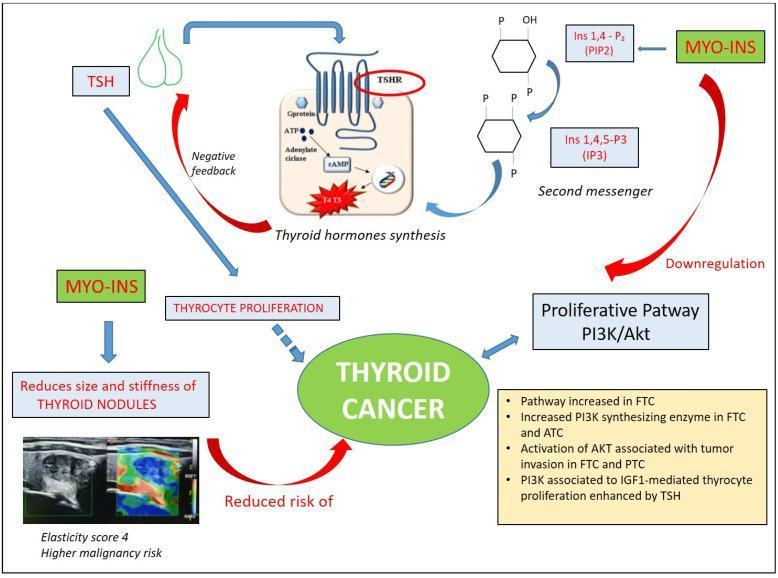
This pathophysiology diagram illustrates the regulatory role of Myo-inositol (MYO-INS) in thyroid function and its protective mechanisms against thyroid cancer. The diagram maps two primary pathways: first, MYO-INS serves as a precursor to phosphoinositide second messengers (PIP2 and IP3), which facilitate thyroid hormone synthesis. Increased T3 and T4 levels then exert negative feedback on TSH secretion, thereby inhibiting TSH-driven thyrocyte proliferation. Second, MYO-INS is shown to downregulate the PI3K/Akt proliferative pathway, which is typically overactive in follicular (FTC), anaplastic (ATC), and papillary thyroid cancer (PTC). A clinical component includes ultrasound elastography images showing a thyroid nodule with high stiffness (Elasticity score 4); the diagram indicates that MYO-INS reduces the size and stiffness of such nodules, ultimately leading to a reduced risk of thyroid cancer. Key molecular elements include TSHR signaling, cAMP, and IGF1-mediated proliferation, highlighting the transition from benign nodules to malignancy.
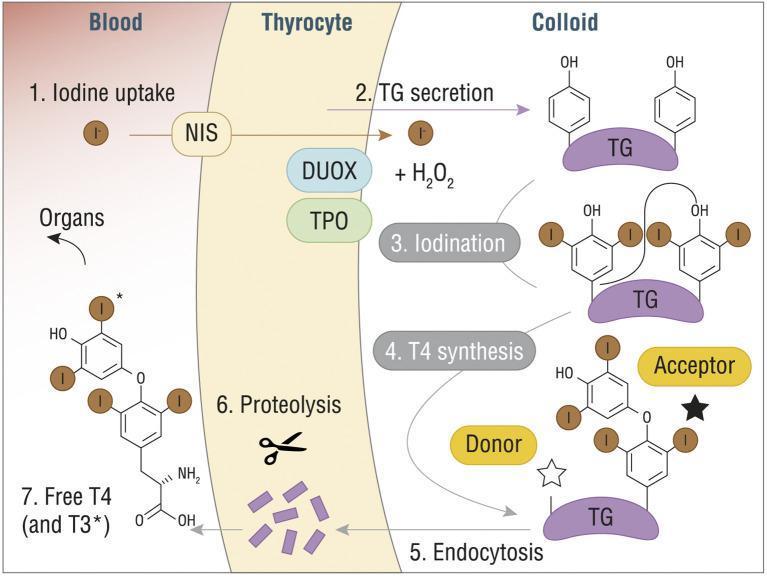
A pathophysiology diagram illustrating the seven-step process of thyroid hormone synthesis (T3 and T4) across three compartments: Blood, Thyrocyte, and Colloid. (1) Iodine uptake: Iodide (I-) enters the thyrocyte from the blood via the Sodium/Iodide Symporter (NIS). (2) TG secretion: Thyroglobulin (TG) is secreted into the colloid. (3) Iodination: Within the colloid, iodide is oxidized by Thyroid Peroxidase (TPO), dual oxidase (DUOX), and H2O2, leading to the attachment of iodine to tyrosine residues on TG. (4) T4 synthesis: A coupling reaction occurs between 'Donor' and 'Acceptor' iodinated tyrosine residues on the TG scaffold. (5) Endocytosis: The modified TG molecule is re-absorbed into the thyrocyte. (6) Proteolysis: Lysosomal enzymes break down TG, releasing individual hormones. (7) Release: Free T4 (thyroxine) and T3 (triiodothyronine) are secreted into the blood for systemic distribution to organs. The diagram includes detailed chemical structures of the phenolic rings and iodine substitutions characteristic of thyroid hormones.
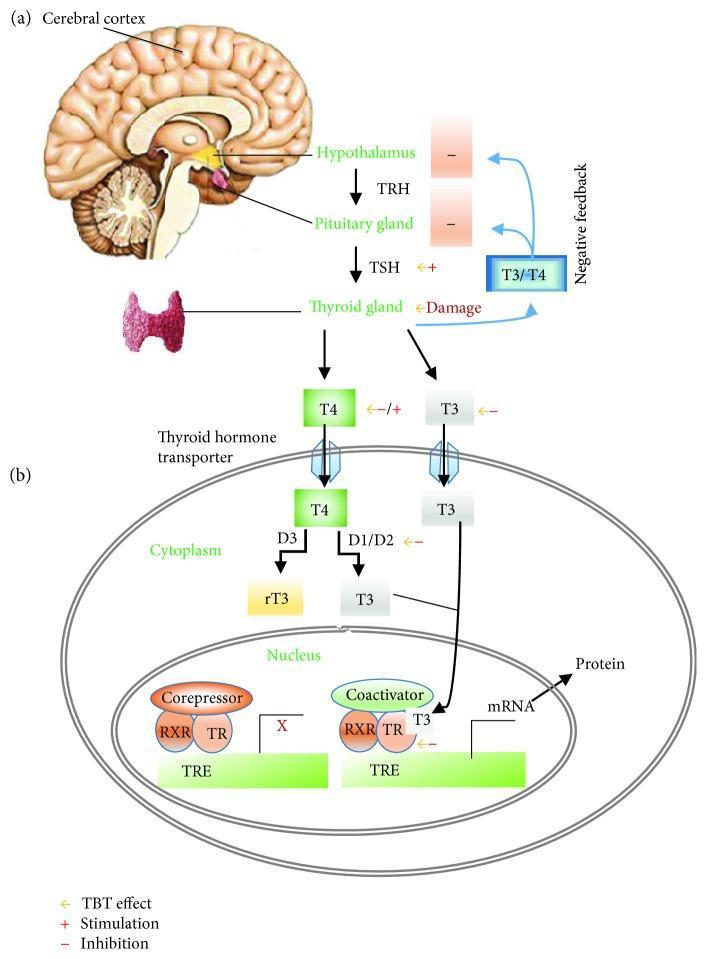
A two-part medical illustration depicting the pathophysiology of the Hypothalamic-Pituitary-Thyroid (HPT) axis and cellular thyroid hormone action. Section (a) shows the systemic HPT axis, beginning with the cerebral cortex and hypothalamus. The hypothalamus releases thyrotropin-releasing hormone (TRH), which stimulates the pituitary gland to secrete thyroid-stimulating hormone (TSH). TSH subsequently acts on the thyroid gland to stimulate the production of T4 and T3 hormones, which exert negative feedback on the hypothalamus and pituitary. Section (b) details the intracellular mechanism of action within a target cell. T4 and T3 enter the cell via thyroid hormone transporters. In the cytoplasm, deiodinases (D1/D2) convert T4 to T3, while D3 converts T4 to inactive reverse T3 (rT3). T3 enters the nucleus, binding to the thyroid hormone receptor (TR) which heterodimerizes with the retinoid X receptor (RXR). This complex binds to the thyroid hormone response element (TRE) on DNA, displacing corepressors and recruiting coactivators to initiate gene transcription (mRNA) and subsequent protein synthesis. The diagram also highlights potential sites of endocrine disruption (e.g., by Tributyltin/TBT), including receptor inhibition and deiodinase interference.
Drugs Used for Hyperthyroidism and Hypothyroidism
HYPERTHYROIDISM
1. Thionamides (Antithyroid Drugs)
- Both inhibit thyroid peroxidase (TPO), blocking iodine organification and coupling of iodotyrosines - thereby preventing T3 and T4 synthesis
- PTU additionally inhibits peripheral deiodination of T4 to T3 (methimazole does NOT have this effect)
- Neither drug blocks iodide uptake into the gland
- Onset is slow (3-4 weeks) because stored hormone must be depleted first
- Dose: 10-40 mg/day (starting), maintenance 5-15 mg once daily
- Advantage: once-daily dosing, lower risk of serious liver injury
- Used in Graves' disease, toxic nodules, and iodine-induced hyperthyroidism
- Dose: 100-200 mg PO three times daily (starting)
- Preferred over methimazole in: pregnancy (first trimester), thyroid storm (due to additional peripheral T4→T3 blockade)
- Carries a black box warning for severe hepatitis (sometimes fatal) - avoid in children and as first-line in adults unless no alternatives
- Common: maculopapular rash (4-6%), nausea, GI distress, arthralgias, fever
- Serious: agranulocytosis (0.1-0.5%) - patients must stop the drug immediately if they develop fever, chills, or sore throat
- PTU-specific: severe hepatitis (black box warning)
- Methimazole-specific: altered sense of taste/smell, cholestatic jaundice (more common than PTU)
- Cross-sensitivity between the two drugs is ~50%, so switching is usually avoided for severe reactions
2. Radioactive Iodine (RAI / ¹³¹I)
- A single oral dose permanently controls hyperthyroidism in ~90% of patients
- Preferred first-line definitive therapy for Graves' disease in most patients
- Contraindicated in pregnancy and breastfeeding
- Main consequence: hypothyroidism (most patients within the first year, then ~3% per year ongoing) - requiring lifelong levothyroxine replacement
- Thionamides must be stopped at least 3 days before RAI therapy (they interfere with uptake)
- Iodine solutions must be stopped at least 2 weeks before RAI
3. Iodides
- Inhibit organification and hormone release (Wolff-Chaikoff effect)
- Decrease size and vascularity of the hyperplastic gland
- Pre-operative preparation (SSKI 40-80 mg bid, started 1-2 weeks before thyroidectomy)
- Preparation before RAI therapy in severe cases
- Note: hyperthyroidism can "escape" the iodide block within weeks, and iodides can paradoxically induce hyperthyroidism in susceptible individuals (Jod-Basedow phenomenon)
4. Beta-Adrenergic Blockers (Symptomatic relief)
- Atenolol 25-100 mg daily (or propranolol)
- Control symptoms from increased adrenergic tone: palpitations, tremor, anxiety, tachycardia
- Propranolol at high doses also mildly inhibits peripheral T4→T3 conversion
- Do not treat the underlying hyperthyroidism - used until definitive therapy takes effect or in transient thyroiditis
5. Anion Inhibitors
- Potassium perchlorate: blocks thyroidal iodide uptake via competitive inhibition of the iodide transporter
- Rarely used clinically due to risk of aplastic anemia
- Main use: blocking thyroidal reuptake in amiodarone-induced hyperthyroidism
6. Glucocorticoids
- Used in thyroid storm and amiodarone-induced hyperthyroidism (type II)
- Inhibit peripheral T4→T3 conversion at high doses
Summary Table - Hyperthyroidism Drugs
| Drug | Mechanism | Key Use |
|---|---|---|
| Methimazole | Inhibits TPO; blocks T3/T4 synthesis | Graves' disease (preferred) |
| PTU | Inhibits TPO + blocks T4→T3 peripherally | Pregnancy (1st trimester), thyroid storm |
| RAI (¹³¹I) | Destroys thyroid tissue | Definitive therapy in Graves' |
| Lugol's / SSKI | Blocks hormone release, reduces vascularity | Pre-op prep |
| Atenolol/Propranolol | Beta-blockade (symptomatic) | Symptom control |
| Potassium perchlorate | Blocks iodide uptake | Amiodarone-induced hyperthyroidism |
| Glucocorticoids | Inhibit T4→T3 peripherally | Thyroid storm, type II amiodarone hyperthyroidism |
HYPOTHYROIDISM
1. Levothyroxine (L-T4) - Drug of Choice
- Synthetic T4 - the standard and preferred treatment for hypothyroidism
- Oral bioavailability: 70-80% (improved with Tirosint liquid-gel formulation)
- T4 is converted to the active T3 in peripheral tissues by deiodinases
- Chemically stable with modest product deterioration during storage
- Dose: weight-based in adults; adjusted by TSH monitoring
- Intravenous route preferred for parenteral use (e.g., myxedema coma)
- Absorption reduced by: calcium carbonate, iron salts, antacids, cholestyramine (take levothyroxine on an empty stomach, 30-60 min before these)
- Metabolism increased by: rifampin, phenobarbital, carbamazepine, phenytoin - patients on these drugs may need higher doses
- Estrogens/oral contraceptives increase TBG, raising total T4 requirements
- Brand vs. generic: brand-name and generic levothyroxine may not be perfectly bioequivalent in severe congenital hypothyroidism - some experts recommend against switching
2. Liothyronine (L-T3)
- Synthetic T3 - faster onset, shorter half-life than T4
- Oral bioavailability nearly complete (~95%)
- Not preferred as monotherapy (harder to maintain stable levels)
- Used in myxedema coma (IV T3 preferred by some clinicians for rapid effect)
- Also used in combination with levothyroxine in some patients with persistent symptoms
3. Desiccated Thyroid Extract (DTE)
- Derived from desiccated porcine or bovine thyroid
- Contains both T4 and T3 in a fixed ratio (~4:1)
- An alternative in patients who prefer it or have persistent symptoms on levothyroxine alone
- Less predictable dosing compared to synthetic preparations
Summary Table - Hypothyroidism Drugs
| Drug | Type | Key Use |
|---|---|---|
| Levothyroxine (T4) | Synthetic T4 | First-line for all hypothyroidism |
| Liothyronine (T3) | Synthetic T3 | Myxedema coma; combination therapy |
| Desiccated thyroid extract | T4 + T3 (natural) | Alternative when levothyroxine insufficient |
- Patients on amiodarone can develop either hypo- or hyperthyroidism; hypothyroidism is managed with levothyroxine even after amiodarone is stopped (due to its very long half-life)
- Drug-induced hypothyroidism (from lithium, tyrosine kinase inhibitors, sunitinib, imatinib, interferon) is managed by either stopping the offending agent or adding levothyroxine
- In pregnancy, PTU is preferred in the first trimester for hyperthyroidism; TSH must be monitored closely as thyroid requirements change throughout pregnancy
Carbamazime is used for
Carbamazepine - Uses, Mechanism, and Key Details
Primary Indications
1. Epilepsy (Seizure Disorders)
- Focal (partial onset) seizures - including simple and complex partial seizures
- Focal-to-bilateral tonic-clonic seizures (formerly called generalized tonic-clonic or grand mal)
- It is one of the most widely used antiseizure medications for these seizure types
- Not effective for absence seizures, myoclonic seizures, or atonic seizures - it may actually worsen these
2. Trigeminal Neuralgia
- Carbamazepine is the drug of first choice for trigeminal neuralgia (tic douloureux) - a condition causing severe, lancinating facial pain along the trigeminal nerve distribution
- Highly effective at reducing the frequency and severity of attacks
3. Bipolar Disorder (Mood Stabilizer)
- Approved for acute mania and prophylaxis of bipolar disorder
- Used when lithium is less than optimally effective or not tolerated
- Considered third-line in bipolar after antipsychotics and valproate
- Dosage: start 200 mg twice daily, maintenance 800-1200 mg/day
- May be used alone or in combination with lithium in refractory cases
- Note: Despite structural similarity to tricyclic antidepressants (TCA), carbamazepine does NOT inhibit monoamine transporters and is not used as an antidepressant
Other Off-Label Uses
- Neuropathic pain (various types)
- Alcohol withdrawal (limited evidence, may be poorly tolerated)
- Restless legs syndrome (occasional use)
- Certain psychiatric conditions - as an adjunct
Mechanism of Action
- Blocks voltage-gated sodium channels (Na⁺) - preferentially binds to channels in the inactivated state
- Stabilizes the inactivated state, preventing the channel from returning to the resting (activatable) state
- Shows use-dependent (frequency-dependent) block: high-frequency neuronal firing (as in seizures or pain) is more effectively inhibited than low-frequency firing
- Also shows voltage-dependence: more effective at depolarized membrane potentials (i.e., in hyperexcitable neurons)
- Result: suppresses sustained repetitive firing of action potentials in epileptic foci and in the trigeminal nucleus
Chemistry
Pharmacokinetics
- Oral absorption is slow and erratic; bioavailability ~70-80%
- Highly protein-bound
- Autoinduction: Carbamazepine induces its own metabolism via CYP3A4 - plasma levels fall over the first few weeks, often requiring dose increases
- Blood levels should be re-checked 2 weeks after any dose increase
- Active metabolite: carbamazepine-10,11-epoxide (contributes to both efficacy and toxicity)
Important Drug Interactions
| Type | Examples |
|---|---|
| Drugs that increase CBZ levels (CYP3A4 inhibitors) | Fluconazole, cimetidine, diltiazem, verapamil, erythromycin, some SSRIs |
| Drugs whose levels CBZ reduces (CYP3A4 inducer) | Oral contraceptives, warfarin, phenytoin, valproate, lamotrigine, antipsychotics |
| Pharmacodynamic interactions | Clozapine (increased neutropenia risk); diuretics (increased hyponatremia risk); lithium (rare neurotoxicity) |
Patients needing contraception must use ≥50 mcg oestrogen preparation or a non-hormonal method.
Adverse Effects
| Effect | Details |
|---|---|
| Dose-related (common) | Diplopia, blurred vision, dizziness, ataxia, nausea, drowsiness |
| Idiosyncratic | Rash (including Stevens-Johnson Syndrome - higher risk in HLA-B*1502 carriers, especially in Asian populations) |
| Hematologic | Leukopenia, aplastic anemia, agranulocytosis (rare but serious) |
| Hyponatremia (SIADH) | More common in elderly |
| Hepatotoxicity | Elevated LFTs, rarely severe |
| Cardiac | AV conduction delay at high levels |
Contraindications / Caution
- Bone marrow suppression (history of)
- AV block
- Structural similarity to TCAs - avoid within 14 days of MAOIs (theoretical)
- Pregnancy: associated with neural tube defects, craniofacial abnormalities (teratogenic - Category D)
Related Drugs
| Drug | Relationship to Carbamazepine |
|---|---|
| Oxcarbazepine | Keto-analogue; fewer drug interactions, less autoinduction, better tolerated; effective for seizures but NOT for bipolar disorder |
| Eslicarbazepine acetate | Prodrug of S(+)-licarbazepine; once-daily dosing |
| Valproate | Alternative mood stabilizer/anticonvulsant |