
red flags and differential diagnosis of back pain, short dondensed presentation for family medicine posting year 3 by 2 students
Back Pain: Red Flags & Differential Diagnosis
Family Medicine Year 3 Presentation
1. Overview
- Nonspecific (mechanical) back pain — most common (~85%)
- Radicular pain — nerve root involvement
- Red flag–associated symptoms — serious underlying pathology
"Clinicians find red flag clues useful as simple ways to reassure themselves and their patients that a common symptom such as back pain does not have a sinister cause." — Harrison's Principles of Internal Medicine 22E
2. Evaluation Approach
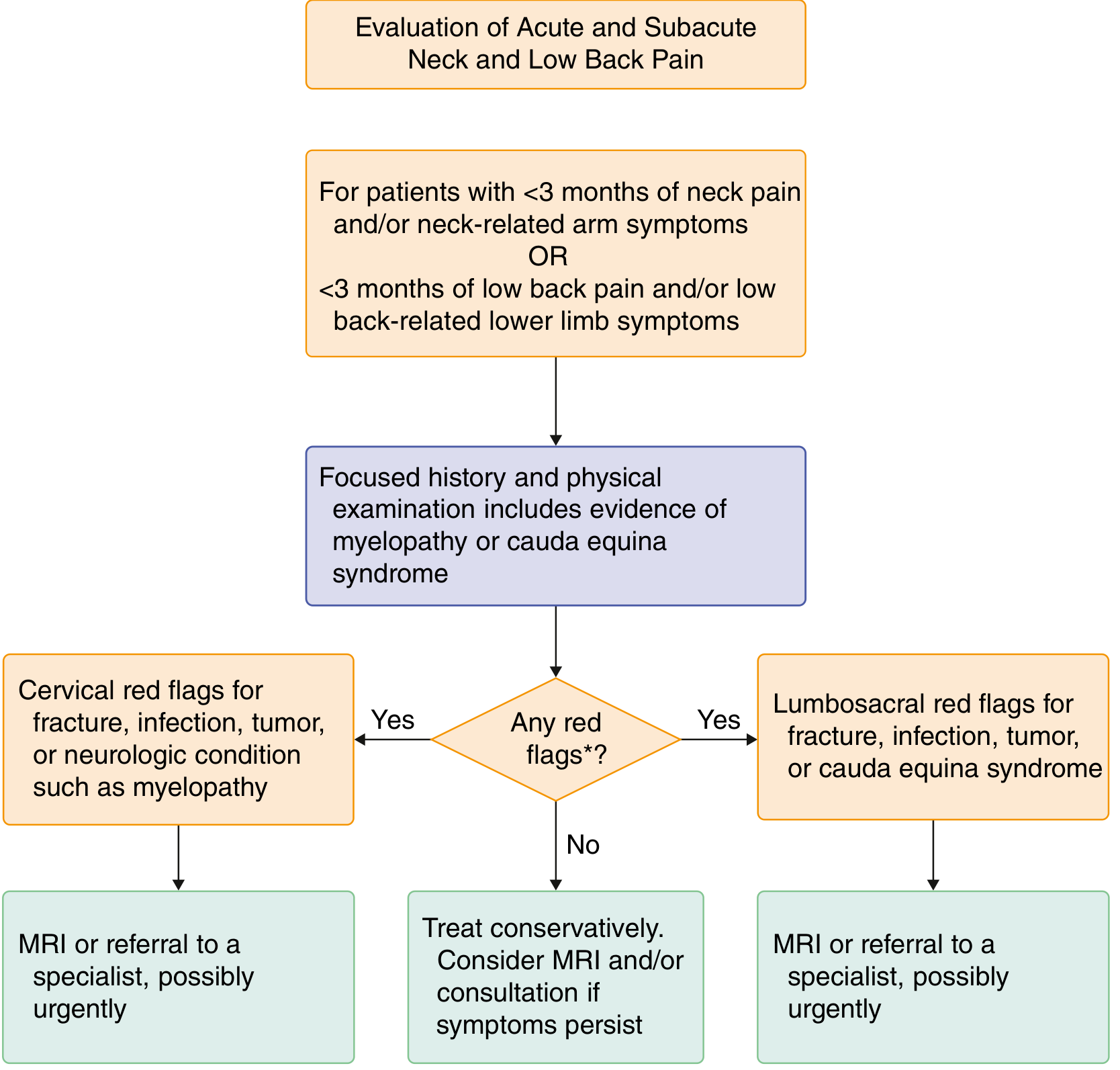
- No red flags → Conservative management; imaging NOT indicated before 6 weeks
- Red flags present → Urgent MRI or specialist referral
3. Red Flags — By Serious Condition
🔴 Cauda Equina Syndrome (SURGICAL EMERGENCY)
| Feature | Detail |
|---|---|
| Bilateral leg weakness | Major motor deficit: knee extension, ankle, foot dorsiflexion |
| Urinary dysfunction | Retention (painless) or incontinence |
| Faecal incontinence | Loss of sensation of rectal fullness |
| Saddle anaesthesia | Perianal/perineal sensory loss — pathognomonic |
| Anal sphincter laxity | Unexpected on exam |
Requires same-day emergency MRI and neurosurgical referral.
🔴 Spinal Fracture
- Sudden severe central spinal pain relieved by lying down
- History of major trauma (RTC, fall from height)
- Minor trauma or lifting in osteoporosis or steroid use
- Structural deformity or step deformity on palpation
- Point tenderness over vertebral body
🔴 Malignancy (Primary or Metastatic)
- Age >50 years
- Gradual onset of worsening pain
- Unremitting pain present at rest/supine and at night (disturbs sleep)
- Pain aggravated by Valsalva (coughing, sneezing, straining at stool)
- Thoracic back pain (unusual distribution)
- Localised spinal tenderness
- Unexplained weight loss
- No improvement after 4–6 weeks of conservative therapy
- History of cancer — especially breast, lung, GI, prostate, renal, thyroid (all metastasise to spine)
🔴 Spinal Infection (Discitis, Vertebral Osteomyelitis, Epidural Abscess)
- Fever
- History of TB or recent UTI
- Diabetes mellitus
- IV drug use
- HIV / immunosuppression / immunocompromise
- Recent spinal surgery
🔴 Other High-Risk Red Flags (Goldman-Cecil Table 369-3)
| Flag | Concern |
|---|---|
| History of trauma | Fracture |
| Unexplained weight loss | Malignancy |
| Unexplained fever | Infection |
| Immunosuppression | Infection/malignancy |
| Prolonged corticosteroid use | Osteoporotic fracture |
| Age <20 years | Back pain in a child = red flag for serious spinal pathology |
| Significant/progressive neurological deficit | Cord or cauda equina compromise |
| Myelopathy signs | Cervical/thoracic cord compression |
| Duration >6–12 weeks unresponsive to treatment | Pathological cause |
| Uncontrollable pain | Malignancy or infection |
"Back pain in a child is a red flag for serious spinal pathology." — Bailey & Love's Surgery 28E
4. Differential Diagnosis of Back Pain
Organised by Category
| Category | Diagnoses |
|---|---|
| Mechanical / Traumatic | Muscle strain / ligament sprain, disc herniation, vertebral fracture, facet joint arthritis, spondylolysis, spondylolisthesis |
| Degenerative | Degenerative disc disease, spondylosis, spinal stenosis (neurogenic claudication), degenerative facet joint disease |
| Inflammatory / Immune | Ankylosing spondylitis / axial spondyloarthritis, reactive arthritis, psoriatic arthritis, Guillain-Barré syndrome |
| Infectious | Discitis, vertebral osteomyelitis, spinal epidural abscess, TB spine (Pott's disease), UTI/pyelonephritis |
| Neoplastic | Metastatic spine disease, primary spinal tumours (extradural, intradural-extramedullary, intramedullary), multiple myeloma |
| Vascular | Aortic aneurysm (AAA) ⚠️, aortic dissection ⚠️, spinal AVM, spinal epidural haematoma |
| Referred / Non-spinal | Renal colic (urolithiasis), pyelonephritis, pancreatitis, peptic ulcer, endometriosis, ovarian pathology, testicular/prostatic carcinoma, retroperitoneal pathology, angina/MI, pulmonary embolism |
| Psychological / Functional | Chronic primary low back pain, central sensitisation, somatisation |
Key point: AAA classically presents as severe, tearing back/flank pain in an older patient — do not miss this vascular emergency.
5. Clinical Clues at a Glance
| Clue | Think of |
|---|---|
| Young athlete, pain with extension, relieved by rest | Spondylolysis |
| Young man, morning stiffness, improves with activity | Ankylosing spondylitis |
| Pain radiating below knee + SLR positive | Disc herniation / radiculopathy |
| Bilateral leg pain on walking, relieved by leaning forward | Spinal stenosis (neurogenic claudication) |
| Older patient, progressive pain, weight loss | Malignancy |
| Fever + localised tenderness + IVDU | Epidural abscess / osteomyelitis |
| Saddle anaesthesia + urinary retention | Cauda equina — EMERGENCY |
| Colicky flank–groin–testicular radiation, haematuria | Renal colic |
| Pulsatile abdominal mass, shock | AAA — EMERGENCY |
6. Key Examination Tests
| Test | Use |
|---|---|
| Straight leg raise (SLR) | Sensitivity 85–91% for disc herniation causing sciatica |
| Crossed SLR | Specificity 86–90% — highly specific for disc extrusion |
| Reverse SLR (femoral stretch) | Upper lumbar (L2–L4) radiculopathy |
| Percussion of spinous processes | Fracture, infection, tumour |
| Saddle sensation + anal tone | Cauda equina screening |
| Abdominal palpation | AAA, organomegaly, masses |
7. When to Image
| Scenario | Action |
|---|---|
| No red flags, <6 weeks | No imaging — reassure, conservative treatment |
| No red flags, >6 weeks, not improving | Consider MRI |
| Any red flag | Urgent MRI (preferred — no radiation) |
| Suspected fracture without MRI | CT spine |
| AAA suspected | Immediate ultrasound / CT |
| Cauda equina | Emergency MRI same day |
Radiographs require 40–60% bone destruction before detecting infection or tumour — not adequate for ruling out serious pathology. — Bailey & Love's Surgery 28E
8. Summary Memory Aid — RED FLAGS Mnemonic
| Letter | Flag |
|---|---|
| R | Recent onset in age <20 or >50 |
| E | Evening/night pain (unremitting, wakes patient) |
| D | Deficit — progressive neurological deficit |
| F | Fever / systemic illness / weight loss |
| L | Levels — thoracic location (unusual) |
| A | Anterior cancers — history of cancer |
| G | Going to toilet problems — bladder/bowel dysfunction |
| S | Steroids / immunosuppression; saddle anaesthesia |
Less than 10 mins presentation,easy to understand undergraduate level for mbbs
Back Pain: Red Flags & Differential Diagnosis
Family Medicine | MBBS Year 3 | ~8 min presentation
Who Presents with Back Pain?
- Extremely common — one of the top reasons patients visit a GP
- 85% is mechanical (muscle strain, disc, posture) — benign, self-limiting
- 15% has a serious cause — your job is to not miss this 15%
The clinical task = screen for red flags first, then manage the rest
The 3-Category Framework
Back Pain
    │
    ├── 1. Nonspecific / Mechanical   ← most common, treat conservatively
    ├── 2. Radicular (nerve root)     ← sciatica, disc herniation
    └── 3. RED FLAG conditions        ← serious, must rule out first
RED FLAGS — The 4 Dangerous Causes
🔴 1. Cancer (Metastatic Spine)
| Red Flag | Memory Hook |
|---|---|
| Age > 50 | |
| History of cancer | breast, lung, prostate, renal, thyroid → spine |
| Pain at rest / night pain (wakes from sleep) | "Sinister pain never rests" |
| Unexplained weight loss | |
| No improvement after 4–6 weeks |
🔴 2. Infection (Osteomyelitis / Epidural Abscess / Discitis)
| Red Flag | Memory Hook |
|---|---|
| Fever | |
| IV drug use | |
| Diabetes / immunosuppression | |
| Recent spine surgery or UTI | |
| TB history | especially in endemic areas |
🔴 3. Fracture
| Red Flag | Memory Hook |
|---|---|
| Trauma (RTC, fall from height) | |
| Osteoporosis + minor lift/twist | "fragility fracture" |
| Steroid use | weakens bone |
| Sudden severe central pain, relieved lying flat | |
| Step deformity on palpation |
🔴 4. Cauda Equina Syndrome — ⚠️ SURGICAL EMERGENCY
Miss this = permanent paralysis / incontinence
| Red Flag |
|---|
| Saddle anaesthesia (numbness around anus/perineum) |
| Urinary retention or incontinence |
| Faecal incontinence |
| Bilateral leg weakness |
| Reduced anal tone on PR exam |
Quick Red Flag Summary Table
| Flag | Suspect |
|---|---|
| Age <20 or >50 | Cancer / developmental |
| Night pain / rest pain | Cancer |
| Weight loss + back pain | Cancer |
| Fever + back pain | Infection |
| IVDU / immunocompromised | Infection |
| Trauma + back pain | Fracture |
| Saddle numbness + bladder/bowel | Cauda equina EMERGENCY |
| Progressive neuro deficit | Cord/cauda equina compromise |
| Back pain in a child | Always investigate — red flag by default |
Differential Diagnosis — Simplified
| Category | Examples |
|---|---|
| Mechanical | Muscle strain, disc herniation, spondylosis, spondylolisthesis |
| Inflammatory | Ankylosing spondylitis, psoriatic arthritis |
| Infectious | Osteomyelitis, epidural abscess, TB spine |
| Neoplastic | Metastases, myeloma, primary spinal tumours |
| Vascular | AAA ⚠️, aortic dissection ⚠️ |
| Referred pain | Renal colic, pyelonephritis, pancreatitis, ectopic pregnancy, MI |
Clinical clue shortcuts:
- Young man + morning stiffness + improves with exercise → Ankylosing spondylitis
- Pain radiating below knee + positive SLR → Disc herniation / Sciatica
- Leg pain on walking + relieved by leaning forward → Spinal stenosis
- Colicky flank pain → groin → testis + haematuria → Renal colic (referred)
- Pulsatile abdominal mass + tearing back pain → AAA — call surgeon NOW
When to Image?
| Situation | Do This |
|---|---|
| No red flags, <6 weeks | No imaging — reassure, physio, NSAIDs |
| No red flags, >6 weeks, not improving | MRI spine |
| Any red flag present | Urgent MRI |
| Cauda equina suspected | Emergency MRI same day |
X-rays miss early cancer and infection (need 40–60% bone destruction first) — MRI is the investigation of choice
Evaluation Flowchart
Take-Home Messages (Say These in Your Conclusion)
- Most back pain is mechanical — reassure and treat conservatively
- Always screen for red flags — CIFS: Cancer, Infection, Fracture, cauda equina Syndrome
- Cauda equina = emergency — saddle anaesthesia + bladder/bowel = call surgeon today
- Night pain + weight loss + age >50 = cancer until proven otherwise
- No imaging before 6 weeks unless red flags are present
- Don't forget referred pain — kidney, aorta, pancreas can all present as back pain
Resources
References
Textbooks
-
Rakel, R.E. & Rakel, D.P. — Textbook of Family Medicine, 9th Edition. Elsevier Saunders.
- Chapter 31: Chronic Low Back Pain — Diagnostic approach, red flag classification, imaging guidelines
-
Goldman, L. & Schafer, A.I. — Goldman-Cecil Medicine, International Edition (2 Vol. Set). Elsevier.
- Table 369-3: Red Flags in the Evaluation of Spine Pain
- Evaluation flowchart for acute and subacute neck and low back pain
-
Williams, N.S., O'Connell, P.R. & McCaskie, A.W. — Bailey and Love's Short Practice of Surgery, 28th Edition. CRC Press/Taylor & Francis.
- Table 37.5: Red flags — serious conditions causing low back pain
- Table 37.6: Non-spinal (referred) causes of low back pain
- Summary box 44.17 & 44.18: Red flag symptoms and signs for spinal pathology
-
Blumenfeld, H. — Neuroanatomy through Clinical Cases, 3rd Edition. Sinauer/Oxford University Press.
- Table 8.2: Differential Diagnosis of Back Pain (organised by pathological category)
-
Kasper, D.L. et al. — Harrison's Principles of Internal Medicine, 22nd Edition (2025). McGraw-Hill Medical.
- Differential diagnosis of mechanical vs. pathological back pain; red flag clues in clinical context
Guidelines Referenced (within textbook content)
- American College of Physicians (ACP) / American Pain Society — Joint 2007 guideline on low back pain: three-category classification framework (nonspecific, radicular, red flag)
- NICE (UK National Institute for Health and Care Excellence) — Guidelines on chronic low back pain management (2009): evidence base for physiotherapy, manual therapy, and conservative care
For Further Reading
- Chou R, et al. Diagnosis and treatment of low back pain: a joint clinical practice guideline from the ACP and APS. Ann Intern Med. 2007;147(7):478–491.
- NICE guideline NG59: Low back pain and sciatica in over 16s. Updated 2020. nice.org.uk/guidance/ng59
Help me understand this topic from a to z
Back Pain: A to Z — Complete MBBS Guide
A — ANATOMY (What Can Hurt?)
Vertebral body
    │
Intervertebral disc ← nucleus pulposus (gel centre) + annulus fibrosus (tough ring)
    │
Facet joints (posterior)
    │
Ligaments (anterior/posterior longitudinal, ligamentum flavum, interspinous)
    │
Paraspinal muscles & fascia
    │
Nerve roots (exit through neural foramina at each level)
    │
Spinal cord (ends at L1 in adults → becomes cauda equina below)
- The spinal cord ends at L1 in adults. Below L1 = cauda equina (a bundle of nerve roots, like a horse's tail)
- L4–5 and L5–S1 are the most common levels for disc herniation (>90% of lumbar herniations)
- The L5 nerve root is the most commonly affected
- Lumbar lordosis (normal concavity) is 40–60° — loss of lordosis = muscle spasm
B — BASIC CLASSIFICATION (The 3 Buckets)
| Bucket | What it means | How common |
|---|---|---|
| 1. Nonspecific / Mechanical | No identifiable structural cause | ~85% |
| 2. Radicular | Nerve root involvement (sciatica) | ~10% |
| 3. Red Flag / Serious | Cancer, infection, fracture, cauda equina | ~5% |
Your job: rule out Bucket 3, identify Bucket 2, manage Bucket 1.
C — CAUSES (Full Differential)
By Category:
| Category | Specific Diagnoses |
|---|---|
| Mechanical | Muscle strain, ligament sprain, disc herniation, facet joint pain, spondylolysis, spondylolisthesis |
| Degenerative | Degenerative disc disease, spondylosis (spinal osteoarthritis), spinal stenosis |
| Inflammatory | Ankylosing spondylitis, psoriatic arthritis, reactive arthritis |
| Infectious | Vertebral osteomyelitis, discitis, epidural abscess, TB spine (Pott's disease) |
| Neoplastic | Spinal metastases, multiple myeloma, primary spinal tumours |
| Vascular | AAA, aortic dissection, spinal AVM, epidural haematoma |
| Referred / Visceral | Renal colic, pyelonephritis, pancreatitis, peptic ulcer, AAA, ovarian pathology, ectopic pregnancy, prostatitis, MI/PE |
| Neurological | Cauda equina syndrome, myelopathy, Guillain-Barré syndrome |
| Functional / Psychosocial | Central sensitisation, somatisation, depression-associated pain |
D — DISC HERNIATION (Understand the Mechanism)
How it happens:
Ageing → loss of water content in disc nucleus
           ↓
Annulus fibrosus thins and tears
           ↓
Nucleus pulposus herniates (usually POSTEROLATERAL)
           ↓
Compresses and inflames adjacent nerve root
           ↓
RADICULOPATHY (pain + numbness + weakness in dermatomal pattern)
Types of disc pathology:
- Bulge — disc bulges but annulus intact
- Protrusion — nucleus pushes out, annulus partially torn
- Extrusion — nucleus through annulus, contained by posterior longitudinal ligament
- Sequestration — disc material free in spinal canal (most severe)
Natural history:
Good news: most disc herniations improve spontaneously as inflammation subsides and the disc material shrinks over time. Only a minority require surgery.
E — EXAMINATION (Step-by-Step)
1. Inspect (Look)
- From behind: scoliosis? muscle wasting? skin lesions?
- From the side: normal lumbar lordosis present? Reduced = muscle spasm
- Hairy tuft / dimple at sacrum = possible spina bifida
2. Palpate (Feel)
- Midline spinous process tenderness → fracture, infection, tumour (percussion is also useful)
- Paraspinal muscle tenderness / spasm → mechanical pain
- Step-off deformity → spondylolisthesis
3. Move
| Movement | Normal Range | Clinical Note |
|---|---|---|
| Flexion | 40–60° | Pain = discogenic |
| Extension | 20–35° | Pain = facet joint / spondylolysis |
| Lateral bending | ~20–30° each side | |
| Rotation | 3–18° |
4. Special Tests
- Patient supine → raise leg with knee extended
- Positive = pain radiating DOWN the leg (not just back) between 30–70°
- Add ankle dorsiflexion to increase sciatic tension (bow-stringing sign)
- Sensitivity: 85–91% for disc herniation
- Tests L4, L5, S1 nerve roots
- Raise the UNAFFECTED leg → pain in the SYMPTOMATIC leg
- Specificity 86–90% — highly specific for disc extrusion
- Patient prone → flex knee with hip extended
- Pain in anterior thigh = L2, L3, L4 nerve root irritation
- Perianal / saddle sensation (pinprick)
- Anal tone (digital rectal exam if suspected)
- Ask about urinary retention vs. incontinence
- Measure post-void residual (PVR >100 mL = denervated bladder)
F — FEATURES THAT DISTINGUISH CAUSES (Clinical Clues)
| Pain Pattern | Likely Cause |
|---|---|
| Unilateral, worsened by movement, relieved by rest, no neurological symptoms | Mechanical / muscle strain |
| Radiates below the knee, dermatomal, worsened by Valsalva/sitting, relieved lying | Disc herniation / radiculopathy |
| Bilateral leg pain walking, relieved leaning forward (shopping cart sign) | Spinal stenosis |
| Young man, morning stiffness >1 hour, improves with exercise, not rest | Ankylosing spondylitis |
| Athlete, pain with back extension, not flexion | Spondylolysis (pars stress fracture) |
| Age >50, progressive, night pain, weight loss | Malignancy |
| Fever + back pain + point tenderness + IVDU or DM | Osteomyelitis / epidural abscess |
| Sudden tearing back pain + hypotension + pulsatile abdominal mass | Ruptured AAA — EMERGENCY |
| Colicky flank pain → groin → testis + haematuria | Renal colic |
| Saddle numbness + urinary retention/incontinence | Cauda equina — EMERGENCY |
| Back pain in a CHILD | Always red flag — investigate |
G — GRADING NEUROLOGICAL DEFICIT (Nerve Root Table)
| Nerve Root | Disc Level | Motor Loss | Sensory Loss | Reflex Lost |
|---|---|---|---|---|
| L4 | L3–4 | Knee extension (quadriceps) | Medial shin | Knee jerk (patellar) ↓ |
| L5 | L4–5 (most common) | Foot/big toe dorsiflexion | Dorsum of foot, lateral shin | No reliable reflex |
| S1 | L5–S1 | Plantarflexion, toe walking | Lateral foot, sole | Ankle jerk ↓ |
Muscles have multi-root innervation, so strength may be preserved despite significant root involvement — sensory and reflex changes are often more reliable.
H — HISTORY (What to Ask)
- Site, Onset, Character, Radiation, Associations, Time course, Exacerbating/relieving, Severity
- Does pain wake you at night? (malignancy)
- Pain at rest / supine? (malignancy)
- Weight loss? Fever? (malignancy / infection)
- Any bowel or bladder changes? (cauda equina — ask about retention, not just incontinence)
- Saddle numbness? (cauda equina)
- Any history of cancer? (metastasis)
- IV drug use? DM? Immunosuppression? (infection)
- Trauma? Steroid use? Osteoporosis? (fracture)
- Mechanical pain: unilateral, worsened by movement, relieved by rest
- Radicular pain: below knee, dermatomal, electrical/shooting, worse with Valsalva
- Discogenic: worse with flexion/sitting
- Facet/spondylolysis: worse with extension
- Inflammatory: morning stiffness >1hr, improves with activity, worse at rest
- Stenosis: bilateral, worse with walking/extension, relieved by sitting/bending
I — INVESTIGATIONS
When to investigate:
Do NOT image in the first 6 weeks if no red flags are present. MRI often shows incidental findings (disc disease in 25% of asymptomatic people under 60, 33% over 60) that mislead management.
Investigation ladder:
| Test | When to use | Key points |
|---|---|---|
| Bloods (FBC, ESR, CRP, Ca²⁺, PSA, LFTs) | Suspected infection, malignancy, inflammatory disease | ESR/CRP raised in infection and malignancy |
| X-ray spine | Trauma, scoliosis assessment | Cannot detect early infection or tumour — needs 40–60% bone destruction. Equivalent to 300 chest X-rays (CT lumbar) |
| MRI spine ✅ | Investigation of choice for soft tissue, nerve roots, cord, discs | >90% sensitivity and specificity for malignancy, infection, epidural compression. Use WITH contrast if abscess/mets suspected |
| CT spine | Trauma (bone detail), MRI contraindicated, post-surgical anatomy | Better than MRI for fractures and bony anatomy |
| Bone scan | Multi-level metastatic survey | Useful when MRI unavailable or full skeletal survey needed |
| Urine dipstick/culture | UTI or pyelonephritis as referred cause | Simple, first-line |
| CT Abdomen/Pelvis | AAA suspected | USS first if stable, CT if unstable or high suspicion |
J — JOINT INFLAMMATORY CAUSES (Spondyloarthropathies)
- Young men (onset <40 years)
- Insidious onset of chronic low back pain
- Morning stiffness >1 hour, improves with exercise, NOT with rest
- Night pain with improvement on getting up
- Bilateral sacroiliitis on imaging (hallmark)
- HLA-B27 positive in ~90%
- MRI sacroiliac joints: osteitis (bone marrow oedema) — earliest sign
- axSpA accounts for only 4–5% of chronic back pain — mechanical is still far more common
K — KEY EMERGENCIES (Do Not Miss)
| Emergency | Key Feature | Immediate Action |
|---|---|---|
| Cauda Equina Syndrome | Saddle anaesthesia + urinary retention + bilateral leg weakness | Same-day emergency MRI → neurosurgery |
| Ruptured/Expanding AAA | Tearing back/flank pain + hypotension + pulsatile mass | Urgent vascular surgery — do NOT delay for imaging if unstable |
| Aortic Dissection | Tearing pain radiating to back + unequal BP in arms + aortic regurgitation murmur | CT aortography immediately |
| Spinal Epidural Abscess | Fever + back pain + progressive neurological deficit | Emergency MRI with contrast → neurosurgery + IV antibiotics |
| Myelopathy | Spastic gait, bilateral UMN signs (hyperreflexia, Babinski), bilateral sensory level | Urgent MRI spine |
L — LOWER MOTOR NEURON vs UPPER MOTOR NEURON (Cord vs. Cauda)
| Feature | Cauda Equina (LMN) | Cord / Myelopathy (UMN) |
|---|---|---|
| Level | Below L1 | Above L1 (conus/cord) |
| Tone | Decreased (flaccid) | Increased (spastic) |
| Reflexes | Decreased / absent | Increased / brisk |
| Plantar | Flexor | Extensor (Babinski +) |
| Bladder | Overflow incontinence / retention | Urgency / urge incontinence |
| Sensation | Saddle distribution | Sensory LEVEL (below a horizontal line) |
M — MANAGEMENT
Acute Mechanical Back Pain (the majority):
- Reassure — 90% resolve within 6–12 weeks
- Stay active — bed rest is harmful and delays recovery
- Analgesia:
- 1st line: Paracetamol + NSAIDs (e.g., ibuprofen/diclofenac)
- Add: Muscle relaxants (e.g., diazepam short-course) for muscle spasm
- Avoid: long-term opioids — risk of dependence with little added benefit
- Physiotherapy — core strengthening, stretching
- No imaging before 6 weeks
Radiculopathy / Sciatica:
- Same as above + Gabapentin/Pregabalin for neuropathic pain
- Epidural steroid injection if no improvement
- Surgery only if: progressive neurological deficit, failed conservative treatment >6–12 weeks, or large disc extrusion
Chronic Low Back Pain:
- Multimodal approach — physical + psychological + pharmacological
- Exercise therapy (aerobic + specific strengthening)
- CBT (Cognitive Behavioural Therapy) — addresses psychological component of central sensitisation
- Avoid MRI early (causes over-medicalisation and more surgery without better outcomes per Family Medicine textbook)
- NICE guidelines: offer physiotherapy, manual therapy, or acupuncture
Red Flag Conditions:
| Cause | Management |
|---|---|
| Malignancy | Oncology referral, MRI, radiotherapy/chemotherapy/surgical decompression |
| Infection | IV antibiotics, bed rest, possible surgical drainage |
| Fracture (stable) | Analgesia, orthopaedic review, consider vertebroplasty/kyphoplasty |
| Cauda equina | Emergency surgical decompression |
N — NEUROGENIC vs. VASCULAR CLAUDICATION (Classic OSCE Question)
| Feature | Neurogenic Claudication (Spinal stenosis) | Vascular Claudication (Peripheral arterial disease) |
|---|---|---|
| Pain onset | After walking | After walking |
| Relief | Sitting or bending forward (increases canal space) | Standing still |
| Position effect | Better leaning on shopping cart | No positional effect |
| Pulses | Normal | Reduced / absent |
| SLR | Usually negative | Negative |
| Skin | Normal | Pale, hairless, cool |
O — OSTEOPOROSIS AND FRACTURE
- Silent disease until fracture occurs
- Fragility fracture = fracture from trivial force (e.g., coughing, bending, minor lift)
- Risk factors: Female sex, post-menopausal, corticosteroid use, low BMI, smoking, alcohol, family history
- Vertebral compression fracture = sudden central back pain, relieved lying flat
- Diagnosis: DEXA scan for BMI (T-score ≤ −2.5 = osteoporosis)
- Management: Analgesia, bisphosphonates, vitamin D + calcium supplementation, vertebroplasty/kyphoplasty for ongoing pain
P — PAIN PHYSIOLOGY (Why Back Pain Becomes Chronic)
Acute pain
    ↓
Peripheral nociceptors (disc, facet, muscle, ligament)
    ↓
Dorsal root ganglion → dorsal horn (spinal cord)
    ↓
Thalamus → Limbic system → Cortex (pain perception + emotional colouring)
    ↓
In chronic pain:
  Neuron hyperexcitability
  Changes in gene expression
  Signal amplification
  Central sensitisation
  ↓
Pain persists even without ongoing tissue damage
- Obesity
- Smoking / nicotine dependence
- Alcohol excess
- Depression and anxiety
- Sedentary lifestyle
Q — QUICK DIAGNOSTIC ALGORITHM
Patient with Back Pain
         │
         ▼
    RED FLAGS?
    ─────────────────────────────────
    YES                           NO
     │                             │
     ▼                             ▼
Urgent MRI               Mechanical / Radicular?
± bloods ± specialist          │
referral                        ├── Radicular (leg pain below knee,
                                │   +SLR, dermatomal)
                                │       → Treat: NSAIDs + gabapentin
                                │         Image if >6 wks no improvement
                                │
                                └── Non-specific mechanical
                                        → Reassure, NSAIDs, physio
                                          No imaging < 6 weeks
R — RED FLAGS RECALL (the CIFS mnemonic)
| C | I | F | S |
|---|---|---|---|
| Cancer | Infection | Fracture | Spinal cord / Cauda equina |
| Age >50, weight loss, night pain, Hx cancer | Fever, IVDU, DM, immunocompromised | Trauma, osteoporosis, steroids | Saddle anaesthesia, bladder/bowel dysfunction |
S — SPINAL STENOSIS (Important in Elderly)
- Acquired narrowing of the spinal canal (or foramina)
- Causes: thickened ligamentum flavum, disc bulge, osteophytes, spondylolisthesis
- Classic patient: elderly, bilateral leg pain/weakness/paraesthesia on walking
- Neurogenic claudication — relieved by sitting/leaning forward
- MRI confirms diagnosis
- Management: conservative initially, epidural steroids, surgical decompression if refractory
T — TB SPINE (Pott's Disease)
- Haematogenous spread from pulmonary TB to vertebral body (usually lower thoracic/upper lumbar)
- Anterior vertebral body destruction → kyphotic deformity (Gibbus)
- Cold abscess may track down psoas muscle → psoas abscess (flank swelling)
- May present as back pain + weakness + constitutional symptoms (fever, weight loss, night sweats)
- Diagnosis: MRI spine + biopsy + Xpert MTB/RIF
- Management: Anti-TB therapy ×6–12 months, surgical decompression if neurological deficit
U — UPPER LUMBAR & THORACIC PAIN (Don't Forget)
- Thoracic back pain = red flag — mechanical thoracic pain is uncommon
- Think: aortic aneurysm, MI, pulmonary embolism, malignancy
- Upper lumbar (L1–3) radiculopathy: pain radiates to groin or anterior thigh, not the posterior leg
- No specific tendon reflex for L1–3; hip flexion power (iliopsoas) is the motor marker
V — VISCERAL / REFERRED PAIN (Non-Spinal Back Pain)
| Organ | Condition | Clue |
|---|---|---|
| Kidney | Renal colic | Colicky, flank → groin → scrotum/labia, haematuria |
| Kidney | Pyelonephritis | Fever + CVA tenderness + dysuria |
| Pancreas | Pancreatitis, pancreatic cancer | Epigastric pain radiating to back, worse lying, relieved leaning forward |
| Aorta | AAA / dissection | Tearing, pulsatile mass, hypotension |
| Uterus/Ovary | Endometriosis, ovarian torsion, ectopic | Cyclical pain or acute onset in women |
| Prostate | Prostatitis, prostate cancer | Urinary symptoms, tender PR |
| Bowel | Peptic ulcer, cholecystitis | Accompanying GI symptoms |
| Lung/Pleura | Pneumonia, mesothelioma | Pleuritic chest pain + back pain |
W — WHEN TO REFER
| Situation | Refer to |
|---|---|
| Cauda equina symptoms | Neurosurgery — SAME DAY |
| Progressive neurological deficit | Neurology / Neurosurgery — URGENT |
| Suspected malignancy | Oncology — within 2 weeks |
| Suspected spinal infection | Infectious disease / Neurosurgery |
| Ankylosing spondylitis | Rheumatology |
| Spinal stenosis refractory to conservative Rx | Orthopaedic / Neurosurgery |
| Mechanical back pain, failed 6 weeks Rx | Physiotherapy ± pain clinic |
X — X-RAYS: What They Show and Miss
| X-ray can show | X-ray CANNOT show |
|---|---|
| Vertebral alignment / spondylolisthesis | Early infection (needs 40–60% bone loss) |
| Fracture (some) | Soft tissue: discs, nerves, cord |
| Scoliosis (whole spine standing film) | Early tumour |
| Osteophytes / disc space narrowing | Nerve root compression |
| Osteoporosis (advanced) | Early osteoporosis |
Y — YELLOW FLAGS (Psychosocial Risk Factors for Chronicity)
| Yellow Flag |
|---|
| Belief that pain = serious damage |
| Avoidance of activity / fear of movement |
| Passive coping (waiting for pain to go away) |
| Depression or anxiety |
| Poor job satisfaction or workplace conflict |
| Previous prolonged sick leave |
| Social isolation |
Identifying yellow flags early and addressing them with CBT / biopsychosocial management prevents acute back pain from becoming chronic.
Z — ZERO IN ON THE DIAGNOSIS (Summary Approach)
Step 1: HISTORY — SOCRATES + red flag screen
Step 2: EXAMINE — Look / Feel / Move / Neuro / Special tests
Step 3: CLASSIFY — Mechanical? Radicular? Red Flag?
Step 4: INVESTIGATE — Bloods only if red flags; MRI if needed
Step 5: MANAGE — Reassure + analgesia + physio (most patients)
                  Urgent referral if red flag
Step 6: FOLLOW UP — Review at 6 weeks; re-assess if not improving
Master Summary Table
| Concept | Key Fact |
|---|---|
| Most common type | Nonspecific mechanical (~85%) |
| Most common disc level | L4–5 and L5–S1 |
| Most common nerve root | L5 |
| SLR tests | L4, L5, S1 roots |
| Femoral stretch tests | L2, L3, L4 roots |
| Imaging threshold | No imaging < 6 weeks without red flags |
| Investigation of choice | MRI spine |
| Cauda equina reflex | Ankle jerk (S1), knee jerk (L4) |
| Emergency that must not be missed | Cauda equina syndrome → same-day MRI |
| Vascular emergency | AAA / aortic dissection |
| Child with back pain | Always investigate |
| Thoracic back pain | Always red flag |
| Chronic pain mechanism | Central sensitisation |
| Psychosocial flags | Yellow flags → CBT approach |
From differential diagnosis to the end, do my slides with prpper images, 16 by 9, take home messages not needed, i need investigation and management, if too redundant isokay
back pain differential diagnosis table spinal causes
MRI lumbar spine disc herniation nerve root compression
spinal stenosis neurogenic claudication imaging
straight leg raise test sciatica examination
cauda equina syndrome saddle anaesthesia bladder
ankylosing spondylitis sacroiliitis bamboo spine xray
vertebral osteomyelitis discitis MRI spine infection
mkdir -p /home/daytona/workspace/back-pain-pptx && ls /home/daytona/workspace/back-pain-pptx
node /home/daytona/skills/shared/scripts/fetch_images.js \ "https://cdn.orris.care/cdss_images/pmc_clinical_VQA_a84ad3fc973fae2a0f6d6f1b295bd04c1df17fc48ca6d8eb48063e909d934d0d.jpg" \ "https://cdn.orris.care/cdss_images/pmc_clinical_VQA_ffb7c41945260763bde7a72f6d5bce0590d167abd7b8c1fc6951d1f4dc53646b.jpg" \ "https://cdn.orris.care/cdss_images/pmc_clinical_VQA_bffd6cdd6d026826a2da9cd6a754df6f6f830798a14f3991b0903cbcc79af5b7.jpg" \ "https://cdn.orris.care/cdss_images/BAILY_1760540610530_0096e21e-9b89-407c-b5c3-e8a325e2fe0e.png" \ "https://cdn.orris.care/cdss_images/pmc_clinical_VQA_7425b51cfdb9992868700cd089803aa4497f8a9888b9ad2d7965359f30e89061.jpg" \ "https://cdn.orris.care/cdss_images/pmc_clinical_VQA_921ac2afb3e00e23b0fd5aae4d22c925d2fa7189c79a4356cb38b97e47e8e6a2.jpg" \ "https://cdn.orris.care/cdss_images/8ccce8a09ffc10d0499ab5567e64e10f3caa336cf44f7c3f037b610a89783417.png" \ 2>/dev/null | node -e "const d=require('fs').readFileSync('/dev/stdin','utf8'); const arr=JSON.parse(d); arr.forEach((x,i)=>{ if(x.base64) require('fs').writeFileSync('/home/daytona/workspace/back-pain-pptx/img'+i+'.txt', x.base64); console.log(i, x.error||'ok', x.base64?x.base64.substring(0,40):'FAIL'); });"
~/back-pain-pptx/build.js
const pptxgen = require("pptxgenjs");
const fs = require("fs");

const pres = new pptxgen();
pres.layout = "LAYOUT_16x9";
pres.title = "Back Pain: Differential Diagnosis, Investigations & Management";

// Load images
const img = {};
for (let i = 0; i <= 6; i++) {
  const p = `/home/daytona/workspace/back-pain-pptx/img${i}.txt`;
  if (fs.existsSync(p)) img[i] = fs.readFileSync(p, "utf8");
}

// Color palette — deep navy + white + crimson accent + teal highlights
const NAV = "0D1B2A";   // deep navy (dominant bg)
const NAV2 = "1A2E45";  // slightly lighter navy for cards
const WHT = "FFFFFF";
const CRM = "C0392B";   // crimson / red accent
const TEA = "1ABC9C";   // teal highlight
const GLD = "F1C40F";   // gold accent
const LGR = "BDC3C7";   // light grey
const DGR = "2C3E50";   // dark blue-grey

// Helper: slide background
function bg(slide) {
  slide.addShape(pres.shapes.RECTANGLE, { x: 0, y: 0, w: 10, h: 5.625, fill: { color: NAV }, line: { color: NAV } });
}

// Helper: header bar with title
function header(slide, title, sub) {
  slide.addShape(pres.shapes.RECTANGLE, { x: 0, y: 0, w: 10, h: 1.0, fill: { color: CRM }, line: { color: CRM } });
  slide.addShape(pres.shapes.RECTANGLE, { x: 0, y: 1.0, w: 10, h: 0.05, fill: { color: TEA }, line: { color: TEA } });
  slide.addText(title, { x: 0.3, y: 0.05, w: 9.4, h: 0.7, fontSize: 26, bold: true, color: WHT, fontFace: "Calibri", valign: "middle", margin: 0 });
  if (sub) slide.addText(sub, { x: 0.3, y: 0.72, w: 9.4, h: 0.32, fontSize: 12, color: "FFCCCC", fontFace: "Calibri", valign: "middle", margin: 0 });
}

// Helper: section label
function sectionBadge(slide, text, x, y, w, color) {
  slide.addShape(pres.shapes.ROUNDED_RECTANGLE, { x, y, w, h: 0.32, fill: { color: color || TEA }, line: { color: color || TEA }, rectRadius: 0.05 });
  slide.addText(text, { x, y, w, h: 0.32, fontSize: 9, bold: true, color: WHT, align: "center", valign: "middle", fontFace: "Calibri", margin: 0 });
}

// Helper: card
function card(slide, x, y, w, h, fillColor) {
  slide.addShape(pres.shapes.ROUNDED_RECTANGLE, { x, y, w, h, fill: { color: fillColor || NAV2 }, line: { color: "2980B9", width: 0.5 }, rectRadius: 0.08, shadow: { type: "outer", color: "000000", blur: 4, offset: 2, angle: 135, opacity: 0.25 } });
}

// ─────────────────────────────────────────────
// SLIDE 1 — TITLE SLIDE
// ─────────────────────────────────────────────
{
  const s = pres.addSlide();
  bg(s);
  // full-width accent bar
  s.addShape(pres.shapes.RECTANGLE, { x: 0, y: 0, w: 0.12, h: 5.625, fill: { color: CRM }, line: { color: CRM } });
  s.addShape(pres.shapes.RECTANGLE, { x: 0.12, y: 0, w: 0.06, h: 5.625, fill: { color: TEA }, line: { color: TEA } });

  s.addText("BACK PAIN", { x: 0.5, y: 0.7, w: 9, h: 1.1, fontSize: 52, bold: true, color: WHT, fontFace: "Calibri", margin: 0 });
  s.addText("Differential Diagnosis · Investigations · Management", { x: 0.5, y: 1.85, w: 9, h: 0.55, fontSize: 20, color: TEA, fontFace: "Calibri", margin: 0 });
  s.addShape(pres.shapes.RECTANGLE, { x: 0.5, y: 2.5, w: 5, h: 0.04, fill: { color: CRM }, line: { color: CRM } });
  s.addText("Family Medicine | MBBS Year 3", { x: 0.5, y: 2.65, w: 9, h: 0.4, fontSize: 15, color: LGR, fontFace: "Calibri", margin: 0 });
  s.addText("Student Presentation — ~8 minutes", { x: 0.5, y: 3.1, w: 9, h: 0.35, fontSize: 13, color: "7F8C8D", fontFace: "Calibri", margin: 0 });

  // Spine silhouette icon using circles
  s.addShape(pres.shapes.OVAL, { x: 8.1, y: 0.8, w: 1.4, h: 1.4, fill: { color: NAV2 }, line: { color: CRM, width: 2 } });
  s.addText("⚕", { x: 8.1, y: 0.85, w: 1.4, h: 1.3, fontSize: 44, color: CRM, align: "center", valign: "middle", margin: 0 });
}

// ─────────────────────────────────────────────
// SLIDE 2 — FRAMEWORK (3 BUCKETS)
// ─────────────────────────────────────────────
{
  const s = pres.addSlide();
  bg(s);
  header(s, "THE CLINICAL FRAMEWORK", "Start every back pain consultation with this");

  // 3 bucket cards
  const buckets = [
    { label: "~85%", title: "NONSPECIFIC\nMECHANICAL", sub: "Muscle strain, disc, posture\nNo red flags\nSelf-limiting", color: "27AE60" },
    { label: "~10%", title: "RADICULAR\n(SCIATICA)", sub: "Nerve root irritation\nLeg pain below knee\nDermatomal pattern", color: "E67E22" },
    { label: "~5%", title: "RED FLAG\nCONDITION", sub: "Cancer · Infection\nFracture · Cauda Equina\nRequires urgent workup", color: CRM },
  ];
  const xs = [0.25, 3.55, 6.85];
  buckets.forEach((b, i) => {
    card(s, xs[i], 1.2, 3.1, 3.8, NAV2);
    s.addShape(pres.shapes.OVAL, { x: xs[i] + 0.9, y: 1.35, w: 1.3, h: 0.55, fill: { color: b.color }, line: { color: b.color } });
    s.addText(b.label, { x: xs[i] + 0.9, y: 1.35, w: 1.3, h: 0.55, fontSize: 16, bold: true, color: WHT, align: "center", valign: "middle", fontFace: "Calibri", margin: 0 });
    s.addText(b.title, { x: xs[i] + 0.1, y: 2.0, w: 2.9, h: 0.75, fontSize: 14, bold: true, color: WHT, align: "center", fontFace: "Calibri", margin: 0 });
    s.addShape(pres.shapes.RECTANGLE, { x: xs[i] + 0.6, y: 2.75, w: 1.9, h: 0.03, fill: { color: b.color }, line: { color: b.color } });
    s.addText(b.sub, { x: xs[i] + 0.1, y: 2.85, w: 2.9, h: 1.0, fontSize: 11, color: LGR, align: "center", fontFace: "Calibri", margin: 0 });
  });

  s.addText("Your primary task: RULE OUT Bucket 3 first, then manage the rest", { x: 0.3, y: 5.1, w: 9.4, h: 0.38, fontSize: 13, bold: true, color: GLD, align: "center", fontFace: "Calibri", margin: 0 });
}

// ─────────────────────────────────────────────
// SLIDE 3 — DIFFERENTIAL DIAGNOSIS TABLE
// ─────────────────────────────────────────────
{
  const s = pres.addSlide();
  bg(s);
  header(s, "DIFFERENTIAL DIAGNOSIS", "Organised by category");

  const rows = [
    ["MECHANICAL", "Muscle strain · Ligament sprain · Disc herniation · Facet joint pain · Spondylolysis · Spondylolisthesis", "27AE60"],
    ["DEGENERATIVE", "Degenerative disc disease · Spondylosis · Spinal stenosis (neurogenic claudication)", "2ECC71"],
    ["INFLAMMATORY", "Ankylosing spondylitis · Psoriatic arthritis · Reactive arthritis", "E67E22"],
    ["INFECTIOUS", "Vertebral osteomyelitis · Discitis · Epidural abscess · TB spine (Pott's disease)", CRM],
    ["NEOPLASTIC", "Spinal metastases · Multiple myeloma · Primary spinal tumours · Leukaemia/Lymphoma", "9B59B6"],
    ["VASCULAR", "AAA · Aortic dissection · Spinal epidural haematoma · Spinal AVM", "E74C3C"],
    ["REFERRED / VISCERAL", "Renal colic · Pyelonephritis · Pancreatitis · Ovarian/testicular · Ectopic pregnancy · MI · PE", "3498DB"],
  ];

  rows.forEach((r, i) => {
    const y = 1.15 + i * 0.6;
    s.addShape(pres.shapes.RECTANGLE, { x: 0.15, y, w: 2.1, h: 0.5, fill: { color: r[2] }, line: { color: r[2] } });
    s.addText(r[0], { x: 0.15, y, w: 2.1, h: 0.5, fontSize: 9.5, bold: true, color: WHT, align: "center", valign: "middle", fontFace: "Calibri", margin: 0 });
    s.addShape(pres.shapes.RECTANGLE, { x: 2.3, y, w: 7.5, h: 0.5, fill: { color: NAV2 }, line: { color: r[2], width: 0.8 } });
    s.addText(r[1], { x: 2.35, y, w: 7.4, h: 0.5, fontSize: 10.5, color: WHT, valign: "middle", fontFace: "Calibri", margin: 0 });
  });
}

// ─────────────────────────────────────────────
// SLIDE 4 — CLINICAL CLUES
// ─────────────────────────────────────────────
{
  const s = pres.addSlide();
  bg(s);
  header(s, "CLINICAL CLUES AT A GLANCE", "Pain pattern → likely cause");

  const clues = [
    ["Movement ↑ pain, rest relieves, no neurology", "Mechanical / Muscle strain", "27AE60"],
    ["Leg pain below knee, dermatomal, worse with Valsalva", "Disc herniation / Sciatica", "E67E22"],
    ["Bilateral leg pain walking, shopping cart sign", "Spinal stenosis", "3498DB"],
    ["Young man, morning stiffness >1hr, improves with exercise", "Ankylosing spondylitis", "E67E22"],
    ["Age >50, night pain, weight loss", "Malignancy ⚠", CRM],
    ["Fever + back pain + IVDU/DM/immunocompromised", "Osteomyelitis / Epidural abscess ⚠", CRM],
    ["Saddle numbness + urinary retention", "Cauda Equina — EMERGENCY 🚨", "8E44AD"],
    ["Colicky flank → groin + haematuria", "Renal colic (referred)", "3498DB"],
    ["Tearing back pain + pulsatile mass + hypotension", "Ruptured AAA — EMERGENCY 🚨", "8E44AD"],
    ["Back pain in a CHILD", "Always red flag — investigate", CRM],
  ];

  clues.forEach((c, i) => {
    const col = i < 5 ? 0 : 1;
    const row = i < 5 ? i : i - 5;
    const x = col === 0 ? 0.15 : 5.1;
    const y = 1.15 + row * 0.82;
    s.addShape(pres.shapes.ROUNDED_RECTANGLE, { x, y, w: 4.8, h: 0.72, fill: { color: NAV2 }, line: { color: c[2], width: 1 }, rectRadius: 0.06 });
    s.addShape(pres.shapes.RECTANGLE, { x, y, w: 0.08, h: 0.72, fill: { color: c[2] }, line: { color: c[2] } });
    s.addText(c[0], { x: x + 0.15, y: y + 0.03, w: 4.6, h: 0.32, fontSize: 9.5, color: LGR, fontFace: "Calibri", margin: 0 });
    s.addText("→ " + c[1], { x: x + 0.15, y: y + 0.35, w: 4.6, h: 0.3, fontSize: 10, bold: true, color: WHT, fontFace: "Calibri", margin: 0 });
  });
}

// ─────────────────────────────────────────────
// SLIDE 5 — DISC HERNIATION + MRI IMAGE
// ─────────────────────────────────────────────
{
  const s = pres.addSlide();
  bg(s);
  header(s, "DISC HERNIATION & RADICULOPATHY", "Most important specific cause to understand");

  // Left content
  const steps = [
    "Ageing → loss of nucleus water content",
    "Annulus fibrosus thins and tears",
    "Nucleus pulposus herniates — usually posterolateral",
    "Compresses and inflames adjacent nerve root",
    "→ RADICULOPATHY (pain + numbness + weakness)",
  ];
  const stepColors = [TEA, TEA, TEA, CRM, GLD];
  steps.forEach((st, i) => {
    const y = 1.25 + i * 0.6;
    s.addShape(pres.shapes.OVAL, { x: 0.2, y: y + 0.05, w: 0.4, h: 0.4, fill: { color: stepColors[i] }, line: { color: stepColors[i] } });
    s.addText(`${i + 1}`, { x: 0.2, y: y + 0.05, w: 0.4, h: 0.4, fontSize: 11, bold: true, color: WHT, align: "center", valign: "middle", fontFace: "Calibri", margin: 0 });
    s.addText(st, { x: 0.7, y, w: 4.8, h: 0.55, fontSize: 12, color: i >= 3 ? GLD : WHT, fontFace: "Calibri", valign: "middle", bold: i >= 3, margin: 0 });
  });

  // Nerve root table
  s.addShape(pres.shapes.RECTANGLE, { x: 0.2, y: 4.25, w: 5.1, h: 0.25, fill: { color: CRM }, line: { color: CRM } });
  s.addText("Nerve Root Map", { x: 0.2, y: 4.25, w: 5.1, h: 0.25, fontSize: 10, bold: true, color: WHT, align: "center", valign: "middle", fontFace: "Calibri", margin: 0 });
  const nrRows = [
    ["L4", "Knee extension", "Medial shin", "Knee jerk ↓"],
    ["L5 (most common)", "Foot dorsiflexion", "Dorsum foot", "No reliable reflex"],
    ["S1", "Plantarflexion", "Lateral foot/sole", "Ankle jerk ↓"],
  ];
  const nrW = [0.9, 1.4, 1.3, 1.5];
  const nrX = [0.2, 1.1, 2.5, 3.8];
  nrRows.forEach((row, ri) => {
    const y = 4.5 + ri * 0.35;
    const bg2 = ri % 2 === 0 ? NAV2 : "152638";
    s.addShape(pres.shapes.RECTANGLE, { x: 0.2, y, w: 5.1, h: 0.33, fill: { color: bg2 }, line: { color: bg2 } });
    row.forEach((cell, ci) => {
      s.addText(cell, { x: nrX[ci], y, w: nrW[ci], h: 0.33, fontSize: 9, color: ci === 0 ? GLD : WHT, bold: ci === 0, fontFace: "Calibri", valign: "middle", margin: 3 });
    });
  });

  // Right: MRI image
  if (img[0]) {
    s.addImage({ data: img[0], x: 5.55, y: 1.2, w: 4.2, h: 4.1 });
    s.addShape(pres.shapes.RECTANGLE, { x: 5.55, y: 5.1, w: 4.2, h: 0.2, fill: { color: DGR }, line: { color: DGR } });
    s.addText("MRI axial — L4/5 disc herniation compressing right L5 nerve root", { x: 5.55, y: 5.1, w: 4.2, h: 0.22, fontSize: 7.5, color: LGR, italic: true, align: "center", fontFace: "Calibri", margin: 0 });
  }
}

// ─────────────────────────────────────────────
// SLIDE 6 — SPINAL STENOSIS
// ─────────────────────────────────────────────
{
  const s = pres.addSlide();
  bg(s);
  header(s, "SPINAL STENOSIS", "Neurogenic claudication — common in the elderly");

  // Left content
  s.addText("What happens:", { x: 0.2, y: 1.15, w: 5.1, h: 0.35, fontSize: 13, bold: true, color: TEA, fontFace: "Calibri", margin: 0 });
  const causes = ["Thickened ligamentum flavum", "Facet joint hypertrophy + osteophytes", "Disc bulging centrally", "→ Narrows spinal canal / neural foramina", "→ Compresses cauda equina nerve roots"];
  causes.forEach((c, i) => {
    s.addText((i < 3 ? "• " : "") + c, { x: 0.3, y: 1.55 + i * 0.38, w: 5.1, h: 0.35, fontSize: 11.5, color: i >= 3 ? GLD : WHT, bold: i >= 3, fontFace: "Calibri", margin: 0 });
  });

  s.addText("Neurogenic Claudication", { x: 0.2, y: 3.55, w: 5.1, h: 0.35, fontSize: 13, bold: true, color: CRM, fontFace: "Calibri", margin: 0 });
  const claudRows = [
    ["Worse with", "Walking, standing, back extension"],
    ["Better with", "Sitting, bending forward (shopping cart sign)"],
    ["Pulses", "Normal (unlike vascular claudication)"],
    ["Imaging", "MRI shows canal narrowing"],
  ];
  claudRows.forEach((row, i) => {
    const y = 3.95 + i * 0.38;
    s.addShape(pres.shapes.RECTANGLE, { x: 0.2, y, w: 1.3, h: 0.33, fill: { color: CRM }, line: { color: CRM } });
    s.addText(row[0], { x: 0.2, y, w: 1.3, h: 0.33, fontSize: 10, bold: true, color: WHT, align: "center", valign: "middle", fontFace: "Calibri", margin: 0 });
    s.addShape(pres.shapes.RECTANGLE, { x: 1.55, y, w: 3.75, h: 0.33, fill: { color: NAV2 }, line: { color: NAV2 } });
    s.addText(row[1], { x: 1.6, y, w: 3.7, h: 0.33, fontSize: 10.5, color: WHT, valign: "middle", fontFace: "Calibri", margin: 0 });
  });

  // Right: MRI image
  if (img[1]) {
    s.addImage({ data: img[1], x: 5.55, y: 1.2, w: 4.2, h: 3.8 });
    s.addText("MRI — central canal stenosis (A=normal, B=stenosis with ligamentum flavum thickening)", { x: 5.55, y: 5.05, w: 4.2, h: 0.32, fontSize: 7.5, color: LGR, italic: true, align: "center", fontFace: "Calibri", margin: 0 });
  }
}

// ─────────────────────────────────────────────
// SLIDE 7 — ANKYLOSING SPONDYLITIS
// ─────────────────────────────────────────────
{
  const s = pres.addSlide();
  bg(s);
  header(s, "ANKYLOSING SPONDYLITIS", "Inflammatory back pain — axial spondyloarthritis");

  // Content left
  const features = [
    ["Patient", "Young male, onset <40 years"],
    ["Onset", "Insidious, gradual over months"],
    ["Pain", "Lower back, buttocks, sacroiliac joints"],
    ["Morning stiffness", ">1 hour — hallmark feature"],
    ["Improves with", "Exercise, movement — NOT rest"],
    ["Night pain", "Wakes patient, improves on getting up"],
    ["HLA-B27", "Positive in ~90%"],
    ["Hallmark imaging", "Bilateral sacroiliitis → bamboo spine"],
  ];
  features.forEach((f, i) => {
    const y = 1.2 + i * 0.51;
    s.addShape(pres.shapes.RECTANGLE, { x: 0.2, y, w: 2.2, h: 0.43, fill: { color: "E67E22" }, line: { color: "E67E22" } });
    s.addText(f[0], { x: 0.2, y, w: 2.2, h: 0.43, fontSize: 10, bold: true, color: WHT, align: "center", valign: "middle", fontFace: "Calibri", margin: 0 });
    s.addShape(pres.shapes.RECTANGLE, { x: 2.45, y, w: 3.05, h: 0.43, fill: { color: NAV2 }, line: { color: NAV2 } });
    s.addText(f[1], { x: 2.5, y, w: 3.0, h: 0.43, fontSize: 10.5, color: WHT, valign: "middle", fontFace: "Calibri", margin: 0 });
  });

  // Right: AS/bamboo spine image
  if (img[4]) {
    s.addImage({ data: img[4], x: 5.7, y: 1.2, w: 4.1, h: 4.0 });
    s.addText("X-ray: Bamboo spine (syndesmophytes) + bilateral sacroiliitis", { x: 5.7, y: 5.2, w: 4.1, h: 0.25, fontSize: 7.5, color: LGR, italic: true, align: "center", fontFace: "Calibri", margin: 0 });
  }
}

// ─────────────────────────────────────────────
// SLIDE 8 — SPINAL INFECTION
// ─────────────────────────────────────────────
{
  const s = pres.addSlide();
  bg(s);
  header(s, "SPINAL INFECTION", "Osteomyelitis · Discitis · Epidural Abscess");

  // Left: risk factors + features
  s.addText("Risk Factors", { x: 0.2, y: 1.15, w: 4.8, h: 0.35, fontSize: 13, bold: true, color: CRM, fontFace: "Calibri", margin: 0 });
  const risks = ["IV drug use (IVDU)", "Diabetes mellitus", "Immunosuppression / HIV", "Recent spinal surgery / UTI", "TB history (endemic areas)"];
  risks.forEach((r, i) => {
    s.addShape(pres.shapes.OVAL, { x: 0.2, y: 1.55 + i * 0.38, w: 0.22, h: 0.22, fill: { color: CRM }, line: { color: CRM } });
    s.addText(r, { x: 0.5, y: 1.52 + i * 0.38, w: 4.5, h: 0.3, fontSize: 11, color: WHT, fontFace: "Calibri", margin: 0 });
  });

  s.addText("Clinical Features", { x: 0.2, y: 3.55, w: 4.8, h: 0.35, fontSize: 13, bold: true, color: GLD, fontFace: "Calibri", margin: 0 });
  const feats = ["Fever + severe, localised back pain", "Point tenderness over spinous process", "Progressive neurological deficit (late)", "↑ ESR, ↑ CRP, ↑ WBC"];
  feats.forEach((f, i) => {
    s.addShape(pres.shapes.OVAL, { x: 0.2, y: 3.95 + i * 0.38, w: 0.22, h: 0.22, fill: { color: GLD }, line: { color: GLD } });
    s.addText(f, { x: 0.5, y: 3.92 + i * 0.38, w: 4.5, h: 0.3, fontSize: 11, color: WHT, fontFace: "Calibri", margin: 0 });
  });

  // Right: MRI infection image
  if (img[5]) {
    s.addImage({ data: img[5], x: 5.4, y: 1.2, w: 4.4, h: 4.1 });
    s.addText("MRI — Discitis-osteomyelitis L2/3 with endplate destruction + psoas involvement", { x: 5.4, y: 5.3, w: 4.4, h: 0.28, fontSize: 7.5, color: LGR, italic: true, align: "center", fontFace: "Calibri", margin: 0 });
  }
}

// ─────────────────────────────────────────────
// SLIDE 9 — CAUDA EQUINA SYNDROME
// ─────────────────────────────────────────────
{
  const s = pres.addSlide();
  bg(s);
  // Red urgency header
  s.addShape(pres.shapes.RECTANGLE, { x: 0, y: 0, w: 10, h: 1.0, fill: { color: "8E0000" }, line: { color: "8E0000" } });
  s.addShape(pres.shapes.RECTANGLE, { x: 0, y: 1.0, w: 10, h: 0.05, fill: { color: GLD }, line: { color: GLD } });
  s.addText("⚠  CAUDA EQUINA SYNDROME — SURGICAL EMERGENCY", { x: 0.2, y: 0.08, w: 9.6, h: 0.85, fontSize: 22, bold: true, color: WHT, fontFace: "Calibri", valign: "middle", margin: 0 });

  // Left: Features
  s.addText("Features — ALL must be screened for:", { x: 0.2, y: 1.15, w: 4.9, h: 0.38, fontSize: 12, bold: true, color: GLD, fontFace: "Calibri", margin: 0 });
  const cesFeats = [
    ["SADDLE ANAESTHESIA", "Numbness around anus, perineum, genitals — pathognomonic"],
    ["URINARY RETENTION", "Painless — patient cannot feel a full bladder"],
    ["URINARY INCONTINENCE", "Or altered urinary sensation"],
    ["FAECAL INCONTINENCE", "Loss of rectal fullness sensation"],
    ["BILATERAL LEG WEAKNESS", "Major motor deficit: hip flexors, knee, foot"],
    ["REDUCED ANAL TONE", "On digital rectal examination"],
  ];
  cesFeats.forEach((f, i) => {
    const y = 1.6 + i * 0.56;
    s.addShape(pres.shapes.RECTANGLE, { x: 0.2, y, w: 2.0, h: 0.48, fill: { color: "8E0000" }, line: { color: "8E0000" } });
    s.addText(f[0], { x: 0.2, y, w: 2.0, h: 0.48, fontSize: 8.5, bold: true, color: WHT, align: "center", valign: "middle", fontFace: "Calibri", margin: 0 });
    s.addShape(pres.shapes.RECTANGLE, { x: 2.25, y, w: 2.8, h: 0.48, fill: { color: NAV2 }, line: { color: NAV2 } });
    s.addText(f[1], { x: 2.3, y, w: 2.75, h: 0.48, fontSize: 10, color: LGR, valign: "middle", fontFace: "Calibri", margin: 0 });
  });

  // Action box
  s.addShape(pres.shapes.ROUNDED_RECTANGLE, { x: 0.2, y: 5.0, w: 5.1, h: 0.42, fill: { color: "8E0000" }, line: { color: GLD, width: 2 }, rectRadius: 0.06 });
  s.addText("ACTION: Same-day EMERGENCY MRI → Neurosurgical referral", { x: 0.2, y: 5.0, w: 5.1, h: 0.42, fontSize: 11, bold: true, color: GLD, align: "center", valign: "middle", fontFace: "Calibri", margin: 0 });

  // Right: CES classification table image
  if (img[3]) {
    s.addImage({ data: img[3], x: 5.45, y: 1.15, w: 4.4, h: 3.5 });
    s.addText("CES Classification — Bailey & Love's Surgery 28E", { x: 5.45, y: 4.7, w: 4.4, h: 0.25, fontSize: 7.5, color: LGR, italic: true, align: "center", fontFace: "Calibri", margin: 0 });
  }
}

// ─────────────────────────────────────────────
// SLIDE 10 — EXAMINATION
// ─────────────────────────────────────────────
{
  const s = pres.addSlide();
  bg(s);
  header(s, "EXAMINATION OF THE BACK", "Look · Feel · Move · Special Tests");

  // 4 quadrant layout
  const quads = [
    {
      title: "LOOK", color: TEA,
      items: ["Scoliosis / kyphosis / lordosis loss", "Paraspinal muscle wasting or spasm", "Skin: hairy tuft/dimple = spina bifida", "Haematoma, bruising (trauma)"]
    },
    {
      title: "FEEL", color: "E67E22",
      items: ["Spinous process percussion tenderness", "  → fracture / infection / tumour", "Paraspinal muscle spasm", "Step-off deformity → spondylolisthesis"]
    },
    {
      title: "MOVE", color: "3498DB",
      items: ["Flexion 40–60° (pain = discogenic)", "Extension 20–35° (pain = facet/spondylolysis)", "Lateral bending, rotation", "Schober's test for ankylosing spondylitis"]
    },
    {
      title: "SPECIAL TESTS", color: CRM,
      items: ["SLR (Lasègue): 30–70° leg pain → L4/5/S1", "Crossed SLR: specific for disc extrusion", "Femoral stretch: L2/3/4 radiculopathy", "Saddle sensation + anal tone (CES screen)"]
    }
  ];
  const qx = [0.15, 5.1, 0.15, 5.1];
  const qy = [1.15, 1.15, 3.45, 3.45];
  quads.forEach((q, i) => {
    card(s, qx[i], qy[i], 4.7, 2.0, NAV2);
    s.addShape(pres.shapes.RECTANGLE, { x: qx[i], y: qy[i], w: 4.7, h: 0.38, fill: { color: q.color }, line: { color: q.color } });
    s.addText(q.title, { x: qx[i], y: qy[i], w: 4.7, h: 0.38, fontSize: 13, bold: true, color: WHT, align: "center", valign: "middle", fontFace: "Calibri", margin: 0 });
    q.items.forEach((item, j) => {
      s.addText("• " + item, { x: qx[i] + 0.15, y: qy[i] + 0.45 + j * 0.37, w: 4.4, h: 0.35, fontSize: 10, color: WHT, fontFace: "Calibri", margin: 0 });
    });
  });
}

// ─────────────────────────────────────────────
// SLIDE 11 — SLR TEST + image
// ─────────────────────────────────────────────
{
  const s = pres.addSlide();
  bg(s);
  header(s, "STRAIGHT LEG RAISE (SLR) TEST", "Lasègue's sign — the key test for radiculopathy");

  // Steps
  const steps = [
    "Patient lies SUPINE on examination table",
    "Examiner raises leg with knee FULLY EXTENDED",
    "Positive: pain radiates DOWN the leg (not just back) between 30°–70°",
    "Add ankle dorsiflexion → increases sciatic tension (confirms result)",
    "Tests L4, L5, S1 nerve roots",
  ];
  const sColors = [TEA, TEA, CRM, GLD, "3498DB"];
  steps.forEach((st, i) => {
    const y = 1.2 + i * 0.64;
    s.addShape(pres.shapes.OVAL, { x: 0.2, y: y + 0.1, w: 0.38, h: 0.38, fill: { color: sColors[i] }, line: { color: sColors[i] } });
    s.addText(`${i + 1}`, { x: 0.2, y: y + 0.1, w: 0.38, h: 0.38, fontSize: 11, bold: true, color: WHT, align: "center", valign: "middle", fontFace: "Calibri", margin: 0 });
    s.addText(st, { x: 0.7, y, w: 4.8, h: 0.58, fontSize: 11.5, color: i >= 2 ? GLD : WHT, bold: i >= 2, fontFace: "Calibri", valign: "middle", margin: 0 });
  });

  // Stats box
  s.addShape(pres.shapes.ROUNDED_RECTANGLE, { x: 0.2, y: 4.55, w: 4.9, h: 0.75, fill: { color: NAV2 }, line: { color: TEA, width: 1.5 }, rectRadius: 0.08 });
  s.addText([
    { text: "Sensitivity: ", options: { color: LGR } },
    { text: "85–91%  ", options: { color: GLD, bold: true } },
    { text: "  Specificity: ", options: { color: LGR } },
    { text: "26–52%", options: { color: GLD, bold: true } },
  ], { x: 0.2, y: 4.55, w: 4.9, h: 0.4, fontSize: 12, fontFace: "Calibri", align: "center", valign: "middle", margin: 0 });
  s.addText("Crossed SLR — sensitivity 23–34%, specificity 86–90% (specific for extrusion)", { x: 0.2, y: 4.95, w: 4.9, h: 0.32, fontSize: 9.5, color: LGR, italic: true, align: "center", fontFace: "Calibri", margin: 0 });

  // Right: SLR image
  if (img[2]) {
    s.addImage({ data: img[2], x: 5.4, y: 1.2, w: 4.4, h: 4.1 });
    s.addText("Clinical illustration — Straight Leg Raise (Lasègue's test)", { x: 5.4, y: 5.3, w: 4.4, h: 0.25, fontSize: 7.5, color: LGR, italic: true, align: "center", fontFace: "Calibri", margin: 0 });
  }
}

// ─────────────────────────────────────────────
// SLIDE 12 — INVESTIGATIONS
// ─────────────────────────────────────────────
{
  const s = pres.addSlide();
  bg(s);
  header(s, "INVESTIGATIONS", "When to investigate and what to order");

  // Imaging rule banner
  s.addShape(pres.shapes.ROUNDED_RECTANGLE, { x: 0.2, y: 1.1, w: 9.6, h: 0.5, fill: { color: "1A5276" }, line: { color: TEA, width: 1.5 }, rectRadius: 0.06 });
  s.addText("⚠  DO NOT IMAGE in first 6 weeks if NO red flags — 1 in 4 asymptomatic adults have MRI disc findings (false positives lead to harm)", { x: 0.25, y: 1.1, w: 9.5, h: 0.5, fontSize: 10.5, bold: true, color: GLD, align: "center", valign: "middle", fontFace: "Calibri", margin: 0 });

  const invRows = [
    ["BLOODS\n(FBC, ESR, CRP,\nCa²⁺, PSA, LFTs)", "Suspected infection or malignancy\nor inflammatory disease", "↑ ESR/CRP in infection & malignancy;\nPSA for prostate; Ca²⁺ for mets", "27AE60"],
    ["X-RAY SPINE", "Trauma (alignment), scoliosis,\nosteoporotic fracture", "Cannot detect early infection/tumour —\nneeds 40–60% bone destruction first", "E67E22"],
    ["MRI SPINE ✅\n(Investigation of choice)", "Any red flag present;\n>6 wks no improvement;\nSuspected cord/cauda equina", "Sensitivity & specificity >90% for\nmalignancy, infection, epidural lesions;\nUse with contrast for abscess/mets", CRM],
    ["CT SPINE", "Trauma (best for bone detail);\nMRI contraindicated", "Radiation = 300 chest X-rays;\nnot first-line", "9B59B6"],
    ["USS / CT ABDOMEN", "Suspected AAA", "Urgent USS if stable;\nCT angiogram if urgent", "3498DB"],
    ["URINE DIPSTICK/\nCULTURE", "Suspected pyelonephritis\nor renal colic", "Simple, fast, first-line for\nreferred causes", TEA],
  ];

  invRows.forEach((row, i) => {
    const y = 1.7 + i * 0.61;
    s.addShape(pres.shapes.RECTANGLE, { x: 0.15, y, w: 1.85, h: 0.53, fill: { color: row[3] }, line: { color: row[3] } });
    s.addText(row[0], { x: 0.15, y, w: 1.85, h: 0.53, fontSize: 8.5, bold: true, color: WHT, align: "center", valign: "middle", fontFace: "Calibri", margin: 0 });
    s.addShape(pres.shapes.RECTANGLE, { x: 2.05, y, w: 3.6, h: 0.53, fill: { color: NAV2 }, line: { color: row[3], width: 0.5 } });
    s.addText(row[1], { x: 2.1, y, w: 3.55, h: 0.53, fontSize: 9.5, color: WHT, valign: "middle", fontFace: "Calibri", margin: 0 });
    s.addShape(pres.shapes.RECTANGLE, { x: 5.7, y, w: 4.1, h: 0.53, fill: { color: "152638" }, line: { color: row[3], width: 0.5 } });
    s.addText(row[2], { x: 5.75, y, w: 4.0, h: 0.53, fontSize: 9.5, color: LGR, valign: "middle", fontFace: "Calibri", italic: true, margin: 0 });
  });
}

// ─────────────────────────────────────────────
// SLIDE 13 — EVALUATION ALGORITHM (with flowchart image)
// ─────────────────────────────────────────────
{
  const s = pres.addSlide();
  bg(s);
  header(s, "EVALUATION ALGORITHM", "Goldman-Cecil Medicine — acute & subacute back pain");

  if (img[6]) {
    s.addImage({ data: img[6], x: 0.5, y: 1.1, w: 9.0, h: 4.3 });
  }
  s.addText("If red flags detected → urgent MRI ± specialist referral. No red flags → treat conservatively; image if not improved at 6 weeks", { x: 0.3, y: 5.2, w: 9.4, h: 0.28, fontSize: 9.5, color: LGR, italic: true, align: "center", fontFace: "Calibri", margin: 0 });
}

// ─────────────────────────────────────────────
// SLIDE 14 — MANAGEMENT: MECHANICAL BACK PAIN
// ─────────────────────────────────────────────
{
  const s = pres.addSlide();
  bg(s);
  header(s, "MANAGEMENT — MECHANICAL BACK PAIN", "The majority of patients — treat conservatively");

  const steps = [
    { num: "1", title: "REASSURE", body: "90% resolve in 6–12 weeks\nBack pain = rarely serious\nAvoid over-investigation and labelling", color: "27AE60" },
    { num: "2", title: "STAY ACTIVE", body: "Bed rest is HARMFUL and delays recovery\nEncourage normal activity as tolerated\nAerobic exercise + core strengthening", color: TEA },
    { num: "3", title: "ANALGESIA", body: "1st line: Paracetamol + NSAIDs (ibuprofen/diclofenac)\nAdd: Short-course muscle relaxant (spasm)\nAvoid: Long-term opioids (dependency risk)", color: "E67E22" },
    { num: "4", title: "PHYSIOTHERAPY", body: "Manual therapy, stretching, posture correction\nNICE guideline recommends as 1st-line\nAcupuncture: some evidence for chronic pain", color: "3498DB" },
    { num: "5", title: "REVIEW AT 6 WEEKS", body: "If not improving → MRI and re-assess\nScreen for yellow flags (psychosocial)\nCBT if central sensitisation suspected", color: "9B59B6" },
  ];

  steps.forEach((st, i) => {
    const col = i < 3 ? 0 : (i === 3 ? 0 : 1);
    const x = [0.2, 5.15, 0.2, 5.15, 2.65][i];
    const y = [1.15, 1.15, 3.15, 3.15, 1.15][i];
    const w = i === 4 ? 4.7 : 4.7;
    const h = 1.8;
    card(s, x, y, w, h, NAV2);
    s.addShape(pres.shapes.RECTANGLE, { x, y, w, h: 0.38, fill: { color: st.color }, line: { color: st.color } });
    s.addText(`${st.num}. ${st.title}`, { x: x, y, w, h: 0.38, fontSize: 12, bold: true, color: WHT, align: "center", valign: "middle", fontFace: "Calibri", margin: 0 });
    s.addText(st.body, { x: x + 0.15, y: y + 0.45, w: w - 0.25, h: 1.25, fontSize: 10, color: WHT, fontFace: "Calibri", margin: 0 });
  });

  // Bottom note
  s.addShape(pres.shapes.RECTANGLE, { x: 0.2, y: 5.1, w: 9.6, h: 0.35, fill: { color: "1A5276" }, line: { color: "1A5276" } });
  s.addText("Radiculopathy (sciatica): add Gabapentin/Pregabalin for neuropathic pain  •  Epidural steroid injection if no improvement  •  Surgery only if progressive deficit", { x: 0.25, y: 5.1, w: 9.5, h: 0.35, fontSize: 9.5, color: LGR, align: "center", valign: "middle", fontFace: "Calibri", margin: 0 });
}

// ─────────────────────────────────────────────
// SLIDE 15 — MANAGEMENT: SPECIFIC RED FLAG CONDITIONS
// ─────────────────────────────────────────────
{
  const s = pres.addSlide();
  bg(s);
  header(s, "MANAGEMENT — RED FLAG CONDITIONS", "Specific urgency and treatment for each cause");

  const conditions = [
    { title: "CAUDA EQUINA", action: "Emergency MRI same day → neurosurgery → surgical decompression within hours", urgency: "EMERGENCY", color: "8E0000" },
    { title: "MALIGNANCY", action: "Oncology referral (2-week cancer pathway) · MRI with contrast · Radiotherapy / chemotherapy / surgical decompression", urgency: "URGENT", color: "9B59B6" },
    { title: "SPINAL INFECTION", action: "Urgent MRI + blood cultures + FBC/CRP/ESR · IV antibiotics (after cultures) · Neurosurgical referral if abscess or neuro deficit", urgency: "URGENT", color: CRM },
    { title: "VERTEBRAL FRACTURE (stable)", action: "Analgesia · Orthopaedic review · Osteoporosis treatment · Consider vertebroplasty/kyphoplasty for ongoing pain", urgency: "SEMI-URGENT", color: "E67E22" },
    { title: "RUPTURED AAA", action: "Do NOT delay for imaging if unstable · Urgent vascular surgery · IV access + resuscitation · CT aortogram if stable", urgency: "LIFE-THREATENING", color: "8E0000" },
    { title: "ANKYLOSING SPONDYLITIS", action: "Rheumatology referral · NSAIDs (1st line) · DMARDs (sulfasalazine) · Biologics (TNF inhibitors, IL-17 inhibitors) if refractory · Physio", urgency: "PLANNED", color: "E67E22" },
  ];

  conditions.forEach((c, i) => {
    const y = 1.15 + i * 0.72;
    s.addShape(pres.shapes.RECTANGLE, { x: 0.15, y, w: 0.8, h: 0.62, fill: { color: c.color }, line: { color: c.color } });
    s.addText(c.urgency, { x: 0.15, y, w: 0.8, h: 0.62, fontSize: 7, bold: true, color: WHT, align: "center", valign: "middle", fontFace: "Calibri", margin: 0 });
    s.addShape(pres.shapes.RECTANGLE, { x: 1.0, y, w: 2.3, h: 0.62, fill: { color: c.color }, line: { color: c.color } });
    s.addText(c.title, { x: 1.0, y, w: 2.3, h: 0.62, fontSize: 11, bold: true, color: WHT, align: "center", valign: "middle", fontFace: "Calibri", margin: 0 });
    s.addShape(pres.shapes.RECTANGLE, { x: 3.35, y, w: 6.45, h: 0.62, fill: { color: NAV2 }, line: { color: c.color, width: 0.8 } });
    s.addText(c.action, { x: 3.4, y, w: 6.35, h: 0.62, fontSize: 10, color: WHT, valign: "middle", fontFace: "Calibri", margin: 0 });
  });

  s.addShape(pres.shapes.RECTANGLE, { x: 0.15, y: 5.25, w: 9.7, h: 0.22, fill: { color: NAV2 }, line: { color: NAV2 } });
  s.addText("Chronic LBP: Multimodal — exercise + CBT (cognitive behavioural therapy) + analgesia + address yellow flags (psychosocial)", { x: 0.2, y: 5.25, w: 9.6, h: 0.22, fontSize: 9, color: LGR, align: "center", fontFace: "Calibri", margin: 0 });
}

// ─────────────────────────────────────────────
// SLIDE 16 — WHEN TO REFER
// ─────────────────────────────────────────────
{
  const s = pres.addSlide();
  bg(s);
  header(s, "WHEN & WHERE TO REFER", "Matching the patient to the right team");

  const refs = [
    { who: "Neurosurgery", when: "Cauda equina symptoms\nProgressive neurological deficit", urgent: "SAME DAY", color: "8E0000" },
    { who: "Vascular Surgery", when: "Suspected ruptured AAA\nAortic dissection", urgent: "IMMEDIATE", color: "8E0000" },
    { who: "Oncology", when: "Suspected malignancy\n(weight loss + night pain + age >50)", urgent: "2-WEEK PATHWAY", color: "9B59B6" },
    { who: "Infectious Disease /\nNeurosurgery", when: "Spinal infection (abscess, osteomyelitis)\nEspecially if neurological deficit", urgent: "URGENT", color: CRM },
    { who: "Rheumatology", when: "Ankylosing spondylitis\nInflammatory back pain", urgent: "PLANNED", color: "E67E22" },
    { who: "Orthopaedics /\nNeurosurgery", when: "Spinal stenosis refractory to conservative Rx\nDisc herniation > 6–12 weeks, failing Rx", urgent: "PLANNED", color: "3498DB" },
    { who: "Physiotherapy\n± Pain Clinic", when: "Mechanical back pain failing 6 weeks Rx\nChronic LBP — multimodal needed", urgent: "ROUTINE", color: "27AE60" },
  ];

  const cols = [0, 0, 0, 1, 1, 1, 1];
  const xPos = [0.2, 0.2, 0.2, 5.1, 5.1, 5.1, 5.1];
  let leftRow = 0, rightRow = 0;
  refs.forEach((r, i) => {
    const col = cols[i];
    const row = col === 0 ? leftRow++ : rightRow++;
    const x = xPos[i];
    const y = 1.15 + row * 1.38;
    const h = 1.28;
    card(s, x, y, 4.75, h, NAV2);
    s.addShape(pres.shapes.RECTANGLE, { x, y, w: 4.75, h: 0.3, fill: { color: r.color }, line: { color: r.color } });
    s.addText(r.who + "  |  " + r.urgent, { x, y, w: 4.75, h: 0.3, fontSize: 10, bold: true, color: WHT, align: "center", valign: "middle", fontFace: "Calibri", margin: 0 });
    s.addText(r.when, { x: x + 0.15, y: y + 0.36, w: 4.45, h: 0.88, fontSize: 10.5, color: WHT, fontFace: "Calibri", margin: 0 });
  });
}

// ─────────────────────────────────────────────
// Write file
// ─────────────────────────────────────────────
pres.writeFile({ fileName: "/home/daytona/workspace/back-pain-pptx/BackPain_FamilyMedicine.pptx" })
  .then(() => console.log("✅ DONE: BackPain_FamilyMedicine.pptx"))
  .catch(e => { console.error("ERROR:", e); process.exit(1); });
2 visual 16 by 9 differential diagnosis slide, 1 visual 16 by 9 clinical approach to evaluate back pain ranging from history taking, physical examination, 1 visual slide on both investigation and management (medical and surgical) remove anything redundant, my family medicine lecturer is quite strict
lumbar spine anatomy disc herniation vertebral cross section diagram
aortic aneurysm renal colic referred back pain visceral
spine physical examination straight leg raise FABER test clinical
back pain management algorithm conservative treatment NSAIDs physiotherapy
spinal surgery discectomy laminectomy operative back pain
mkdir -p /home/daytona/workspace/back-pain-v2 && node /home/daytona/skills/shared/scripts/fetch_images.js \ "https://cdn.orris.care/cdss_images/pmc_clinical_VQA_a31562881717ab6940fb5469407fa7debf857636919ed59f8ac7fe33af0debb1.jpg" \ "https://cdn.orris.care/cdss_images/pmc_clinical_VQA_a84ad3fc973fae2a0f6d6f1b295bd04c1df17fc48ca6d8eb48063e909d934d0d.jpg" \ "https://cdn.orris.care/cdss_images/pmc_clinical_VQA_7425b51cfdb9992868700cd089803aa4497f8a9888b9ad2d7965359f30e89061.jpg" \ "https://cdn.orris.care/cdss_images/pmc_clinical_VQA_921ac2afb3e00e23b0fd5aae4d22c925d2fa7189c79a4356cb38b97e47e8e6a2.jpg" \ "https://cdn.orris.care/cdss_images/pmc_clinical_VQA_bffd6cdd6d026826a2da9cd6a754df6f6f830798a14f3991b0903cbcc79af5b7.jpg" \ "https://cdn.orris.care/cdss_images/8ccce8a09ffc10d0499ab5567e64e10f3caa336cf44f7c3f037b610a89783417.png" \ "https://cdn.orris.care/cdss_images/BAILY_1760540610530_0096e21e-9b89-407c-b5c3-e8a325e2fe0e.png" \ 2>/dev/null | node -e " const d=require('fs').readFileSync('/dev/stdin','utf8'); const arr=JSON.parse(d); arr.forEach((x,i)=>{ if(x.base64) require('fs').writeFileSync('/home/daytona/workspace/back-pain-v2/img'+i+'.txt', x.base64); console.log(i, x.error||'ok', (x.base64||'').substring(0,30)||'FAIL'); });"
Those differential diagnosis, what is the script i can use to talk short sweet simple
Could you give me script for differential diagnosis
Speaking Script: Differential Diagnosis of Back Pain
"When a patient walks in with back pain, our job isn't just to treat the pain — it's to figure out what's causing it. Back pain has a wide differential, so we organise it into categories to make it manageable."
"The most common category — and this accounts for about 85% of all back pain — is mechanical. This includes muscle strain, ligament sprain, disc herniation, and facet joint arthritis. The key feature here is that pain is related to movement and usually improves with rest."
"Closely related is degenerative disease — think spondylosis, degenerative disc disease, and spinal stenosis. These tend to develop gradually with age. Spinal stenosis in particular gives us the classic picture of leg pain that's worse walking and better leaning forward — we call this neurogenic claudication."
"Then we have inflammatory causes — the most important being ankylosing spondylitis. The clue here is a young man, with morning stiffness lasting more than an hour, that actually improves with exercise — not rest. That pattern is the opposite of mechanical pain, and it's what makes it stand out."
"Infection is a red flag category. Vertebral osteomyelitis, discitis, and epidural abscess are the main ones. Think of it when the patient has fever, IV drug use, diabetes, or is immunocompromised. TB spine — Pott's disease — is also important, especially in our local context."
"Neoplastic causes — spinal metastases, multiple myeloma, primary tumours. The warning signs are age over 50, a known history of cancer, pain that doesn't go away at rest, and unexplained weight loss. The most common primary cancers that spread to the spine are breast, lung, prostate, renal, and thyroid."
"Vascular — and this is critical. A ruptured abdominal aortic aneurysm can present as sudden severe back pain with hypotension and a pulsatile abdominal mass. This is a life-threatening emergency. Aortic dissection also presents with tearing back pain. These patients do not reach the GP — they need a surgeon immediately."
"Finally — and this one is easy to miss — referred pain from visceral organs. The back is a common site for referred pain from the kidneys, pancreas, and pelvic organs. Renal colic classically radiates from flank to groin with haematuria. Pancreatitis causes epigastric pain that radiates to the back and is relieved by leaning forward. Pyelonephritis gives fever plus costovertebral angle tenderness. We must always ask about associated symptoms to catch these."
"So to summarise the differential — we think in seven boxes: mechanical, degenerative, inflammatory, infectious, neoplastic, vascular, and referred. Most patients fall in the first two. Our job is to make sure we don't miss the last five."