
Teach me carcinoma Breast for neet ss preparation
Reading File
Now let me search the medical library for comprehensive breast carcinoma content in parallel.
Finding Sources
Finding Sources
Excellent results. Let me now read the most comprehensive sources in parallel - Robbins Pathology, Bailey & Love Surgery, and Schwartz's Surgery for the best NEET SS coverage.
Reading File
Reading File
Reading File
Good material. Now let me read the detailed pathogenesis, staging, management, and special types sections in parallel.
Reading File
Reading File
Reading File
Excellent content. Let me now read the clinical features, special histologic types, staging, and management sections from Bailey & Love and Schwartz's Surgery.
Reading File
Reading File
Reading File
I now have excellent, comprehensive content from Robbins Pathology, Bailey & Love, and Schwartz's Surgery. Let me fetch a couple of key diagnostic images and also get the Schwartz's content on management and surgical options.
Reading File
Loading Image
I now have rich content from multiple authoritative textbooks. Let me compile the comprehensive NEET SS study guide.
🎯 Carcinoma Breast - Complete NEET SS Guide
Sources: Robbins & Cotran Pathologic Basis of Disease | Bailey & Love's Surgery 28th Ed | Schwartz's Principles of Surgery 11th Ed
1. EPIDEMIOLOGY & INCIDENCE
- Most common cancer in women globally (surpassed lung cancer in 2020 with 2.3 million new cases)
- Leading cause of cancer death in females worldwide
- Lifetime risk: 1 in 8 females in the US (living to age 90)
- Incidence highest in North America, Northern/Western Europe, Australia
- In India: incidence is rising; resource-poor countries show 1 in 28 women affected
- ~12% of all new cancer diagnoses globally
2. RISK FACTORS
Non-Modifiable
| Factor | Details |
|---|---|
| Female sex | ~100x more common than male breast cancer |
| Age | Risk increases after 40; peaks in postmenopause |
| Family history | First-degree relative with breast cancer |
| BRCA1/BRCA2 mutations | ~10% of all breast cancers; lifetime risk 50-85% |
| Previous breast cancer | Contralateral risk elevated |
| Atypical ductal/lobular hyperplasia | RR ~4-5x |
| Dense breast tissue | On mammography |
| Race | White women higher incidence; Black women higher mortality |
Modifiable (Hormonal/Lifestyle)
| Factor | Relative Risk |
|---|---|
| Obesity (BMI >30) | RR = 1.29 (postmenopausal) |
| Nulliparity / first pregnancy >35 yrs | Increased risk |
| Early menarche (<12 yrs) | Increased |
| Late menopause (>55 yrs) | Increased |
| HRT use >10 years | RR = 1.2 |
| Alcohol (>4 drinks/day) | RR = 1.46 |
| Smoking (25+ cigarettes/day) | RR = 1.14 |
| Radiation exposure | RR = 6 (esp. mantle radiation in young age) |
| Breastfeeding >12 months | PROTECTIVE |
| Pregnancy before 20 yrs | PROTECTIVE |
NEET SS Recall: Increased estrogenic exposure = increased risk. All factors that prolong estrogen stimulation of the breast epithelium are risk factors.
3. PATHOGENESIS
3A. Familial Breast Cancer (BRCA Pathway)
- BRCA1 (chromosome 17q) and BRCA2 (chromosome 13q) are tumor suppressor genes involved in DNA double-strand break repair (homologous recombination)
- Germline mutations in BRCA1/2 cause ~10% of all breast cancers
- BRCA1-associated cancers tend to be triple negative (ER-/PR-/HER2-), high-grade
- BRCA2-associated cancers are more often ER-positive
- Treatment implication: PARP inhibitors (olaparib) work in BRCA-mutated tumors
3B. Sporadic (Non-Familial) Breast Cancer
- Multistep progression:
- Normal epithelium → Hyperplasia → Atypical hyperplasia (ADH/ALH) → In situ carcinoma (DCIS/LCIS) → Invasive carcinoma
- Key molecular events:
- ER/PR positivity: ~70% of breast cancers express estrogen receptor
- HER2 amplification: HER2/neu (ErbB2) oncogene amplified in ~15-20% → poor prognosis but targetable with trastuzumab
- TP53 mutations: especially in high-grade and TNBC
- PIK3CA mutations: found in ER-positive tumors; targetable with PI3K inhibitors
4. MOLECULAR SUBTYPES (Intrinsic/Gene Expression)
This is high-yield for NEET SS:
| Subtype | ER | PR | HER2 | Grade | Prognosis | Notes |
|---|---|---|---|---|---|---|
| Luminal A | + | + | - | Low | Best | Most common; responds to hormone therapy |
| Luminal B | + | ± | - or + | Intermediate | Intermediate | Higher proliferation index |
| HER2-enriched | - | - | + | High | Poor (without Rx) | Trastuzumab responsive |
| Basal-like / TNBC | - | - | - | High | Worst | BRCA1 associated; no targeted Rx; chemo only |
| Normal-like | ± | ± | - | Low | Good | Resembles normal breast |
| Claudin-low | - | - | - | High | Poor | Stem cell features |
Clinical grouping (used in practice):
- Luminal = ER+/HER2- (hormone receptor positive)
- HER2 = HER2+ (regardless of ER/PR)
- TNBC = ER-/PR-/HER2- (triple negative)
5. IN SITU CARCINOMAS
5A. Ductal Carcinoma In Situ (DCIS)
- Malignant cells confined within ducts; basement membrane intact (no invasion)
- Most detected by mammography (microcalcifications)
- Subtypes by architecture: comedo, cribriform, micropapillary, solid, papillary
- Comedo type: central necrosis with dystrophic calcification; most aggressive; high-grade
- Risk of progression to invasive carcinoma: if untreated, ~30-50% develop invasive cancer
- Treatment: lumpectomy + radiation ± endocrine therapy (if ER+); mastectomy for extensive disease
5B. Lobular Carcinoma In Situ (LCIS)
- Malignant cells fill and distend the acini of a lobule
- Not palpable, not visible on mammography (no calcification typically)
- Incidental finding in breast biopsies
- Bilateral marker of increased risk in both breasts (~30% lifetime risk of invasive cancer in either breast)
- Lacks E-cadherin expression (E-cadherin negative on IHC) - hallmark finding
- Classic LCIS does NOT require excision; surveillance with or without chemoprevention (tamoxifen)
- Pleomorphic LCIS: aggressive variant - requires excision
Key distinction:
- DCIS = precursor lesion → treat locally
- LCIS = bilateral risk marker → manage bilaterally
6. INVASIVE BREAST CARCINOMA - HISTOLOGICAL TYPES
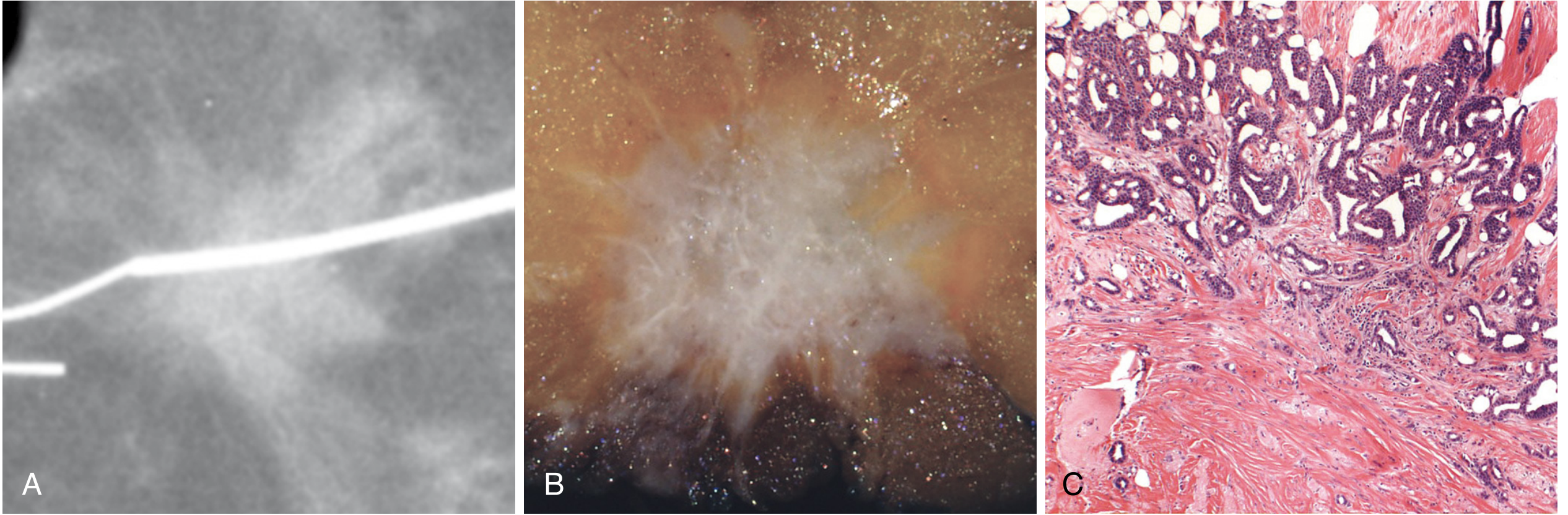
Classification (Foote & Stewart):
- Invasive ductal carcinoma - No Special Type (NST) - ~75-80%
- Invasive lobular carcinoma - ~10%
- Medullary carcinoma - ~4%
- Mucinous (colloid) carcinoma - ~2%
- Tubular carcinoma - ~2%
- Papillary carcinoma - ~2%
- Paget's disease of the nipple
- Rare types: adenoid cystic, metaplastic, apocrine
6A. Invasive Ductal Carcinoma - NST (Most Common)
- Gross: hard, gritty mass with irregular stellate borders; chalky-white streaks; characteristic grating sound when cut (due to desmoplasia)
- Micro: infiltrating glands/cords/solid nests in desmoplastic stroma; variable grade
- Desmoplastic reaction: tumor cells release FGF, TGFα/β, VEGF → fibrocytes become fibroblasts → collagen deposition → contraction → skin dimpling/nipple retraction
6B. Invasive Lobular Carcinoma
- "Indian file" / single-file pattern of infiltrating cells
- Cells encircle ducts in a targetoid pattern
- E-cadherin negative (same as LCIS - its precursor)
- Bilateral and multicentric more common
- Tends to be ER/PR positive
- Difficult to detect clinically and on mammography (no mass, no calcification)
- More commonly metastasizes to peritoneum, retroperitoneum, leptomeninges, GI tract, ovaries
6C. Medullary Carcinoma
- Well-circumscribed (deceptively benign appearance), soft consistency
- Syncytial growth of large pleomorphic cells
- Dense lymphoplasmacytic infiltrate (TILs) - associated with better prognosis
- Frequently BRCA1-associated, high-grade, triple-negative
- Despite high grade: better prognosis than IDC of similar grade
6D. Mucinous (Colloid) Carcinoma
- Small clusters of tumor cells floating in lakes of extracellular mucin
- Well-circumscribed, gelatinous appearance on gross
- Better prognosis among special types
- Older women; slow-growing
6E. Tubular Carcinoma
- Well-formed tubules with open lumina lined by single layer of cells
- Excellent prognosis - best of all invasive types
- Always low-grade, ER/PR positive
6F. Paget's Disease of the Nipple
- Chronic eczematous eruption of nipple-areola complex → ulceration, weeping
- Pathognomonic: Paget cells - large, pale, vacuolated cells in the rete pegs of nipple epidermis
- Associated with underlying DCIS (always) ± invasive carcinoma
- IHC: CEA positive, CK7 positive; S-100 negative (differentiates from melanoma)
- vs. Pagetoid intraepithelial melanoma: S-100 positive, HMB-45 positive
6G. Inflammatory Breast Carcinoma
- Clinical diagnosis - NOT a histological type
- Rapid onset: breast erythema, warmth, skin thickening, peau d'orange
- Due to dermal lymphatic invasion by tumor emboli
- Most aggressive form of locally advanced breast cancer
- T4d in TNM staging
7. NOTTINGHAM HISTOLOGIC GRADING (Elston-Ellis Modification)
Grades ALL invasive carcinomas based on 3 parameters (each scored 1-3):
| Parameter | Score 1 | Score 2 | Score 3 |
|---|---|---|---|
| Tubule formation | >75% | 10-75% | <10% |
| Nuclear pleomorphism | Small, uniform | Moderate variation | Marked variation |
| Mitotic count | Low | Moderate | High |
- Total 3-5 → Grade 1 (well differentiated, best prognosis)
- Total 6-7 → Grade 2 (moderately differentiated)
- Total 8-9 → Grade 3 (poorly differentiated, worst prognosis)
8. SPREAD OF BREAST CANCER
8A. Local Spread
- Skin involvement → peau d'orange (lymphatic obstruction, not direct invasion)
- Skin dimpling/puckering: shortening of Cooper's ligaments due to desmoplasia
- Nipple retraction: desmoplasia involving subareolar ligaments
- Ulceration: advanced skin invasion
- Chest wall invasion (T4a): pectoralis major, serratus anterior, ribs
8B. Lymphatic Spread (primary route)
- Axillary lymph nodes (most important): drains outer quadrant → Level I → II → III
- Internal mammary nodes: drains inner quadrant/central tumors
- Supraclavicular nodes: N3c (M1 in old staging)
- Axillary nodal status = most important prognostic factor for early breast cancer
Axillary lymph node levels:
- Level I: lateral to pectoralis minor
- Level II: behind pectoralis minor (includes Rotter's nodes between pec major and minor)
- Level III: medial to pectoralis minor (infraclavicular)
8C. Haematogenous Spread
- Neoangiogenesis begins at tumor size 1-2 mm (10⁵ cells)
- Metastatic sites in order of frequency:
- Bone (most common): lumbar vertebrae > neck of femur > thoracic vertebrae > ribs > skull
- Lung/pleura
- Liver
- Brain
- Adrenal glands, ovaries (occasional)
- Bone mets: mostly osteolytic; occasionally osteosclerotic or mixed
- Bone marrow replacement → leukoerythroblastic anemia
- ILC specifically metastasizes to: peritoneum, GI, ovaries, leptomeninges
9. CLINICAL FEATURES
Symptoms
- Hard, painless lump (most common presentation) - usually upper outer quadrant (50%)
- Skin changes: dimpling, peau d'orange, erythema, ulceration
- Nipple changes: retraction, discharge (bloody = most suspicious), Paget's changes
- Axillary lymphadenopathy
Signs on Examination
| Sign | Mechanism |
|---|---|
| Skin dimpling | Cooper's ligament shortening |
| Peau d'orange | Dermal lymphatic blockage causing skin edema |
| Nipple retraction | Desmoplasia of retroareolar ligaments |
| Paget's changes | Intraepithelial spread to nipple |
| Fixed mass | Chest wall/skin infiltration (T4) |
| Hard, matted axillary nodes | Nodal metastasis |
Quadrant distribution of breast cancers:
- Upper outer: 50%
- Upper inner: 15%
- Lower outer: 10%
- Lower inner: 5%
- Central/subareolar: 20%
10. INVESTIGATIONS & IMAGING
Triple Assessment (Gold Standard)
- Clinical examination
- Imaging (mammography ± USG)
- Tissue biopsy (FNAC or core needle biopsy)
Mammography
- Gold standard for screening (>40 years)
- Suspicious features:
- Spiculated mass with irregular margins
- Clustered microcalcifications (fine stippled, pleomorphic)
- Asymmetric density
- Architectural distortion
- Screening mammography reduces mortality by 20-33%
- BIRADS classification used to stratify findings (0-6)
Ultrasound
- Preferred in women <35 years (dense breasts)
- Distinguishes cystic vs. solid lesions
- Guides FNA/biopsy
MRI Breast
- Highest sensitivity (~90-95%) but lower specificity
- Indications: BRCA carriers, implants, occult primary, assessing extent, neoadjuvant response monitoring
Biopsy
- FNAC: cytology only; cannot distinguish invasive vs. in situ
- Core needle biopsy (CNB): histology; preferred - gives architecture, ER/PR/HER2 status
- Open excision biopsy: when CNB non-diagnostic
11. TNM STAGING (AJCC 8th Edition)
T - Primary Tumor
| Stage | Size |
|---|---|
| Tis | DCIS / Paget's without invasive component |
| T1mi | ≤1 mm |
| T1a | >1-5 mm |
| T1b | >5-10 mm |
| T1c | >10-20 mm |
| T2 | >20-50 mm |
| T3 | >50 mm |
| T4a | Chest wall invasion |
| T4b | Skin ulceration / satellite nodules / peau d'orange |
| T4c | Both T4a + T4b |
| T4d | Inflammatory carcinoma |
N - Regional Lymph Nodes
| Stage | Description |
|---|---|
| N0 | No nodal mets |
| N1 | 1-3 axillary nodes (mobile) |
| N2a | 4-9 axillary nodes (fixed/matted) |
| N2b | Internal mammary nodes clinically positive |
| N3a | ≥10 axillary nodes OR infraclavicular (Level III) |
| N3b | Internal mammary + axillary nodes |
| N3c | Ipsilateral supraclavicular nodes |
M
| M0 | No distant mets |
| M1 | Distant metastasis |
Overall Stage Grouping
| Stage | TNM |
|---|---|
| 0 | Tis N0 M0 |
| IA | T1 N0 M0 |
| IB | T0-1 N1mi M0 |
| IIA | T0-1 N1 or T2 N0 M0 |
| IIB | T2 N1 or T3 N0 M0 |
| IIIA | T0-3 N2 or T3 N1 M0 |
| IIIB | T4 any N M0 |
| IIIC | Any T N3 M0 |
| IV | Any T Any N M1 |
NEET SS note: The AJCC 8th edition introduced Prognostic Stage which adjusts anatomic stage based on ER/PR/HER2 and grade. TNBC is typically "up-staged"; Luminal A is "down-staged."
12. SENTINEL LYMPH NODE BIOPSY (SLNB)
- Gold standard for axillary staging in clinically node-negative patients
- Sentinel node = first node to receive lymphatic drainage from the tumor
- Technique: Blue dye (Patent Blue V/Isosulfan blue) + Radioisotope (Tc-99m sulfur colloid) injected peritumorally
- Intraoperative assessment: frozen section or touch imprint cytology
- If sentinel node negative → no further axillary dissection needed
- If sentinel node positive → axillary lymph node dissection (ALND) OR completion axillary irradiation
13. SURGICAL MANAGEMENT
Breast Surgery Options
| Procedure | Extent | Indications |
|---|---|---|
| Lumpectomy (wide local excision) | Tumor + 1 cm margin | T1-T2 with BCS feasible |
| Breast Conserving Surgery (BCS) | = lumpectomy + axillary surgery | Early breast cancer (Stage I-II) |
| Simple mastectomy | Entire breast, no axilla | DCIS, prophylactic |
| Modified Radical Mastectomy (MRM) | Breast + axillary LN (levels I-III), pectoral fascia preserved | T2-T3, BCS not feasible |
| Radical mastectomy (Halsted) | Breast + pec major + pec minor + axillary LN | Rarely done now; T4a with pec major involvement |
| Skin-sparing/Nipple-sparing mastectomy | Breast parenchyma only; skin/NAC preserved | Prophylactic or oncoplastic |
BCS contraindications (absolute): multifocal/multicentric disease, previous breast irradiation, pregnancy (relative), positive margins after re-excision, inflammatory carcinoma, diffuse malignant microcalcifications
BCS + Radiation = Equivalent to MRM for survival (landmark NSABP B-06 trial)
Axillary Surgery
- SLNB → standard for cN0 (clinically node-negative)
- ALND (levels I & II) → cN1, failed SLNB, post-neoadjuvant with residual disease
- Z0011 trial: If 1-2 positive sentinel nodes + BCS + whole breast RT → no further ALND needed
14. SYSTEMIC THERAPY
A. Chemotherapy
Adjuvant regimens:
- AC-T: Doxorubicin (Adriamycin) + Cyclophosphamide × 4 → Paclitaxel (Taxol) × 4
- CMF: Cyclophosphamide + Methotrexate + 5-FU (older regimen)
- Anthracyclines + Taxanes: current backbone
Neoadjuvant Chemotherapy (NACT) - indications:
- Locally advanced breast cancer (T3, T4, N2, N3)
- To downsize tumor for BCS
- HER2-positive tumors
- Triple-negative breast cancer
- Premenopausal women with node-positive disease
- Pathologic Complete Response (pCR) after NACT = best prognostic marker; ~1/3 of TNBC and HER2+ achieve pCR
B. Endocrine Therapy (for ER/PR-positive tumors)
| Drug | Mechanism | Use |
|---|---|---|
| Tamoxifen | Selective ER modulator (SERM); blocks ER | Premenopausal; 5-10 years; also used for DCIS |
| Aromatase inhibitors (letrozole, anastrozole, exemestane) | Block peripheral aromatization of androgens to estrogen | Postmenopausal; superior to tamoxifen in postmenopausal |
| Fulvestrant | Pure ER antagonist (SERD) | Metastatic ER+ disease |
| Ovarian suppression + AI | GnRH agonist + AI | High-risk premenopausal |
C. Targeted Therapy (HER2-positive)
| Drug | Mechanism | Use |
|---|---|---|
| Trastuzumab (Herceptin) | Anti-HER2 monoclonal antibody | Adjuvant + metastatic; 1 year |
| Pertuzumab | Binds different HER2 epitope; blocks HER2-HER3 dimerization | Neoadjuvant + metastatic (with trastuzumab) |
| Lapatinib | Dual tyrosine kinase inhibitor (HER1/HER2) | Metastatic |
| T-DM1 (ado-trastuzumab emtansine) | Antibody-drug conjugate | Residual disease after NACT |
| T-DXd (trastuzumab deruxtecan) | ADC (newer) | HER2+ metastatic; also HER2-low |
D. PARP Inhibitors (BRCA-mutated)
- Olaparib, Talazoparib: for germline BRCA1/2-mutated HER2-negative (early or metastatic)
- Mechanism: synthetic lethality - block DNA repair in BRCA-deficient cells
E. CDK 4/6 Inhibitors (ER+/HER2- metastatic)
- Palbociclib, Ribociclib, Abemaciclib + aromatase inhibitor
- Standard of care for metastatic luminal breast cancer
F. Immunotherapy
- Pembrolizumab (anti-PD1): approved for high-risk early TNBC (with chemo) and PD-L1+ metastatic TNBC
G. Radiation Therapy
- Whole breast irradiation (WBI): mandatory after BCS
- Post-mastectomy RT (PMRT): ≥4 positive lymph nodes, T3/T4, positive margins
- Regional nodal irradiation: N2-N3 disease
15. PROGNOSTIC FACTORS
Most Important (in order):
- Axillary lymph node status - single most important prognostic factor in early breast cancer
- Tumor size (T stage)
- Histologic grade (Nottingham grade)
- ER/PR/HER2 status (determines subtype)
- Lymphovascular invasion (LVI)
- Surgical margins
- Age (<35 yrs = worse prognosis)
Biomarkers with NEET SS importance:
- ER+ → better prognosis (responds to hormone therapy); late recurrences (>10 years)
- HER2+ → aggressive but targetable; trastuzumab improves survival dramatically
- TNBC → worst short-term prognosis; chemo sensitive; recurrences within 5 years
- High TILs → better prognosis in TNBC and HER2+; better chemo response
- Ki-67 >20% = high proliferation index = aggressive tumor
- ESR1 mutations = endocrine therapy resistance (metastatic ER+ disease)
Gene Expression Assays:
- Oncotype DX (21-gene): ER+/HER2- early breast cancer; identifies who can avoid chemo
- MammaPrint (70-gene): similar utility; identifies high-risk vs. low-risk
16. SPECIAL SITUATIONS
Male Breast Cancer
- Rare (~1% of all breast cancers)
- Usually presents late (more advanced stage)
- Almost always ER/PR positive
- BRCA2 mutation more common than BRCA1 (unlike female)
- Gynecomastia is NOT a risk factor
- Treatment: MRM (BCS rarely possible), hormone therapy (tamoxifen)
Bilateral Breast Cancer
- Synchronous (both at diagnosis) vs. metachronous (second primary after interval)
- ILC more likely to be bilateral than IDC
Locally Advanced Breast Cancer (LABC) - Stage III
- Definition: T3/T4 or N2/N3 disease
- Management: NACT first → surgery → adjuvant RT + systemic therapy
Metastatic (Stage IV) Breast Cancer
- Sites: Bone > Lung > Liver > Brain
- Goal: palliative (except in rare oligometastatic disease)
- Bone mets: bisphosphonates (zoledronic acid) or denosumab to reduce skeletal events
- Brain mets: stereotactic radiosurgery, whole brain RT, or systemic therapy
17. SCREENING GUIDELINES (Key Points for NEET SS)
| Organization | Recommendation |
|---|---|
| American Cancer Society | Annual mammogram from age 40; mandatory from 45; can start at 40 |
| ACS/ACOG | Begin at 40, annually |
| High-risk (BRCA carriers) | Annual MRI + mammogram from age 25-30 |
| Self-breast examination | Monthly from age 20 |
| Clinical breast exam | Every 3 years 20-39 yrs; annually ≥40 |
18. HIGH-YIELD NEET SS MNEMONICS & QUICK FACTS
Must-Know One-Liners:
- Most common cancer in women globally: Breast cancer
- Most common histological type: IDC-NST (75%)
- Best prognosis histological type: Tubular carcinoma
- Worst prognosis: Inflammatory carcinoma (clinically); TNBC (molecularly)
- Bilateral marker (not precursor): LCIS
- E-cadherin negative: ILC and LCIS
- Paget cells: Large, pale, vacuolated cells in nipple epidermis; CEA+, CK7+
- Peau d'orange: dermal lymphatic blockage (NOT direct skin invasion by tumor)
- Skin dimpling: Cooper's ligament shortening (desmoplastic reaction)
- Most common site of mets: Bone (lumbar vertebrae first)
- Most common bone met type: Osteolytic
- Sentinel node technique: Blue dye + Tc-99m
- BCS = MRM in survival: NSABP B-06 trial
- BRCA1 cancers: Usually TNBC, high-grade
- BRCA2 cancers: Usually ER+, lower-grade
- pCR after NACT: Best predictor of long-term outcome in TNBC and HER2+
- HER2 targeted therapy: Trastuzumab (do NOT use with anthracyclines simultaneously - cardiotoxicity)
- Tamoxifen side effects: Endometrial cancer, DVT/PE, hot flashes
- Aromatase inhibitors side effects: Osteoporosis, arthralgia (no endometrial cancer)
MNEMONIC for Risk Factors - "BEACH FARM":
- BREAST feeding (protective)
- Early menarche
- Age / Alcohol
- Chemical exposure / Combined HRT
- History (family) / HER2
- Family history / BRCA
- Age at first birth (late)
- Radiation
- Menopause (late)
19. QUICK COMPARISON TABLE (Exam-Focused)
| Feature | DCIS | LCIS | IDC | ILC |
|---|---|---|---|---|
| Origin | Ducts | Lobules | Ducts | Lobules |
| E-cadherin | + | - | + | - |
| Calcification | Yes (comedo) | No | Variable | No |
| Bilaterality | No | Yes (marker) | No | More common |
| Mammography | Microcalcifications | Invisible | Mass/spiculation | May be invisible |
| Metastasis pattern | N/A | N/A | Lung, liver, bone | GI, peritoneum, ovaries |
| Precursor | Yes | Risk marker | N/A | N/A |
Sources: Robbins, Cotran & Kumar Pathologic Basis of Disease (9780443264528) | Bailey and Love's Short Practice of Surgery 28th Edition (9780367548117) | Schwartz's Principles of Surgery 11th Edition (9781259835346)
This is a shared conversation. Sign in to Orris to start your own chat.