
Explain me about the classification of digestive system for anatomy
Reading File
Now let me search the medical library for digestive system anatomy classification content in parallel:
Finding Sources
Finding Sources
Searching Images
digestive system anatomy classification overview diagram
Good finds. Let me now read the most relevant sections in parallel — the Histology textbook's overview of the digestive system and Langman's embryology section:
Reading File
Finding Sources
Finding Sources
Excellent! Now let me read the key content sections — the overview from Histology and the wall layers/GI organization:
Reading File
Reading File
Reading File
I found rich diagram image URLs. Let me fetch the key diagrams and read more content:
Loading Image
Loading Image
Loading Image
Reading File
I now have comprehensive content and three excellent diagrams. Let me compile the full answer.
Classification of the Digestive System — Anatomy
The digestive system is organized into two major divisions: the alimentary canal (GI tract) and the accessory digestive organs. Together they carry out ingestion, mechanical and chemical digestion, absorption, and elimination.
Overview Diagram
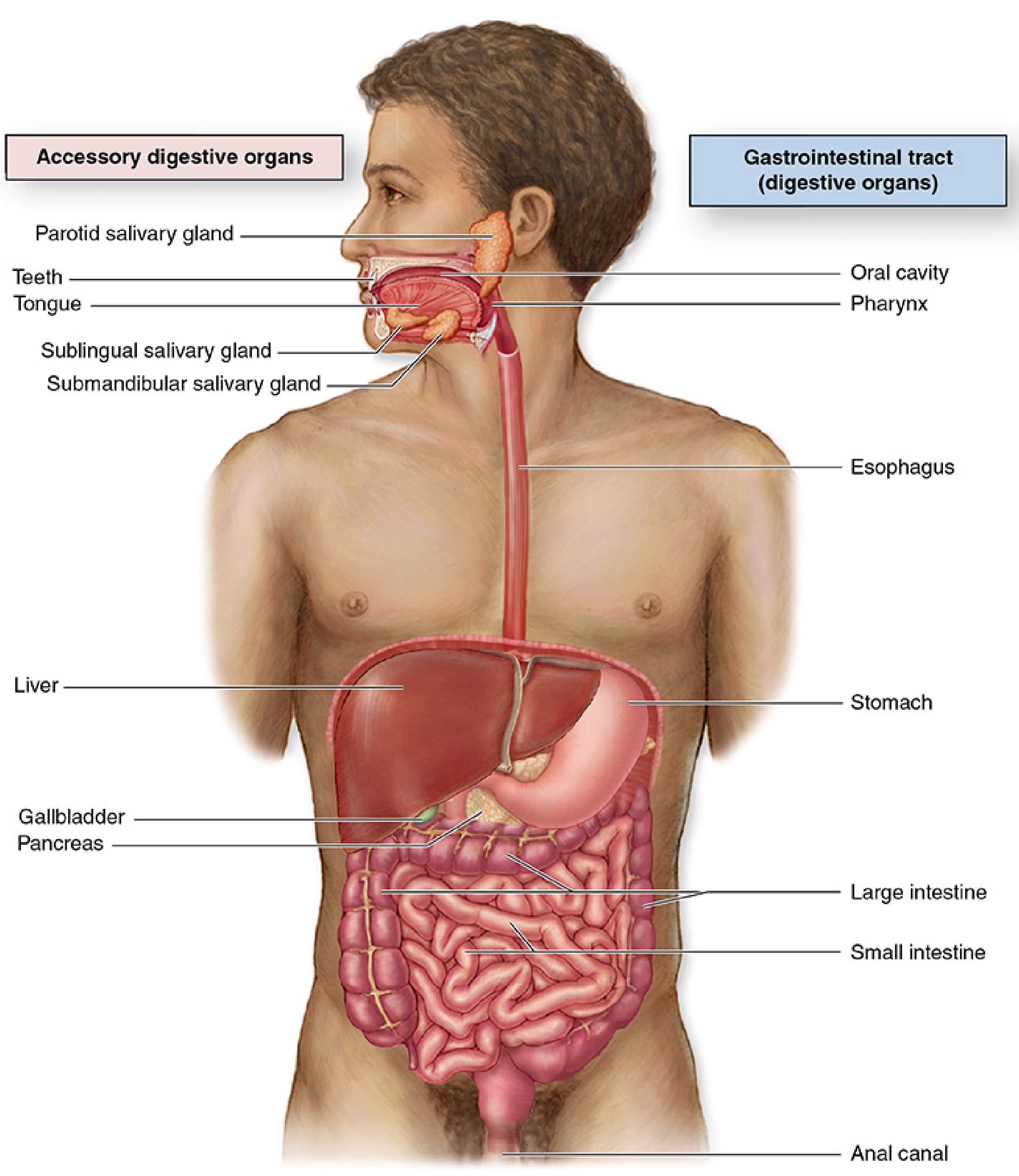
Figure: The digestive system showing the GI tract (right, blue) and accessory digestive organs (left, pink). — Junqueira's Basic Histology, 17e
I. The Alimentary Canal (GI Tract)
The alimentary canal is a continuous hollow tube extending from the oral cavity to the anus. It is subdivided regionally:
A. Upper GI Tract
| Segment | Key Features |
|---|---|
| Oral Cavity | Bounded by lips, cheeks, hard/soft palate, tongue; vestibule + oral cavity proper; stratified squamous epithelium |
| Pharynx | Shared passageway for digestive and respiratory tracts; Waldeyer's tonsillar ring of lymphoid tissue surrounds its entrance |
| Esophagus | Muscular conduit; upper third = skeletal muscle, lower third = smooth muscle; lacks a serosa (has adventitia instead) |
B. Lower GI Tract
| Segment | Key Features |
|---|---|
| Stomach | J-shaped; regions: cardia, fundus, body, pylorus; secretes HCl and pepsinogen; has oblique inner muscle layer in addition to circular/longitudinal |
| Small Intestine | ~6–7 m; three parts: duodenum (receives bile and pancreatic juice), jejunum (major absorption), ileum (vitamin B₁₂, bile salts) |
| Large Intestine | ~1.5 m; cecum + appendix, ascending colon, transverse colon, descending colon, sigmoid colon, rectum, anal canal; absorption of water and electrolytes; characteristic features: taeniae coli, haustra, epiploic appendages |
"The digestive system consists of the tract from the mouth (oral cavity) to the anus, as well as the digestive glands emptying into this tract." — Junqueira's Basic Histology, 17e
II. Accessory Digestive Organs
These organs lie outside the alimentary canal but empty secretions into it via ducts:
| Organ | Secretion / Function |
|---|---|
| Salivary glands (parotid, submandibular, sublingual) | Saliva: amylase, mucin, antibodies (IgA) |
| Liver | Bile (emulsification of fats); metabolic, synthetic, detoxification functions |
| Gallbladder | Concentrates and stores bile |
| Pancreas | Exocrine: pancreatic juice (lipase, amylase, proteases, bicarbonate); Endocrine: insulin, glucagon |
The liver and pancreas are extramural glands that empty into the duodenum.
III. General Structure of the Alimentary Canal Wall
The wall of the alimentary canal has the same four-layer organization from the esophagus to the anal canal:
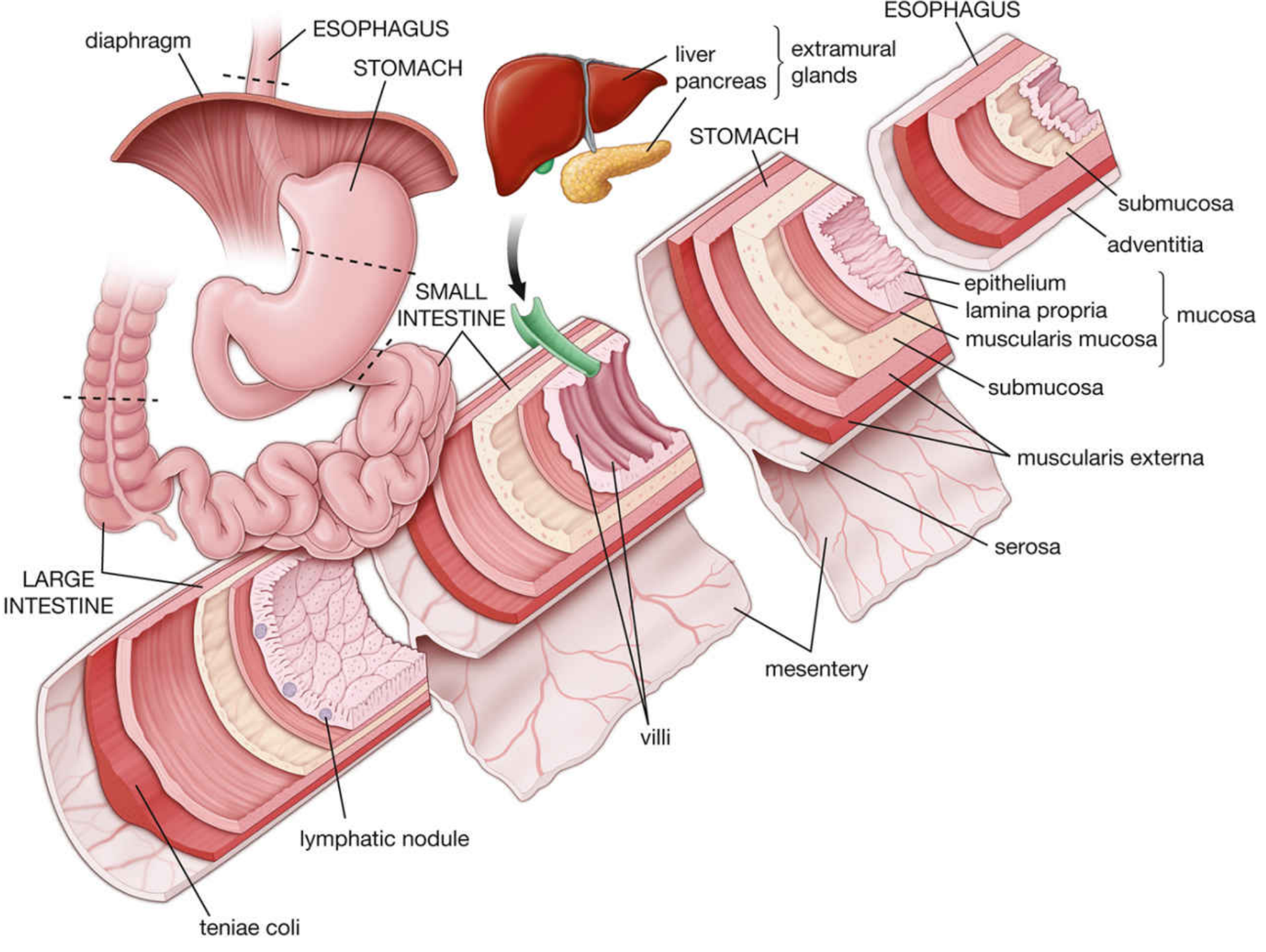
Figure: Wall structure in esophagus, stomach, small intestine, and large intestine showing all four layers. — Histology: A Text and Atlas, Pawlina
Layer by Layer (lumen → exterior)
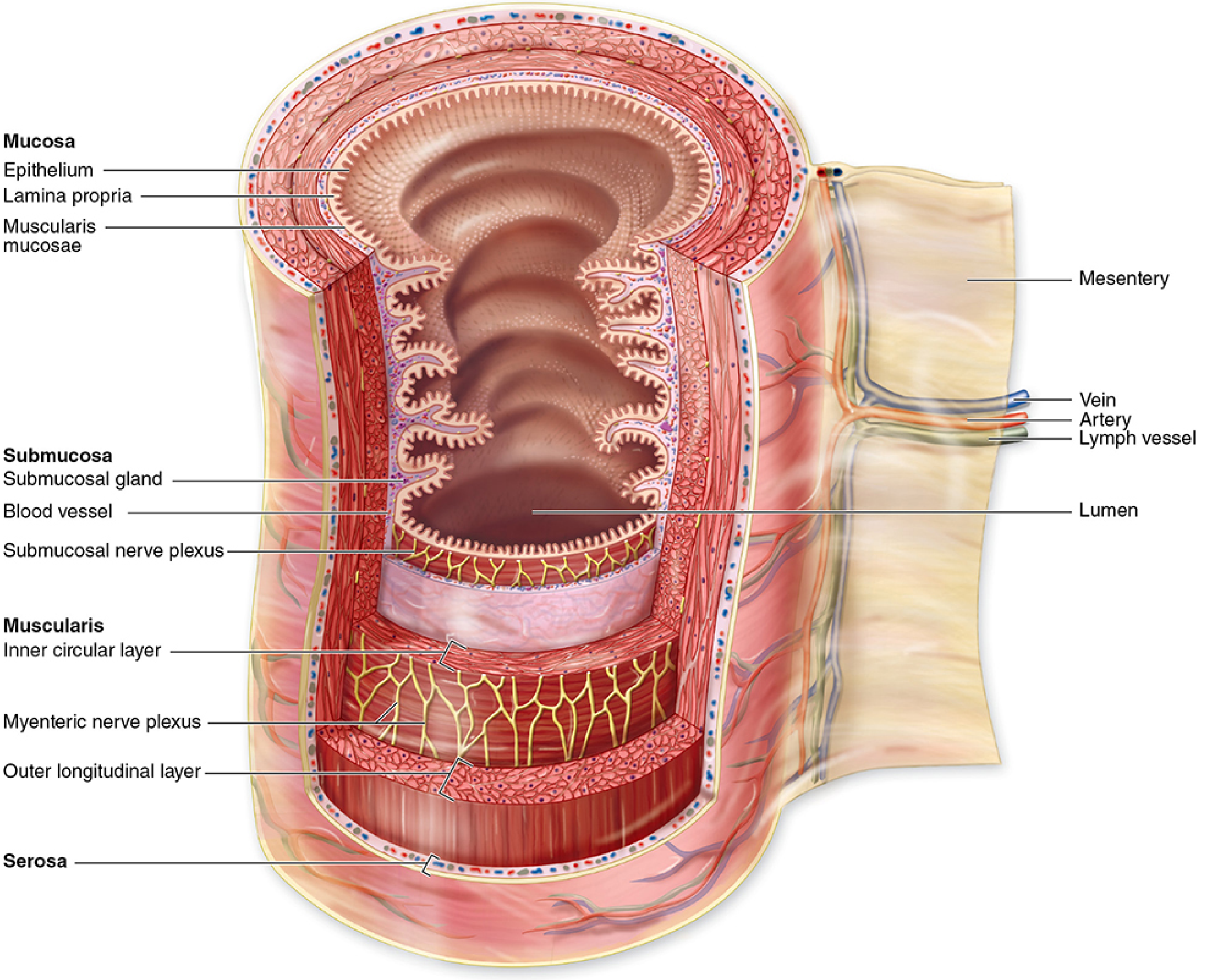
Figure: Cross-section of the small intestine showing all four wall layers with their sub-components. — Junqueira's Basic Histology, 17e
1. Mucosa
The innermost layer, with three sub-layers:
- Epithelium — varies by region (stratified squamous in esophagus/oral cavity; simple columnar in stomach/intestines)
- Lamina propria — loose connective tissue with blood vessels, lymphatics, immune cells (IgA-producing plasma cells, macrophages), and small glands
- Muscularis mucosae — thin smooth muscle layer that permits local mucosal movements
2. Submucosa
- Dense irregular connective tissue
- Contains larger blood vessels, lymphatics, and adipose tissue
- Houses the submucosal (Meissner) plexus — part of the enteric nervous system
- Contains glands in specific regions (esophageal and Brunner's glands of the duodenum)
3. Muscularis Externa
- Usually two smooth muscle layers:
- Inner circular layer — narrows the lumen (peristalsis)
- Outer longitudinal layer — shortens the tube
- Between the layers: myenteric (Auerbach) plexus — coordinates motility
- Exception: Stomach has an additional oblique inner layer; upper esophagus has skeletal muscle
4. Serosa / Adventitia
- Serosa: simple squamous mesothelium + thin connective tissue; present where the gut is suspended in the peritoneal cavity (stomach, most of small and large intestine); continuous with mesenteries
- Adventitia: connective tissue only (no epithelium); present where the gut is retroperitoneal or fixed (esophagus, parts of duodenum, ascending/descending colon, rectum)
IV. Functional Classification by Region
| Region | Primary Function |
|---|---|
| Oral cavity | Ingestion, mastication, salivary digestion (amylase), bolus formation |
| Pharynx + Esophagus | Transport (peristalsis) |
| Stomach | Mechanical mixing, acid digestion, chyme formation |
| Small intestine | Enzymatic digestion, nutrient + water absorption |
| Large intestine | Water/electrolyte reabsorption, feces formation, elimination |
V. Summary of Classification
DIGESTIVE SYSTEM
├── Alimentary Canal (GI Tract)
│ ├── Oral cavity
│ ├── Pharynx
│ ├── Esophagus
│ ├── Stomach
│ ├── Small intestine (duodenum → jejunum → ileum)
│ └── Large intestine (cecum → colon → rectum → anal canal)
│
└── Accessory Organs
├── Salivary glands (parotid, submandibular, sublingual)
├── Liver
├── Gallbladder
└── Pancreas
Sources:
- Histology: A Text and Atlas with Correlated Cell and Molecular Biology (Pawlina), Ch. 16–17
- Junqueira's Basic Histology: Text and Atlas, 17e, Ch. 15
This is a shared conversation. Sign in to Orris to start your own chat.