
Teach me dwarfism as I'm 3rd year pg resident of medicine appearing for muhs theory exam also help me write answer for same
Reading File
Now let me search the medical library for dwarfism content across multiple angles simultaneously.
Finding Sources
Finding Sources
Finding Sources
Excellent. Now let me read the most comprehensive sources in parallel.
Reading File
Reading File
Reading File
Reading File
Now let me pull the detailed achondroplasia content and GH deficiency/pituitary dwarfism sections, plus short stature classification from medicine textbooks.
Reading File
Reading File
Finding Sources
Finding Sources
Now let me get Harrison's content on short stature and the GH treatment pharmacology details:
Reading File
Reading File
Finding Sources
Let me fetch the achondroplasia image and get Harrison's detailed short stature content:
Loading Image
Finding Sources
Finding Sources
I now have comprehensive material from multiple authoritative textbooks. Let me compile the full, exam-ready answer.
DWARFISM - Complete Study Guide for MUHS PG Medicine Theory Exam
QUICK DEFINITION
Dwarfism is defined as an adult height of less than 147 cm (4 ft 10 in). It results from a heterogeneous group of disorders affecting skeletal growth, endocrine function, or metabolic processes.
- Campbell's Operative Orthopaedics 15th Ed 2026
- Adams and Victor's Principles of Neurology, 12th Ed
CLASSIFICATION
A. By Body Proportions
| Type | Description | Examples |
|---|---|---|
| Proportionate dwarfism | Symmetric reduction in both trunk AND limb length; body proportions normal | GH deficiency, hypothyroidism, malnutrition, mucopolysaccharidoses |
| Disproportionate dwarfism | Selective shortening of trunk or limbs | See below |
Disproportionate dwarfism - subtypes:
-
Short-trunk variety - trunk shorter relative to limbs
- Example: Kniest syndrome (spondyloepiphyseal dysplasia)
-
Short-limb variety - limbs disproportionately short; trunk relatively normal
- Example: Achondroplasia, diastrophic dysplasia
- Short-limb dwarfism is further subclassified by which segment is short:
- Rhizomelic - proximal limb (humerus/femur) is short
- Mesomelic - middle segment (radius-ulna/tibia-fibula) is short
- Acromelic - distal segment (hands/feet) is short
- Miller's Review of Orthopaedics 9th Ed
CAUSES / ETIOLOGY
1. Endocrine Causes (Proportionate)
| Condition | Mechanism |
|---|---|
| GH deficiency (panhypopituitarism) | Most common cause of proportionate dwarfism |
| Hypothyroidism | Impaired GH secretion and target action |
| Cushing's syndrome | Excess glucocorticoids suppress growth |
| Precocious puberty | Early epiphyseal fusion |
| Diabetes mellitus (poorly controlled) | Mauriac syndrome |
2. Genetic / Skeletal Dysplasias (Disproportionate)
| Condition | Inheritance | Mutation | Key Feature |
|---|---|---|---|
| Achondroplasia | AD | FGFR3 (gain-of-function) | Most common skeletal dysplasia |
| Thanatophoric dysplasia | Sporadic | FGFR3 (more severe gain-of-function) | Most common LETHAL dwarfism |
| Diastrophic dwarfism | AR | SLC26A2 gene | Multiple joint contractures |
| Spondyloepiphyseal dysplasia | AD/XL | COL2A1 | Short trunk |
| Osteogenesis imperfecta | AD | COL1A1/COL1A2 | Fragile bones + blue sclerae |
3. Metabolic / Nutritional
- Mucopolysaccharidoses (storage disorders) - proportionate dwarfism
- Nutritional dwarfism (malnutrition, celiac disease, Crohn's disease)
- Renal osteodystrophy
4. Psychosocial Dwarfism
- Also called Kaspar-Hauser syndrome, maternal deprivation syndrome, or abuse dwarfism
- Growth retardation from emotional/psychological neglect
- Associated with retarded bone age and osteopenia
- Reversible with change in environment
- Brogdon's Forensic Radiology
5. Chromosomal / Syndromic
- Turner syndrome (45,X0) - short stature, gonadal dysgenesis
- Down syndrome (Trisomy 21)
- Russell-Silver syndrome - prenatal onset short stature, hemihypertrophy, craniofacial dysostosis
- Seckel (bird-headed) dwarfism - microcephaly, beaked nose, severe cognitive impairment (mutation in RAD3-related protein)
DETAILED PATHOPHYSIOLOGY
A. GH Deficiency Dwarfism (Pituitary Dwarfism)
The GH - IGF-1 axis:
Hypothalamus (GHRH)
      ↓
Anterior Pituitary (GH)
      ↓
Liver (IGF-1 / Somatomedin-C)
      ↓
Bone epiphyseal plates → Linear growth
Defects at any level cause dwarfism:
- Decreased GHRH (hypothalamic dysfunction)
- Primary GH deficiency (pituitary)
- Failure to generate IGF-1 (liver)
- GH receptor defects or IGF-1 receptor defects
Clinical features of GH deficiency dwarfism:
-
Proportionate short stature
-
Body proportions normal
-
Mild obesity (lack of fat mobilization)
-
Delayed puberty
-
No sexual development in 2/3 of patients; 1/3 do mature sexually
-
Normal intelligence
-
Delayed bone age
-
Guyton & Hall Textbook of Medical Physiology; Costanzo Physiology 7th Ed
B. Laron Dwarfism (GH Resistance)
- GH levels are elevated (not deficient)
- GH receptors are defective - cannot generate IGF-1
- Treatment with exogenous GH is INEFFECTIVE
- Treatment requires recombinant IGF-1
- Costanzo Physiology 7th Ed
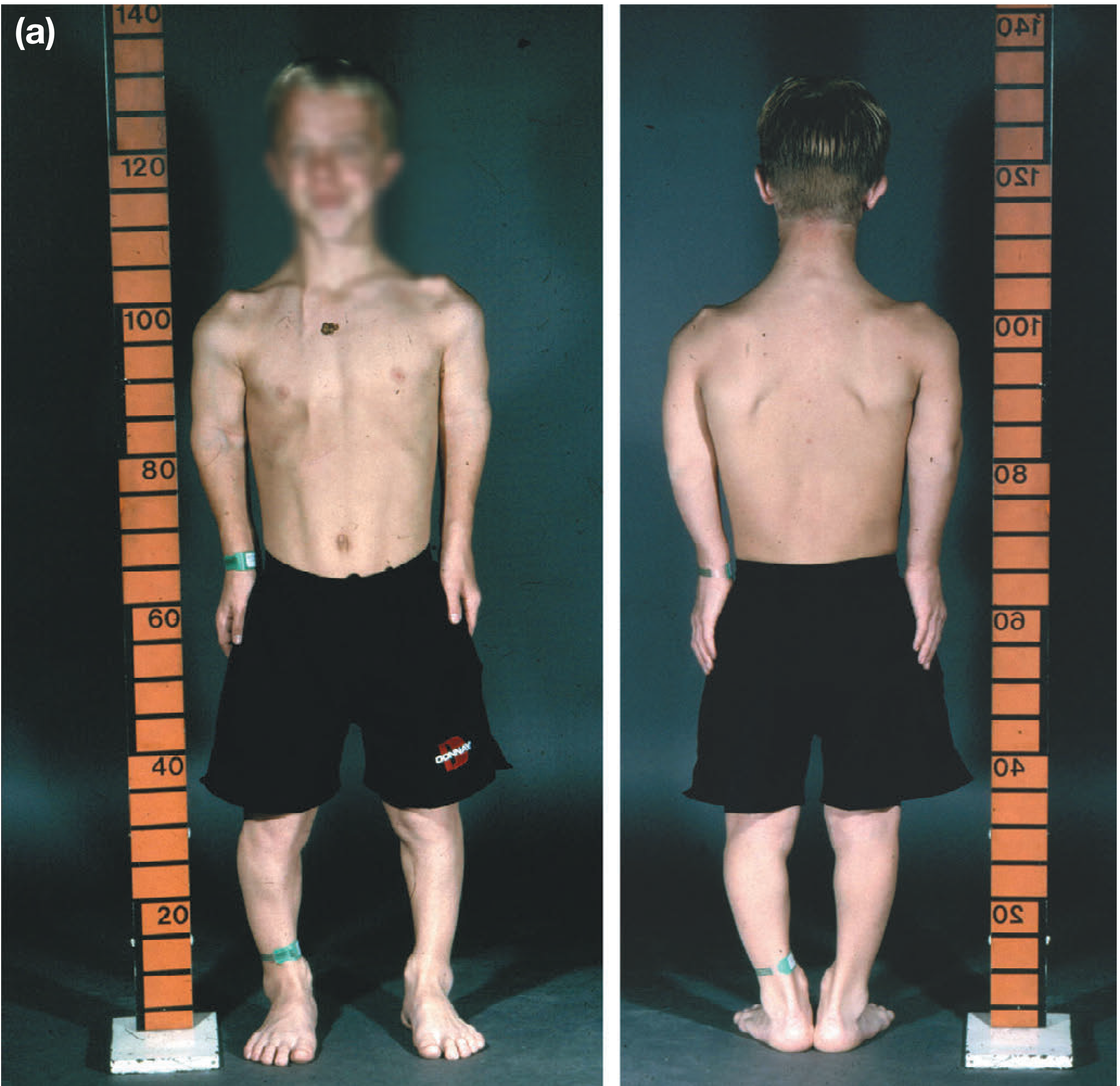
C. Achondroplasia (Most Common Skeletal Dysplasia)
Gene: FGFR3 (fibroblast growth factor receptor 3), located on short arm of chromosome 4
Mutation: Gain-of-function - FGFR3 is constitutively active, causing pathologic suppression of endochondral cartilage growth
Inheritance: Autosomal dominant; ~90% are new mutations occurring almost exclusively on the paternal allele
Pathology: Normal membranous bone formation; defective endochondral ossification (affects long bones but not skull vault)
Clinical Features:
- Disproportionate short stature (limbs << trunk)
- Rhizomelic shortening (proximal limb segments most affected)
- Enlarged head with frontal bossing
- Depression at root of nose (saddle nose)
- Relatively normal trunk
- Normal intelligence
- Normal lifespan (usually)
- Foramen magnum narrowing - can cause spinal cord compression, sleep apnea
- Lumbar spinal stenosis - claudication and leg symptoms in adults
- Trident hand - fingers appear to diverge in three groups
Radiology:
-
Short, wide long bones
-
Champagne glass pelvis (narrow sacroiliac notch)
-
Bullet-shaped vertebrae
-
Decreasing interpedicular distance from L1 to L5 (reversed in normal)
-
Robbins & Kumar Basic Pathology; Bailey and Love's Surgery 28th Ed; Adams & Victor's Neurology
D. Thanatophoric Dysplasia
- Most common lethal form of dwarfism
- Also FGFR3 gain-of-function mutation, but more severe than achondroplasia
- Incidence: 1 in 20,000 live births
- Severe limb shortening, frontal bossing, macrocephaly
- Small chest cavity → respiratory insufficiency → death at birth or soon after
- Robbins & Kumar Basic Pathology
INVESTIGATIONS
For Proportionate Short Stature (Endocrine Work-Up)
- Bone age (X-ray wrist) - delayed in GH deficiency, hypothyroidism; advanced in precocious puberty
- Serum IGF-1 (Somatomedin-C) - best screening test for GH deficiency (stable, not pulsatile)
- Serum IGFBP-3 - low in GH deficiency
- GH stimulation tests (definitive):
- Insulin tolerance test (gold standard)
- Arginine stimulation
- Clonidine stimulation
- L-DOPA stimulation
- Thyroid function tests (TSH, free T4)
- Karyotype - in girls to rule out Turner syndrome
- MRI pituitary - to look for craniopharyngioma, tumors
- Serum cortisol - to rule out Cushing's
- IGF-1 generation test - if Laron syndrome suspected (high GH, low IGF-1, no response to exogenous GH)
For Disproportionate Short Stature (Skeletal Dysplasia Work-Up)
- Skeletal survey X-rays (whole body)
- Molecular genetic testing (FGFR3 for achondroplasia)
- MRI spine/foramen magnum (in achondroplasia - assess stenosis)
- CT pelvis/femur (if arthroplasty planned)
TREATMENT
Pituitary (GH Deficiency) Dwarfism
| Treatment | Detail |
|---|---|
| Recombinant human GH (somatropin) | Given daily SC injections; effective only if given before epiphyseal fusion; pure GH deficiency can be completely cured if treated early |
| Dose | 0.025-0.05 mg/kg/day SC |
| Response | Best in first year; continue until final height achieved |
| GH is species-specific | Animal GH does NOT work in humans; must use human recombinant GH |
| Laron dwarfism | Exogenous GH ineffective; treat with recombinant IGF-1 (mecasermin) |
- Guyton & Hall; Lippincott Illustrated Reviews Pharmacology; Katzung Pharmacology 16th Ed
GH is approved for:
- GH deficiency
- Turner syndrome
- Prader-Willi syndrome
- Chronic renal insufficiency (children)
- Small for gestational age (SGA)
- Idiopathic short stature (ISS)
Achondroplasia
- No cure currently
- Vosoritide (CNP analog, C-type natriuretic peptide) - recently approved to increase height velocity in children with achondroplasia
- Limb lengthening procedures (Ilizarov technique) used in some centers
- Foramen magnum decompression if symptomatic stenosis
- Spinal stenosis management
Hypothyroid Dwarfism
- Early thyroxine replacement (irreversible cognitive damage if untreated)
IMPORTANT EPONYMS & SPECIAL TYPES
| Eponym | Description |
|---|---|
| Laron dwarfism | GH resistance - high GH, low IGF-1, defective GH receptor |
| Seckel syndrome | Nanocephalic (bird-headed) dwarfism; microcephaly, beaked nose, severe mental retardation |
| Russell-Silver syndrome | Prenatal short stature, hemihypertrophy, craniofacial dysostosis |
| Psychosocial dwarfism | Kaspar-Hauser syndrome; emotional deprivation; reversible |
| Diastrophic dwarfism | AR, SLC26A2; multiple joint contractures; high scoliosis rate (88%) |
| Thanatophoric dwarfism | Most common lethal form; FGFR3; dies at/soon after birth |
HIGH-YIELD MNEMONICS
Causes of SHORT stature (MUTCD):
- M - Metabolic / nutritional
- U - Unknown (constitutional)
- T - Turner syndrome / chromosomal
- C - Chronic illness (renal, GI, cardiac)
- D - Dysmorphic syndromes / Dysplasias / Deficiency of GH
Short-limb segments (RMA):
- Rhizomelic = pRoximal (e.g., achondroplasia)
- Mesomelic = Middle
- Acromelic = distal (Acral)
EXAM-FORMAT WRITTEN ANSWER
Q. Write a short note on Dwarfism.
(This is a model answer for MUHS MD Medicine theory - 10 marks)
DEFINITION
Dwarfism is defined as a height of less than 147 cm (4 feet 10 inches) in an adult. It encompasses a wide spectrum of disorders affecting bone growth, endocrine function, and metabolism.
CLASSIFICATION
Dwarfism is broadly classified as:
I. Proportionate dwarfism: Symmetric reduction in both trunk and limb length with normal body proportions. Causes include GH deficiency, hypothyroidism, malnutrition, and mucopolysaccharidoses.
II. Disproportionate dwarfism:
- Short-trunk variety: e.g., spondyloepiphyseal dysplasia (Kniest syndrome)
- Short-limb variety: e.g., achondroplasia, diastrophic dwarfism
- Further subclassified as rhizomelic (proximal), mesomelic (middle), or acromelic (distal)
CAUSES
- Endocrine: GH deficiency (panhypopituitarism), Laron dwarfism (GH resistance), hypothyroidism, Cushing's syndrome, precocious puberty
- Skeletal dysplasias: Achondroplasia (FGFR3 gain-of-function mutation, AD), thanatophoric dysplasia (most common lethal form), diastrophic dwarfism (AR), osteogenesis imperfecta
- Chromosomal: Turner syndrome (45,X0), Down syndrome, Russell-Silver syndrome
- Nutritional: Malnutrition, celiac disease, inflammatory bowel disease
- Psychosocial: Deprivation/Kaspar-Hauser syndrome - reversible with treatment
- Constitutional: Familial short stature, constitutional delay of growth and puberty
PATHOPHYSIOLOGY
GH Deficiency (most common endocrine cause): The hypothalamic-pituitary-IGF-1 axis is disrupted at any level. GH acts via IGF-1 (somatomedin-C) produced in the liver to stimulate epiphyseal plate chondrocyte proliferation. Defects in GHRH, GH secretion, or IGF-1 generation all result in proportionate short stature with delayed bone age.
Achondroplasia: A gain-of-function mutation in FGFR3 gene (chromosome 4p) causes constitutive receptor activation, which pathologically suppresses endochondral ossification. 90% are new mutations occurring on the paternal allele. Results in rhizomelic short-limb dwarfism with normal membranous bone (skull, clavicle unaffected).
CLINICAL FEATURES
GH Deficiency: Proportionate short stature, delayed bone age, mild obesity, delayed puberty, infantile facies, high-pitched voice, normal intelligence
Achondroplasia: Disproportionate short stature with rhizomelic limb shortening, frontal bossing, saddle nose (depressed nasal bridge), relative trunk preservation, trident hand, normal intelligence, foramen magnum stenosis, lumbar spinal stenosis
INVESTIGATIONS
- Bone age X-ray (wrist)
- Serum IGF-1 and IGFBP-3 (screening for GH deficiency)
- GH stimulation tests (insulin tolerance test - gold standard)
- Thyroid function tests (TSH, free T4)
- Karyotype (girls - to rule out Turner syndrome)
- MRI pituitary (rule out craniopharyngioma)
- Skeletal survey X-rays (for skeletal dysplasias)
- Molecular genetic testing (FGFR3 in achondroplasia)
TREATMENT
GH deficiency: Recombinant human GH (somatropin) SC daily - most effective before epiphyseal fusion; pure GH deficiency can be completely cured if treated early
Laron dwarfism (GH resistance): Recombinant IGF-1 (mecasermin) - exogenous GH is ineffective as GH receptors are defective
Hypothyroidism: Early thyroxine replacement
Achondroplasia: Vosoritide (CNP analog) for children; limb lengthening (Ilizarov technique); foramen magnum/spinal canal decompression for neurological complications
Psychosocial dwarfism: Change of environment and psychosocial rehabilitation - leads to catch-up growth
COMPLICATIONS
- Foramen magnum stenosis (achondroplasia) - sleep apnea, sudden death, quadriplegia
- Lumbar spinal stenosis - claudication
- Premature osteoarthritis of hip
- Scoliosis (especially in diastrophic dwarfism - 88%)
- Psychological and social morbidity
SOURCES
- Guyton & Hall Textbook of Medical Physiology, p. 924-925
- Costanzo Physiology 7th Ed, p. (GH Pathophysiology section)
- Robbins & Kumar Basic Pathology (Achondroplasia, Thanatophoric Dysplasia)
- Adams and Victor's Principles of Neurology 12th Ed, p. 1016
- Bailey and Love's Short Practice of Surgery 28th Ed
- Campbell's Operative Orthopaedics 15th Ed 2026, p. 290
- Miller's Review of Orthopaedics 9th Ed
Key exam points to remember:
- Achondroplasia = most common skeletal dysplasia; FGFR3 gain-of-function; AD; 90% new mutations on paternal allele
- Thanatophoric dysplasia = most common LETHAL dwarfism; also FGFR3 but more severe
- Laron dwarfism = high GH + low IGF-1; GH receptor mutation; treat with IGF-1 not GH
- Psychosocial dwarfism = reversible with change in environment
- GH is species-specific - must use recombinant human GH
- Diastrophic dwarfism = AR; scoliosis in 88%
- Short-limb segments: Rhizomelic (proximal) > Mesomelic > Acromelic
This is a shared conversation. Sign in to Orris to start your own chat.