Pathogenesis of pyogenic meningitis
"bacterial meningitis" AND pathogenesis
pyogenic bacterial meningitis pathogenesis review blood brain barrier
Pathogenesis of pyogenic meningitis
Sequence of events
-
Colonization of a mucosal site
- Common organisms first colonize the nasopharynx:
- Streptococcus pneumoniae
- Neisseria meningitidis
- Haemophilus influenzae
- In neonates, infection is often acquired vertically or perinatally, commonly due to group B streptococci or E. coli.
- Common organisms first colonize the nasopharynx:
-
Mucosal invasion and bacteremia
- Bacteria breach the mucosal epithelium, enter lymphatics/blood, and survive in the circulation.
- Capsulated bacteria resist phagocytosis and complement-mediated killing, allowing sustained bacteremia.
-
Entry into the CNS
- Bacteria adhere to and cross cerebral microvascular endothelium or the choroid plexus, entering the CSF/subarachnoid space.
- Less commonly, infection reaches the meninges by:
- Direct extension from otitis media, mastoiditis, sinusitis, skull osteomyelitis
- Head trauma, neurosurgery, CSF leak, or congenital dermal sinus
-
Rapid multiplication in CSF
- CSF is relatively deficient in immunoglobulins, complement, and effective phagocytic cells.
- Therefore, organisms multiply rapidly in the subarachnoid space.
-
Acute inflammatory response
- Bacterial cell-wall products and toxins trigger release of inflammatory mediators, including TNF, IL-1, IL-6, and chemokines.
- Endothelial activation causes:
- Increased blood-brain barrier permeability
- Neutrophil migration into CSF
- Protein-rich purulent exudate in the subarachnoid space
-
Brain injury and complications
- Inflammation produces cerebral edema:
- Vasogenic edema from blood-brain barrier disruption
- Cytotoxic edema from cellular injury
- Interstitial edema due to impaired CSF absorption and hydrocephalus
- Vasculitis, thrombosis, and reduced cerebral perfusion may cause ischemia and infarction.
- Raised intracranial pressure, seizures, cranial-nerve palsies, hydrocephalus, and herniation may result.
- Inflammation produces cerebral edema:
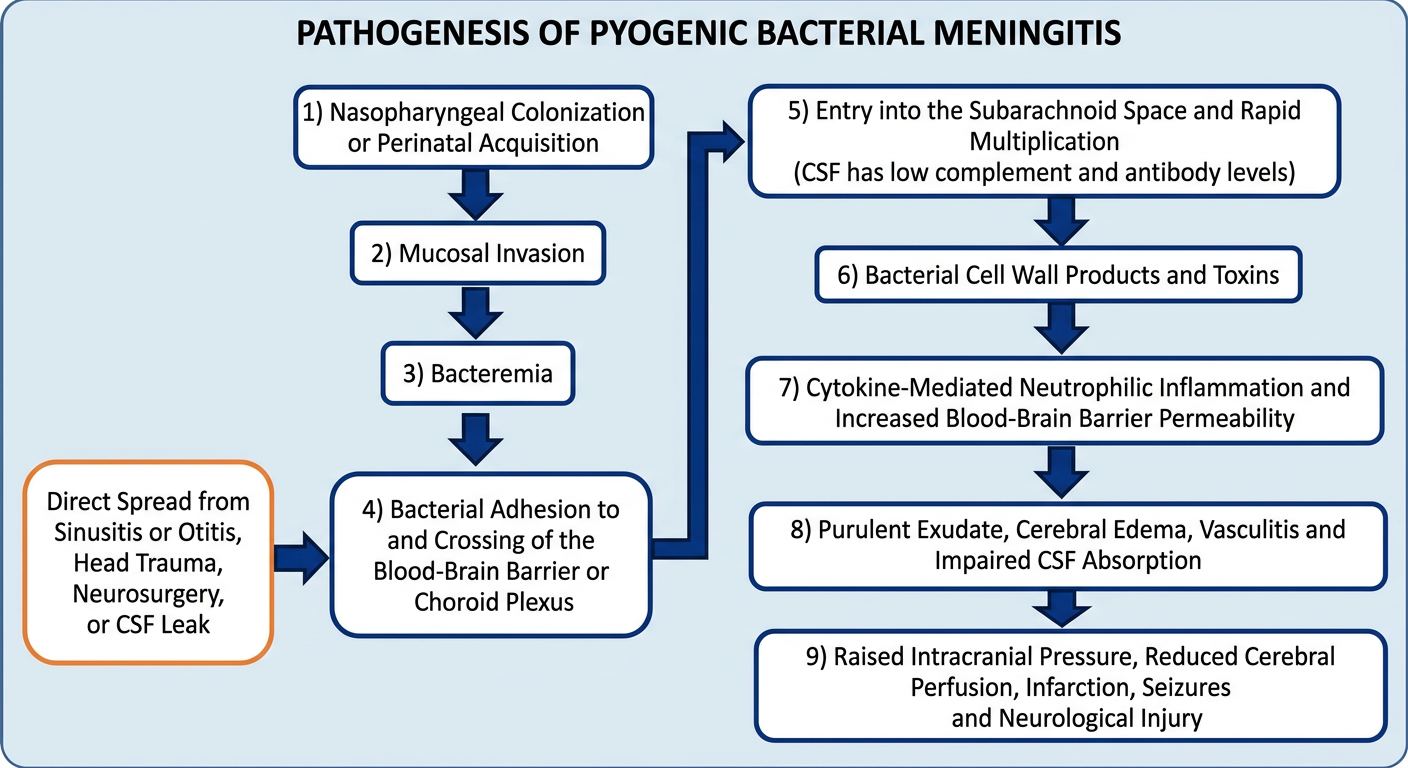
Flowchart
→ mucosal invasion
→ bacteremia
→ crossing of blood-brain barrier/choroid plexus
→ entry into subarachnoid space
→ rapid multiplication in poorly defended CSF
→ bacterial products induce cytokines and neutrophilic inflammation
→ purulent exudate, edema, vasculitis, raised ICP
→ neuronal injury and neurological complications.
Create a flowchart of pyogenic meningitis pathogenesis
A clear educational flowchart of the pathogenesis of pyogenic bacterial meningitis. Use connected boxes and arrows showing: 1) nasopharyngeal colonization or perinatal acquisition, 2) mucosal invasion, 3) bacteremia, 4) bacterial adhesion to and crossing of the blood-brain barrier or choroid plexus, 5) entry into the subarachnoid space and rapid multiplication because CSF has low complement and antibody levels, 6) bacterial cell wall products and toxins, 7) cytokine-mediated neutrophilic inflammation and increased blood-brain barrier permeability, 8) purulent exudate, cerebral edema, vasculitis and impaired CSF absorption, 9) raised intracranial pressure, reduced cerebral perfusion, infarction, seizures and neurological injury. Include a smaller side branch for direct spread from sinusitis or otitis, head trauma, neurosurgery, or CSF leak entering the subarachnoid space. Ensure all labels are accurate, readable, and spelled correctly.