
Find the best drug for
Alzhimers
Alzheimer disease treatment drugs
best drug treatment Alzheimer's disease 2025 2026 FDA approved
Best Drugs for Alzheimer's Disease (2026)
1. Symptomatic Drugs (all stages)
Cholinesterase Inhibitors (AChEIs)
| Drug | Brand | Dose | Stage |
|---|---|---|---|
| Donepezil | Aricept | 5-10 mg/day (oral or weekly patch "Adlarity") | Mild - Severe |
| Rivastigmine | Exelon | 6-12 mg/day oral or 4.5-9 mg/day patch | Mild - Moderate |
| Galantamine | Razadyne / Zunveyl | 16-24 mg/day | Mild - Moderate |
- All three delay symptom progression at 6-12 months to a statistically significant but clinically modest degree.
- Donepezil is the most widely used and has the best evidence base. It can benefit patients even into the moderate-severe phase.
- Zunveyl (a chemically modified galantamine) received FDA approval and reached the market in 2025.
- Goldman-Cecil Medicine notes that "individual patients often do not show any clear benefits," so response should be reassessed at 3-6 months.
NMDA Receptor Antagonist
| Drug | Brand | Dose | Stage |
|---|---|---|---|
| Memantine | Namenda | 10 mg twice daily | Moderate - Severe |
- Blocks excess glutamate activity, reducing excitotoxic neuronal damage.
- Best added to a cholinesterase inhibitor in moderate-severe disease.
- Benefits functional decline more than cognition.
Drugs that do NOT work (evidence against):
2. Disease-Modifying Therapies (Early-Stage Only)
Anti-Amyloid Monoclonal Antibodies
| Drug | Brand | Status |
|---|---|---|
| Lecanemab | Leqembi | Full FDA approval July 2023; slows decline ~27% vs placebo |
| Donanemab | Kisunla | FDA approved 2024; similar results |
- Who they're for: Early AD only - mild cognitive impairment (MCI) or mild dementia with confirmed amyloid on PET or blood test.
- How they work: IV infusions clear amyloid-beta plaques from the brain.
- Lecanemab update (2025-2026): Monthly IV maintenance approved Jan 2025; subcutaneous weekly autoinjector approved Aug 2025. A subcutaneous starting dose is under FDA Priority Review (PDUFA date May 24, 2026 - decision pending as of late April 2026).
- Kisunla advantage: Treatment can potentially be stopped once scans show amyloid clearance.
- Key risk: ARIA (Amyloid-Related Imaging Abnormalities) - brain swelling/micro-bleeds, especially in APOE4 carriers. Requires regular MRI monitoring.
- Insurance: Medicare now covers both Leqembi and Kisunla.
Note: A Cochrane systematic review published April 2026 concluded that the class effect on cognition is "trivial," sparking ongoing expert debate. The drugs do slow decline measurably, but whether that benefit is clinically meaningful to patients in daily life remains contested.
3. Newest Approval (April 2026)
- Dextromethorphan-bupropion (Auvelity) - FDA approved April 30, 2026, for management of agitation in Alzheimer's disease. This is not for cognition but for one of AD's most distressing behavioral symptoms.
Summary: Choosing by Stage
| Stage | First Choice | Add-on |
|---|---|---|
| MCI / Early mild (amyloid-confirmed) | Lecanemab or donanemab + donepezil | - |
| Mild (no amyloid therapy) | Donepezil | - |
| Moderate | Donepezil | + Memantine |
| Severe | Donepezil (if tolerated) | + Memantine |
| Agitation | Brexpiprazole (FDA-approved) or Auvelity | - |
- Goldman-Cecil Medicine, p. 3865
- Kaplan & Sadock's Comprehensive Textbook of Psychiatry, p. 13057
- 2025 AD treatment update - PMC
- 2026 FDA approvals overview - Cleveland ADRC
Any new treatment or research going which is going to be implemented
Alzheimer's disease new treatments pipeline 2025 2026 clinical trials upcoming
Alzheimer disease novel therapy clinical trial 2025
https://www.brightfocus.org/resource/expanding-the-alzheimer…
trontinemab tau Alzheimer immunotherapy semaglutide
trontinemab semaglutide tau vaccine Alzheimer 2025 2026 trial results
semaglutide GLP-1 Alzheimer disease cognitive
New & Upcoming Alzheimer's Treatments in the Pipeline (2026)
1. Next-Generation Amyloid-Clearing Antibodies
Trontinemab (Roche) - The Most Exciting Candidate
- Uses a "brain shuttle" technology - it attaches to a transferrin receptor that acts like a ferry, pulling it across the blood-brain barrier ~50x more efficiently than conventional antibodies.
- Phase 1b/2a results (presented at CTAD 2025): ~91% of patients at the 3.6 mg/kg dose became amyloid-PET negative within just 28 weeks - dramatically faster than lecanemab or donanemab.
- It clears amyloid even in deep brain regions (hippocampus, caudate) that current drugs struggle to reach.
- ARIA rate was under 5% - far lower than lecanemab (~35%) and donanemab.
- Phase 3 trials began recruiting in September 2025 across 18 countries. Results are not expected until ~2028.
2. Tau-Targeting Therapies (Beyond Amyloid)
- AADvac1 (Axon Neuroscience) - a tau vaccine entering a Phase 3 platform trial (Alzheimer's Tau Platform Trial). It aims to trigger the immune system to clear tau tangles.
- Etalanetug - a tau antibody; Phase 2 data showed some patients had a 90% drop in eMTBR-tau243 (a tau biomarker), a strikingly large effect.
- Anti-tau ASO (antisense oligonucleotide) - a gene-silencing approach to reduce tau production; first-in-human studies presented at CTAD 2025.
- The Alzheimer's Association has committed $11M+ in new funding specifically for tauopathy therapeutics.
3. GLP-1 Receptor Agonists (Semaglutide / Ozempic) - Disappointing Result
- Two large Phase 3 trials (evoke and evoke+, ~3,680 participants total) tested semaglutide in early symptomatic AD.
- Top-line results presented at CTAD December 2025: Semaglutide definitively failed to benefit people with early symptomatic Alzheimer's disease.
- Despite promising early signals and significant weight loss in the treatment group, no cognitive benefit was seen. This was one of the most closely watched trials of the year.
- GLP-1 agonists for AD now appear unlikely to move forward without a major re-think.
4. Blarcamesine (Anavex) - Sigma-1 Receptor Activator
- An oral pill - a huge practical advantage over infusions.
- Works differently: activates the sigma-1 receptor to boost the cell's own "garbage removal" system (autophagy) to clear amyloid plaques from within.
- Phase IIb/III trial (ANAVEX2-73-AD-004) published in early 2025 (PMID: 39800452). Showed encouraging safety data and early effectiveness signals.
- Still in ongoing Phase 2/3 evaluation.
5. Oral / Small Molecule Drugs (Pill-Based Treatments on the Horizon)
- Gamma-secretase modulators (e.g., Roche's Nivegacetor) - target the enzyme that produces amyloid-beta in the first place, stopping plaque formation upstream. Phase 1b data in 2025 showed it shifts Aβ production toward shorter, less toxic isoforms.
- Piromelatine - a melatonin receptor agonist for sleep/cognitive symptoms; Phase 2/3 ongoing.
- Metformin (long-acting) - being tested in the MAP trial (Phase 2/3) in 326 overweight/obese MCI patients. Metformin's metabolic effects may protect neurons.
- Senicapoc - targets neuroinflammation via ion channels; Phase 2 proof-of-mechanism study ongoing.
6. Neuroinflammation & Immune Approaches
- Multiple trials are targeting TREM2, complement pathways, and microglial activation.
- Cell therapy approaches - some companies are infusing engineered cells that cross the blood-brain barrier and produce therapeutic proteins. Early Phase 1 data (AAIC 2025) showed cells did enter the brain and reduce CSF biomarkers.
7. Prevention Trials
- AHEAD 3-45 trial: Testing lecanemab in people who are cognitively normal but have elevated amyloid - trying to prevent symptoms before they start.
- Trontinemab is planning a future presymptomatic AD trial for people who have no symptoms yet but carry genetic risk.
- All stages of the AD continuum (from asymptomatic to severe) are now represented in trials.
8. Lifestyle Intervention - U.S. POINTER Trial (Published July 2025, JAMA)
- 2,111 older adults at dementia risk.
- A structured 2-year multidomain intervention (exercise + nutrition + cognitive/social engagement + heart-health monitoring) produced significantly better global cognitive outcomes than a self-guided program.
- The benefit held across sex, ethnicity, and APOE genotype. Confirms that lifestyle is a real and accessible protective strategy.
Big Picture: When Will New Drugs Arrive?
| Drug/Approach | Current Stage | Estimated Readout |
|---|---|---|
| Trontinemab | Phase 3 (enrolling) | ~2028 |
| Tau vaccines (AADvac1) | Phase 3 platform | 2027-2028 |
| Blarcamesine (oral) | Phase 2/3 | 2026-2027 |
| Gamma-secretase modulators | Phase 1b | 2028+ |
| Metformin (MAP trial) | Phase 2/3 | 2027 |
| Semaglutide | Phase 3 - FAILED | -- |
| Cell therapy | Phase 1 | 2030+ |
| Prevention trials (lecanemab) | Phase 3 | 2028-2030 |
Create an image so i can read easily
A clean, professional medical infographic titled "Alzheimer's Disease: New Treatments & Research Pipeline 2026" with a dark blue and white color scheme. Organized into clearly labeled sections with icons: Section 1 - "Next-Gen Amyloid Antibodies": Trontinemab (Roche) - Brain shuttle tech, 91% amyloid clearance in 28 weeks, ARIA under 5%, Phase 3 enrolling, results ~2028 Section 2 - "Tau-Targeting Therapies": AADvac1 tau vaccine (Phase 3), Etalanetug antibody (90% tau drop), Anti-tau ASO gene silencing Section 3 - "Oral Pill Treatments": Blarcamesine - sigma-1 receptor activator (Phase 2/3), Gamma-secretase modulators, Metformin MAP trial, Senicapoc (neuroinflammation) Section 4 - "Notable Failure": Semaglutide (Ozempic) - Phase 3 FAILED December 2025 - no cognitive benefit Section 5 - "Prevention Trials": AHEAD 3-45 (lecanemab in pre-symptomatic patients), Trontinemab prevention trial planned Section 6 - "Timeline": Table showing drug name, trial phase, and expected readout year (2026-2030) Footer note: 192 clinical trials, 158 novel agents, 17 disease targets in 2026 pipeline. Clean readable fonts, color-coded sections, medical icons for brain/pills/syringes.
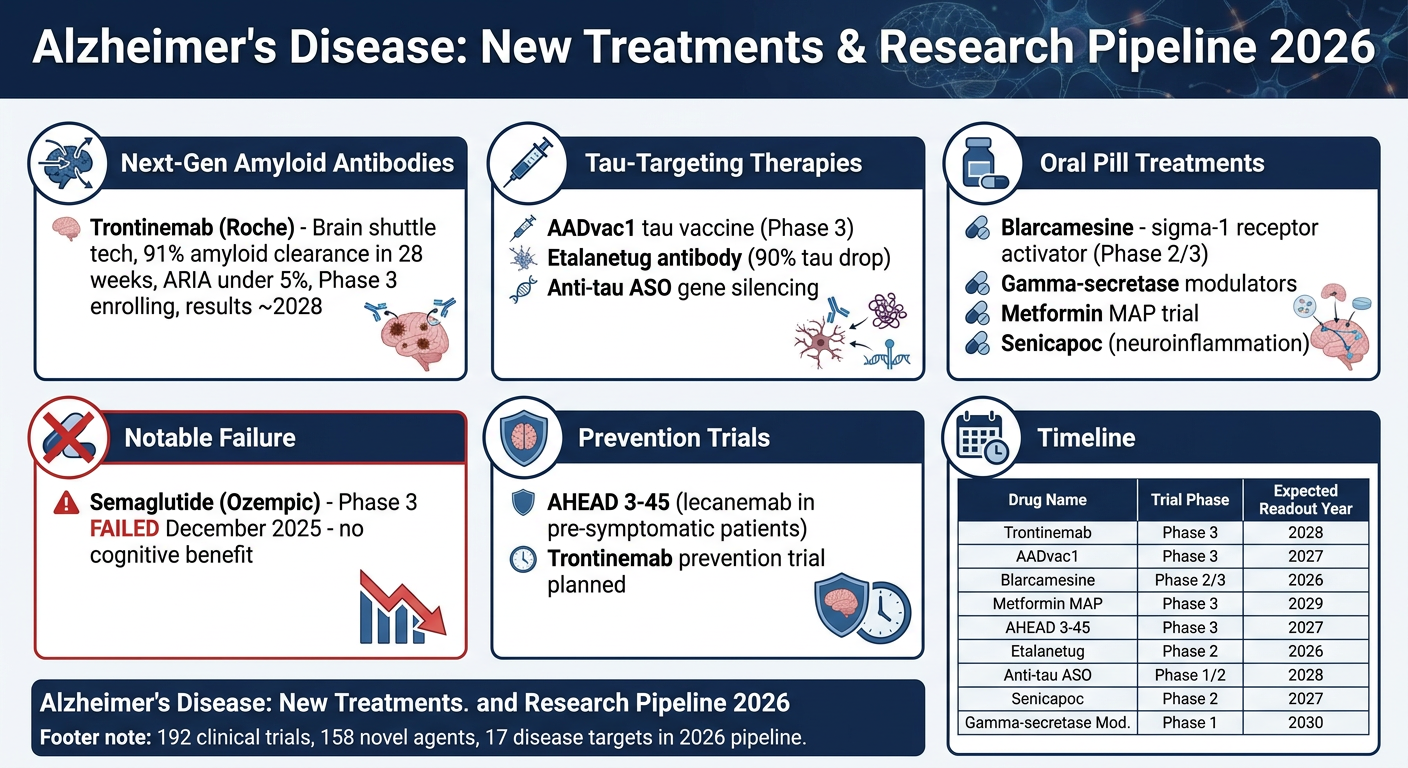
- Trontinemab - the most promising next-gen amyloid drug
- Tau therapies - vaccines and antibodies going beyond amyloid
- Oral pill treatments - blarcamesine, metformin, and others
- Semaglutide's failure - the notable Phase 3 disappointment
- Prevention trials - treating people before symptoms appear
- Timeline of when results are expected