
Zn staining details for viva
Reading File
"Zn staining" could mean a few different things in a medical/pathology context. Let me clarify before diving in.
Asking for Preferences
Which 'Zn staining' are you referring to?
Ziehl-Neelsen stain - a classic viva topic. Let me pull everything from the textbooks now.
Searching sources...
Finding Sources
Finding Sources
Reading File
Reading File
Reading File
Reading File
Finding Sources
Reading File
Reading File
I now have comprehensive information from multiple authoritative sources. Let me compile a complete viva-ready answer.
Loading Image
Here is a complete, viva-ready breakdown of Ziehl-Neelsen (ZN) staining:
Ziehl-Neelsen (ZN) Stain - Viva Details
What Is It?
A hot acid-fast stain used to detect acid-fast bacilli (AFB), primarily Mycobacterium tuberculosis and other mycobacteria. It is also used to identify M. leprae and some other organisms.
Principle (The KEY viva point)
Mycobacteria have a high lipid content cell wall (>60%), dominated by mycolic acids - long-chain fatty acids that:
- Resist penetration by conventional aniline dyes (e.g., crystal violet in Gram stain)
- Bind arylmethane dyes (carbol fuchsin) tightly in the presence of phenol + heat
- Resist decolorization by strong acid-alcohol once stained
This property is called acid-fastness. - Sherris & Ryan's Medical Microbiology, 8th Ed.
Procedure (Step-by-Step)
| Step | Action | Detail |
|---|---|---|
| 1 | Fix smear | Pass slide through flame 3 times (or flood with alcohol) |
| 2 | Primary stain | Cover with carbol fuchsin, steam gently 5 min over direct flame (or 20 min over water bath) - do NOT boil or let dry |
| 3 | Wash | Deionized water |
| 4 | Decolorize | 3% acid-alcohol (95% ethanol + 3% HCl) until only faint pink remains |
| 5 | Wash | Water |
| 6 | Counterstain | Loeffler's methylene blue for 1 minute |
| 7 | Wash and dry | Deionized water, air dry |
- Park's Textbook of Preventive and Social Medicine
Result
| Component | Colour |
|---|---|
| Acid-fast bacilli (AFB) | Bright red/pink |
| Background cells, non-AFB | Blue (methylene blue) |
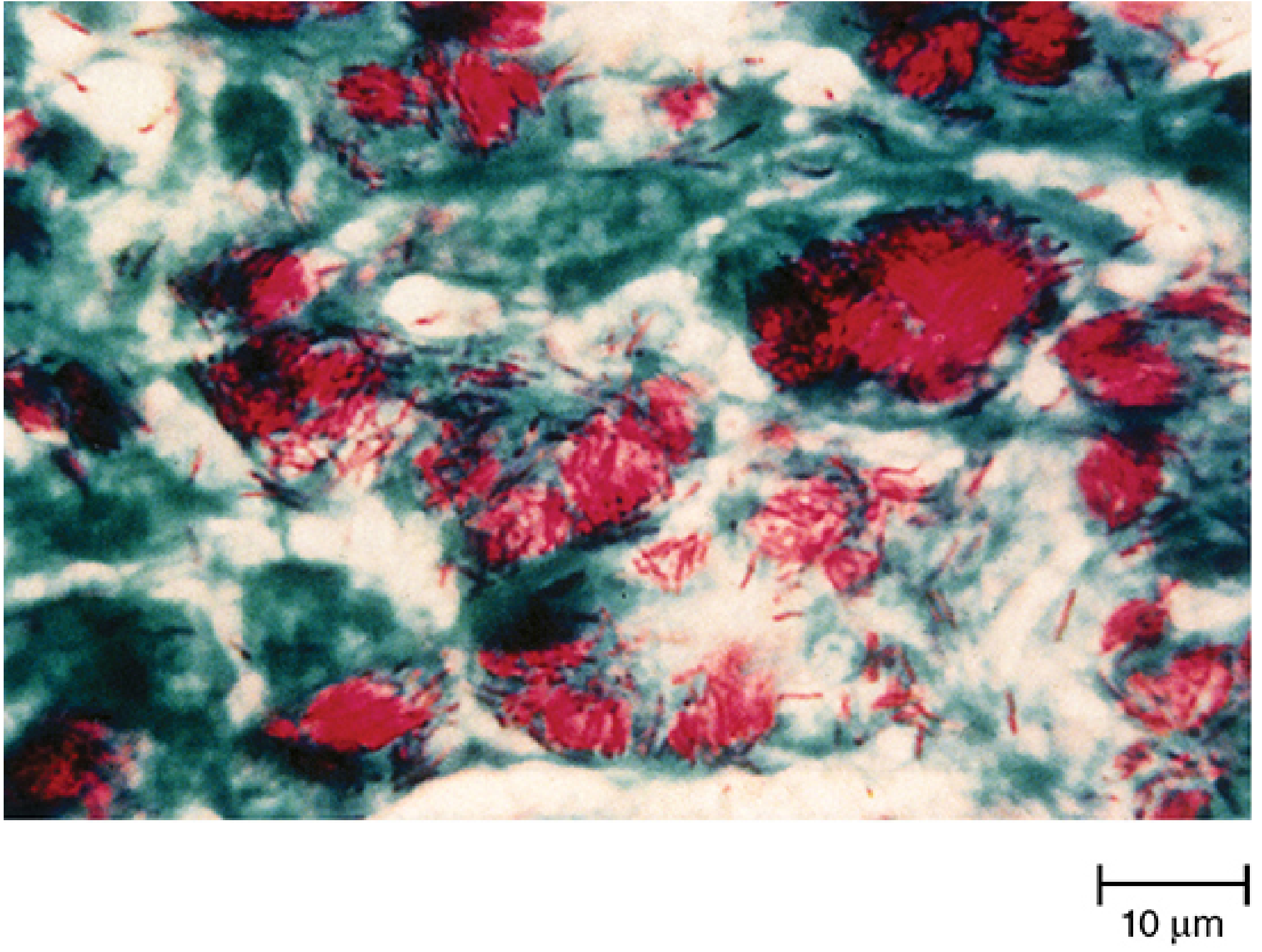
Morphology of AFB on ZN Stain
- Slender, slightly bent or beaded rods
- May appear V-shaped (two organisms adhering at one end) in sputum
- Often lie parallel to each other
- Examined under 100x oil-immersion lens
- Quick Compendium of Clinical Pathology, 5th Ed.
Smear Reporting (WHO Standard - 1000x magnification)
| Finding | Result Reported |
|---|---|
| No AFB per 100 oil immersion fields | 0 (negative) |
| 1-9 AFB per 100 fields | Scanty (report exact number) |
| 10-99 AFB per 100 fields | 1+ |
| 1-10 AFB per oil immersion field | 2+ |
| >10 AFB per oil immersion field | 3+ |
- Smear positivity requires at least 10,000 organisms/mL of sputum
- One positive specimen out of two is sufficient for smear-positive TB diagnosis
- Park's Textbook of Preventive and Social Medicine
ZN Stain Variations - Comparison (High-Yield Viva Table)
| Feature | Ziehl-Neelsen | Kinyoun | Fite | Fluorochrome (Auramine-Rhodamine) |
|---|---|---|---|---|
| Heat | Yes (hot) | No (cold) | No (cold) | No |
| Primary stain | Carbol fuchsin | Carbol fuchsin (high concentration + detergent) | Carbol fuchsin | Auramine-O / Auramine-rhodamine |
| Decolorizer | 3% acid-alcohol (strong) | 3% acid-alcohol | Weak acid (sulfuric acid in ethanol) | Acid-alcohol |
| Counterstain | Methylene blue | Methylene blue | Methylene blue | Potassium permanganate |
| Microscopy | Light (100x oil) | Light (100x oil) | Light (100x oil) | Fluorescent (40x objective) |
| Organisms | True AFB | True AFB | Weakly AFB (M. leprae, Nocardia, Rhodococcus) | AFB appear golden/yellow fluorescent |
| Sensitivity | Baseline | Similar to ZN | Lower (weaker decolorizer by design) | ~20% MORE sensitive than carbol fuchsin stains |
- Quick Compendium of Clinical Pathology, 5th Ed.; Tietz Textbook of Laboratory Medicine, 7th Ed.
Why Mycobacteria Don't Stain with Gram Stain
- Their hydrophobic cell wall resists penetration of aniline dyes like crystal violet
- May appear as ghost bacilli (bacilli-shaped clear zones) on Gram stain
- Tietz Textbook of Laboratory Medicine, 7th Ed.
False Positives and Negatives
False positives:
- Red stain retained by scratches on slide
- Transfer of AFB from a positive slide to a negative one
- Environmental mycobacteria contaminating the specimen
- Acid-fast particles: food particles, precipitates
False negatives:
- Fewer than 10,000 organisms/mL
- Severe immunocompromise (HIV) - decreased inflammation means fewer bacilli expectorated
- Poor smear preparation or over-decolorization
Other Organisms Positive on ZN / Acid-Fast Stains
| Organism | Type of Acid-Fastness |
|---|---|
| Mycobacterium tuberculosis, M. leprae, NTM | True acid-fast |
| Nocardia spp. | Weakly acid-fast |
| Rhodococcus equi | Weakly acid-fast |
| Legionella micdadei | Weakly acid-fast |
| Cryptosporidium, Cyclospora, Cystoisospora (oocysts) | Modified acid-fast positive |
| Schistosoma egg spines, Echinococcus hooklets | Modified acid-fast positive |
Limitations / WHY Fluorochrome is Now Preferred by WHO
- Fluorochrome (auramine-rhodamine) is ~20% more sensitive than carbol fuchsin stains
- Allows reading at lower magnification (250-400x) - faster, less eye strain
- WHO has endorsed global phase-out of ZN in favour of auramine-rhodamine
- However, ZN remains widely used in resource-limited settings where fluorescent LED microscopes are unavailable (only 7% of global labs had fluorescent capability as of 2014)
- Tietz Textbook of Laboratory Medicine, 7th Ed.
Quick Recall Mnemonics
- ZN = Hot stain (uses heat; Kinyoun is the Cold version)
- AFB = Red on Blue (carbol fuchsin red on methylene blue background)
- Acid-fastness = Mycolic acids in cell wall resist acid-alcohol decolorization
- Smear positive = 1 positive out of 2 specimens is enough
This is a shared conversation. Sign in to Orris to start your own chat.