
TGF beta role in cancer hallmarks
TGF-beta (Transforming Growth Factor-beta) plays a dual role in cancer - acting as a tumor suppressor in early stages but switching to a tumor promoter in advanced disease. It influences nearly all of Hanahan & Weinberg's cancer hallmarks: it can suppress proliferation, induce apoptosis, and maintain genomic stability in normal cells, but in established tumors it drives invasion, metastasis, immune evasion, angiogenesis, and epithelial-mesenchymal transition (EMT).
Searching sources...
Reading File
Searching PubMed
TGF-beta cancer hallmarks tumor progression
Now let me search the medical library and web in parallel for comprehensive TGF-beta content:
Finding Sources
Finding Sources
Searching PubMed
"TGF-beta" AND "epithelial mesenchymal transition" AND cancer
Let me search the library more specifically for cancer biology content and TGF-beta signaling pathways:
Finding Sources
Finding Sources
Searching the Web
TGF-beta role in all cancer hallmarks Hanahan Weinberg EMT immune evasion angiogenesis 2024
Now let me read the key Robbins Pathology and Schwartz Surgery sections for detailed content:
Reading File
Reading File
Reading Web Page
https://pmc.ncbi.nlm.nih.gov/articles/PMC3076078
Let me get more details from Robbins Pathology on EMT and angiogenesis sections, and also grab the TGF-beta pathway diagram:
Reading File
Reading File
Loading Image
Let me now search for EMT and immune evasion specifics from Robbins Pathology:
Finding Sources
Finding Sources
Let me read the key passage from Robbins, Cotran & Kumar (the full Pathologic Basis of Disease) on TGF-beta and cancer hallmarks:
Reading File
Reading File
I now have comprehensive information. Let me also fetch the TGF-beta SMAD signaling diagram from Robbins, Cotran & Kumar:
Loading Image
I now have all the key information needed. Let me compile the comprehensive answer:
TGF-β and the Hallmarks of Cancer
TGF-β (Transforming Growth Factor-beta) is one of the most biologically complex cytokines in cancer biology. It functions paradoxically - as a powerful tumor suppressor in normal and early-stage cells, but evolving into a potent tumor promoter in established, late-stage cancers. This "TGF-β paradox" means it touches virtually every Hanahan-Weinberg cancer hallmark, on both sides of the equation.
The TGF-β Signaling Pathway
TGF-β binds a heterotetrameric receptor complex of serine/threonine kinase receptors (TβRI and TβRII). Receptor activation phosphorylates SMAD2/3, which then partners with SMAD4 to form a complex that translocates to the nucleus and regulates gene transcription. The canonical output in normal cells: increase CDKIs (p15INK4B, p21), decrease cyclins, CDKs, and MYC - leading to G1 arrest.
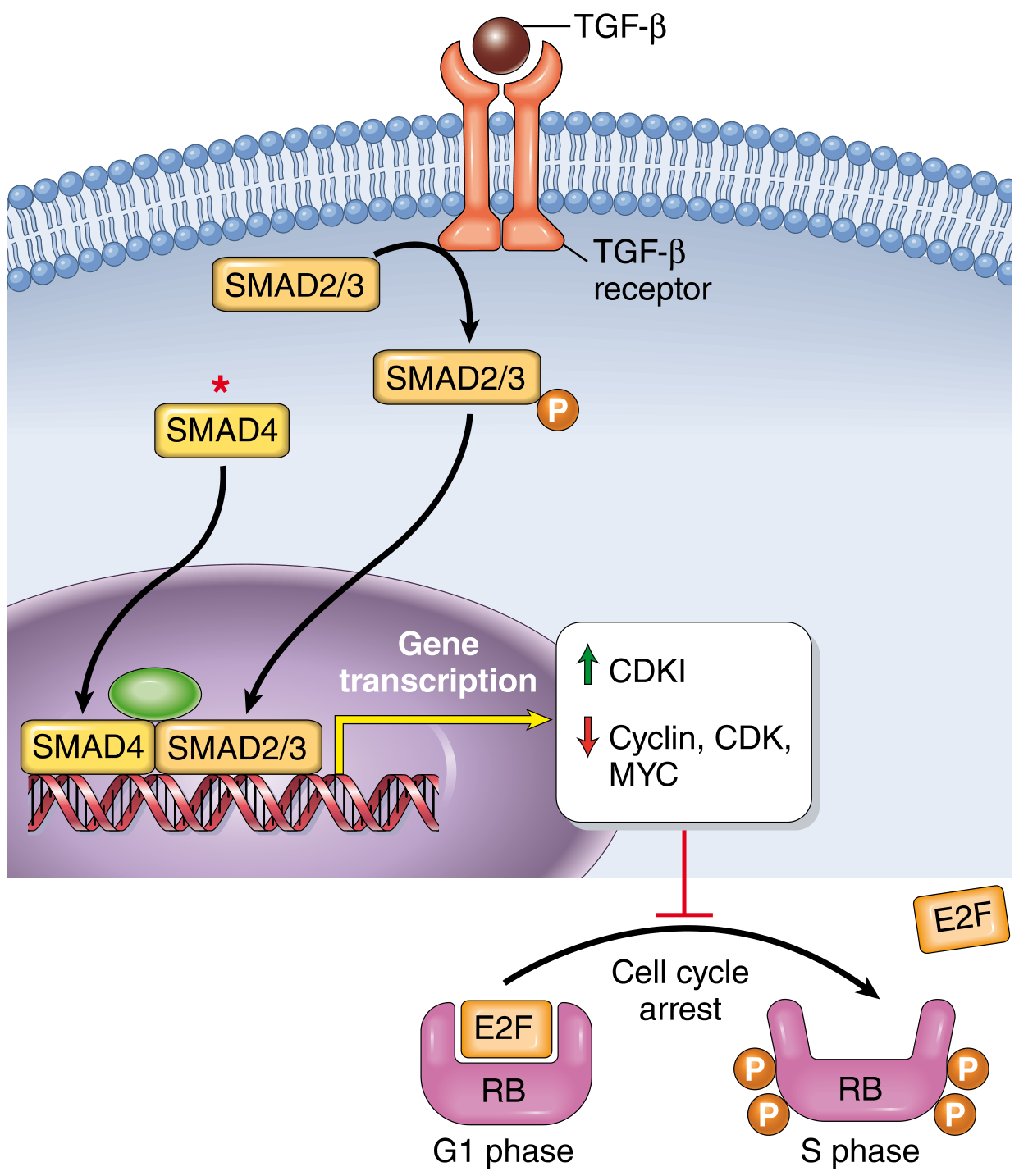
Fig. 7.29 from Robbins, Cotran & Kumar - Pathologic Basis of Disease: TGF-β receptor activation → SMAD2/3 phosphorylation → SMAD4 heterodimerization → nuclear translocation → ↑CDKI, ↓Cyclin/CDK/MYC → RB hypophosphorylation → cell cycle arrest. SMAD4 (asterisk) is frequently mutated in pancreatic cancer.
Hallmark-by-Hallmark Breakdown
1. Sustaining Proliferative Signaling (SUPPRESSOR role)
In normal epithelial, endothelial, and hematopoietic cells, TGF-β is a potent inhibitor of proliferation. It achieves cytostasis late in G1 phase through two synchronized actions:
- Downregulates growth-promoting transcription factors: c-Myc, Id1-3, cyclin D, CDK4
- Upregulates CDK inhibitors: p15INK4B (CDKN2B), p21
The net result is RB hypophosphorylation and G1 arrest. This is one of the most important anti-tumor barriers in normal tissues. - Robbins, Cotran & Kumar Pathologic Basis of Disease; Schwartz's Principles of Surgery
Cancer escape: Resistance to this growth arrest is a hallmark of cancer. Tumors lose TGF-β responsiveness by:
-
Mutations in TβR1 or TβRII (colon, stomach, endometrial cancers)
-
Loss-of-function mutations in SMAD4/DPC4 - seen in ~100% of pancreatic cancers, and common in colorectal cancer (where the locus 18q is deleted)
-
Deletion of the p15INK4B locus
-
CDK4 mutations that block p15INK4B binding
-
Persistent MYC expression overriding TGF-β's transcriptional effects
-
Schwartz's Principles of Surgery, p. 517
2. Evading Growth Suppressors (SUPPRESSOR role - lost in cancer)
TGF-β is itself classified as one of the major growth suppressors alongside RB and p53. Its signaling pathway converges on RB: by inducing CDKIs, it maintains RB in its active (hypophosphorylated) growth-suppressing state. Loss of the TGF-β pathway disrupts this, freeing E2F transcription factors to drive S-phase entry. - Robbins Pathology; Schwartz's Surgery
3. Resisting Cell Death / Apoptosis (SUPPRESSOR early, PROMOTER late)
TGF-β normally promotes apoptosis in epithelial and hematopoietic cells - a key tumor-suppressive function. However, once tumorigenesis subverts TGF-β's cytostatic activity, the same pathway is co-opted to promote cancer cell survival:
- TGF-β protects cancer cells following radiation and chemotherapy
- It activates anti-apoptotic signaling via PI3K/AKT
- It upregulates BCL-2 family pro-survival proteins in certain contexts
This switch from apoptosis activator to cell survival promoter is part of what makes late-stage TGF-β oncogenic. - PMC3076078 - "TGF-β and the Hallmarks of Cancer"
4. Enabling Replicative Immortality
While TGF-β's direct role in telomere biology is indirect, its suppression of senescence pathways (through crosstalk with p53 and RB circuits) and its induction of EMT allow cancer cells to escape senescence barriers and acquire traits that facilitate indefinite replication. Loss of TGF-β-mediated growth arrest removes a key gateway to cellular senescence.
5. Inducing Angiogenesis (PROMOTER role)
TGF-β directly promotes tumor angiogenesis - a pro-oncogenic activity identified even when its anti-proliferative signaling is intact. Mechanisms include:
- Direct upregulation of VEGF expression in tumor-associated stromal cells
- Stimulation of tumor-associated macrophages to produce angiogenic factors
- Induction of endoglin (CD105), a TGF-β co-receptor that is highly expressed on proliferating tumor vasculature
- CAFs stimulated by TGF-β secrete FGF and HGF, further driving angiogenesis
"TGF-β also suppresses the host immune response and promotes angiogenesis, both prooncogenic activities." - Robbins & Kumar Basic Pathology
6. Activating Invasion and Metastasis - EMT (PROMOTER role)
This is TGF-β's most studied and clinically significant oncogenic function. In late-stage tumors, TGF-β becomes the master inducer of Epithelial-to-Mesenchymal Transition (EMT):
- Canonical pathway: SMAD2/3-SMAD4 complex suppresses epithelial genes (E-cadherin, cytokeratins) and activates mesenchymal genes (vimentin, fibronectin, N-cadherin, SNAIL, TWIST, ZEB1/2)
- Non-canonical pathways: TGF-β activates Ras/MAPK, PI3K/AKT, Rho/ROCK, NF-κB, Wnt/β-catenin, Jagged/Notch, and MDM2/p53 - all of which cooperate to drive EMT, invasion, and metastasis
- Particularly, Ras/MAPK cooperates synergistically with TGF-β to drive squamous-to-spindle cell EMT in skin cancers
- TGF-β's activation of NF-κB promotes EMT and lung colonization by breast cancer cells with oncogenic Ras
EMT consequences: loss of polarity and cell-cell adhesion, acquisition of migratory/invasive capability, resistance to anoikis, stem cell-like properties. - Scott-Brown's Otorhinolaryngology (Head & Neck Surgery); Robbins Pathology
7. Tumor-Promoting Inflammation (PROMOTER role)
TGF-β is a key cytokine in shaping a pro-tumorigenic inflammatory microenvironment:
-
Promotes cancer-associated fibroblast (CAF) activation - CAFs secrete TGF-β3, CXCL12, FGF7, and additional growth factors that sustain tumor growth
-
Stimulates ECM remodeling and degradation by matrix metalloproteinases (MMPs) to facilitate invasion
-
Creates a "wound that does not heal" microenvironment that fosters progression
-
Cummings Otolaryngology Head and Neck Surgery
8. Evading Immune Destruction (PROMOTER role)
TGF-β is one of cancer's most potent immunosuppressive weapons:
- Inhibits CD8+ CTL activation and effector function - directly suppresses cytotoxic T lymphocyte killing
- Inhibits NK cell function by repressing the mTOR pathway in NK cells
- Expands regulatory T cells (Tregs) - TGF-β is a key Treg differentiation factor, creating an immunosuppressive niche
- Recruits MDSCs (myeloid-derived suppressor cells) to the tumor microenvironment
- Downregulates MHC class I on tumor cells, limiting CTL recognition
- Works in concert with PD-L1: TGF-β and PD-1/PD-L1 are co-expressed as immunosuppressive mechanisms by tumors
"Tumors may avoid the immune system by...immunosuppression mediated by expression of certain factors (e.g., TGF-β, PD-1 ligand) by the tumor cells." - Robbins, Cotran & Kumar Pathologic Basis of Disease
9. Genome Instability (Indirect role)
TGF-β normally promotes genomic stability by regulating DNA damage responses and suppressing cell cycle progression through damaged cells. Loss of TGF-β signaling removes a checkpoint that would otherwise halt cells with DNA damage, contributing to increased mutational burden and genomic instability that accelerates oncogenesis.
10. Deregulating Cellular Energetics (Indirect role)
In the context of the tumor microenvironment, TGF-β-driven CAF activation promotes metabolic reprogramming. CAFs stimulated by TGF-β undergo aerobic glycolysis (reverse Warburg effect), supplying lactate and other metabolic substrates to fuel tumor cell oxidative phosphorylation.
The TGF-β Paradox - Mechanism of the Switch
| Phase | TGF-β Role | Key Mechanism |
|---|---|---|
| Normal cells / Early tumor | Suppressor | Intact SMAD signaling → cell cycle arrest, apoptosis |
| Late-stage tumor | Promoter | Truncated/mutated SMAD pathway; upregulated non-canonical (Ras, NF-κB, PI3K) signaling |
The switch happens because:
- Mutations in SMAD4, TβRI/II dismantle the cytostatic arm
- Oncogenic mutations (especially RAS) cooperate with TGF-β to activate pro-invasive non-SMAD pathways
- The tumor microenvironment amplifies TGF-β's immunosuppressive and stromal-remodeling activities
Cancer-Specific Examples
| Cancer | TGF-β Alteration |
|---|---|
| Pancreatic | SMAD4 mutation in ~100% of cases |
| Colorectal | TβRII mutation (MSI tumors); SMAD4 loss (18q deletion) |
| Gastric | TβRII mutations |
| Endometrial | TβRI/TβRII frameshift mutations |
| Breast | EMT-driven metastasis; Ras/TGF-β cooperation |
| Head & Neck | TGF-β3-expressing CAFs drive invasion |
Therapeutic Implications
Because TGF-β is central to so many hallmarks in late-stage cancers, it is an attractive therapeutic target. Galunisertib (LY2157299, TβRI kinase inhibitor) has been investigated in clinical trials for hepatocellular carcinoma, glioblastoma, and pancreatic cancer. Anti-TGF-β antibodies (e.g., fresolimumab) and TGF-β/PD-L1 bispecific approaches (bintrafusp alfa) are in development. The Cambridge Core review on TGF-β and cancer hallmarks covers emerging therapeutic designs in detail.
Key challenge: TGF-β inhibition must be timed carefully - blocking it in early cancer may actually remove a tumor-suppressive barrier. Targeting only the pro-metastatic/immunosuppressive arms (e.g., combined TGF-β/PD-1 blockade) in established cancers is the more rational approach.
Sources: Robbins, Cotran & Kumar - Pathologic Basis of Disease | Robbins & Kumar Basic Pathology | Schwartz's Principles of Surgery, 11e | PMC3076078 - TGF-β and the Hallmarks of Cancer | Tumor Microenvironment Review 2025 (PMC12535698)
This is a shared conversation. Sign in to Orris to start your own chat.